
Table of Contents
The GenAI revolution is no longer a future trend. Enterprises are already using generative AI for customer support, software development, content, analytics, and internal automation. But there is a gap between wanting GenAI and being able to run it. Training and serving large models need huge amounts of compute, specialized chips, and data pipelines that most organizations cannot build on their own.
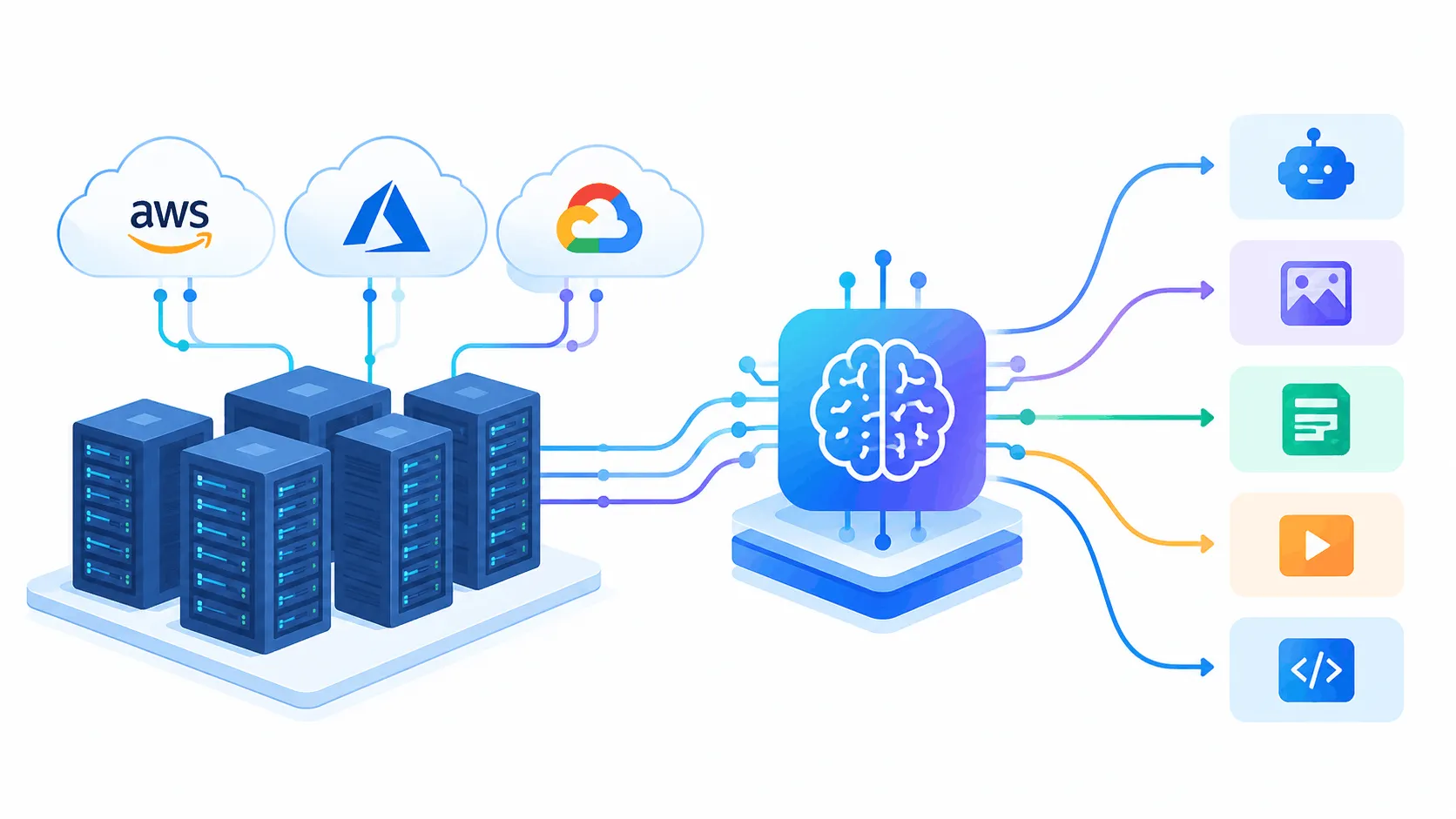
That is where hyperscalers come in and why they matter so much to the GenAI revolution. AWS, Microsoft Azure, and Google Cloud have become the engine room of the GenAI revolution, giving businesses ready access to the infrastructure, models, and tools they need. This blog explains how hyperscalers power GenAI and fuel the GenAI revolution, what each major provider offers, the risks to plan for, and how to choose the right one.
What Is a Hyperscaler?
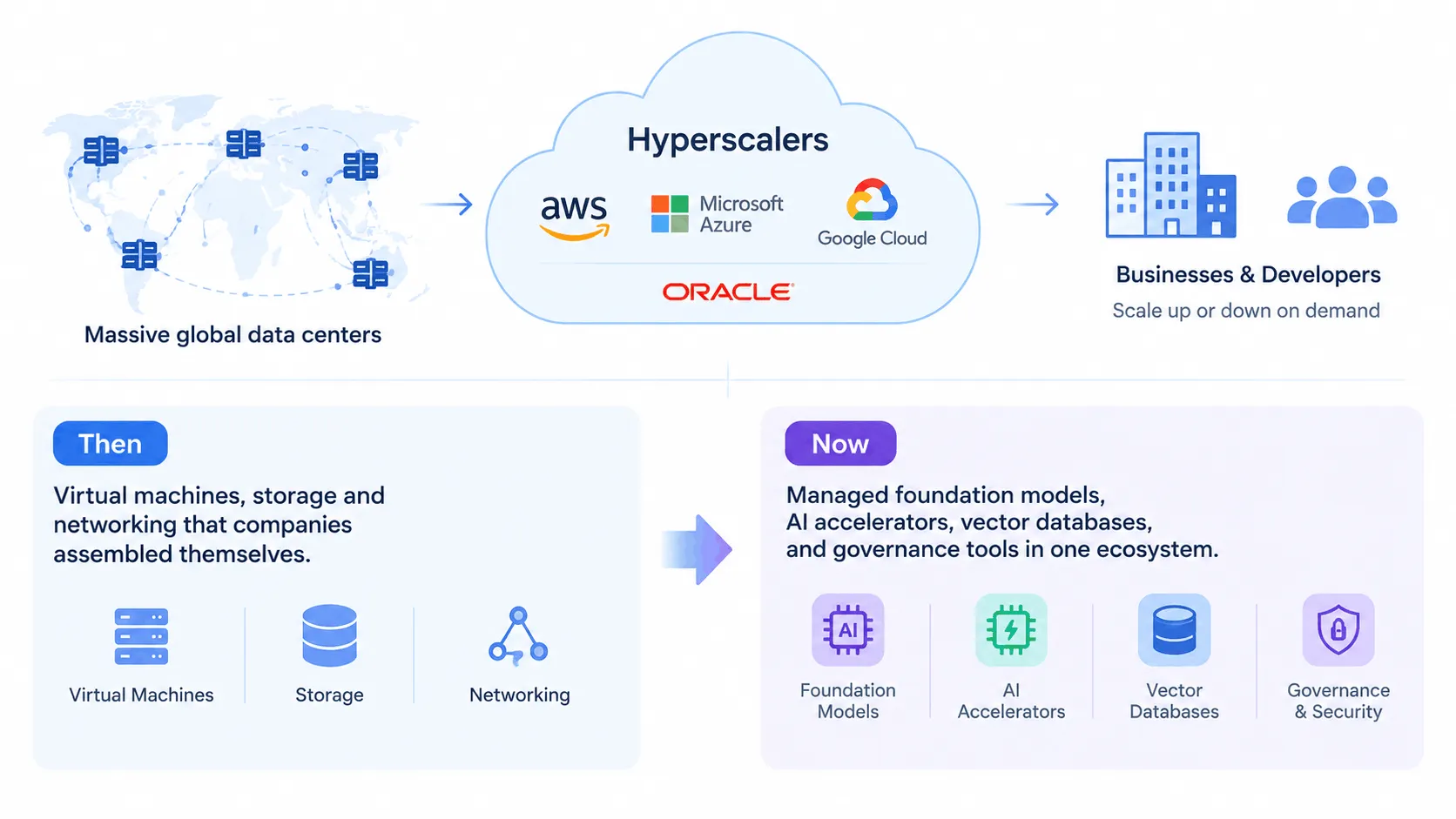
A hyperscaler is a cloud provider that operates data centers at a massive global scale and lets customers scale computing, storage, and networking up or down on demand. The best-known hyperscalers are AWS, Microsoft Azure, and Google Cloud, with players such as Oracle Cloud also growing in AI.
The role has changed in a big way. Hyperscalers started by renting servers and storage. Today they sell complete AI platforms, which is why they sit at the center of enterprise GenAI strategy and the GenAI revolution.
Why the GenAI Revolution Needs Hyperscalers
Workloads in the GenAI revolution are different from traditional applications. They are compute-hungry, data-heavy, and hard to predict. Building this capacity in-house means buying scarce GPUs, hiring specialized talent, and absorbing large upfront costs.
Hyperscalers remove most of that burden, which is why the GenAI revolution has moved so quickly. They have already invested in the hardware, the data centers, and the software layers, and they let enterprises rent what they need.
- Scale: Capacity for training and serving models that would be out of reach for most private data centers, which is what lets the GenAI revolution scale.
- Speed: Teams can start building in days instead of waiting months for hardware.
- Expertise: Providers bring tested architectures, security controls, and support.
How Hyperscalers Power the GenAI Revolution
The contribution of hyperscalers to the GenAI revolution can be understood as four layers that work together.
1. Compute: GPUs and Custom AI Chips
At the base of the GenAI revolution is raw compute. Hyperscalers offer access to high-end GPUs and also build their own AI chips to improve performance and control cost. Examples include AWS Trainium and Inferentia, Google TPUs, and Microsoft’s Maia accelerators.
- Training capacity: Large clusters for building or fine-tuning models.
- Inference capacity: Optimized infrastructure for serving model responses to users at scale.
2. Managed Model Platforms
The second layer is where most enterprises join the GenAI revolution. Instead of building a model, teams can use managed platforms that provide access to leading foundation models through APIs.
- Amazon Bedrock: A managed service for accessing multiple foundation models through one API, with tools for customization and guardrails.
- Azure AI Foundry: Microsoft’s platform for building and deploying AI applications, closely tied to its OpenAI partnership and the wider Microsoft ecosystem.
- Google Vertex AI: Google’s AI platform, offering Gemini models, model tuning, and tools for building agents and applications.
3. Data and Storage
The GenAI revolution is only as good as the data behind it. Hyperscalers provide scalable data lakes, warehouses, and vector databases that support retrieval-augmented generation (RAG), where a model draws on a company’s own documents to give accurate, current answers.
- Data pipelines: Tools to ingest, clean, and organize enterprise data.
- Vector search: Storage and retrieval of embeddings so models can find relevant information quickly.
4. Security, Governance, and Compliance
For enterprises, trust matters as much as performance in the GenAI revolution. Hyperscalers offer identity management, encryption, audit trails, and compliance certifications that help regulated industries move GenAI from pilot to production.
- Access control: Fine-grained permissions over who can use which models and data.
- Guardrails: Content filters and policy controls to reduce harmful or off-brand output.
- Compliance support: Frameworks that help meet industry and regional regulations.
AWS vs Azure vs Google Cloud for GenAI
All three hyperscalers offer strong capabilities for the GenAI revolution, but each has a different center of gravity. Features and model availability change quickly, so verify current details before making a decision.
| Factor | AWS | Microsoft Azure | Google Cloud |
|---|---|---|---|
| Main GenAI platform | Amazon Bedrock, SageMaker | Azure AI Foundry, Azure OpenAI | Vertex AI |
| Model approach | Choice of multiple third-party and Amazon models | Strong link to OpenAI models | Gemini models plus open and partner models |
| Custom AI chips | Trainium, Inferentia | Maia | TPUs |
| Ecosystem strength | Broadest cloud service catalog | Microsoft 365, Dynamics, and enterprise tools | Data analytics, BigQuery, and AI research |
| Best fit | Teams that want model choice and deep cloud flexibility | Organizations already built on Microsoft | Data-driven teams and AI-first builders |
The right choice is rarely about which provider is “best” overall. It is about which one fits your existing stack, data, and use cases in the GenAI revolution.
Real-World Use Cases Driving the GenAI Revolution
Hyperscaler platforms are being used across industries to turn the GenAI revolution from a demo into daily operations.
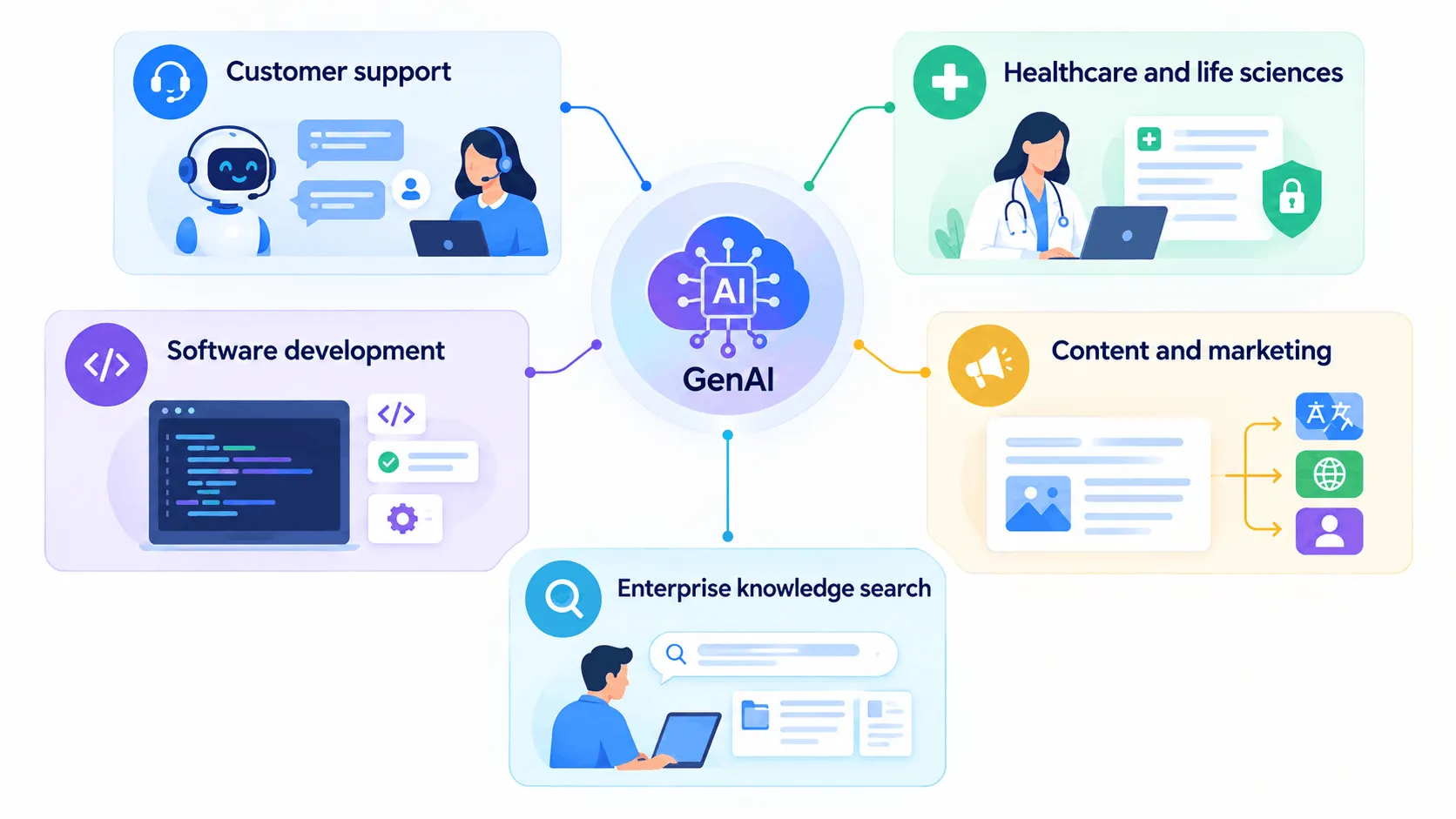
- Customer support: Virtual assistants that answer questions, summarize cases, and hand off to human agents.
- Healthcare and life sciences: Clinical documentation, summarization, and research assistance, within strict privacy controls.
- Software development: Code generation, review, and testing support that speeds up delivery.
- Content and marketing: Drafting, localization, and personalization at scale.
- Enterprise knowledge search: RAG-based assistants that let employees query internal documents in plain language.
Key Benefits for Enterprises
- Faster time to market: Pre-built models and APIs let teams launch GenAI features without building everything from scratch.
- Elastic scalability: Resources grow or shrink with demand, so you are not paying for idle capacity.
- Lower upfront investment: Pay-as-you-go pricing replaces heavy capital spending on hardware.
- Built-in security and compliance: Enterprise controls are part of the platform, not an afterthought.
- Access to innovation: New models and features arrive on the platform without a hardware refresh.
Challenges and Risks to Plan For
The GenAI revolution on hyperscalers is powerful, but it is not risk-free. Going in with clear eyes avoids expensive surprises.
- Cost overruns: GPU time and inference usage can grow quickly. Without monitoring and budgets, bills can climb faster than business value.
- Vendor lock-in: Building deeply on one provider’s proprietary services can make moving later difficult and costly.
- Data privacy and sovereignty: Regulated industries must control where data lives and how it is used by models.
- Skills gap: Teams still need expertise in prompt design, evaluation, MLOps, and cloud architecture.
- Output quality and risk: Test, monitor, and oversee hallucinations, bias, and security issues.
How to Choose the Right Hyperscaler for GenAI
Use this simple framework to guide the decision.
- Start with your existing ecosystem: If your data and applications already live on one cloud, staying close usually reduces cost and complexity.
- Match the platform to the use case: Customer chatbots, analytics, and developer tools have different needs, so test your top use case on each shortlisted platform.
- Check model access: Confirm that the models you want are available in the regions you need.
- Model the full cost: Include compute, inference, data transfer, storage, and support, not just the headline price.
- Review security and compliance fit: Make sure certifications and data residency options match your industry.
- Plan for portability: Use open standards and modular architecture, and consider a multi-cloud approach for critical workloads.
What’s Next for the GenAI Revolution
The GenAI revolution is still moving fast, and hyperscalers are shaping the next phase.
- Custom AI silicon: Providers are investing in their own chips to improve performance and lower the cost of training and inference.
- Agentic AI: Platforms are moving beyond chatbots toward AI agents that can plan and complete multi-step tasks.
- Sovereign and regional AI: Demand is growing for AI that keeps data within national or regional boundaries.
- Smaller, efficient models: Cost-conscious enterprises are adopting smaller models that perform well for specific tasks.
- Stronger governance: Expect more built-in tools for evaluation, monitoring, and responsible AI.
Conclusion
The GenAI revolution depends on infrastructure, and hyperscalers have become the foundation. They provide the compute, managed model platforms, data services, and security that make enterprise GenAI practical. At the same time, success depends on making informed choices about cost, lock-in, governance, and fit with your business.
The winners of the GenAI revolution will not be the companies that simply adopt GenAI first. They will be the ones that build on the right platform, with the right architecture and controls.
At HyScaler, we help businesses plan, build, and scale GenAI solutions and join the GenAI revolution on leading cloud platforms. If you are evaluating hyperscalers or moving a GenAI pilot into production, talk to our team about a cloud and GenAI strategy consultation.
FAQs
What is a hyperscaler?
A hyperscaler is a cloud provider that runs data centers at very large global scale and offers on-demand computing, storage, and AI services. AWS, Microsoft Azure, and Google Cloud are the most widely recognized examples.
Why are hyperscalers important for the GenAI revolution?
They provide the GPUs, custom chips, managed models, data services, and security controls that GenAI needs, which most companies cannot build on their own.
Which is best for GenAI: AWS, Azure, or Google Cloud?
There is no single winner. AWS suits teams that want model choice, Azure suits Microsoft-first organizations and OpenAI-committed buyers, and Google Cloud suits teams whose data already sits in BigQuery. Your existing cloud, data location, and compliance needs usually decide it.
What is the difference between Amazon Bedrock, Azure OpenAI, and Vertex AI?
Bedrock gives one managed API over models from several providers. Azure OpenAI runs OpenAI’s models inside your Azure environment. Vertex AI is built around Google’s data and ML tooling and the Gemini models. Platform names change often (Azure AI Foundry has been renamed Microsoft Foundry, and Vertex AI has reportedly been rebranded), so check each provider’s current naming.
Do enterprises have to choose just one hyperscaler for GenAI?
No. Many organizations already use more than one cloud for AI, matching each platform to a use case, so plan for portability from the start.
How much does GenAI cost on the cloud?
Most managed platforms charge per token for input and output, with rates that vary by model, and some offer reserved or provisioned capacity for steady workloads. Set budgets and usage alerts early, because inference spend grows with adoption, and confirm current rates on each provider’s pricing page.
Should we use a hyperscaler platform or call a model provider’s API directly?
Direct APIs from model providers are often the fastest path for startups and prototypes. Hyperscaler platforms make more sense when you need enterprise procurement, existing cloud commitments, security controls, or several models behind one bill.
Can enterprises avoid vendor lock-in with GenAI?
You can reduce it with open standards, modular architecture, and portable tooling, and by using a multi-cloud approach for critical workloads.