

Table of Contents
Enterprise AI has crossed a threshold.
The conversation is no longer about whether to deploy AI agents; it’s about which workflows justify the overhead, and how fast teams can move from pilots to production.
The data reflects this shift decisively.
According to Gartner, less than 5% of enterprise applications will embed AI agent capabilities in 2025.
By the end of 2026, that figure is projected to reach 40%, one of the steepest adoption curves in enterprise software history.
A separate McKinsey survey found that 62% of organizations are at a minimum experimenting with AI agents, with 23% reporting full-scale deployment.
PwC’s survey of 308 senior executives found that 79% say AI agents are already being adopted in their companies, and of those, 66% report measurable productivity gains.
What’s driving this: rising operational costs, persistent talent gaps, growing demand for 24/7 operations, and the hard realization that rule-based automation hits a ceiling.
AI agents break that ceiling by combining reasoning, memory, tool use, and multi-step execution into systems that can operate with minimal human intervention.
This article covers 12 of the most high-value, production-validated enterprise use cases curated from deployment patterns across IT, security, engineering, finance, and operations, along with implementation guidance, governance requirements, and a verified citation index.
What Are AI Agents And How Do They Differ from Traditional Automation?
What are AI agents?
AI agents are autonomous software systems that can reason, plan, use tools, and complete multi-step tasks with minimal human input.
Enterprise AI agents connect to existing systems, CRMs, ERPs, ticketing platforms, and data pipelines, and execute workflows end-to-end rather than simply generating outputs for humans to act on.
AI Agents vs. Traditional Automation
| Dimension | Traditional Automation (RPA/scripts) | AI Agents |
|---|---|---|
| Logic type | Rule-based, deterministic | Goal-driven, adaptive |
| Workflow handling | Static, pre-defined paths | Dynamic, handles exceptions |
| Triggers | Manual or scheduled | Autonomous, event-driven |
| Context awareness | None | Memory + reasoning across steps |
| Failure handling | Breaks on unrecognized inputs | Can reason through ambiguity |
| Integration scope | Single system, point-to-point | Multi-system orchestration |
What Makes Enterprise AI Agents Different from Consumer AI
Enterprise deployments add layers that consumer tools don’t require:
- Multi-system orchestration agents operate across ERP, CRM, HRIS, and ticketing platforms simultaneously
- Persistent memory context retained across sessions and workflows
- Tool use agents call APIs, query databases, and write to systems of record
- Human-in-the-loop (HITL) controls approval gates for high-stakes actions
- Audit trails queryable logs of every agent action for compliance and governance
- Role-based access agents operate under least-privilege principles, not broad system access
Platforms leading enterprise deployments include Salesforce Agentforce, ServiceNow AI Agents, Microsoft Copilot Studio, and SAP Business AI.
Infrastructure-layer providers like AWS Bedrock Agents and Google Cloud Agent Builder handle the orchestration substrate.
Why Enterprises Are Prioritizing AI Agents in 2026
Several structural pressures have converged:
- Operational cost pressure: Enterprises are dealing with inflationary cost structures across support, IT, and back-office functions areas where agents deliver immediate throughput.
- Alert and ticket volume overload: SOC teams, IT helpdesks, and customer support functions are drowning in volume that human headcount cannot linearly scale to address.
- Competitive differentiation: 73% of PwC survey respondents agree that how they use AI agents will provide a significant competitive advantage in the next 12 months.
- The copilot ceiling: Copilots generate outputs for humans to act on. Agents close the loop; they take the action. That distinction is where the real productivity leverage lives.
Visual suggestion “Enterprise AI Evolution”:
Rules-Based → RPA → Copilots (generate) → AI Agents (execute) → Multi-Agent Systems (orchestrate)
12 AI Agent Use Cases Transforming Enterprises in 2026
1. Autonomous Customer Support Resolution
The problem:
Tier-1 and Tier-2 support queues are high-volume, repetitive, and expensive to staff at scale, particularly across time zones.
How agents help:
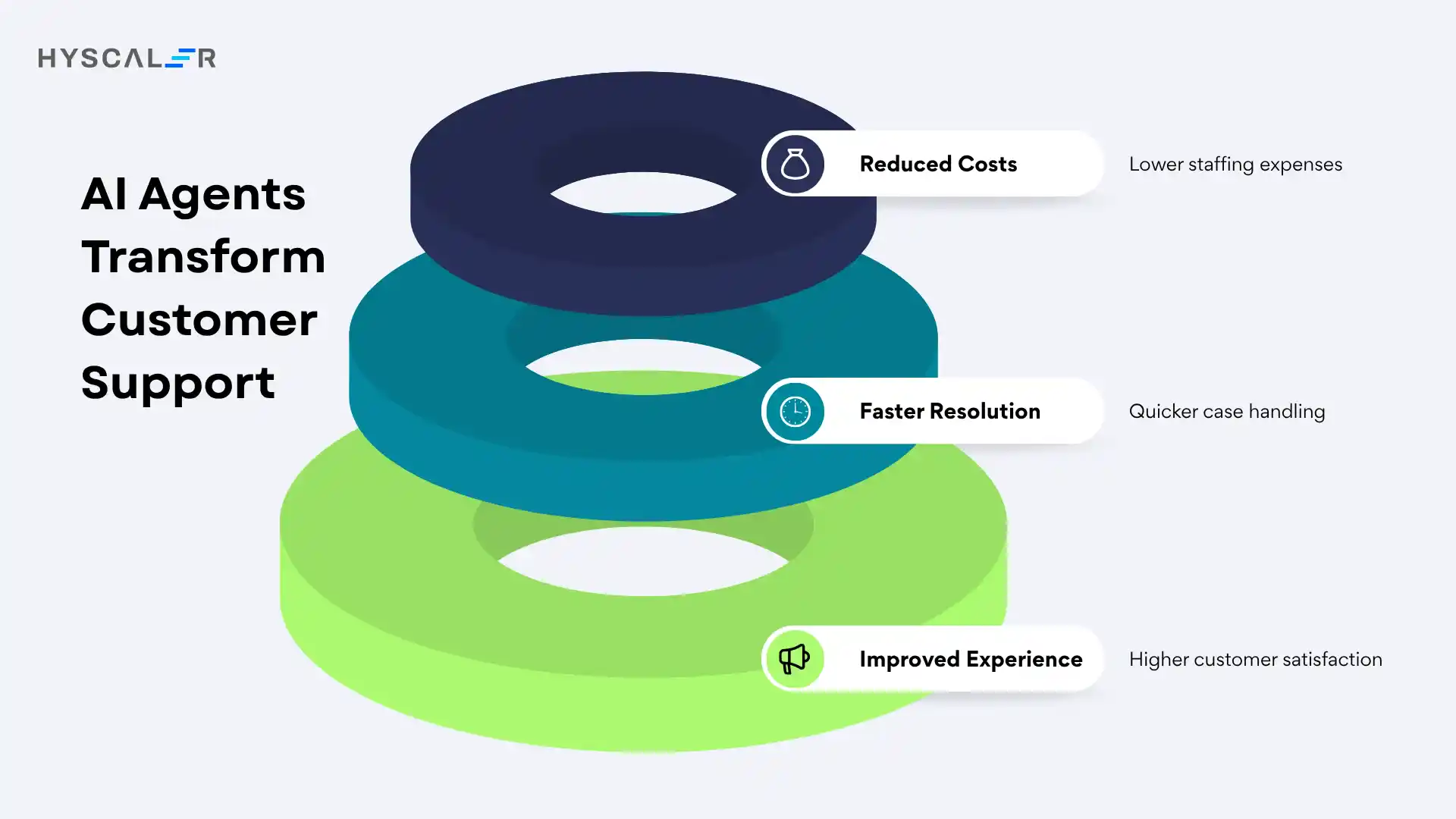
AI agents handle ticket intake, classification, information retrieval, refund processing, and escalation routing without human involvement for the majority of cases.
They integrate with CRM and ticketing platforms (Salesforce, Zendesk, ServiceNow) to update records in real time.
Multimodal agents can handle voice, chat, and email within the same workflow.
Business impact:
AI chatbots and AI voice agents now handle up to 80% of Tier-1 and Tier-2 support queries, reducing response times and enabling 24/7 customer support operations.
ServiceNow reported a 52% reduction in time to handle complex customer service cases after integrating AI agents.
Example:
Salesforce Agentforce enables agents to autonomously resolve customer issues across channels, escalating to human agents only when predefined confidence thresholds are not met.
2. IT Helpdesk Automation
The problem:
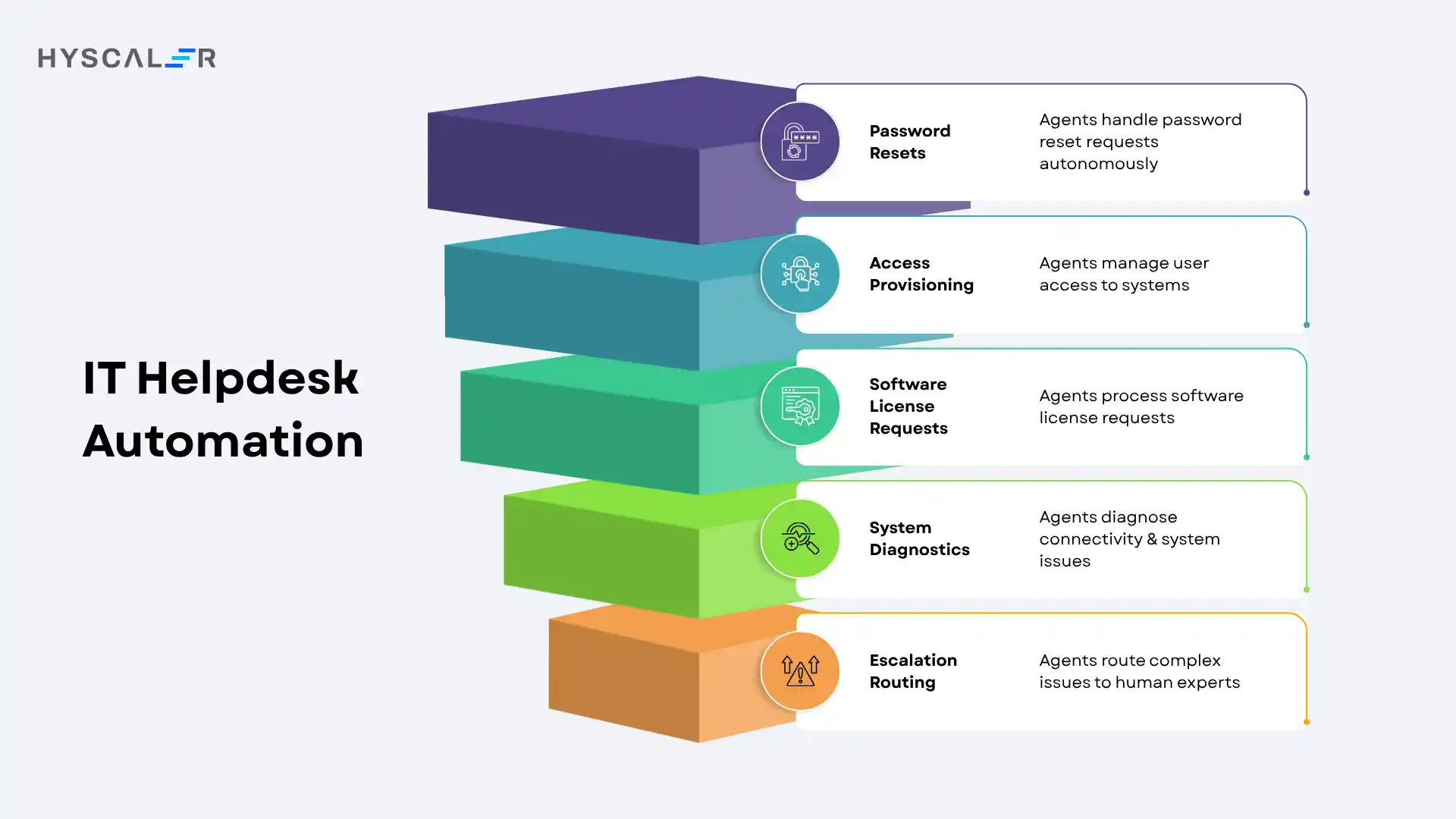
IT teams spend a disproportionate amount of time on low-complexity, high-frequency tasks, such as password resets, access provisioning, software license requests, and system diagnostics, that don’t require human judgment but consume engineering bandwidth.
How agents help:
IT agents integrate with identity management systems (Okta, Active Directory), ITSM platforms (ServiceNow, Jira Service Management), and monitoring tools to autonomously resolve tickets, provision software, diagnose connectivity issues, and route escalations.
They operate 24/7 without SLA degradation.
Business impact:
Workflow automation is the top use case across 64% of enterprise AI agent deployments.
For IT specifically, automated L1/L2 resolution removes the most time-consuming ticket categories from human queues entirely.
Example:
ServiceNow’s AI agents handle password resets, hardware requests, and incident triage autonomously with HITL review for privilege escalation requests.
3. Cybersecurity Threat Detection and Response
The problem:
SOC analysts face unsustainable alert volumes.
82% of SOC analysts report concern that they are missing real threats due to the sheer volume of alerts and data they face daily, a problem traditional SIEM and SOAR tooling have not fully solved.
How agents help:
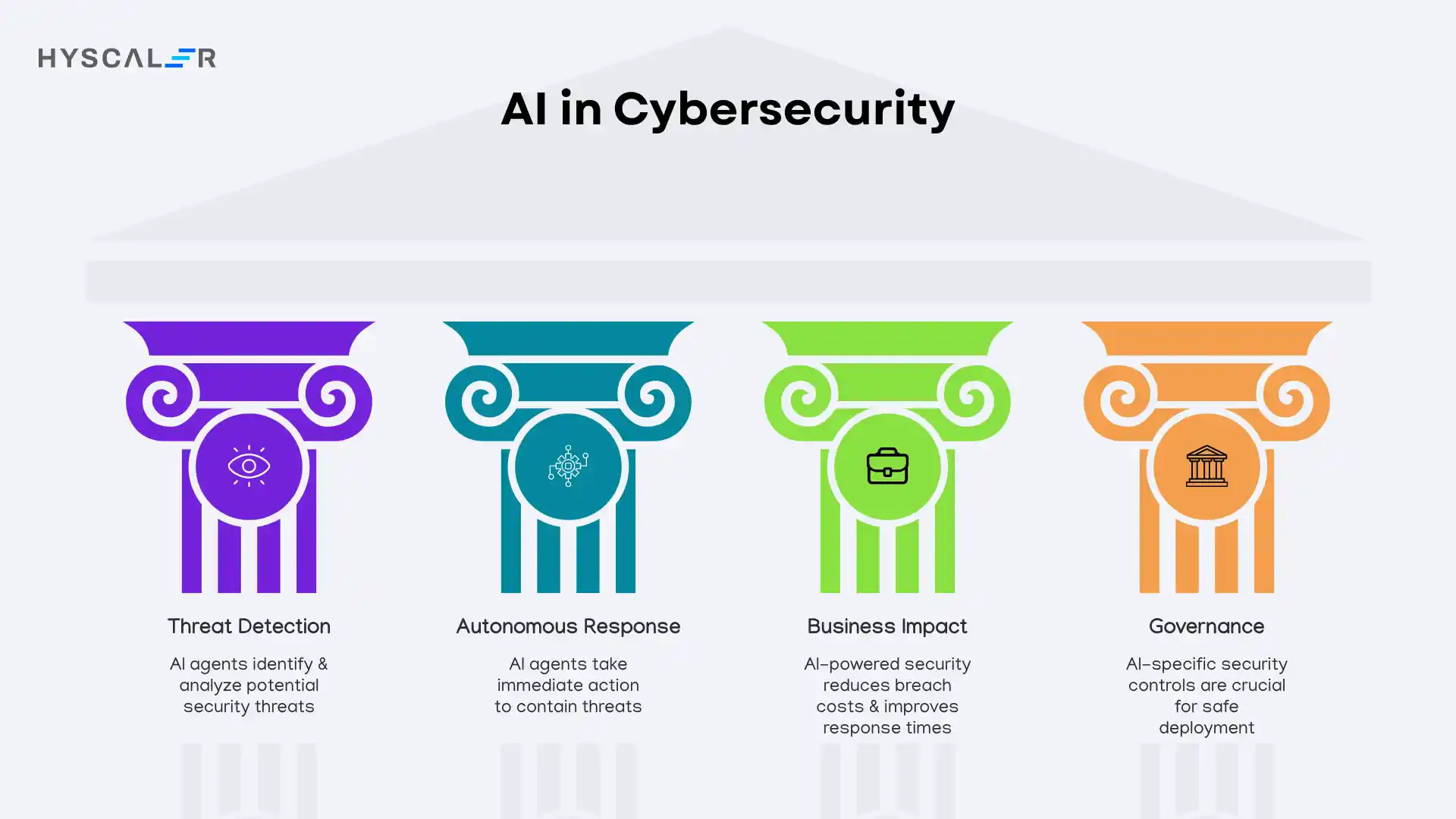
Agentic security systems monitor network traffic, correlate events across SIEM, endpoint, and identity systems, investigate alerts autonomously, and take containment actions (quarantining endpoints, disabling compromised accounts) based on threat severity, all without waiting for analyst intervention.
Alert triage and phishing investigation are the most mature, lowest-risk entry points.
Business impact:
Organizations using AI-powered security identify breaches 108 days faster and reduce average breach costs from $4.44M to $2.54M, a $1.9M saving per incident.
74% of enterprises report positive ROI on security AI within the first year.
Among early adopters, 65% report reduced time to resolution and 58% report fewer total security tickets.
Example:
Torq’s Socrates platform (built on Google Cloud) achieves 90% automation of Tier-1 analyst tasks and 10x faster response times.
Microsoft Security Copilot’s autonomous agents, launched in March 2025, investigate alerts by querying multiple data sources and quarantine endpoints based on threat severity.
Governance note:
Only 34% of enterprises currently have AI-specific security controls in place (Cisco State of AI Security, 2025).
Before deploying agents with access to sensitive systems, define a formal agent registry, enforce least-privilege credentials, and conduct adversarial testing, including prompt injection simulation.
4. AI Software Engineering Agents
The problem:
Engineering teams have finite bandwidth.
Code review cycles, test coverage, documentation, and context-switching between tasks create compounding drag on delivery velocity.
How agents help:
Coding agents (Claude Code, GitHub Copilot, OpenAI Codex, Cursor) now operate across the full SDLC planning tasks, editing code across repositories, writing and running tests, fixing failing builds, and submitting pull requests.
As of 2026, they support long-running autonomous workflows, operating through execution loops rather than single-prompt responses.
Engineers are shifting from writing code to reviewing and guiding agent-generated outputs.
Business impact:
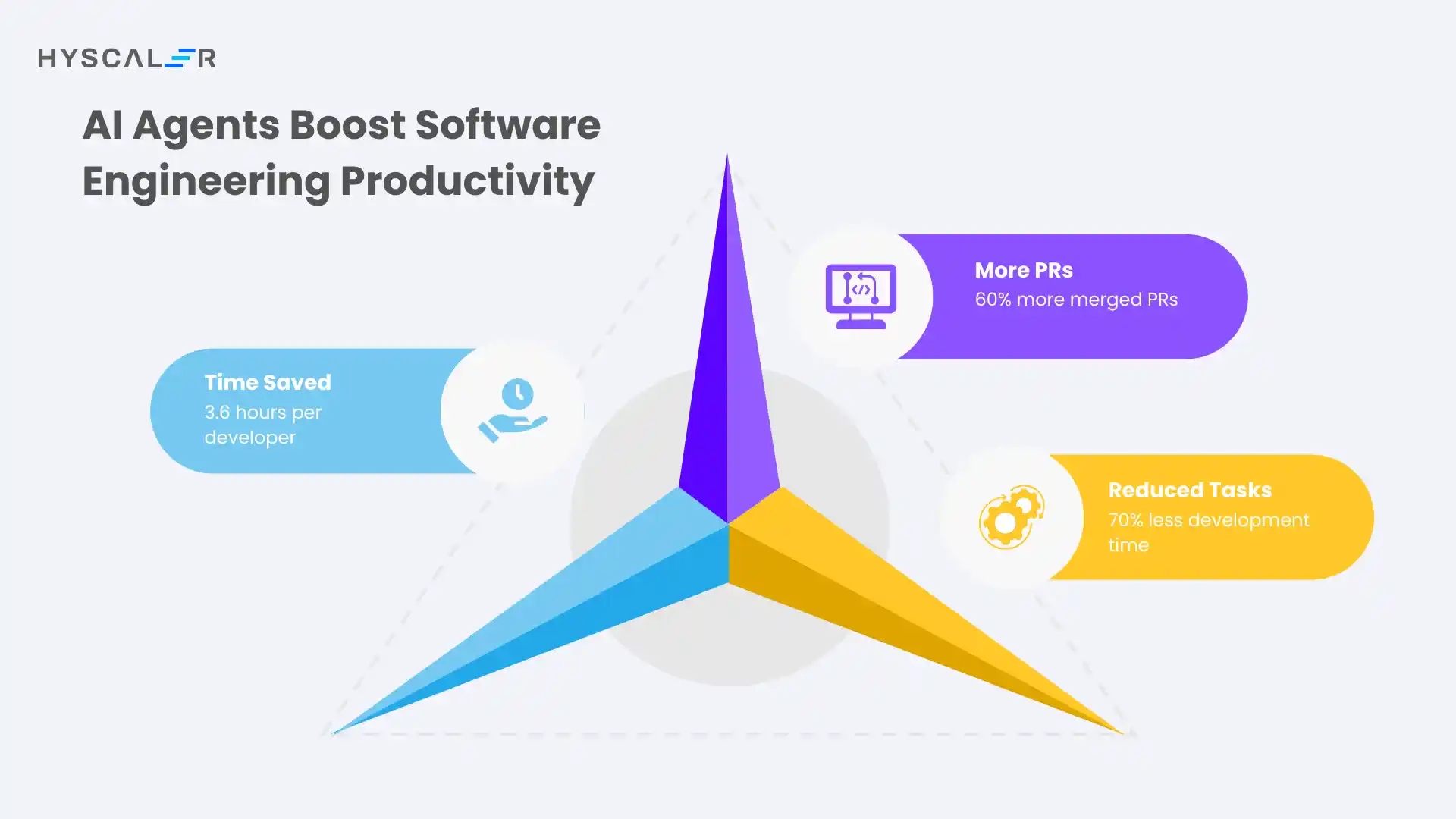
DX’s analysis of 135,000+ developers found an average of 3.6 hours saved per developer per week when using AI coding tools, with daily users merging approximately 60% more PRs.
The Stack Overflow Developer Survey 2025 found 70% of agent users agree that agents have reduced time on specific development tasks.
71% of professional developers report using an AI coding agent daily (Stack Overflow Developer Survey 2026).
Key tradeoff:
CodeRabbit’s December 2025 analysis found approximately 1.7x more issues in AI-coauthored PRs compared to human-only code.
Productivity gains are real, but require new review patterns, security scanning gates in CI/CD, and review automation to prevent accruing verification debt.
Example:
Amazon Q Developer achieves 49% on SWE-bench Verified.
JetBrains Junie reports 30% faster task completion on engineering workflows.
Devin (Cognition) has merged hundreds of thousands of PRs at enterprise scale, with Goldman Sachs among reported deployments.
5. AI-Powered Financial Operations
The problem:
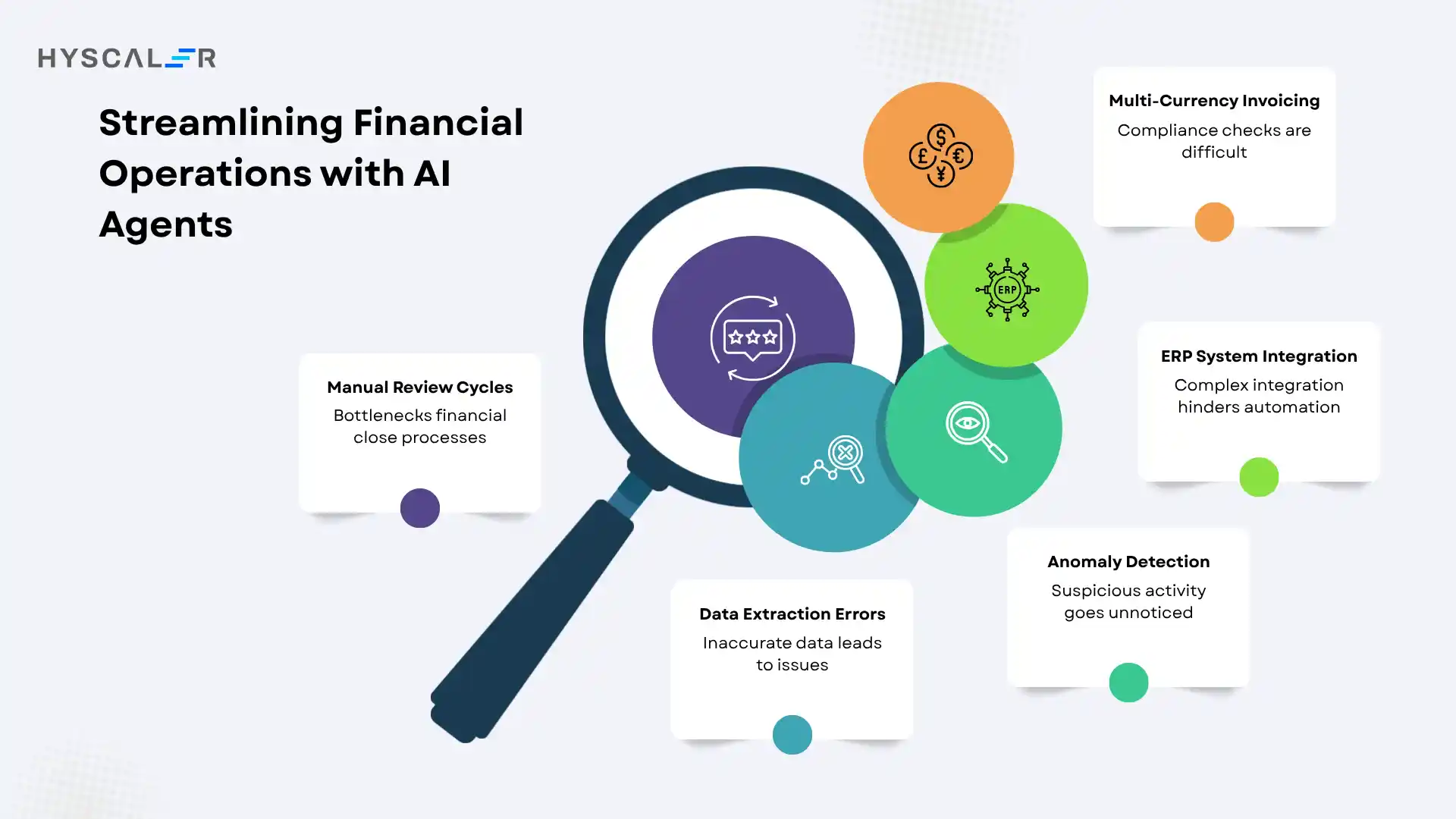
Accounts payable, expense auditing, invoice processing, and financial close workflows involve repetitive document-heavy tasks prone to human error and bottlenecked by manual review cycles.
How agents help:
Financial AI agents extract structured data from invoices and receipts, validate against purchase orders, flag anomalies, route for approval, and update ERP systems (SAP, Oracle, NetSuite).
Fraud detection agents analyze transaction patterns in real time, applying models trained on historical signals to flag suspicious activity before settlement.
Business impact:
AI-powered financial operations are accelerating close processes by 30–50% in production deployments.
35% of organizations using AI agents report cost savings through automation, with finance and operations among the highest-impact functions.
Example:
Fraud detection held the highest market share among AI cybersecurity and financial applications in 2024, reflecting clear ROI in financial services.
Enterprise AP automation platforms (Tipalti, Coupa) have integrated agentic workflows to handle multi-currency invoicing and compliance checks autonomously.
6. Sales Prospecting and Pipeline Qualification
The problem:
Sales development involves high-volume, low-differentiation research and outreach tasks, prospect discovery, CRM enrichment, personalized sequencing, and meeting scheduling that consume SDR capacity without requiring senior judgment.
How agents help:
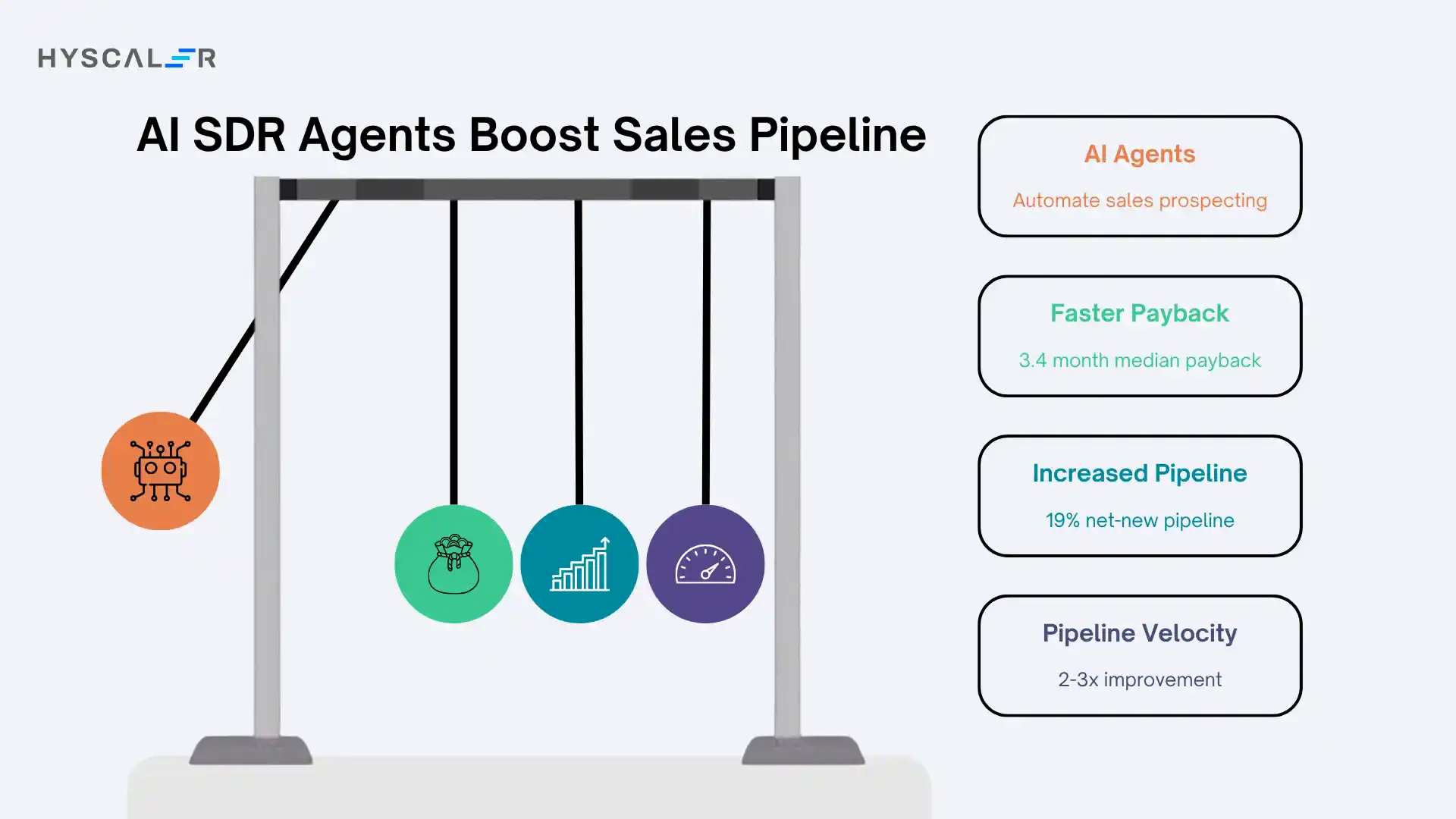
AI SDR agents autonomously research target accounts, craft personalized outreach sequences, update CRM records, follow up based on engagement signals, and route qualified leads to account executives. These capabilities can significantly improve sales team efficiency by reducing repetitive work and allowing sales representatives to focus more time on qualified opportunities and customer conversations.
They integrate with CRM platforms (Salesforce, HubSpot), sequencing tools (Outreach, Salesloft), and data enrichment APIs.
Business impact:
SDR agents have the fastest payback period of any enterprise agent function, a median of 3.4 months (BCG/Forrester).
41% of marketing organizations now run at least one SDR agent.
Enterprises running SDR agents report 19% of net-new pipeline sourced through agentic outreach as of Q1 2026.
AI sales agents are producing 2–3x improvements in pipeline velocity.
Example:
SDR agents integrated with Salesforce Agentforce handle outbound prospecting, follow-up, and meeting booking, operating at volumes no human SDR team can match, with HITL review for high-value accounts.
7. HR, Onboarding, and Recruitment Automation
The problem:
HR teams handle a high volume of structured, repeatable tasks, such as resume screening, interview scheduling, onboarding documentation, benefits queries, and policy guidance, that are time-intensive and delay time-to-productivity for new hires.
How agents help:
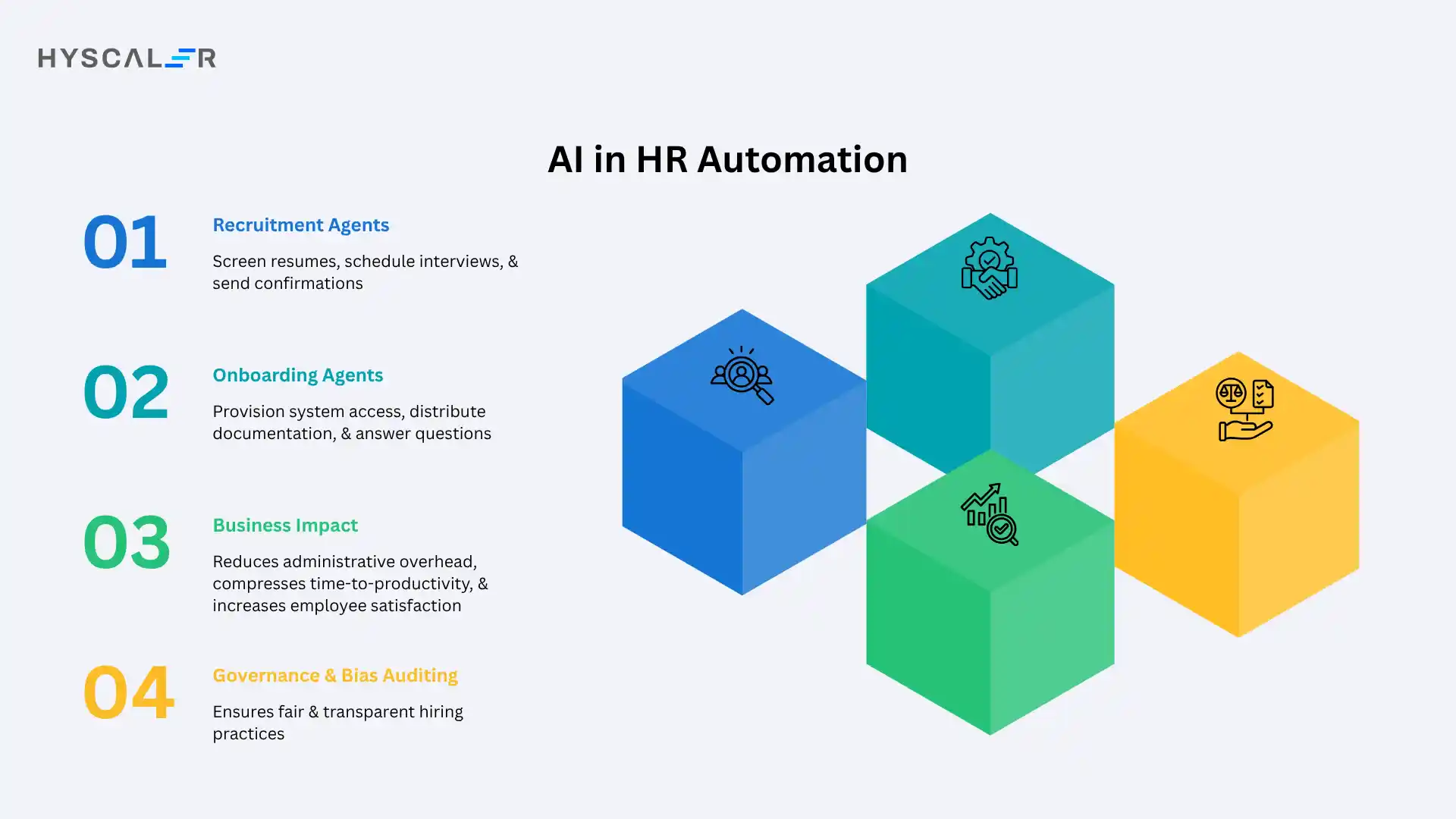
Recruitment agents integrate with ATS platforms (Greenhouse, Workday) to screen resumes against structured criteria, shortlist candidates, schedule interviews across calendars, and send confirmations.
Onboarding agents provision system access, distribute documentation, answer policy questions, and track completion of required steps.
Business impact:
HR is consistently in the top functions for business process automation. AI-driven onboarding reduces administrative overhead and compresses time-to-productivity, critical in high-growth hiring cycles.
Organizations using AI in HR report higher employee satisfaction scores tied to faster, cleaner onboarding experiences.
Note:
Resume screening agents require careful governance bias auditing, transparent criteria, and HITL review for final shortlisting decisions, which are non-negotiable in regulated industries and jurisdictions with AI employment law requirements.
8. Legal Contract Review and Compliance Checks
The problem:
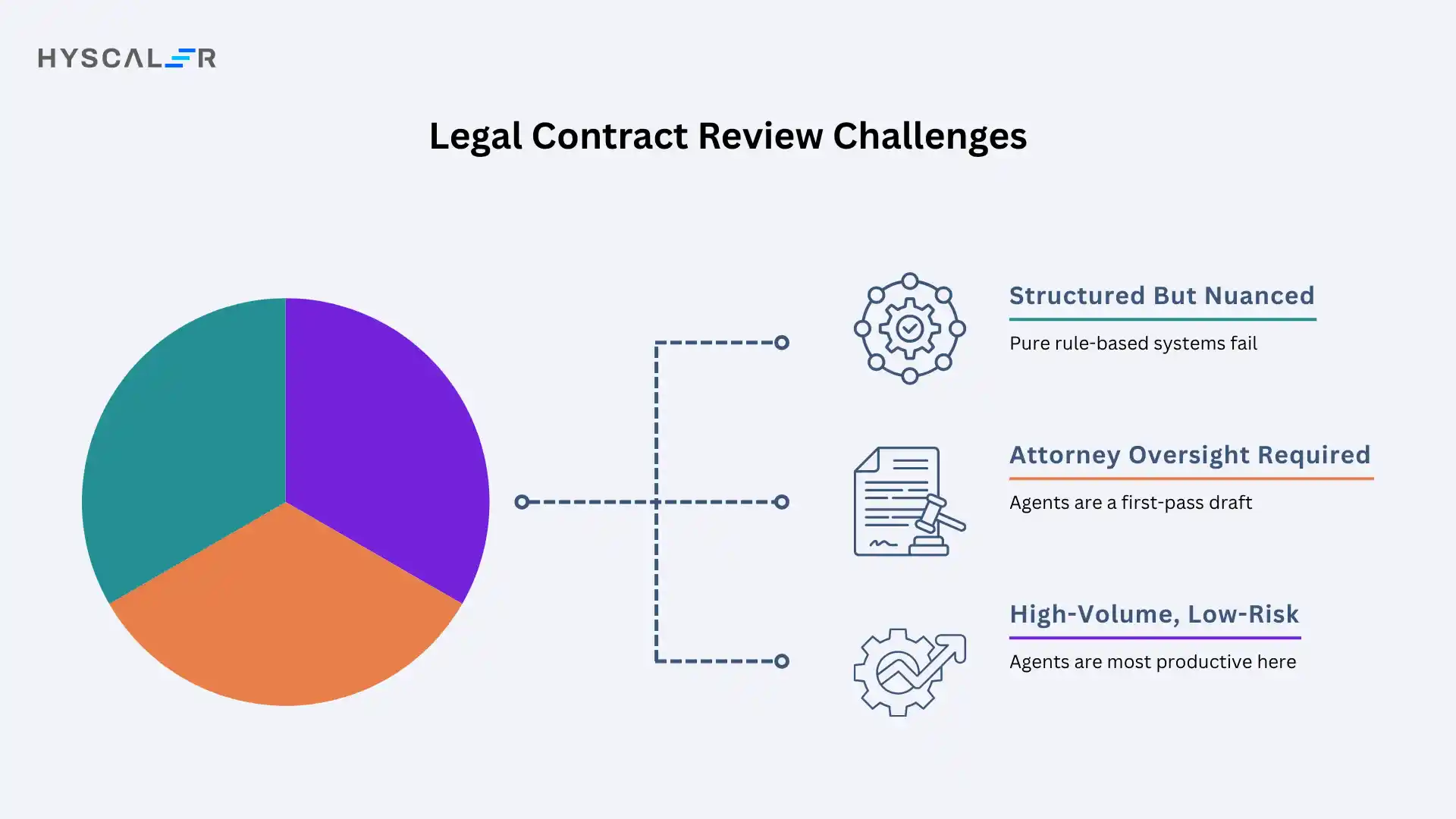
Legal teams spend significant billable and operational time on contract review, clause extraction, and risk flagging tasks that are structured enough for automation but nuanced enough that pure rule-based systems fail.
How agents help:
Legal AI agents ingest contracts (MSAs, NDAs, SOWs, vendor agreements), extract key clauses, flag non-standard terms against a defined playbook, summarize risk exposure, and suggest redlines.
They integrate with contract lifecycle management (CLM) platforms like Ironclad, DocuSign CLM, and Conga.
Business impact:
AI contract review reduces average review time from hours to minutes for standard agreements.
Legal teams at enterprises using agentic review tools report a 60–80% reduction in time-to-first-review for inbound vendor contracts, freeing attorneys for high-stakes negotiation and advisory work.
Governance note:
Agent outputs should be treated as a first-pass draft, not a final review.
Contractual obligations, regulatory exposure, and jurisdiction-specific requirements still require attorney oversight.
Agents are especially productive on high-volume, low-risk contracts (NDAs, standard SaaS agreements).
9. Supply Chain Monitoring and Demand Forecasting
The problem:
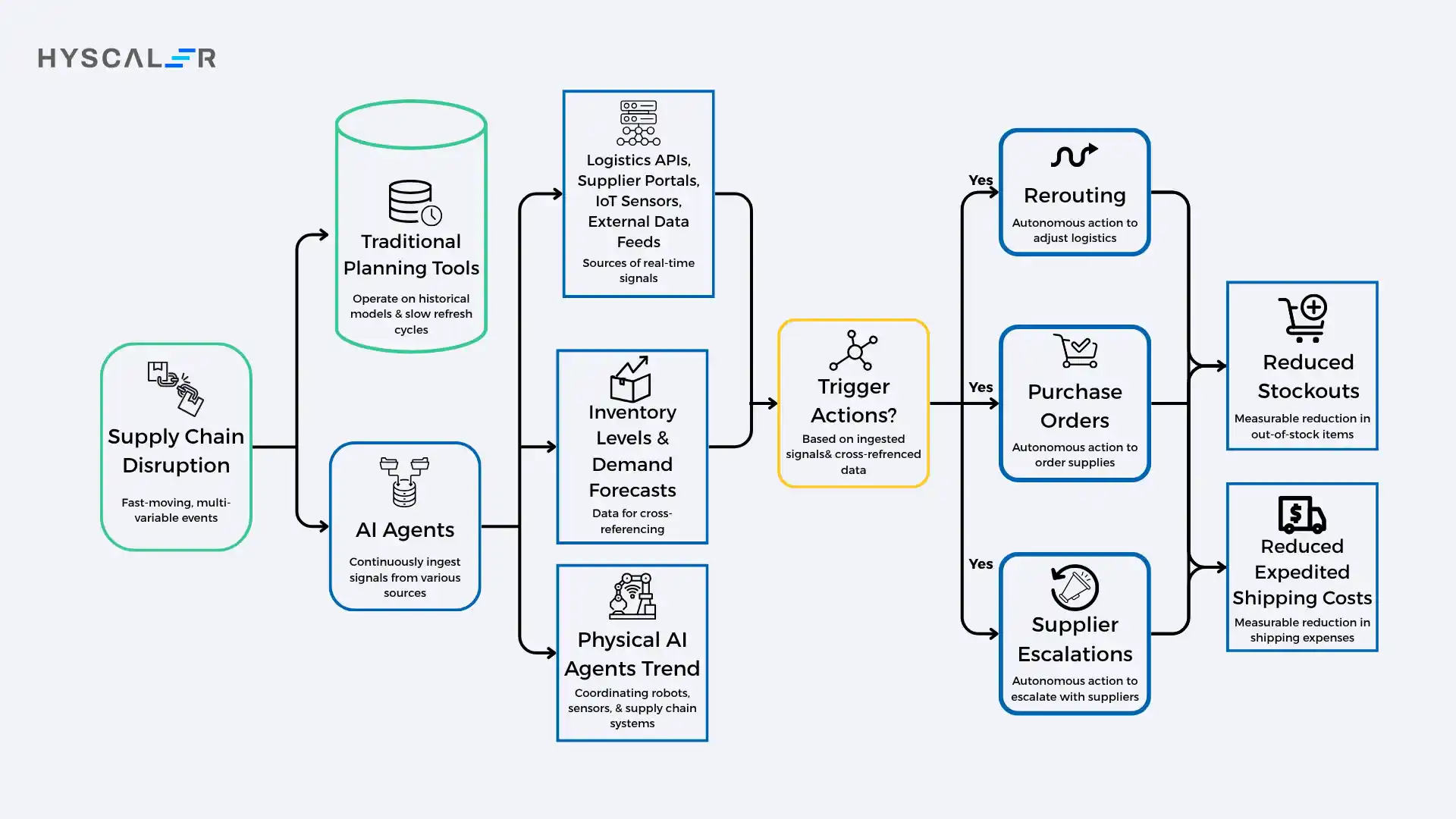
Supply chain disruptions are fast-moving, multi-variable events.
Traditional planning tools operate on historical models and scheduled refresh cycles too slow to respond to real-time signals like port delays, supplier shutdowns, or demand spikes.
How agents help:
Supply chain agents continuously ingest signals from logistics APIs, supplier portals, IoT sensors, and external data feeds (weather, geopolitical events), then cross-reference against inventory levels and demand forecasts to trigger rerouting, purchase orders, or supplier escalations autonomously.
Business impact:
Forrester identifies “physical AI” agents coordinating robots, sensors, and supply chain systems in real time as a major 2026 trend area.
Enterprises report measurable reductions in stockouts and expedited shipping costs when agents are deployed for continuous demand signal monitoring.
10. Enterprise Knowledge Management and Internal Search
The problem:
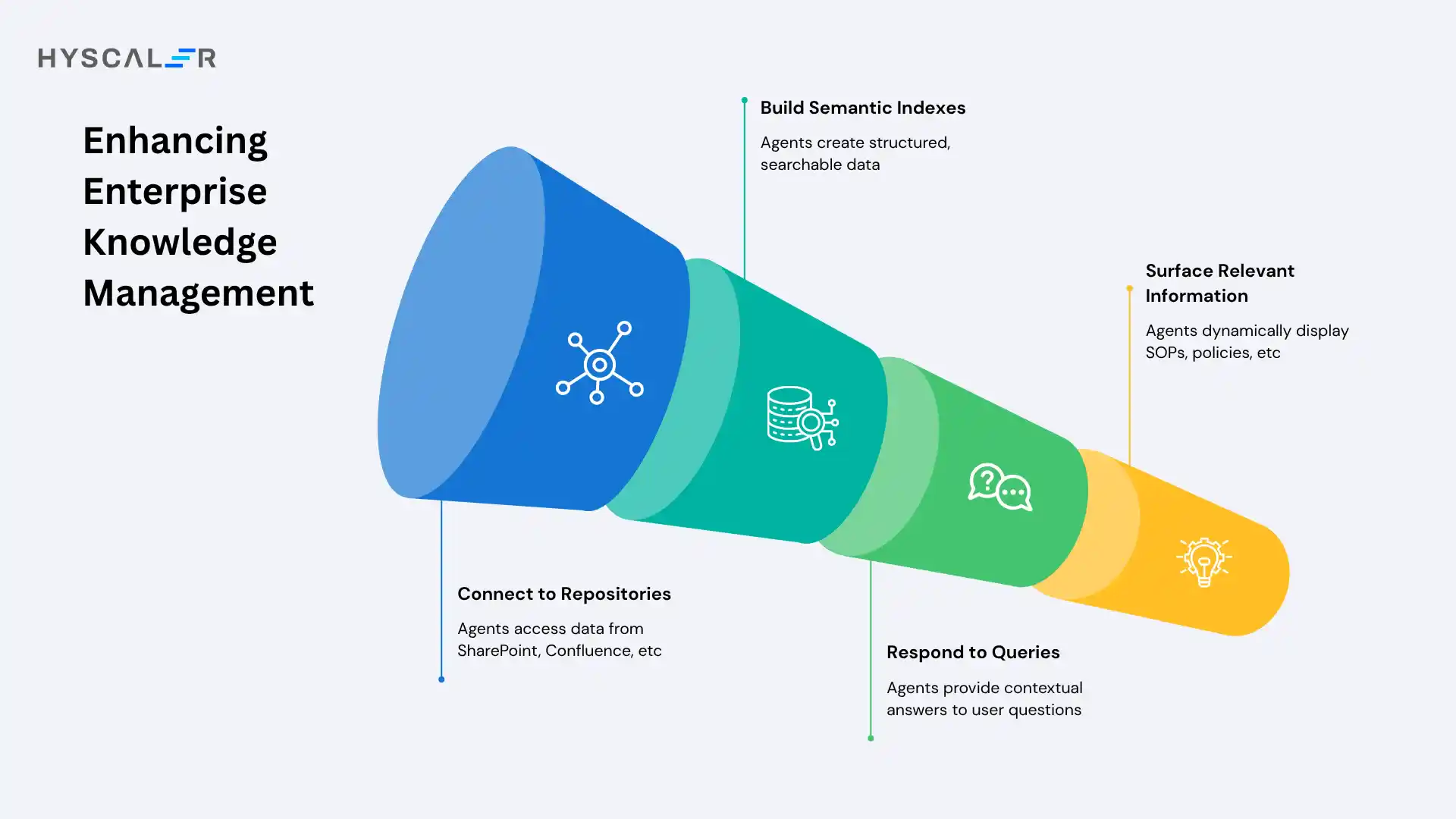
Enterprise knowledge is distributed across SharePoint, Confluence, Notion, Slack, email, and siloed databases.
Employees spend significant time searching for the right policy, runbook, or technical spec time that compounds across thousands of knowledge workers.
How agents help:
Knowledge agents connect to internal repositories, build semantic indexes, and respond to natural language queries with cited, contextual answers rather than returning a list of documents.
They can surface SOPs, technical documentation, HR policies, and onboarding guides dynamically, and update their index as documents change.
Business impact:
Intelligence-infused knowledge processes are projected to grow to 25% of enterprise workflows in 2026, an 8x increase in two years.
Organizations with deployed knowledge agents report significant reductions in “knowledge search time” and faster onboarding for new engineers and analysts.
Example:
Enterprise platforms like Microsoft 365 Copilot and Glean deploy agents across connected data sources to serve internal knowledge queries at scale.
11. AI Agents for Business Intelligence and Reporting
The problem:
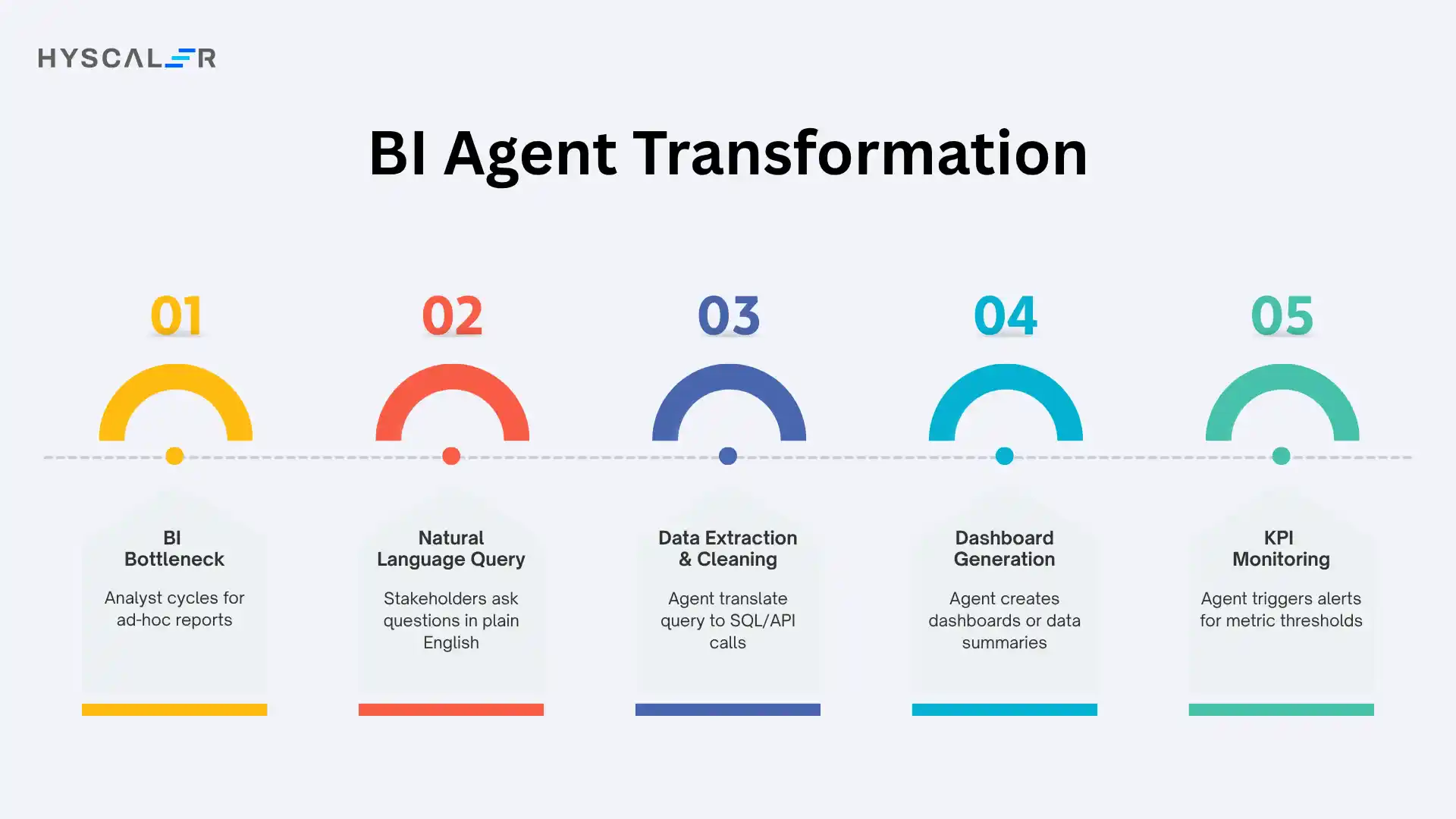
BI teams are bottlenecks.
Business stakeholders request ad-hoc reports and dashboards that require analyst cycles to pull, clean, and visualize data, often taking days when the underlying question needs a same-day answer.
How agents help:
BI agents accept natural language queries, translate them to SQL or API calls against connected data warehouses (Snowflake, BigQuery, Redshift), generate dashboards or data summaries, and distribute them on a schedule or on demand.
They can autonomously monitor KPIs and trigger alerts when metrics cross defined thresholds.
Business impact:
Natural language analytics interfaces are reducing time-to-insight from days to minutes for common reporting requests.
Analyst capacity is redirected from data extraction to interpretation, modeling, and strategic analysis.
Example:
Platforms like ThoughtSpot, Mode, and Microsoft Fabric have integrated agentic query capabilities that allow non-technical stakeholders to self-serve data analysis without writing SQL.
12. Cross-System Workflow Orchestration (Multi-Agent Systems)
The problem:
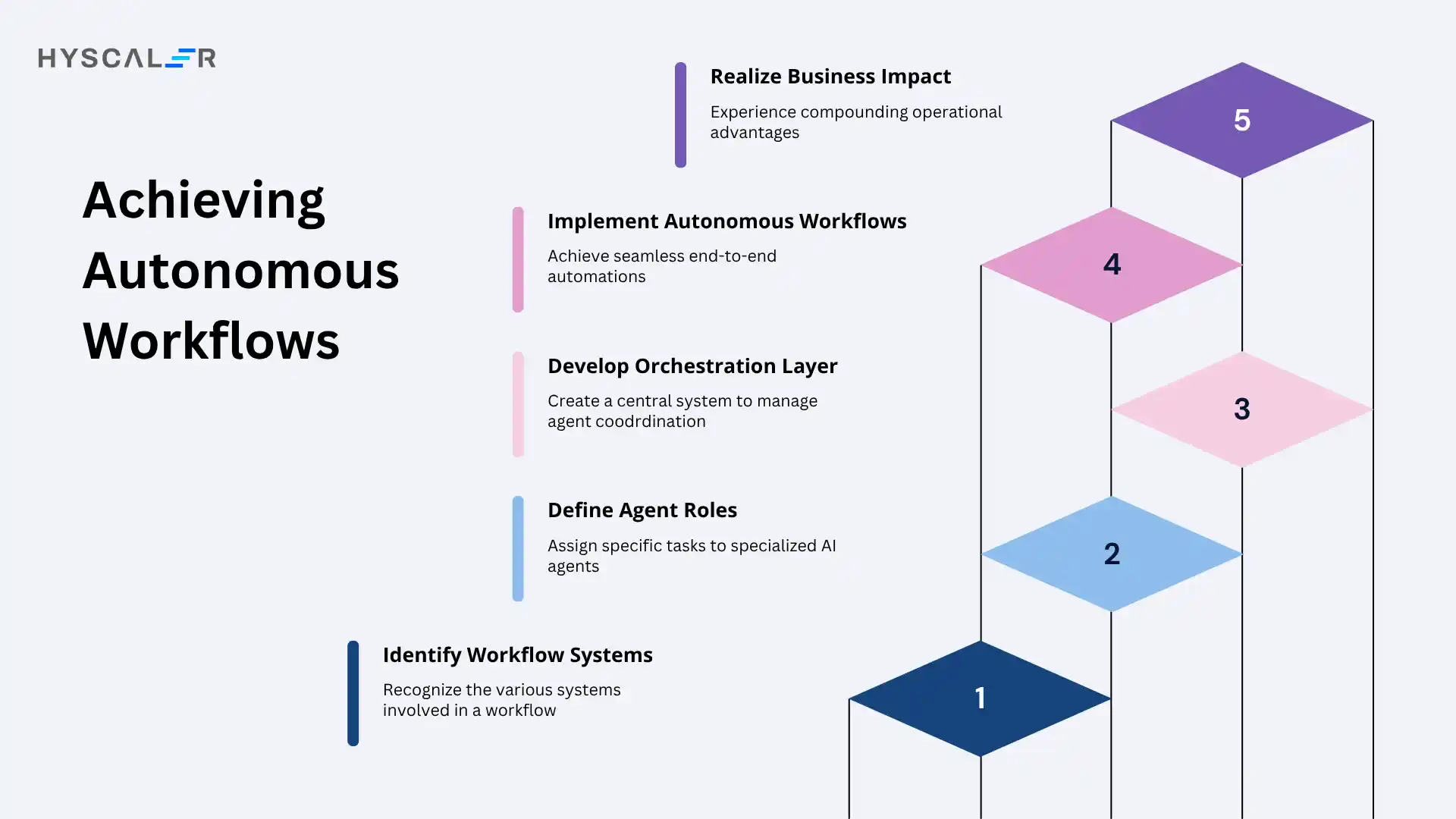
Enterprise workflows span multiple systems, and a single customer escalation might touch CRM, ticketing, billing, ERP, and communication platforms.
Traditional automation can’t coordinate across these systems dynamically; each handoff is a manual step or a brittle point of integration.
How agents help:
Multi-agent orchestration layers coordinate specialized agents, one for CRM updates, one for billing lookups, one for communication under a central orchestrator that manages context, sequencing, and exception handling.
This is the architectural pattern enabling true end-to-end autonomous workflows.
Business impact:
This is the highest-leverage use case in enterprise AI architecture.
Both Gartner and Forrester identify 2026 as the breakthrough year for multi-agent systems.
Enterprises that invest in orchestration infrastructure now will have compounding operational advantages as agent capabilities mature.
The structural parallel most cited: what Kubernetes did for container management, orchestration layers are doing for AI agents.
Example:
In a documented deployment at a hospitality company (PwC case study), teams of AI agents working across functions, customer experience, operations, and cost management are already delivering measurable cross-functional outcomes.
13. Autonomous Workflow Delegation and Execution
The problem:
Most enterprise AI implementations remain stuck in a “copilot” loop, where humans must manually prompt tools to generate single-step outputs. This creates a bottleneck, as teams cannot scale workflows that require multi-system orchestration, persistent memory, and strict adherence to brand and security guidelines without constant supervision.
How agents help:
WRITER enables enterprises to build and deploy autonomous AI agents that execute complex workflows from start to finish. Built on the proprietary Palmyra LLM family and featuring a graph-based RAG architecture, Writer agents don’t just assist they delegate. They can connect to Snowflake, Salesforce, and other systems of record to plan and carry out multi-step tasks while maintaining enterprise-grade security and brand consistency.
Business impact:
By moving from “prompting” to “delegating,” organizations see immediate throughput gains. Uber, for example, has leveraged the platform to scale inbound support responses, while other Global 2000 firms use Writer to automate high-stakes marketing, sales, and IT playbooks, reducing manual overhead and ensuring 24/7 operational reliability.
Example:
A marketing team can deploy a Writer agent to autonomously monitor competitive news, analyze internal 10-K reports, and generate an account-specific intelligence dashboard, complete with personalized sales decks, every morning without human intervention.
Challenges of Deploying Enterprise AI Agents
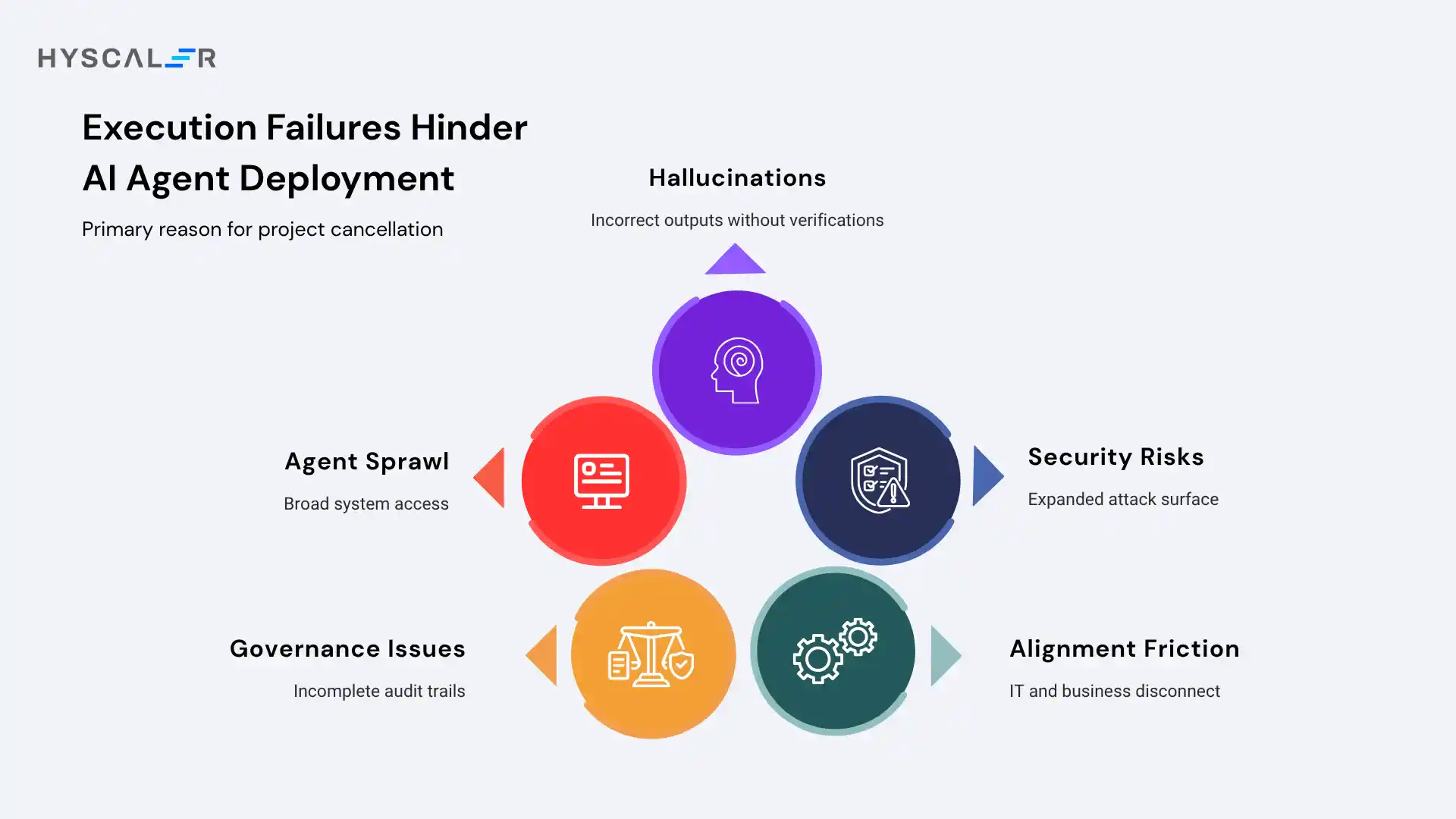
40% of agentic AI projects are projected to be cancelled by the end of 2027, according to Gartner, primarily due to execution failures, not capability gaps.
The challenges are real and require deliberate architectural decisions.
Governance and Audit Trails
Enterprise procurement and legal teams now require complete, queryable records of every agent action.
Deployments without audit trail infrastructure are failing security review during scaling.
This is not a post-launch problem; it must be built into the agent architecture from day one.
Agent Sprawl and Permission Enforcement
63% of executives cite “platform sprawl” as a growing concern (Bain, 2025).
Agents operating with broad system access create compounding security and compliance risk. Production-grade deployments enforce role-based permissions at the action level, not just at authentication.
Define a formal agent registry catalog for every agent, its permissions, its intended scope, and its escalation paths.
Hallucinations and Verification Debt
AI agents can produce plausible-but-incorrect outputs.
In high-stakes workflows (legal, financial, medical), acting on a hallucinated output without verification can have serious downstream consequences.
Implement confidence thresholds, human approval gates, and output validation layers.
For code agents specifically, CodeRabbit’s 2025 analysis found ~1.7x more issues in AI-authored PRs without new review patterns; this becomes technical debt at scale.
Security Attack Surface
AI agents, their models, data pipelines, and APIs expand the enterprise attack surface.
Prompt injection (malicious instructions embedded in data an agent processes) is an under-addressed risk in most early deployments. 87% of organizations reported at least one AI-driven cyberattack in the past year.
Alignment Between IT and Business Teams
68% of executives report friction between IT and other departments in AI adoption (Writer, 2025).
Without a formal AI strategy, enterprise AI adoption success rates drop from 80% to 37%.
Governance isn’t just a technical problem; it requires organizational alignment, clear ownership, and a change management process.
How to Implement Enterprise AI Agents: A Practical Framework
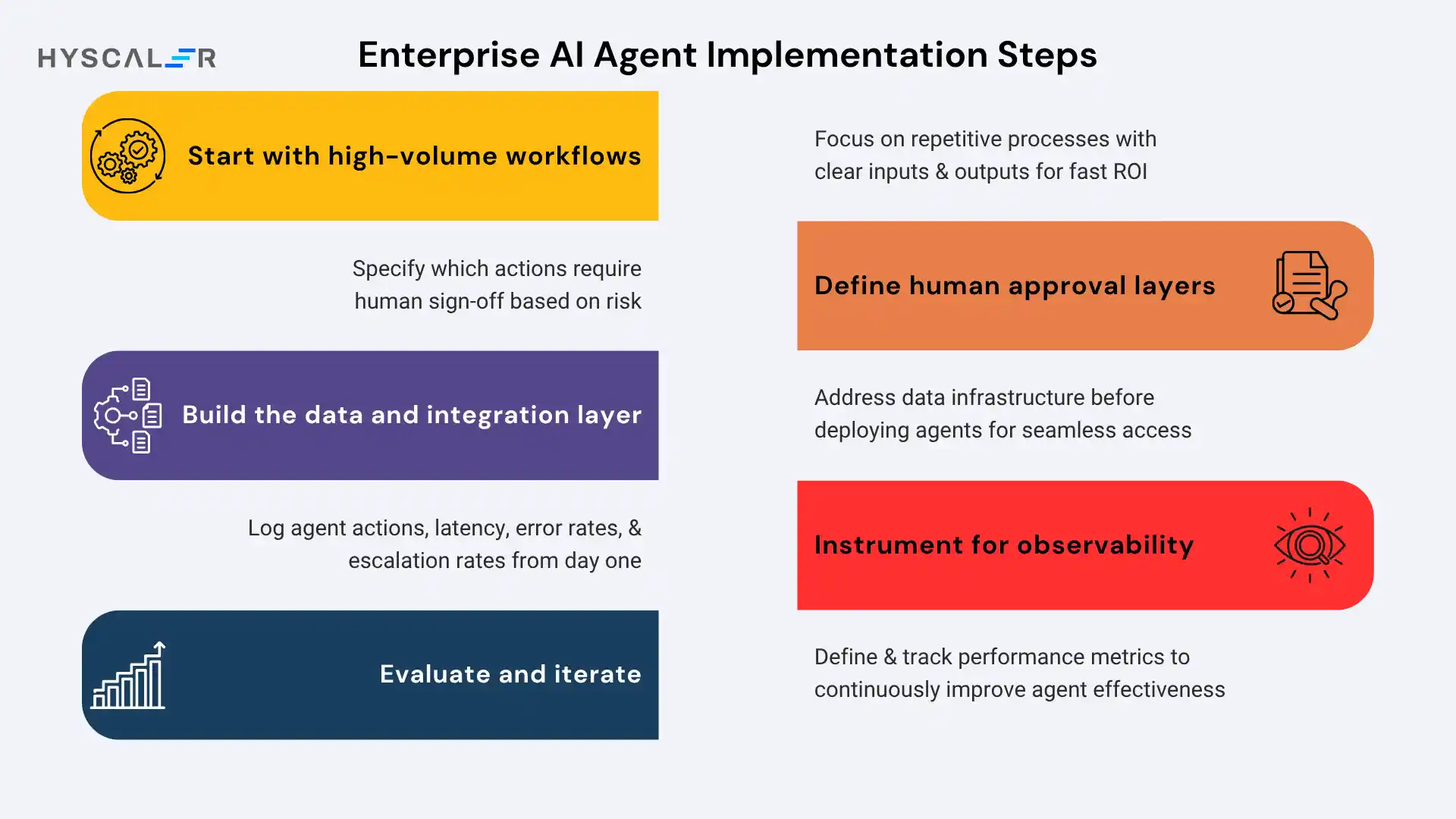
Step 1: Start with high-volume, structured workflows.
Repetitive target processes have clear inputs and outputs, and don’t require judgment in edge cases (IT ticketing, invoice processing, alert triage).
These deliver the fastest ROI and generate the operational data needed to calibrate more complex deployments.
Step 2: Define human approval layers before launch.
Specify which actions agents can take autonomously versus which require human sign-off.
Approval gates should be proportional to the risk of the action, not added as an afterthought.
The median payback on agent deployments is 5.1 months; finance and ops agents take longer (8.9 months) precisely because of the governance overhead required.
Step 3: Build the data and integration layer first.
Agents are only as capable as the systems they can access.
A fragmented data layer, siloed databases, inconsistent schemas, and missing APIs are the single most common technical blockers to production deployment.
Address data infrastructure before deploying agents, not in parallel.
Step 4: Instrument for observability from day one.
Most organizations are adapting monitoring tools for agents to use Grafana + Prometheus (43%) and Sentry (32%), familiar DevOps tooling.
AI-native observability is still maturing, but at a minimum, you need logging of agent actions, latency metrics, error rates, and escalation rates. You cannot govern what you cannot observe.
Step 5: Evaluate and iterate on performance metrics.
For customer support: deflection rate, CSAT, escalation rate.
For security: time-to-detection, alert-to-analyst ratio, and tickets closed without human intervention.
For coding agents: PR throughput, defect rate on AI-authored code, review cycle time.
Define these before launch; build toward them deliberately.
Planning enterprise AI agent adoption? Learn how modern AI infrastructure, orchestration, and LLMOps practices impact scalability [explore HyScaler’s enterprise AI infrastructure work]
The Future of Enterprise AI Agents
The architectural trajectory for the next 12–24 months is becoming clearer:
Multi-agent coordination becomes the default: Single-purpose agents are already being described as outdated. Orchestration layers coordinating specialized agents with shared context and defined handoff protocols are the architecture pattern most enterprises are building toward.
Protocol standardization unlocks composability: As MCP (Model Context Protocol) adoption matures and agent-to-agent communication protocols stabilize, the cost of switching between underlying models drops. This shifts leverage from foundation model providers to whoever holds the workflow context layer.
Agents acquire memory and long-horizon planning: Current deployments are largely stateless within a session. Persistent memory agents that retain context across deployments, learn from past outcomes, and adjust behavior accordingly are the next capability frontier and the one that enables genuinely autonomous enterprise operations.
Physical AI emerges as a category: Forrester identifies agents coordinating robots, sensors, and supply chain systems as a significant 2026+ trend extending agentic architectures beyond software into operational infrastructure.
Industry-specific agent stacks consolidate: Generic agents are giving way to domain-specific deployments: compliance agents for financial services, clinical documentation agents for healthcare, contract intelligence agents for legal. Vertical specialization improves accuracy and reduces governance overhead.
Want to build enterprise-grade AI agents securely and at scale?
Explore how HyScaler helps businesses implement production-ready AI systems and agentic workflows from data infrastructure and LLMOps to multi-agent orchestration and governance architecture.
Talk to HyScaler’s enterprise AI team
FAQ
What are AI agents?
AI agents are autonomous software systems that can reason, plan, use external tools, and complete multi-step tasks with minimal human input, as distinct from AI assistants that generate responses for humans to act on.
How are AI agents different from chatbots?
Chatbots respond to inputs. AI agents act on them. An agent can query a database, update a CRM record, trigger an approval workflow, and send a confirmation email as a single autonomous action; a chatbot cannot.
What is agentic AI?
Agentic AI refers to AI systems designed for goal-directed, autonomous behavior: perceiving their environment, reasoning through multi-step problems, selecting and using tools, and taking action to complete objectives.
Which industries are leading enterprise AI agent deployment?
Telecommunications (48% actively deploying), financial services and insurance (47%), healthcare (18%), and government (14%), according to 2026 industry surveys. Banking and insurance lead due to high-volume, rules-adjacent workflows; government lags due to procurement cycles and compliance requirements.
Are AI agents secure for enterprise use?
With proper governance, yes. Without it, no. The key controls: a formal agent registry, least-privilege credentials with automatic rotation, role-based permission enforcement at the action level, audit trail infrastructure, and adversarial testing before production deployment. Only 34% of enterprises currently have AI-specific security controls in place; this gap is the primary risk vector.
Can AI agents replace employees?
Agents automate tasks, not roles. Current deployments remove the lowest-judgment, highest-volume work from human queues, freeing experienced staff for analysis, judgment, and exception handling. In SOC environments, 35% of respondents expect agents to replace Tier-1 analysts within three years (McKinsey, 2025), but the net effect is role transformation, not elimination, at the enterprise level.
What platforms support enterprise AI agent deployment?
At the application layer: Salesforce Agentforce, ServiceNow, Microsoft Copilot Studio, SAP Business AI. At the infrastructure layer: AWS Bedrock Agents, Google Cloud Agent Builder, Azure AI Foundry. For orchestration: LangChain, LangGraph, CrewAI, and increasingly native orchestration within cloud platforms.
Last reviewed: May 2026. Statistics reflect data published between October 2025 and May 2026 unless otherwise noted.