
Table of Contents
A company with 800 employees deployed an internal AI support assistant. It resolved customer tickets initially. Within three months, documentation updates caused stale citations, CRM schema modifications broke retrieval, peak latency doubled, and API bills surged.
This reflects a broad industry pattern. According to Gartner research, at least 30% of generative AI projects will be abandoned after the proof-of-concept stage by late 2025 due to poor data quality, inadequate risk controls, and escalating costs.
The team treated deployment as a completed milestone. Instead, developers spent weeks debugging prompt regressions and rebuilding vector indexes.
This operational gap is where managed AI services become essential.
What Are Managed AI Services?
Managed AI services provide ongoing operational management, monitoring, security, and maintenance for production artificial intelligence systems.
Building, deploying, and operating software require distinct disciplines:
- Building an AI solution involves data preparation, model selection, prompt engineering, and application logic.
- Deploying an AI solution involves containerization, endpoint configuration, and CI/CD pipelines.
- Operating an AI solution involves telemetry, drift detection, data sync, patching, and cost governance.
Deployment completion does not mean a system is managed. Without disciplined AI deployment and management, production models degrade as business data, user queries, and external APIs evolve.
What Do Managed AI Services Include?
Engaging a provider for AI operations services covers core operational areas:
- AI Infrastructure Management: Compute, GPU clusters, and autoscaling under managed AI infrastructure.
- AI Model Monitoring and Maintenance: Continuous AI model monitoring of accuracy, hallucinations, and p95 latency.
- MLOps and AI Operations: Automated CI/CD, version control, and regression testing under managed machine learning services.
- Data Management and Integration: Maintaining vector stores, embeddings, and enterprise connectors.
- AI Security and Governance: Access controls, prompt guardrails, and audit logging under enterprise AI governance and AI security services.
- Cost and Performance Optimization: Tracking token consumption, query caching, and routing to smaller models.
- Technical Support and Incident Management: Escalation tiers, troubleshooting workflows, and resolution targets.
In What We Learned from a Year of Building with LLMs, practitioners observed that maintenance requires continuous evaluation and retrieval tuning rather than prompt tweaking. Engineers on Hacker News confirm that upstream model API updates and retrieval drift drive most production failures.
How Do Managed AI Services Work?
Transitioning an application to managed artificial intelligence services follows six stages:
- Assessment: Audit model architecture, pipelines, integrations, and infrastructure.
- Scope Definition: Establish a RACI matrix defining ownership of data, updates, security, and billing.
- Observability Setup: Deploy monitoring agents, alert thresholds, and automated evaluations.
- Operational Handoff: Assume responsibility for health checks and patch management.
- Active Operations: Resolve pipeline failures, mitigate drift, and tune latency.
- Continuous Review: Review performance benchmarks, audit spend, and deploy updates.
For example, providers run automated evaluations against historical tickets, updating vector indexes before users encounter degraded responses.
Managed AI Services vs. Other AI Service Models
Organizations often confuse managed AI services with consulting, development, or platform subscriptions.
| Service Model | Primary Focus | Typical Deliverable | Ongoing Responsibility |
|---|---|---|---|
| AI Consulting | Strategy and feasibility | Architecture roadmaps | None; the client executes internally. |
| AI Development | Custom engineering | Code, models, and pipelines | Concludes after AI implementation services |
| Managed AI Services | Production operations | System uptime, drift monitoring, SLAs | The provider manages ongoing operations. |
| AI as a Service (AIaaS) | Platform access | Access to model APIs | The client manages the application and monitoring. |
Buyer reviews on Gartner Peer Insights confirm that while AIaaS platforms provide raw APIs, an enterprise AI managed services engagement delivers engineering oversight and operational ownership across your stack.
Benefits of Managed AI Services
Adopting AI as a managed service delivers distinct operational advantages:
- Specialized Skills: Access MLOps, security, and infrastructure skills without hiring niche specialists.
- Proactive Quality: Continuous evaluations catch drift and hallucinations before errors impact users.
- Predictable Costs: Query caching and token tracking prevent unexpected cloud invoices.
- Consistent Governance: Providers enforce access controls, guardrails, and audit logging.
- Engineering Focus: Internal developers build core features rather than triaging operational alerts.
Managed AI Services vs. an In-House AI Team
Building an in-house team offers direct control but requires recruiting data engineers, MLOps specialists, and security analysts while maintaining 24/7 support.
A managed AI service provider delivers established monitoring toolchains and operational coverage at predictable cost.
External management does not replace internal ownership. Technology leaders must still direct strategy, approve data permissions, set risk limits, and oversee vendors.
When Should a Business Consider Managed AI Services?
Consider external operational support when:
- Production AI workloads lack dedicated MLOps oversight.
- Developers spend excessive time debugging regressions and broken connectors.
- AI applications expand without centralized governance or cost controls.
- Infrastructure and model API expenses fluctuate unpredictably.
Managed services are unnecessary for prototypes, sandbox experiments, or static batch jobs.
Pricing and Cost Factors
Pricing for managed AI solutions reflects several technical variables:
- Workload Complexity: Single-agent assistants cost less than multi-agent architectures querying enterprise databases.
- Infrastructure: Dedicated GPU clusters demand more operational oversight than serverless model APIs.
- Integrations: High-frequency data pipelines and custom enterprise connectors increase maintenance overhead.
- Support Coverage: 24/7 incident response commands higher retainers than standard business hours.
- Compliance: Workloads subject to HIPAA, SOC 2, or private VPCs require specialized operational controls.
Commercial contracts typically use fixed retainers, tiered per-workload fees, or hybrid agreements. Compare these fees against internal salaries, tooling, and on-call rotations.
How to Choose a Provider and Define SLAs
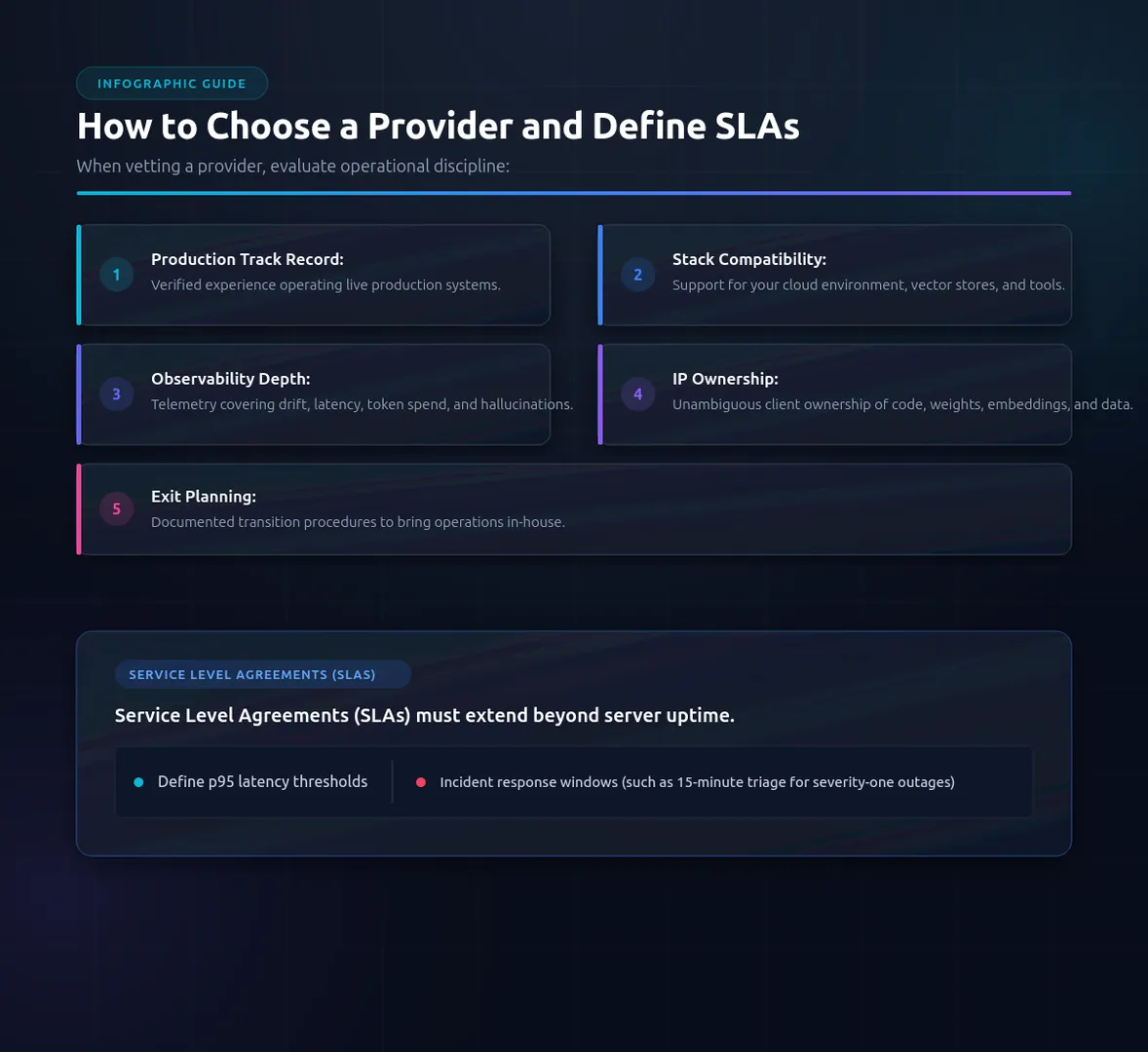
When vetting a provider, evaluate operational discipline:
- Production Track Record: Verified experience operating live production systems.
- Stack Compatibility: Support for your cloud environment, vector stores, and tools.
- Observability Depth: Telemetry covering drift, latency, token spend, and hallucinations.
- IP Ownership: Unambiguous client ownership of code, weights, embeddings, and data.
- Exit Planning: Documented transition procedures to bring operations in-house.
Service Level Agreements (SLAs) must extend beyond server uptime. Define p95 latency thresholds, incident response windows (such as 15-minute triage for severity-one outages), and drift review cadences. Agree on task-specific metrics rather than broad accuracy guarantees.
Common Challenges and Risks of Managed AI Services
- Vendor Lock-In: Mandate containerized workloads, portable data formats, and infrastructure as code.
- Ambiguous Responsibilities: Establish a RACI matrix detailing data ownership, prompt approvals, and infrastructure.
- Data Security Risks: Enforce dedicated VPCs, private endpoints, and zero-retention vendor agreements.
- Uncontrolled Cost Creep: Implement automated spend alerts, query caching, and hard token limits.
Frequently Asked Questions About Managed AI Services
What are managed AI services?
Ongoing operational management, monitoring, security, and maintenance for production AI applications.
What does a managed AI service provider do?
Monitors model performance, manages cloud infrastructure, maintains data pipelines, enforces guardrails, and resolves incidents.
How do managed AI services differ from AI consulting?
Consulting provides strategic roadmaps. Managed services deliver continuous operational execution and maintenance.
Are managed AI services practical for mid-market businesses?
Yes. Mid-market companies use them to operate AI workloads reliably without staffing dedicated MLOps teams.
What is included in a typical managed AI service contract?
Infrastructure uptime, model drift monitoring, pipeline maintenance, security patching, incident support, and cost governance.
How are managed AI services priced?
Fixed monthly management retainers, tiered per-workload fees, or hybrid agreements.
How do providers keep enterprise data secure?
Isolated cloud VPCs, role-based access, automated data redaction, and zero-retention API configurations.
How does managed AI differ from AI as a Service (AIaaS)?
AIaaS provides raw model APIs. Managed services provide engineers who monitor, maintain, and operate the system.
Who owns the intellectual property and data in a managed engagement?
The client retains complete ownership of proprietary data, custom embeddings, fine-tuned weights, code, and logic.
Does a business still need an internal technical team?
Yes. Internal leaders must establish business priorities, manage data permissions, set risk tolerances, and oversee vendors.
Conclusion
Deploying an AI system is only the starting line. Long-term reliability requires continuous monitoring, pipeline maintenance, and active governance. Choosing managed AI services protects application quality, controls expenses, and keeps internal engineers focused on core product goals.
If your organization is building custom AI applications or integrating models into existing enterprise software, HyScaler develops production-ready architectures engineered for reliable operation. Contact our engineering team to discuss your requirements.