

Table of Contents
The way businesses build, connect, and scale digital products has changed dramatically. APIs are no longer just technical utilities; they are the foundation of modern enterprise architecture. Organisations today are treating API management as a strategic priority, not an afterthought. Whether you are running microservices, building developer-facing products, or integrating cloud systems at scale, having the right platform determines how well your APIs perform, remain secure, and scale.
This blog covers what it means in practice, the key features to look for, and the top tools engineering teams are choosing right now.
What Is API Management?
API management refers to the process of designing, publishing, securing, monitoring, and governing APIs across their full lifecycle. A platform sits between your backend services and the consumers of your API, whether internal teams, third-party developers, or automated systems.
At its core, it involves:
- API gateway: the runtime layer that routes requests, enforces authentication, and controls traffic
- Developer portal: where developers discover, test, and onboard to your APIs
- API lifecycle management: from design and version control to deprecation
- API analytics: real-time dashboards tracking usage, error rates, latency, and consumer behaviour
- API governance: enforcing policies, compliance rules, and security standards across all endpoints
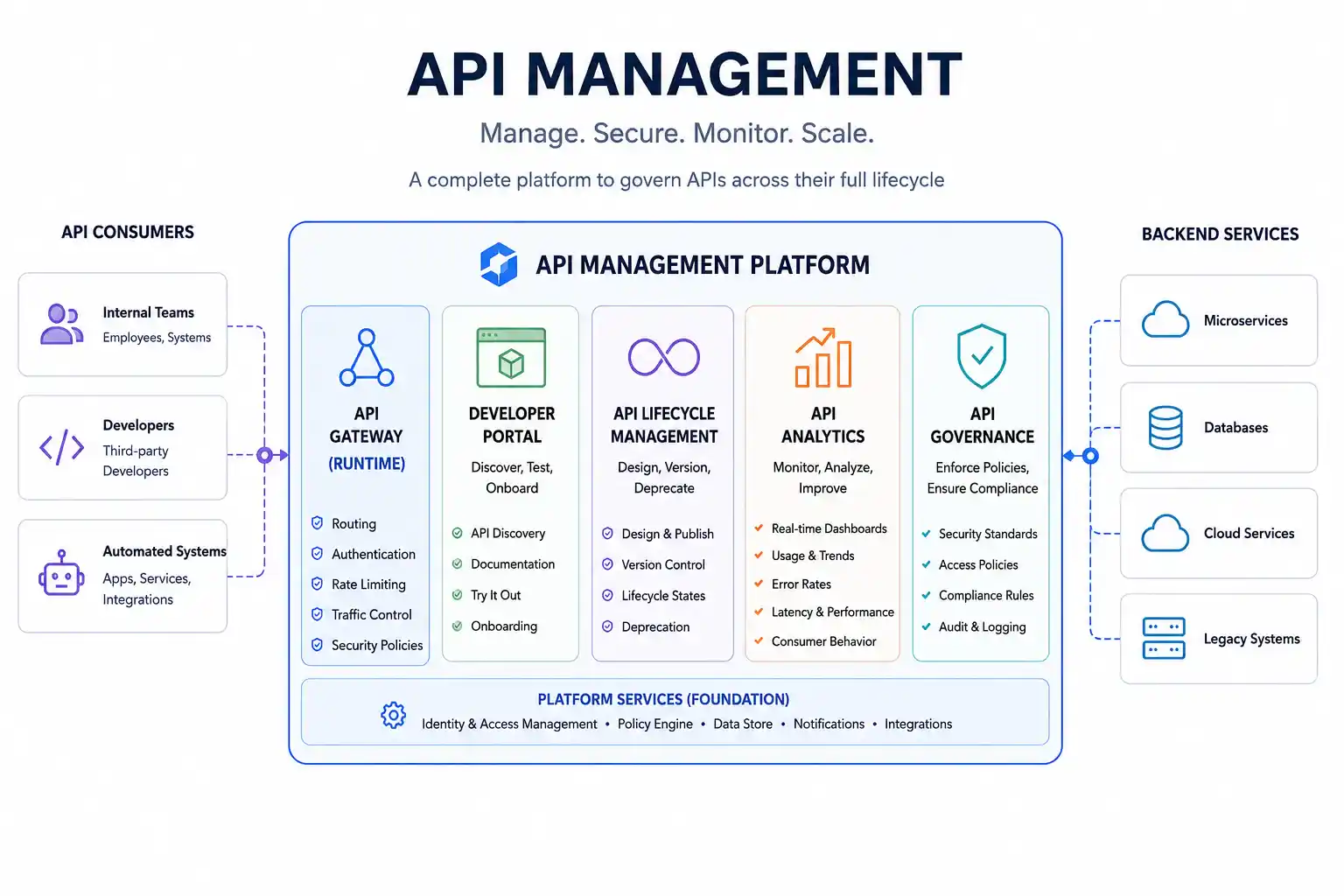
A common point of confusion is the difference between an API gateway and a full API management platform. A gateway handles runtime traffic, routing, rate limiting, and authentication. The broader platform includes the gateway, the developer portal, lifecycle tooling, and an observability layer. Think of the gateway as one module inside a complete solution.
Why API Management Matters
The numbers paint a clear picture of why API management has moved from a developer concern to a boardroom priority:
- 66% of organisations now manage more than 100 APIs, up from 59% the previous year. (Resource: Salt Security)
- 94% of firms experienced at least one API security incident in the past year. (Resource: Noname Security)
- 80% of API traffic is now driven by non-human actors, AI agents, IoT devices, and automated workflows. (Resource: TBlocks)
- 58% of businesses use API gateways to streamline microservices communication. (Resource: Global Growth Insights)
- 52% of deployments are now integrated with CI/CD pipelines. (Resource: Global Growth Insights)
The shift to cloud-native architectures, AI-driven services, and partner ecosystem expansion means organisations need solutions that handle governance, security, observability, and monetisation, not just routing.
Key Features of an API Management Platform
When evaluating tools, these are the capabilities that matter most:
Security and zero-trust enforcement: Token-based authentication, OAuth 2.0, and role-based access control are table stakes. Leading platforms now support zero-trust models with policy enforcement at every layer.
Rate limiting and throttling: Protecting backend services from traffic spikes and abuse through configurable limits per consumer, plan, or endpoint.
Developer portal and onboarding: A self-service portal where developers can explore documentation, generate API keys, and test endpoints. A strong developer portal significantly reduces onboarding friction and accelerates adoption.
Real-time API analytics: Usage dashboards, error tracking, latency monitoring, and consumer-level reporting that tie performance directly to business outcomes.
Multi-cloud and hybrid deployment: The best tools support deployment across AWS, Azure, GCP, and on-premises environments from a single control plane, giving teams flexibility without vendor lock-in.
AI-enhanced observability: Platforms are increasingly integrating machine learning into their analytics layer to detect anomalies, predict traffic issues, and surface actionable insights in real time.
Top API Management Tools
Here is a breakdown of the leading platforms’ engineering and platform teams are choosing, with a structured view of each tool’s strengths, best-fit use case, and pricing.
1. Google Apigee
| Area | Details |
|---|---|
| Best for | Large enterprises needing deep analytics and governance |
| Deployment | Cloud (Apigee X on GCP), Hybrid (Kubernetes AKS, EKS) |
| Key strengths | Built-in monetisation, business-level analytics, mature governance |
| Pricing | Starts at $500/month (Standard tier) |
| Consideration | Verbose XML-based policy configuration; slower deployment cycles |
Apigee is the most feature-complete enterprise API management platform available. It offers deep analytics, built-in monetisation, and comprehensive governance tools that go beyond what most other platforms provide. Apigee X runs entirely on Google Cloud, while Apigee Hybrid allows the API runtime to run on Kubernetes clusters, including AKS and EKS, while keeping the management control plane on GCP. For organisations with mature API programmes that need business-level visibility and multi-tier monetisation, Apigee remains the benchmark.
2. Kong Gateway / Kong Konnect
| Area | Details |
|---|---|
| Best for | Kubernetes-native teams needing high performance and extensibility |
| Deployment | Self-hosted (OSS), Managed (Konnect cloud) |
| Key strengths | Low latency (~1–2ms), vast plugin ecosystem, RBAC, GitOps-friendly |
| Pricing | OSS free; Konnect Enterprise ~$48,000/year |
| Consideration | Requires PostgreSQL and Kubernetes ops expertise for self-hosted setups |
Kong is one of the most widely deployed API management solutions in the Kubernetes ecosystem. The open-source edition is production-ready, while Kong Konnect adds a managed control plane, RBAC, audit logging, and enterprise support. Its Lua-based plugin architecture gives platform teams extensive customisation capability, from authentication to request transformation. For teams that prioritise low-latency performance and plugin extensibility, Kong is the natural starting point.
3. MuleSoft Anypoint Platform
| Area | Details |
|---|---|
| Best for | Enterprises with complex system integration requirements |
| Deployment | CloudHub (managed), Runtime Fabric (Kubernetes), Hybrid |
| Key strengths | 400+ pre-built connectors, API-led connectivity model, Salesforce integration |
| Pricing | Enterprise contract (typically six figures annually) |
| Consideration | Steep learning curve; cost requires active governance to manage |
MuleSoft combines iPaaS integration with full API management, making it the natural choice for enterprises connecting Salesforce, SAP, Oracle, Workday, and legacy systems. Its API-led connectivity model promotes reusable integration layers, system APIs, process APIs, and experience APIs that accelerate delivery across distributed teams. MuleSoft Anypoint Exchange acts as an internal API marketplace where teams discover and reuse integration assets. For integration-heavy enterprises already within the Salesforce ecosystem, Anypoint Platform is purpose-built for the scale and complexity they face.
4. AWS API Gateway
| Area | Details |
|---|---|
| Best for | Teams building natively on AWS |
| Deployment | Fully managed on AWS |
| Key strengths | Seamless Lambda, DynamoDB, IAM, and CloudWatch integration; auto-scaling |
| Pricing | Pay-per-call ($1–3.50 per million requests) |
| Consideration | Region-bound; lacks a full developer portal and multi-cloud capabilities |
AWS API Gateway is the default API management tool for teams already building within the AWS ecosystem. It integrates seamlessly with Lambda for serverless backends, CloudWatch for monitoring, and IAM for fine-grained access control, making it easy to build secure, event-driven architectures with minimal configuration overhead. It scales automatically and requires no infrastructure to manage. Teams operating exclusively on AWS will find it the most operationally efficient choice, though those with multi-cloud requirements should evaluate more portable alternatives.
5. Azure API Management (APIM)
| Area | Details |
|---|---|
| Best for | Microsoft-first enterprise teams |
| Deployment | XML policy configuration: the developer portal is weaker than Apigee |
| Key strengths | Native Entra ID, Azure Functions, Logic Apps integration |
| Pricing | Developer tier free; production tiers from ~$140/month |
| Consideration | XML policy configuration: the developer portal is weaker than Apigee |
Azure APIM is the go-to platform for organisations standardised on Microsoft infrastructure. It integrates natively with Entra ID for identity management, Azure Functions for serverless backends, and Logic Apps for workflow automation. While the developer portal lags behind more developer-focused tools, it provides strong security and governance capabilities that fit naturally into enterprise Microsoft environments. Teams with Azure as their primary cloud will benefit from its tight ecosystem integration and consolidated billing.
6. Tyk
| Area | Details |
|---|---|
| Best for | Mid-market teams needing a full stack without enterprise pricing |
| Deployment | Self-hosted (OSS), Tyk Cloud (managed), Hybrid |
| Key strengths | Native GraphQL support, Go-based performance, full open-source stack |
| Pricing | OSS free; Cloud plans from ~$500/month |
| Consideration | Smaller ecosystem compared to Kong and Apigee |
Tyk offers a complete API management stack, gateway, dashboard, developer portal, and analytics, available in both open-source and commercial editions. Written in Go, it handles high concurrency efficiently with a low memory footprint, performing well on modest infrastructure. Native GraphQL support at the gateway level, including schema stitching and federation, makes it a strong choice for teams building GraphQL-first APIs. For organisations that need more than a gateway but cannot justify Apigee or MuleSoft pricing, Tyk hits a compelling middle ground.
API Security Best Practices
Security is the fastest-growing application segment within API management platforms. With roughly 80% of attacks happening over authenticated APIs, security cannot be bolted on after the fact; it must be built into the architecture from the start. Teams should enforce the following:
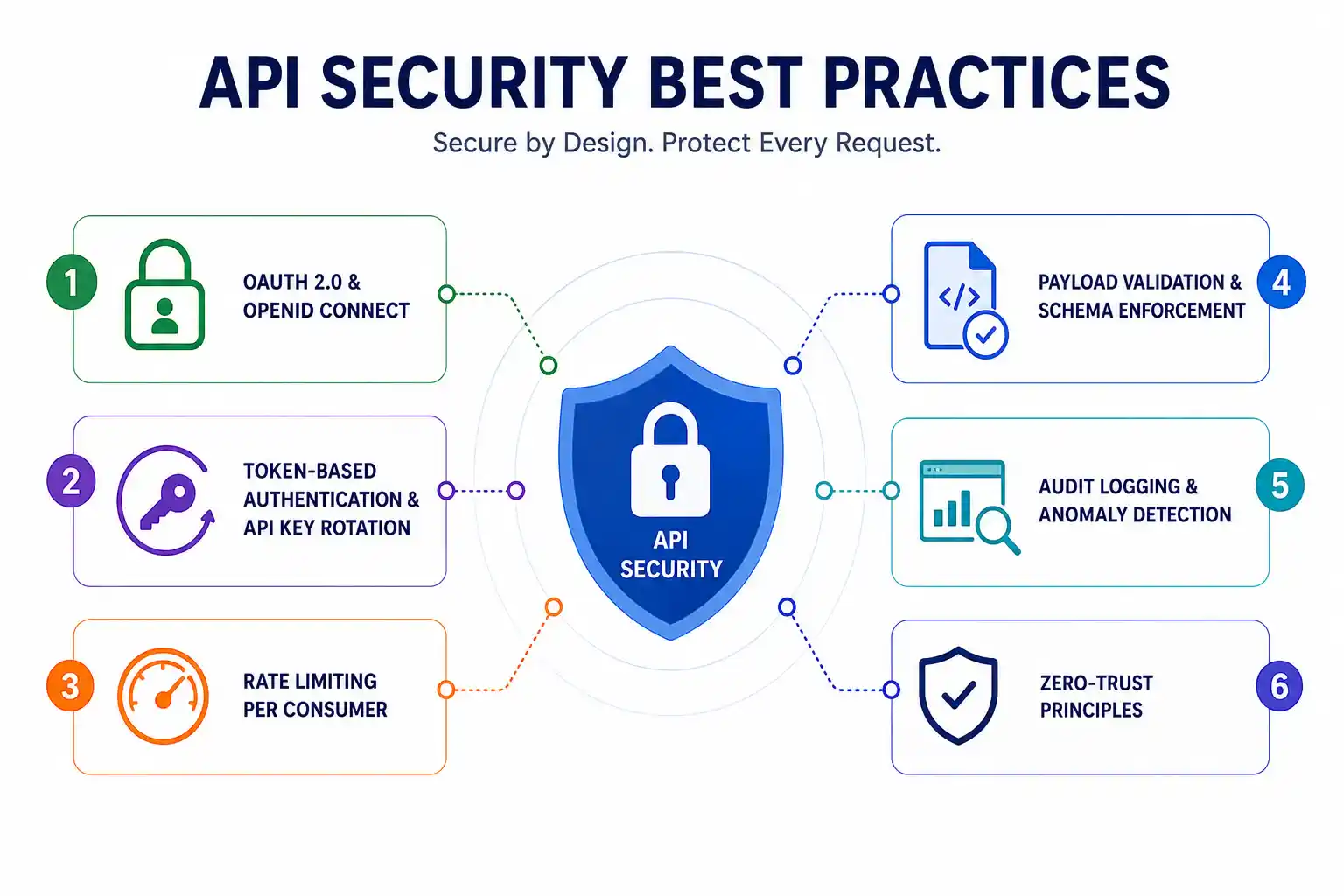
- OAuth 2.0 and OpenID Connect for identity and access
- Token-based authentication and API key rotation policies
- Rate limiting per consumer to prevent abuse and enumeration attacks
- Payload validation and schema enforcement at the gateway level
- Audit logging and anomaly detection through the analytics layer
- Zero-trust principles ensure every request is verified regardless of origin
Conclusion
API management is no longer optional for any organisation operating at scale. With APIs proliferating across cloud environments, AI systems, and partner ecosystems, the right platform gives engineering teams the governance, security, and observability they need to move fast without breaking things.
The landscape is also evolving rapidly. With the majority of API traffic now driven by non-human actors, AI agents, IoT devices, and automated workflows, platforms are adding capabilities like AI gateway routing, semantic caching, prompt injection protection, and Model Context Protocol (MCP) support for AI agent integration. API management is no longer just about managing developer traffic; it is becoming the central control layer for how enterprises govern all digital interactions.
Whether you are evaluating Apigee for enterprise depth, Kong for Kubernetes flexibility, MuleSoft for integration reach, or Tyk for open-source control, the best API management tool is the one that aligns with your infrastructure, team skills, and long-term strategy. Start with the use case you need to solve today, and choose a platform that gives you room to scale into tomorrow.
At HyScaler, we help businesses design and implement scalable platform architectures that support digital transformation across cloud and AI environments.
FAQ
Is Kong’s open-source version actually production-ready, or do I need to pay eventually?
OSS is production-ready but headless, with no GUI, so you manage everything via CLI/YAML, which gets painful past a handful of APIs.
Why did our Kong Konnect bill suddenly spike?
Konnect bills per gateway service plus request volume, so adding new APIs or LLM endpoint stacks costs fast, especially past the included request tier.
Should a startup self-host an API gateway or use a managed one?
Most startups are lean-managed; self-hosting looks free, but the hidden ops cost (patching, scaling, and on-call) often outweighs subscription fees.
What’s the real difference between an API gateway and full API management?
A gateway only handles runtime traffic (routing, auth, rate limits); full API management adds the developer portal, lifecycle tooling, and analytics layer on top.
How painful is AWS API Gateway lock-in really?
It’s tightly coupled to Lambda/IAM/CloudWatch, so migrating off AWS later means re-architecting the API layer, not just swapping a gateway.
How do teams handle AI/LLM traffic through traditional API gateways?
It’s an emerging pain point; traditional per-service billing models charge per LLM endpoint, making AI routing disproportionately expensive on platforms built for REST traffic.