
Table of Contents
A claim rarely stalls because one decision is hard.
It stalls because a photo sits in one inbox, a repair estimate in another, and a policy lookup waits on a third system, while an adjuster retypes the same details into the claims platform.
Multiply that by thousands of claims a month, and you get slow settlements, rising handling costs, and policyholders left waiting for updates.
AI claims processing targets that friction by combining document intelligence, predictive analytics, and workflow automation.
The technology is the easy part.
The harder questions are what to automate, how to connect AI to the systems you already run, where people must stay in the loop, and how to prove the return.
This guide covers use cases, architecture, a phased roadmap, governance, and ROI, so your team can plan with AI development services from a position of clarity.
What Is AI Claims Processing?
AI claims processing is the use of artificial intelligence, machine learning, and intelligent automation to manage insurance claims.
It helps insurers automate claim intake, extract information from documents, assess damage, detect potential fraud, prioritize cases, and support claim decisions while keeping human professionals involved in complex or sensitive cases.
In practice, that means several technologies working together.
Natural language processing reads documents and messages, computer vision analyzes photos, machine learning scores risk and severity, and automation engines move each claim to its next step.
How Does AI Claims Processing Work?
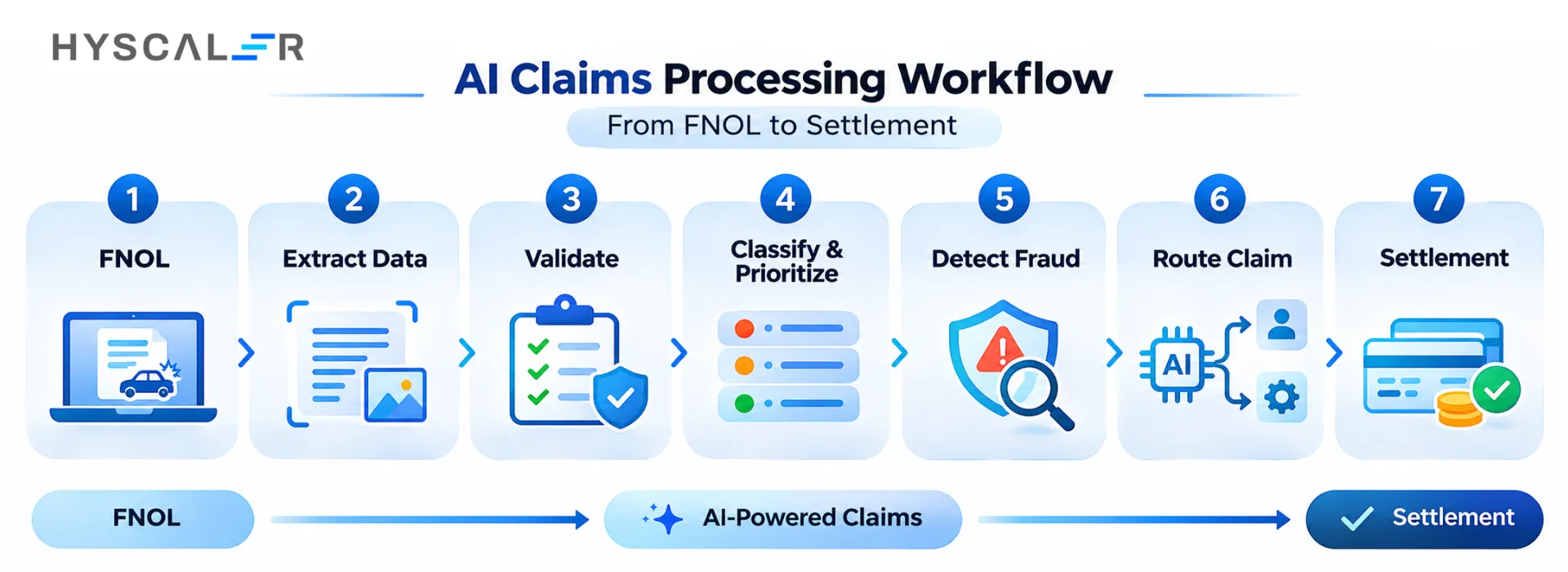
- Receive the claim through a portal, app, email, or call center.
- Extract information from forms, invoices, reports, and images.
- Validate the details against policy data.
- Classify and prioritize the claim by complexity and severity.
- Flag potential fraud or inconsistencies for review.
- Route the claim to automated handling or a human adjuster.
- Support settlement and payment workflows.
Traditional vs. AI-Powered Claims Processing
| Area | Traditional processing | AI-powered processing |
|---|---|---|
| Data entry | Mostly manual | Automated extraction |
| Document review | Employee-led | AI-assisted |
| Claim classification | Manual rules and queues | AI-supported triage |
| Fraud identification | Conventional investigation | Pattern and anomaly detection |
| Prioritization | Basic rules | Predictive risk scoring |
| Settlement | Manual evaluation | Decision support and controlled automation |
| Reporting | Periodic reports | Real-time analytics |
Where Can Insurance Companies Use AI in Claims Processing?
1. Automated First Notice of Loss (FNOL)
AI captures claims from websites, apps, email, and call centers, pulls out incident and policyholder details, flags missing information, and creates the claim record.
For an auto accident submitted with photos, the first record can exist before an adjuster opens the file.
2. Intelligent Document Processing
Claims arrive wrapped in invoices, medical records, repair estimates, and police reports.
AI-powered document processing classifies each document, extracts key fields, spots gaps or inconsistencies, and summarizes long files.
A health insurer, for example, can have a stack of medical bills organized and pre-read before a reviewer sees it.
3. AI-Powered Damage Assessment
Computer vision analyzes vehicle and property photos, identifies visible damage, and supports repair estimates using approved valuation data.
It also flags the cases that still need a physical inspection.
4. Fraud Detection and Anomaly Identification
Models look for unusual claim patterns, duplicate documents, and suspicious submissions, then give investigators a risk score.
An AI fraud alert is an investigation signal, not proof of fraud.
The Coalition Against Insurance Fraud has put the annual U.S. cost of insurance fraud at $308.6 billion, although academic critics at Rutgers dispute the methodology behind that number.
Even so, fraud is a real cost, and better triage helps investigators focus on the right files.
5. Intelligent Claims Triage
Claims are classified by complexity and severity, routed to the right adjuster, and escalated when something looks unusual or high-risk.
6. Predictive Analytics for Claims Management
Predictive models forecast claim severity and cost, support reserve estimation, anticipate processing delays, and project workload so managers can staff accordingly.
This is where predictive analytics solutions connect directly to financial planning.
7. Automated Customer Communication
Status updates, requests for missing documents, and answers to routine questions can run through chatbots and digital portals, which cuts the repetitive “where is my claim?” contacts.
AI Claims Processing Architecture: How the System Works
The difference between a pilot and a production system is architecture.
Here is how the layers fit together.
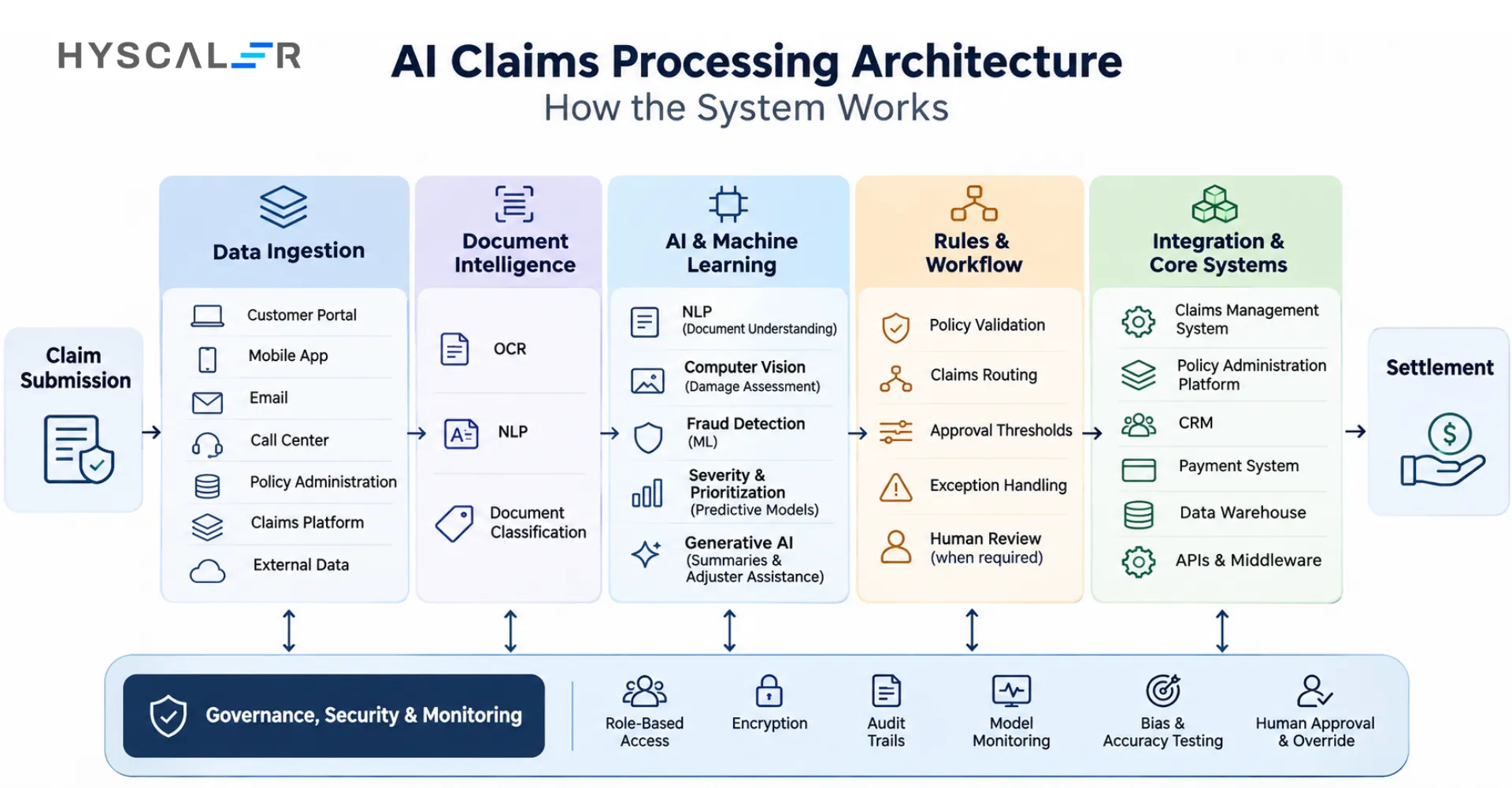
1. Data ingestion layer: Collects claims data from customer portals, mobile apps, email, call-center systems, policy administration systems, claims platforms, and external data providers.
2. Document intelligence layer: Uses OCR, NLP, and document classification to turn unstructured claim documents into structured, usable data.
3. AI and machine learning layer: Hosts the models: NLP for document understanding, computer vision for damage assessment, machine learning for fraud detection, predictive models for severity and prioritization, and generative AI for summaries and adjuster assistance.
4. Rules engine and workflow orchestration: Business rules and workflow engines coordinate policy validation, claims routing, approval thresholds, exception handling, and human review. This layer decides what happens with a model’s output.
5. Integration and core systems layer: Connects AI services to existing claims management systems, policy administration platforms, CRM software, payment systems, and data warehouses. Using APIs and middleware means insurers can add AI without replacing their core systems.
6. Governance, security, and monitoring layer: Provides role-based access, encryption, audit trails, model performance monitoring, bias and accuracy testing, and human approval and override mechanisms.
This blueprint for enterprise AI solutions fits into an existing technology estate rather than competing with it.
How to Implement AI Claims Processing in an Insurance Company
Experimentation is widespread, but scaled deployment is not.
A Deloitte survey of 200 U.S. insurance executives found that 76% had implemented generative AI in at least one business function, while fewer than half believed the benefits outweighed the risks.
Bain’s claims research found that 78% of surveyed P&C insurers use generative AI in some capacity, but only 4% have scaled it across the organization.
A staged roadmap with a concrete deliverable at each step helps close that gap.
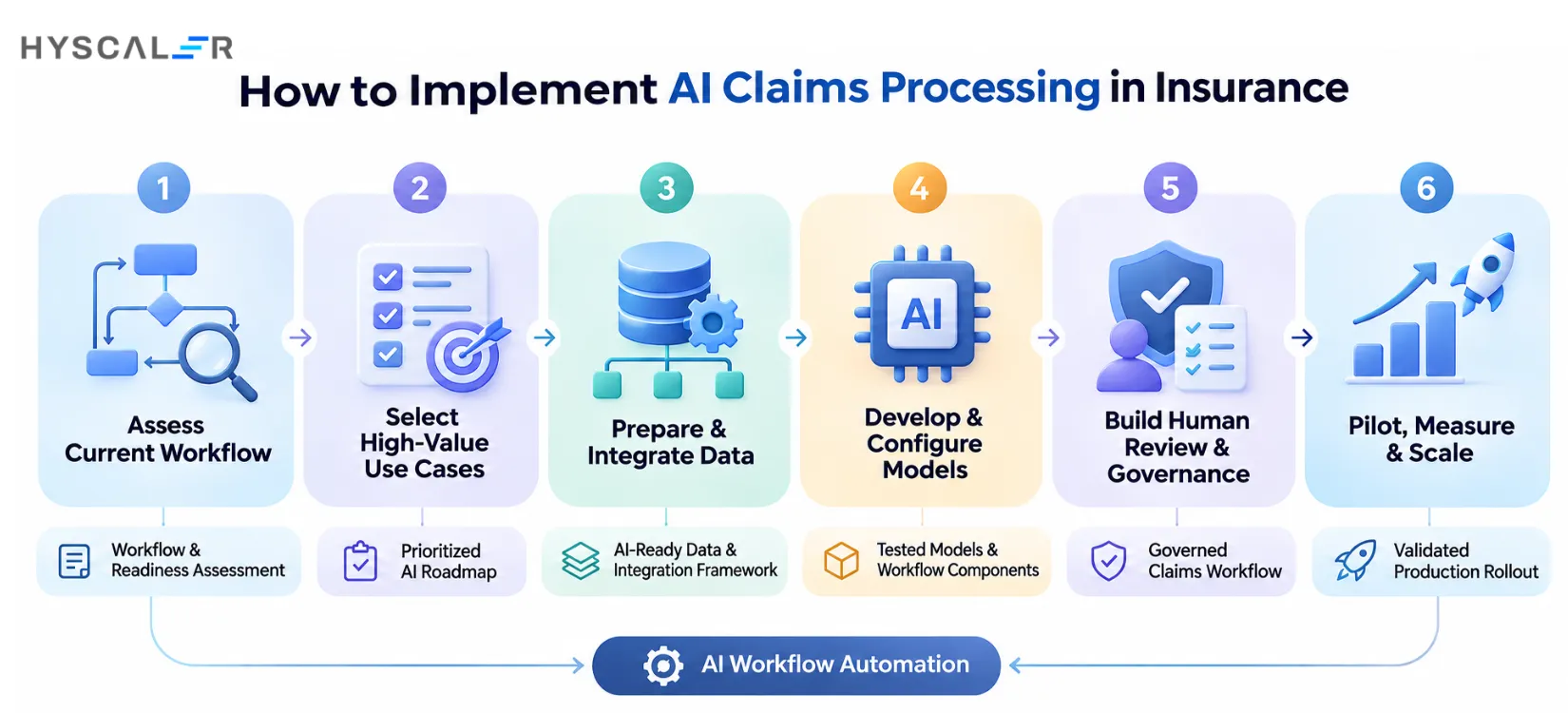
Step 1. Assess the existing claims workflow.
Map the lifecycle, identify manual bottlenecks, and review current systems and data sources.
Deliverable: workflow and automation readiness assessment.
Step 2. Select high-value use cases.
Rank candidates by claim volume, cost, complexity, data availability, and business impact. Start with document extraction, FNOL automation, or triage rather than full claims automation.
Deliverable: prioritized AI roadmap.
Step 3. Prepare and integrate claims data.
Consolidate data, standardize formats and fields, and build secure API integrations.
This step matters more than most teams expect: Deloitte’s survey identified data security, privacy, quality, and integration as the top challenges to scaling.
Deliverable: AI-ready data and integration framework.
Step 4. Develop and configure the models.
Build document intelligence, NLP, predictive, and computer vision components for the chosen use cases.
Deliverable: tested models and workflow components.
Step 5. Build in human review and governance.
Define approval thresholds, escalation paths, audit logs, validation procedures, and override mechanisms.
Deliverable: governed claims workflow.
Step 6. Pilot, measure, and scale.
Run a pilot on selected claim categories, compare results with the existing process, monitor accuracy, processing time, and exceptions, then expand.
Deliverable: validated production rollout plan.
AI workflow automation works best when it is introduced in this order: process first, models second, scale last.
Benefits of AI Claims Processing for Insurance Companies
- Faster processing – Less repetitive document review and re-keying shortens the path from notice to resolution.
- Lower administration costs – Automating high-volume tasks lets adjusters spend more time on judgment work.
- Better fraud targeting – Suspicious patterns surface earlier, so investigators focus on higher-risk files.
- Greater accuracy – Consistent extraction and validation reduce avoidable errors and rework.
- Better customer experience – Faster updates and fewer repeated information requests.
- Scalability – Claim volumes can grow without manual workload growing at the same rate.
Published estimates give a sense of scale, but treat them as directional rather than guaranteed.
An early McKinsey report estimated that automation could reduce the cost of a claims journey by as much as 30%, and McKinsey research also projected that more than half of current claims activities could be replaced by automation by 2030.
Both are forecasts, not results you should expect by default.
Bain estimates that, at scale, AI could cut home claims processing times in half and lift productivity by 35%, and notes that most carriers have not yet reached that scale.
How to Calculate the ROI of AI Claims Processing
Executives will ask whether this pays for itself.
Start by agreeing on the metrics, then measure against a baseline.
| KPI | What it measures |
|---|---|
| Average handling time | Time spent processing each claim |
| Cost per claim | Total operational cost per processed claim |
| Claims cycle time | Time from submission to resolution |
| Automation rate | Share of eligible tasks completed automatically |
| First-pass accuracy | Records processed correctly without rework |
| Fraud alert precision | Share of fraud alerts validated as meaningful |
| Adjuster productivity | Claims handled per adjuster |
ROI formula:
ROI (%) = (Annual Benefits − Annual Costs) ÷ Annual Costs × 100
Illustrative example (hypothetical assumptions, not benchmarks):
| Parameter | Assumption |
|---|---|
| Annual claims volume | 100,000 |
| Manual processing cost per claim | $20 |
| Eligible automation rate | 40% |
| Cost reduction on automated claims | 50% |
| Annual AI operating and implementation cost | $250,000 |
- Existing annual processing cost: 100,000 × $20 = $2,000,000
- Annual savings: 40,000 automated claims × $10 saved = $400,000
- Net annual benefit after AI costs: $400,000 − $250,000 = $150,000
- Illustrative ROI: $150,000 ÷ $250,000 = 60%
These numbers demonstrate the method only.
They are not industry benchmarks or promised HyScaler results, and they exclude additional benefits such as fraud savings and any implementation costs outside the assumed annual figure.
In a real analysis, include integration, infrastructure, licensing, model monitoring, and ongoing maintenance, and expect timelines to be longer than a single budget year.
Deloitte research cited by Bain suggests many insurance and financial services executives expect AI initiatives to take two to four years to deliver satisfactory returns.
Challenges of AI Claims Processing and How to Address Them
| Challenge | Recommended approach |
|---|---|
| Poor-quality claims data | Data cleansing and validation |
| Legacy system integration | API-based and middleware integration |
| AI hallucinations | Grounded outputs, source references, human verification |
| Algorithmic bias | Regular fairness testing and model validation |
| Data privacy and security | Encryption, access controls, secure data handling |
| Lack of explainability | Decision logs and traceable model outputs |
| Employee adoption | Training and human-centered workflows |
US regulation: what insurers need to know
The NAIC adopted its Model Bulletin on the Use of AI Systems by Insurers on December 4, 2023, and it expects insurers to implement and maintain a written program for responsible use of AI systems.
The bulletin is guidance, not law, and becomes enforceable only when individual states adopt it.
Adoption has been broad: one spring 2026 tracker reports 24 states plus D.C., and other counts run slightly higher, so confirm current status for the states where you write business.
Some states have gone their own way, with California, Colorado, and New York taking different approaches.
The NAIC is also developing exam tooling, with an AI Systems Evaluation Tool piloted with 12 states between March and September 2026.
For a risk management structure, the NIST AI Risk Management Framework is a practical complement.
It is organized around four functions: Govern, Map, Measure, and Manage, and it is voluntary.
In claims terms: Govern sets ownership and policy, Map defines each model’s context and use, Measure covers accuracy and bias testing, and Manage covers monitoring and response.
NIST has also published a Generative AI Profile (NIST AI 600-1, July 2024) that is relevant if you use generative AI for claim summaries.
AI Claims Processing Software vs. Custom AI Development
| Factor | Off-the-shelf software | Custom AI solution |
|---|---|---|
| Deployment | Usually faster | Requires development |
| Customization | Vendor-defined features | Business-specific workflows |
| Integration | Depends on available connectors | Designed around existing systems |
| Data control | Depends on vendor architecture | Greater architectural control |
| Scalability | Depends on product capabilities | Designed around business requirements |
| Cost structure | Licensing and usage fees | Development and operating costs |
| Best suited for | Standardized workflows | Complex or differentiated workflows |
Neither option is always right.
The best choice depends on your existing infrastructure, how much your workflows differ from the standard, your security requirements, and total cost of ownership over several years.
Many insurers end up with a hybrid: packaged software for commodity steps and custom components where their process is a competitive advantage.
How HyScaler Helps Insurance Companies Build AI-Powered Claims Solutions

HyScaler’s AI services help organizations design and build AI systems around their own workflows and technology environment.
For claims operations, that can include:
- Custom AI solutions for insurance workflows
- Intelligent document processing for claim forms and supporting records
- AI automation for repetitive claims operations
- Predictive analytics for prioritization and risk assessment
- Integration with existing enterprise applications
- Secure, scalable architecture with governance controls built in
If you are weighing build-versus-buy, or want to scope a first use case, explore HyScaler AI Services.
FAQ
Can AI fully automate insurance claims processing?
It can automate many repetitive tasks, and some low-complexity claims end-to-end. Complex coverage, liability, and settlement decisions typically still need human judgment.
How does AI detect insurance fraud?
Through anomaly detection, comparison with historical claims, duplicate detection, and risk scoring. The output is a signal for investigators, not a verdict.
What types of claims can AI process?
Auto, property, health, life, and commercial claims, though capabilities vary with data quality and workflow complexity.
How much does it cost to implement?
It depends on claim volume, integrations, model complexity, infrastructure, and governance requirements. A scoped pilot is the most reliable way to get a real number.
Will AI replace claims adjusters?
It reduces repetitive work, but people keep responsibility for complex investigations and consequential decisions. McKinsey has suggested the handler role may split into a digitally enabled customer adviser for simple claims and a complex-claim handler for cases automation cannot yet manage.
How long does implementation take?
There is no fixed answer. Timelines depend on integration complexity, data readiness, scope, and regulatory requirements.