
Table of Contents
Mid-market businesses running scattered, fragmented systems often come to AI hoping it will tie everything together, only to learn the systems need tying together first. The ERP holds finance, the CRM holds sales, marketing keeps its own tools, and a spreadsheet somewhere holds whatever the other three get wrong. None of it talks.
Mid-market AI consulting is outside help that closes that gap: choosing the problems worth solving, fixing the data and integrations that block them, and getting working systems into daily use. It differs from consulting for a small business or a large enterprise because a mid-sized company has real systems to connect and no spare team to connect them.
Why do companies need mid-market AI consulting?
Ask mid-market executives whether AI is part of the business and most say yes. In the RSM Middle Market AI Survey 2026, which heard from 827 US and 203 Canadian executives, 86% said AI is integrated into operations.
Only 36% said it is fully embedded across core processes.
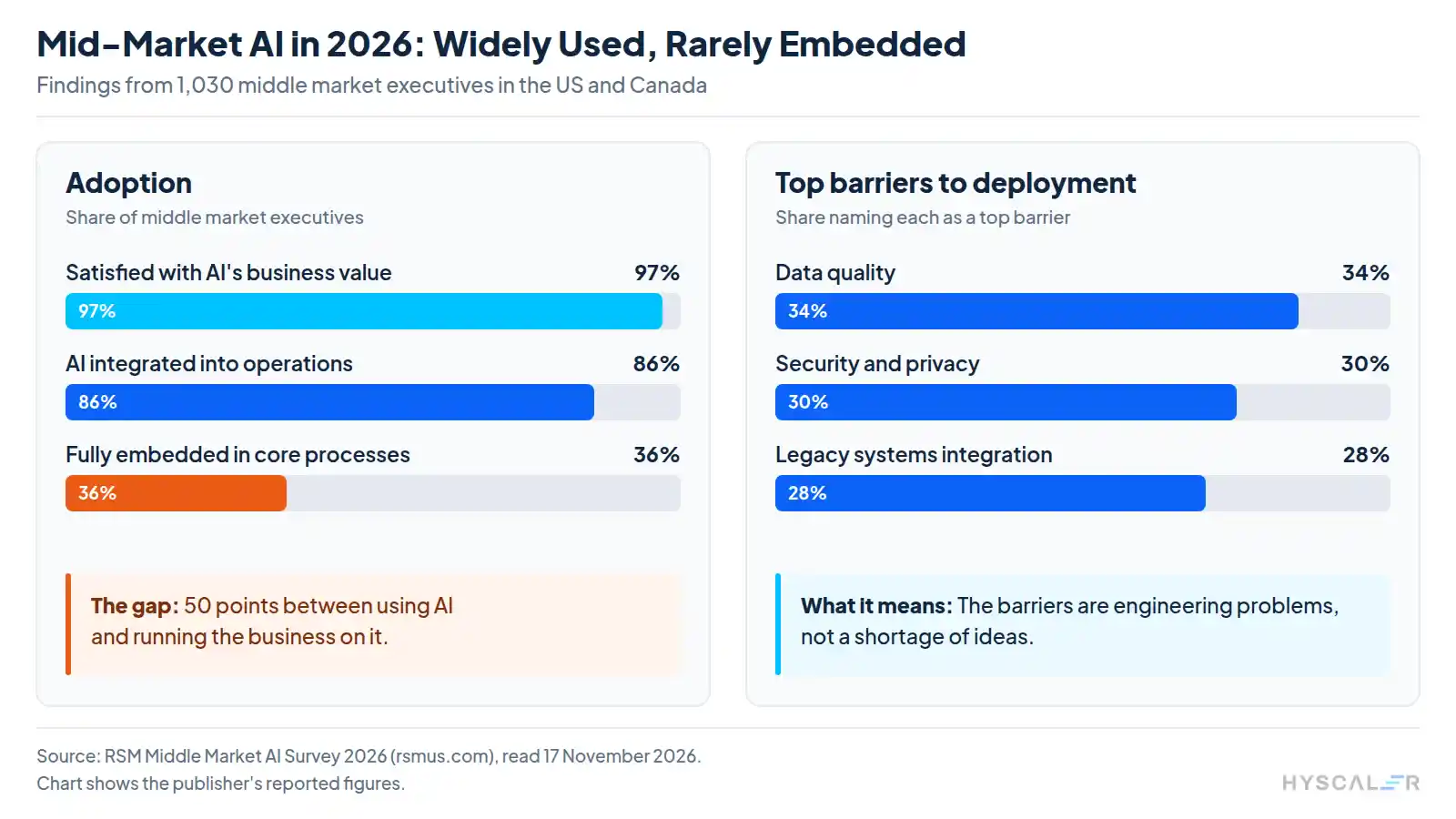
Asked what holds them back, executives gave these as their top obstacles:
| Barrier named as a top obstacle | Share of executives |
|---|---|
| Data quality | 34% |
| Security and privacy concerns | 30% |
| Legacy systems integration | 28% |
In the same survey, 97% of respondents reported satisfaction with AI’s business value, though RSM adds that many organisations are measuring early wins rather than enterprise-wide outcomes. 85% also said leadership is more enthusiastic about AI than employees are.
In our view, mid-market AI consulting starts with those barriers: data you can rely on, safe connections into older systems, and staff who believe the output.
How is mid-market AI consulting different from small business or enterprise consulting?
Nobody agrees on a single definition of the middle market, so this article uses a working one: a company with established systems such as NetSuite, Microsoft Dynamics 365 or SAP Business One for finance, Salesforce or HubSpot for sales, several departments, and an IT team too small to take on a new programme alone. On that definition, mid-market AI consulting is mostly integration and delivery. A small business needs help choosing tools, and an enterprise needs governance across many projects. The table below is our own comparison.
| Small business | Mid-market | Large enterprise | |
|---|---|---|---|
| Starting point | Few systems, little data | ERP, CRM and years of data, unevenly kept | Many systems, dedicated data teams |
| Main need | Pick and set up tools | Connect AI to core systems and prove value | Govern many projects at once |
| Who does the work | Owner and one adviser | A small outside team beside your own staff | Internal teams plus large firms |
| Biggest risk | Paying for tools nobody uses | Pilots that never reach production | Programmes that outrun their controls |
If you run a smaller firm, our guide to AI consulting for small business is the better fit.
What should an AI consultant deliver?
In mid-market AI consulting, the short list is a working system in production, a way to measure it, and something you own at the end of every stage, whether that is a documented integration, a trained team or a report somebody actually opens on Monday morning. A strategy deck on its own does not make the list.
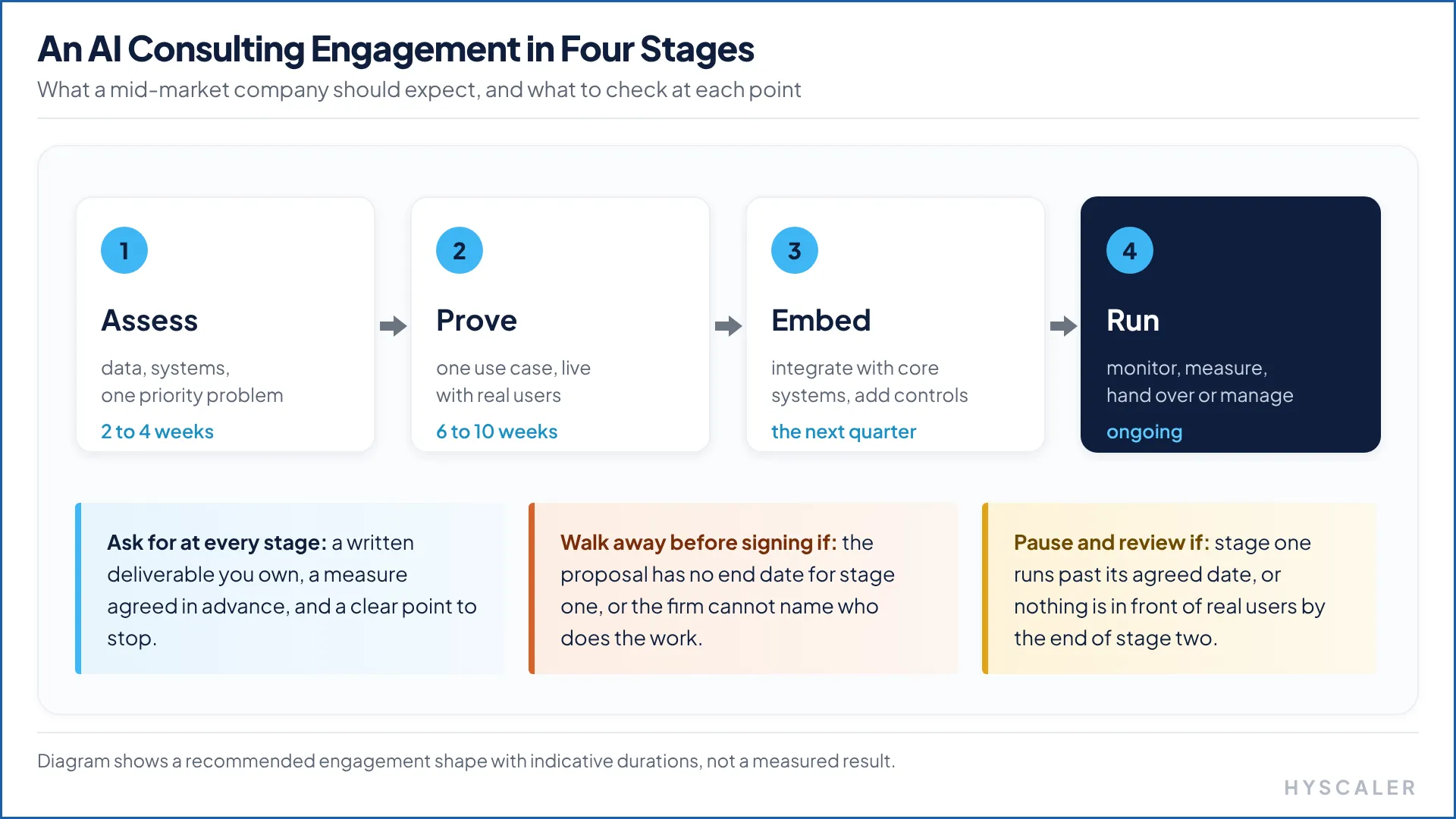
We split a mid-market AI consulting engagement into four stages. The timings are our recommendation. Assess takes two to four weeks: a review of your data, systems and processes that ends in one priority problem, a written plan and a success measure agreed in advance. Prove takes six to ten weeks and puts one use case live with real users and real data, rather than a demonstration on samples.
Embed fills the following quarter with integration into your core systems, access controls, monitoring and training for the people who use it. Run is ongoing, either handed over to your team or kept as a managed arrangement with regular reporting against the agreed measure.
Whatever the stage, ask for the same three things. A written deliverable you keep. A measure agreed before work starts. A point where you can walk away. Small, finished jobs tend to beat a grand programme, a case we make in our article on AI transformation for mid-sized companies.
How do AI consultants charge?
Four pricing models are in common use, and each rewards a different behaviour.
| Model | How it works | Suits | Watch for |
|---|---|---|---|
| Fixed-price assessment | One fee for a defined review and plan | The first stage | A plan with no build attached |
| Fixed-price pilot | One fee for one working use case | The prove stage | Scope that is vague about what “working” means |
| Time and materials | Hourly or daily rates for a team | Integration work with unknowns | No cap and no milestones |
| Retainer or managed service | A monthly fee to run and improve systems | The run stage | Paying for availability, not outcomes |
We have left mid-market AI consulting rates out. The rate guides we found online mostly come from firms that sell the work, and their figures differ widely. Ask each firm for a fixed price on the first two stages instead. A firm that cannot price an assessment and a single pilot deserves a few more questions. Vague answers there tell you plenty. For more on fees, see our guide to AI strategy consultant services, costs and benefits.
What questions should you ask a mid-market AI consulting firm?
Who will do the work? You should get names and roles on the first call. What have you put into production for a company our size? The best answer is a system that is still running, described in detail. We would trust a firm that can say what went wrong with it more than one that cannot.
Data and legacy systems both sit in the survey’s top three obstacles, so press on them. How will you deal with our data quality? A data review before any model work is what you want to hear. How do you integrate with our ERP and CRM? Look for the existing APIs of systems such as NetSuite or Salesforce, your own permissions, and your IT team involved from the start.
On ownership, the code, prompts, documentation and data should all be yours, so ask what will we own at the end? and get the answer into the contract. For results, ask how will we measure success? and expect one business measure, agreed in writing before the build starts.
Data handling needs a direct answer: what happens to our data? Where it is stored, who can see it and whether any model is trained on it should all be spelled out. The same goes for which models and vendors do you use, and why? A reasoned choice, with a way to change it later, is what to listen for.
The last two are about life after launch. How do you bring our staff along? Real training and a named owner inside your business are the minimum. What does it cost to run after you leave? Ask for a monthly estimate covering usage, hosting and support.
What are the red flags?
Walk away from any firm that cannot put an end date on the first stage. An assessment that drifts past a month with no finish line is more likely a sales process than a project. By our rule of thumb, a plan with nothing live by month four is in trouble too, because momentum and budget tend to run out before the first system does.
Be wary when a partner does the selling, juniors do the work and nobody is named, and be wary of anyone who quotes a return before they have seen your data, because a figure offered in the first meeting is a guess whatever the slide says. And ask who owns the code and the prompts. If the answer is the firm, you are renting your own process.
Should you hire a consultant, build a team, or use a managed service?
Timing decides most of this. A consultant gets the first systems into production quickly and is the right call while you are still learning what works. An in-house team makes sense once AI sits at the centre of the product or the operation and you can keep specialists busy.
A managed service suits a company that wants results without hiring, and we cover it in our guide to managed AI services.
Mid-market AI consulting can use all three in turn: a consultant to start, an in-house team to keep it going, a managed service for what you would rather not staff. If you are comparing firms, our list of the best AI consulting companies in the USA is a starting point.
How HyScaler helps with mid-market AI consulting
For mid-market AI consulting, we act as the small outside team beside your own staff: we assess, build one use case into production, then connect it to the systems you already run.
Several parts of our work apply here. The AI services and solutions team covers assessment through to production. AI-powered automation takes on repetitive processes that slow teams down, anqd retrieval-augmented generation solutions put answers from your own documents and data in front of staff. Our data engineering services address the barrier the survey ranks highest, and digital transformation services fit when AI is one part of a larger modernisation.
Bring the ten questions to a call with us and score our answers. Talk to our AI team.
Frequently asked questions
What is mid-market AI consulting?
It is outside expertise that helps a mid-sized business choose where to apply AI, prepare its data and systems, and put working AI into daily operations.
How long does a mid-market AI consulting engagement take?
A first working use case should be live within about three months. In our plan, embedding it across core systems takes a further quarter.
What is the biggest barrier to AI in the middle market?
Data quality, according to the RSM survey. Security and privacy concerns and legacy systems integration come next.
Do mid-market companies need an AI strategy before starting?
They need a short one. A two-to-four-week assessment that picks one problem and one measure is enough to begin. A long strategy exercise delays the learning that only a live system gives you.
What do AI development services include for a mid-sized company?
In our plan, an assessment of your data and systems, one use case built and live with real users, and integration with your ERP and CRM through their existing APIs, followed by monitoring and support.
Can a mid-market AI consulting firm work with our existing ERP and CRM?
Yes, and they should. AI that sits outside your core systems stays a side project. Ask how the firm will connect through your existing APIs and permissions.
How should AI agents be governed and tested before they go live?
Agree the success measure first, test the agent on real data with real users, and put access controls and monitoring in place before it reaches production. Ask the firm who is accountable once it is live.
Sources
- RSM US, RSM Middle Market AI Survey 2026, published 21 July 2026, key findings read 20 November 2026