

Table of Contents
Most businesses don’t struggle with a lack of AI ideas.
They struggle with too many of them, no shared agreement on which ones matter, and no reliable way to turn a promising pilot into something that runs in production.
Leadership sees dozens of possible use cases on a slide, a handful of proofs-of-concept that impressed a room once, and very little that has actually changed how the business operates.
This is the gap an AI strategy consultant is hired to close: which AI initiatives are worth prioritizing, where AI can generate measurable ROI, what technology and data foundations are actually required, and how to move from experimentation to something running in production.
This guide covers what an AI strategy consultant does, the services they typically provide, when it makes sense to hire one, what it costs in 2026, how to evaluate a consultant, and which firms are frequently mentioned as leaders in this space.
What is an AI strategy consultant? An AI strategy consultant helps organizations identify high-value AI opportunities, prioritize use cases against feasibility and risk, assess data and technology readiness, define governance, and build a practical roadmap for implementing and scaling AI.
What Is an AI Strategy Consultant?
An AI strategy consultant is a specialist – an individual, boutique firm, or practice inside a larger consultancy – who helps a business figure out where AI creates value and how to pursue it responsibly, before (or alongside) any actual building.
In practical terms, that means helping a business work out:
- Where AI can create measurable business value
- Which AI use cases deserve investment first
- What data and technology foundations are needed to support them
- Which AI tools, models, or platforms are the right fit
- How AI initiatives should be implemented and scaled
- How AI risk and governance should be managed
- How to measure ROI once something is live
AI Strategy Consultant vs. AI Consultant
The two titles are often used interchangeably, but the scope tends to differ.
| AI Strategy Consultant | AI Consultant (general) | |
|---|---|---|
| Scope | Business-wide: priorities, roadmap, governance | Often narrower: a specific tool, model, or project |
| Business strategy | Central focus | Secondary, if present at all |
| Technology recommendations | High-level, vendor-agnostic | Frequently tied to a specific stack |
| Implementation involvement | Advisory, sometimes hands-on | Usually hands-on |
| Typical deliverables | Roadmap, use-case portfolio, governance framework | Working prototype, integration, configured tool |
| Best use case | Deciding what to do and why | Executing a defined technical task |
AI Strategy Consultant vs. AI Implementation Company
This is the distinction that trips up the most buyers.
A strategy consultant helps you decide what to build and why it matters to the business.
An implementation company (or the implementation arm of a broader firm) builds and deploys it.
Some firms genuinely do both under one roof; many don’t, which is exactly why the “strategy consultant vs. implementation company” question comes up so often later in this guide.
What Does an AI Strategy Consultant Do?
Strip away the buzzwords, and the work breaks down into a handful of concrete activities businesses actually pay for.
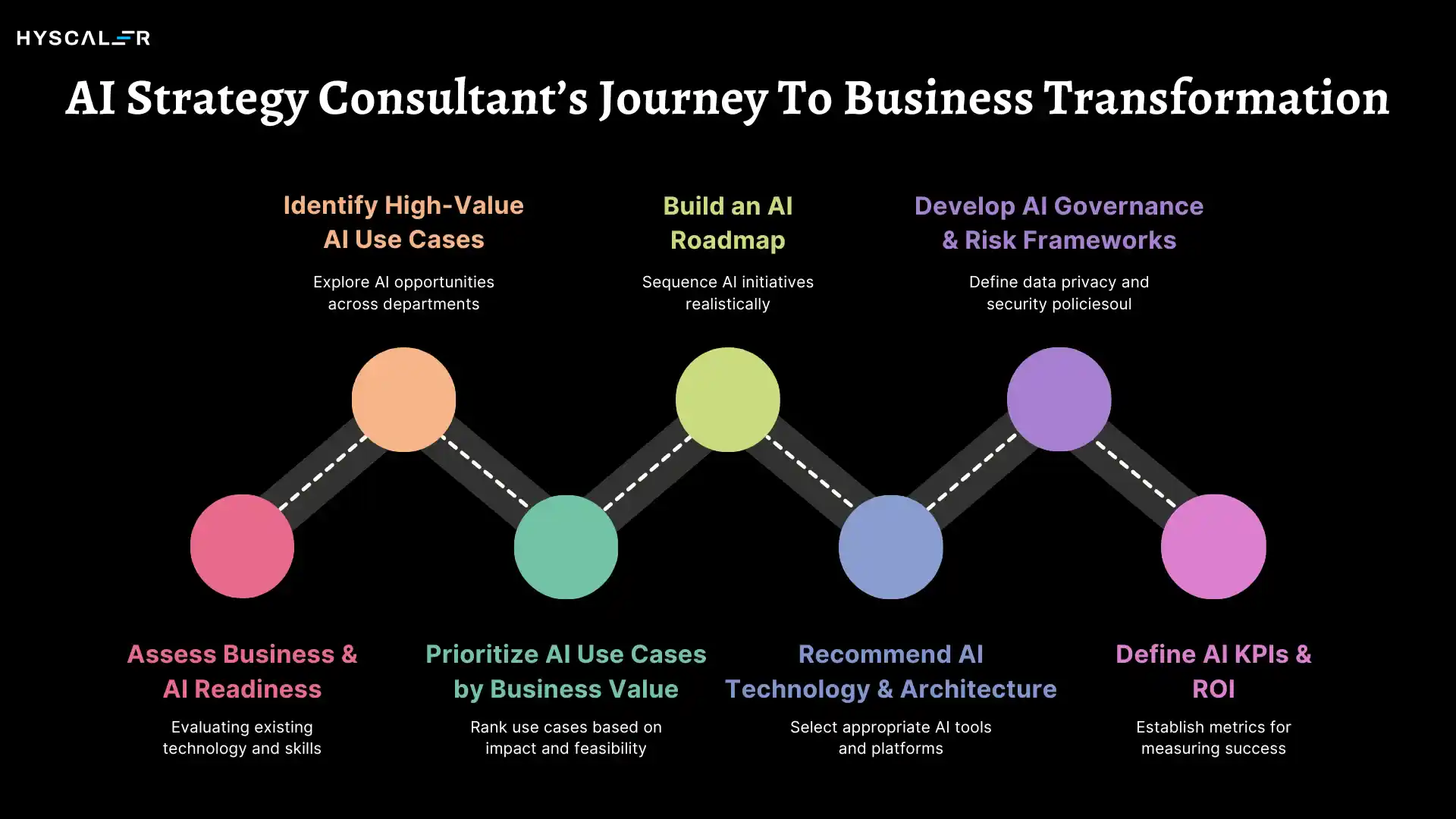
Assess Business and AI Readiness
Before recommending anything, a consultant should look honestly at what’s already in place: existing technology, data maturity, in-house AI skills, infrastructure, current business processes, and how ready the organization actually is to change how it works, not just whether it can buy a tool.
Identify High-Value AI Use Cases
Good consultants look across the whole business, not just IT, for opportunities; customer service, operations, marketing, sales, finance, HR, product development, and analytics all tend to surface distinct AI use cases with very different payback timelines.
Prioritize AI Use Cases by Business Value
Rather than chasing every idea at once, the strongest engagements apply a simple, repeatable framework:
Business impact × Feasibility × AI readiness × Risk
Use cases that score well across all four dimensions get built first. Everything else waits, gets simplified, or gets dropped.
Build an AI Roadmap
A roadmap sequences work realistically instead of promising everything at once, typically broken into 30-day priorities, 90-day initiatives, a 6–12 month plan, and a longer-term transformation horizon.
Recommend AI Technology and Architecture
This covers the technical decisions behind the strategy: large and small language models, generative AI, AI agents, retrieval-augmented generation (RAG), cloud AI platforms, APIs, data platforms, and where custom-built AI makes more sense than an off-the-shelf tool.
Develop AI Governance and Risk Frameworks
Data privacy, security, regulatory compliance, responsible AI practices, model risk, human oversight, and access control all need to be defined before, not after, an AI system touches real customers or real decisions.
Define AI KPIs and ROI
The best consultants tie AI initiatives to metrics the business already tracks, rather than vanity numbers like “models trained” or “pilots launched.”
AI Strategy Consulting Services
Most firms package this work into some combination of the following:
- AI readiness assessment – a structured look at your data, technology, and organizational maturity
- AI opportunity assessment – surfacing where AI could plausibly create value
- AI strategy development – the overarching plan connecting AI investment to business goals
- AI roadmap development – sequencing initiatives over time
- AI use-case prioritization – scoring and ranking opportunities
- Generative AI strategy – a strategy specific to LLMs and generative tools
- AI agent strategy – planning for autonomous or semi-autonomous agents inside your workflows
- AI governance consulting – risk, compliance, and oversight frameworks
- AI transformation consulting – broader organizational and operating-model change
- AI technology and vendor selection – choosing platforms, models, and partners
- AI implementation advisory – guidance (or direct support) through the build phase
Later in this guide, we’ll look at how HyScaler approaches this, with a bias toward getting one real workflow into production rather than producing a strategy document that sits in a drive folder.
Why Does Your Business Need an AI Strategy Consultant?
The value isn’t the technology recommendation; it’s the discipline around it.
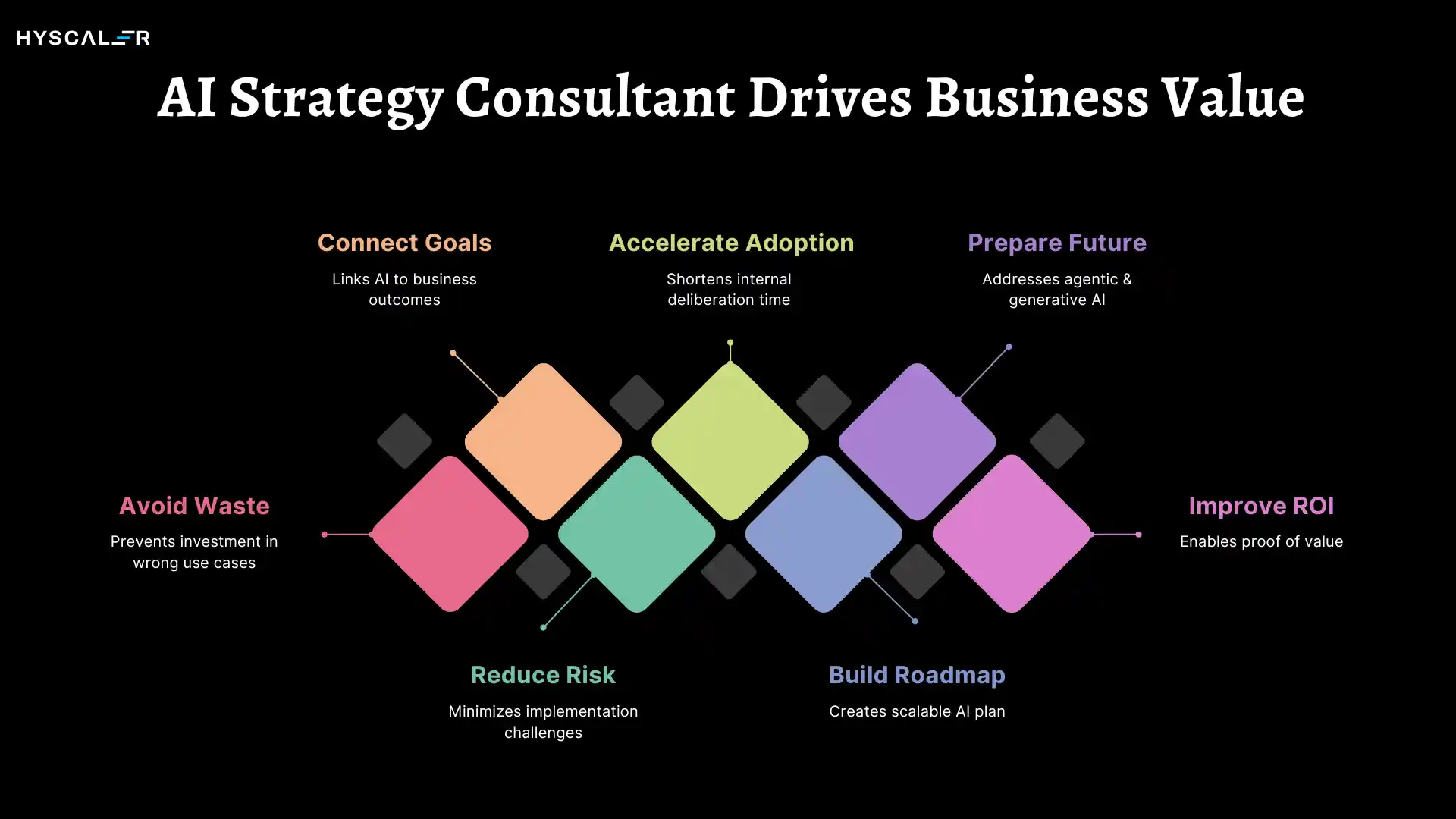
- Avoid investing in the wrong AI use cases. A structured assessment prevents budget from going toward ideas that look exciting but don’t move a real metric.
- Connect AI investments to business goals. Every initiative should trace back to a business outcome, not a technology trend.
- Reduce AI implementation risks. Governance and readiness work done up front avoids expensive rework or compliance exposure later.
- Accelerate AI adoption. An outside perspective with pattern recognition across other engagements can shortcut months of internal deliberation.
- Build a scalable AI roadmap. One workflow done well should make the second and third easier, not harder.
- Prepare for agentic and generative AI. These categories carry different risk and integration considerations than earlier “traditional AI” projects.
- Improve AI ROI. Clear KPIs, defined up front, make it possible to actually prove, or disprove, the value of an initiative.
When Should You Hire an AI Strategy Consultant?
Consider bringing one in when:
- Your organization has multiple competing AI ideas and no shared way to compare them
- AI pilots keep launching but never make it into production
- Leadership can’t agree on AI priorities
- You genuinely don’t know where AI would generate ROI in your business
- Your data infrastructure isn’t ready to support AI reliably
- Security or regulatory compliance is a real concern
- You need an enterprise-wide AI roadmap, not just a single project
- You want to move beyond isolated experiments toward something that scales
When You May Not Need an AI Strategy Consultant
A consultant isn’t always the right next step.
You can often skip one when:
- The use case is already clearly defined and agreed upon
- The technology requirement is straightforward
- You already have the internal AI expertise to make the call
- Implementation, not strategy, is the only thing standing in your way
How Much Does an AI Strategy Consultant Cost in 2026?
There is no single, standardized “AI strategy consultant rate.”
Published figures vary enormously depending on who’s doing the work and at what scale.
General strategy-consultant hourly rates in the US commonly fall somewhere in the 60–175 range depending on experience and market.
At the same time, specialized AI engineers working in a consulting capacity have reportedly commanded fees as high as several hundred dollars an hour, with at least one widely reported case near $900 an hour for hands-on AI integration work at large enterprises.
Full engagements can run from a few thousand dollars for a narrow assessment to well into six figures for enterprise-wide transformation work.
Treat the numbers below as indicative market ranges, not fixed pricing; actual cost depends heavily on the scope, the provider, and your industry.
| Engagement | Indicative US Cost |
|---|---|
| AI readiness assessment | 5,000–25,000+ |
| AI strategy & roadmap | 15,000–75,000+ |
| Enterprise AI strategy | 50,000–250,000+ |
| AI strategy + implementation advisory | 50,000–250,000+ |
| Enterprise AI transformation | $250,000+ |
Factors That Affect AI Strategy Consulting Cost
- Business size
- Number of departments involved
- Number of AI use cases in scope
- Data complexity
- Existing AI infrastructure (or lack of it)
- Regulatory requirements
- Consultant or firm expertise
- Whether the engagement is strategy-only or strategy plus implementation
- Engagement duration
AI Strategy Consultant Pricing Models
- Hourly – common for narrow, advisory-only engagements
- Fixed project – common for defined-scope assessments or roadmaps
- Retainer – for ongoing advisory relationships
- Value or outcome-based – pricing tied to a measurable result rather than time spent
What Deliverables Should You Expect From an AI Strategy Consultant?
“An AI strategy deck” is not a deliverable; it’s a description that could mean almost anything.
Before signing an engagement, know specifically what you’re buying.
A well-scoped engagement typically includes some combination of:
- AI readiness assessment
- Business and technology assessment
- AI opportunity map
- Prioritized use-case portfolio
- ROI / business-case analysis
- Technology recommendations
- AI architecture recommendations
- Governance framework
- Implementation roadmap
- KPIs and success metrics
- Executive presentation
- Recommended next steps
If a proposal can’t tell you which of these you’ll actually receive, ask before signing.
How to Choose the Right AI Strategy Consultant
- Evaluate AI and industry expertise: general strategy experience isn’t the same as AI-specific or industry-specific experience.
- Check proven case studies: ask for specifics, not just logos.
- Assess technical depth: can they actually explain the technology choices, or only the business case?
- Look beyond AI buzzwords: “agentic,” “generative,” and “transformation” get used loosely; ask what they mean in your context.
- Ask how they measure ROI: vague answers here are a warning sign.
- Understand their implementation capability: can they carry a strategy into production, or does it get handed off?
- Evaluate security and governance expertise: especially important in regulated industries.
- Compare engagement models and pricing: hourly, fixed, retainer, or outcome-based, and what each implies about incentives.
- Ask who will actually work on your project: the people in the sales pitch aren’t always the people who do the work.
- Check whether they can scale with you: from a single pilot to an enterprise-wide rollout, if that’s the trajectory you expect.
10 Questions to Ask an AI Strategy Consultant Before Hiring
- What AI use cases have you implemented in my industry?
- How do you identify and prioritize AI opportunities?
- How do you calculate AI ROI?
- What does your AI strategy engagement actually include?
- What deliverables will I receive?
- How long does the strategy process take?
- How do you assess AI readiness?
- How do you address AI security and governance?
- Can you support implementation after the strategy phase?
- How do you measure success after implementation?
Top AI Strategy Consulting Companies in the USA in 2026
Rather than a single arbitrary ranking, evaluate providers against consistent criteria: AI strategy expertise, technical capability, industry experience, implementation capacity, governance expertise, client portfolio and case studies, geographic presence, engagement model, and, critically, their ability to connect strategy with actual execution.
Firms frequently mentioned in 2026 discussions of AI strategy and AI consulting include the large global consultancies, McKinsey & Company (via QuantumBlack), Boston Consulting Group (via BCG X), Accenture, Deloitte, Bain & Company, PwC, EY, IBM Consulting, and Capgemini, alongside more focused AI transformation partners such as HyScaler.
Directories like Clutch also surface a long tail of specialized US AI strategy providers worth researching for narrower needs.
| Provider Type | Best For |
|---|---|
| Global Big Four / MBB-style firms (McKinsey/QuantumBlack, BCG X, Bain, Accenture, Deloitte, PwC, EY, IBM Consulting) | Large enterprises needing broad organizational transformation, deep industry benchmarking, and global reach |
| Full-stack AI transformation partners (e.g., HyScaler) | Mid-market to enterprise businesses that want strategy tied directly to a working system in production, not a standalone deck |
| Boutique / specialized AI consultancies | Narrow, well-defined use cases or industry-specific niches |
Rather than defaulting to brand recognition, match the provider type to what you actually need: broad organizational change, a working system in production, or deep expertise in a narrow problem.
Why Choose HyScaler as Your AI Strategy Consultant?
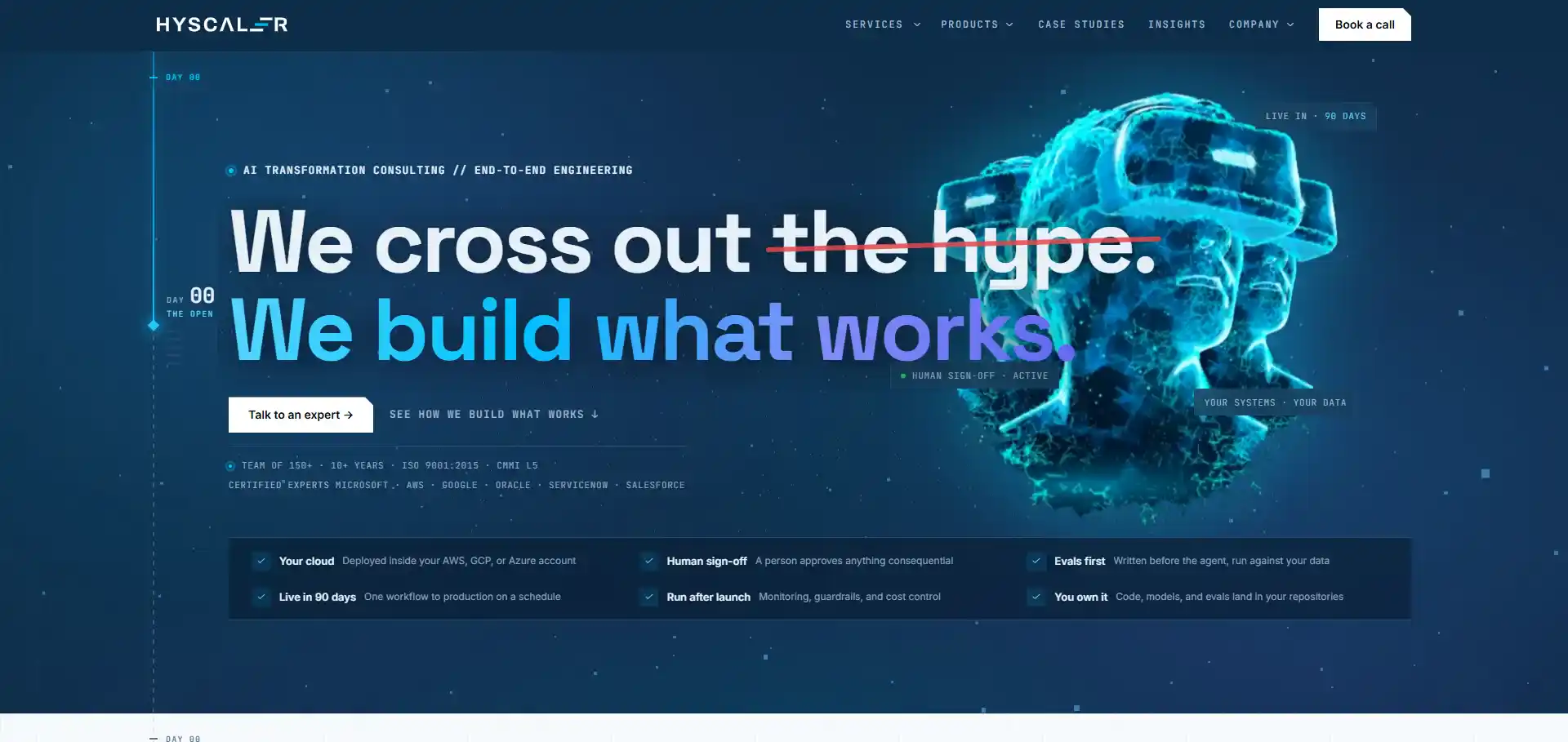
HyScaler is the AI transformation and engineering brand of NetTantra Technologies, a firm that has been building and running software for clients since 2010.
The team, 150+ people across offices in Santa Clara, California, and Bhubaneswar, India, holds ISO 9001:2015 and ISO/IEC 27001:2022 certifications and has been appraised at CMMI Level 5.
What differentiates HyScaler’s approach is a deliberate rejection of the “strategy deck first” model.
Instead of a 12-month roadmap document, the engagement is built around getting one real AI workflow live in your own systems within 90 days, because a working system running in production tells you more about your AI readiness than any slide ever will.
That’s backed by hands-on capability across the full stack an AI strategy actually depends on:
- AI readiness assessment and use-case identification
- AI roadmap development, sequenced realistically
- Generative AI and AI agent strategy and integration
- Custom AI development, wired into the ERP, CRM, and systems you already run
- Data readiness and data engineering, the foundation every agent inherits
- AgentOps and managed operations after launch
- End-to-end product engineering, so a second vendor isn’t needed to finish the job
HyScaler has delivered production AI and engineering work across industrial, fintech, and healthcare clients, including cutting a document-retrieval workflow in an industrial deployment from around 10 minutes down to under 30 seconds, and building an AWS-based lending platform now supporting 200+ loan programs on one system.
HyScaler’s AI Strategy Consulting Approach
Discover → Assess → Prioritize → Strategize → Roadmap → Implement → Measure
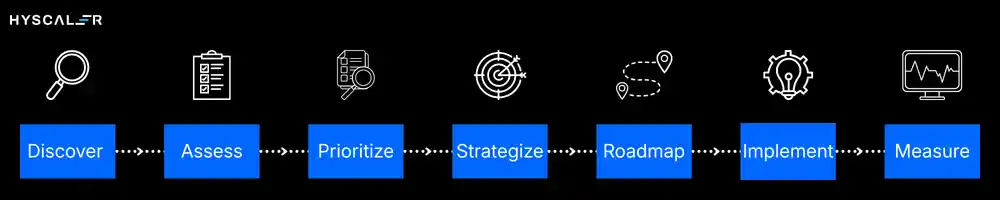
In practice, this runs on a structured cadence:
- Week one is spent inside your actual operations, observing real workflows, mapping everything, and being deliberately willing to rule most of them out, ending with a written requirement, tool choices, and a 90-day plan for the one workflow worth building first.
- Days 1–90 follow a Crawl–Walk–Run model: readiness and tool selection in the first 30 days, a working agent built and integrated into your systems by day 60, and a live production system with monitoring and guardrails by day 90.
- After day 90, HyScaler either operates the system with you on a managed retainer or hands it over fully documented so your own team can run it independently.
Every consequential action an AI agent takes is designed to carry a named human sign-off, and everything built – code, models, evaluation suites – is delivered into your own cloud environment and repositories, so you retain ownership regardless of whether the engagement continues.
AI Strategy Consulting Framework: From Assessment to Execution
01. Discover – Understand business goals and pain points.
02. Assess – Evaluate AI, data, technology, and organizational readiness.
03. Identify – Find high-value AI opportunities.
04. Prioritize – Rank use cases by value, feasibility, cost, and risk.
05. Strategize – Define the target AI vision and operating model.
06. Roadmap – Create an actionable implementation sequence.
07. Execute – Build and deploy prioritized AI solutions.
08. Measure – Track ROI, adoption, performance, and business outcomes.
AI Strategy Consulting by Business Size
Strategy depth, available budget, governance requirements, and implementation complexity all shift significantly depending on company size.
AI Strategy Consulting for Startups
Lean, fast-moving engagements focused on one or two high-leverage use cases rather than a company-wide roadmap.
AI Strategy Consulting for Small and Mid-Sized Businesses
A balance between structured planning and practical budget constraints, usually one clear roadmap with a small number of prioritized initiatives.
AI Strategy Consulting for Enterprises
Broader scope across multiple business units, more complex governance requirements, and closer integration with existing enterprise architecture.
AI Strategy Consulting for Fortune 500 Companies
Full organizational transformation programs, often spanning multiple years, with dedicated governance, risk, and change-management workstreams.
AI Strategy Consulting by Industry
AI priorities differ meaningfully across sectors.
A few examples:
Healthcare: patient data privacy, clinical decision support boundaries, and EHR integration shape almost every use case.
Financial Services: regulatory compliance, fraud detection, and model risk sit at the center of most engagements.
Retail & E-commerce: personalization, demand forecasting, and inventory optimization dominate.
Manufacturing: predictive maintenance, quality control, and edge AI on the factory floor.
Logistics: routing optimization, supply chain visibility, and exception handling.
Real Estate: valuation modeling, document processing, and lead qualification.
Professional Services: knowledge management, document automation, and client-facing research tools.
Technology & SaaS: embedded AI features, usage-based product analytics, and internal productivity tooling.
Common AI Strategy Consulting Mistakes to Avoid
- Starting with technology instead of business problems
- Trying to implement too many use cases at once
- Ignoring data readiness before building
- Underestimating integration requirements with existing systems
- Ignoring AI governance until something goes wrong
- Focusing on pilots instead of pushing toward production
- Never clearly defining ROI up front
- Creating a roadmap with no clear owner
- Choosing a consultant based on brand name alone
- Treating AI strategy as a one-time document instead of a living plan
AI Strategy Consultant vs. DIY AI Strategy
| Situation | Best Option |
|---|---|
| One simple AI workflow | DIY or an implementation provider |
| Several possible use cases | AI strategy consultant |
| Enterprise-wide AI transformation | Strategy consulting firm |
| Highly regulated AI deployment | Specialist AI strategy consultant |
| Clear use case but no technical capability | AI implementation partner |
| Unclear AI priorities | AI readiness/strategy consultant |
Build an AI Strategy That Delivers Business Value
AI strategy isn’t about adopting the most advanced technology available.
It’s about identifying where AI can create measurable business value and building a practical, honest path to get there, one that ends in a working system, not just a well-argued deck.
Need help turning AI opportunities into an actionable business strategy? Talk to HyScaler about AI strategy consulting and build a roadmap aligned with your business goals.
FAQ
What is an AI strategy consultant?
A specialist who helps a business identify where AI can create value, prioritize use cases, assess readiness, and build a roadmap for implementation.
What does an AI strategy consultant do?
They assess business and AI readiness, identify and prioritize use cases, recommend technology and architecture, build governance frameworks, and define ROI metrics.
How much does an AI strategy consultant cost?
It varies widely, from a few thousand dollars for a narrow readiness assessment to six figures or more for enterprise-wide transformation. See the pricing section above for indicative ranges.
Is AI strategy consulting worth it?
For businesses with multiple competing AI ideas, unclear priorities, or pilots that never reach production, a structured strategy engagement typically pays for itself by preventing wasted investment. For a single, well-defined use case, it may be unnecessary.
What services does an AI strategy consultant provide?
Readiness assessments, opportunity identification, use-case prioritization, roadmap development, technology and vendor selection, governance frameworks, and often implementation advisory.
How long does an AI strategy engagement take?
Assessments can take a few weeks; full strategy and roadmap engagements often run one to three months; enterprise transformation programs can extend over a year or more.
What is the difference between an AI consultant and an AI strategy consultant?
An AI strategy consultant focuses on business-wide priorities and roadmaps; a general AI consultant is often focused on a narrower technical task or tool.
How do I choose an AI strategy consultant?
Evaluate industry and technical expertise, ask for concrete case studies, understand their implementation capability, and clarify pricing and deliverables before signing.
What should an AI strategy consultant deliver?
At minimum: a readiness assessment, a prioritized use-case portfolio, technology recommendations, a governance framework, and an implementation roadmap with defined KPIs.
Can an AI strategy consultant help with implementation?
Some can, some can’t; this varies significantly by firm. Clarify this before signing, since it affects both cost and how smoothly strategy translates into a working system.
Who needs an AI strategy consultant?
Businesses with multiple competing AI priorities, pilots that aren’t reaching production, or no clear internal agreement on where AI should be applied first.
What industries use AI strategy consulting?
Virtually all of them, though healthcare, financial services, retail, manufacturing, and logistics are among the most active in 2026.