
Fabric IQ is the part of Microsoft Fabric that tells AI agents what a company’s data means, such as what counts as a customer and how revenue is calculated. Microsoft introduced it in November 2025 and, at Ignite 2026, brought it into Copilot. The tool supplies the layer; agreeing the definitions, fixing the data, and running agents safely is still work your team has to do.
Table of Contents
An AI agent can read a company’s data without knowing what the data means. Ask two agents for last quarter’s revenue and you can get two different numbers, because each one guessed which table and which definition to use. At Microsoft Ignite 2026, held in San Francisco from 17 to 20 November, Microsoft put its answer to that problem at the centre of its AI plans.
What is Fabric IQ?
Fabric IQ is a set of tools inside Microsoft Fabric that gives data a shared business meaning, so reports and AI agents use the same definitions. Microsoft describes it as part of Microsoft IQ, “the enterprise intelligence layer of the Microsoft stack.”
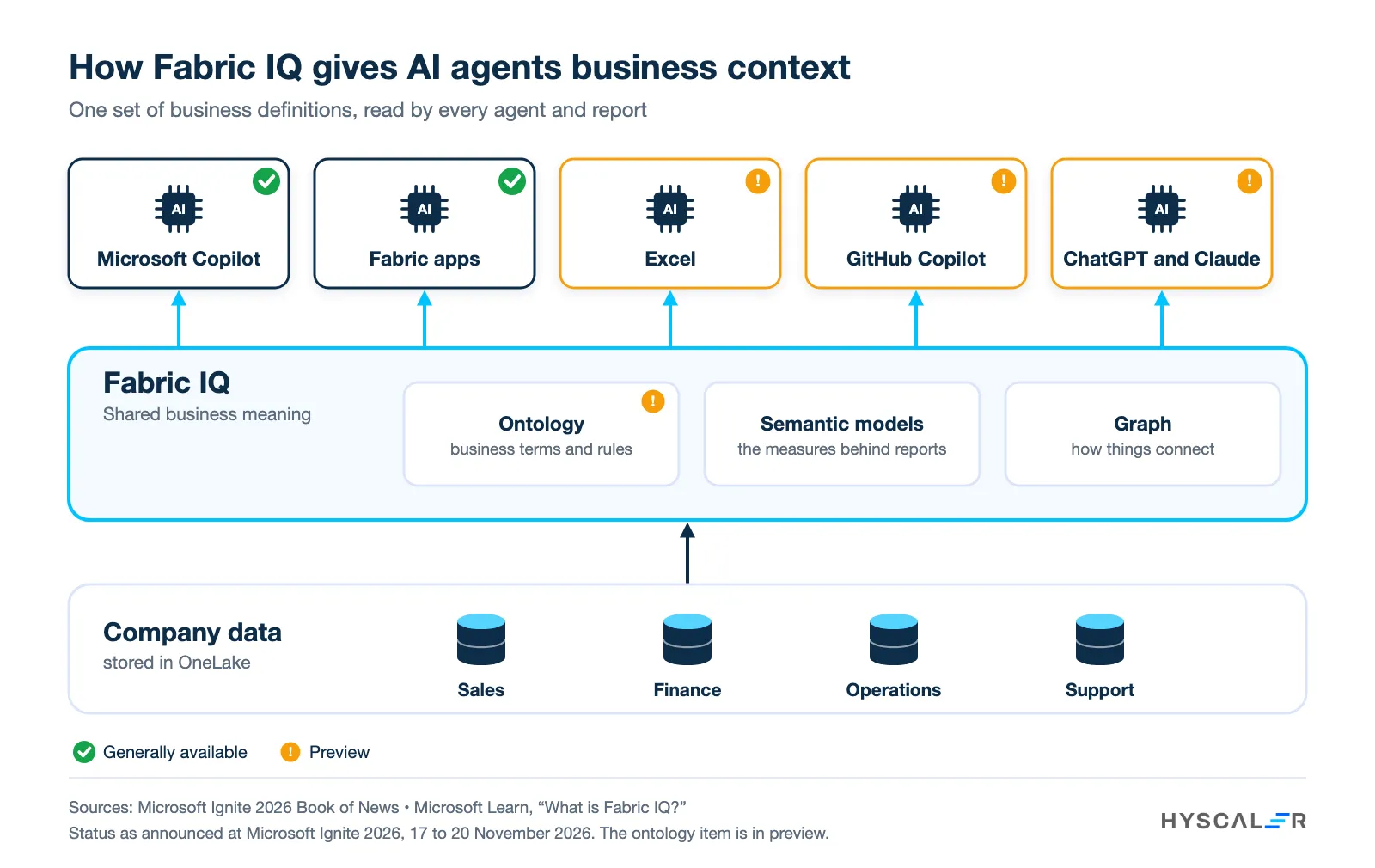
Its centre is the ontology, “a shared business vocabulary” that names what a business cares about, such as customers and orders, and records how they relate and which rules apply. Microsoft says ontologies “can be generated directly from semantic models already in production,” meaning the Power BI models many companies already use for reporting. Data agents and operations agents then answer questions and recommend actions using those definitions.
What did Microsoft announce for Fabric IQ at Ignite 2026?
Microsoft made the wider Microsoft IQ platform generally available, brought Fabric IQ into Copilot, and opened previews in Excel, GitHub Copilot, ChatGPT, and Claude. According to its Book of News, Microsoft IQ comes “with no new SKU or subscription.”
| Announcement | Status |
|---|---|
| Microsoft IQ (Work IQ, Fabric IQ, Foundry IQ, and Web IQ together) | Generally available |
| Fabric IQ in Microsoft Copilot, and Power BI semantic models in Copilot | Generally available |
| Fabric IQ in Excel, including live PivotTables | Preview |
| Ontologies in GitHub Copilot | Preview |
| Connectors for ChatGPT and Claude | Preview |
| The ontology item itself | Preview, per Microsoft Learn |
Within Microsoft IQ, Fabric IQ covers structured business data, Work IQ covers context from Teams, Outlook, and documents, and Foundry IQ covers unstructured documents. The ChatGPT and Claude connectors matter most for mixed environments, because a definition built once in Fabric can now reach assistants Microsoft does not make.
Why do AI agents need a semantic layer?
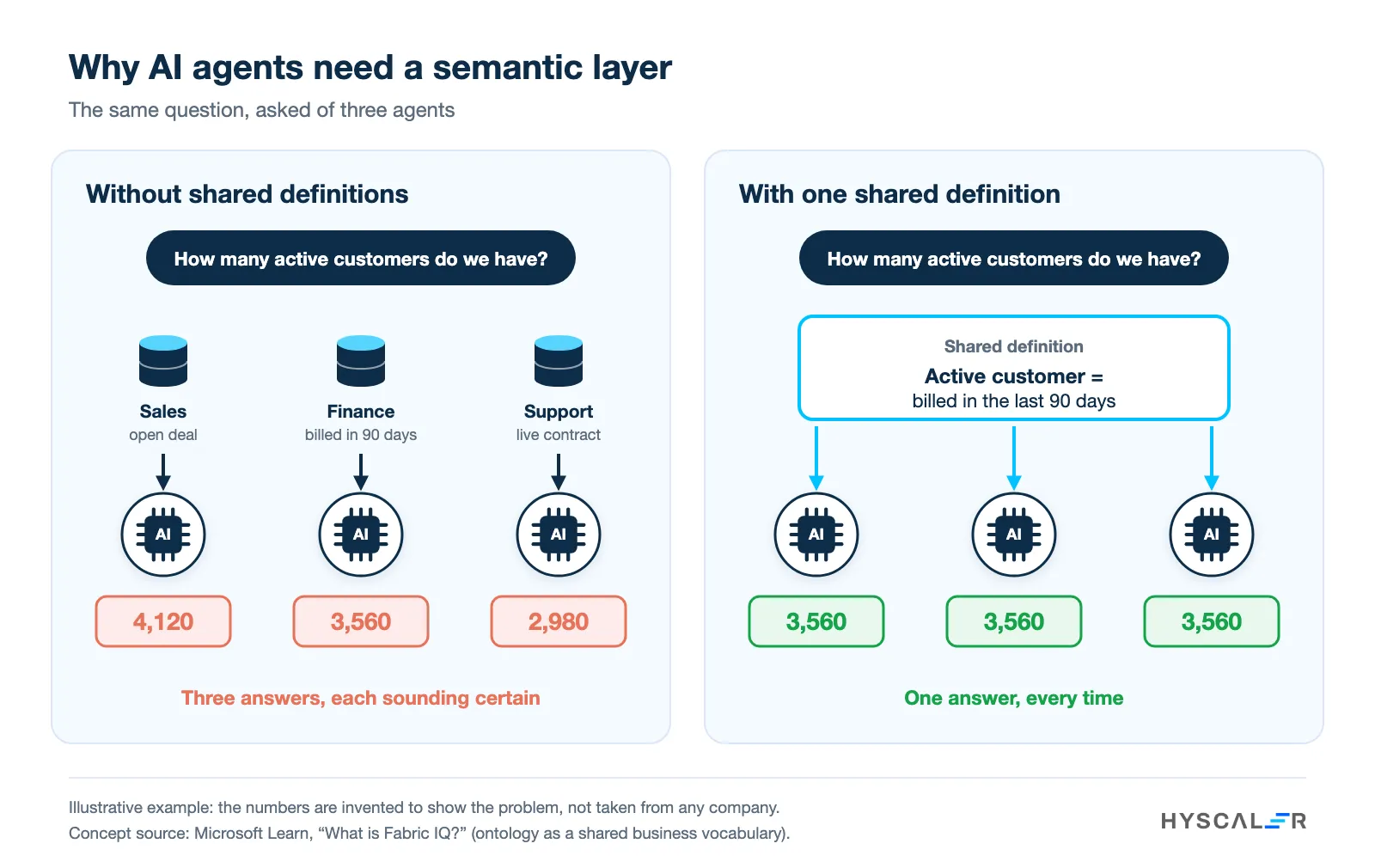
AI agents need a semantic layer because data does not carry its own meaning, and an agent that guesses gives confident, wrong answers. A semantic layer defines each business term once, so every agent calculates it the same way.
Take “active customer.” Sales may count anyone with an open deal, finance anyone billed in the last 90 days, and support anyone with a live contract. An agent without a shared definition picks one, and its number looks just as authoritative as a correct one.
This is different from retrieval-augmented generation (RAG), which, as VentureBeat put it, “pulls relevant documents to provide context.” RAG finds the right paragraph; a semantic layer makes sure the number in it means what the reader thinks. Our comparison of RAG and MCP covers how agents fetch context in the first place.
What are the risks and open questions?
The main risks are the upfront work and the lock-in. Analysts quoted by InfoWorld at the 2025 launch put it plainly:
- Upfront work. Michael Ni, principal analyst at Constellation Research: “There is upfront work for IT. Ontologies don’t build themselves.”
- Lock-in. Robert Kramer, principal analyst at Moor Insights and Strategy: “The more an enterprise builds on this semantic layer, the harder it becomes to move that logic elsewhere.”
- Fit. Suhas AR of HFS Research advised companies with low data maturity, or outside Microsoft’s data stack, to “wait and watch.”
The ontology is also still in preview, and operations agents are designed to act on live data, so someone has to decide where a person signs off. Our guide to human in the loop and human on the loop covers that choice.
Where does HyScaler fit in a Fabric IQ project?
Fabric IQ supplies the layer, but it does not decide what your terms mean, clean the data underneath, or run agents safely in production. That surrounding work is where projects succeed or stall, and it is the work HyScaler takes on for the businesses we work with, whether the data ends up in Microsoft Fabric or on another platform. We run it as one team, with one written plan and one owner, so a definition agreed in week one carries through to every agent that ships.
| What Fabric IQ provides | What still has to be done | How HyScaler helps |
|---|---|---|
| A place to store business definitions | Agreeing what “customer” or “revenue” means across teams | Data engineering and modelling |
| A connection to data in OneLake | Clean, well-modelled data with clear lineage | Pipelines and warehousing |
| Permission settings | Deciding who and which agents may see what, with an audit trail | Data governance and compliance |
| Data and operations agents | Agents that match your workflows, with tests and approval steps | MCP-based agent development |
| Agents running in Microsoft’s tools | Monitoring, cost control, and a way to stop an agent | AgentOps |
Fix the definitions and the data first
Our starting rule is simple: “Agents inherit every gap in your data. Schemas, quality, lineage, and access get fixed before anything is built on them.” In practice, that means agreeing the handful of terms your agents will use, tracing where each number comes from, and building the pipelines and warehouse models those definitions sit on. If your Power BI semantic models are already trusted, they are the natural starting point for an ontology, because Microsoft lets you generate one from them. If finance and sales still disagree on revenue, that conversation comes before any tool.
Govern who and what can see the data
Once agents can query business data in plain language, access control matters more, not less. Our data governance and compliance work covers cataloguing and lineage, plus role-based access with a review cadence and audit logging, so who can see what is a record rather than a guess.
Build agents that use the context
A semantic layer gives agents the meaning of your data; they still need to be built around a real workflow, such as answering a finance team’s margin questions or flagging late orders for operations. We build MCP-based AI agents with evals written before the agent and human checkpoints where they count. They are deployed inside your own AWS, GCP, or Azure account, and the code, models, and evals land in your repositories.
Run them in production
An agent that works in a demo still needs watching. Our AgentOps practice covers monitoring, guardrails, and cost control, with a kill switch on every action and an audit trail of what each agent did. That matters most for operations agents, which are designed to act on live data rather than only answer questions. Model and infrastructure spend runs through your own cloud accounts, so the cost of each agent stays visible to you.
Start with one workflow
We start with one workflow that matters and aim for a live agent in production in 90 days, on a fixed scope. The second workflow reuses the data work, the evals, and the guardrails of the first, which is how a shared semantic layer starts paying for itself. If the first agent answers revenue questions, the second can reuse the same agreed definition of revenue and the same governed tables, instead of starting again.
Fabric IQ FAQ
What is Fabric IQ in simple terms?
Fabric IQ is a layer in Microsoft Fabric that defines what a company’s data means, such as what counts as a customer or how revenue is calculated, so that AI agents and reports use the same definitions.
Is Fabric IQ generally available?
Partly. At Ignite 2026, Microsoft made its Copilot integrations generally available, along with the wider Microsoft IQ platform. The ontology item, and the Excel, GitHub Copilot, ChatGPT, and Claude integrations, are in preview.
Does Fabric IQ cost extra?
Microsoft says Microsoft IQ is built on products customers already use, “with no new SKU or subscription.” At the 2025 launch, Microsoft told InfoWorld that it runs on Fabric capacity with no separate SKU or add-on fee.
What is the difference between Fabric IQ and Work IQ?
Fabric IQ gives agents the meaning of structured business data, such as metrics and business rules. Work IQ gives agents everyday work context from Teams meetings, Outlook email, and documents. Both sit under Microsoft IQ.
What work does Fabric IQ leave to my team?
It stores and serves business definitions, but your team still has to agree those definitions and prepare the data underneath, then build and monitor the agents that use it. HyScaler helps with each of those steps.
Sources
Microsoft, Ignite 2026 Book of News, November 2026: https://news.microsoft.com/events/ignite/2026/book-of-news/
Microsoft Learn, “What is Fabric IQ?”: https://learn.microsoft.com/en-us/fabric/iq/overview
VentureBeat, “Microsoft’s Fabric IQ teaches AI agents to understand business operations, not just data patterns,” November 18, 2025: https://venturebeat.com/data/microsofts-fabric-iq-teaches-ai-agents-to-understand-business-operations-not
InfoWorld, “Microsoft Fabric IQ adds ‘semantic intelligence’ layer to Fabric,” November 19, 2025: https://www.infoworld.com/article/4093181/microsoft-fabric-iq-adds-semantic-intelligence-layer-to-fabric.html
Talk to HyScaler about Fabric IQ and AI agents
If you are weighing Fabric IQ against the stack you already run, start with the groundwork: our data engineering services and MCP-based AI agents pages show how we work. Talk to our team and we will help you decide where your definitions should live before you choose the tool.