

Table of Contents
The U.S. artificial intelligence consulting market is projected to surpass $50 billion by 2027, growing at a compound annual rate of over 37%.
Yet despite this surge.
Why? Because AI adoption is not a technology problem.
It is a strategy, data, talent, and implementation problem simultaneously.
In 2026, the gap between companies that are experimenting with AI and those operationalizing it at scale has never been wider.
CIOs and CTOs are no longer asking whether to adopt AI.
They are asking which partner can help them do it correctly, quickly, and in a way that delivers measurable ROI without accumulating technical debt.
This guide evaluates the 11 best AI consulting companies in the USA for 2026, analyzing each firm across capability, industry depth, technical execution, and fit for different organizational profiles from growth-stage startups to Fortune 500 enterprises.
How We Evaluated These Companies
Each firm in this list was assessed across seven dimensions:
- AI Strategy Expertise: Ability to define AI roadmaps aligned to business objectives
- Generative AI Capabilities: Depth of experience with LLMs, RAG systems, and AI agents
- Enterprise Implementation Experience: Track record of deploying AI at production scale
- Industry Specialization: Vertical-specific AI knowledge and domain expertise
- Technical Stack Modernity: Use of current frameworks, tooling, and infrastructure approaches
- Scalability and Delivery Model: Ability to scale engagements and provide long-term support
- Client Reputation: Market perception, analyst recognition, and independent reviews
Quick Comparison: Top AI Consulting Companies in the USA (2026)
| Company | Best For | Key Industries | AI Services | Size |
|---|---|---|---|---|
| Accenture | Enterprise AI Transformation | Cross-industry | End-to-End AI | Large |
| McKinsey QuantumBlack | AI Strategy & Analytics | Enterprise | AI Strategy + Analytics | Large |
| BCG X | AI Innovation & Productization | Cross-industry | AI Product Development | Large |
| Deloitte | Regulated Industry AI | Finance, Healthcare | AI + Compliance | Large |
| IBM Consulting | AI Infrastructure & Hybrid Cloud | Enterprise | AI + Cloud | Large |
| HyScaler | AI Product Development & Custom AI | Startups, SaaS, FinTech, Healthcare | AI Engineering + Product | Mid-Size |
| Cognizant | Enterprise AI Deployment | Cross-industry | AI Implementation | Large |
| Infosys Topaz | Cost-Effective AI at Scale | Enterprise | AI Services | Large |
| Capgemini | Digital + AI Transformation | Cross-industry | AI Consulting | Large |
| PwC | AI Governance & Risk | Enterprise | AI Risk + Compliance | Large |
Top 11 Best AI Consulting Companies in the USA (2026)
1. Accenture
Overview
Accenture is one of the largest and most operationally sophisticated AI consulting organizations in the world.
Its AI practice spans strategy, implementation, and managed services, supported by a global network of over 300 AI centers and innovation hubs.
In 2026, Accenture’s AI capabilities are organized around three pillars: Applied Intelligence (data and analytics), Generative AI, and Responsible AI frameworks.
The firm has made substantial investments in building proprietary AI assets, including pre-built industry AI models, data foundation toolkits, and AI governance accelerators.
Its scale enables it to rapidly staff large, cross-functional teams, making it a strong match for complex enterprise transformation programs.
Core AI Services
- Enterprise AI strategy and operating model design
- Generative AI program development and scaling
- AI-powered process automation and intelligent workflows
- Responsible AI and ethics frameworks
- Cloud-native AI infrastructure on AWS, Azure, and GCP
- AI talent transformation and change management
Key Industries Served
Financial services, healthcare, life sciences, retail, manufacturing, public sector, communications
Notable AI Capabilities
Accenture’s proprietary AI Navigator for Enterprise framework provides a structured methodology for AI readiness assessment and deployment prioritization.
The firm also operates LearnVantage, an AI skilling platform that helps enterprises build internal AI capability alongside external consulting engagements.
Pros
- Unmatched global delivery capacity and bench depth
- Strong proprietary AI tools and pre-built assets
- Comprehensive coverage from strategy through managed operations
- Recognized leader across all major analyst firm rankings
Cons
- Engagement costs are among the highest in the market
- Large project teams can introduce coordination overhead
- Mid-market and startup budgets are typically not served
Best For: Large enterprises executing multi-year AI transformation programs requiring cross-functional coordination, regulatory compliance, and global delivery capacity.
2. McKinsey & Company (QuantumBlack)
Overview
McKinsey’s dedicated AI arm, QuantumBlack, occupies a distinct position in the AI consulting market: it is the firm most associated with translating AI capability into quantifiable business value at the C-suite level.
Where many consulting firms lead with technology, QuantumBlack leads with economics, building the business case for AI investment before a single model is trained.
Founded as an independent data science firm and acquired by McKinsey in 2012, QuantumBlack brings a hybrid identity: management consulting rigor combined with deep technical execution capability.
In 2026, its practice spans generative AI strategy, advanced analytics, AI operating model transformation, and proprietary tooling through its Lilli enterprise AI platform.
Core AI Services
- AI opportunity identification and value case development
- Generative AI strategy and enterprise deployment
- Analytics transformation and data estate modernization
- AI operating model and governance design
- Proprietary AI platform deployment (Lilli)
Key Industries Served
Financial services, healthcare, pharmaceuticals, retail, energy, telecommunications, public sector
Notable AI Capabilities
QuantumBlack’s Leap methodology provides a structured sprint-based framework for moving from AI concept to scalable deployment in compressed timeframes.
The firm also publishes the McKinsey Global Institute AI State of the Field report, which is widely used as a benchmark for enterprise AI adoption decisions.
Pros
- Strongest brand recognition for AI strategy at the executive level
- Deep industry benchmarks and proprietary data assets
- Combines business case development with technical execution
- High credibility in board-level and investor conversations
Cons
- Among the highest fee structures in the market
- Significant variation in delivery quality depending on team composition
- Primarily suited to large enterprises and institutional clients
Best For: Enterprise organizations that need to build internal consensus and a rigorous business case for large-scale AI investment before committing to implementation.
3. Boston Consulting Group (BCG X)
Overview
BCG X is BCG’s dedicated technology build and design unit, established to bridge the gap between strategic AI consulting and hands-on product development.
Unlike traditional management consulting AI practices, BCG X operates more like a product studio embedded within a strategy firm, staffing teams of engineers, data scientists, designers, and product managers alongside business consultants.
In 2026, BCG X has expanded its presence significantly across North America, with delivery hubs in San Francisco, New York, and Boston.
Its approach emphasizes building AI products that organizations can own, operate, and scale independently rather than creating long-term consulting dependency.
Core AI Services
- AI product strategy and development
- Generative AI application prototyping and scaling
- Personalization and recommendation systems
- AI-powered customer experience platforms
- Data platform modernization for AI readiness
- AI change management and adoption programs
Key Industries Served
Consumer goods, financial services, healthcare, industrials, retail, technology
Notable AI Capabilities
BCG X has built significant depth in agentic AI systems and multi-model orchestration.
Its Fabriq data and AI platform accelerator enables faster deployment of enterprise-grade AI environments, reducing infrastructure setup time from months to weeks.
Pros
- Product-build orientation produces tangible, deployable AI assets
- Strong design thinking integration alongside technical delivery
- Faster time-to-prototype than traditional consulting models
- Combines strategic advisory with engineering execution
Cons
- Premium pricing positions this outside most SMB budgets
- Engagement model can be complex for organizations needing simple, focused delivery
- Not the strongest choice for pure infrastructure or compliance-heavy AI programs
Best For: Enterprise organizations that need to build new AI-powered products or customer-facing experiences and want a partner that handles both strategy and engineering.
4. Deloitte
Overview
Deloitte’s AI practice is one of the most comprehensive in the market, distinguished particularly by its strength in regulated industries, such as financial services, healthcare, life sciences, and government, where AI deployment must navigate complex compliance, auditability, and ethics requirements simultaneously.
Deloitte operates through its Trustworthy AI framework, which integrates technical AI capabilities with risk management, regulatory compliance, and governance architecture.
This makes it the default choice for many regulated enterprises that cannot afford AI implementations that create downstream compliance exposure.
Core AI Services
- AI strategy, roadmap, and readiness assessment
- Generative AI integration and enterprise deployment
- Responsible AI and ethics program development
- AI risk management and compliance frameworks
- Intelligent automation and process AI
- AI-enabled audit and finance transformation
Key Industries Served
Financial services, healthcare, government, life sciences, energy, insurance
Notable AI Capabilities
Deloitte’s Trustworthy AI framework has become a reference model for responsible AI governance.
The firm has also developed strong capabilities in AI-enabled regulatory reporting, particularly relevant for banking and insurance clients navigating SEC, OCC, and HIPAA compliance in AI contexts.
Pros
- Industry-leading expertise in AI governance and responsible AI
- Deep knowledge of regulatory environments across financial services and healthcare
- Comprehensive suite of AI services from strategy through operations
- Strong audit and risk management integration
Cons
- Less engineering-forward than pure AI development firms
- High cost structures typical of Big Four consulting
- Generative AI product development capabilities less mature than strategy capabilities
Best For: Regulated enterprises, particularly in banking, insurance, healthcare, and government, where AI deployments must be defensible, auditable, and compliant with existing regulatory frameworks.
5. IBM Consulting
Overview
IBM Consulting brings a distinctive combination of AI software ownership and consulting services that few competitors can match.
As the developer of WatsonX, IBM’s enterprise AI and data platform, IBM Consulting operates with deep product knowledge that third-party consulting firms simply cannot replicate.
In 2026, this integration of products and services creates a compelling value proposition for enterprises already invested in IBM infrastructure.
IBM Consulting’s AI practice is particularly strong in hybrid cloud AI deployment, integrating AI workloads across on-premise, private cloud, and multi-cloud environments, a capability that is critically relevant for regulated industries and large enterprises with complex existing infrastructure.
Core AI Services
- Enterprise AI strategy and WatsonX platform deployment
- AI model development, tuning, and governance
- Intelligent automation and process transformation
- Hybrid cloud AI infrastructure design and deployment
- AI governance and model risk management
- AI-powered ERP and supply chain optimization
Key Industries Served
Financial services, manufacturing, telecommunications, retail, healthcare, government
Notable AI Capabilities
IBM’s Watsonx governance module provides model monitoring, bias detection, and explainability tooling that is natively integrated with consulting delivery, enabling IBM Consulting to offer AI governance solutions that are audit-ready from day one.
Pros
- Unique combination of proprietary AI platform and consulting services
- Strong hybrid cloud and enterprise infrastructure expertise
- Leading AI governance and model risk capabilities
- Cost-competitive relative to other global consulting firms of comparable scale
Cons
- Strongest value proposition for existing IBM infrastructure clients
- Watsonx ecosystem creates some lock-in considerations
- Less relevant for organizations built on competing cloud-native AI stacks
Best For: Enterprises with existing IBM infrastructure, hybrid cloud environments, or strong AI governance and model risk management requirements.
6. HyScaler (Our Pick for AI Product Development)
Overview
HyScaler occupies a distinct and increasingly relevant position in the 2026 AI consulting landscape: a specialist AI product engineering firm that combines strategic advisory capability with hands-on engineering execution.
While the larger firms on this list excel at enterprise transformation programs measured in years, HyScaler is built for organizations that need to move from an AI concept to a deployed product in weeks, not quarters.
Founded with a product-first philosophy, HyScaler serves startups, SMBs, and mid-market enterprises that require AI consulting and engineering partners capable of delivering working AI systems, not just strategic recommendations.
The firm’s dual capability, deep AI consulting expertise, combined with full-stack product engineering, makes it a natural fit for organizations that want a single accountable partner across the entire AI product lifecycle.
In 2026, HyScaler’s practice is concentrated across four high-growth areas: Generative AI solutions, Enterprise AI agents, AI SaaS product development, and Machine learning engineering, precisely the capability clusters where demand is outpacing supply across both startup and enterprise markets.
Core AI Consulting Services
AI Strategy & Roadmap Development: HyScaler’s strategy engagements begin with a rigorous AI readiness assessment evaluating data infrastructure, organizational capability, and competitive positioning before defining a prioritized AI adoption roadmap. The output is a practical, sequenced plan tied to business metrics, not a theoretical framework.
Generative AI Solutions: HyScaler designs and builds production-grade generative AI applications, including RAG (Retrieval-Augmented Generation) systems, LLM-powered workflows, AI copilots, and document intelligence platforms. Engagements span model selection, prompt architecture, vector database design, and deployment infrastructure.
Enterprise AI Agents: HyScaler has developed deep expertise in autonomous AI agent development, building multi-step, tool-using agents capable of executing complex business workflows with minimal human intervention. This includes both standalone agents and multi-agent orchestration systems integrated with enterprise data sources.
AI SaaS Product Development: For software companies embedding AI into their core products, HyScaler offers end-to-end AI SaaS development from feature architecture through API design, model integration, performance optimization, and scalable deployment on cloud-native infrastructure.
Custom AI Application Development: HyScaler engineers custom AI applications tailored to specific operational requirements, including intelligent document processing, predictive analytics platforms, AI-powered recommendation engines, and computer vision systems.
Machine Learning Solutions & MLOps: The firm provides full ML pipeline development, from data engineering and feature engineering through model training, evaluation, and production deployment alongside MLOps infrastructure that enables continuous model monitoring, retraining, and performance governance.
Data Engineering & AI Integration Services: HyScaler builds the data foundations that AI systems require: modern data pipelines, vector databases, real-time data infrastructure, and API-based AI integrations that connect AI capabilities to existing enterprise systems.
Industries Served
| Industry | AI Use Cases |
|---|---|
| Healthcare | Clinical documentation AI, diagnostic support, patient data intelligence |
| FinTech | Fraud detection, AI underwriting, intelligent compliance automation |
| SaaS | AI feature development, LLM integration, AI-powered UX personalization |
| Retail | Demand forecasting, personalization engines, and inventory optimization AI |
| Logistics | Route optimization, predictive maintenance, warehouse automation AI |
| Manufacturing | Quality inspection AI, predictive failure analysis, production optimization |
Key Differentiators
What separates HyScaler from both large consulting firms and pure software development agencies is a specific combination of capabilities that the 2026 AI market increasingly demands:
1. Engineering-First AI Delivery: HyScaler’s teams are built around AI engineers, ML practitioners, and product architects, not primarily management consultants. Every strategy engagement is designed to produce systems that can be built, not just frameworks that can be presented. This orientation consistently reduces the gap between AI recommendations and AI deployment.
2. Product-First Development Philosophy: HyScaler approaches AI development with the discipline of product engineering, defining clear user outcomes, prioritizing iterative delivery, and building modular architectures that scale without requiring expensive rearchitecting. This is particularly valuable for startups and SaaS companies where speed to market and maintainability are equally critical.
3. Modern AI Tech Stack: HyScaler’s technical teams work across the current generation of AI infrastructure: LangChain, LlamaIndex, OpenAI and Anthropic APIs, AWS Bedrock, Azure OpenAI Service, Pinecone, Weaviate, Qdrant, and Kubernetes-based MLOps platforms. There is no legacy methodology debt; the firm’s practices are designed for the current AI stack, not adapted from it.
4. Faster Implementation Cycles: Where large consulting firms often require 3-6 months of discovery and design phases before any engineering work begins, HyScaler operates on compressed delivery cycles, typically reaching a working proof of concept within 4-8 weeks and a production-ready system within 3-4 months for most mid-complexity AI products.
5. Startup-to-Enterprise Flexibility: HyScaler’s engagement model scales across organizational size. Early-stage startups building their first AI-powered product receive the same quality of AI architecture thinking as enterprise clients integrating AI into established systems, with pricing and team structures calibrated to organizational context.
Pros
- Strong AI product development, expertise, strategy, and engineering under one roof
- Flexible, milestone-based engagement models suitable for startups and enterprises
- Modern AI tech stack with no legacy methodology constraints
- Faster implementation cycles than large consulting firms
- Deep expertise in Generative AI, AI agents, and LLM applications
- End-to-end accountability from AI strategy through deployed product
Cons
- Smaller global footprint compared to Tier 1 consulting firms
- Less suited for pure management consulting engagements without implementation
- Not the first choice for the largest enterprise transformation programs requiring hundreds of consultants simultaneously
Best For: Startups, SaaS companies, and mid-market enterprises that need AI consulting combined with hands-on product development and engineering execution, and want a partner who is accountable for both the strategy and the shipped system.
Looking to build an AI-powered product? HyScaler’s team of AI engineers and strategists helps organizations move from AI concept to production in weeks, not quarters. Explore HyScaler’s AI Consulting & Development Services →
7. Cognizant
Overview
Cognizant’s AI practice has undergone significant restructuring in recent years, consolidating its data, analytics, and AI capabilities under a unified Neuro AI platform.
In 2026, Cognizant positions itself as an AI implementation and deployment specialist, with particular strength in large-scale enterprise AI rollouts that require integration with complex legacy system environments.
Core AI Services
- Enterprise AI strategy and Neuro AI platform deployment
- Generative AI solution development and integration
- Intelligent automation and AI-powered business processes
- AI-enabled application modernization
- Data platform engineering and MLOps
- AI-powered customer experience and contact center transformation
Key Industries Served
Financial services, healthcare, manufacturing, retail, communications, life sciences
Pros
- Strong legacy system integration expertise relevant for enterprises with complex IT estates
- Competitive pricing relative to Big Four and strategy firm competitors
- Large delivery capacity with global resource pools
- Solid track record in large-scale AI deployment programs
Cons
- Generative AI capabilities are still maturing relative to strategy-led firms.
- Engagement quality can vary across geographies and practice areas
- Less differentiated in AI strategy compared to implementation
Best For: Large enterprises that need to deploy AI at scale within complex legacy IT environments, with cost efficiency as a primary consideration alongside capability.
8. Infosys Topaz
Overview
Infosys Topaz is Infosys’s AI-first services brand, launched in 2023 and significantly expanded through 2025-2026.
Topaz represents Infosys’s strategic bet on AI services as the primary growth driver, consolidating the company’s AI capabilities, including its Infosys Nia platform, generative AI studio, and AI research investments under a single integrated offering.
Core AI Services
- AI-first enterprise transformation
- Generative AI application development via Infosys AI Studio
- Data engineering and AI-ready data platform design
- AI-powered ERP and CRM modernization
- MLOps and AI operations infrastructure
- Responsible AI and AI governance frameworks
Key Industries Served
Financial services, retail, manufacturing, healthcare, energy, communications
Pros
- Cost-competitive pricing model, particularly strong for budget-conscious enterprises
- Significant investment in proprietary AI tooling and accelerators
- Strong delivery capacity in North America, Europe, and Asia-Pacific
- Improving generative AI capability following recent acquisitions and R&D investment
Cons
- AI strategy depth lags behind McKinsey, BCG, and Accenture
- The Topaz brand is still establishing differentiation in the market
- Less suitable for organizations that need deep generative AI product development expertise
Best For: Cost-conscious enterprise organizations seeking broad AI services coverage and managed AI operations at competitive price points.
9. Capgemini
Overview
Capgemini’s AI consulting practice is differentiated by its strong engineering heritage and its ability to integrate AI transformation with broader digital modernization programs.
The firm operates its AI practice through its AI & Analytics service line and its Sogeti technology consulting unit, combining advisory, engineering, and managed services into integrated offerings.
Core AI Services
- AI strategy and enterprise AI operating model design
- Generative AI solution development and deployment
- Data intelligence and analytics transformation
- AI-enabled cloud migration and infrastructure modernization
- Industry AI solutions across manufacturing, retail, and financial services
- Responsible AI and data ethics frameworks
Key Industries Served
Manufacturing, financial services, retail, automotive, energy, public sector, telecommunications
Pros
- Strong integration of AI with digital transformation and cloud modernization
- Deep industrial and manufacturing AI expertise
- Competitive European-anchored pricing
- Broad geographic coverage, including a strong presence in North America and Europe
Cons
- AI strategy depth below top-tier strategy firms
- Generative AI maturity is still catching up to early movers
- Service quality can be inconsistent across practice areas
Best For: Industrial, manufacturing, and public sector enterprises seeking to combine AI adoption with broader digital transformation and cloud modernization initiatives.
10. PwC
Overview
PwC’s AI consulting practice is anchored in its Big Four identity: trust, governance, risk, and compliance.
Its AI & Data practice focuses on helping enterprises build AI programs that are not only capable, but auditable, defensible, and aligned with an increasingly complex global regulatory landscape, including the EU AI Act, SEC AI disclosure guidance, and sector-specific AI regulations in healthcare and financial services.
Core AI Services
- AI governance and responsible AI program development
- AI risk assessment and regulatory compliance
- Generative AI strategy and enterprise deployment
- AI-powered financial reporting and audit transformation
- Data strategy and AI readiness assessment
- AI ethics frameworks and board-level AI governance
Key Industries Served
Financial services, healthcare, insurance, asset management, government, professional services
Pros
- Market-leading AI governance and responsible AI expertise
- Deep regulatory knowledge across financial services, healthcare, and government
- Strong board-level and executive credibility
- Integrated approach combining tax, legal, risk, and AI advisory
Cons
- Less technically sophisticated than engineering-oriented AI firms
- Generative AI product development is not a primary strength
- High fee structures typical of Big Four advisory
Best For: Enterprises where AI governance, regulatory compliance, and board-level accountability are primary requirements, particularly in financial services, insurance, and highly regulated sectors.
11. Ascendion
Overview
Ascendion is an AI-native software engineering disruptor that differentiates itself through its “Engineering to the Power of AI” approach. Named a Horizon 3 Market Leader by HFS, Ascendion focuses on moving AI beyond pilots to production by connecting human guidance with agentic automation. Their proprietary AI platform, AAVA, orchestrates a network of AI agents to enhance how software is designed, built, and scaled, delivering measurable business impact for Fortune 50 banks and global healthcare leaders alike.
Core AI Services
- Applied AI and agentic engineering platform development
- DataAI for advanced analytics and decision velocity
- ExperienceAI for adaptive, intelligent user experiences
- AI-powered Product and Platform Engineering
- Global Capability Centers (GCCAI) modernization
Key Industries Served
Financial services, healthcare, life sciences, high-tech, and logistics.
Notable AI Capabilities
The AAVA platform provides a coordinated network of AI agents that accelerate the software development life cycle, enabling “Services-as-Software” delivery models and providing measurable gains in engineering productivity.
Pros
- Recognized leader in agentic AI and software engineering automation.
- Proprietary AAVA platform offers sophisticated technical orchestration.
- Proven track record of up to 50% productivity improvements in large-scale banking deployments.
Cons
- Highly specialized engineering focus may be too technical for organizations only seeking strategy.
- Smaller global delivery footprint compared to the largest system integrators.
Best For: Enterprises looking to modernize their software engineering through agentic AI and those seeking to accelerate product development with a mature, AI-native delivery model.
How to Choose the Right AI Consulting Company
Selecting the right AI consulting partner is a decision that will significantly shape your AI outcomes positively or negatively.
The following framework provides a structured approach.
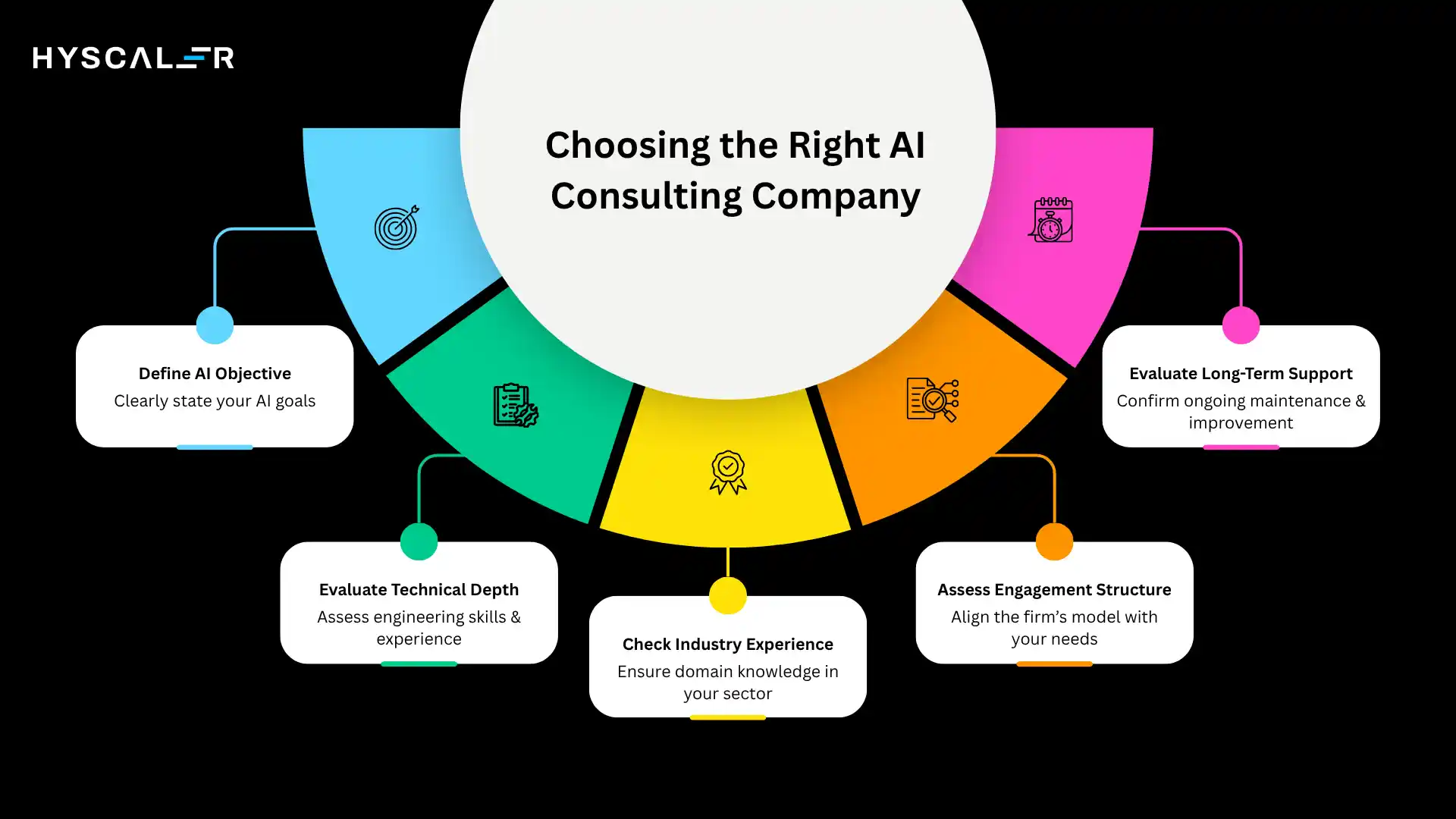
1. Define Your Primary AI Objective
Before evaluating vendors, be explicit about what you actually need:
- AI Strategy: You understand AI’s potential but need help defining where and how to invest
- AI Implementation: You have a strategy, but need technical capability to build and deploy
- Generative AI Deployment: You need to integrate LLMs, AI agents, or GenAI capabilities into existing systems or products
- AI Product Development: You are building a new AI-powered product or embedding AI into your software offering
- AI Governance: You need to ensure existing or planned AI systems are compliant, auditable, and risk-managed
Different firms on this list are optimized for different objectives.
Matching your primary goal to a firm’s core capability is the most important selection variable.
2. Evaluate Technical Depth Against Your Requirements
Assess whether the firm’s technical capabilities match what your project actually requires. Key questions:
- Do they have engineers on the team, or primarily consultants who subcontract engineering?
- Can they demonstrate experience with your target AI tech stack?
- Do they have a track record of shipping production AI systems (not just prototypes and recommendations)?
- What does their MLOps and post-deployment support capability look like?
3. Check Industry-Specific AI Experience
AI implementations in healthcare require different expertise than AI implementations in logistics or FinTech.
Firms with deep domain knowledge in your industry will move faster, make better architectural decisions, and navigate compliance requirements without expensive learning curves.
4. Assess Scalability and Engagement Structure
Consider whether the firm’s engagement model fits your organizational profile.
Large consulting firms typically require minimum engagement sizes that are inaccessible for startups and growth-stage companies.
Specialist firms like HyScaler offer milestone-based engagement structures that align cost to progress.
5. Evaluate Long-Term Support Capability
AI systems are not one-time deployments.
They require ongoing monitoring, retraining, performance governance, and iterative improvement.
Assess whether the firm can support your systems post-deployment or whether you will need to transition to a different partner once initial delivery is complete.
AI Consulting Services to Expect in 2026
Any credible AI consulting partner should offer competence across the following service areas:
AI Readiness Assessment: A structured evaluation of your data infrastructure, organizational capability, and technology landscape before any AI investment is committed.
Generative AI Consulting: Strategy and implementation support for LLM integration, RAG architectures, AI copilots, and generative AI applications across business functions.
AI Agent Development: Design and engineering of autonomous AI agents capable of multi-step decision-making and tool use across enterprise workflows.
Custom AI Application Development: End-to-end engineering of AI applications built to your specific business requirements, not repurposed generic solutions.
Data Engineering: Pipeline architecture, data quality frameworks, and infrastructure development that ensures AI systems are trained and operated on reliable, well-governed data.
MLOps & AI Operations: Infrastructure and tooling for model deployment, monitoring, performance tracking, and continuous retraining at production scale.
AI Governance & Compliance: Frameworks for model explainability, bias monitoring, regulatory compliance, and board-level AI accountability.
AI Modernization: Migration of legacy analytics and automation systems to modern AI architectures, reducing technical debt while increasing capability.
AI Consulting Trends Shaping 2026
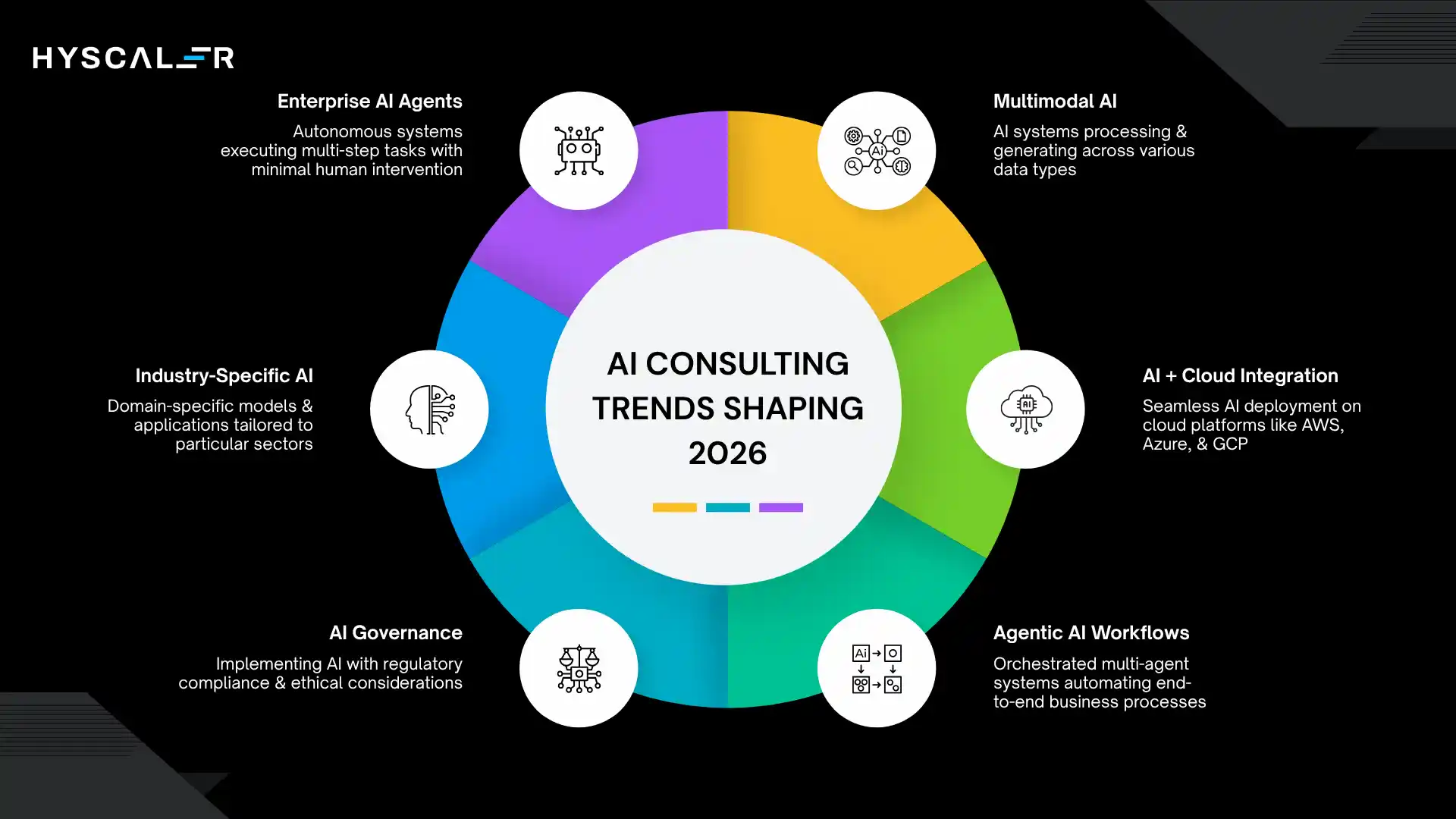
Rise of Enterprise AI Agents
Autonomous AI agent systems that can execute multi-step tasks, use external tools, and operate with minimal human intervention are moving from research curiosity to production deployment.
Enterprise demand for agent development expertise is accelerating rapidly in 2026.
Industry-Specific AI Solutions
Generic AI implementations are giving way to domain-specific models and applications.
Consulting firms with vertical depth are commanding premium positioning as organizations recognize that healthcare AI and financial services AI require fundamentally different expertise.
Insurance is a clear example, where insurance technology trends increasingly center on carriers and brokers replacing periodic manual reviews with continuous, verified property and exposure data feeding their underwriting models.
AI Governance and Responsible AI
The regulatory landscape is tightening globally.
The EU AI Act, U.S. AI executive orders, and sector-specific regulations are creating demand for governance-ready AI implementations.
Firms with strong responsible AI capabilities are differentiating significantly.
Multimodal AI Applications
AI systems that process and generate across text, image, audio, and structured data simultaneously are moving into production across industries.
Consulting firms building expertise in multimodal architectures are ahead of a fast-growing demand curve.
AI + Cloud Integration
AI without cloud-native infrastructure is increasingly untenable at scale.
The convergence of AI consulting with cloud architecture expertise on AWS, Azure, and GCP is becoming a baseline requirement rather than a differentiator.
Agentic AI Workflows
Organizations are moving beyond single-model AI applications toward orchestrated multi-agent systems that automate entire business processes end-to-end.
This is the fastest-growing area of enterprise AI demand in 2026.
Cost of Hiring an AI Consulting Company in the USA (2026)
Understanding AI consulting cost structures helps organizations budget appropriately and avoid sticker shock mid-engagement.
| Service Type | Estimated Cost Range | Notes |
|---|---|---|
| AI Readiness Assessment | $10,000 – $30,000 | Scope, team size, and depth of analysis drive variance |
| AI Strategy Workshop | $15,000 – $50,000 | Executive workshop vs. full roadmap development |
| AI Proof of Concept | $25,000 – $100,000 | Complexity of use case and data availability are key factors |
| Generative AI Solution | $50,000 – $500,000+ | RAG systems, copilots, and agents vary widely in complexity |
| Enterprise AI Deployment | $100,000 – $1M+ | Full-scale enterprise programs at top-tier firms can exceed this |
| AI SaaS Product Development | $75,000 – $500,000+ | End-to-end product builds, including infrastructure and MLOps |
| Ongoing MLOps & AI Operations | $5,000 – $30,000/month | Retainer-based post-deployment monitoring and support |
Note: Rates at top-tier management consulting firms (McKinsey, BCG, Deloitte) are typically at the upper end or above these ranges. Specialist engineering-focused firms and mid-size consultancies generally offer more competitive pricing for equivalent technical delivery.
Conclusion
The AI consulting market in 2026 is more differentiated than it has ever been.
The right partner for a Fortune 500 enterprise managing a multi-year regulatory AI transformation is not the same firm that is right for a Series B SaaS company embedding its first LLM features.
The firms in this guide represent the strongest options across different organizational profiles and AI objectives:
- For enterprise-scale transformation – Accenture, McKinsey, QuantumBlack, and Deloitte offer the broadest capabilities at the highest price points
- For AI product build and innovation – BCG X and HyScaler lead in combining strategy with hands-on engineering delivery
- For regulated industry compliance – Deloitte and PwC have the deepest AI governance expertise
- For cost-effective enterprise deployment – Cognizant, Infosys Topaz, and Capgemini offer competitive delivery models
- For AI product development combined with engineering execution: HyScaler offers a differentiated combination of strategic thinking, modern AI engineering capability, and flexible engagement models that make it the strongest choice for startups, SaaS companies, and enterprises building AI-powered products.
The best AI consulting partner is not necessarily the largest or most recognized.
It is the one whose capability profile aligns most precisely with your AI goals, technical requirements, budget, and timeline.
FAQ
What does an AI consulting company do?
An AI consulting company helps organizations identify AI opportunities, develop AI strategies, design and build AI systems, and deploy them in production environments. Engagements range from strategic advisory (defining where and how to invest in AI) through technical delivery (building and deploying AI applications) and ongoing support (monitoring, retraining, and governance of deployed AI systems).
How much does AI consulting cost in the USA?
AI consulting costs vary significantly based on engagement scope, firm type, and project complexity. Strategy workshops typically range from $15,000-$50,000. Full AI product development engagements range from $75,000-$500,000+. Enterprise transformation programs at major consulting firms can reach $1M+. Specialist firms like HyScaler offer more competitive pricing for engineering-focused AI delivery without sacrificing quality.
Which AI consulting company is best for startups?
Startups require AI consulting partners that offer flexible engagement models, fast delivery cycles, and the ability to scale without requiring enterprise-scale minimum commitments. HyScaler is purpose-built for this profile, offering startup-friendly engagement structures combined with the engineering depth to ship production AI systems rapidly.
Which AI consulting firms specialize in Generative AI?
Most major firms now claim generative AI capabilities. For deep technical execution of RAG architectures, LLM integration, AI agents, and GenAI application development, HyScaler, BCG X, and Accenture are among the strongest in the market. For generative AI strategy at the enterprise level, McKinsey, QuantumBlack, and Deloitte are frequently cited.
How long does an AI implementation project take?
Timeline depends heavily on scope and complexity. A focused AI proof of concept typically takes 4-8 weeks. A production-ready AI application can be delivered in 3-4 months with the right partner. Enterprise-scale AI transformation programs typically run 12-36 months. Specialist firms with engineering-forward delivery models generally achieve shorter timelines than strategy-led consulting firms.
What industries benefit most from AI consulting?
Every industry benefits from AI consulting, but the highest ROI applications currently concentrate in financial services (fraud detection, underwriting, compliance automation), healthcare (clinical documentation, diagnostic support, patient analytics), retail (demand forecasting, personalization, inventory optimization), manufacturing (predictive maintenance, quality inspection), and SaaS (AI feature development, personalization, intelligent automation).
Ready to Build Your AI Product?
HyScaler’s AI consulting and engineering team works with startups, SaaS companies, and enterprises to design, build, and deploy AI-powered products from initial strategy through production.
Talk to HyScaler’s AI Team →Explore AI Development Services →Learn About Enterprise AI Agents →