
Table of Contents
Most small business owners didn’t sign up to be technologists.
You’re already running sales, service, marketing, hiring, and finance, often before lunch.
Somewhere in the last two years, “add AI to the list” got added to that pile too, and it’s not an idle suggestion anymore.
By 2026, generative AI use among small businesses will have roughly tripled since 2023, and a majority of small firms now say they use some form of AI regularly.
That’s the encouraging part.
The harder part is that adoption and strategy are two very different things.
Most owners who’ve “used AI” have tried ChatGPT for an email draft or a social post, but have not built AI into how the business actually runs.
That gap between casual use and real operational advantage is exactly where AI consulting for small businesses earns its keep: identifying which problems are worth solving with AI, in what order, at what cost, and with what expected return, before you spend a dollar on tools or development.
This guide walks through what AI consulting actually involves, why it matters more in 2026 than it did even a year ago, what it typically costs, and how to pick a partner who won’t sell you more than you need.
What Is AI Consulting for Small Business?
AI consulting is the practice of helping a business figure out where artificial intelligence can realistically improve operations, then guiding or directly handling the work of getting there.
It sits upstream of software.
Buying an AI tool answers “what can this product do?” A consultant answers a different question first: “What does your business actually need to fix, and is AI the right way to fix it?”
That distinction matters because most wasted AI spend doesn’t come from bad software.
It comes from skipping the diagnosis and jumping straight to a purchase.
A full-service AI consulting engagement typically covers:
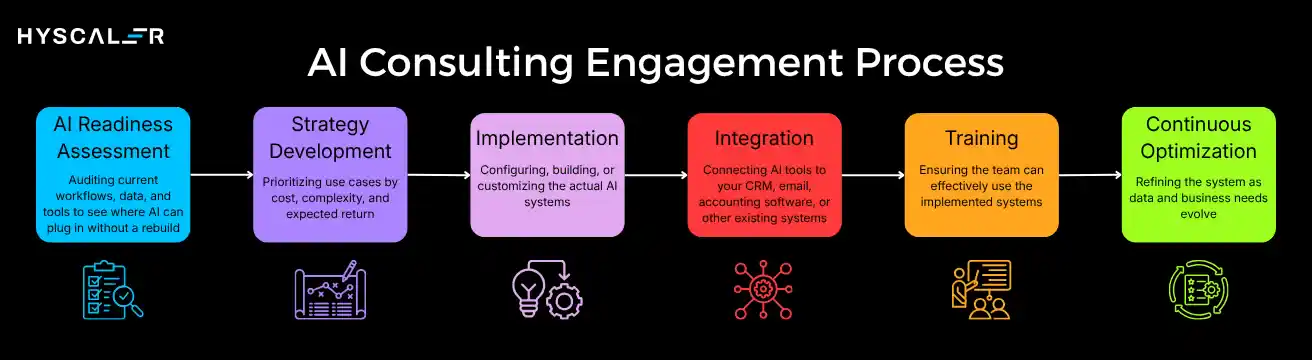
- AI readiness assessment: auditing current workflows, data, and tools to see where AI can plug in without a rebuild
- Strategy: prioritizing use cases by cost, complexity, and expected return
- Implementation: configuring, building, or customizing the actual AI systems
- Integration: connecting AI tools to your CRM, email, accounting software, or other existing systems
- Training: making sure your team can actually use what’s been built
- Continuous optimization: refining the system as your data and needs change
Not every engagement includes all six.
Some businesses just need a two-week assessment and roadmap; others want a consultant to build and run the whole thing.
Good consultants scope the engagement to match your actual need, not their sales quota.
Why Small Businesses Need AI Consulting in 2026
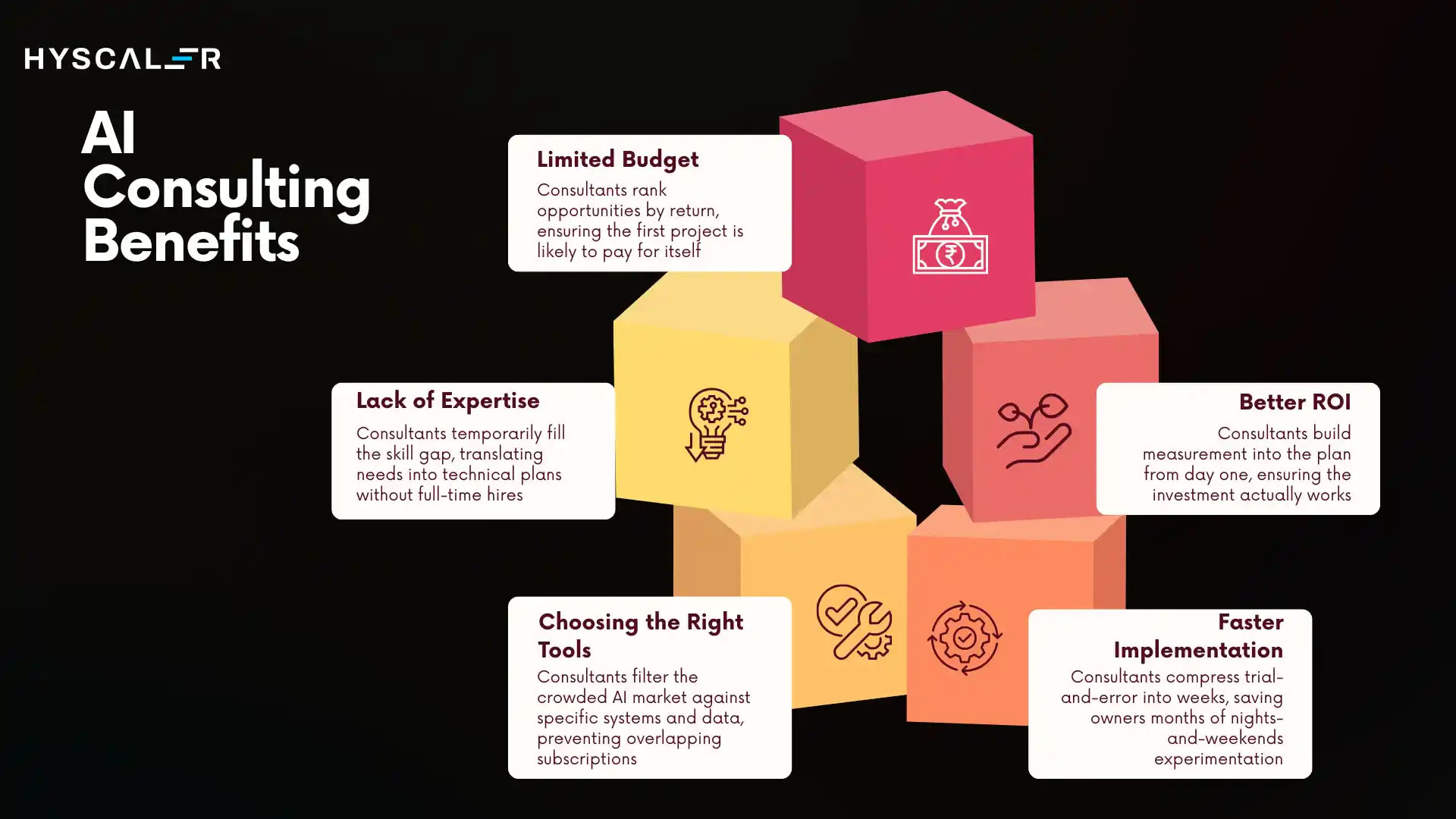
Limited Budget
Every dollar spent on the wrong tool is a dollar you don’t get back, and small businesses rarely have room to absorb that mistake.
A consultant’s job is to rank opportunities by return, so the first project you fund is the one most likely to pay for itself, not the flashiest demo you saw at a trade show.
Lack of AI Expertise
You don’t need to hire a data scientist to benefit from AI.
A consultant temporarily fills that skills gap, translating “we’re drowning in customer emails” into a concrete technical plan, without the overhead of a full-time AI hire you may not need year-round.
Choosing the Right AI Tools
The AI tooling market is crowded and growing more so by the month.
A surprisingly large share of small businesses using AI report struggling to identify which tools actually fit their workflow, rather than which ones have the best marketing.
A consultant filters that noise against your specific systems and data, so you’re not paying for three overlapping subscriptions six months from now.
Faster Implementation
Trial-and-error is expensive when you’re doing it yourself.
Consultants who’ve deployed similar systems before can compress a process that might take an owner months of nights-and-weekends experimentation into weeks.
Better ROI
An AI project without a defined success metric tends to quietly die after a month, then be forgotten.
Consultants build measurement into the plan from day one: hours saved, response time reduced, conversion rate lifted, so you know whether the investment actually worked.
Benefits of AI Consulting for Small Businesses
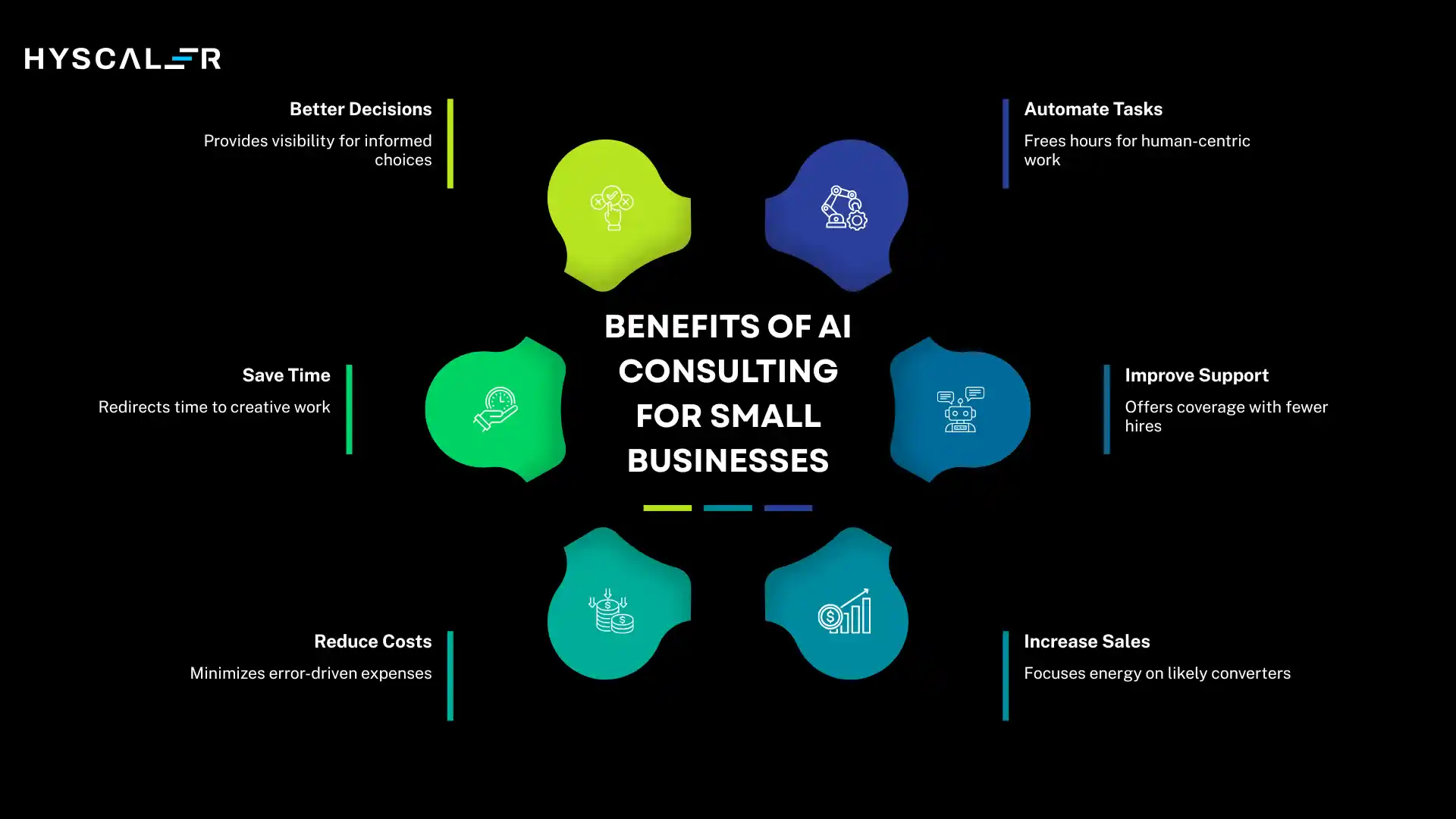
Automate Repetitive Tasks
Email triage, appointment scheduling, and data entry are exactly the kind of high-volume, low-judgment work that eats an owner’s day and is well-suited to automation, freeing hours for the parts of the business that actually need a human.
Improve Customer Support
AI chatbots, voice assistants, and automated ticket routing let a small team offer coverage that used to require several extra hires.
Customer service is now one of the fastest-growing AI use cases among small businesses, and for good reason: response time is one of the easiest wins to measure.
Increase Sales
Personalized product recommendations, AI-assisted CRM follow-ups, and lead scoring help a small sales team focus energy on the prospects most likely to convert, instead of treating every lead the same.
Reduce Operational Costs
Automation doesn’t just save time; it reduces the error-driven costs that come with manual work: missed invoices, duplicate data entry, and scheduling conflicts.
Small businesses that report AI reducing costs or improving efficiency now make up a strong majority of active adopters.
Better Business Decisions
AI-powered analytics and forecasting give owners visibility they used to need a finance team for sales trends, demand forecasts, and inventory needs surfaced automatically instead of being buried in a spreadsheet nobody has time to update.
Save Employee Time
Every task AI takes off a team member’s plate is time redirected toward work that actually requires a person: relationship-building, problem-solving, creative work.
That’s the compounding benefit that shows up in retention and morale, not just the P&L.
AI Consulting Services Small Businesses Should Consider
| Service | Business Value |
|---|---|
| AI Readiness Assessment | Understand where you actually stand before spending |
| AI Strategy | Build a prioritized roadmap tied to business goals |
| Workflow Automation | Cut manual, repetitive work |
| AI Chatbots | Extend customer support coverage without new hires |
| Predictive Analytics | Sharper forecasting and inventory planning |
| AI Agents | Automate multi-step business processes end-to-end |
| Custom AI Development | Solutions built around your specific workflow |
| Data Engineering | A reliable data foundation that AI tools can actually use |
| AI Integration | Connect AI to the systems you already run |
| Employee Training | Turn a new tool into a habit your team keeps using |
Industries That Benefit Most from AI Consulting
- Retail: inventory management, personalized recommendations, demand forecasting
- Healthcare: scheduling, clinical documentation support, patient engagement
- Finance: fraud detection, reporting automation, compliance workflows
- Manufacturing: predictive maintenance, quality control
- Real Estate: lead qualification, property matching
- Logistics: route optimization, fleet monitoring
- Professional Services: proposal generation, knowledge management, workflow automation
Adoption varies significantly by sector: retail, professional services, and healthcare already treat AI as close to a competitive baseline, while fields like construction and hospitality still have real first-mover advantage available for whoever moves first on administrative and scheduling automation.
Common AI Use Cases for Small Businesses
- AI-powered customer support and chatbots
- Marketing automation and campaign optimization
- Content creation (posts, product copy, ad variations)
- Sales forecasting
- Email automation and prioritization
- Document processing
- Invoice automation
- HR screening and resume triage
- Meeting summaries and note-taking
- Inventory optimization
- Demand forecasting
- Business intelligence dashboards
- AI search assistants for internal knowledge
- Internal knowledge bots for staff Q&A
- AI coding assistants for in-house technical work
Content creation and marketing remain the single most common entry point for small businesses experimenting with AI, with customer service and data analysis close behind, a pattern that holds across most 2026 industry surveys.
How the AI Consulting Process Works
1. Discovery: Understanding your business, goals, and current pain points through interviews and process review.
2. Business Assessment: Mapping existing workflows, systems, and data quality to see what’s actually usable.
3. AI Opportunity Analysis: Identifying where AI can realistically move the needle, ranked by feasibility and impact.
4. Roadmap Creation: Turning the highest-value opportunities into a phased, budgeted plan.
5. Pilot Project: Testing the top-priority use case on a small scale before committing further budget.
6. Full Implementation & Optimization: Rolling out proven solutions business-wide, then refining based on real usage data.
Signs Your Small Business Is Ready for AI
Not every business needs to start today, but a few signals suggest it’s time to talk to a consultant rather than keep experimenting solo:
- Your team is spending hours a week on repetitive, rules-based tasks (data entry, scheduling, basic email replies)
- You’re turning down growth opportunities because you don’t have the staff capacity to handle them
- You have decent data (customer records, sales history, support tickets), but no way to act on it systematically
- You’ve tried a free AI tool, liked what it did, and want to go further, but aren’t sure how
- Competitors in your space are visibly moving faster on service, pricing, or marketing than your team can match manually
If two or three of these sound familiar, a focused AI readiness assessment is usually a low-risk next step, far cheaper than a full implementation, and it tells you exactly where to spend first.
A 30-60-90 Day AI Adoption Roadmap for SMBs
Days 1–30: Assess and Prioritize: Audit current workflows and data quality. Identify the two or three highest-friction, highest-volume tasks in the business. Rank them by expected time or cost savings versus implementation difficulty.
Days 31–60: Pilot One Use Case: Choose the single highest-value, lowest-risk opportunity, often customer support or a marketing workflow, and run a contained pilot. Set a measurable target before you start (e.g., cut average response time by 40%), not after.
Days 61–90: Measure, Train, and Expand: Review the pilot against your target. Train the team on what worked. If the numbers hold up, expand to a second use case; if they don’t, adjust the approach before spending further. This phased pattern, one department, one workflow, measured before scaling, consistently outperforms trying to roll AI out everywhere at once.
DIY AI Tools vs. AI Consultant vs. AI Consulting Firm
| Approach | Best For | Tradeoffs |
|---|---|---|
| DIY AI Tools (ChatGPT, Canva AI, off-the-shelf apps) | Very small teams testing single tasks with no budget for outside help | Fast and cheap to start, but no integration, no strategy, and results plateau quickly |
| Independent AI Consultant | Businesses needing a focused assessment or a single well-defined project | More personal, often lower cost than a firm, but limited bandwidth for larger or multi-system builds |
| AI Consulting Firm | Businesses ready for integration, custom development, or ongoing support | Broader team and capability, typically higher cost, but built for scaling past a single tool or task |
Many small businesses start with DIY tools, hit a ceiling around six months in, and bring in a consultant once the manual limits of free tools become obvious, usually around data security, integration, or the need for something tools weren’t designed to do out of the box.
How Much Does AI Consulting for Small Businesses Cost?
Pricing depends heavily on scope, so treat any flat number with suspicion.
Broadly, engagements fall into a few categories:
| Type | Typical Structure |
|---|---|
| AI Assessment | Fixed-fee project, usually the lowest-cost entry point |
| Strategy Workshop | Fixed fee, short-term engagement |
| Implementation | Project-based, scoped to the specific build |
| Monthly Advisory | Ongoing retainer for continued guidance |
| Enterprise AI Development | Custom pricing based on complexity |
What drives cost up or down:
- Scope of the project (single workflow vs. multiple departments)
- Number and complexity of integrations
- Data quality and how much cleanup is needed before AI can use it
- Whether the project needs a custom model or an off-the-shelf configuration
- Security and compliance requirements
- Whether ongoing support is included
Rather than shopping by price alone, weigh cost against expected return.
A more expensive engagement that automates a task consuming 15 hours a week can pay for itself faster than a cheap tool that never gets fully adopted.
A Simple ROI Example
Say a customer support automation project costs $6,000 to implement and reduces manual ticket handling by 12 hours per week.
At a fully loaded cost of $25/hour for that work, that’s $300/week, or roughly $15,600/year in reclaimed staff time, a payback period under five months, before counting any gains from faster response times or higher customer satisfaction.
Run this same math against your own numbers before committing to any project; it’s the fastest way to separate a good investment from an expensive experiment.
Mistakes Small Businesses Make When Adopting AI
- Buying tools without a strategy: subscribing to AI software because it’s trending, not because it solves a defined problem
- Poor data quality: feeding AI tools messy, incomplete, or inconsistent data and expecting clean results
- Ignoring employee training: rolling out a tool and assuming the team will figure it out
- Trying to automate everything at once: spreading a limited budget too thin instead of proving value on one workflow first
- Unrealistic expectations: expecting AI to replace judgment-heavy work it isn’t suited for
- No success metrics: never defining what “working” looks like before launch
- Choosing vendors solely on price: picking the cheapest option without checking integration support or long-term reliability
How to Choose the Right AI Consulting Partner
✔ Industry expertise relevant to your business
✔ Actual AI development capability, not just tool reselling
✔ Experience integrating with systems like yours
✔ Clear security and data compliance practices
✔ Verifiable case studies with real, measurable outcomes
✔ Transparent, scope-based pricing rather than vague estimates
✔ Willingness to support you after launch, not just at delivery
✔ Solutions built to scale as your business grows
✔ A defined implementation methodology, not an improvised process
A quick gut check: if a consultant can’t explain, in plain language, how they’ll measure success before the project starts, that’s worth a second conversation before you sign anything.
Conclusion
AI is no longer a large-enterprise advantage.
The tools are accessible, the cost of entry has dropped sharply, and small businesses that adopt with intention are already outperforming those still experimenting without a plan.
The risk isn’t moving too slowly on AI; it’s spending money on the wrong project before you understand which one actually matters.
A strategic approach, starting with a focused readiness assessment rather than a tool purchase, protects that investment and points you toward the use case most likely to pay for itself.
From there, the right consulting partner helps you identify high-impact opportunities, implement them efficiently, and measure whether they actually worked so your next AI decision is based on evidence, not guesswork.
If you’re not sure where to start, the smallest first step is usually the right one: a readiness assessment that tells you exactly where AI fits in your business before you commit to anything bigger.
FAQ
What is AI consulting for small businesses?
It’s advisory and implementation work that helps a small business identify where AI can realistically improve operations, then plan, build, and integrate the right solution rather than buying software and hoping it fits.
Is AI consulting worth it for a small business?
For businesses with a clear, repetitive pain point and some budget to invest, yes, especially since a strong majority of small businesses actively using AI report real reductions in cost or improvements in efficiency. It’s less worth it if you just want to try a free chatbot for occasional tasks; that doesn’t need a consultant yet.
How much does AI consulting cost?
It varies widely based on scope, from a few thousand dollars for a focused assessment to significantly more for custom development and integration. Most firms price by project scope rather than a flat rate.
Can AI help businesses with fewer than 50 employees?
Yes, in fact, the smallest businesses have shown some of the fastest AI adoption rates, largely because a small team benefits disproportionately from automating even a few hours of manual work per week.
What industries benefit most from AI consulting?
Retail, healthcare, finance, real estate, logistics, and professional services see some of the clearest early returns, though almost any business with repetitive manual workflows can benefit.
How long does AI implementation take?
A focused pilot can often launch within 30–60 days. Larger, multi-system integrations typically take longer, depending on data readiness and complexity.
Do I need technical expertise to use AI?
No. Good implementations are designed for the team that will actually use them day to day, with training built into the rollout.
What AI tools do consultants typically recommend?
It depends entirely on the use case and existing systems. Good consultants recommend tools based on your workflow and data, not a fixed shortlist.
How do I measure ROI from AI projects?
Set a specific, measurable target before the project starts: hours saved, response time reduced, conversion lift, and track it against a defined baseline, not a vague sense of “it feels faster.”
Can AI consulting help with customer service and sales?
Yes, these are two of the highest-return use cases for small businesses, from chatbots and ticket routing to lead scoring and personalized recommendations.