

Table of Contents
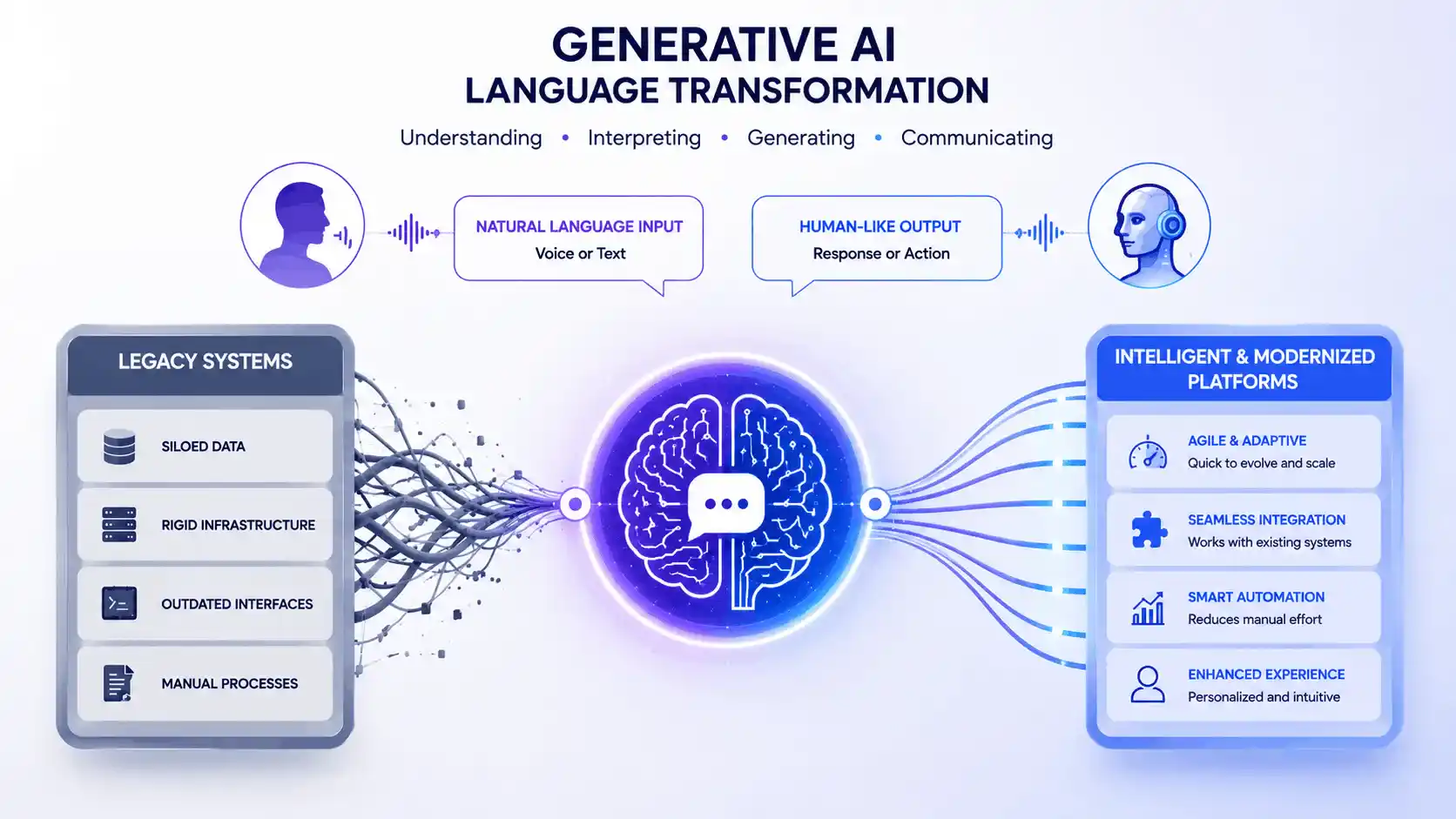
Generative Artificial Intelligence has moved far past being a simple upgrade to existing tools. At the center of this shift sits Gen AI’s innovation in language transformation: the ability to understand and generate human-like communication at scale. This capability is now the driving force behind the modernization of legacy systems across healthcare, finance, and e-commerce, turning rigid, outdated infrastructure into agile, adaptive platforms.
What Makes Gen AI’s Innovation Different
Gen AI’s innovation isn’t just a technical upgrade; it’s a shift in how machines relate to language itself. Unlike earlier automation tools that followed rigid rules, Gen AI’s innovation lies in its capacity to interpret context, tone, and intent behind a piece of communication, not just the words themselves.
What sets it apart from traditional automation:
- Context awareness: reads meaning beyond keyword matching
- Tone recognition: adapts responses based on how something is said, not just what is said
- Intent detection: identifies the goal behind a query, even when phrased informally
- Flexible input handling: processes natural language queries without requiring rigid, pre-defined formats
This is where Gen AI’s innovation becomes genuinely transformative for legacy systems. Older platforms were often built around static rules and fixed input formats. Gen AI’s innovation injects flexibility into that structure, allowing systems to process natural language the way a person would, rather than requiring users to adapt to rigid system logic.
Healthcare: Smarter Records, Better Diagnostics
Healthcare has long struggled with legacy systems built around complex medical terminology and inconsistent documentation formats. Gen AI’s innovation addresses this directly by streamlining medical language processing and improving the accuracy of digital health records.
Where it makes a measurable difference:
- Documentation: converts unstructured clinical notes into structured, searchable records
- Diagnostic support: surfaces relevant medical literature faster for physicians
- Care team communication: reduces miscommunication caused by inconsistent terminology
- Patient time: frees up staff time previously spent on manual documentation
Tools like IBM Watson for Healthcare apply Gen AI’s innovation to interpret dense medical literature, helping physicians make faster, better-informed decisions.
Finance: Sharper Risk Models, Smarter Decisions
Financial institutions are pairing Gen AI’s innovation with advanced quantitative models built on tools like TensorFlow.
Key areas of impact:
- Risk assessment: identifies nuanced patterns across large, unstructured datasets
- Market analysis: surfaces trends that manual review would likely miss
- Customer communication: improves clarity and responsiveness in client-facing interactions
- Decision-making speed: shortens the time between data and actionable insight
By combining Gen AI’s innovation in language understanding with TensorFlow’s deep learning capabilities, institutions can extract meaningful insight from large, unstructured datasets far faster than legacy tools allow.
E-commerce: Personalization at Scale
E-commerce platforms often run on legacy systems that struggle to deliver truly personalized experiences. Gen AI’s innovation, paired with natural language processing tools & AI in HR, changes that equation.
How personalization improves:
- Query interpretation: understands what a shopper actually wants, not just literal keywords
- Recommendation accuracy: connects user intent to relevant product suggestions
- Conversational interfaces: supports natural back-and-forth instead of rigid menu navigation
- Modernization without replatforming: adds a personalization layer on top of existing systems
Amazon’s Alexa is a clear example: it applies Gen AI’s innovation to interpret user queries and generate product recommendations that actually reflect what a shopper wants.
Why Gen AI’s Innovation Works Better Paired with Other AI Tools
Gen AI’s innovation rarely operates in isolation. Its real strength shows up when it’s paired with other specialized AI tools.
Why the pairing works:
- Division of labor: Gen AI handles language; domain tools handle specialized analysis
- Faster deployment: layered integration avoids full system overhauls
- Cross-industry flexibility: the same core approach adapts across healthcare, finance, and retail
- Incremental modernization: legacy systems evolve in stages, not all at once
This kind of AI tools integration strategy allows Gen AI’s innovation to focus on what it does best, understanding and generating language, while domain-specific tools handle deeper analytical work.
This combination of generative AI with existing technologies is also useful when enterprises need to modernize complex legacy environments. By combining AI-driven capabilities with existing systems and workflows, organizations can gradually improve applications without having to replace the entire technology stack at once. Ascendion is an example of how this approach can be applied to help enterprises navigate complex modernization initiatives while making better use of their existing technology investments.
Technical Architecture: How the Integration Actually Works
Behind the language and personalization improvements, there’s a fairly consistent technical pattern across healthcare, finance, and e-commerce implementations. Breaking it down layer by layer:
- Input layer: the user’s query arrives as natural voice or text, without needing a rigid, predefined format
- Language layer: this is where the language model interprets context, tone, and intent behind the query
- Integration layer: a middleware/API layer sits between the language model and the existing legacy stack, so the underlying database and business logic don’t need to be rebuilt
- Domain-tool layer: specialized tools (TensorFlow for financial modeling, IBM Watson for medical literature, etc.) run in parallel with the legacy system to handle deeper analytical work
- Output layer: the final response, record update, or recommendation is returned to the user
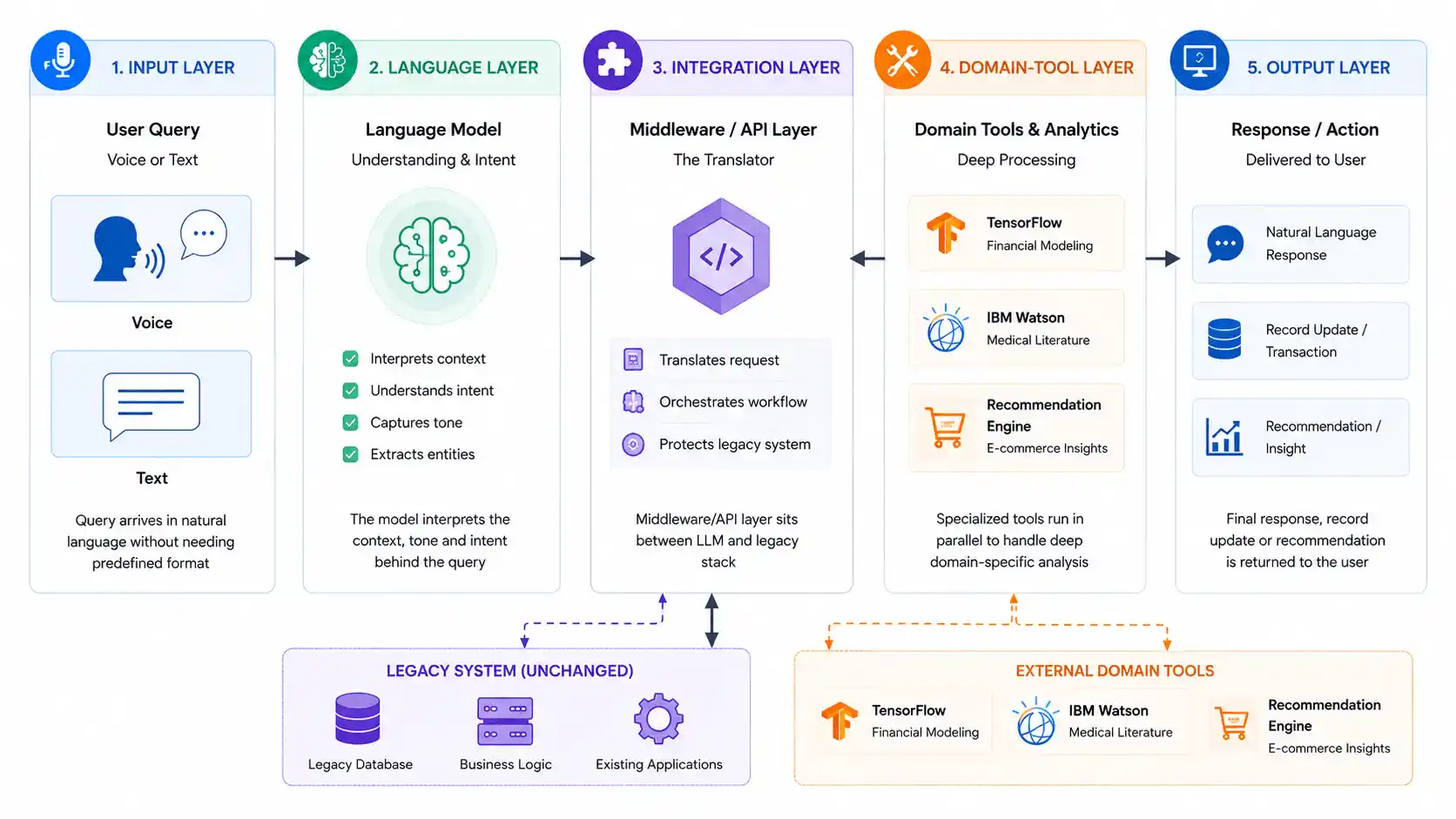
The key technical takeaway is that the legacy system is never replaced; it’s wrapped. The integration layer acts as a translator between modern language interfaces and older, rule-based infrastructure, which is why this kind of modernization tends to be faster and lower-risk than a full rebuild.
Gen AI Toolkit: Industry-Wise Breakdown
| Healthcare | Finance | E-commerce | Customer support | Content & marketing | Development | Data & analytics |
|---|---|---|---|---|---|---|
| IBM Watsonx for Health | TensorFlow | Amazon Alexa | Salesforce Agentforce (formerly Einstein GPT) | Jasper | GitHub Copilot | Google Vertex AI |
| Nuance DAX Copilot (Dragon Copilot) | Bloomberg GPT | Shopify Sidekick | Intercom Fin | Grammarly Business | Amazon Q Developer (formerly CodeWhisperer) | Microsoft Azure OpenAI Service |
| Suki AI | BlackRock Aladdin | Klaviyo | Zendesk AI | Copy.ai | Cursor | AWS SageMaker |
| Abridge | AlphaSense | Algolia | Ada | Writer | Replit Agent | Databricks Mosaic AI |
| Hippocratic AI | Hebbia | Bloomreach | Freshdesk Freddy AI | Surfer SEO | Tabnine | Snowflake Cortex AI |
| Nabla | MindBridge | Nosto | Drift | Canva Magic Studio | Sourcegraph Cody | DataRobot |
| Aidoc | Kasisto (KAI) | Dynamic Yield | Forethought | Semrush ContentShake AI | Windsurf (Codeium) | Qlik AutoML |
Addressing Challenges and Paving the Way Forward
Navigating the integration of Gen AI innovations and AI tools into our technological landscape represents a frontier of unparalleled potential, albeit not without its share of intricate challenges. The ethical dimensions of artificial intelligence, the intricacies of data privacy, and the imperative for responsible AI deployment constitute critical considerations that demand meticulous attention.
Adopting Gen AI’s innovation at scale isn’t without friction. A few considerations organizations can’t skip over:
| Challenge | What It Means | Why It Matters |
|---|---|---|
| Data privacy | How user and patient data is collected, stored, and used | Mishandled data creates legal and trust risks, especially in healthcare and finance |
| Algorithmic transparency | Being able to explain how and why a decision was made | Regulators and users increasingly expect explainable outcomes, not black-box answers |
| Bias and fairness | Ensuring outputs don’t reinforce existing inequities | Unchecked bias can quietly skew diagnostics, lending decisions, or hiring outcomes |
| Accountability | Clear ownership when AI-assisted decisions affect real outcomes | Without clear ownership, errors are harder to trace, correct, or take responsibility for |
These challenges don’t cancel out the benefits, but they do require deliberate planning. Legacy systems modernized with Gen AI’s innovation still need clear governance around how data is used, how decisions are explained, and how accountability is maintained.
The Future Landscape: Gen AI, AI Tools, and Language Evolution
The trajectory is clear: Gen AI’s innovation, combined with the broader ecosystem of AI tools, is reshaping how legacy systems evolve across healthcare, finance, and e-commerce. This isn’t a one-time upgrade cycle; it’s an ongoing shift toward systems that are more adaptive, more conversational, and more capable of keeping pace with how people actually communicate.
Where this is headed:
- From assistive to agentic: tools are moving from answering queries to autonomously completing multi-step tasks
- Deeper cross-tool collaboration: language models increasingly hand off work to specialized domain tools rather than working alone
- Continuous modernization, not one-time projects: legacy systems are treated as an ongoing evolution rather than a single migration
- Higher expectations for explainability: as adoption grows, so does the demand for transparent, auditable AI decisions
Organizations that treat Gen AI’s innovation as a long-term modernization strategy, rather than a single project, are the ones best positioned to keep their legacy infrastructure relevant as expectations around AI-driven digital transformation continue to rise.
FAQs
Can generative AI actually replace a full legacy rewrite, or is it just an assistant?
It’s an assistant, not a replacement. This is where Gen AI’s innovation functions best, supporting engineers through targeted changes rather than attempting a full, unsupervised rebuild of undocumented architecture.
Is it safe to feed proprietary legacy code into a public AI model?
Not without safeguards. Enterprise teams generally use private, on-premises, or enterprise-grade AI solutions rather than public models when working with proprietary source code, since data privacy is a real risk.
What’s the realistic ROI on these AI modernization projects?
Mixed and worth tempering expectations around. A widely cited study found that a large share of enterprise generative AI pilots delivered no measurable return, though the reasons were rarely about the model’s quality itself.
Can AI tools handle massive legacy codebases in one go, or is there a limit?
There’s a real technical ceiling. Teams that tried processing tens of thousands of files at once hit memory and context limits and had to shift from bulk processing to targeted, line-by-line changes instead.
Can AI understand undocumented business logic buried in old code?
Largely, yes. Modern tools can read large legacy codebases and generate human-readable summaries, surfacing hidden “shadow business rules” that were never formally documented.
How does Gen AI actually connect to a decades-old legacy system?
Through a middleware/API integration layer that sits between the language model and the existing database and business logic, the legacy system is wrapped, not replaced.