
Table of Contents
Customers now expect instant answers, at any hour, on any channel.
Hiring enough human agents to meet that expectation around the clock is expensive, and traditional IVR systems, with their rigid menus and “press 1 for…” prompts, frustrate callers more often than they help them.
AI voice agents have changed that equation.
Powered by advances in speech recognition and large language models, they can understand natural speech, reason through a request, and respond conversationally, without a human on the other end of the line.
As a result, businesses across every sector are replacing static phone systems and overstretched call centers with conversational AI that scales instantly and never clocks out.
The market reflects that shift.
The global AI voice agents market was valued at roughly $2.5 billion in 2025 and is projected to grow at a compound annual rate of around 39% through 2033, with healthcare emerging as the fastest-growing segment.
Enterprise adoption has followed suit: production voice agent deployments grew by an estimated 340% year over year, and Gartner projects that conversational AI will cut contact center labor costs by $80 billion globally in 2026 alone.
In this guide, you’ll learn everything about AI voice agents, from how they work to where they deliver ROI and how businesses can successfully implement them.
What Are AI Voice Agents?
Definition
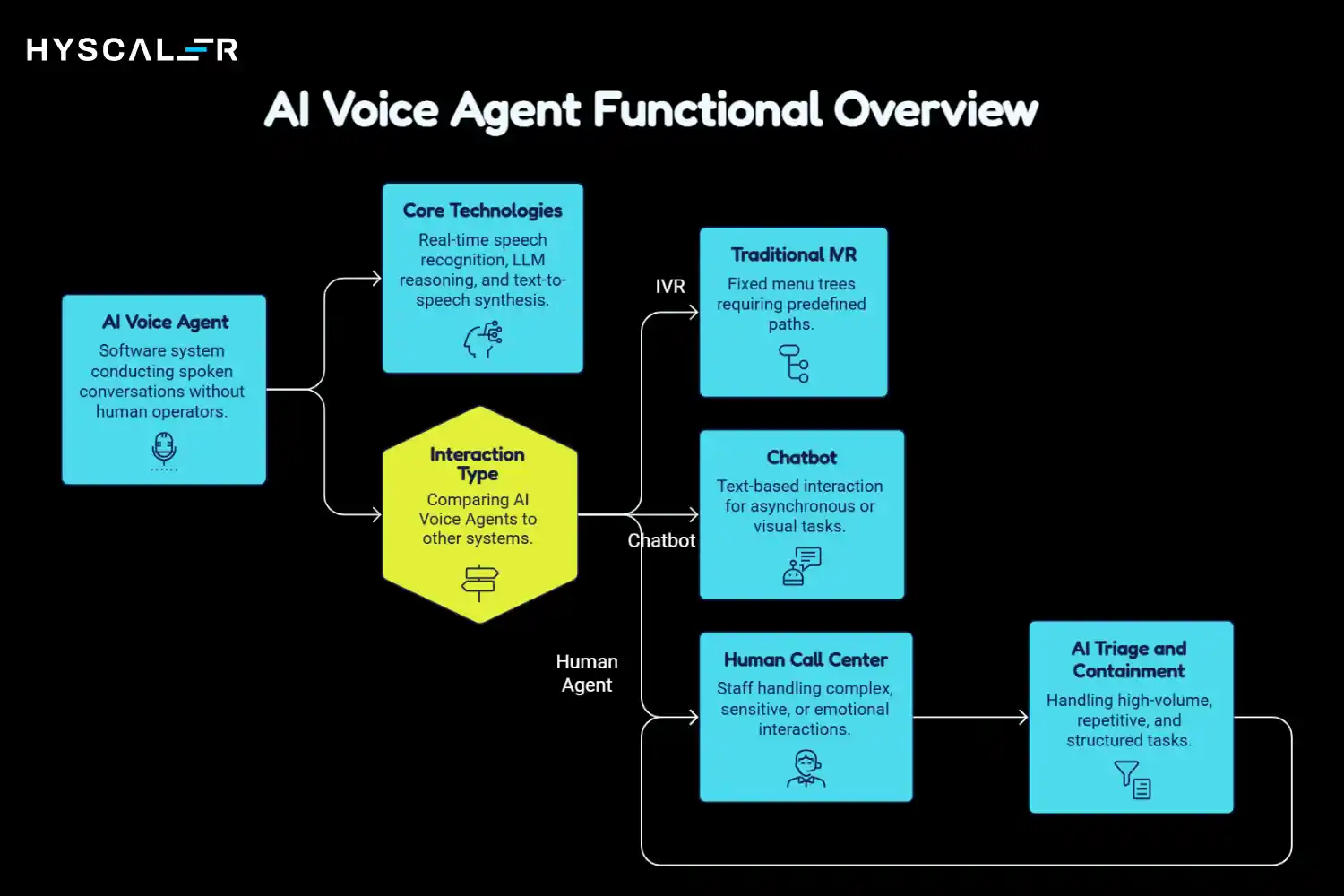
An AI voice agent is a software system that conducts spoken conversations with customers or employees, understands their intent, and completes tasks or answers questions without a human operator.
Unlike scripted voice assistants, modern AI voice agents combine real-time speech recognition, large language model reasoning, and text-to-speech synthesis to hold fluid, multi-turn conversations that closely resemble talking to a trained representative.
AI Voice Agent vs. Traditional IVR
Traditional Interactive Voice Response (IVR) systems rely on fixed menu trees: press 1 for billing, press 2 for support, and so on.
Callers must fit their request into a predefined path, and anything outside that structure typically leads to a dead end or a long hold.
AI voice agents remove the menu entirely.
Callers simply say what they need, in their own words, and the system interprets intent dynamically rather than matching it against a rigid script.
AI Voice Agent vs. Chatbot
Chatbots and voice agents share the same underlying reasoning layer in many cases, but the interaction channel changes the experience substantially.
Voice is faster for many use cases, hands-free, and more natural for people who prefer speaking over typing, particularly for urgent, emotional, or complex requests.
Text-based chatbots remain better suited to asynchronous or highly visual interactions, such as sharing documents or links.
AI Voice Agent vs. Human Call Center
AI voice agents are not a wholesale replacement for human agents; they are a triage and containment layer.
They handle high-volume, repetitive, and structured conversations, such as appointment booking or order status checks, at a fraction of the cost and with no wait time, while escalating complex, sensitive, or emotionally charged calls to trained staff.
The most effective deployments combine both, with the AI agent absorbing volume so human agents can focus on the interactions that genuinely need judgment and empathy.
How AI Voice Agents Work
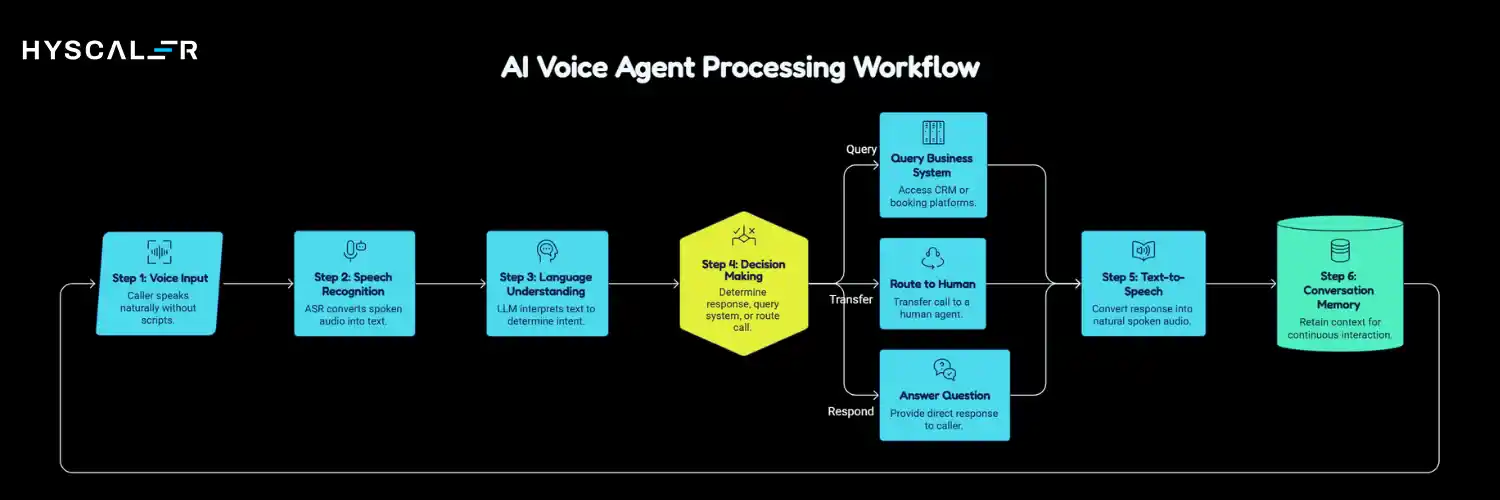
At a technical level, an AI voice agent processes a call through six sequential stages:
Step 1: Voice Input – The caller speaks naturally, without needing to follow a script or menu structure.
Step 2: Speech Recognition – Automatic Speech Recognition (ASR) converts spoken audio into text in real time.
Step 3: Language Understanding – A large language model interprets the transcribed text to determine intent, extract relevant details, and decide what the caller actually needs.
Step 4: Decision Making – The system determines the appropriate response or action, whether that’s answering a question directly, querying a connected business system (like a CRM or booking platform), or routing the call to a human agent.
Step 5: Text-to-Speech – The response is converted back into natural-sounding spoken audio using voice synthesis.
Step 6: Conversation Memory – The system retains context from earlier in the call (and, in more advanced deployments, from prior interactions), so the conversation feels continuous rather than starting from zero at every turn.
This entire loop typically completes within a few hundred milliseconds, close to the natural pause length in human conversation, which is part of why modern voice agents feel dramatically more fluid than the voice assistants of just a few years ago.
Key Components of an AI Voice Agent
A production-grade AI voice agent is built from several interlocking components:
- Speech Recognition (ASR): Converts spoken language into accurate text, even across accents and background noise.
- Natural Language Understanding (NLU): Extracts intent, entities, and sentiment from the transcribed conversation.
- Large Language Models (LLMs): Provide the reasoning layer that interprets context and generates coherent, relevant responses.
- Voice Synthesis (TTS): Produces natural, human-like speech output, increasingly with adjustable tone and emotional inflection.
- Conversation Memory: Maintains context across a single call or, for more advanced systems, across a customer’s entire history.
- APIs and Business Integrations: Connect the agent to CRMs, scheduling tools, payment systems, and internal databases so it can take real action, not just talk.
- Analytics Dashboard: Tracks containment rate, resolution accuracy, call outcomes, and other KPIs so teams can monitor and continuously improve performance.
Benefits of AI Voice Agents
| Benefit | Why It Matters |
|---|---|
| 24/7 availability | Calls are answered around the clock, including nights, weekends, and holidays |
| Faster response times | No hold queues; conversations begin immediately |
| Reduced operational costs | Voice AI typically costs a small fraction of a human agent’s hourly cost |
| Higher customer satisfaction | Consistent, immediate service improves the overall experience |
| Better scalability | Handles call volume spikes instantly, without hiring or training |
| Multilingual support | Serves global customers in multiple languages without added headcount |
| Consistent service quality | Every caller receives the same accurate, on-policy information |
| Personalized interactions | Can recognize returning callers and tailor responses using account data |
| Lower call abandonment | Immediate pickup reduces the number of callers who hang up while waiting |
| Better lead qualification | Captures and scores inbound leads automatically, in real time |
The cost differential is one of the clearest drivers of adoption.
Industry estimates put AI voice agent costs at roughly $0.07 to $0.40 per minute or call, compared with $5 to $12 (and often more for complex or transferred calls) for a human-handled interaction, a gap wide enough that most contact centers report 30–50% overall cost reduction on the call types they automate.
Top AI Voice Agent Use Cases
Customer Support

Problem: Support lines are overwhelmed during peak hours, leading to long holds.
AI Solution: The agent handles common questions (order status, account details, troubleshooting steps) instantly.
Business Outcome: Reduced average handle time and higher first-call resolution.
Example: A retail brand’s voice agent resolves “where is my order” queries without any wait, freeing human agents for complex disputes.
For enterprise customer support, platforms such as Parloa take voice AI beyond basic question answering by enabling conversational agents to handle customer interactions across voice, chat, and messaging. These agents can understand customer intent, maintain conversation context, and automate support workflows while escalating more complex cases to human agents. This approach helps businesses scale customer service while maintaining consistent and personalized interactions across channels.

Sales Qualification

Problem: Sales teams waste time manually qualifying every inbound lead.
AI Solution: The agent asks qualifying questions and scores leads automatically.
Business Outcome: Faster speed-to-lead and higher conversion rates.
Example: A SaaS company’s voice agent qualifies demo requests and books meetings directly onto reps’ calendars.
Appointment Booking

Problem: Missed calls mean missed bookings, especially after hours.
AI Solution: The agent checks availability and books, reschedules, or cancels appointments conversationally.
Business Outcome: Fewer no-shows and higher calendar utilization.
Example: A dental clinic’s agent confirms and reschedules appointments overnight, when the front desk is closed.
Healthcare

Problem: Patient calls for scheduling and triage overwhelm front-desk staff.
AI Solution: The agent handles scheduling, prescription refill requests, and basic triage routing.
Business Outcome: Reduced missed-call revenue loss and improved patient access.
Example: A multi-location practice recovers revenue from calls that would previously go unanswered after hours.
Banking

Problem: Routine balance and transaction inquiries clog call center queues.
AI Solution: The agent securely verifies identity and answers account questions.
Business Outcome: Reduced call center load and faster resolution for simple requests.
Example: A regional bank’s agent handles card-lock requests instantly, escalating fraud cases to specialists.
Insurance

Problem: Claims status inquiries generate high call volume.
AI Solution: The agent provides real-time claims updates and collects First Notice of Loss (FNOL) details.
Business Outcome: Faster claims intake and reduced adjuster workload.
Example: An insurer’s voice agent captures accident details immediately after a claim is filed by phone.
Retail

Problem: Product and order questions spike during promotions.
AI Solution: The agent answers product availability and order questions in real time.
Business Outcome: Improved conversion during high-traffic periods.
Example: An e-commerce brand fields order-tracking calls without adding seasonal staff.
Restaurants

Problem: Phone orders go unanswered during rush hours.
AI Solution: The agent takes orders and reservations, even during peak call volume.
Business Outcome: No missed orders, higher table utilization.
Example: A multi-location chain captures every incoming order call, even at peak dinner rush.
Travel

Problem: Booking changes and flight status inquiries generate high call volume.
AI Solution: The agent handles rebooking, cancellations, and status updates.
Business Outcome: Reduced call center strain during disruptions.
Example: An airline’s agent manages rebooking calls during weather-related delays.
Logistics

Problem: Shipment status calls are repetitive and high-volume.
AI Solution: The agent provides real-time tracking information conversationally.
Business Outcome: Reduced call center headcount needs for tracking inquiries.
Example: A logistics provider automates delivery status updates for thousands of daily calls.
HR & Recruitment

Problem: Screening candidates by phone is time-consuming.
AI Solution: The agent conducts initial screening calls and schedules interviews.
Business Outcome: Faster time-to-hire and reduced recruiter workload.
Example: A staffing firm’s agent pre-screens applicants before human recruiters engage.
IT Helpdesk

Problem: Internal IT tickets for common issues overload support staff.
AI Solution: The agent resolves routine requests like password resets conversationally.
Business Outcome: Reduced ticket volume and faster employee resolution times.
Example: An enterprise IT desk contains a majority of internal service requests through its voice agent, according to reported industry benchmarks.
Industries Using AI Voice Agents
| Industry | Primary Use Case |
|---|---|
| Healthcare | Scheduling, triage, prescription refills |
| Finance | Account inquiries, fraud alerts, collections |
| Retail | Order tracking, product questions |
| SaaS | Lead qualification, support triage |
| Education | Enrollment inquiries, student support |
| Manufacturing | Supplier coordination, order status |
| Telecom | Plan changes, outage reporting |
| Real Estate | Property inquiries, showing scheduling |
| Government | Citizen service inquiries |
| Hospitality | Reservations, guest services |
Healthcare is currently the fastest-growing vertical for voice AI adoption, with industry forecasts projecting a compound annual growth rate above 40% through the early 2030s, driven largely by scheduling automation and after-hours patient access.
In financial services, BFSI (banking, financial services, and insurance) is reported to hold the largest overall adoption share among industry verticals.
AI Voice Agents vs. Traditional Call Centers
| Factor | AI Voice Agents | Traditional Call Centers |
|---|---|---|
| Cost per interaction | Fraction of a cent to a few cents per minute | $5–$12+ per call, often higher when transferred |
| Speed | Immediate pickup, no hold time | Subject to queue length and staffing |
| Availability | 24/7/365 | Limited to staffed hours |
| Accuracy | High for structured, well-scoped tasks | Variable, dependent on training and fatigue |
| Scalability | Instant, handles volume spikes automatically | Requires hiring and onboarding lead time |
| Personalization | Data-driven, consistent across every call | Depends on individual agent knowledge |
| Maintenance | Requires ongoing model tuning and monitoring | Requires ongoing training and turnover management |
| Analytics | Granular, real-time reporting by default | Often manual or sampled QA |
| Languages | Scales to multiple languages without new hires | Requires bilingual staff for each language |
| Human involvement | Reserved for complex or sensitive cases | Handles every call regardless of complexity |
The most effective operating model is not “AI or humans,” but a blended one: AI agents absorb high-volume, structured interactions, and human agents are reserved for the calls that genuinely require judgment, empathy, or complex problem-solving.
Business Benefits (ROI)
The financial case for AI voice agents has become well documented across independent research firms.
Reported figures include:
- Cost reduction: Contact centers automating call types with voice AI report 30–50% average operational cost reduction, with per-interaction savings as high as 70–90% compared to traditional call costs, a range corroborated across research from ISG, Deloitte, Forrester, and PwC.
- Higher conversions: Businesses using voice AI to qualify inbound leads report meaningfully faster speed-to-lead and improved conversion rates, since every caller is engaged immediately rather than waiting in a queue.
- Reduced wait times: With no hold queue, average handle time drops by an estimated 25–50% in reported deployments.
- Increased customer satisfaction: Reported customer satisfaction with AI voice interactions has risen substantially over the past few years as conversational quality has improved.
- Higher first-call resolution: Consistent, data-backed responses reduce the need for repeat contacts.
- Employee productivity: Freed from repetitive calls, human agents can focus on higher-value, complex interactions.
- Revenue growth: Recovering previously missed after-hours calls and reducing abandonment directly protects revenue that would otherwise be lost.
A Forrester Consulting study on enterprise voice AI deployments reported a three-year ROI in the range of 331–391%, with payback periods typically under six months, figures broadly consistent with other independent analyses citing positive ROI within two to nine months depending on call volume and use case.
Common Challenges
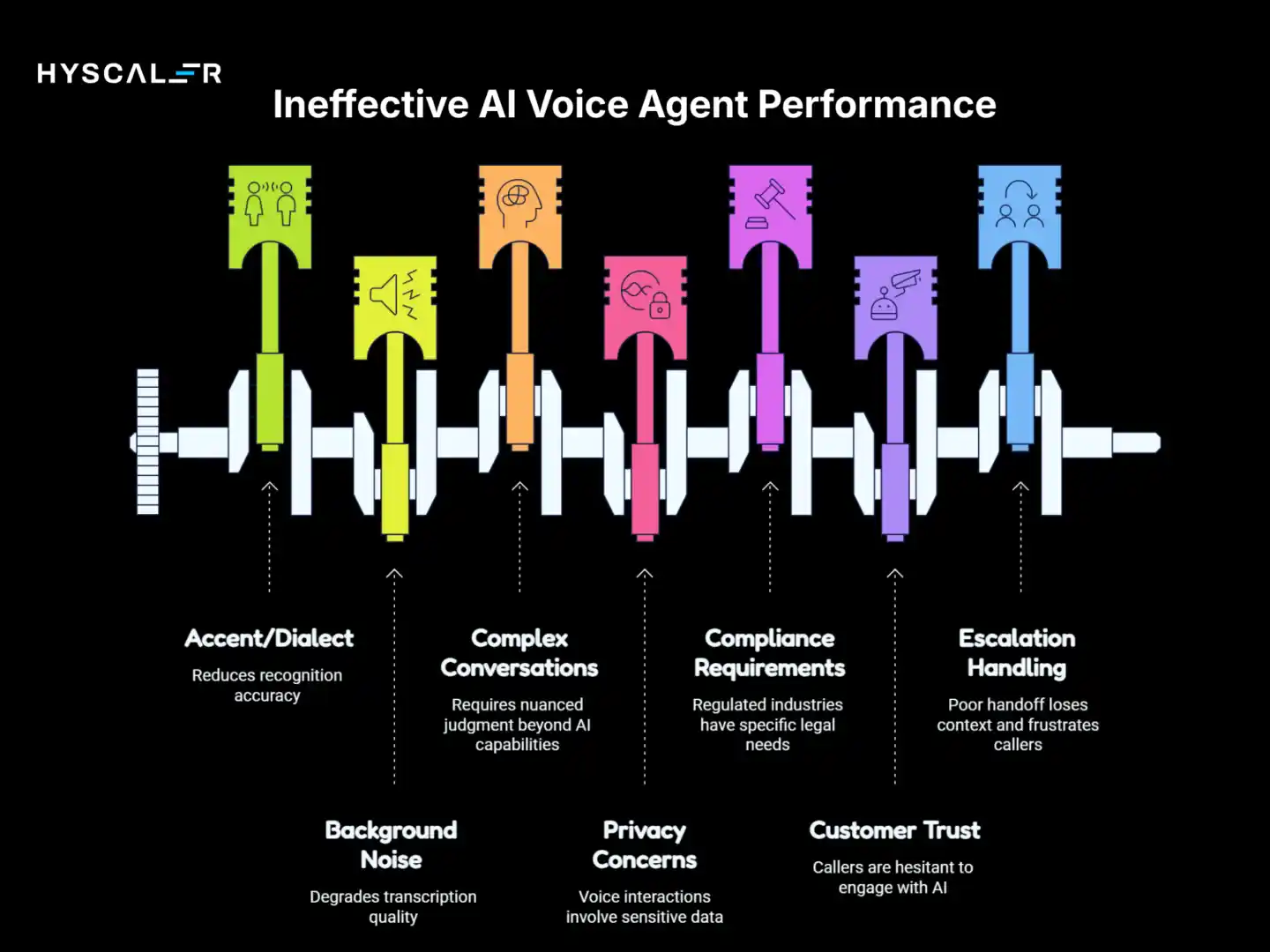
Accent and dialect understanding – Regional accents and speech patterns can reduce recognition accuracy.
How to solve it: Choose ASR models trained on diverse, representative speech data and continuously monitor recognition accuracy by region.
Background noise – Noisy environments can degrade transcription quality.
How to solve it: Use noise-cancellation preprocessing and confirm critical details back to the caller before acting on them.
Complex, multi-intent conversations – Some calls genuinely require nuanced judgment.
How to solve it: Build clear escalation logic that hands off to a human agent, with full conversation context, when confidence drops.
Privacy – Voice interactions often involve sensitive personal or financial data.
How to solve it: Apply real-time redaction of sensitive information and enforce strict data retention policies.
Compliance – Regulated industries (healthcare, finance) carry specific legal requirements.
How to solve it: Select platforms with relevant certifications, such as HIPAA or PCI DSS compliance, built into the architecture.
Customer trust – Some callers remain hesitant to engage with an AI system.
How to solve it: Be transparent that the caller is speaking with an AI agent, and always offer an easy path to a human.
Escalation handling – A poorly designed handoff can lose context and frustrate the caller.
How to solve it: Ensure the receiving human agent gets a full summary of what the AI attempted and why it escalated.
Best Practices for Implementing AI Voice Agents
- Define clear business goals before selecting a platform, whether that’s cost reduction, coverage expansion, or lead capture.
- Start with one workflow: Pick a single high-volume, well-structured use case (appointment booking or order status, for example) before expanding scope.
- Build a human fallback into every flow: No deployment should trap a caller without an escalation path.
- Invest in continuous training: Voice agents improve with ongoing tuning against real call transcripts.
- Measure the right KPIs: Track containment rate, resolution accuracy, average handle time, and customer satisfaction, not just call volume handled.
- Prioritize security from day one: Encrypt call data in transit and at rest, and limit access to sensitive information.
- Build for compliance: Confirm the platform meets the regulatory requirements of your industry before launch.
- Optimize continuously: Treat the voice agent as a living system that needs regular review, not a one-time deployment.
How to Choose the Right AI Voice Agent Solution
Use this checklist when evaluating vendors:
- Accuracy: How well does the platform perform on real-world speech, not just controlled demos?
- Integrations: Does it connect natively to your CRM, scheduling, and payment systems?
- Scalability: Can it handle concurrent call spikes without degraded performance?
- Security: What encryption, access controls, and data handling policies are in place?
- Customization: Can the conversation flow and voice be tailored to your brand?
- Analytics: Does it provide real-time, granular reporting on outcomes?
- Pricing model: Is pricing per-minute, per-call, or per-resolution, and does it match your call volume pattern?
- Vendor support: What level of onboarding and ongoing support is included?
- Industry expertise: Has the vendor built agents for your specific sector’s compliance and workflow requirements?
AI Voice Agents in the Future
Several trends are shaping where voice AI is headed over the next few years:
- Emotional voice AI: Systems increasingly detect and respond to caller tone and sentiment, not just words.
- Real-time translation: Live cross-language conversations without a human interpreter are becoming commercially viable.
- Deeper personalization: Agents increasingly draw on full customer history to tailor every interaction.
- Autonomous business workflows: Voice agents are expanding beyond answering questions to completing entire multi-step processes end to end.
- AI-powered customer success: Proactive outbound check-ins are becoming a standard part of retention strategy.
- Industry-specific voice agents: Purpose-built agents trained on vertical-specific compliance and terminology are replacing generic, one-size-fits-all systems.
- Voice-first enterprise applications: Internal tools, not just customer-facing ones, are increasingly being redesigned around voice interaction.
Analysts broadly agree that the line between “chatbot” and “voice agent” will continue to blur, as businesses move toward unified conversational AI platforms that operate seamlessly across voice, chat, and messaging from a single underlying system.
Why Businesses Choose HyScaler for AI Voice Agent Development
Building a production-grade AI voice agent involves far more than connecting a speech API to a language model.
It requires the right architecture, integrations, and safeguards to perform reliably at scale.
Custom Voice AI Development
HyScaler designs voice agents around your specific workflows and customer conversations, rather than forcing your business into a generic template.
Enterprise Integrations
Voice agents are connected directly to your CRM, scheduling, payment, and support systems, so they can take real action, not just answer questions.
Workflow Automation
Beyond simple Q&A, HyScaler builds agents capable of completing multi-step processes end-to-end, from qualification to booking to follow-up.
Industry Expertise
HyScaler brings experience across sectors with distinct compliance and operational needs, helping ensure the solution fits your industry’s specific requirements from day one.
Secure AI Solutions
Data handling, encryption, and access controls are built into the architecture from the start, not added as an afterthought.
Scalable Architecture
Solutions are built to handle call volume growth and added use cases over time, without requiring a rebuild.
Looking to build AI voice agents tailored to your business?
HyScaler helps organizations design, develop, and deploy secure, scalable voice AI solutions that automate customer interactions and improve operational efficiency.
FAQ
What is an AI voice agent?
An AI voice agent is a software system that has natural spoken conversations with callers, understanding their intent and completing tasks or answering questions without a human operator.
How do AI voice agents work?
They combine speech recognition, natural language understanding, large language model reasoning, and text-to-speech synthesis to interpret what a caller says and respond conversationally in real time.
Are AI voice agents better than chatbots?
Neither is universally “better”; they serve different needs. Voice is faster and more natural for urgent or complex spoken requests, while chatbots suit asynchronous, text-based, or visually detailed interactions.
What industries use AI voice agents?
Healthcare, finance, retail, SaaS, education, manufacturing, telecom, real estate, government, and hospitality are among the leading adopters, with healthcare currently the fastest-growing segment.
Can AI voice agents replace call centers?
They typically don’t replace call centers entirely, but they absorb high-volume, structured calls, allowing human agents to focus on complex or sensitive interactions.
How much does an AI voice agent cost?
Pricing generally ranges from a few cents to under half a dollar per minute or call, depending on the platform and complexity, compared with several dollars per call for human-handled interactions.
Are AI voice agents secure?
Reputable platforms include encryption, real-time redaction of sensitive data, and industry-specific compliance certifications such as HIPAA or PCI DSS, but security depends heavily on the specific vendor and configuration chosen.
Can AI voice agents book appointments?
Yes. Appointment booking, rescheduling, and cancellation are among the most common and highest-ROI use cases for AI voice agents.
Do AI voice agents support multiple languages?
Yes, most modern platforms support multilingual conversations, allowing a single deployment to serve global customer bases without additional bilingual staffing.
What is the difference between AI voice agents and virtual assistants?
Virtual assistants (like general-purpose smart speaker assistants) are typically designed for broad, personal tasks, while AI voice agents are purpose-built for specific business workflows, such as support, sales, or scheduling.
How long does it take to build an AI voice agent?
Timelines vary by complexity and integrations required, ranging from a few days for a narrowly scoped deployment to several weeks or months for a fully integrated, multi-workflow enterprise system.
Can small businesses use AI voice agents?
Yes. Adoption among small and mid-sized businesses has grown rapidly, as usage-based pricing models make voice AI accessible without large upfront infrastructure investment.