
Table of Contents
Quick Summary: Legacy application modernization services help organizations transform outdated, monolithic software into cloud-native, AI-ready systems that cut costs, improve security, and accelerate growth.
This guide covers every strategy, technology, and business case your team needs to make the right decision and execute it successfully.
What Are Legacy Application Modernization Services?
Legacy application modernization services are professional engagements that transform outdated, underperforming software systems into modern, cloud-native, and AI-ready platforms without discarding the years of embedded business logic those systems hold.
Think of it like renovating a structurally sound building rather than tearing it down and starting over.
The foundation (your core business processes) is preserved.
The structure (architecture, code, and infrastructure) is rebuilt to meet today’s demands.
A legacy system, in terms of 2026, is not solely defined by age.
It is defined by what it cannot do:
- It cannot support real-time AI or machine learning workloads
- It cannot integrate cleanly with modern APIs or cloud services
- It cannot scale to meet mobile or high-concurrency demands
- It cannot be patched at the cadence modern cybersecurity requires
- It cannot attract or retain modern engineering talent
Legacy application modernization services bridge that gap through a combination of assessment, architecture redesign, migration, re-platforming, and ongoing engineering support.
Why 2026 Is the Tipping Point for Modernization
Three converging forces have pushed legacy modernization from a “nice to have” to a board-level imperative.
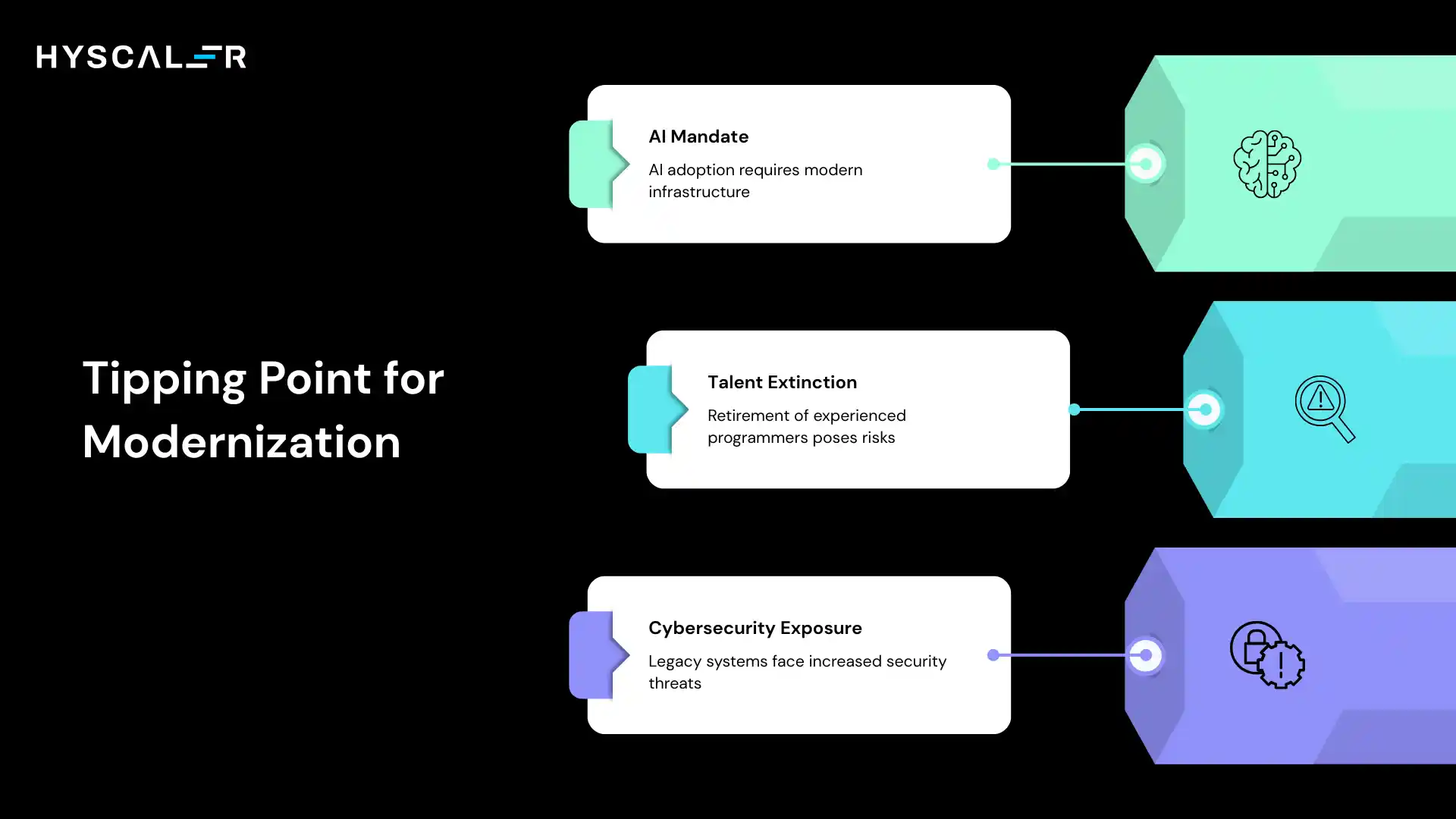
The AI Mandate
Generative AI and agentic workflow adoption accelerated sharply in 2025 and 2026.
But here’s what most organizations discovered too late: AI cannot run on legacy infrastructure.
AI workloads require real-time data pipelines, millisecond-latency API access, and continuous model training capabilities that batch-processing, siloed legacy systems simply cannot provide.
Modernization is no longer just about efficiency.
It is the prerequisite for participating in the AI economy.
The Talent Extinction Problem
The typical COBOL programmer was expected to be around 70 years old by 2025, with nearly all COBOL talent projected to retire by 2030.
Fewer than 2,000 COBOL programmers graduated worldwide in 2024.
When the institutional knowledge walking out the door is your system’s documentation, you face an existential risk that no maintenance contract can fix.
Cybersecurity and Compliance Exposure
Cyber insurance providers fundamentally changed underwriting requirements in 2026, treating legacy systems on unsupported platforms as unacceptable risks.
Organizations running Windows Server 2012, outdated Java frameworks, or end-of-life databases face policy non-renewal or premium increases.
Zero Trust security frameworks, now required by many compliance standards, simply cannot be layered on top of legacy architectures that lack modern identity management and network segmentation.
The True Cost of Doing Nothing
Most organizations dramatically underestimate what legacy systems are actually costing them.
The maintenance invoice is only one line of a much longer bill.
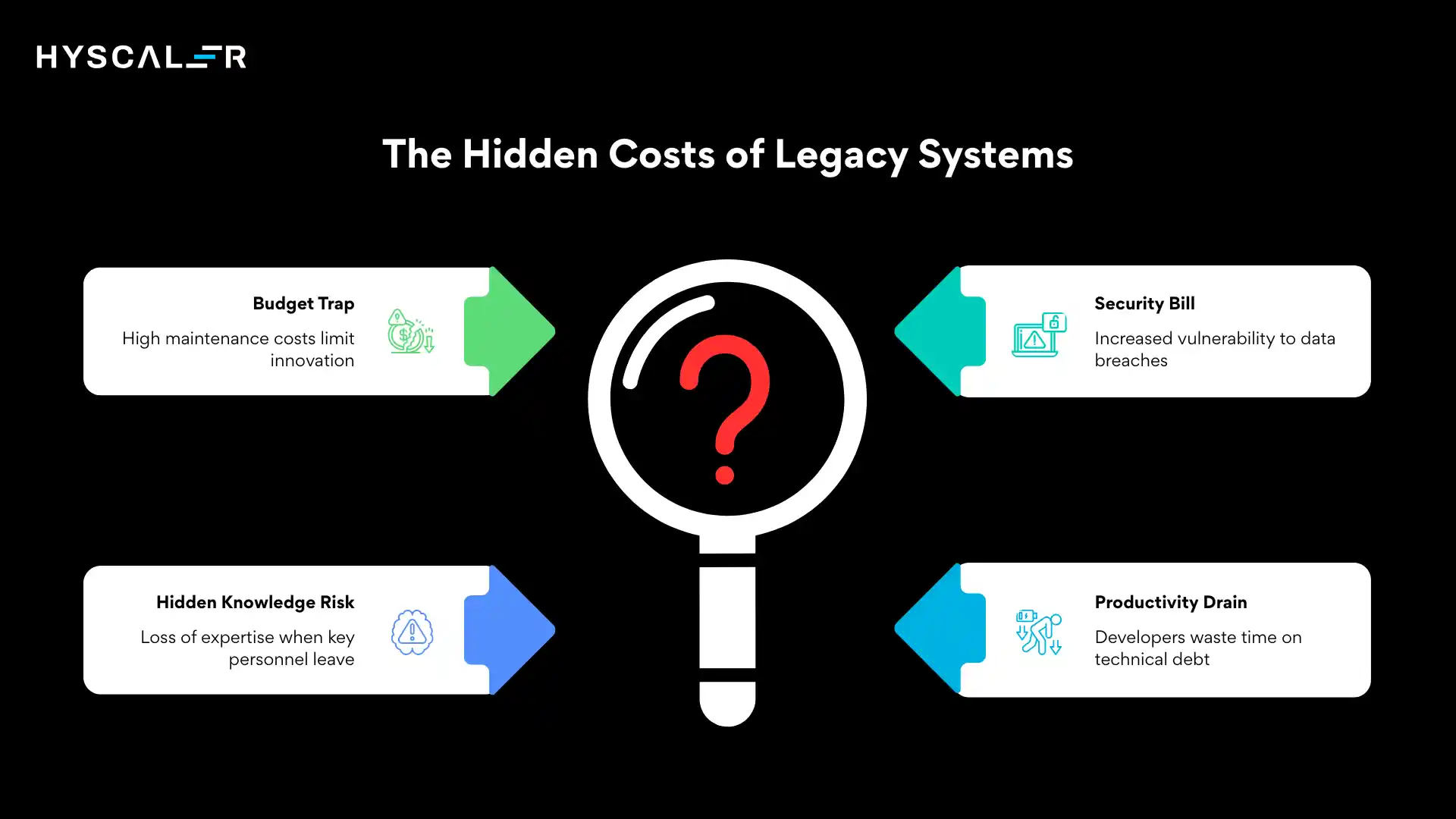
The Budget Trap
Industry data consistently showed that enterprises allocated 60 to 80% of their IT budgets to maintaining old systems, leaving a fraction for innovation and growth.
Gartner estimated that by 2025, companies would spend 40% of their IT budgets on maintaining technical debt alone.
Put simply: if 70–80% of your engineering capacity is consumed keeping lights on, less than 30% remains to build the competitive advantages your business actually needs.
The Security Bill
IBM’s 2024 Cost of a Data Breach Report found that the average financial-sector breach cost reached $6.08 million, significantly above the global average of $4.88 million.
Outdated and unsupported systems consistently show significantly higher exposure to security vulnerabilities due to missing patches and unsupported software components.
Research shows that unpatched vulnerabilities are involved in a significant percentage of data breaches, and legacy or unsupported systems are especially vulnerable because they often lack current security updates.
The Productivity Drain
According to a survey by Stripe, software developers spent an average of 13.5 hours per week, nearly a third of their time addressing technical debt.
When developers themselves were asked how many hours they “wasted” on maintaining bad legacy code, the average answer was 17.3 hours per week.
That is not an IT problem.
It is a strategy problem, and it compounds every quarter.
The Hidden Knowledge Risk
In many legacy environments, critical business logic exists primarily in undocumented code and the institutional knowledge of long-tenured employees.
As experienced personnel retire or leave, organizations face growing operational and modernization risks.
The 7 R’s: Core Legacy Application Modernization Strategies
There is no single playbook for modernization.
The right approach depends on system complexity, business criticality, budget, and transformation goals.
The industry-standard framework is the “7 R’s,” each representing a distinct strategy with distinct trade-offs.
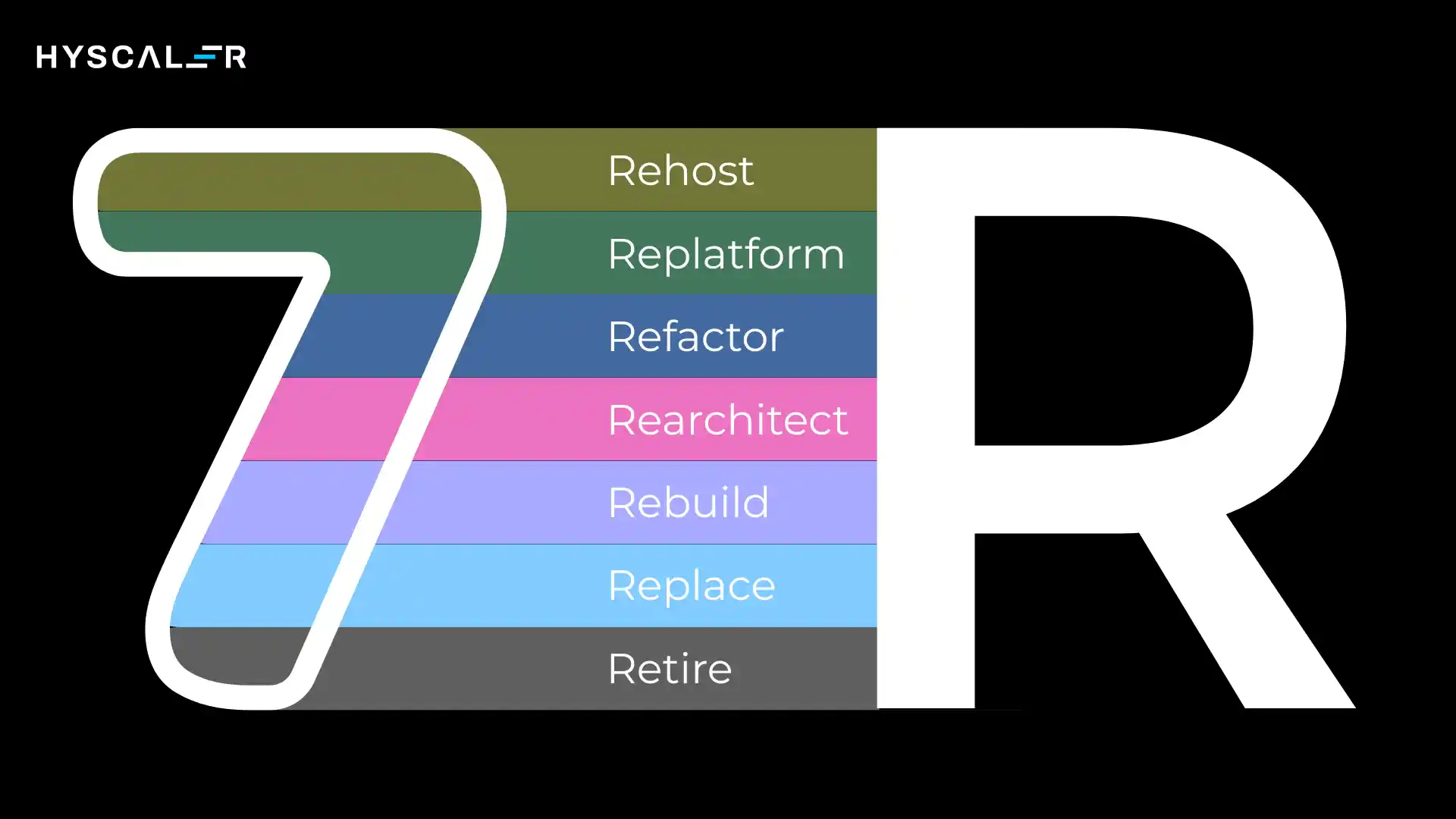
1. Rehost (Lift and Shift)
Move the application to a new infrastructure, typically cloud, with minimal code changes.
It is the fastest path to the cloud and offers immediate infrastructure cost savings.
It is best used as a stepping stone, not a final destination. Limited cloud-native benefits are realized at this stage.
2. Replatform (Lift and Reshape)
Move to a new platform while making targeted optimizations.
For example, migrating an application to the cloud while simultaneously moving its database to a managed database service.
More cloud-native benefits than rehosting, with manageable risk.
3. Refactor
Restructure the existing code and architecture to improve maintainability, scalability, and performance without changing external behavior.
This is ideal when the core business logic is sound, but the internal architecture is inefficient or monolithic.
4. Rearchitect
Redesign the system’s architecture more fundamentally, often breaking a monolith into microservices or event-driven services.
Research from Mordor Intelligence shows that re-architecting is expected to expand at a CAGR of 22.74% until 2031, making it the fastest-growing method in modernization.
5. Rebuild
Rewrite the application from scratch, preserving its original scope and business logic but using modern languages, frameworks, and architectural patterns.
This is the highest-effort approach but yields the best outcomes for systems that have genuinely passed the point of repair.
6. Replace (Repurchase)
Decommission the legacy application and replace it with a third-party SaaS solution.
This is the right call when the application’s function is not a competitive differentiator, HR systems, basic CRM, or generic finance workflows, and a well-matched commercial product exists.
7. Retire
Portfolio audits typically reveal that 15–30% of applications are retirement candidates.
Retiring redundant or obsolete systems first reduces the scope of everything that follows and frees budget for higher-priority modernization.
Pro Insight: Most enterprise modernization programs use a combination of all seven strategies across different applications. A thorough portfolio assessment is what determines which R applies to which system.
AI and Legacy Modernization: The New Game-Changer
In 2025 and 2026, AI stopped being a reason to modernize and became the engine that makes modernization faster, cheaper, and less risky.
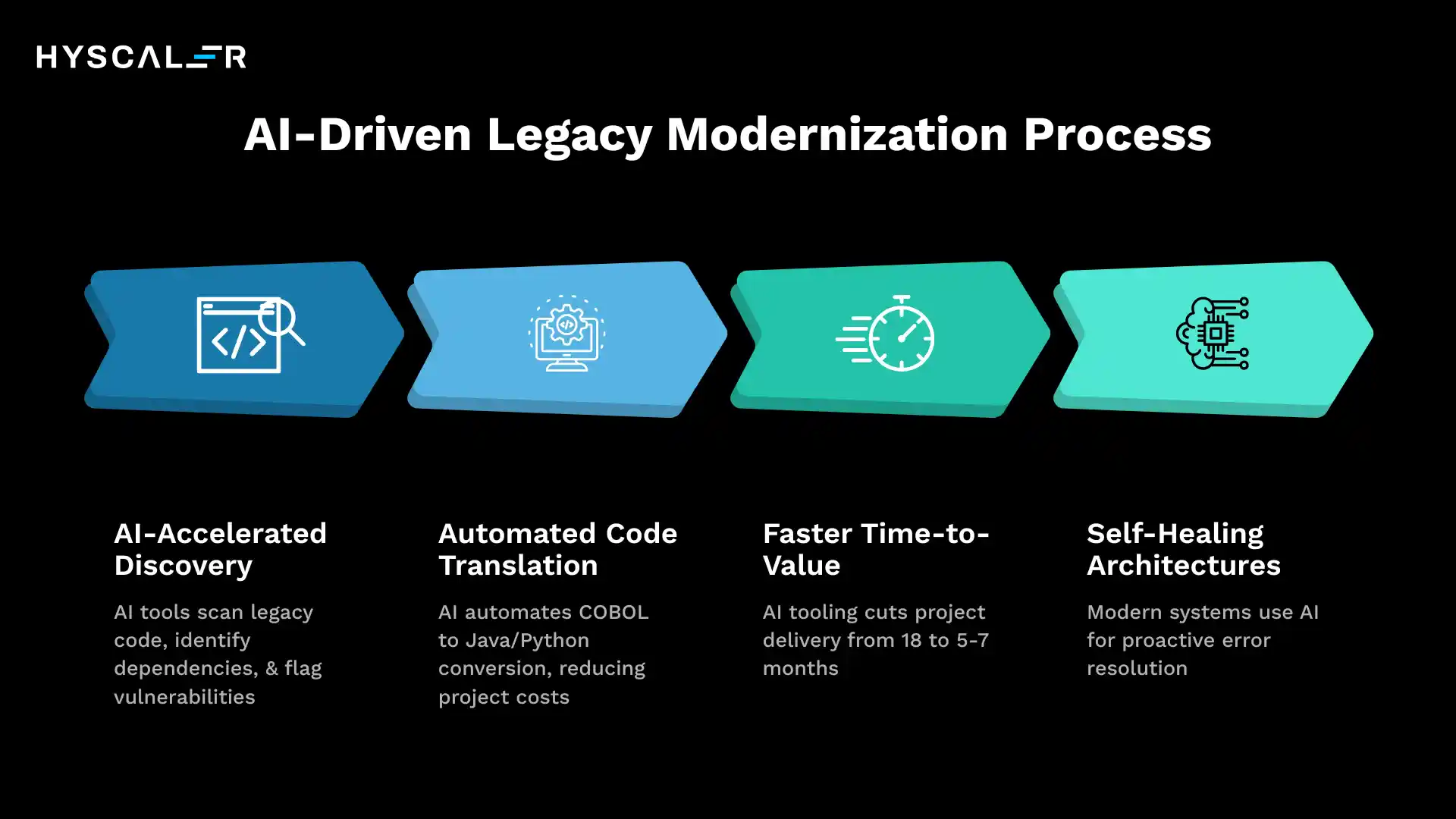
AI-Accelerated Discovery and Assessment
Historically, the assessment phase, understanding what a legacy codebase actually does, consumed the majority of the project budget.
AI-powered code analysis tools now scan undocumented legacy estates, visualize hidden dependencies, flag security vulnerabilities, and generate refactoring roadmaps in a fraction of the time.
Automated Code Translation
AI tools can automate the conversion of legacy languages like COBOL into modern languages like Java or Python, with far greater speed and accuracy than manual rewriting.
The average cost of a typical COBOL modernization project dropped from $9.1 million in 2024 to $7.2 million in 2025, according to industry tracking.
This is primarily due to AI tooling reducing the discovery and translation phases that consumed the majority of the project budget a 21% cost reduction in a single year.
Faster Time-to-Value
A project that would have taken 18 months traditionally can be delivered in 5 to 7 months with AI tooling.
This fundamentally changes the ROI math for projects that were previously borderline.
Self-Healing Architectures
Modern systems built today use intelligent automation to proactively resolve common errors before they impact users.
When combined with observability tooling and FinOps dashboards, this creates a “continuous modernization” posture rather than a one-time program.
Key Technologies Powering Legacy Application Modernization Services
The best modernization outcomes come from a deliberate combination of technologies chosen to match the organization’s specific architecture, industry, and goals.
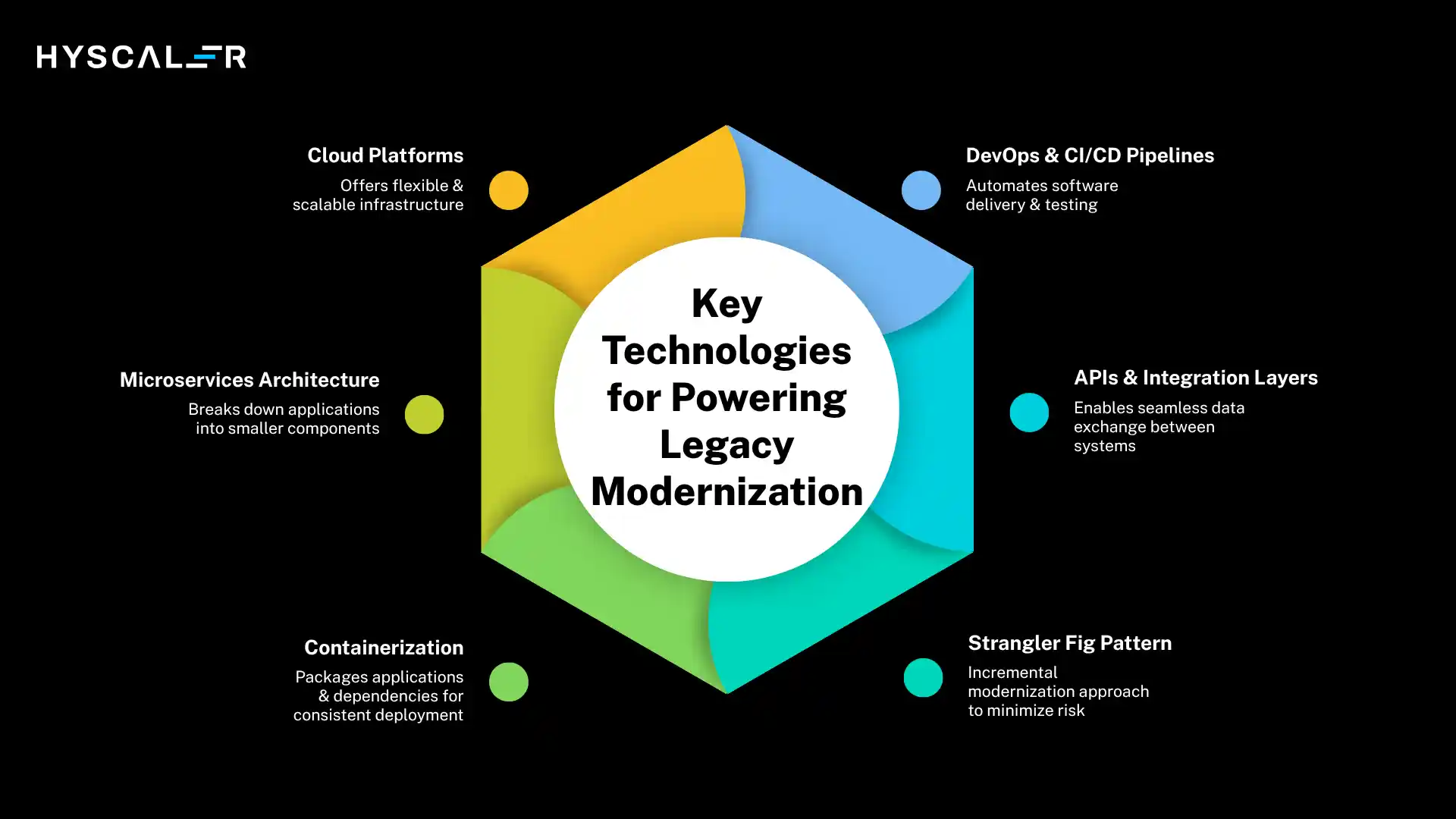
Cloud Platforms (AWS, Azure, Google Cloud)
Cloud computing platforms such as AWS, Azure, and Google Cloud offer flexible infrastructure for cloud application modernization without needing upfront hardware purchases.
They provide the elastic scalability, managed databases, and AI/ML services that legacy on-premises systems cannot match.
Microservices Architecture
Microservices involve breaking down large, monolithic applications into smaller, more manageable components or services.
The practice of encapsulating certain data or components within well-defined boundaries is essential to achieve better maintainability in software systems.
Microservices enable teams to update, scale, and deploy individual capabilities independently, a fundamental shift from monolithic deployments.
Containerization
Containerization allows you to package a legacy application and its dependencies into a standardized, portable unit, a container that can run consistently across any environment.
This approach effectively decouples the application from its underlying legacy hardware and operating system, providing a direct bridge to a modern cloud platform.
DevOps and CI/CD Pipelines
Tools like Jenkins, GitHub Actions, and Terraform enable quicker releases, automated testing, and continuous delivery.
DevOps practices flip the traditional maintenance-to-innovation ratio.
APIs and Integration Layers
Creating robust APIs and integration connectors enables fast, secure data exchange between modernized components, existing systems, and third-party services.
APIs are also what make a modernized system AI-compatible.
The Strangler Fig Pattern
One of the most proven execution approaches for large modernization programs.
Rather than a risky “big bang” rewrite, the Strangler Fig Pattern involves incrementally building modern microservices alongside the existing system, redirecting traffic feature-by-feature, and eventually retiring the legacy core once all functionality has been migrated safely.
Industry-Specific Legacy Application Modernization Use Cases
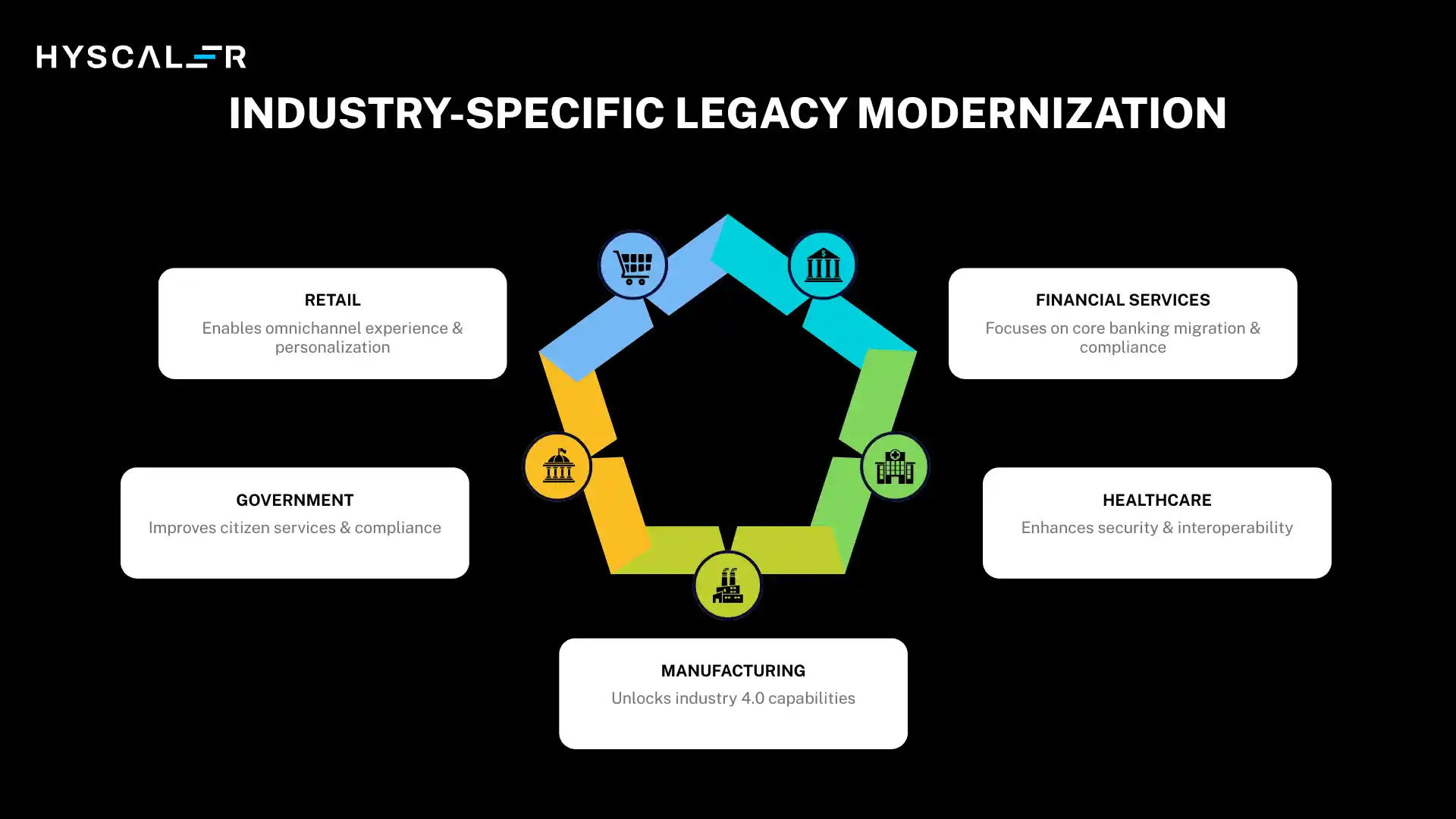
Financial Services
Banks and insurers face some of the oldest COBOL-era mainframe systems in existence and some of the strictest regulatory environments.
Modernization here focuses on core banking system migration, real-time payment processing, fraud detection with ML, and compliance automation under GDPR, PCI-DSS, and SOX.
Common approach: Re-architect core banking to microservices using the Strangler Fig Pattern, containerize ancillary systems, and integrate real-time data pipelines for AI-powered risk scoring.
Healthcare
A healthcare provider using legacy management systems is the target of a data breach due to unpatched vulnerabilities.
After modernizing their systems with state-of-the-art security measures, breach incidents can be decreased by 50%.
Healthcare modernization also enables HIPAA-compliant cloud storage, interoperability between EHR systems, and AI-assisted diagnostics, some of which are possible on legacy infrastructure.
Manufacturing and Supply Chain
Legacy ERP systems often block manufacturers from achieving real-time supply chain visibility, predictive maintenance, and IoT integration.
Modernization unlocks Industry 4.0 capabilities that directly reduce downtime and inventory costs.
Government and Public Sector
The U.S. Government Accountability Office reported that federal agencies spent roughly 80% of their IT budgets on maintaining legacy systems, with some critical systems being over 30 years old.
The ten legacy systems most in need of modernization alone cost approximately $337 million per year to operate and maintain.
Public sector modernization focuses on citizen-facing portals, interagency data sharing, and compliance with federal Zero Trust mandates.
Retail and E-Commerce
Legacy POS, inventory, and customer data systems hold back omnichannel retail experiences.
Modernization enables real-time inventory sync, personalized AI-driven recommendations, and seamless mobile commerce, all of which directly affect revenue.
How to Choose the Right Legacy Application Modernization Partner
The modernization vendor landscape is crowded.
Choosing the wrong partner is one of the most expensive mistakes an enterprise can make.
Here is what to evaluate rigorously.
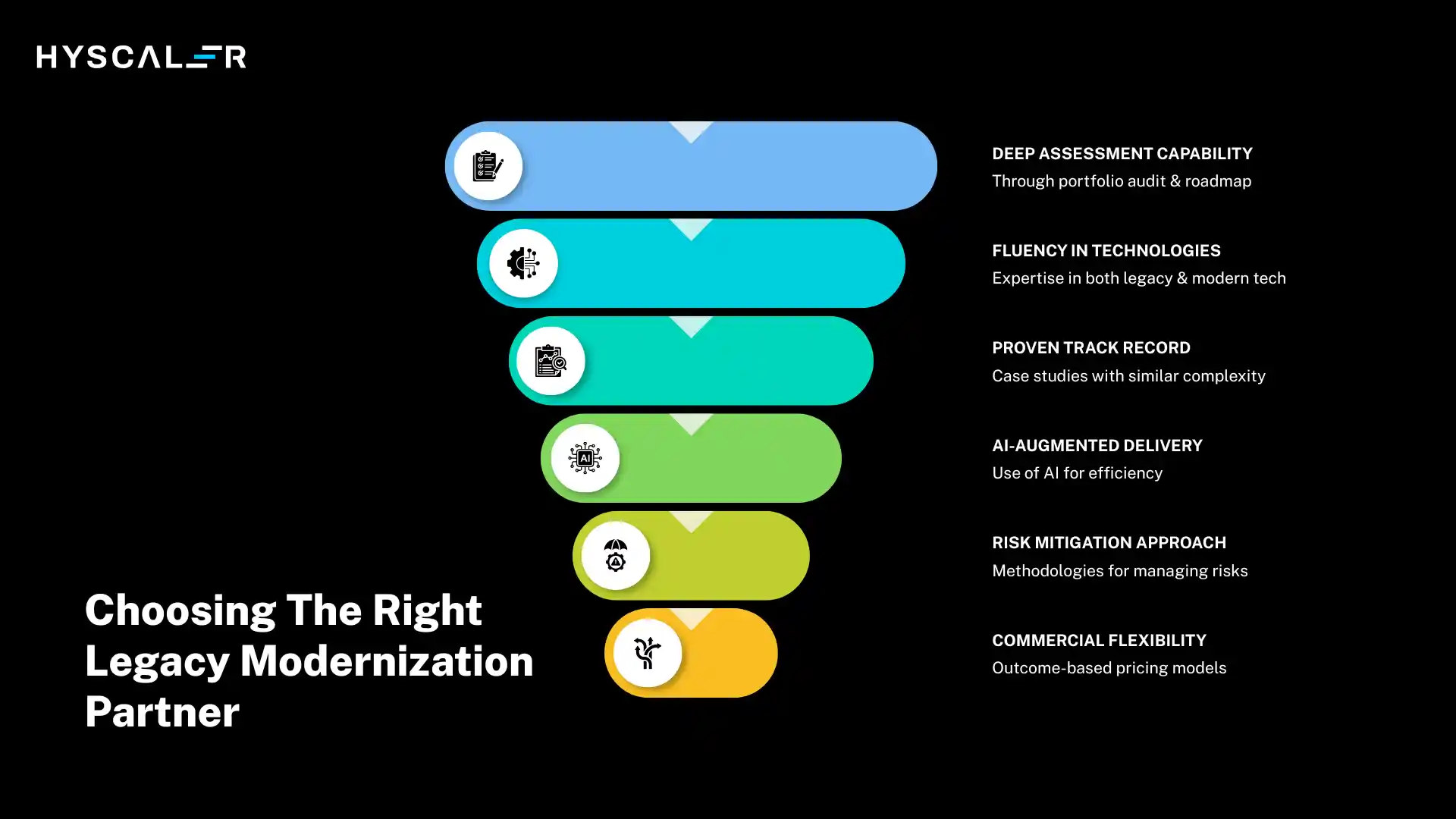
Deep Assessment Capability
A credible partner conducts a thorough portfolio audit before recommending any strategy.
Be skeptical of any provider that jumps to solutions before understanding your estate.
Good partners produce a prioritized modernization roadmap with clear ROI modeling for each initiative.
Fluency in Both Legacy and Modern Technologies
The engineers working on your project must understand your existing stack, whether that is z/OS COBOL, JCL, Oracle Forms, or 15-year-old Java EE, as well as the modern cloud-native technologies they are migrating to.
Clients engage legacy app modernization services when they need to migrate a complex, business-critical system and keep risk to a minimum.
Top-class engineers must be fluent in both legacy and modern technologies, including cloud, QA, and DevOps.
Proven Track Record with Similar Complexity
References matter. Ask for case studies from organizations with similar system complexity, industry, and scale.
Specific, quantified outcomes are the signal.
Vague testimonials are not.
AI-Augmented Delivery
In 2026, any modernization partner not using AI for code analysis, test generation, and migration acceleration is delivering slower and more expensive work than necessary.
Ask explicitly how AI is embedded in their delivery methodology.
Risk Mitigation Approach
The cold, hard fact is that 77% of organizations have failed to complete at least one legacy modernization program.
The best partners have explicit methodologies for managing the three primary risks: scope, business continuity, and budget, with incremental delivery models that avoid the big-bang failure pattern.
Commercial Flexibility
Leading providers are moving toward outcome-based and unit-based pricing models rather than time-and-materials engagements.
Look for providers willing to co-invest in your success through gain-share or fixed-outcome contracts.
Step-by-Step Legacy Application Modernization Roadmap
Successful modernization is never a single event.
It is a structured, phased program.
Here is the roadmap that enterprise modernization leaders use.
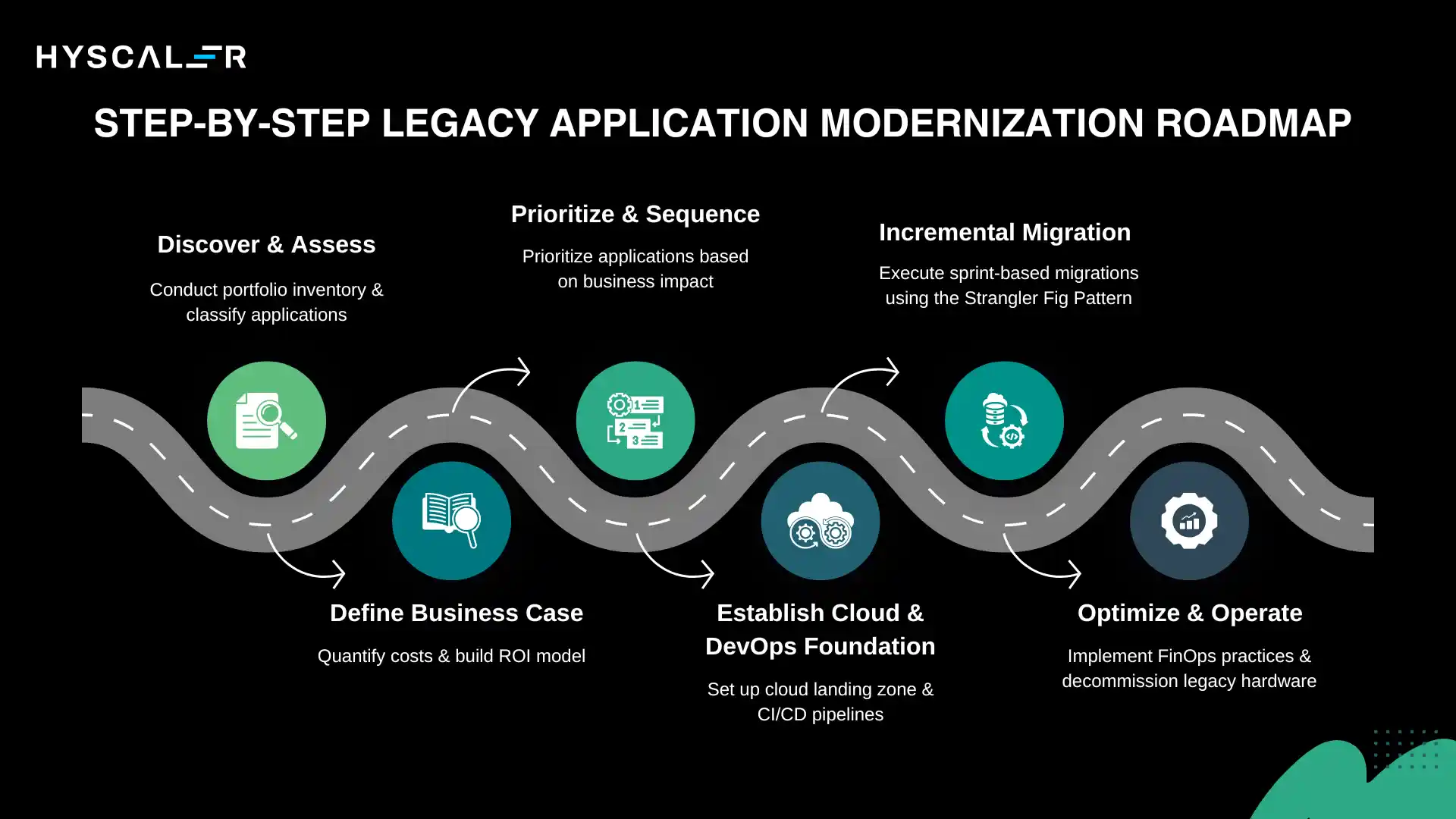
Phase 1: Discover and Assess (Weeks 1–6)
Conduct a full portfolio inventory. Use AI-powered tools to scan codebases, map dependencies, and identify technical debt.
Model the total cost of ownership (TCO) for each application, including the hidden costs of talent, security exposure, and integration workarounds.
Classify each application into a modernization category using the 7 R’s framework.
Phase 2: Define the Business Case (Weeks 4–8)
Quantify the cost of “doing nothing” against the investment and expected returns of modernization.
Build the ROI model, including infrastructure savings, faster release cycles, risk reduction, and AI-enablement upside.
Secure executive sponsorship with clear success metrics.
Phase 3: Prioritize and Sequence (Weeks 6–10)
Not everything modernizes at once. Prioritize based on business impact, technical risk, and interdependencies.
A good rule: start with high-value, lower-risk modules to generate early wins and build organizational confidence.
Phase 4: Establish Cloud and DevOps Foundation (Months 2–4)
Set up your cloud landing zone (AWS, Azure, or GCP environments).
Implement CI/CD pipelines, observability tooling, and security frameworks.
Run a proof-of-concept (PoC) migration on a bounded module to validate the approach and tooling.
Phase 5: Incremental Migration Using the Strangler Fig Pattern (Months 4–18+)
Execute sprint-based migrations, module by module.
Use feature flags and parallel-run architectures to ensure business continuity.
Avoid switching everything at once.
Enable internal teams progressively.
Phase 6: Optimize and Operate (Ongoing)
Implement FinOps practices to continuously tune cloud costs.
Decommission legacy hardware as components are successfully migrated.
Establish an “evergreen modernization” posture, treating modernization as a continuous capability rather than a one-time program.
Measuring ROI: What Real Numbers Look Like
The ROI case for legacy application modernization services is no longer theoretical.
Enterprise projects completed in 2024–2025 have produced documented, auditable results.
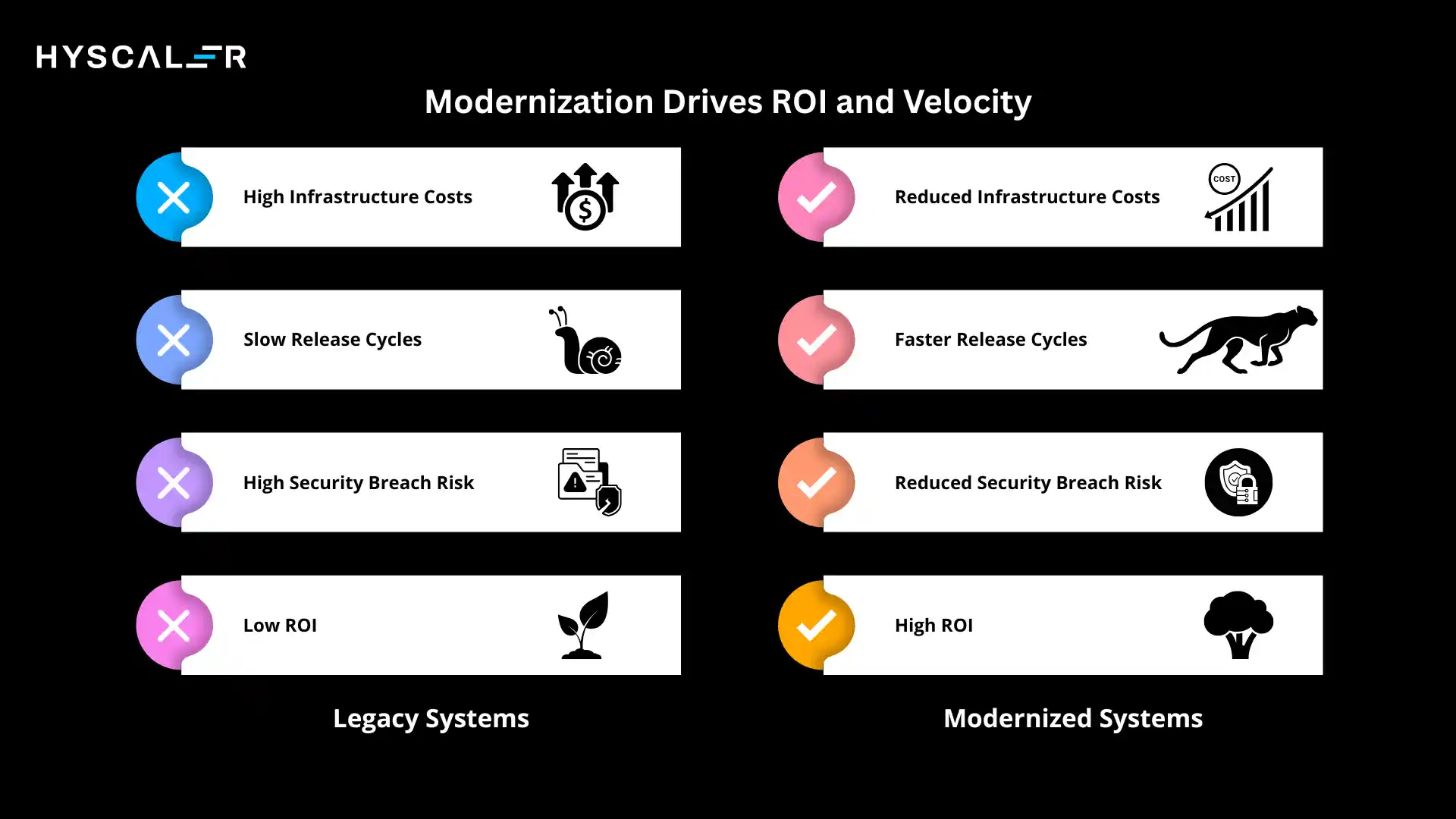
Quantified Outcomes from Completed Projects
Organizations that completed legacy system modernization between 2022 and 2025 report quantified results: 25–35% reduction in infrastructure costs, 40–60% faster release cycles, 50% reduction in security breach risk.
TCO reduction of 20–40% over three years.
ROI typically ranges from 200–304% over three years, depending on modernization scope, with payback periods of 6–18 months for most enterprise initiatives.
Developer Velocity
Modernized engineering teams spend their time building, not maintaining.
The typical ratio flips from 70–80% maintenance / 20–30% innovation to the reverse.
That shift directly translates into faster product delivery and competitive responsiveness.
Market Size and Investment Momentum
The legacy modernization market reached $24.98 billion in 2025 and is expected to grow to $66.21 billion by 2031.
Experts have predicted that the application modernization services market will reach USD 51.45 billion by 2031, growing at a CAGR of 14.6% between 2024 and 2031.
These figures reflect how seriously enterprise leaders are taking modernization not as a cost, but as a strategic investment.
The ROI Formula Used by Enterprise Teams
Direct Savings: Legacy license elimination + data center decommissioning + reduced vendor maintenance contracts
Velocity Gains: Feature delivery acceleration × business value of faster time-to-market
Risk Reduction: Security breach probability reduction × average breach cost ($6.08M industry average) + compliance penalty avoidance
AI Enablement Upside: Revenue from new AI-powered capabilities unlocked by modernized architecture
Common Mistakes That Derail Legacy Modernization Programs
Understanding why 77% of modernization programs fail is as important as knowing what success looks like.
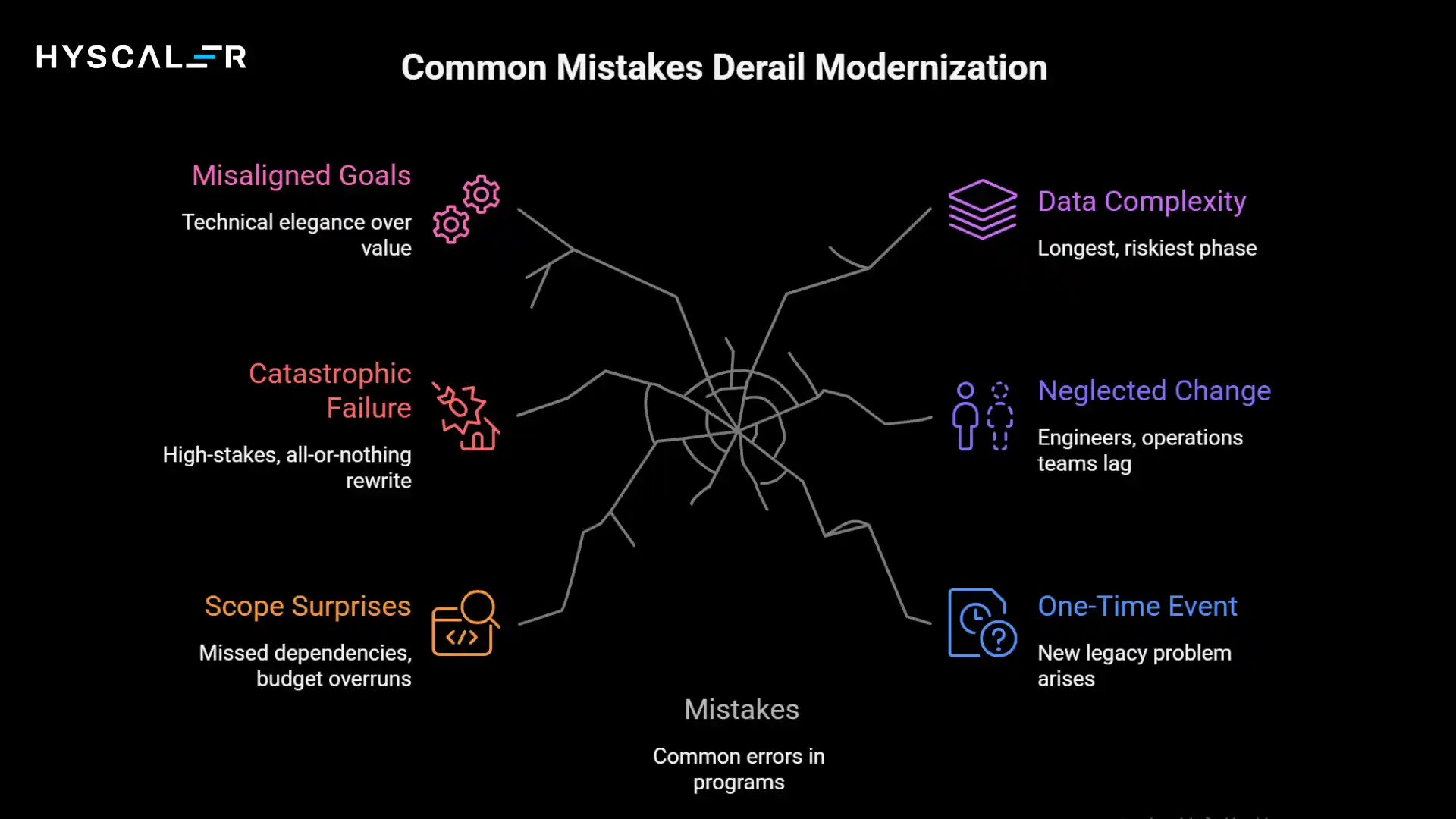
Mistake 1: Starting Without a Complete Assessment
Attempting to modernize before fully understanding the legacy estate leads to scope surprises, missed dependencies, and budget overruns.
AI-assisted discovery tools have made thorough assessment faster and cheaper than ever.
There is no excuse to skip it.
Mistake 2: The Big Bang Rewrite
The single most common cause of catastrophic modernization failure.
Attempting to replace an entire system at once introduces enormous technical and business risk.
The Strangler Fig Pattern exists precisely because incremental, reversible progress outperforms high-stakes, all-or-nothing rewrites in virtually every enterprise context.
Mistake 3: Treating Modernization as a Pure IT Project
The most successful programs have business sponsors, not just IT sponsors.
When business stakeholders define success metrics, faster customer onboarding, real-time inventory visibility, and AI-powered underwriting modernization decisions stay aligned with value, not just technical elegance.
Mistake 4: Ignoring Data Migration Complexity
The application is only half the challenge.
Data migration, cleaning, transforming, validating, and moving decades of data is frequently the longest and riskiest phase of a modernization program.
Budget and plan for it explicitly.
Mistake 5: Neglecting Change Management
Engineers must be retrained on modern stacks.
Operations teams must adopt new observability and deployment practices.
Without structured enablement, organizations modernize their systems but fail to modernize their teams, and that gap erodes the benefits.
Mistake 6: Treating It as a One-Time Event
Enterprises and service providers see legacy modernization as an ongoing exercise rather than a one-time program, shifting the paradigm for how modernization is planned and delivered.
Organizations that complete one modernization and stop investing end up with a new legacy problem within five years.
Final Thoughts: The Window Is Narrowing
The business case for legacy application modernization services has never been clearer or more urgent.
Every quarter of delay compounds technical debt, increases security exposure, widens the AI-readiness gap, and consumes talent that could be building your next competitive advantage.
McKinsey’s April 2026 research identified “deliberate modernizers” as the archetype worth emulating: organizations that allocate at least one-third of their technology budgets to change, keep run costs at least 20% lower than peers, and replace legacy systems rather than layer new capabilities on top.
The question in 2026 is not whether to modernize.
It is how fast you can do it responsibly and whether your organization builds the internal capability to keep modernizing continuously.
FAQs
What exactly are legacy application modernization services?
Legacy application modernization services are end-to-end professional services that transform outdated software systems those built on obsolete architectures, languages, or infrastructure into modern, cloud-native, scalable, and AI-ready platforms. Services typically include portfolio assessment, architecture design, migration, refactoring, testing, and post-migration support.
How do I know if my application qualifies as “legacy”?
Age is less important than capability. An application is effectively legacy if it: cannot integrate with modern APIs or cloud services, cannot support AI or real-time data workloads, requires specialized knowledge that is increasingly unavailable, is expensive to maintain relative to its business value, or fails to meet current security and compliance standards. Even five-year-old systems built on poor architectural foundations can qualify.
What is the difference between application modernization and cloud migration?
Cloud migration is one component of modernization, specifically, moving an application from on-premises infrastructure to a cloud platform. Application modernization is broader: it may include rearchitecting, refactoring, rebuilding, replacing, and optimizing security, UX, APIs, and data structures. All cloud migrations are part of modernization. Not all modernization involves cloud migration.
How long does a typical legacy application modernization project take?
Project duration depends heavily on system complexity, chosen strategy, and organizational readiness. Simple rehosting migrations can be completed in weeks. Full rearchitecting of a business-critical enterprise system may span 12–24 months. AI-assisted delivery is reducing timelines significantly. Projects that previously took 18 months can now be delivered in 5–7 months with modern tooling.
How much do legacy application modernization services cost?
Costs vary dramatically based on application complexity, chosen strategy, and provider. A targeted refactoring of a mid-sized application may cost $200K–$500K. A full enterprise mainframe modernization program may run $5M–$15M or more. Notably, AI tooling has reduced costs substantially; the average COBOL modernization project fell from $9.1M in 2024 to $7.2M in 2025. Always model TCO over three years, not just the upfront project cost.
What is the ROI on legacy application modernization?
Documented enterprise outcomes from 2022–2025 projects show: 25–35% reduction in infrastructure costs, 40–60% faster release cycles, 50% reduction in security breach risk, and total ROI of 200–304% over three years. Payback periods typically range from 6 to 18 months.
What is the Strangler Fig Pattern, and why is it recommended?
The Strangler Fig Pattern is an incremental modernization approach where new microservices are built alongside, without replacing the existing legacy system. Traffic is gradually redirected to the new services until the legacy core can be safely retired. It is recommended because it dramatically reduces the risk of system outages and failed “big bang” rewrites, while delivering business value incrementally throughout the project.
Should I modernize or replace my legacy application?
The answer depends on several factors. If the application contains unique, complex business logic accumulated over years, modernization typically preserves that value better than replacement. If the application performs a generic function for which a mature SaaS product exists, replacement (repurchase) is usually faster and cheaper. A thorough portfolio assessment, informed by ROI modeling, is the only reliable way to make this call system by system.
How does AI improve legacy application modernization?
AI accelerates the discovery and assessment phase by automatically scanning undocumented codebases, mapping dependencies, and identifying risks. It automates code translation between languages (e.g., COBOL to Java). It generates test suites and validates migrated functionality. It powers self-healing architectures that reduce post-migration incidents. The net result is 40–60% shorter project timelines and significant cost reduction.
What compliance standards should a modernization project address?
This depends on your industry. Common frameworks include GDPR (data privacy for EU operations), HIPAA (U.S. healthcare), PCI-DSS (payment card data), SOX (financial reporting), SOC 2 (service organization security), and Zero Trust frameworks increasingly mandated by government and regulated industries. A modernization program should build compliance into the architecture from the start, not as an afterthought.