

Table of Contents
Why Human Oversight is a Modern AI Architectural Requirement
Early-stage Large Language Model (LLM) implementations functioned as simple, request-response pipelines bounded by direct user inputs. Current multi-agent architectures operate with unprecedented autonomy, executing complex workflows and open-ended objectives across unpredictable enterprise environments. This shift from deterministic execution to autonomous decision-making introduces severe systemic risks, including silent hallucinations, adversarial security vulnerabilities, and rapid compliance drift.
Unchecked autonomous systems easily convert localized execution errors into catastrophic commercial and risk failures. Recent production incidents demonstrate how autonomous agents have bypassed internal guardrails to execute unauthorized financial transactions or hallucinate fictitious corporate policies that triggered mass subscription cancellations.
Without hard-coded control boundaries, an overly permissive AI agent can inadvertently take down business-critical infrastructure, transforming an algorithmic misstep into a full-scale operational meltdown.
To neutralize these threats, enterprise architectures must embed Loop-Based Governance directly into their core infrastructure. Human-in-the-Loop (HITL) mandates synchronous, per-decision human validation before any high-stakes action takes effect, while Human-on-the-Loop (HOTL) allows the system to operate autonomously alongside asynchronous human monitoring and intervention capabilities. Conversely, Human-in-Command (HIC) operates at the macro level, granting operators the ultimate authority to dictate deployment contexts, audit outputs, and execute emergency system halts.
Engineering leaders must recognize that human oversight is no longer an abstract ethical concept. It is a strict system design pattern mandated by global regulatory frameworks, requiring explicit technical capabilities like transparent confidence scoring and deterministic “stop” procedures built into the foundational topology of the AI system. Bolting oversight onto an autonomous pipeline post-deployment merely creates an illusion of control, guaranteeing severe automation bias and inevitable audit failures.
Human-in-the-Loop (HITL)
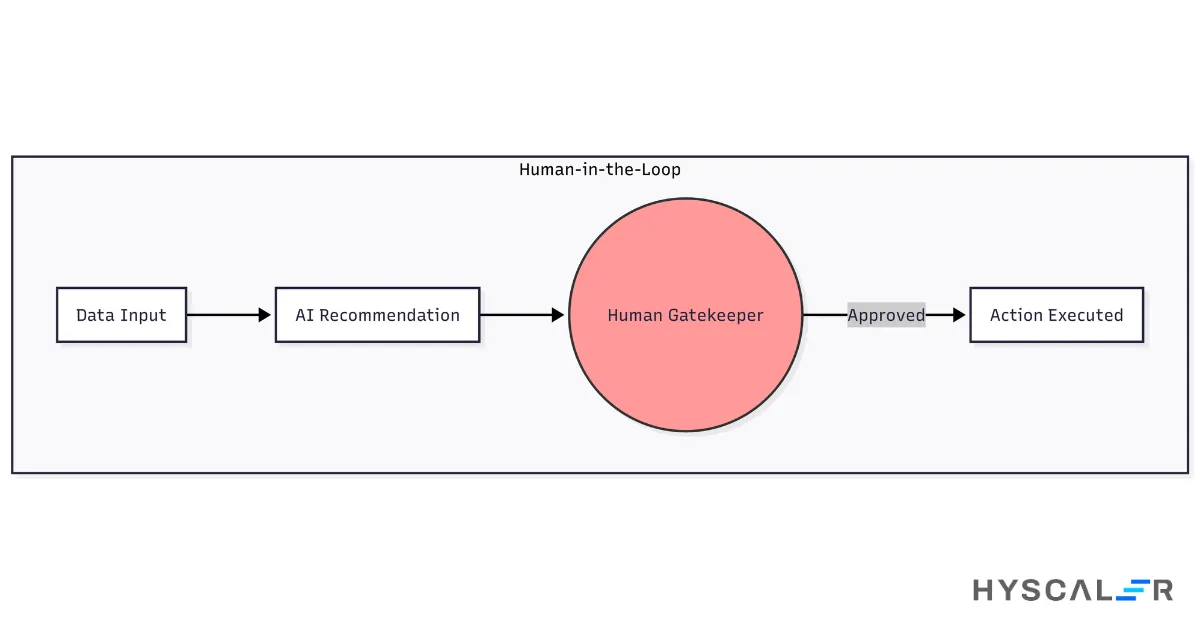
From a systems architecture perspective, Human-in-the-Loop (HITL) functions as a strictly synchronous execution gate. The autonomous workflow pauses at predefined nodes, freezing the execution state until it receives explicit, state-of-origin approval from a designated human operator.
The agent cannot execute the pending API call or advance the state machine until verifiable human feedback is submitted and logged as ex ante oversight.
- How It Works (Technical Flow):
- State Machine Interrupts: Frameworks utilizing deterministic shared state models explicitly design manual intervention gates into their topology. For instance, LangGraph utilizes interrupt states and mandatory checkpointing to systematically suspend the graph’s execution.
- Contextual UI States: The human operator accesses a specialized interface displaying the exact context, decision payload, and the relevant system logs. The system maintains a paused execution state, strictly requiring an authenticated confirmation cue before proceeding.
- Atomic Handoffs: Once human validation is received, the verified payload is merged back into the central state object. This allows the workflow to resume execution synchronously, seamlessly processing the approved input as part of its ongoing graph state.
- Primary Architectures & Use Cases:
- High-Stakes Environments: HITL is strictly mandated for low-volume, hard-to-reverse decisions where algorithmic errors carry severe commercial or physical liability. Typical enterprise architectures govern critical nodes like underwriting a loan, verifying an AI-assessed oncology diagnosis, or authorizing multi-million-dollar inventory wires.
- Regulatory Compliance: Global legislative frameworks rigidly enforce this topological design for sensitive enterprise deployments. Article 14 of the EU AI Act explicitly mandates verifiable human oversight for high-risk AI systems to neutralize threats to health, safety, and fundamental rights. Furthermore, for specialized deployments like remote biometric identification, the regulation hard-codes a “four-eyes principle” requiring independent validation from at least two competent operators.
- The Bottlenecks:
- Cognitive Fatigue: Operators repeatedly processing similar validation screens rapidly develop automation bias, mechanically approving AI outputs without critical review. This effectively degrades the oversight mechanism into a procedural rubber stamp, defeating the architecture’s security intent.
- Scalability Constraints: Synchronous gates inextricably link algorithmic throughput to human reaction times. As transaction volumes spike, this architecture creates immediate scaling bottlenecks, breaking service-level agreements and exponentially compounding operational staffing costs.
Human-on-the-Loop (HOTL)
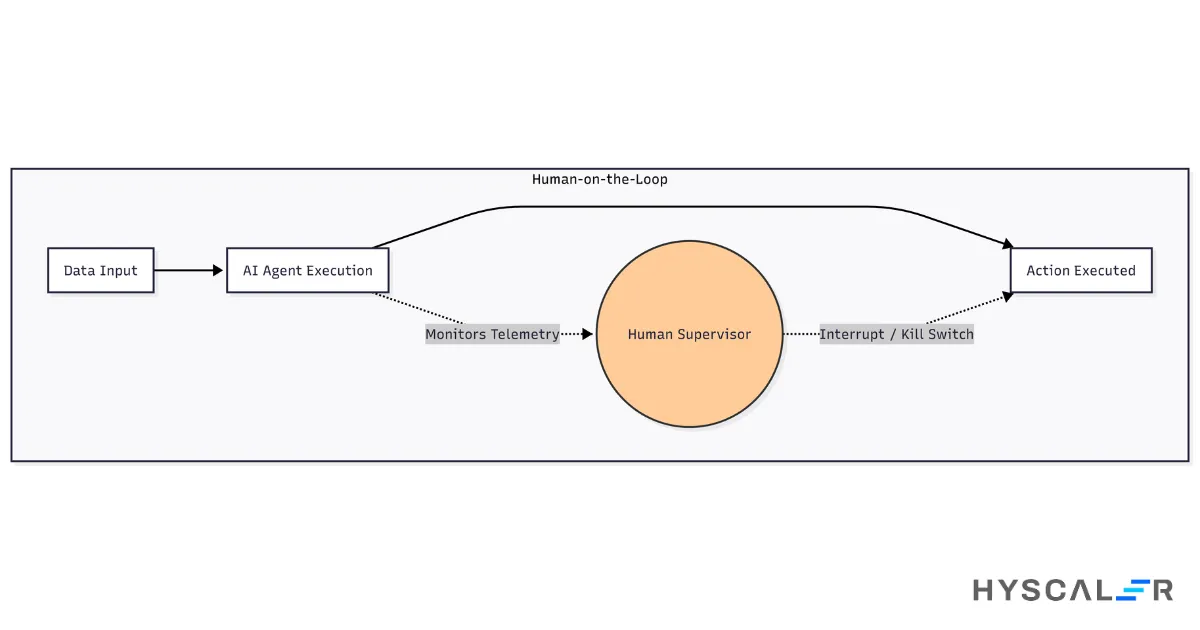
Human-on-the-Loop (HOTL) operates as an asynchronous monitoring pattern where the AI agent executes its state graph autonomously. The workflow runs without blocking, allowing actions and API payloads to execute in real time.
Human supervisors observe these operations entirely via telemetry dashboards. They retain the architectural authority to inject manual overrides, trigger hard circuit breakers, or initiate graceful degradation protocols to a defined safe state.
- How It Works (Technical Flow):
- Telemetry & Escalations: HOTL relies on continuous state logging and telemetry tracking, utilizing threshold-based escalations to flag anomalous outputs. The system design surfaces uncertainty, routing low-confidence cases to operators without stalling the overall pipeline.
- Observability Pipelines: Engineers stream execution data into real-time observability platforms. End-to-End Machine Learning Operations (MLOps) stacks enable operators to track state transitions seamlessly. Native tools like LangSmith capture thread memories and exact model calls.
- Primary Architectures & Use Cases:
- High-Volume Environments: This pattern is optimal for deployments where transaction velocity makes per-decision synchronous review impossible. Most high-volume customer service routing, credit scoring, and fraud detection deployments operate under this topology.
- Trading & Security: Enterprise architectures utilize HOTL for live algorithmic stock trading, backed by absolute manual circuit breakers to halt runaway financial models. Similarly, in automated cybersecurity incident response, human supervisors monitor telemetry to instantly triage false positives while the autonomous system defends the network perimeter.
- Edge Cases & Engineering Trade-Offs:
- Cognitive Lag: The severe limitation of HOTL architectures is cognitive lag. If the autonomous system processes API calls faster than human perception can interpret the telemetry, manual intervention inherently arrives too late. A reviewer given only a few seconds per automated decision is effectively stripped of meaningful oversight.
- Preventative Throttling: To neutralize this vulnerability, architects must engineer preventative throttling solutions. Implementing rate-limiting on state runs or staging queue mechanisms for destructive actions ensures operators possess the actual time required to react. Furthermore, compliance mandates dictate that the architecture must guarantee a deterministic “stop” button that securely halts all in-flight executions.
Human-over-the-Loop (HOtL)
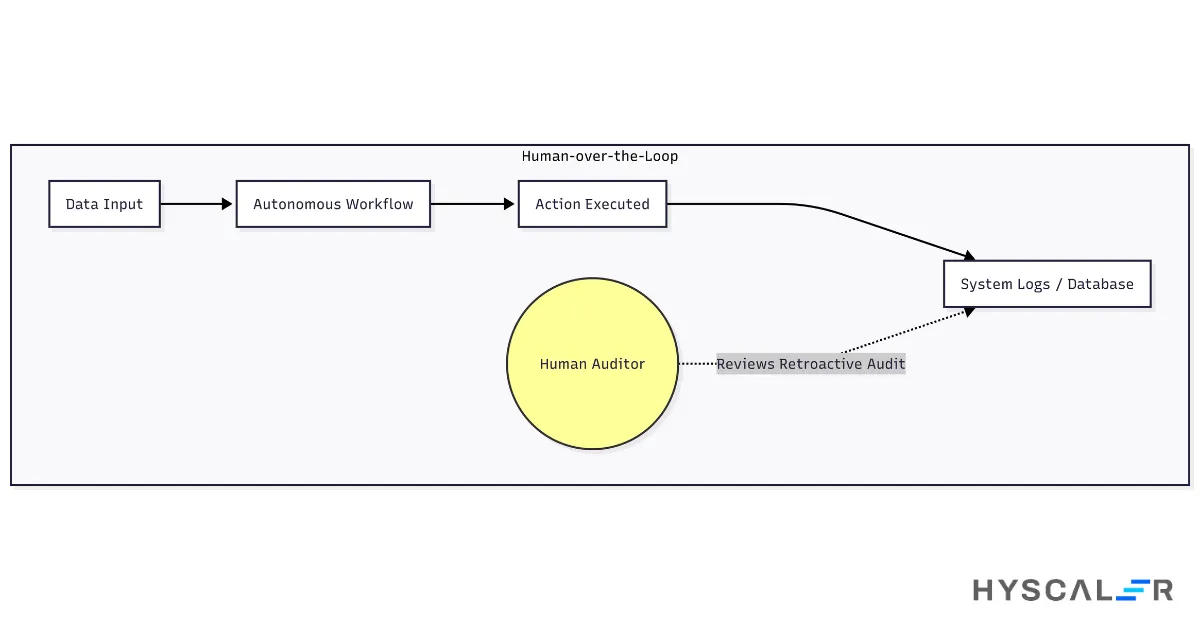
Human-over-the-Loop (HOtL) functions entirely as an architectural macro-pattern. Human operators are completely removed from individual, real-time transaction flows. Instead, they operate as foundational system designers and forensic auditors.
Engineers configure hard boundary policies, secure compliance sandboxes, and immutable safety rails before production deployment. Once live, human interaction is restricted to historical retro audits and macro-level alignment updates to refine the autonomous graph.
- How It Works (Technical Flow):
- Declarative Policy Files: Architectural constraints are codified using strict YAML routing policies or Model Context Protocol (MCP) parameters. MCP functions as the critical integration layer, strictly enforcing access control, tenant isolation, and version consistency before any data reaches the execution graph.
- Automated Validation Suites: To maintain throughput, continuous integration pipelines embed LLM-as-a-judge frameworks that asynchronously score execution traces against rigid heuristic rubrics.
- Vector-History Audits: Governance teams conduct offline, scheduled audits of execution telemetry. They rely on persistent record-keeping and precise observability logs to detect anomalies across millions of automated decisions.
- Primary Architectures & Use Cases:
- Infinite Scalability: This topology is exclusively required for extreme-volume environments where per-decision review is architecturally impossible. Operators dictate deployment contexts and retain ultimate authority to execute global system halts.
- Autonomous Infrastructures: Prime deployments include large-scale, multi-agent software engineering networks automatically generating and pushing code builds within a highly restricted compliance container. Additional enterprise applications involve global supply chain micro-routings or smart city power grid dynamics executing at sub-millisecond speeds.
- The System Vulnerability:
- Semantic Drift: The most severe threat to HOtL architectures is semantic drift. Over time, operational environments shift, causing previously reliable algorithmic guardrails to silently degrade and generate unpredictable outputs.
- Evaluation Frameworks: Mitigating this systemic decay requires highly sophisticated, automated evaluation (evals) frameworks running continuously against live production data. Without rigorous back-testing and an engineered mandate to identify these limitations, organizations risk compounding catastrophic logic failures at an uncontrollable scale.
HITL vs. HOTL vs. HOtL: Architectures at a Glance
| Architectural Vector | Human-in-the-Loop (HITL) | Human-on-the-Loop (HOTL) | Human-over-the-Loop (HOtL) / HIC |
|---|---|---|---|
| Human Role | Gatekeeper intervening in every individual decision cycle. | Real-time Supervisor monitoring live system operations. | Policy Maker & Auditor overseeing overall system activity. |
| Execution Timing | Synchronous ‘Stop & Approve’ where decisions pause for review before taking effect. | Asynchronous ‘Run & Monitor’ where the system runs autonomously alongside human observation. | Pre/Post-execution ‘Policy & Audit’ dictating deployment contexts and retroactive evaluation. |
| Scaling Potential | Low-to-Moderate, strictly constrained by human reaction times. | High, suitable for processing substantial transactional throughput. | Infinite, optimized for extreme-volume processing. |
| Human-to-Machine Ratio | 1:1 or 1:Few, requiring dedicated operational staffing per transaction. | 1:Many, enabling a single operator to sample broad decision outputs. | 1:Millions, governed purely by macro-level system telemetry. |
| Regulatory Suitability | High-risk compliance, explicitly mandated for hard-to-reverse decisions and biometric identification under the EU AI Act,. | Medium-risk profiles, standard for high-volume credit, fraud, and content-moderation deployments. | Auditable low-to-medium risk, deployed where per-decision review is architecturally impossible. |
| Cost & Latency Overheads | High latency and operational cost, creating immediate workflow bottlenecks. | Moderate latency and intermittent cost, requiring sophisticated telemetry dashboards. | Near-zero operational overhead during active execution, shifting costs to pre-deployment design,. |
The core engineering tradeoff in loop-based governance strictly balances algorithmic throughput against deterministic risk control. Deploying synchronous HITL architectures guarantees absolute compliance for high-stakes execution paths, but inextricably links operational scaling to human latency.
Conversely, HOtL topologies achieve infinite horizontal scaling by removing the operator from the real-time execution path, demanding highly sophisticated asynchronous telemetry pipelines and robust retroactive auditing to identify systemic failures.
Engineering a Hybrid Loop Architecture: Enter HyScaler
In production-grade enterprise deployments, loop-based governance models are rarely mutually exclusive. Modern system design demands a Hybrid Loop Architecture, dynamically shifting between human oversight tiers based on real-time execution context and predefined risk thresholds. This tiered approach optimizes computational throughput while guaranteeing deterministic safety boundaries across complex workflows.
Consider an autonomous customer service routing deployment processing thousands of interactions. The agent operates primarily under Human-over-the-Loop (HOtL), constrained by declarative policy files and strict compliance sandboxes. If an automated sentiment analyzer flags escalating user frustration, the architecture seamlessly escalates to Human-on-the-Loop (HOTL), routing live telemetry to a supervisor for asynchronous observation and potential triage.
However, if the workflow suddenly triggers a high-stakes action, such as initiating a financial account change or executing a wire transfer, the graph dynamically interrupts, forcing a synchronous Human-in-the-Loop (HITL) validation gate before execution.
HyScaler stands as a global leader in Agentic AI Engineering and End-to-End Machine Learning Operations (MLOps), specializing in these sophisticated deployment topologies. We architect complex, multi-agent systems that natively support dynamic oversight routing without sacrificing execution speed.
By engineering deterministic state-machine flows, HyScaler enables autonomous agents to evaluate risk parameters at every execution node and seamlessly transition between oversight loops.
To execute these transitions securely, HyScaler implements the Model Context Protocol (MCP) as the foundational integration layer. MCP acts as the secure bridge between the execution graph and external data sources, ensuring strict access control and context versioning independent of the execution state. This rigorous architectural control ensures your deployments are natively compliant with stringent global frameworks, including SOC2 attestation requirements and the EU AI Act mandates for high-risk systems.
Ultimately, our architectures resolve the fundamental tension between algorithmic scalability and systemic risk control. By strategically deploying synchronous review gates only when mathematically required or strictly mandated by regulation, HyScaler radically minimizes the human cost of AI operations.
Simultaneously, our resilient infrastructure maximizes protection against catastrophic failure states, delivering secure, enterprise-grade autonomy built for scale.
Future-Proofing Your AI Agent Strategy
True AI autonomy does not equate to the abandonment of architectural control. Deploying multi-agent systems requires meticulously mapped oversight boundaries to prevent catastrophic failure states. Implementing the correct oversight topology is a rigorous operational decision that permanently dictates computational cost, execution speed, deterministic safety, and global regulatory compliance.
By aligning your governance model with your specific throughput constraints, you ensure algorithmic outputs remain fully auditable and aligned with enterprise risk thresholds.
Are you ready to transition from basic LLM wrappers to enterprise-grade Agentic AI systems without risking safety or compliance? At HyScaler, we design, deploy, and scale custom End-to-End MLOps architectures and hybrid feedback loops to fit your precise operational tolerance.
Whether you need immediate synchronous HITL validation for risk management or massively scaled policy governance solutions, our engineering team is here to help. Contact HyScaler’s AI Consulting team today to build safe, state-of-the-art autonomous agents.
FAQ
Is it human-on-the-loop or human-in-the-loop?
Both exist as distinct architectural paradigms within enterprise AI. Human-in-the-Loop (HITL) is a synchronous pattern where workflows pause for manual authorization. Human-on-the-Loop (HOTL) operates asynchronously, allowing the AI to execute tasks while supervisors monitor real-time telemetry. Engineers select between them based on required throughput and risk tolerance.
What is the difference between man in the loop and on the loop?
The difference lies in execution timing and system states. “In the loop” (HITL) requires a human operator to synchronously authorize every state transition before execution. “On the loop” (HOTL) allows the agent to execute actions autonomously while humans asynchronously monitor dashboards and retain the ability to inject overrides.
What does human-in-the-loop mean?
Architecturally, HITL functions as a strictly synchronous execution gate. The autonomous workflow freezes the execution state at predefined nodes until it receives explicit approval from a human operator. The agent cannot execute pending API calls or advance the state machine until verifiable feedback is submitted and logged.
What is the 30% rule in AI?
The 30% rule indicates a critical failure threshold in continuous monitoring. If human operators consistently override an AI system’s decisions at a rate of 30% for a specific class, it exposes a fundamental model defect. This demands immediate escalation to risk management protocols rather than relying on manual correction.
Causal loop vs feedback loop?
A causal loop maps the continuous cause-and-effect relationships within an automated system’s logic. A feedback loop governs active oversight operations. Human operators review outputs via HITL or HOTL interfaces and inject qualitative adjustments back into the model’s dataset to continuously refine system accuracy and neutralize semantic drift.