

Table of Contents
Long waiting rooms, overbooked clinics, and last-minute staff shortages are problems every hospital administrator knows too well. AI hospital scheduling software is changing that picture by predicting patient demand, matching staff to real-time needs, and closing the gaps that used to slow everything down. Instead of static spreadsheets and manual overrides, hospitals are turning to AI hospital scheduling software to keep departments running at a steady, predictable pace.
This shift isn’t just a back-office upgrade. AI hospital scheduling software touches nearly every part of the patient journey from the moment an appointment is booked to the moment a discharge is processed. It also connects closely with broader hospital IT modernization efforts, including EHR integration strategies and healthcare AI adoption already reshaping how care teams operate. Below, we break down exactly how it works, what to look for, and which tools are leading the way.
What Is AI Hospital Scheduling Software?
AI hospital scheduling software is a category of healthcare technology that uses machine learning models to forecast patient volume, allocate staff, and automatically manage appointment slots. Unlike traditional scheduling tools that rely on fixed rules, AI hospital scheduling software learns from historical patterns, seasonal spikes, day-of-week trends, and department-specific bottlenecks and adjusts schedules before problems occur.
In simple terms, it acts like a constantly updating traffic controller for a hospital’s daily operations, rerouting resources the moment something shifts.
Why Hospitals Struggle Without AI Hospital Scheduling Software
Before adopting AI hospital scheduling software, most hospitals rely on manual planning done days or weeks in advance. That approach breaks down quickly when:
- Patient volume spikes unexpectedly during flu season or local events
- Staff call in sick, and shifts need last-minute coverage
- Multiple departments compete for the same shared equipment or rooms
- No-shows leave gaps that go unfilled until it’s too late to rebook
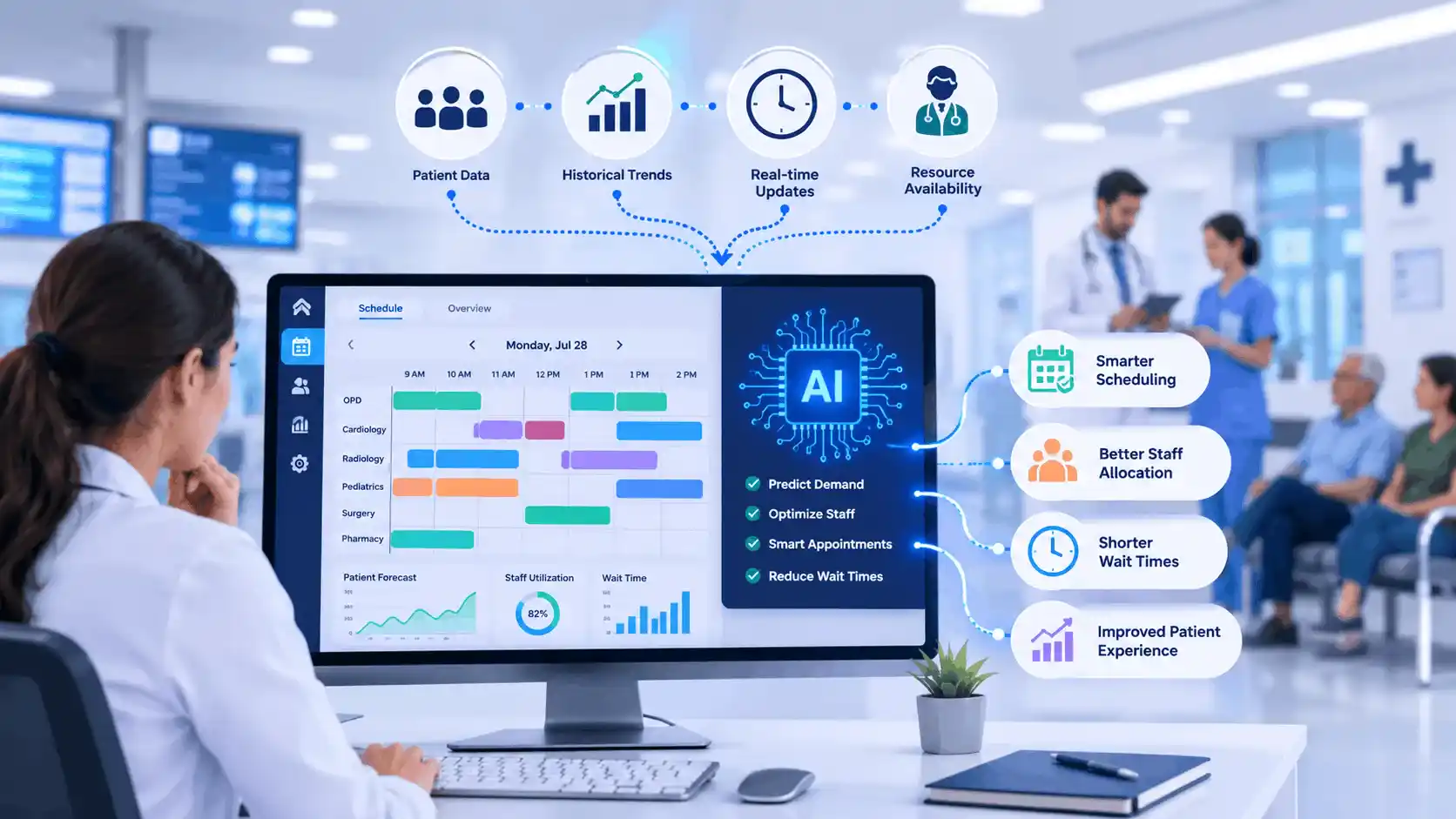
These gaps compound into longer wait times, frustrated patients, and burned-out staff, exactly the problems AI hospital scheduling software is designed to close.
How AI Hospital Scheduling Software Actually Reduces Wait Times
1. Predictive demand forecasting
AI hospital scheduling software analyzes historical visit data to anticipate busy periods before they happen, so departments can staff up in advance rather than scrambling after the fact.
- Data inputs: historical admission logs, seasonal illness trends, local event calendars, and day-of-week visit patterns
- Modeling approach: time-series forecasting models trained on multi-year visit data to project hourly and daily patient volume
- Output: a rolling demand curve per department, updated continuously as new visit data comes in
- Operational trigger: when projected demand crosses a set threshold, the system flags the department for review before the surge hits
2. Dynamic staff allocation
Instead of fixed shift patterns, AI hospital scheduling software continuously rebalances staff assignments based on real-time patient load, pulling extra support into high-demand areas automatically.
- Real-time inputs: live patient check-in counts, current staff-to-patient ratios, and department-level capacity data
- Allocation logic: a rules-and-optimization engine matches available staff skill sets to the departments showing the highest projected load
- Escalation path: if a department exceeds its staffing threshold, the system surfaces reassignment suggestions to shift supervisors instead of making unilateral changes
- Feedback loop: actual outcomes (wait times, patient throughput) are fed back into the model to refine future allocation decisions
3. Smart appointment slotting
Rather than fixed 15- or 30-minute blocks, AI hospital scheduling software adjusts appointment lengths based on visit type and patient history, reducing the ripple-effect delays that build up over a busy day.
- Classification step: incoming appointments are tagged by visit type (routine check-up, follow-up, procedure, new-patient intake)
- Duration modeling: historical visit-length data per category is used to assign a more accurate time slot than a one-size-fits-all default
- Buffer logic: the system inserts small buffer windows around visit types with historically higher variability, absorbing delays before they cascade
- Recalculation: slot lengths adjust automatically as new visit-duration data accumulates over time
4. No-show and cancellation management
AI hospital scheduling software flags high-risk no-show slots and automatically offers them to waitlisted patients, keeping calendars full instead of leaving empty gaps.
- Risk scoring: each booked appointment gets a no-show likelihood score based on factors like appointment lead time, past attendance history, and reminder response
- Waitlist matching: when a slot is flagged high-risk, the system pre-identifies eligible waitlisted patients who fit that appointment type and time window
- Automated outreach: confirmed cancellations trigger automatic notifications to matched patients, rather than requiring staff to manually call down a list
- Backfill window: the system defines a cutoff time before which backfill attempts are made, after which the slot is released back to walk-in availability
5. Cross-department coordination
Shared resources like imaging rooms, surgical suites, and specialist consults are coordinated centrally, so AI hospital scheduling software prevents the double-booking conflicts that used to require manual phone calls to resolve.
- Shared resource registry: a central system tracks real-time availability of rooms, equipment, and specialist staff across departments
- Conflict detection: booking requests are checked against the registry before confirmation, flagging overlaps automatically instead of after the fact
- Priority rules: configurable rules determine which department gets priority access when demand for a shared resource overlaps
- Cross-system sync: updates from one department’s schedule propagate in real time to any other department relying on the same resource
Popular AI Hospital Scheduling Software Tools
Several vendors have built dedicated platforms in this space, each with a slightly different focus:
| Software | Best For | Deployment Style |
|---|---|---|
| Qventus | Perioperative and inpatient flow command centers | Cloud, EHR-integrated |
| LeanTaaS iQueue | OR block scheduling and infusion center capacity | Cloud, module-based |
| Epic Cognitive Computing Platform | Predictive staffing inside the Epic EHR ecosystem | Native EHR extension |
| Olive AI | Administrative scheduling automation | Cloud, workflow bots |
| Innovaccer | Scheduling combined with population health tools | Cloud, platform suite |
Hospitals evaluating AI hospital scheduling software should weigh integration complexity, EHR compatibility, and how much staff training the rollout will require before committing to a platform.
What to Look for in AI Hospital Scheduling Software Before Choosing a Platform
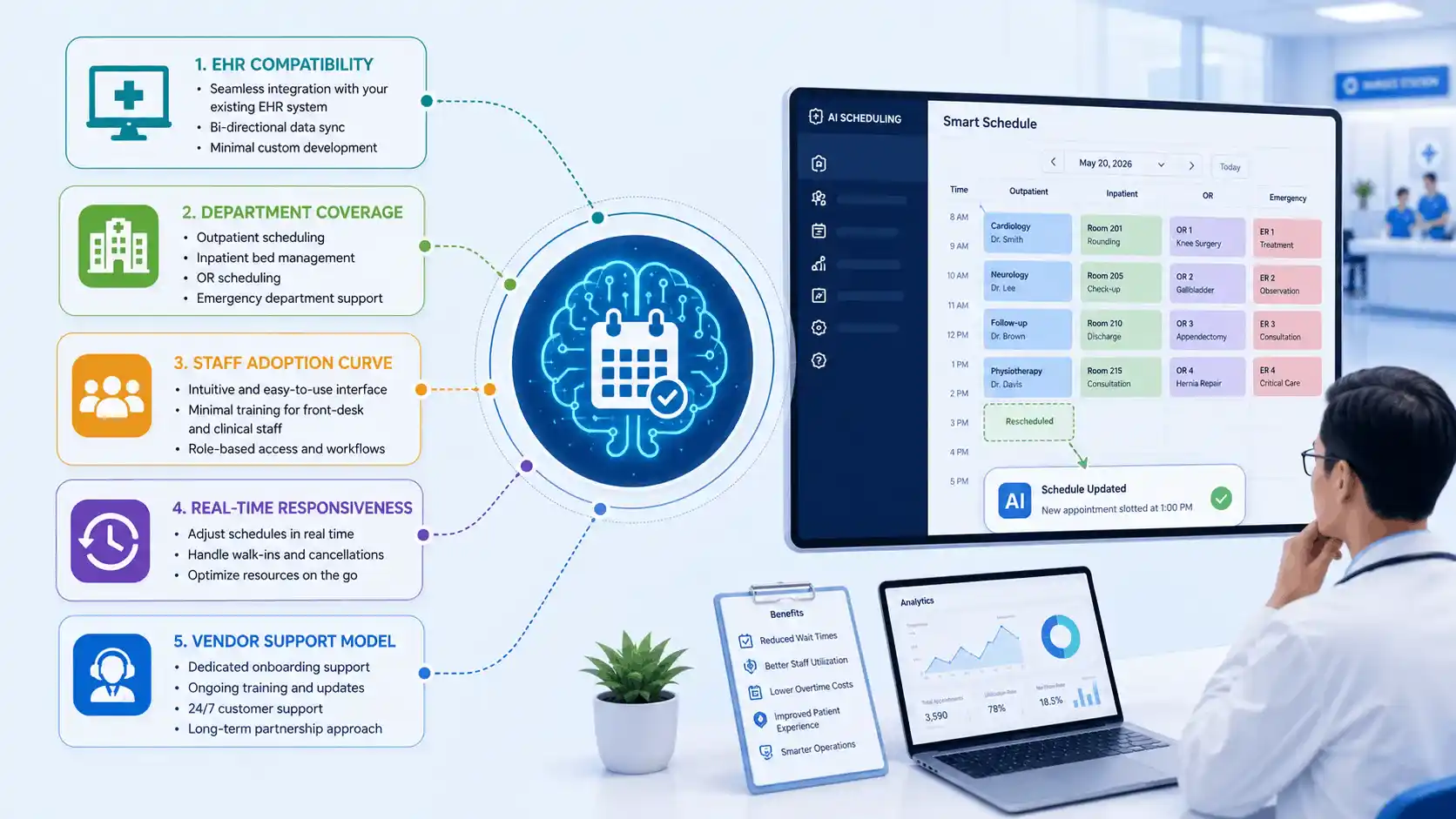
Not every AI hospital scheduling software platform fits every hospital. Here’s a quick breakdown of what to check before choosing one:
- EHR compatibility: Does it plug into your existing electronic health record system without heavy custom development?
- Department coverage: Does it handle outpatient, inpatient, OR, and emergency scheduling, or just one area?
- Staff adoption curve: How much training does front-desk and clinical staff need to use it day-to-day?
- Real-time responsiveness: Can it adjust schedules midday or only plan in batches?
- Vendor support model: Is there dedicated onboarding and ongoing support, or is it a self-serve tool?
Getting Started with AI Hospital Scheduling Software
Rolling out AI hospital scheduling software doesn’t have to mean replacing everything overnight. Most hospitals start with a single high-friction department, often the emergency room or outpatient clinics, before expanding hospital-wide. A phased approach lets teams adjust to new workflows, validate the software’s recommendations against real outcomes, and build internal confidence before scaling further.
The hospitals seeing the strongest results with AI hospital scheduling software tend to treat it as an ongoing process, not a one-time install, regularly reviewing how the system’s recommendations align with actual patient flow and refining it over time.
Final Thoughts
Hospitals under pressure to reduce wait times and improve patient satisfaction are increasingly turning to AI hospital scheduling software as a practical, measurable solution. Rather than a single fix, it’s a shift in how hospitals plan, adjust, and respond to daily demand, one that keeps getting smarter the longer it runs.
If your hospital or health system is exploring how AI hospital scheduling software could fit into your operations, HyScaler’s team can help evaluate the right platform and build an implementation roadmap tailored to your departments.
Ready to reduce wait times at your hospital? Talk to HyScaler about building or integrating AI-powered scheduling solutions tailored to your care teams. Get in touch with our team →
Frequently Asked Questions
How does AI scheduling actually reduce hospital wait times?
By forecasting patient demand and adjusting staff and appointment slots before bottlenecks happen, rather than reacting after wait times already build up.
Is AI hospital scheduling software HIPAA-compliant?
Reputable platforms are built with HIPAA compliance in mind, encrypting patient data and controlling what information the AI can access at each step.
Can AI scheduling handle rescheduling and cancellations, not just new bookings?
Yes, most platforms handle the full lifecycle, including rebooking cancelled slots automatically from a waitlist.
Can AI scheduling integrate with our existing EHR system?
Most major platforms are designed to integrate with widely used EHR systems, though the depth of integration (read-only vs. full read/write) varies by vendor.
How long does implementation typically take?
Timelines vary widely depending on EHR integration complexity, but many hospitals start with a single department before expanding.