
Table of Contents
Ever wondered how technology keeps your healthcare running smoothly?
Different types of healthcare software are the answer; it’s changing how doctors, patients, and clinics operate every day.
But here’s what’s different in 2026: healthcare software isn’t just digitizing paperwork anymore.
It’s becoming intelligent rather than transactional.
AI is now embedded across nearly every category, from the EHR your doctor types into to the app that reminds you to take your meds.
Hospitals in 2026 are prioritizing AI automation, interoperability, cybersecurity, predictive analytics, ambient clinical documentation, and remote patient engagement, not as separate initiatives, but as one connected stack.
Let’s break down what’s out there now.
Overview of Healthcare Software Categories
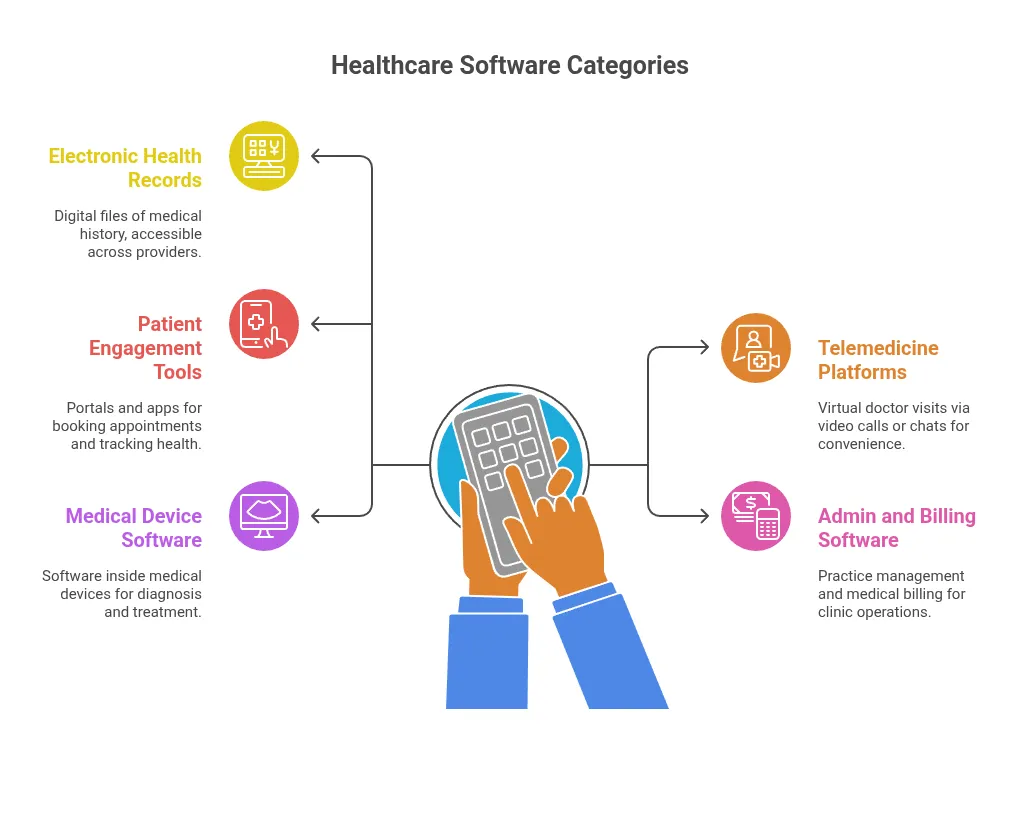
Healthcare software isn’t one thing; it’s a toolkit.
Records systems, virtual care platforms, engagement apps, billing tools, AI agents, monitoring devices.
Each does a job; together they keep providers and patients on the same page.
In 2026, the toolkit has grown.
You’ve still got the core: EHR/EMR, telemedicine, patient engagement, practice management, medical billing, medical device software.
But now you also have AI clinical decision support, ambient documentation, AI agent platforms, remote patient monitoring at scale, digital therapeutics, and population health platforms sitting alongside them, often talking to each other through the same APIs.
Core Software Types (Updated for 2026)
Electronic Health Records (EHR) and EMR Systems
EMRs stay within one practice.
EHRs travel across providers.
That distinction still holds, but what EHRs do has changed.
What’s new in 2026:
- AI-generated visit summaries pulled straight from the encounter
- Conversational search: ask the record a question instead of clicking through tabs
- Predictive charting that pre-fills likely diagnoses/orders based on patient history
- FHIR APIs and SMART on FHIR apps as the default integration layer, not an add-on
- Real-time interoperability between hospital systems, labs, and pharmacies
- AI-assisted medical coding to cut billing errors
Use case: A clinic connects its EHR to a SMART on FHIR app that flags overdue screenings automatically during check-in, with no manual chart review needed.
Telemedicine and Virtual Care Platforms
Still your ticket to seeing a doctor without leaving home.
But it’s no longer just video calls.
What’s new in 2026:
- AI symptom triage before you even reach a doctor
- Digital prescriptions sent straight to your pharmacy
- Home diagnostic kits that feed data into the same visit
- Virtual nursing for post-op check-ins
- Remote rehabilitation programs with video-guided exercises
- Real-time AI translation for non-English speakers
- Voice assistants for scheduling and follow-up
Use case: A rural clinic runs AI symptom triage before every telehealth booking, cutting unnecessary video visits by routing simple cases to a nurse line instead.
Patient Portals and Engagement Tools
Log in, check your labs, message your doctor; that’s still the core job.
In 2026, these tools will do more of the driving for you.
- AI-personalized reminders (meds, appointments, screenings) instead of generic alerts
- Two-way messaging is summarized by AI so staff triage faster
- Example: MyChart-style portals now surface AI-flagged “things to review” instead of a raw data dump
Admin and Billing Software Solutions
Practice management keeps a clinic running: scheduling, registration, intake.
Medical billing software handles claims, insurance, and payments.
Larger facilities often lean on dedicated hospital billing services for the claim volume and payer complexity that standard tools can’t absorb.
What’s new in 2026:
- AI-assisted denial prediction before claims are even submitted
- Automated prior authorization checks
- Predictive staffing tied to patient demand forecasts
Medical Device Software Examples
The software inside imaging machines, monitors, and wearables.
Same core job, sharper diagnostics, precision-guided procedures, but now with more on-device AI processing (edge AI) for real-time analysis without a round trip to the cloud.
- Example: Software that sharpens an MRI scan in real time for faster reads.
- Increasingly used in surgery for AI-assisted, precision-guided tool movement.
New Software Categories in 2026
AI Clinical Decision Support Software (CDSS)
Sits alongside the EHR and actively assists diagnosis and treatment decisions.
- Diagnostic assistance from symptom/lab pattern matching
- Risk prediction (readmission, sepsis, deterioration)
- Treatment recommendations based on current guidelines
- Drug interaction analysis in real time
- Personalized care pathways based on patient history
Use case: An ICU uses a CDSS to flag early sepsis risk 6+ hours before symptoms would normally trigger concern, based on vitals trends.
Ambient AI Documentation Software
One of the biggest healthcare software trends of 2026 is AI listening to the consultation and writing the note.
- AI medical scribes that generate structured notes from conversation
- Automatic consultation summaries pushed into the EHR
- Voice-based documentation, hands-free for the clinician
- Directly tied to reduced physician burnout
- Integrates with existing EHR systems rather than replacing them
Solutions like Microsoft’s Dragon Copilot are one example of this category gaining traction, mentioned here as an illustration of the trend, not an endorsement.
Use case: A physician finishes a 20-minute consult with a complete, structured note already drafted, no after-hours charting.
Healthcare AI Agent Platforms
AI agents that handle operational tasks end-to-end, not just chat.
- Appointment scheduling and rescheduling
- Patient follow-up outreach
- Billing queries
- Prior authorization requests
- Insurance verification
- Clinical workflow automation (routing, task assignment)
Use case: An AI agent handles insurance verification automatically before a patient’s appointment, flagging only the exceptions for staff.
Remote Patient Monitoring (RPM) Software
Bigger than telemedicine’s video-call use case, this is continuous data collection outside the clinic.
- Wearables feeding real-time vitals
- IoT devices (connected scales, BP cuffs)
- Blood glucose monitoring for diabetics
- Cardiac monitoring for post-op or chronic patients
- Elderly care monitoring (falls, activity levels)
- Continuous data streams instead of point-in-time checkups
Use case: A cardiac patient’s connected monitor flags an irregular rhythm and alerts the care team automatically, before it becomes an ER visit.
Digital Therapeutics (DTx)
Software as the primary treatment, not just a support tool, is growing fast in 2026.
- Mental health programs (CBT-based apps)
- Diabetes management programs
- Sleep disorder treatment
- ADHD treatment software
- Chronic pain management programs
Population Health Management Platforms
Zooms out from the individual patient to the whole patient panel or region.
- Predictive analytics across patient populations
- Care gap analysis (who’s missed a screening)
- Preventive care outreach at scale
- Chronic disease management tracking
- Risk stratification to prioritize high-risk patients
Comparison Table
| Software Type | Primary Users | AI Integration | Best For |
|---|---|---|---|
| EHR/EMR | Hospitals, clinics | High | Clinical documentation |
| Telemedicine | Providers | Medium | Virtual care |
| Patient Engagement | Patients | Medium | Communication, self-service |
| Practice Management | Clinics | Medium | Scheduling, admin |
| Medical Billing | Finance teams | High | Revenue cycle |
| Medical Device Software | Hospitals | Medium | Diagnostics, imaging |
| AI Clinical Decision Support | Physicians | Very High | Diagnosis, treatment guidance |
| Ambient Documentation | Physicians | Very High | Reducing charting burden |
| AI Agent Platforms | Enterprise/Ops | Very High | Workflow automation |
| RPM Software | Clinics, patients | High | Chronic disease monitoring |
| Digital Therapeutics | Patients | High | Treatment delivery |
| Population Health Platforms | Health systems | High | Preventive, risk-based care |
Healthcare Software Trends in 2026
- Generative AI – drafting notes, summaries, patient communication
- Agentic AI – software that takes multi-step action, not just suggestions
- Ambient documentation – voice-first, hands-free charting
- FHIR interoperability – the default data-exchange standard, not optional
- Zero Trust cybersecurity – assume breach, verify everything
- Cloud-native healthcare infrastructure – replacing legacy on-prem systems
- Digital twins – simulated patient models for treatment planning
- Edge AI – real-time processing on-device (imaging, wearables)
- Personalized medicine – treatment plans built from individual data, not population averages
Healthcare Interoperability Explained
Interoperability is now a core requirement for healthcare software, not a nice-to-have.
- FHIR (Fast Healthcare Interoperability Resources) – the modern data-exchange standard
- HL7 – the older messaging standard FHIR builds on
- SMART on FHIR – lets third-party apps plug directly into an EHR
- APIs – real-time data exchange between systems instead of batch file transfers
- Connected ecosystems – EHR, RPM, billing, and CRM systems sharing data automatically
Without interoperability, every other AI feature above runs on incomplete data.
Healthcare Cybersecurity
Healthcare data is a high-value target, and 2026 systems are built around this from day one.
- Zero Trust Architecture – no implicit trust, every request verified
- Multi-factor authentication (MFA) – across all clinical logins
- Ransomware protection – backup and recovery built into the architecture
- AI threat detection – anomaly detection on network traffic
- Encryption at rest and in transit
- Identity and access management – role-based access tied to least privilege
How to Choose the Right Healthcare Software in 2026
- Compliance – HIPAA (US), GDPR (EU) readiness baked in, not bolted on
- AI readiness – can it actually use AI features, or bolt them on later
- API/integration support – FHIR-compliant, plays well with your existing stack
- Scalability – grows with patient volume without a re-platform
- Cloud vs on-premise – weigh control against maintenance overhead
- Security posture – Zero Trust, encryption, audit logging
- Vendor support – SLAs, update cadence, responsiveness
- Total cost – licensing, implementation, and ongoing maintenance
- User experience – adoption fails if clinicians find it clunky
Benefits of Modern Healthcare Software
- Better patient outcomes through earlier detection
- Reduced clinician burnout via automated documentation
- Faster diagnosis through AI-assisted analysis
- Lower operational costs from automation
- Improved regulatory compliance
- Data-driven decision-making at every level
- More personalized care plans
- Higher patient satisfaction from less friction
Future of Healthcare Software Beyond 2026
Expect agentic AI to move from “assist” to “act,” with agents completing multi-step clinical and administrative workflows with light human oversight.
Interoperability standards will keep tightening, making cross-provider data exchange closer to instant.
Edge AI on wearables and devices will push more diagnostics out of the cloud and into real time, right where the patient is.
Summary
Healthcare software in 2026 covers a lot more ground than it did even two years ago:
- EHR and EMR still keep records straight, now with AI summaries and predictive charting
- Telemedicine still brings the doctor to your screen, now with AI triage built in
- Patient engagement software still hands you the reins, now more proactive
- Practice management and billing still tackle the admin grind, now with AI catching errors before they cost you
- Medical device software still powers diagnostic tools, now processing more at the edge
- AI clinical decision support, ambient documentation, AI agents, RPM, digital therapeutics, and population health platforms are the categories defining what’s next
It’s still about making healthcare work better for you, less hassle, more care, smarter tools doing the heavy lifting in the background.
FAQs
What are the common types of healthcare software?
You’re looking at EHR and EMR systems, telemedicine platforms, patient engagement software, practice management software, medical billing software, and medical device software. Pretty much the core of modern healthcare tech.
Which healthcare apps are in demand?
People love telemedicine apps for convenience, plus health trackers and patient portals. Anything that makes managing your health simpler is hot right now.
What is the use of EMR, EHR, and telemedicine software?
EMRs lock your data in one practice. EHRs share it across providers for bigger-picture care. Telemedicine software? That’s your ticket to seeing a doctor remotely, perfect when you can’t make it in person.
What are the main types of healthcare software?
EHR/EMR, telemedicine, patient engagement, practice management, medical billing, medical device software, plus the 2026 additions: AI clinical decision support, ambient documentation, AI agent platforms, RPM, digital therapeutics, and population health platforms.
Which healthcare software uses AI?
Nearly all categories now have an AI layer, but AI clinical decision support, ambient documentation, and AI agent platforms are “AI-native,” meaning AI is the core function, not an add-on.
What is the difference between EHR and EMR?
EMRs stay within a single practice. EHRs are built to be shared across providers, so your data follows you.
What healthcare software is essential for small clinics?
EHR, practice management, and medical billing cover the basics. Ambient documentation is worth adding early; it cuts charting time without needing a big infrastructure investment.
How much does healthcare software cost?
Highly variable,cloud-based SaaS tools can start in the low hundreds per month per provider; enterprise EHR/interoperability platforms run into six or seven figures depending on scale and customization.
Is cloud healthcare software secure?
Yes, when built with Zero Trust architecture, encryption, and MFA, which is now standard for reputable vendors. Security depends more on implementation than on cloud vs. on-premises.
What is ambient AI in healthcare?
Software that listens during a patient visit and automatically generates the clinical note, cutting manual documentation time.
What is FHIR interoperability?
FHIR is the modern data standard that lets different healthcare systems, EHRs, labs, pharmacies, and apps exchange patient data in real time through APIs.
How do AI agents improve healthcare operations?
By handling multi-step administrative tasks, scheduling, insurance verification, and follow-ups end-to-end, freeing staff to focus on patient-facing work.