
Table of Contents
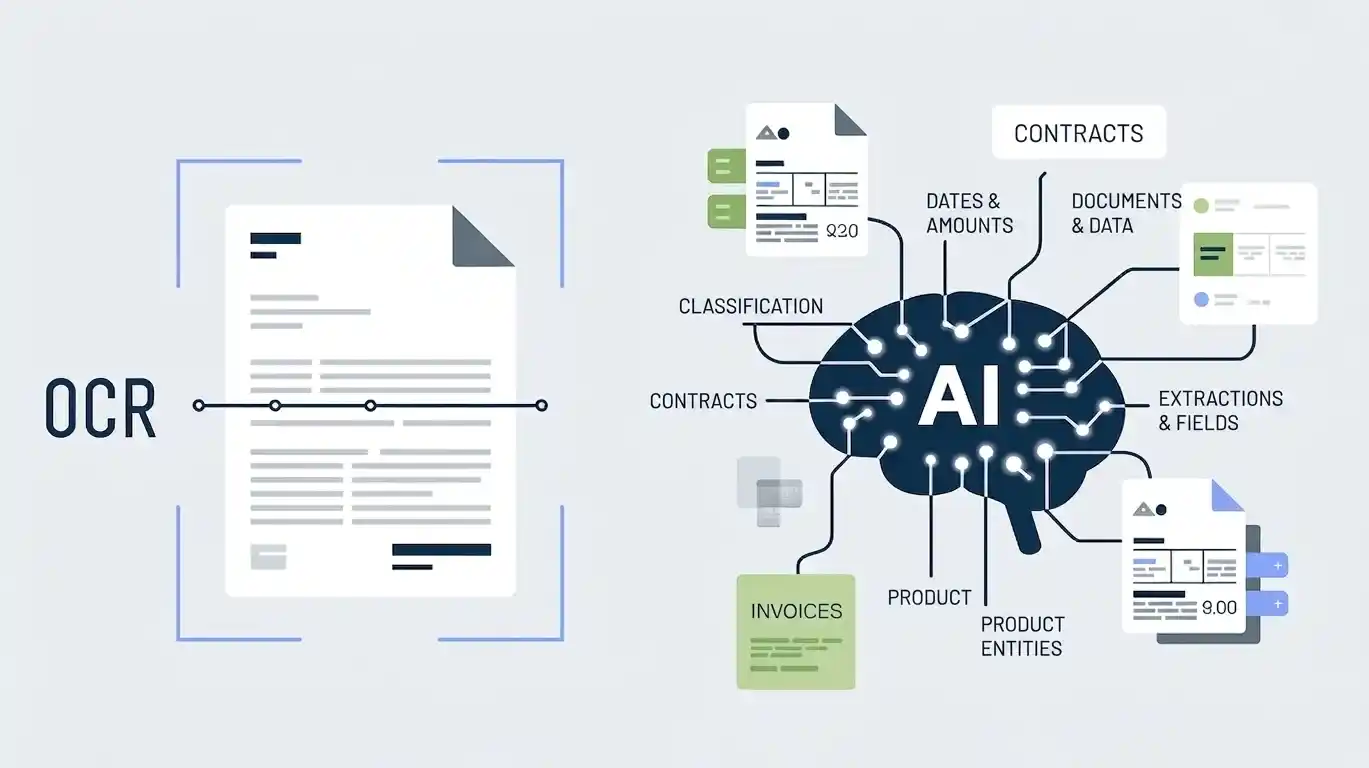
For decades, businesses have relied on Optical Character Recognition (OCR) to digitize paper-based records. OCR was a breakthrough in its time, converting scanned images into machine-readable text. But OCR only reads characters.
It does not understand content. It cannot distinguish an invoice from a contract, identify intent, or extract contextual meaning from unstructured data.
That gap is exactly where it steps in.
Document intelligence is the application of artificial intelligence, machine learning, and natural language processing not just to read but to deeply comprehend documents, their structure, semantics, and business logic. As organizations generate and process millions of documents daily, the shift from simple text extraction to true document intelligence is no longer optional. It is a strategic imperative.
What Is Document Intelligence?
It’s refers to the AI-driven capability to automatically classify, extract, validate, and reason over content within documents, whether they are PDFs, Word files, scanned forms, emails, contracts, or invoices.
Unlike traditional OCR, which merely converts pixels into text, document intelligence systems can:
- Understand the context and intent behind information
- Identify and extract named entities (dates, amounts, names, clauses)
- Classify document types and categories automatically
- Handle unstructured, semi-structured, and structured data
- Integrate extracted data directly into business workflows
The result is a technology that goes far beyond reading; it begins to understand genuinely.
The Limitations of Traditional OCR
Before exploring what it offers, it is important to understand why OCR alone falls short in today’s enterprise environment.
1. No Semantic Understanding: OCR extracts characters but cannot interpret what they mean. It does not know if “Net 30” refers to a payment term in an invoice or a line item in a report.
2. Layout Sensitivity: Traditional OCR struggles with complex layouts, multi-column documents, tables, handwritten annotations, or non-standard formatting.
3. No Classification Capability: OCR cannot determine whether a document is a purchase order, a legal contract, or a medical record. This requires additional manual effort.
4. High Error Rates with Poor Scans: Degraded documents, low-resolution scans, or unusual fonts significantly reduce OCR accuracy, resulting in costly manual corrections.
These limitations are precisely what modern document intelligence platforms are designed to solve.
How AI Powers the Next Generation of Document Understanding
Modern document intelligence solutions are built on a stack of advanced AI technologies working in concert.
1. Natural Language Processing (NLP)
NLP enables systems to understand the meaning and relationships between words. In the context of document intelligence, NLP allows machines to extract key clauses from contracts, identify sentiment in customer feedback, or recognize obligations buried in dense legal language.
2. Computer Vision
AI-powered computer vision allows their systems to interpret the visual layout of a document, identifying tables, checkboxes, signatures, logos, and spatial relationships between elements.
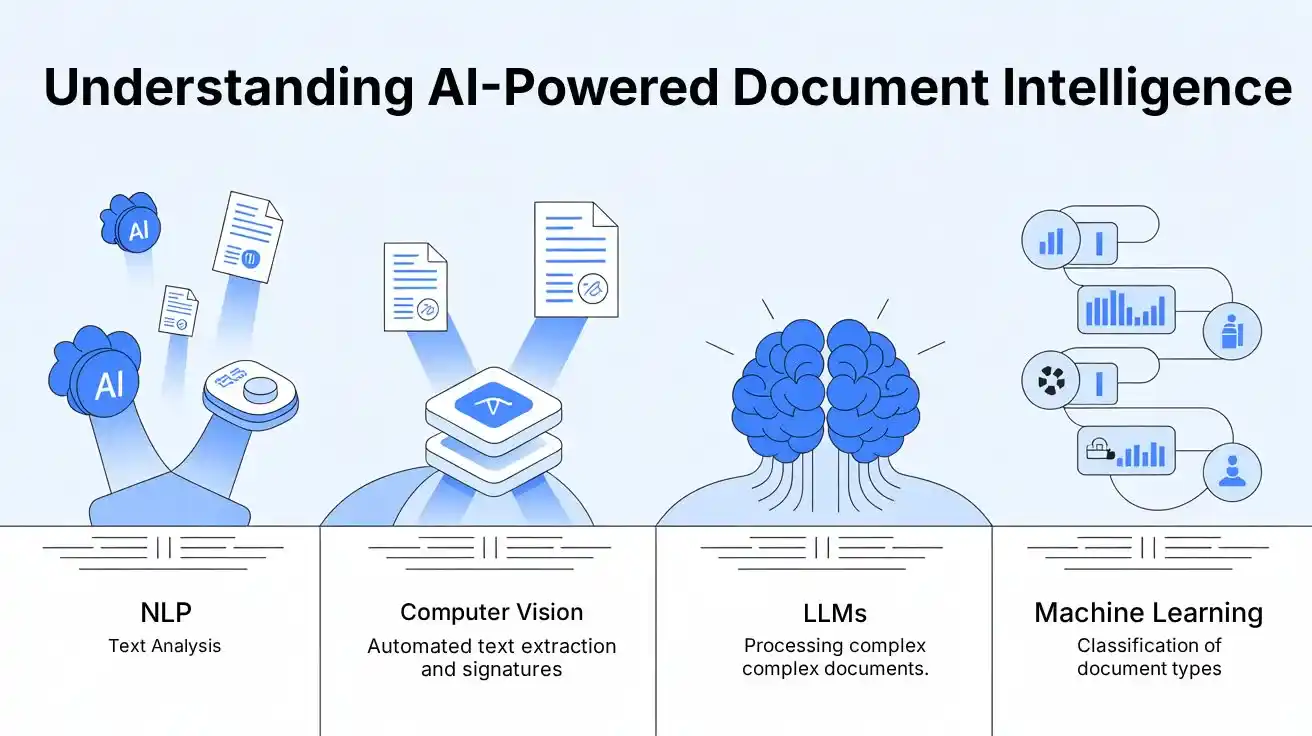
3. Large Language Models (LLMs)
The integration of LLMs has been transformative for document intelligence. Models like GPT and Claude can summarize long documents, answer questions based on document content, flag anomalies, and even generate insights, taking document intelligence from extraction to reasoning.
4. Machine Learning for Classification
Supervised and unsupervised ML models allow their platforms to automatically classify thousands of document types with high accuracy, routing them to the appropriate workflows without human intervention.
Key Use Cases Across Industries
The real-world impact of it is being felt across virtually every sector.
🏦 Financial Services
Banks and insurers rely on document intelligence to replace slow, manual document handling with AI-driven verification and routing.
- Loan & Mortgage Processing: Document intelligence auto-extracts applicant data, cross-verifies records, and flags discrepancies, cutting processing time from days to hours.
- KYC & AML Compliance: ID proofs and regulatory forms are verified automatically, ensuring every submission meets compliance standards without manual review.
- Claims Management: Supporting documents are read and validated simultaneously, accelerating claim approvals and reducing manual effort by up to 70%.
🏥 Healthcare
It lifts the administrative burden off clinical staff, freeing them to focus on patient care instead of paperwork.
- Patient Record Processing: Diagnoses, medications, and visit histories are extracted from unstructured records and surfaced instantly at the point of care.
- Prior Authorization: Clinical notes are automatically mapped to payer criteria, slashing approval wait times from days to hours.
- Clinical Trial Documentation: Trial consent forms, lab reports, and adverse event documents are classified and extracted automatically, ensuring audit-ready compliance.
⚖️ Legal
It turns a slow, billable-hour-heavy review process into a fast, consistent, and scalable workflow.
- Contract Review: Contracts are scanned in bulk to highlight risk clauses, non-standard terms, and missing obligations in a fraction of manual time.
- M&A Due Diligence: Key terms from financial agreements, IP filings, and regulatory documents are extracted and summarized automatically under tight deadlines.
- Litigation Management: Discovery documents are categorized, indexed, and retrieved by case context, eliminating hours of manual sorting.
🚚 Supply Chain & Procurement
It keeps goods moving by automating the most document-intensive steps in the procurement lifecycle.
- Invoice Matching & AP: Three-way matching of purchase orders, receipts, and invoices is done automatically in real time, cutting payment cycles dramatically.
- Customs & Shipping Docs: Bills of lading and customs declarations are read and validated instantly, reducing clearance delays from entry errors.
- Vendor Onboarding: Key vendor data is extracted and verified automatically, flagging incomplete submissions before they cause downstream delays.
🏛️ Government & Public Sector
It helps agencies reduce backlogs and deliver faster, more accurate public services.
- Tax Filing & Revenue Processing: Tax data is extracted and validated automatically, accelerating processing and eliminating peak-season review queues.
- Permit & License Applications: Application forms and supporting documents are verified and routed for approval automatically, reducing wait times from weeks to days.
- Benefits Administration: Income statements and eligibility forms are verified at scale, ensuring consistent decisions while cutting the workload on case workers.
Read our case study: Lending Operations Automation
Document Intelligence vs. Intelligent Document Processing (IDP)
These two terms are often used interchangeably, but there is a meaningful distinction.
| Feature | Traditional IDP | Document Intelligence |
|---|---|---|
| Core Function | Extract & route data | Extract, understand & reason |
| AI Depth | Rule-based + basic ML | NLP, LLMs, Computer Vision |
| Handles Unstructured Data | Partially | Fully |
| Contextual Reasoning | No | Yes |
| Continuous Learning | Limited | Adaptive |
It represents the evolution of IDP, a more intelligent, adaptive, and reasoning-capable approach to document understanding.
The Business Case: Why Document Intelligence Matters Now
The urgency around document intelligence is driven by clear business realities:
- 80–90% of enterprise data is unstructured, with documents being the primary source. (Source: Gartner, as cited by CDO Magazine and MIT Sloan Management Review)
- Manual document processing costs organizations between $5 and $25 per document, depending on complexity and volume. (Source: DocuExprt, 2026 – Hidden Costs of Manual Document Processing)
- Errors in document handling contribute to compliance risks, payment delays, and customer dissatisfaction. Manual data entry carries an error rate of 1–4%, with each correction costing between $15 and $90 to remediate. (Source: PaperWise – The True Cost of Manual Document Processing)
- Enterprises processing thousands of documents daily cannot scale manual review without proportional cost increases.
It directly addresses all of these pain points, delivering speed, accuracy, scalability, and cost savings simultaneously.
Leading Platforms and Tools
Several enterprise-grade platforms are advancing their field:
- Microsoft Azure Document Intelligence: Formerly Azure Form Recognizer, offering pre-built and custom models for a wide range of document types.
- Google Document AI: A cloud-native document intelligence platform with powerful NLP and vision capabilities.
- Amazon Textract: AWS’s solution for extracting structured data from virtually any document format.
- IBM Watson Discovery: Focused on unstructured data and deep document intelligence for enterprise search and insights.
- Hyperscience and ABBYY: Specialized platforms offering high-accuracy document intelligence for complex enterprise workflows.
Each platform brings unique strengths, and organizations often combine tools to build robust document intelligence pipelines tailored to their needs.
Challenges and Considerations
Despite its potential, deploying it at scale comes with challenges:
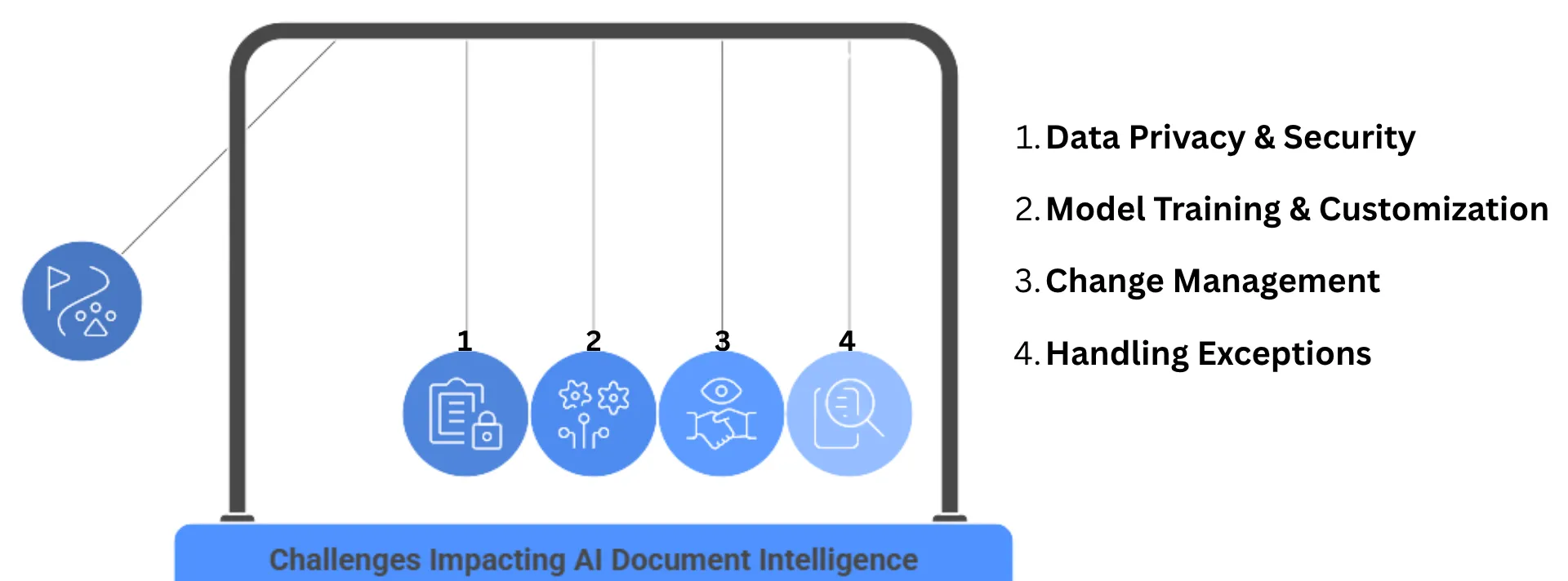
Data Privacy & Security: Documents often contain sensitive personal and financial data. Robust encryption, access controls, and compliance with GDPR and HIPAA are essential.
Model Training & Customization: Out-of-the-box models may not perform well on industry-specific documents. Custom training on proprietary data is often required for high-accuracy document intelligence.
Change Management: Transitioning from manual workflows to AI-driven document intelligence requires organizational buy-in, process redesign, and user training.
Handling Exceptions: No AI system achieves 100% accuracy. A human-in-the-loop approach remains essential for edge cases, ensuring that document intelligence augments rather than entirely replaces human judgment.
The Road Ahead: What’s Next for Document Intelligence
The trajectory of document intelligence points toward even deeper integration with enterprise systems and more sophisticated reasoning capabilities.
- Multimodal AI will enable document intelligence systems to simultaneously process text, images, audio transcripts, and video captions within a single workflow.
- Agentic AI will allow document intelligence systems to not just extract but also act, automatically triggering payments, sending notifications, or flagging compliance issues without human prompts.
- Real-time document intelligence will become standard, with AI processing documents the moment they are received and delivering instant insights to decision-makers.
The era of passive document storage is ending. Document intelligence is ushering in the age of active, thinking document ecosystems.
Conclusion
OCR gave us the ability to read documents digitally. It gives us the ability to understand them. For enterprises drowning in unstructured data, this shift represents one of the most significant productivity and competitive opportunities of the decade.
Organizations that invest in document intelligence today are not just automating processes; they are building a foundation for smarter, faster, and more informed decision-making at every level of their business.
The question is no longer whether to adopt document intelligence. The question is how quickly you can afford not to.
Frequently Asked Questions (FAQs)
What is document intelligence?
It is the use of AI to automatically extract, classify, and understand content from business documents.
How is document intelligence different from OCR?
OCR only converts images to text, while it understands context, structure, and meaning within documents.
What types of documents can AI-powered document intelligence process?
It can process invoices, contracts, forms, emails, medical records, legal documents, and virtually any structured or unstructured file.
Is it secure for sensitive data?
Yes, many cloud-based document intelligence platforms offer scalable, pay-as-you-go models accessible to businesses of all sizes.
What is the difference between IDP and document intelligence?
IDP focuses on extraction and routing, while document intelligence adds contextual reasoning, learning, and deeper AI-driven understanding.
Can documented intelligence integrate with existing enterprise systems?
Yes, most platforms offer APIs and pre-built connectors for ERP, CRM, and workflow automation tools like SAP, Salesforce, and Microsoft 365.