
Table of Contents
Every day, the world generates an almost unmanageable volume of images and video, from security cameras and satellites to smartphones and industrial sensors. For decades, computers could store this visual data but not truly understand it. That’s changing fast.
Computer vision started as a narrow discipline: teach a machine to detect edges, recognize a face, or classify an object. Over the past few years, it has evolved into something far more capable: Vision AI, where deep learning, multimodal reasoning, and language understanding combine to let machines not just see, but interpret, reason about, and increasingly act on what they see.
This shift matters because visual data is often the richest, least-structured information a business has. Vision AI is what makes it usable. In this guide, we’ll cover what Vision AI is, how it works, where it’s being applied, what it costs to build, and where the technology is headed in 2026 and beyond.
What Is Vision AI?
Vision AI refers to AI systems that combine computer vision with broader machine intelligence, including language understanding and contextual reasoning, to interpret visual data and support decisions or actions, rather than simply detecting or classifying objects.
How Does Vision AI Work?
At a high level, Vision AI follows a pipeline: visual data is captured by cameras or sensors, preprocessed (resizing, normalizing, filtering noise), then passed through machine learning models trained to detect, classify, segment, or recognize elements within it. More advanced systems add a layer of contextual understanding, connecting what’s detected to language, intent, or downstream decisions, before triggering an output or action.
Vision AI vs Computer Vision: What’s the Difference?
| Computer Vision | Vision AI |
|---|---|
| Primarily focuses on visual perception | Adds AI-driven interpretation and reasoning |
| Often task-specific | Supports broader contextual understanding |
| Traditionally rule/model driven | Increasingly multimodal and foundation-model driven |
| Detects and classifies | Understands, reasons, and can trigger actions |
How Vision AI Has Evolved
Vision AI didn’t appear overnight; it’s the product of several waves of progress.
Traditional image processing relied on hand-coded rules and filters to detect edges or shapes. Deep learning-based computer vision introduced neural networks that could learn patterns directly from labeled data, dramatically improving accuracy in detection and classification. Modern Vision AI builds on this with larger, more generalizable models.
Two more recent developments define the current frontier. Vision-Language Models (VLMs) connect visual inputs with natural language, allowing a system to describe an image, answer questions about it, or reason about relationships within a scene. Vision-Language-Action (VLA) models go a step further, linking perception and language to physical action, a foundation increasingly used in robotics and embodied AI, where a system doesn’t just recognize an object but decides what to do with it.
The overall trajectory is: see → detect → understand → reason → act.
Core Capabilities of Vision AI
Modern Vision AI systems typically combine several capabilities:
- Object detection and recognition: identifying and locating objects within an image or video
- Image classification: categorizing an image based on its content
- Image segmentation: isolating specific regions or objects pixel-by-pixel
- Optical character recognition (OCR): extracting text from images or documents
- Facial and human activity recognition: identifying people or actions (with privacy implications to manage)
- Anomaly and defect detection: spotting irregularities, often in manufacturing or quality control
- Pose and gesture estimation: tracking body position or movement
- Video analytics: analyzing motion and events across video streams
- Scene and context understanding: interpreting the broader situation, not just isolated objects
Vision AI Applications Across Industries
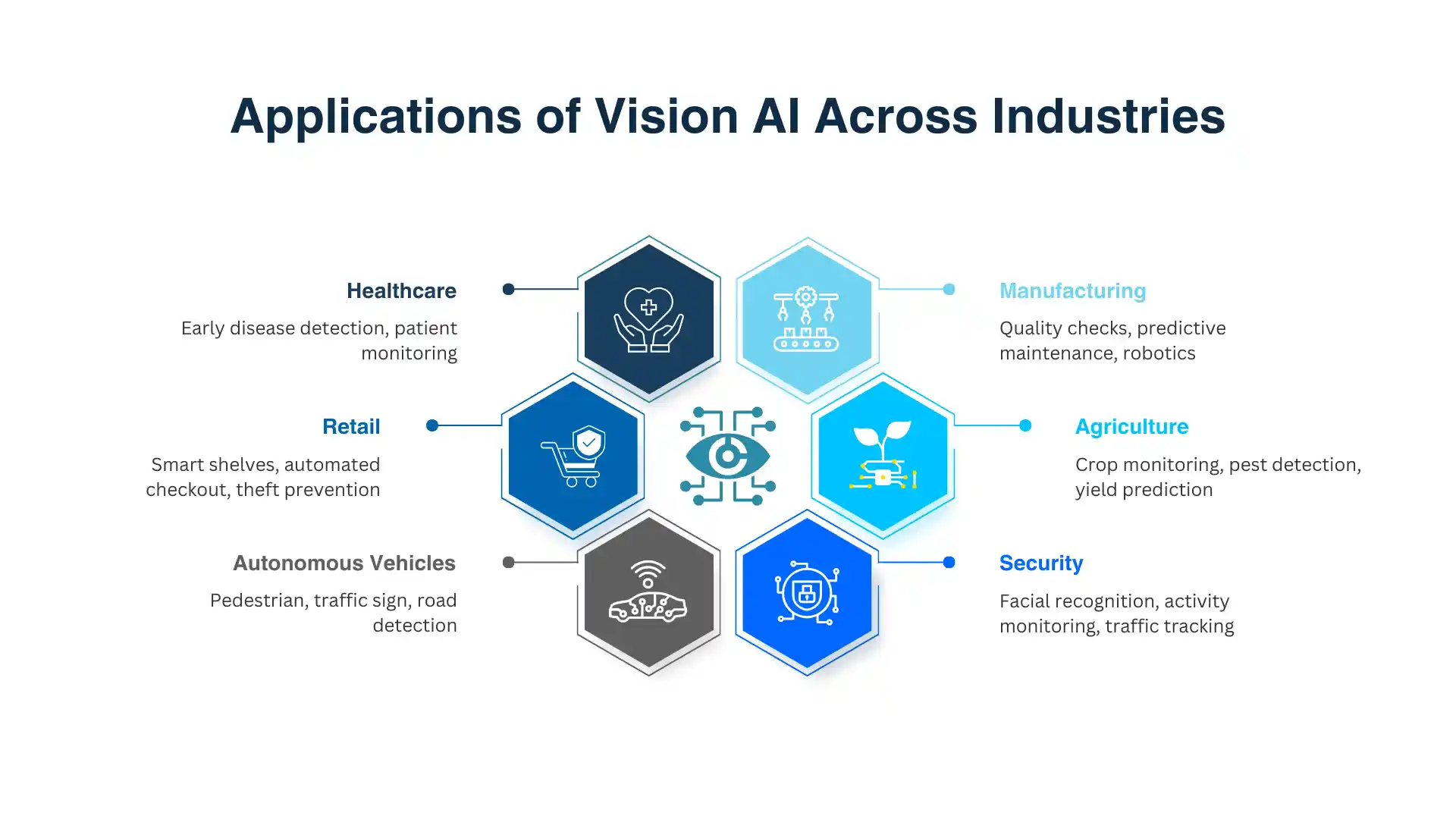
Healthcare: Vision AI supports medical imaging analysis, earlier disease detection, surgical assistance, patient monitoring, and automation of routine diagnostic workflows.
Retail and e-commerce: Use cases include smart checkout, shelf and inventory monitoring, customer behavior analytics, visual search, virtual try-ons, and loss prevention.
Autonomous vehicles and transportation: Vision AI enables pedestrian and object detection, lane and road recognition, advanced driver-assistance systems (ADAS), driver monitoring, and progress toward autonomous navigation.
Security and surveillance: Applications include threat detection, crowd monitoring, perimeter security, and real-time alerting. This is also an area where privacy considerations, consent, data retention, and regulatory compliance need to be addressed directly rather than treated as an afterthought.
Agriculture: Vision AI supports crop and livestock monitoring, disease and pest detection, yield estimation, and drone-based field inspection for precision agriculture.
Manufacturing: Common uses include automated quality inspection, defect detection, predictive maintenance, worker safety monitoring, and robotic inspection.
Other emerging applications include logistics and warehouse automation, sports analytics, construction site monitoring, smart city infrastructure, insurance claims processing, banking and document verification, and robotics more broadly.
Vision AI and Emerging AI Technologies
This is where Vision AI is moving fastest heading into 2026.
Vision AI + Generative AI: Combining visual inputs with generative models enables visual question answering, deeper image and video understanding, automated report generation, and more natural conversational interfaces around visual content, enabling tools like an Instagram video maker to create visually stunning and highly shareable content effortlessly.
Vision AI + Vision-Language Models: VLMs let systems connect what they see with natural language, enabling richer semantic understanding, describing a scene, answering nuanced questions about it, or reasoning about relationships between objects.
Vision AI + Vision-Language-Action Models: VLA models represent the next step, connecting visual perception, language understanding, and physical action. This is especially relevant in robotics and embodied AI, where a system needs to translate what it sees and understands into a physical response.
Vision AI + Edge AI: Processing visual data closer to the camera or device, rather than sending everything to the cloud, reduces latency, improves privacy, lowers bandwidth needs, supports offline operation, and enables real-time decision-making. HyScaler’s Vision & Edge Computing work focuses specifically on this intersection.
Vision AI + AI Agents: Traditional systems detect an event and generate an alert. Agentic vision systems go further: detect → interpret → decide → trigger a workflow → verify the outcome, turning passive monitoring into active automation.
Benefits of Vision AI for Businesses
- Faster real-time decision-making based on live visual input
- Higher inspection and detection accuracy than manual review
- Reduced manual work in repetitive visual-checking tasks
- Improved safety through automated hazard and compliance monitoring
- Operational cost reduction from fewer errors and less manual labor
- Scalable visual data processing across large volumes of footage or images
- Better customer experiences through visual search, personalization, and faster service
- New automation opportunities that weren’t previously feasible with text-only systems
The specific ROI depends heavily on the use case; inspection accuracy gains look different from customer experience gains, so it’s worth measuring against a clear baseline rather than assuming a universal return.
How Businesses Can Implement Vision AI
- Identify a specific business use case. Start with the problem you’re solving, not the model you want to use.
- Assess your visual data. Consider availability, quality, annotation needs, privacy requirements, and whether synthetic data can supplement real-world data.
- Choose the right approach. Options range from pre-trained models and APIs to fine-tuned models, fully custom models, VLMs, or hybrid architectures.
- Choose your deployment model.
| Deployment | Best For |
|---|---|
| Cloud | Large-scale processing and centralized workloads |
| Edge | Low latency, privacy, and real-time applications |
| Hybrid | Complex enterprise environments |
- Integrate with existing systems, ERP, CRM, IoT devices, cameras, robotics, data platforms, and mobile or web applications.
- Test accuracy and real-world performance, including precision/recall, false positive and negative rates, latency, and how the model holds up under varying environmental conditions.
- Deploy, monitor, and retrain using ongoing MLOps practices, since visual environments and edge cases shift over time.
How Much Does Vision AI Development Cost?
Costs vary significantly based on data requirements, accuracy needs, hardware, integrations, and deployment scale; the figures below are directional planning ranges, not fixed quotes.
| Project Type | Estimated Cost |
|---|---|
| Proof of concept | $10,000–$35,000 |
| MVP / single-use-case solution | $35,000–$120,000 |
| Production Vision AI platform | $120,000–$350,000+ |
| Enterprise / multi-site deployment | $350,000+ |
Key cost factors include data collection and labeling, model complexity, custom training, VLM/VLA requirements, camera and sensor infrastructure, edge hardware, cloud infrastructure, API integrations, security and compliance work, MLOps, number of deployment sites, and ongoing maintenance.
Vision AI Challenges and Limitations
- Data quality and availability: models are only as good as the data behind them
- Privacy and data security: especially relevant for facial recognition and surveillance use cases
- Bias and fairness: models can inherit and amplify biases present in training data
- Model accuracy and reliability: particularly in unpredictable real-world conditions
- High compute and infrastructure requirements: training and running large models isn’t cheap
- Edge deployment constraints: limited processing power and memory on-device
- Explainability: understanding why a model made a particular visual judgment
- Regulatory and compliance requirements: which vary significantly by industry and region
- Real-world generalization: strong benchmark performance doesn’t guarantee reliable field performance, a challenge especially relevant for newer VLM/VLA systems, where data quality, timing alignment, and action semantics all affect real-world reliability
Vision AI Trends to Watch in 2026 and Beyond
- Vision-Language Models become more capable: closing the gap between visual perception and language understanding
- Agentic vision moves from detection to action: automating entire workflows rather than just flagging events
- Edge AI enables real-time vision in latency-sensitive and privacy-sensitive environments
- Vision AI meets physical/embodied AI: extending perception into robotics and real-world interaction
- Smaller, more efficient vision models make deployment more practical and affordable
- Synthetic data increasingly supplements real-world training data
- Multimodal AI becomes standard: with vision as one input among several
- AI-powered video intelligence expands: moving beyond still images into continuous video understanding
Real-World Vision AI Examples
Vision AI is already embedded in recognizable products and services.
Google Cloud Vision AI offers pre-built and customizable vision models for developers.
Amazon Go popularized cashierless retail using computer vision to track what shoppers pick up.
Siemens has applied computer vision within manufacturing for automated quality inspection.
And in robotics, VLM/VLA-based systems are increasingly extending Vision AI from perception into physical action: robots that not only recognize an object but understand instructions about it and act accordingly.
Why Businesses Should Invest in Vision AI
Visual data is becoming a strategic business asset, not just a byproduct of cameras and devices. Vision AI extends automation beyond text-based workflows, enables real-time operational intelligence, and supports better safety and quality outcomes. As it increasingly connects with AI agents and physical systems, it also offers a way to future-proof existing computer vision investments rather than treating them as a dead end.
How HyScaler Can Help With Vision AI Development
HyScaler supports Vision AI initiatives across the full lifecycle, from consulting and custom computer vision solution design to edge AI deployment, real-time video analytics, model development, IoT and camera integration, enterprise system integration, and ongoing MLOps and optimization. For businesses exploring low-latency or privacy-sensitive deployments in particular, HyScaler’s Vision & Edge Computing services are built around processing visual data closer to where it’s captured.
From Seeing to Understanding and Acting
Vision AI is evolving from systems that simply detect objects into multimodal systems capable of understanding context, reasoning over visual information, and eventually triggering actions. The right approach isn’t to adopt Vision AI because it’s an emerging technology; it’s to identify high-value visual workflows where better perception can produce measurable improvements in efficiency, safety, quality, or customer experience.
FAQs
What is Vision AI?
Vision AI combines computer vision with broader AI capabilities, including language understanding and reasoning, to interpret visual data and support decisions or actions.
How does Vision AI work?
It processes visual input through stages of preprocessing, model-based detection or classification, and increasingly, contextual reasoning before producing an output.
What is the difference between Vision AI and computer vision?
Computer vision focuses on visual perception and is often task-specific; Vision AI adds interpretation, reasoning, and broader contextual understanding.
What are the most common Vision AI applications?
Healthcare imaging, retail analytics, autonomous vehicles, security monitoring, agriculture, and manufacturing quality inspection are among the most common.
What is a Vision-Language Model (VLM)?
A VLM connects visual inputs with natural language, allowing a system to describe, question, or reason about images and video.
What are Vision-Language-Action (VLA) models?
VLA models extend VLMs by connecting perception and language understanding to physical action, commonly used in robotics and embodied AI.
How much does Vision AI development cost?
Costs typically range from roughly $10,000 for a proof of concept to $350,000+ for enterprise-scale deployments, depending on data, complexity, and infrastructure needs.
How can businesses implement Vision AI?
By starting with a specific use case, assessing available visual data, selecting the right model approach and deployment method, integrating with existing systems, and testing rigorously before scaling.