
Table of Contents
Most pilots for AI agents for enterprise look great in a sandbox. Then they break the moment IT wires them into live Enterprise Resource Planning (ERP) and Customer Relationship Management (CRM) systems.
Gartner predicts over 40% of agentic AI projects will be canceled by the end of 2027, pointing to escalating costs and unclear business value alongside weak risk controls and widespread “agent washing” by software vendors. A 2025 MIT Project NANDA report, The GenAI Divide, covered by Fortune, found 95% of generative AI pilots deliver zero measurable P&L impact because stateless tools fail to retain feedback or integrate into live workflows.
Vendor demos make autonomous cross-system updates look effortless. Independent benchmarks show a steeper climb. For Chief Technology Officers (CTOs), Chief Information Officers (CIOs), and IT directors, deploying AI agents for enterprise systems means running live ERP and CRM writes without breaking Role-Based Access Control (RBAC), blowing API budgets, or corrupting ledgers.
This guide breaks down the multi-agent AI architecture, identity exchange, deterministic policy gates, and audit pipelines needed for production enterprise AI workflow automation.
Summary
- Independent benchmarks (
CRMArena-Pro,τ-bench) show multi-turn agent accuracy drops sharply to 35% and under 25% across repeated runs, proving prompts alone cannot guard database writes.- Replace shared admin keys with OAuth 2.1, Proof Key for Code Exchange (PKCE), and IETF RFC 8693 token exchange so every call logs both human (
sub) and agent (act) identities.- Separate read-only CRM and ERP agents from a gated write worker inside an open-source stateful orchestrator (Temporal, Kestra, or LangGraph) backed by PostgreSQL inside your own Virtual Private Cloud (VPC).
- Protect cross-system mutations with SHA-256 idempotency keys and Saga undo handlers paired with Human-in-the-Loop (HITL) approval holds.
- Stream OpenTelemetry GenAI spans (
invoke_agent,execute_tool) directly into your Security Information and Event Management (SIEM) platform.
Why AI Agents for Enterprise Integration Break in Production
Test demos run against clean mock tables and wide-open API keys. Production ERP and CRM databases carry years of custom fields and regional tax rules alongside Apex triggers and strict access hierarchies. When unguarded multi-agent systems meet those constraints, they fail in four predictable ways.
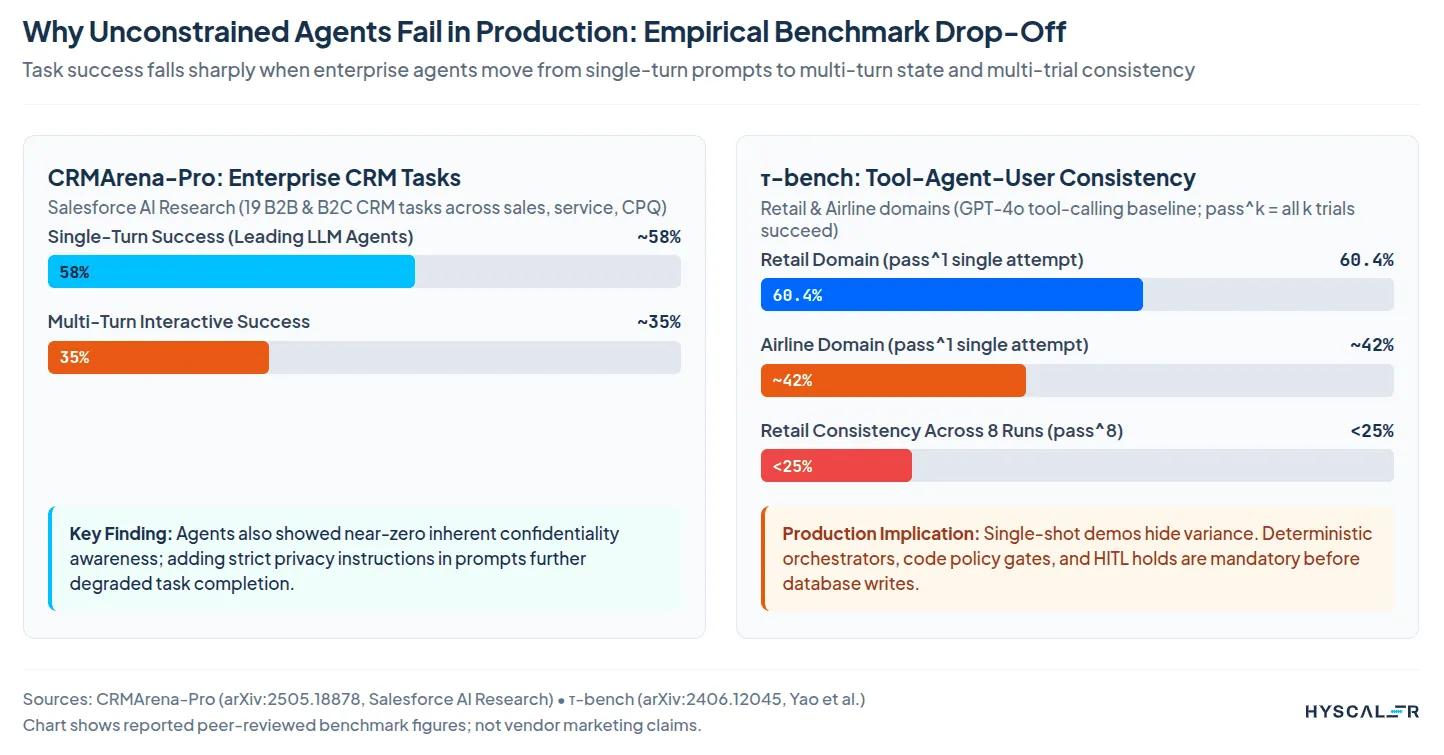
First, accuracy collapses over multi-turn workflows and repeated runs. Salesforce AI Research tested leading models across 19 realistic B2B and B2C tasks in CRMArena-Pro (arXiv:2505.18878). Single-turn success averaged roughly 58%, then dropped to around 35% in multi-turn interactive dialogues. Agents also showed near-zero inherent confidentiality awareness, and adding strict privacy rules into system prompts degraded task completion further.
Similarly, τ-bench (arXiv:2406.12045) evaluated GPT-4o tool calling on stateful retail and airline workflows: single-attempt (pass^1) accuracy reached 60.4% in retail and roughly 42% in airline tasks, yet eight-run consistency (pass^8) fell below 25%. Data on the Berkeley Function Calling Leaderboard (BFCL) confirms that multi-turn stateful execution lags well behind single-turn function syntax.
Second, shared service logins erase accountability when teams wire AI agents for enterprise workflows to one static admin key. Many pilot teams hand a prototype bot a single master login to ship faster, so every read and write executes under one account. Security teams cannot trace which employee triggered a ledger edit or isolate a prompt injection attempt.
Third, platform API limits and blind retries break live operations. In Salesforce, Platform API limits cap Production and Sandbox orgs at 25 concurrent inbound requests lasting 20 seconds or more (5 in Developer and Trial orgs), throwing REQUEST_LIMIT_EXCEEDED once breached. Meanwhile, the Agentforce Models API caps standard generation throughput at 2,000 requests per minute per org (and 1,000 requests per minute for embeddings and feedback), returning HTTP 429 when exceeded. A looping agent soon starves human staff of API capacity. Even worse, models retry timed-out calls on their own. Without deterministic idempotency keys, one dropped packet turns a single customer refund into duplicate ledger entries.
Fourth, consumption billing and data hygiene catch teams off guard. Practitioners on r/salesforce warn that background data features and misconfigured loops can burn through Agentforce Flex Credits unexpectedly. On r/SAP, engineers report similar bill shocks from SAP Business Technology Platform (BTP) AI Units and Joule usage charges. Buyer reviews on Gartner Peer Insights for Conversational AI Platforms, including feedback on Microsoft Copilot Studio and SAP Joule, repeatedly stress that vendor marketing glosses over governance overhead and inconsistent master data, plus the engineering work required before agents can touch production records. For a closer look at these failure patterns, see our post-mortem on why enterprise AI projects fail.
Practical Example: Multi-Agent Order Management Across CRM and ERP
Consider how AI agents for enterprise order management handle a routine support request that crosses customer records and fulfillment ledgers: a buyer asks for an order status check and requests a shipping address change. A production architecture processes that job in five controlled steps.
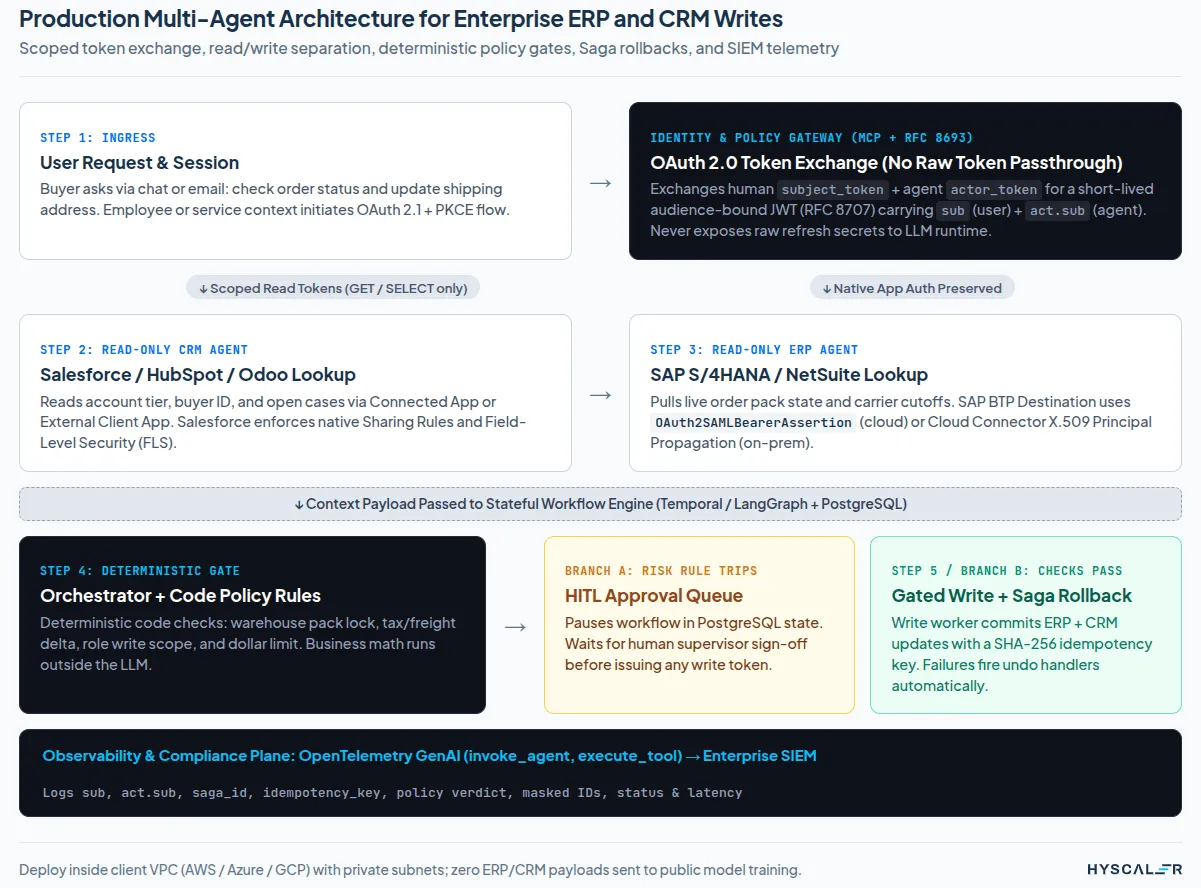
Each stage enforces strict scope boundaries before passing control forward:
- Ingress and identity exchange: The buyer submits the request via chat or email. An identity gateway intercepts the session and swaps the employee’s token and the agent’s credential for a short-lived, audience-bound token pair with no raw secret passthrough.
- Read-only CRM lookup: The CRM agent queries Salesforce, HubSpot, or Odoo CRM for the buyer’s account tier and contact ID along with open support cases. Scoped read tokens ensure the agent sees only records visible to the signed-in representative.
- Read-only ERP lookup: The ERP agent queries SAP S/4HANA, Oracle, or NetSuite for fulfillment status and warehouse pack state alongside carrier cutoffs. Keeping this worker strictly read-only guarantees a lookup bug can never modify shipping tables.
- Orchestrator and deterministic policy checks: The Orchestrator runs hard-coded validation checks against the context payload. Has the warehouse already packed the order? Does the new postal code change freight rates or regional sales tax? Does the requester’s role permit editing open orders? If a dollar limit or compliance threshold trips, the workflow pauses in PostgreSQL and routes to a HITL review queue.
- Controlled write and Saga rollback: Once checks clear, a separate write worker updates the ERP order and logs a CRM case note using a SHA-256 idempotency key. If the ERP mutation fails after the CRM note commits, a Saga compensation handler reverts the CRM change and writes a linked incident record to the audit log.
Multi-Agent AI Architecture for Controlled Transactions
Wiring one LLM prompt to 30 or 40 ERP and CRM endpoints creates an unacceptable blast radius for AI agents for enterprise operations. As Anthropic documents in Building Effective Agents, production reliability comes from deterministic workflows and narrow tool boundaries rather than unconstrained agent loops. Practitioner discussions on Hacker News around HumanLayer’s 12-Factor Agents echo the same lesson: treat agents as focused software components with unified state and explicit pause/resume hooks, not autonomous loops.
Another Hacker News engineering thread notes that concurrency, task queueing, and race conditions do not resolve automatically behind a supervisory orchestrator, with engineers recommending explicit request queues and sequential write processing instead of unguarded parallel calls.
Follow four architectural rules when building enterprise AI agent workflows:
- Separate read agents from write workers: Read agents hold
GETorSELECTscopes only. Write workers receive short-lived mutation tokens only after the orchestrator clears every policy check. - Keep business math in deterministic code: Use models to parse unstructured emails and classify intent before drafting customer replies. Keep tax calculations and discount ceilings as well as freight rules and approval matrices in versioned application code outside the prompt.
- Own your orchestration inside your VPC: Rather than locking transaction flows into proprietary Integration Platform as a Service (iPaaS) middleware that often costs $10,000 to $30,000 per year in connector fees, run open-source orchestrators such as Temporal, Kestra, or LangGraph inside your own AWS, Azure, or GCP Virtual Private Cloud (VPC). In HyScaler’s retail system consolidation engagement, third-party marketplace connectors delivered only 80% of transaction data and dropped critical tax, refund, storage fee, and foreign-exchange deltas. Replacing them with Kestra and bidirectional NetSuite-Odoo sync inside the client’s AWS VPC retired $10,000/year in connector fees and avoided $25,000 to $30,000 in iPaaS migration charges, running at roughly $458/month for cloud infrastructure and $300 to $350/month for AI usage on AWS Bedrock with zero per-seat licenses.
- Protect cross-system writes with Saga state in PostgreSQL: ERP and CRM platforms do not share distributed database locks. Tag every write with a deterministic idempotency key and persist Saga state in managed PostgreSQL (such as Amazon RDS or Aurora), not in container memory. If a worker pod restarts during a three-hour HITL approval wait, the workflow resumes cleanly without duplicating writes.
This Python 3.11 example builds a SHA-256 idempotency key and blocks writes above an autonomous dollar threshold for human review before executing the write or triggering a Saga rollback on failure:
import hashlib
import json
from dataclasses import dataclass
from typing import Any, Awaitable, Callable, Dict


@dataclass(frozen=True)
class WriteIntent:
    saga_id: str
    subject_id: str
    actor_id: str
    target_system: str
    operation: str
    risk_value_usd: float
    payload: Dict[str, Any]


def build_idempotency_key(intent: WriteIntent) -> str:
    """Create a deterministic key so retries never duplicate writes."""
    canonical = json.dumps(
        {
            "saga_id": intent.saga_id,
            "subject_id": intent.subject_id,
            "target_system": intent.target_system,
            "operation": intent.operation,
            "payload": intent.payload,
        },
        sort_keys=True,
    )
    return hashlib.sha256(canonical.encode("utf-8")).hexdigest()[:32]


class ApprovalRequiredError(Exception):
    """Raised when a transaction requires human sign-off."""


async def execute_controlled_write(
    intent: WriteIntent,
    auto_approve_limit_usd: float,
    write_fn: Callable[[WriteIntent, str], Awaitable[Dict[str, Any]]],
    rollback_fn: Callable[[WriteIntent, str], Awaitable[None]],
    idempotency_store: Dict[str, Dict[str, Any]],
) -> Dict[str, Any]:
    """Run an idempotent write with approval gating and Saga rollback."""
    if intent.risk_value_usd > auto_approve_limit_usd:
        raise ApprovalRequiredError(
            f"Approval required: {intent.operation} (${intent.risk_value_usd:.2f}) "
            f"exceeds ${auto_approve_limit_usd:.2f} autonomous limit."
        )

    idem_key = build_idempotency_key(intent)
    if idem_key in idempotency_store:
        return idempotency_store[idem_key]

    try:
        result = await write_fn(intent, idem_key)
        idempotency_store[idem_key] = result
        return result
    except Exception as exc:
        await rollback_fn(intent, idem_key)
        raise RuntimeError(f"Transaction rolled back ({idem_key})") from exc
In production, back idempotency_store with a unique-constrained PostgreSQL table (PRIMARY KEY (idempotency_key)) and pair it with API gateway rate limits and circuit breakers. Our data engineering practice uses this same PostgreSQL-first state layer to avoid maintaining separate NoSQL stores for workflow checkpoints.
Preserving RBAC, Native Permissions, and Audit Trails
Prompt rules like “never touch locked accounts” fail under context truncation and indirect prompt injection when running AI agents for enterprise data. Role-Based Access Control (RBAC) must be enforced inside the identity gateway on every tool invocation.
The Model Context Protocol (MCP) Authorization specification (2025-11-25) treats remote MCP servers as OAuth 2.1 resource servers. It enforces PKCE, Protected Resource Metadata discovery (RFC 9728), and strict audience binding via Resource Indicators (RFC 8707). Crucially, it explicitly forbids token passthrough: an MCP server must never accept tokens not issued for it or forward raw client tokens straight to downstream APIs. (For how retrieval and tool protocols complement each other in enterprise stacks, read our breakdown of RAG vs. MCP architectures.)
To preserve least privilege across agent hops, pair MCP gateways with IETF RFC 8693 OAuth 2.0 Token Exchange. A token service exchanges the human subject_token and the agent’s actor_token for one short-lived, audience-scoped JWT carrying an explicit act claim:
{
  "sub": "maya.patel@company.com",
  "aud": "https://mcp-erp.internal.company.com",
  "scope": "erp:order:read erp:address:update",
  "exp": 1794479220,
  "act": {
    "sub": "agent-order-orchestrator-v2"
  }
}
Open-source brokers like Zalando Incubator’s Agentic Identity Broker keep user refresh tokens inside a central vault and support Open Policy Agent (OPA) policy checks so the model runtime never touches raw user credentials.
Mapping Identity to Native ERP and CRM Controls
Gateway tokens still need to trigger native permission enforcement inside your systems of record.
On SAP, teams deploying API Management on SAP Integration Cell and MCP servers via SAP Integration Suite propagate the human identity downstream rather than falling back to a technical superuser. For SAP S/4HANA Cloud backends, configure the SAP BTP Destination Service with OAuth2SAMLBearerAssertion and x_user_token.jwks_uri pointing to your identity provider’s JWKS endpoint to verify incoming user JWTs. For on-premise SAP S/4HANA, configure X.509 Principal Propagation via SAP Cloud Connector so native SAP authorization objects block unauthorized ledger or vendor writes immediately.
In Salesforce, route agent requests through MuleSoft API Manager, Connected Apps, or External Client Apps (ECAs) using scoped OAuth contexts. Salesforce enforces native Org-Wide Defaults and Sharing Rules alongside Field-Level Security (FLS) on every REST and SOQL call. A support agent can update a shipping address on an open order while tax IDs and closed invoices, as well as payment terms, remain locked. For teams running custom or open-source ERP/CRM stacks, see our comprehensive ERP integration guide and enterprise AI integration guide.
Streaming Immutable Audit Trails to Your SIEM
Chat transcripts from AI agents for enterprise workflows will not pass SOC 2, SOX, or financial audits. Security and compliance teams need immutable records linking user intent and policy verdicts directly to final database writes.
OpenTelemetry GenAI Semantic Conventions (documented in the OpenTelemetry GenAI attribute registry) standardize trace spans across agent stacks, including invoke_agent, chat, retrieval, and execute_tool. Each span tags gen_ai.operation.name, gen_ai.agent.name, gen_ai.agent.id, and gen_ai.conversation.id, while omitting raw prompt payloads by default to prevent accidental Personally Identifiable Information (PII) exposure. Stream every execute_tool span to Splunk, Datadog, or Microsoft Sentinel with five mandatory fields:
- Human
suband agentact.subextracted from the verified RFC 8693 token. - Distributed trace ID,
saga_id, andidempotency_keylinking CRM and ERP mutations. - Policy gateway verdict (
allow,deny, orhitl_pending) logged before the API call fires. Target record IDs (such as SalesforceOrderIdor SAPSalesOrder) with PII fields masked. - HTTP status code and field-level validation errors alongside token counts and end-to-end latency.
Pilot Setup vs Production Enterprise AI Workflow Automation
| Control Dimension | Typical Agent Pilot | Production Enterprise Workflow |
|---|---|---|
| Identity and Auth | Static service-account key shared across all users | OAuth 2.1 + PKCE and RFC 8693 token exchange (sub + act) |
| Permission Checks | Prompt instructions (“only edit allowed orders”) | Policy gateway RBAC + native SAP Principal Propagation and Salesforce FLS |
| Agent Topology | Single prompt wired to 30+ read and write tools | Stateful orchestrator + read-scoped CRM/ERP agents + gated write worker |
| Write Safety | Direct API calls with unchecked LLM retries | SHA-256 idempotency keys + PostgreSQL Saga state + rollback handlers |
| Human Oversight | Manual spot checks after records change | Policy-driven HITL pause queues above risk or dollar thresholds |
| Infrastructure & Cost | Vendor-hosted SaaS runtime or $10k to $30k/yr iPaaS | Open-source orchestrator inside client cloud VPC; zero public model training |
| Audit and Telemetry | Unstructured console logs and chat transcripts | OpenTelemetry gen_ai.* spans streamed directly into enterprise SIEM |
How to Evaluate an Enterprise Implementation Partner
Moving AI agents for enterprise from demo decks into SAP and NetSuite or Salesforce takes distributed-systems engineering, not prompt tinkering. Before committing budget to an internal build or an outside partner, CTOs and CIOs should test four concrete requirements:
- Evals before deployment: Ask how they measure multi-turn task accuracy and policy-bypass rates alongside p95 latency against historical tickets before any agent touches production data.
- True token exchange, not shared keys: Verify they implement OAuth 2.1 and RFC 8693 token exchange with zero token passthrough, rather than hiding behind one admin service account.
- Saga rollback verification: Ask to see failure-injection tests proving how their workflow recovers if an ERP write times out immediately after a CRM update succeeds.
- Sovereign VPC deployment without core rewrites: Confirm the orchestrator and PostgreSQL state layer as well as model endpoints run inside your own cloud VPC while leaving your existing SAP authorization objects and Salesforce FLS alongside SIEM pipelines intact.
At HyScaler, our AI services practice and MCP-based agent engineering team build multi-agent workflows inside client-owned cloud accounts using an “evals before agents” discipline. In production engagements, from our industrial agentic AI deployment handling 5,000+ monthly CRM-linked inquiries (cutting technical document lookup from 10 minutes to under 30 seconds across 50,000+ manuals) to our retail ERP/CRM consolidation unifying NetSuite and Odoo through Kestra, every architecture is built around client ownership and auditable state.
Planning to connect AI agents for enterprise workflows with your ERP or CRM?
Schedule an enterprise AI architecture review with HyScaler to scope token exchange and policy gates alongside Saga rollbacks and SIEM observability for your environment.
Frequently Asked Questions
How do AI agents for enterprise systems connect safely to ERP and CRM platforms?
Production AI agents for enterprise platforms separate read-only CRM and ERP agents from gated write workers behind a policy gateway. Every call uses OAuth 2.1 and RFC 8693 token exchange alongside deterministic code-level checks and SHA-256 idempotency keys, backed by PostgreSQL-backed Saga rollbacks before modifying live records.
Why do enterprise AI agent pilots fail when moving into production?
Pilots typically run on clean mock data and static admin keys with single-turn prompts. In live environments, multi-turn accuracy drops sharply (down to 35% on CRMArena-Pro), while agents hit Salesforce concurrency caps and silent write failures alongside missing approval holds and unexpected consumption bills.
How can AI agents respect existing SAP and Salesforce user permissions?
Pair MCP gateways with RFC 8693 token exchange so every request carries the human sub claim and agent act claim without passing raw user tokens downstream. Map that identity to SAP OAuth2SAMLBearerAssertion or Cloud Connector X.509 Principal Propagation and Salesforce Sharing Rules plus Field-Level Security.
What happens if an AI agent fails midway through an ERP and CRM transaction?
Saga workflows tag each step with a SHA-256 idempotency key and persist state to PostgreSQL inside your VPC. If an ERP write fails after a CRM update commits, the Orchestrator automatically executes an undo handler and records the rollback event.
What should an enterprise audit trail capture for AI-driven transactions?
Every SIEM log entry should link the human sub, agent act.sub, saga_id, idempotency_key, policy decision (allow, deny, or hitl_pending), masked record IDs and HTTP status along with OpenTelemetry gen_ai.* token and latency attributes.