
Table of Contents
Construction has always run on tight margins, tighter schedules, and a lot of guesswork.
That’s changing.
Artificial intelligence is no longer a pilot-project curiosity in this industry; it’s showing up in how teams estimate jobs, track safety on-site, catch defects before they become expensive, and predict problems before they cost real money.
This guide covers what AI in construction actually means, where it’s being used today, the benefits it delivers, the real challenges of adopting it, and where the industry is headed through 2026 and beyond.
AI helps construction teams turn project data into faster decisions, better predictions, improved safety, and greater operational efficiency.
What Is AI in Construction?
AI in construction refers to the use of machine learning, computer vision, generative AI, and predictive analytics to help construction teams plan, build, and manage projects more accurately and efficiently, from design through building operations.
In practice, this means software that can look at a jobsite photo and flag a missing hard hat, a scheduling tool that predicts a delay three weeks before it happens, or a chatbot that can answer a question about a 400-page spec document in seconds.
These systems typically draw on:
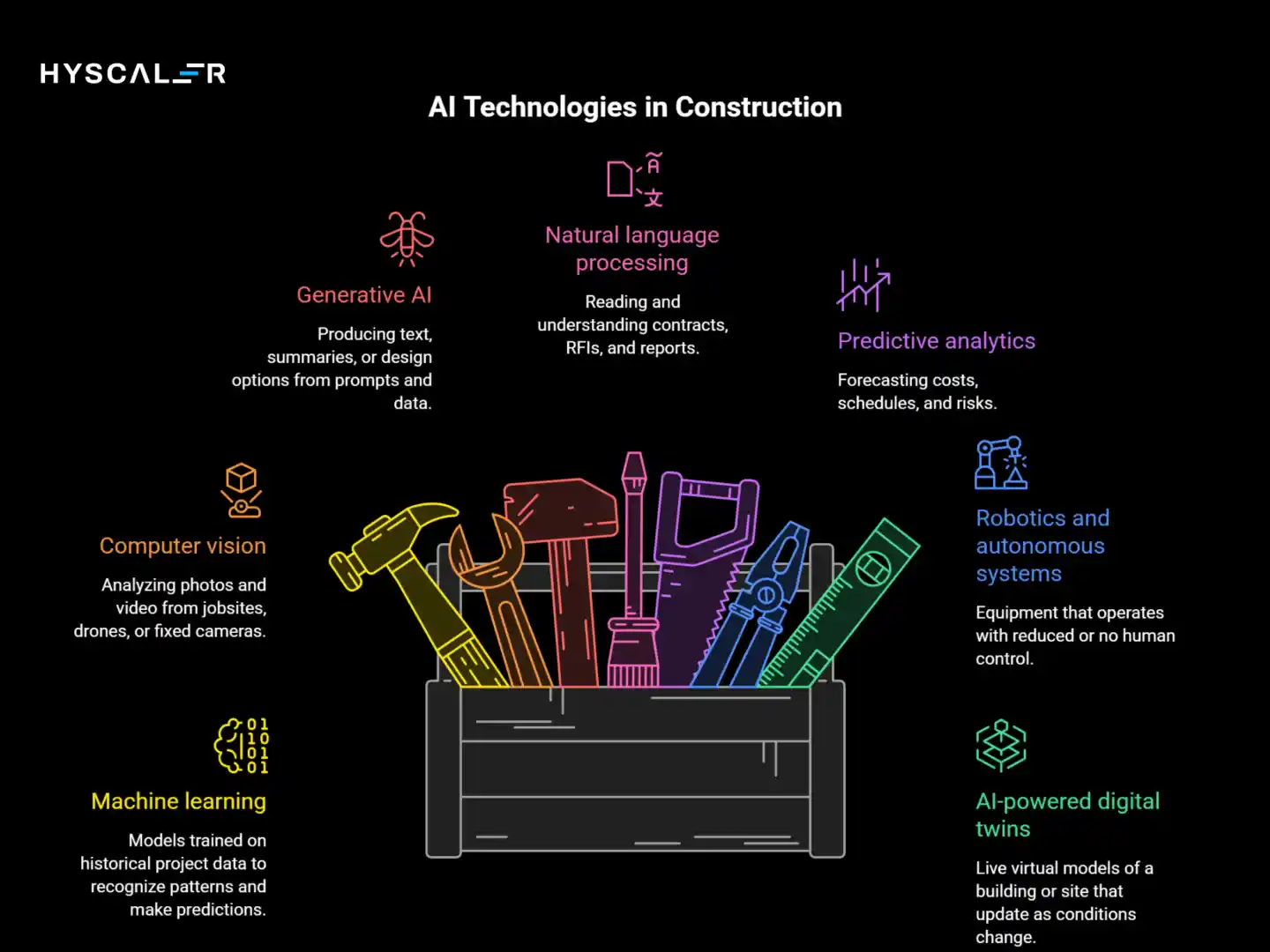
- Machine learning – models trained on historical project data to recognize patterns and make predictions
- Computer vision – analyzing photos and video from job sites, drones, or fixed cameras
- Generative AI – producing text, summaries, or design options from prompts and data
- Natural language processing – reading and understanding contracts, RFIs, and reports
- Predictive analytics – forecasting costs, schedules, and risks
- Robotics and autonomous systems – equipment that operates with reduced or no human control
- AI-powered digital twins – live virtual models of a building or site that update as conditions change
All of this depends on the data construction teams already generate: BIM models, drawings, schedules, cost records, site photos and video, sensor readings, contracts, and equipment logs.
AI’s job is to make that data useful in real time, rather than something reviewed weeks after the fact.
Why Is AI Important for the Construction Industry?
Construction is one of the least digitized major industries, and it shows in the numbers: projects routinely run over budget, over schedule, or both.
A handful of persistent problems keep coming up across the sector:
- Cost overruns
- Project delays
- Labor shortages
- Safety incidents
- Manual, error-prone documentation
- Fragmented communication between teams
- Material waste
- Unplanned equipment downtime
- Data scattered across disconnected systems
- Unreliable forecasting
These aren’t new problems.
What’s new is that AI can now process the volume of project data needed to actually address them, something that was too labor-intensive to do manually at scale.
10 Benefits of AI in Construction
1. Improves Construction Project Planning
AI models can analyze historical project data, timelines, resource use, weather patterns, and site conditions to build more realistic plans and flag risks before ground is broken.
2. Improves Cost Estimation
AI-assisted estimating tools can generate quantity takeoffs and cost projections by learning from thousands of past bids and change orders, reducing the guesswork in early-stage pricing.
3. Increases Jobsite Safety
Computer vision systems can monitor live camera feeds for PPE compliance, unsafe proximity to equipment, or fall hazards, flagging risks in real time instead of during a weekly walkthrough.
4. Improves Quality Control
AI-assisted inspection tools compare what’s actually being built against the design intent, catching deviations early, before they’re buried behind drywall.
5. Reduces Project Delays
Predictive analytics can surface schedule risk weeks in advance by cross-referencing weather forecasts, material lead times, subcontractor performance, and permitting status.
6. Boosts Construction Productivity
Automating repetitive administrative work, daily logs, status reports, and RFI routing frees project teams to spend more time on decisions that actually need human judgment.
7. Enables Predictive Equipment Maintenance
Sensor data from heavy equipment can be used to predict failures before they happen, cutting unplanned downtime and extending equipment life.
8. Reduces Material Waste
AI-driven demand forecasting and inventory tracking help teams order more closely to what a project actually needs, reducing over-ordering and waste.
9. Simplifies Construction Documentation
AI tools can draft RFIs, summarize daily reports, and make searching thousands of pages of contracts and specifications nearly instant.
10. Supports Better Decision-Making
By pulling together data that’s normally scattered across a dozen systems, AI gives project leaders a single, current picture to make decisions from, instead of a spreadsheet that’s already a week stale.
| Benefit | AI Application | Business Impact |
|---|---|---|
| Better planning | Predictive analytics | Fewer delays |
| Cost control | AI estimating | Better bids |
| Safety | Computer vision | Earlier hazard detection |
| Quality | AI inspection | Fewer defects |
| Productivity | Workflow automation | Less manual work |
AI Applications in Construction
AI in Construction Design – Generative design, design optimization, clash detection, and BIM analysis help design teams surface conflicts and alternatives earlier.
AI in Preconstruction – Quantity takeoffs, cost estimation, bid analysis, and risk assessment happen faster and with more historical context.
AI in Project Management – Schedule optimization, progress tracking, risk prediction, resource allocation, and automated reporting reduce the manual overhead of running a job.
AI on Construction Jobsites – Computer vision, worker safety monitoring, equipment tracking, and progress monitoring turn cameras and sensors into an early-warning system.
AI in Construction Quality Control – Defect detection and as-built verification against specifications catch problems before rework becomes expensive.
AI in Construction Equipment Management – Predictive maintenance, utilization tracking, and fuel monitoring keep fleets running and reduce unplanned costs.
AI in Building Operations and Maintenance – Once a building is occupied, AI continues to add value through predictive maintenance, energy optimization, and asset management.
8 Real-World AI Use Cases in Construction
1. AI-Powered Construction Estimating
Problem: manual estimating is slow and inconsistent.
How AI works: models trained on historical bids generate faster, more accurate quantity takeoffs.
Benefit: tighter, more competitive bids.
2. AI-Based Safety Monitoring
Problem: safety walkthroughs only catch issues at a point in time.
How AI works: computer vision continuously scans site footage for hazards.
Benefit: incidents are caught before they happen, not after.
3. Automated Progress Tracking
Problem: manual progress reporting lags reality.
How AI works: drone or camera imagery is compared against the BIM model to measure actual progress.
Benefit: accurate, near-real-time status.
4. Predictive Project Risk Analysis
Problem: schedule and cost risk often surface too late to fix cheaply.
How AI works: models flag risk indicators across schedule, cost, and subcontractor data.
Benefit: earlier intervention, lower cost of fixes.
5. AI-Powered BIM Analysis
Problem: clash detection and design review are time-intensive.
How AI works: AI scans BIM models for conflicts and inefficiencies.
Benefit: fewer costly changes during construction.
6. Intelligent Document and Contract Analysis
Problem: finding a clause in a stack of contracts eats hours.
How AI works: NLP tools search and summarize documents on demand.
Benefit: faster answers, fewer missed obligations.
7. Predictive Equipment Maintenance
Problem: equipment failures happen without warning.
How AI works: sensor data predicts failure before it occurs.
Benefit: less downtime, longer equipment life.
8. AI-Assisted Scheduling
Problem: schedules are built on assumptions that rarely hold.
How AI works: AI models continuously adjust schedules against real project data.
Benefit: fewer surprises, more realistic timelines.
How AI Technologies Are Transforming Construction
Several underlying technologies power the applications above:
Machine learning for pattern recognition and prediction.
Computer vision for interpreting site imagery.
Generative AI for content and design assistance.
Natural language processing for documents and communication.
Digital twins for live virtual project models.
IoT for continuous sensor data.
Robotics for autonomous or semi-autonomous equipment.
Industry research points to IoT, machine learning, BIM-integrated systems, digital twins, and drones as the technologies construction firms are actively exploring right now.
AI in Construction: Before vs. After
| Traditional Approach | AI-Powered Approach |
|---|---|
| Manual estimating | AI-assisted estimating |
| Reactive safety management | Predictive safety monitoring |
| Manual inspections | Computer vision-assisted inspections |
| Spreadsheet-based forecasting | Predictive analytics |
| Manual reporting | Automated reports |
| Reactive equipment maintenance | Predictive maintenance |
| Manual document search | AI-powered document analysis |
Generative AI in Construction
Generative AI has quickly become one of the most visible applications in the industry – not for generating flashy content, but for cutting through the sheer volume of documentation construction teams produce.
Teams are using it to draft project documentation, summarize meetings, search specifications, analyze contracts, draft RFIs, generate reports, and answer project questions on demand.
The real value shows up when generative AI is connected to a project’s own data rather than working from generic knowledge.
Approaches like retrieval-augmented generation (RAG) let an AI system pull answers directly from a project’s specs, drawings, and contracts, which matters enormously in an industry where the right answer often lives in one specific paragraph of one specific document.
AI, BIM, and Digital Twins: How They Work Together
These three pieces increasingly work as a single system:
BIM → Project Data → AI/ML → Digital Twin → Predictions & Decisions
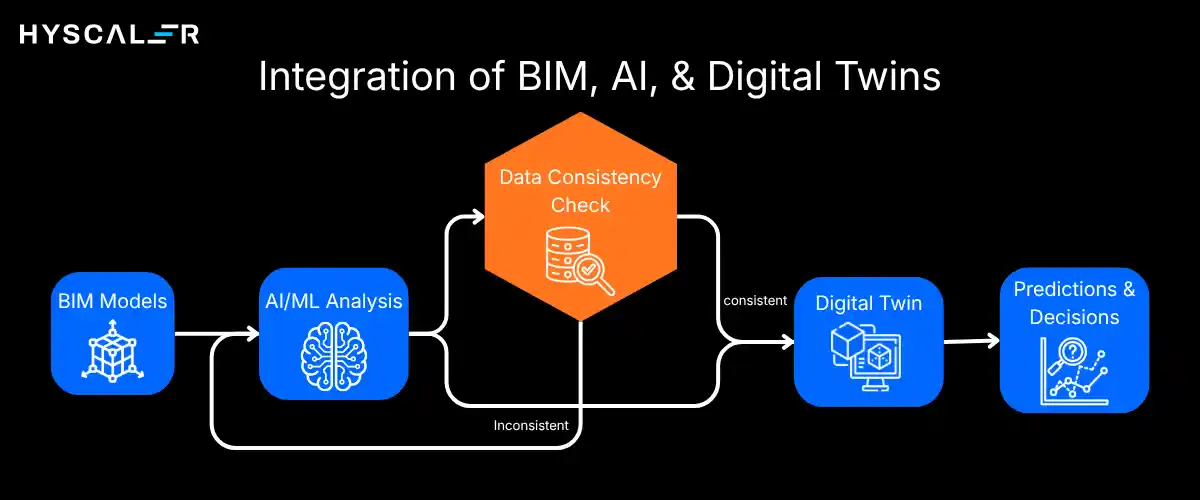
BIM models provide the structured data.
AI and machine learning analyze that data for design optimization, clash detection, and progress comparison.
Digital twins turn that analysis into a live, continuously updated model of the building, useful for predictive maintenance, performance monitoring, and asset management long after construction wraps.
Recent research highlights real potential in combining AI/ML with BIM for efficiency and sustainability gains, while also flagging data inconsistency as a genuine obstacle to doing this well.
Challenges of Implementing AI in Construction
AI adoption in construction isn’t frictionless, and it’s worth being upfront about that:
- Poor data quality – inconsistent or incomplete project data undermines model accuracy
- Lack of AI skills – few teams have in-house expertise to deploy and manage these tools
- Integration with existing systems – many firms run on legacy software that doesn’t connect easily
- High initial investment – custom AI solutions require real upfront spend
- Resistance to change – construction has entrenched workflows that are hard to shift
- Data security and privacy – project and contract data is sensitive
- AI accuracy and reliability – models are only as good as the data and oversight behind them
- Lack of standardization – no industry-wide framework yet for how AI should be applied
- Human oversight – AI recommendations still need experienced judgment behind them
Industry research backs this up: skills shortages, system integration, and data quality are consistently cited as the leading barriers to AI adoption in construction, and overall adoption across the sector remains relatively limited.
How to Implement AI in Construction
A practical path looks like this:
Problem → Data → Pilot → Measure → Integrate → Scale
- Identify a high-value problem – pick something specific, like estimating accuracy or safety monitoring, not “AI” in the abstract.
- Assess available data – AI is only as good as what it’s trained on.
- Select the right AI technology – match the tool to the problem, not the hype.
- Start with a pilot project – prove value on one job before rolling out further.
- Integrate with existing construction software – AI that lives outside your workflow won’t get used.
- Measure ROI – track time saved, costs avoided, incidents prevented.
- Scale successful workflows – expand what’s working across more projects.
- Establish AI governance and human oversight – keep people accountable for the decisions AI informs.
How Much Does AI in Construction Cost?
There’s no single answer here; cost depends on model complexity, data volume, required integrations, computer vision needs, cloud infrastructure, custom development work, existing systems, security requirements, and ongoing maintenance.
Broadly, firms choose between off-the-shelf AI tools, which are cheaper and faster to deploy but less tailored to specific workflows, and custom AI solutions, which cost more upfront but fit a firm’s exact data and processes.
For teams weighing that decision, working with an experienced AI development partner can help clarify which route actually makes sense for a given project size and budget.
What Is the Future of AI in Construction?
Looking past 2026, a few directions stand out:
- AI construction copilots that assist project managers directly inside existing software
- Agentic AI that can carry out multi-step project workflows with minimal supervision
- AI-powered digital twins that update in real time as a building is constructed and operated
- Computer vision and reality capture that continuously compare planned vs. actual site conditions
- Autonomous construction equipment operating with increasing independence
- AI-powered robotics for repetitive or hazardous physical tasks
- Predictive project management that flags risk before it becomes a problem
- AI-powered sustainability optimization for energy and material efficiency
A notable trend already underway: AI is increasingly paired with visual intelligence and reality-capture systems, giving teams a continuous read on steel cost per kg and what’s actually happening on-site versus what was planned.
Final Thoughts
AI isn’t simply about replacing manual construction tasks.
Its larger value is helping construction professionals predict problems, analyze project data, automate repetitive work, and make better decisions earlier, before a delay, a defect, or a cost overrun becomes expensive to fix.
If your team is exploring where AI actually fits into your workflows, HyScaler works with construction and AEC firms to build practical AI, computer vision, and generative AI solutions tailored to real project data, not generic tools bolted onto existing systems.
Get in touch to talk through your use case.
FAQ
What is AI in construction?
AI in construction is the use of machine learning, computer vision, and related technologies to improve planning, safety, quality, and efficiency across the building lifecycle.
How is AI used in the construction industry?
It’s used for cost estimating, safety monitoring, progress tracking, predictive maintenance, quality inspection, scheduling, and document analysis, among other applications.
What are the benefits of AI in construction?
Better planning, more accurate estimating, improved safety, fewer delays, less waste, and stronger decision-making across projects.
How does AI improve construction safety?
Computer vision systems monitor jobsite footage in real time, flagging PPE violations, unsafe proximity to equipment, and other hazards as they happen.
Can AI reduce construction costs?
Yes, through more accurate estimating, less material waste, fewer delays, and reduced equipment downtime from predictive maintenance.
How does AI help with construction project management?
AI supports scheduling, resource allocation, progress tracking, risk prediction, and automated reporting, reducing manual overhead.
What are examples of AI in construction?
AI-powered estimating tools, safety monitoring cameras, predictive maintenance systems, and generative AI for document search are common examples.
How is generative AI used in construction?
It’s used to draft documentation, summarize meetings, search specifications and contracts, and answer project-related questions quickly.
What are the challenges of AI adoption in construction?
Poor data quality, limited in-house AI skills, integration with legacy systems, and high upfront costs are the most cited barriers.
Will AI replace construction workers?
Unlikely in the near term. AI is largely being used to support decision-making and automate administrative work, not replace skilled trades or field labor.
What is the future of AI in construction?
Expect more AI copilots, agentic workflows, real-time digital twins, and deeper integration between computer vision and project management systems.