
Table of Contents
Data engineering is the discipline of building and running systems that turn raw data into data your business can use for dashboards, AI models, and decisions.
This guide covers what it is, how it works, what it costs, and how to evaluate whether you need a partner to do it.
What Is Data Engineering?
Data engineering is the practice of designing, building, and operating the systems that collect, store, transform, and deliver data so it’s reliable enough for analytics, AI, and business decisions.
It’s infrastructure work, not analysis work: the plumbing that makes insight possible, not the insight itself.
If you’re evaluating whether your organization needs it: any time raw data has to move from where it’s created to where someone needs to use it, cleanly, on schedule, without breaking, that’s a data engineering problem.
Data Engineer vs. Data Scientist vs. Data Analyst
This is the question people search most often alongside “data engineering,” so here’s the direct answer.
| Data Engineer | Data Scientist | Data Analyst | |
|---|---|---|---|
| Core job | Builds and maintains the systems that move and store data | Builds predictive models from data | Interprets data to answer specific business questions |
| Output | Pipelines, warehouses, clean datasets | Models, predictions, algorithms | Reports, dashboards, recommendations |
| Primary skills | SQL, Python/Java, distributed systems, cloud infrastructure | Statistics, machine learning, Python/R | SQL, spreadsheets, BI tools, statistics |
| Depends on | Raw data from source systems | Clean data from data engineers | Clean data from data engineers |
| Who depends on them | Data scientists and analysts | Business/product leaders | Business/product leaders |
In short: the data engineer builds the pipes, the data scientist builds the models that run on what flows through them, and the analyst interprets what comes out the other end.
Data engineering sits upstream of both.
What Does a Data Engineer Do?
- Builds and maintains data pipelines
- Integrates data from disparate source systems
- Designs storage, databases, warehouses, lakes, lakehouses
- Cleans, transforms, and validates data
- Automates workflows so pipelines run without manual intervention
- Monitors pipelines and fixes failures
- Enforces access control, security, and governance
- Optimizes performance and infrastructure cost
The Data Engineering Lifecycle
Every data engineering system, regardless of tooling, moves data through the same six stages:
- Generation: Data originates in apps, databases, sensors, APIs, and transactions.
- Ingestion: Data enters the platform, either in scheduled batches or continuously via streaming/CDC.
- Storage: Data lands in a database, warehouse, lake, or lakehouse, chosen based on structure and use case.
- Transformation: Raw data is cleaned, deduplicated, standardized, and enriched into a usable shape.
- Quality validation: Data is checked for accuracy, completeness, consistency, and freshness before anyone relies on it.
- Serving: Processed data reaches dashboards, analysts, ML models, or AI applications.
Governance, security, and monitoring aren’t a seventh stage; they run underneath all six, continuously, not just at the end.
What Is a Data Pipeline?
A data pipeline is the automated sequence that moves data from a source to a destination, applying validation and transformation along the way.
Example: a customer completes a purchase → the event is ingested → validated → transformed into warehouse schema → loaded → surfaced on a dashboard or scored for fraud in real time.
ETL vs. ELT
| ETL | ELT | |
|---|---|---|
| Order | Extract → Transform → Load | Extract → Load → Transform |
| Transform happens | Before storage | After storage, inside the destination |
| Best for | Structured data, traditional warehouses, strict compliance needs | Large or varied data volumes, modern cloud platforms |
Neither is “better”; the right choice depends on data volume, how much compute the destination platform has, and how quickly raw data needs to be queryable.
Data Engineering Architecture
Architecture is the blueprint for how data moves through your organization.
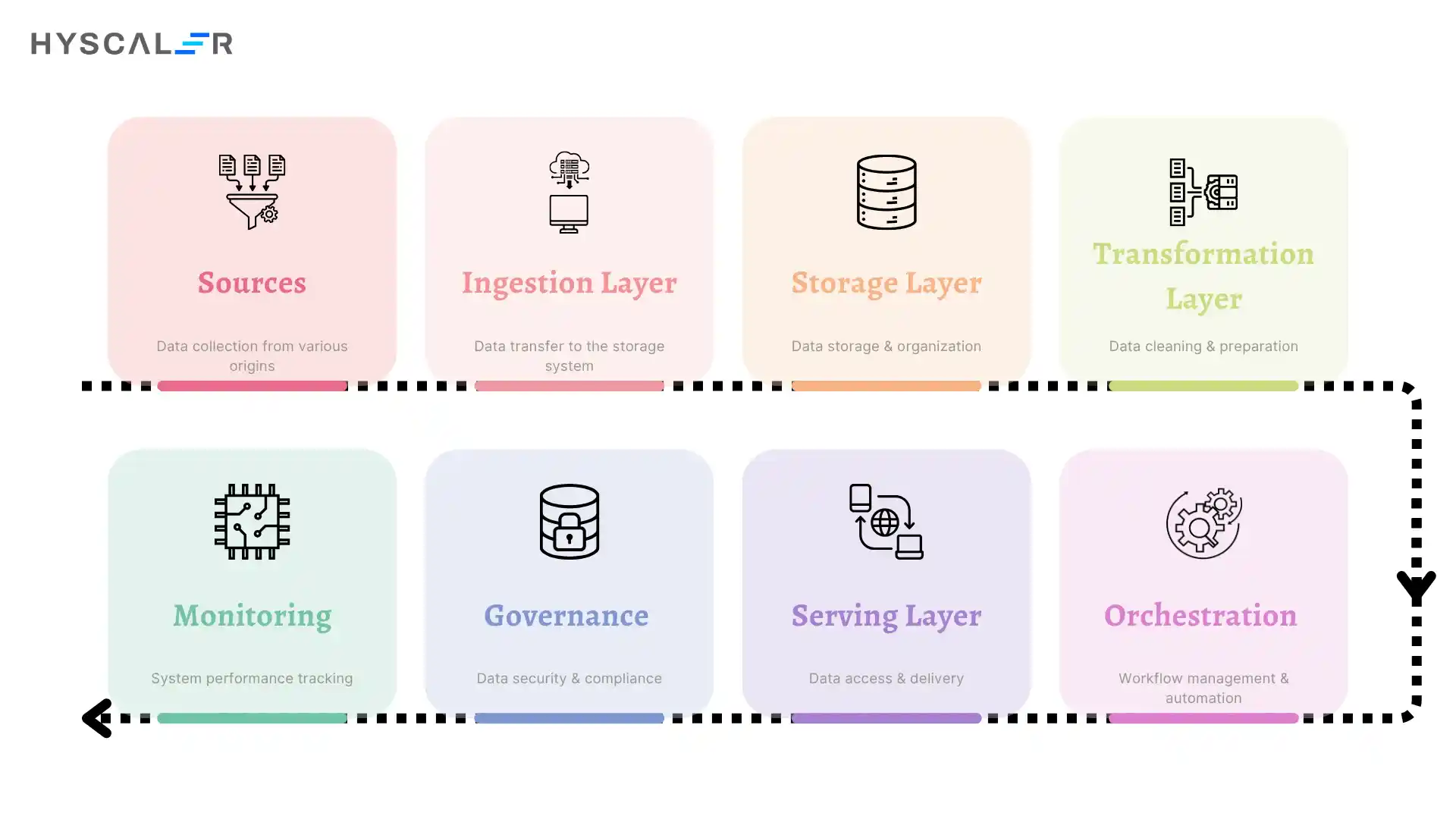
Core components: sources → ingestion layer → storage layer → transformation layer → orchestration → serving layer → governance → monitoring.
Three architecture patterns dominate modern platforms:
- Data warehouse: structured, query-optimized, best for BI
- Data lake: flexible, raw-first, handles any data type
- Lakehouse: combines lake flexibility with warehouse performance; increasingly the default for new builds
A good architecture is scalable, reliable, secure, observable, and cost-efficient, in that rough order of priority, since a system that’s cheap but unreliable costs more in incident response than it saves in infrastructure.
Business Benefits (With Real Examples)
- Faster decisions: a logistics company with real-time pipelines reroutes shipments the moment a delay is detected, instead of finding out the next morning.
- Fewer silos: unifying sales, support, and product data lets a customer success team see the full account picture instead of piecing it together across five tools.
- Lower long-term cost: fixing a fragmented data estate later costs more than architecting it well up front; data debt compounds like technical debt.
- AI that actually works: a model trained on inconsistent data makes inconsistent predictions, regardless of how much it’s tuned afterward.
- Audit-ready compliance: a healthcare provider with proper lineage can demonstrate HIPAA compliance during an audit instead of reconstructing history under pressure.
Where Data Engineering Shows Up by Industry
- Healthcare: EHR integration, clinical analytics, predictive care models
- Finance: fraud detection, risk modeling, regulatory reporting
- Retail: recommendation engines, demand forecasting, inventory intelligence
- Manufacturing: predictive maintenance from IoT sensor data
- Logistics: route optimization, real-time shipment tracking
- SaaS: product usage analytics, customer health scoring
Data Engineering for AI and Generative AI
AI output quality is capped by the data underneath it; this is the fastest-growing driver of data engineering demand in 2026.
For traditional ML, data engineering handles training data preparation, feature pipelines, and real-time data delivery.
For generative AI specifically, it adds a distinct set of requirements: document ingestion at scale, chunking and preprocessing for retrieval, embedding/vector pipelines, and continuous updates so a RAG system isn’t answering from stale knowledge.
A generative AI application is only as current and accurate as the retrieval pipeline feeding it, which is a data engineering problem, not a model problem.
2026 Trends
- AI-assisted pipeline development: AI tools now write, monitor, and repair routine pipeline issues, cutting manual engineering load
- Real-time by default: streaming architecture is becoming the norm for fraud, personalization, and operational use cases, not just an upgrade
- Lakehouse adoption: fewer teams maintaining separate lake and warehouse systems
- Data observability: monitoring freshness, volume, and schema drift, not just pipeline uptime
- Data contracts: datasets treated as owned, versioned products with defined interfaces, reducing “upstream broke downstream” incidents
- Cost-aware engineering: infrastructure spend treated as a design constraint, since cloud data costs scale as fast as capability if unmanaged
Common Challenges
- Poor data quality undermining everything built on top
- Data silos across disconnected systems
- Pipelines that don’t scale past the volume they were designed for
- Real-time processing is harder to build and debug than batch
- Rising infrastructure cost as data volume grows
- Legacy systems that are expensive to modernize without disruption
Best Practices
- Start from the business question, not the technology
- Build quality checks into pipelines from day one, not after problems surface
- Automate – manual data handling doesn’t scale
- Monitor pipelines so failures surface to engineers before stakeholders
- Treat pipeline code like application code: version control, CI/CD, testing
- Document lineage so anyone can trace where data came from
Building a Data Engineering Strategy
- Define the business objective: what decision or capability needs this data?
- Audit existing data sources: what exists, where, and how clean is it?
- Choose the architecture: batch, real-time, or hybrid, based on the workload
- Design the pipeline: map ingestion through serving
- Establish governance: access, compliance, lineage, before scale makes it painful
- Build monitoring in: not after the first incident
- Measure against the original objective: did decisions get faster, did cost drop, did the AI initiative work?
What Does Data Engineering Cost?
There’s no reliable industry-wide average; project scope varies too much to compress into one number, and any site publishing a flat figure is guessing.
What reliably drives cost:
- Number and diversity of data sources
- Current data quality (messy sources cost more to integrate)
- Real-time vs. batch requirements
- Compliance obligations (HIPAA, GDPR add scope)
- One-time migration vs. ongoing managed support
The ongoing infrastructure and maintenance cost, not the initial build, is usually the larger number over a multi-year horizon; budget for both separately.
Choosing a Data Engineering Partner
- Technical depth across ingestion, storage, transformation, and orchestration, not just one tool
- Relevant industry experience, since healthcare, finance, and manufacturing each carry different compliance and data-shape constraints
- Specific security practices: ask how they handle encryption, access control, and audit trails, not whether they “take it seriously”
- Ongoing support model, since a partner who disappears after go-live leaves you exposed the first time something breaks
Why HyScaler for Data Engineering
HyScaler treats data engineering as the prerequisite for AI work, not a separate service; the reasoning is that an AI agent inherits every gap in the data underneath it, so schema, quality, lineage, and access get fixed before anything is built on top of them.
The work is organized into six practices: data migration, ETL/ELT pipeline development, data lake architecture, data architecture and warehousing, DataOps enablement, and governance and compliance, covering frameworks like GDPR and HIPAA.
Migrations run through phased cutovers with dual-run validation and rollback plans, and every pipeline ships with monitoring, alerting, and automated quality checks so failures surface to engineers before they reach stakeholders.
Example: a mid-sized mortgage lender had 50+ loan qualifiers scattered across 200+ PDF programs, with loan officers spending roughly 65% of their time manually extracting guidelines. HyScaler built an AWS platform with an AI-driven knowledge base, sub-second search across programs, and a real-time compliance dashboard, consolidating 200+ programs onto one auditable system.
Talk to HyScaler about your data infrastructure →
FAQ
What is data engineering?
Data engineering is the practice of building and operating the systems that collect, store, transform, and deliver data so it’s reliable enough for analytics, AI, and business decisions. It’s infrastructure work that sits upstream of data analysis.
What’s the difference between a data engineer and a data scientist?
A data engineer builds the pipelines and infrastructure that move and clean data. A data scientist uses that clean data to build predictive models. Data engineers make the data usable; data scientists make it insightful.
What is a data pipeline?
A data pipeline is an automated sequence that moves data from a source to a destination, applying validation and transformation along the way, for example, from a transaction event to a warehouse to a dashboard.
What’s the difference between ETL and ELT?
ETL transforms data before loading it into storage; ELT loads raw data first, then transforms it inside the destination system. ETL suits structured, compliance-heavy workloads; ELT suits large, varied cloud-scale data.
Is data engineering hard to learn?
It has a real learning curve; SQL, a programming language, distributed systems, and cloud platforms are all baseline requirements. It’s approachable for people with a software engineering background, harder as a first technical role.
How does data engineering support AI?
AI models and generative AI applications are only as accurate as the data feeding them. Data engineering prepares training data, builds retrieval pipelines for RAG systems, and keeps that data current; the ceiling on AI quality is set here.
How much does data engineering cost?
There’s no reliable flat average; cost depends on the number of data sources, current data quality, real-time vs. batch requirements, and compliance scope. Budget for ongoing infrastructure costs separately from the initial build; it’s usually the larger number over time.
When should a company bring in a data engineering partner?
When internal teams lack the bandwidth or specialized expertise to build and maintain reliable pipelines, most commonly before an AI initiative, since AI inherits every weakness already present in the underlying data.