
AI reverse engineering uses AI agents to drive tools such as Ghidra and IDA, reading compiled software and rebuilding how it works. In November 2026, researchers used it to rebuild working copies of Slack and Apple’s Finder from the shipped programs. For businesses it cuts both ways: it can recover knowledge locked in undocumented legacy systems, and it can expose the logic of apps you ship.
Table of contents
Reverse engineering used to be slow, specialist work. An expert would spend weeks inside a disassembler, naming functions one at a time, to work out what a program did. In the last two months that changed. An open-source project connected AI coding agents to the same tools, and a security team used agents to rebuild working copies of well-known apps from the files users download.
What is AI reverse engineering?
AI reverse engineering is the use of AI agents to analyze compiled software, the files a program ships as, and explain or rebuild how it works without access to the original source code. The agent does what a human analyst would: it runs disassemblers and decompilers, reads the output, names functions, and maps how the parts fit together.
The best-known example is REA, short for “Reverse Engineer Anything,” an open-source project released under the MIT license. Its README describes it as a way to “reverse engineer anything with agents, from app behavior down to native binaries.” It connects any agent “that supports local MCP servers,” such as Claude Code or Codex, to tools including Ghidra, Hopper, and IDA, and it can inspect native programs, JavaScript and Electron apps, .NET assemblies, Android apps, and firmware. On 23 November 2026 the GitHub repository showed 474,600 stars. InfoQ, which covered the launch in October, noted that REA “does not claim to recover the original source code.”
If you are new to MCP, the protocol that lets agents call tools like these, our guide to MCP and how it compares with UTCP covers the basics.
How does AI reverse engineering work?
AI reverse engineering works in a loop: a tool turns the compiled program into readable assembly or pseudocode, an agent interprets it and writes new code, and the new code is compiled and compared with the original until the two match closely enough.
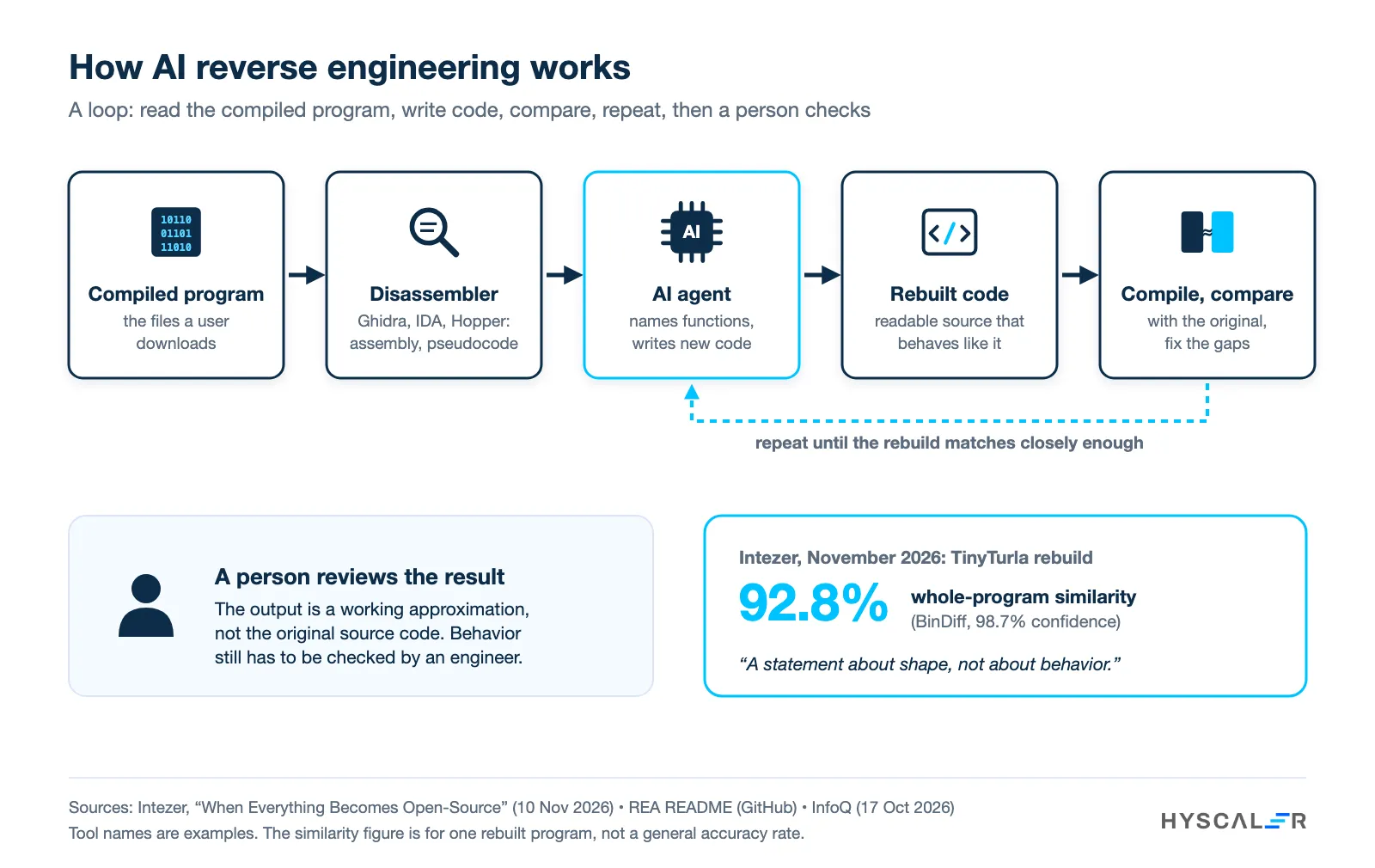
The clearest public example came from Intezer on 10 November 2026. Its researchers rebuilt Slack, Apple’s Finder, and a sample of the TinyTurla backdoor from the shipped programs, working in an isolated lab. Codex, running GPT-5.6-sol-high, drove the workflow, Kimi K3 filled three supporting roles, and Claude helped map the third-party libraries inside Slack. They then added an AI autocomplete feature to their rebuilt Slack.
The numbers show how close the rebuilds came. For TinyTurla, the original had 1,041 functions and the rebuild 1,072, and BinDiff, a comparison tool, matched them at “92.8% whole-program similarity at 98.7% confidence.” The researchers were careful to add: “That is a statement about shape, not about behavior.” Intezer did not publish how long the rebuilds took or what they cost.
Two points follow for anyone evaluating these tools. The output is a working approximation, not the original source code. And it still needs a person who can judge whether the rebuilt behavior is correct.
Is AI reverse engineering legal?
For a business, the safe ground is your own software: systems you built, own, or have written permission to examine. Using AI to pick apart someone else’s product so you can copy it, or to get around its license or protections, can breach both the license and copyright law. AI does not change that. This section is general information, not legal advice.
In practice, this means two things. First, before you point these tools at a legacy system, confirm you hold the rights to it. Code written by a vendor or contractor may still be covered by their license, so check the contract or ask them. Second, don’t rely on the law alone to protect your own apps. Most software licenses forbid reverse engineering, but a license stops honest users, not attackers. That is why the protection steps below matter.
How can AI reverse engineering help with legacy systems?
AI reverse engineering helps with legacy systems by recovering what old software does when the people who wrote it, and the documentation, are gone. That knowledge has to be recovered before a system can be safely replaced or modernized.
The large platform vendors already use AI for the source-code version of this work. AWS Transform for mainframe says it analyzes an entire codebase “to surface dependencies, complexity metrics, and workload boundaries,” and that “every business rule is extracted from your source code and traced to its origin.” IBM’s mainframe modernization tooling promises to “capture application logic, business rules, dependencies, and system context in reusable documentation.” Both keep a person in the loop: AWS asks for approval on intermediate steps, and IBM describes “developer checkpoints.”
What changed this year is the harder case: systems where only the compiled program survives, or where the source no longer matches what runs in production. The Intezer and REA work shows agents can now produce a readable, working approximation from the binary itself. For an undocumented order system or an unsupported vendor tool, that can turn guesswork into a documented plan, provided engineers verify the behavior before anything is switched off.
How do you protect your software from AI reverse engineering?
You protect your software by keeping what matters off the user’s device and treating obfuscation as an extra layer, not the defense itself. Anything you ship to a customer can now be read faster than before.
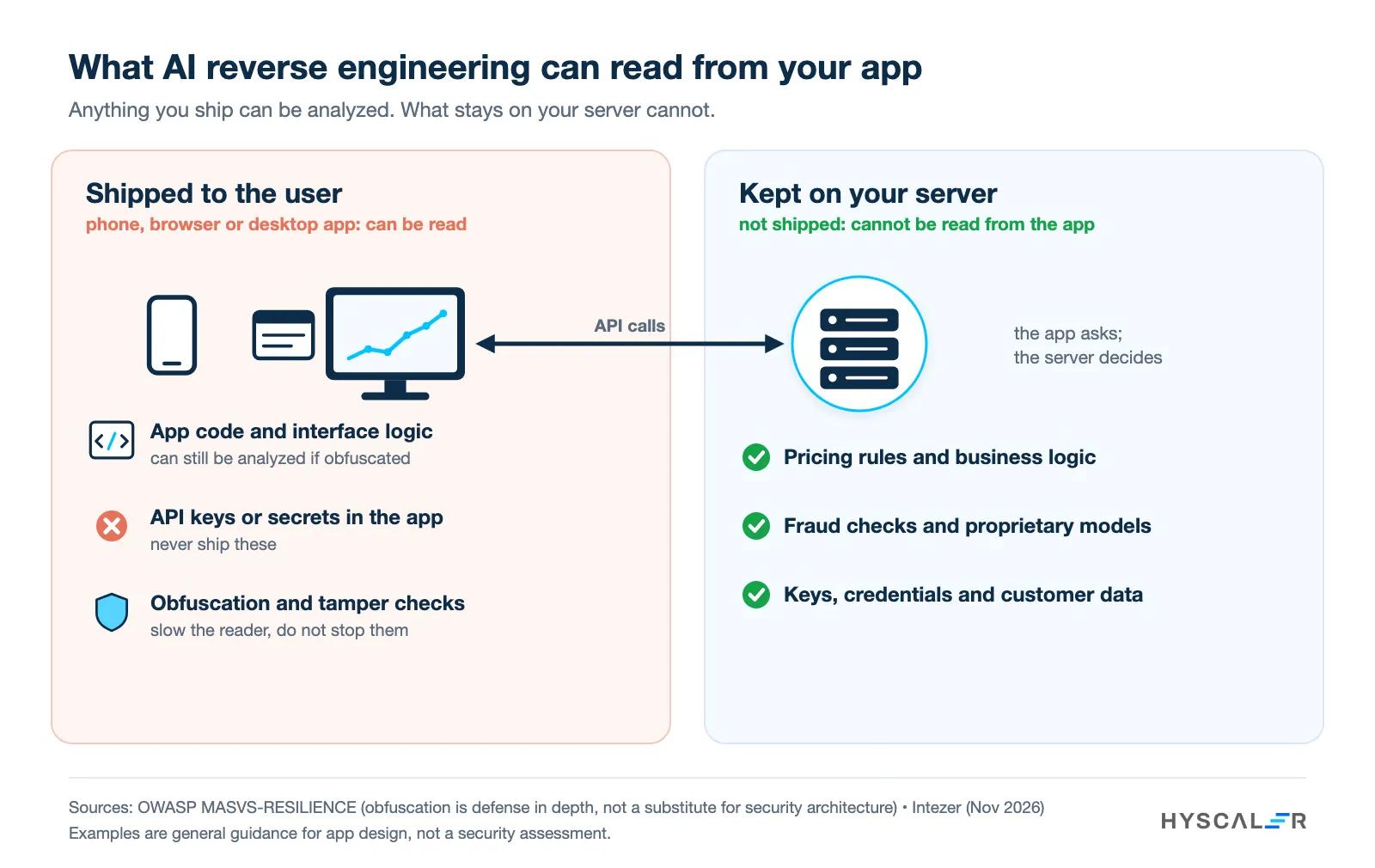
Intezer’s own advice is that “encryptors and obfuscators” will make the process “much harder for AI agents and raise the bar.” The OWASP Mobile Application Security Verification Standard puts those measures in context. It calls obfuscation, anti-tampering, and runtime self-protection “defense-in-depth measures” that make it “more difficult for attackers to modify code or extract sensitive information,” and warns that they “must not be used as a substitute for proper security architecture.” Its guidance is that security “must rely on verifiable design, strong cryptography, and server-side validation.”
In practice, that means:
- Keep pricing rules and proprietary models on the server, where a downloaded app cannot reveal them.
- Never ship secrets such as API keys inside a client app.
- Add obfuscation and tamper detection to apps that carry real business value, such as payment or subscription apps.
- Assume your client code will be read, and design so that reading it does not hurt you.
Where does HyScaler fit?
HyScaler helps businesses use AI reverse engineering on their own legacy systems safely, and design the apps they ship so the same techniques cannot expose what matters.
| Situation | What the work involves | How HyScaler helps |
|---|---|---|
| A legacy system nobody fully understands | Recovering what it does, with evidence, before changing it | Product modernization, starting with a full analysis |
| Only the compiled program survives | AI-assisted recovery, checked by engineers | AI agents with evals and human checkpoints |
| Replacing the old system | Moving without stopping the business | Phased migration with rollback |
| Apps you ship to customers | Keeping logic and secrets off the device | Architecture and secure delivery |
Start with analysis and a baseline
Our product modernization work begins with a “comprehensive analysis of existing systems to identify modernization opportunities and technical debt.” We also measure response times and throughput on the current system first, so the modernized one has a real number to beat. AI reverse engineering speeds up that analysis; it does not replace it.
Recover knowledge with agents and human review
Where code or documentation is missing, we build AI agents to do the reading, with evals written before the agent and human checkpoints where they count. The agents run inside your own AWS, GCP, or Azure account, and the code, models, and evals land in your repositories, so the recovered knowledge stays yours. Our guide to human in the loop and human on the loop explains how we decide where a person signs off.
Move in phases
Once the old system is understood, migration runs in phases with parallel operation and rehearsed rollback, so the business keeps running while systems change underneath. Our guide to legacy system modernization covers the wider process.
Protect what you ship
For new apps, we keep business logic and secrets on the server, and our DevOps practice runs vulnerability scanning, access controls, and compliance checks inside the delivery process, so every release is assessed before it reaches production.
AI reverse engineering FAQ
What is AI reverse engineering?
AI reverse engineering is the use of AI agents to analyze compiled software and explain or rebuild how it works without the source code. The agents drive tools such as Ghidra, IDA, and Hopper, read their output, and write readable code that behaves like the original.
Is AI reverse engineering legal?
Using it on software you built, own, or have written permission to examine is the safe ground. Using it to copy someone else’s product, or to get around its license or protections, can breach the license and copyright law. This is general information, not legal advice.
Can AI recover source code from an executable?
AI can produce a working approximation, not the source. In Intezer’s November 2026 research, a rebuilt program matched the original at 92.8% structural similarity, and the researchers stressed that this measured shape, not behavior.
How do you protect software from AI reverse engineering?
Keep business logic and keys on the server, never ship secrets in client apps, and add obfuscation and tamper detection as an extra layer. OWASP warns that obfuscation must not replace proper security architecture.
What tools are used for AI reverse engineering?
Agents such as Claude Code and Codex are connected to disassemblers and decompilers such as Ghidra, IDA, Hopper, and Binary Ninja. Open-source projects such as REA connect them through MCP so the agent can call the tools directly.
Sources
REA (Reverse Engineer Anything), GitHub repository and README, accessed 23 November 2026: https://github.com/morluto/rea
InfoQ, “Reverse Engineer Anything Project Brings AI Agents to Binary Analysis,” Renato Losio, 17 October 2026: https://www.infoq.com/news/2026/10/reverse-engineer-anything/
Intezer, “When Everything Becomes Open-Source,” Nicole Fishbein, 10 November 2026: https://research.intezer.com/blog/2026/11/when-everything-becomes-open-source/
Help Net Security, “AI reverse engineering let researchers add a new feature to Slack,” Mirko Zorz, 10 November 2026: https://www.helpnetsecurity.com/2026/11/10/slack-ai-reverse-engineering/
AWS Transform for mainframe: https://aws.amazon.com/transform/mainframe/
IBM, mainframe modernization for IBM Z: https://www.ibm.com/products/watsonx-code-assistant-z
OWASP MASVS-RESILIENCE, Resilience Against Reverse Engineering and Tampering: https://github.com/OWASP/owasp-masvs/blob/master/Document/11-MASVS-RESILIENCE.md
Talk to HyScaler about legacy systems and AI reverse engineering
If you have a system nobody fully understands, start with what it does today. Our product modernization and AI agents pages show how we work. Talk to our team and we will help you recover what the old system knows before anything is switched off.