
Table of Contents
Quick Answer: An IoT application development company designs and builds the software, cloud infrastructure, and integrations that connect physical devices to digital systems: turning sensor data into dashboards, alerts, and automated actions.
Costs typically range from $5,000 for a proof of concept to $500,000+ for an enterprise-grade platform, depending on device count, connectivity protocols, and cloud/edge architecture.
The right partner combines hardware integration experience, cloud and edge expertise, security discipline, and a proven end-to-end development process.
If you’re evaluating vendors, building a business case, or just trying to understand what “IoT application development” actually involves, this guide walks through the full picture: what these companies build, how the development process works, what it costs, which technologies matter, and how to choose the right partner.
At its core, IoT application development connects five layers that don’t exist in traditional software: connected devices → data → cloud/edge processing → applications → analytics and automation.
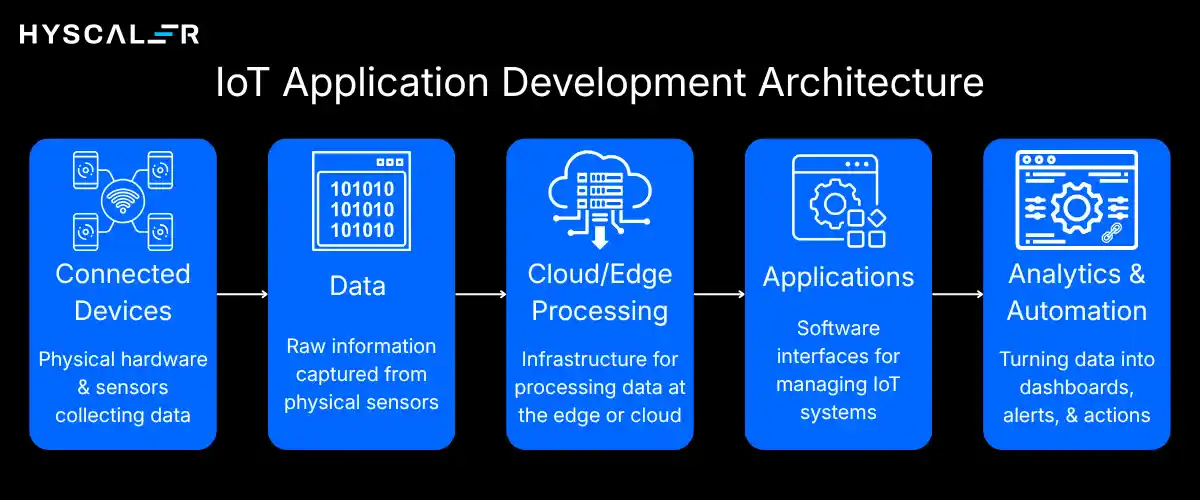
Every section below builds on that chain.
What Is IoT Application Development?
IoT application development is the process of building software that connects physical devices, sensors, machines, wearables, vehicles, and appliances to cloud or edge systems, then turns the data those devices generate into something people and businesses can act on.
Unlike a typical mobile or web app, an IoT application doesn’t start with a user typing something in.
It starts with a device measuring something in the physical world – temperature, location, vibration, motion, moisture – and sending that reading somewhere useful.
A complete IoT solution generally includes:
- Connected devices and sensors that capture real-world data
- Data collection mechanisms that gather readings continuously or on a schedule
- Connectivity: the protocols and networks that move data from device to cloud
- Cloud or edge processing that stores, filters, and analyzes incoming data
- Mobile and web applications that let people view and control the system
- IoT dashboards for real-time visibility
- Analytics that turn raw readings into insight
- Automation that triggers actions without a human in the loop
- Device management tools to monitor, update, and troubleshoot the fleet of connected hardware
How Does an IoT Application Work?
At a high level, data moves through a consistent path:
Device/Sensor → Connectivity → IoT Gateway → Cloud/Edge → Data Processing → Application → Analytics → Automation

A sensor captures a reading. That reading travels, via Wi-Fi, cellular, Bluetooth, or a low-power protocol, to a gateway that aggregates and forwards it.
From there, it reaches the cloud (or is processed locally at the edge for speed).
The platform stores and processes the data, an application surfaces it to users, analytics tools look for patterns, and automation rules act on what’s found, shutting off a valve, sending an alert, adjusting a thermostat, flagging a machine for maintenance.
IoT Application vs. Traditional Application
The two share code and interfaces, but the underlying engineering problem is different.
| Factor | Traditional App | IoT Application |
|---|---|---|
| Data source | User/system input | Devices + sensors + systems |
| Connectivity | Internet/API | Multiple protocols (Wi-Fi, BLE, LoRaWAN, cellular, etc.) |
| Real-time data | Optional | Often essential |
| Hardware dependency | Low | High |
| Edge computing | Rare | Common |
| Device management | Limited | Essential |
| Security | Application-focused | Device + network + cloud + application |
This is why a company that’s excellent at building SaaS products isn’t automatically equipped to build IoT systems; the hardware, connectivity, and device-management layers require a different skill set entirely.
What Does an IoT Application Development Company Do?
A capable IoT development partner doesn’t just build a mobile app that happens to talk to a sensor.
It understands and can execute across the entire connected ecosystem, from strategy through hardware integration to long-term maintenance.
- IoT Consulting and Strategy: Helping businesses figure out whether IoT is the right investment, what problem it should solve, and what a realistic roadmap looks like before any code is written.
- IoT Solution Architecture: Designing how devices, gateways, cloud services, and applications fit together, including decisions about where data is processed (device, edge, or cloud) and how the system scales.
- IoT Application Development: Building the core software that ties the connected system together: business logic, APIs, data pipelines, and integrations.
- IoT Mobile App Development: Native or cross-platform apps that let users monitor and control connected devices from a phone or tablet.
- IoT Web Dashboard Development: Browser-based interfaces, often used by operations teams, that visualize device data, fleet status, and alerts in real time.
- IoT Device and Sensor Integration: Connecting physical hardware – existing or custom – to the software layer, including firmware-level communication and protocol handling.
- IoT Cloud Development: Building the backend infrastructure (data ingestion, storage, APIs, device shadows) on platforms like AWS IoT, Azure IoT, or Google Cloud.
- IoT Gateway Development: Creating the local hardware/software bridge that aggregates device data before it reaches the cloud, often handling protocol translation and local filtering.
- IoT Data Engineering and Analytics: Structuring the pipelines and models that turn raw sensor streams into dashboards, reports, and predictive insights.
- AIoT Development: Layering machine learning and AI on top of IoT data for predictive maintenance, anomaly detection, and intelligent automation.
- Industrial IoT (IIoT) Development: Purpose-built solutions for manufacturing, energy, and industrial environments, where reliability and real-time performance are non-negotiable.
- IoT Testing and Quality Assurance: Validating device communication, data accuracy, load handling, and security across the entire stack- not just the app’s UI.
- IoT Maintenance and Support: Ongoing monitoring, firmware/software updates, and scaling support after launch, since connected fleets need continuous upkeep.
HyScaler’s own IoT solution services span this full range – from consulting and app development through AIoT, industrial IoT, and long-term testing and maintenance – which is the kind of end-to-end coverage worth looking for in any partner.
Types of IoT Applications Businesses Can Develop
IoT isn’t one category of product; it’s a set of patterns applied differently across industries and use cases.
Consumer IoT Applications
- Smart home systems
- Smart appliances
- Wearables and fitness trackers
- Connected consumer products (locks, cameras, thermostats)
Industrial IoT Applications
- Predictive maintenance systems
- Machine and equipment monitoring
- Asset tracking across facilities
- Production line monitoring
Healthcare IoT Applications
- Remote patient monitoring
- Connected medical devices
- Wearable health applications
- Hospital asset and equipment tracking
Logistics and Fleet IoT Applications
- GPS-based fleet tracking
- Fleet management platforms
- Cold-chain monitoring for perishable goods
- End-to-end supply-chain visibility
Smart Agriculture Applications
- Soil condition monitoring
- Crop health monitoring
- Automated irrigation systems
- Livestock tracking and monitoring
Smart Retail Applications
- Real-time inventory tracking
- Smart shelves and stock alerts
- In-store customer behavior analytics
- Connected point-of-sale systems
Smart Building and Smart City Applications: Building automation, energy management, connected infrastructure, and public-safety monitoring at city scale.
Connected Automotive Applications: Telematics, fleet diagnostics, and in-vehicle connectivity.
Energy and Utility IoT Applications: Smart grids, remote meter reading, and equipment monitoring across energy infrastructure.
IoT Application Development Services: What Should You Look For?
Rather than treating this as a checklist of buzzwords, it’s worth understanding what each service should actually deliver.
| Service | What It Includes | Business Outcome |
|---|---|---|
| IoT consulting | Strategy, feasibility, roadmap | Lower project risk |
| App development | Mobile/web applications | Device control & monitoring |
| Device integration | Sensors, gateways, hardware | Connected ecosystem |
| Cloud IoT | Infrastructure & APIs | Scalability |
| Edge computing | Local processing | Lower latency |
| Analytics | Real-time/predictive analytics | Better decisions |
| AIoT | AI + IoT combined | Intelligent automation |
| Security | Device/network/app security | Risk reduction |
| Maintenance | Monitoring & updates | Long-term reliability |
If a vendor can only speak confidently to one or two rows of this table, that’s a signal they may be a good fit for a narrow task, but not for owning the full system.
IoT Application Development Process
Building an IoT application involves more moving parts than a typical software project, because hardware, connectivity, and software all have to be designed together.
- Business and IoT Use-Case Discovery: Defining the problem IoT is meant to solve and the outcome that justifies the investment.
- Feasibility and Requirement Analysis: Assessing whether existing hardware can be used, what data is actually needed, and what technical constraints exist.
- IoT Architecture Design: Mapping out the device, connectivity, edge, cloud, and application layers.
- Hardware and Device Selection: Choosing sensors, gateways, and hardware components (or validating existing ones).
- Connectivity and Protocol Planning: Selecting the right mix of Wi-Fi, cellular, BLE, LoRaWAN, or other protocols based on range, power, and bandwidth needs.
- UX/UI Design: Designing dashboards and app interfaces around how operators actually use the data.
- Application and Backend Development: Building the core software, APIs, and business logic.
- Cloud and Edge Integration: Connecting the application to cloud infrastructure and, where needed, local edge processing.
- Data Analytics and AI Integration: Building the pipelines and models that generate insight from device data.
- IoT Security Testing: Validating device authentication, encryption, and network security.
- Device and Application Testing: End-to-end testing across real hardware, not just simulated data.
- Deployment: Rolling out the system to production devices and users.
- Monitoring, Maintenance, and Scaling: Ongoing support as the connected fleet grows.
Typical timelines:
| Phase | Approximate Duration |
|---|---|
| Proof of concept | 4–8 weeks |
| MVP | 2–4 months |
| Mid-complexity solution | 4–8 months |
| Enterprise-grade platform | 8–14+ months |
These are directional, not fixed; a project with heavy hardware customization or strict compliance requirements (healthcare, industrial safety) will run longer than a straightforward consumer app.
IoT Application Development Tech Stack
The right technology choice depends on the use case: this isn’t a list to memorize; it’s a set of trade-offs to understand.
IoT Connectivity Protocols
- MQTT: lightweight, widely used for device-to-cloud messaging
- CoAP: designed for constrained devices and low-power networks
- HTTP/HTTPS: simple, but heavier than purpose-built IoT protocols
- WebSockets: good for real-time, bidirectional dashboards
- Bluetooth/BLE: short-range, low-power, common in wearables
- Wi-Fi: high bandwidth, higher power draw
- Zigbee / Z-Wave: mesh networking for smart home and building systems
- LoRaWAN: long-range, low-power, ideal for agriculture and remote monitoring
- Cellular/5G: wide-area coverage for mobile or remote assets
IoT Cloud Platforms: AWS IoT, Microsoft Azure IoT, Google Cloud IoT, IBM Cloud. Each offers device management, data ingestion, and analytics tooling; the choice usually comes down to existing enterprise infrastructure and specific service capabilities.
Edge Computing Technologies: Used when latency, bandwidth cost, or offline reliability matter more than centralizing everything in the cloud (e.g., a factory floor that can’t tolerate network delay).
Backend Technologies: Frameworks and languages chosen for throughput and reliability under high-frequency data ingestion, not just standard web-app needs.
Mobile Development Technologies: Native (Swift, Kotlin) or cross-platform (Flutter, React Native), selected based on how tightly the app needs to integrate with device-level APIs like Bluetooth.
Databases and Data Platforms: Time-series databases are common for sensor data; relational and NoSQL databases handle other application data.
AI/ML Technologies: Used for anomaly detection, predictive maintenance, and forecasting on top of collected data.
IoT Device Management Technologies: Tools for provisioning, monitoring, and remotely updating devices at scale.
IoT Application Architecture: Key Components
A well-designed IoT architecture typically includes:
- Devices and sensors: the physical layer collecting real-world data
- Firmware: the low-level software running on the device
- Connectivity layer: the protocols moving data off the device
- IoT gateway: aggregates and forwards data from multiple devices
- Edge layer: local processing for latency-sensitive tasks
- Cloud platform: central infrastructure for storage and processing
- Data ingestion: pipelines that bring device data into the system
- Data storage: databases suited to high-volume, time-series data
- Analytics: tools that turn stored data into insight
- API layer: connects the backend to applications and third-party systems
- Mobile/web application: the interface users interact with
- Device management: provisioning, monitoring, and updating the device fleet
- Security layer: spans every component above, not a single point in the stack
How Much Does IoT Application Development Cost in 2026?
There’s no single honest number here; IoT project costs vary more than typical software projects because hardware, connectivity, and infrastructure choices all move the price independently.
Treat the ranges below as planning estimates, not fixed quotes.
| IoT Project Type | Estimated Cost |
|---|---|
| Basic IoT proof of concept | $5,000 – $30,000 |
| IoT MVP | $30,000 – $100,000 |
| Mid-complexity IoT solution | $80,000 – $200,000 |
| Enterprise IoT platform | $150,000 – $500,000+ |
| Large-scale industrial IoT | $500,000+ |
Factors That Affect IoT Development Cost
- Number of connected devices
- Hardware requirements and customization
- Number of platforms supported (iOS, Android, web)
- Connectivity protocols used
- Cloud infrastructure complexity
- Whether edge computing is required
- Real-time processing needs
- AI/ML integration
- Third-party system integrations
- Security requirements
- Regulatory compliance (HIPAA, industrial safety standards, etc.)
- Volume of data collected and stored
- Dashboard and reporting complexity
- Testing scope, especially across physical hardware
- Ongoing maintenance needs
IoT Development Cost by Project Complexity
A single-device consumer prototype and a 10,000-sensor industrial rollout aren’t the same category of project, even though both get called “IoT development.”
Complexity: not device count alone, is what drives cost: how many protocols are in play, how much of the processing happens at the edge, and how deeply the system integrates with existing enterprise software.
How to Reduce IoT Development Costs Without Sacrificing Quality
- Start with a focused proof of concept before committing to a full-scale build
- Use existing certified hardware instead of custom hardware where possible
- Choose managed cloud IoT services over building infrastructure from scratch
- Phase the rollout, validate with a smaller device fleet before scaling
- Prioritize the connectivity protocol that fits the actual use case, not the most feature-rich option
- Build device management and security in from the start, rather than retrofitting later (retrofits are expensive)
How Long Does It Take to Develop an IoT Application?
| Project Type | Typical Timeline |
|---|---|
| Proof of concept | 4–8 weeks |
| MVP | 2–4 months |
| Medium-scale solution | 4–8 months |
| Enterprise IoT platform | 8–14+ months |
IoT projects generally take longer than comparable standard mobile or web applications because multiple layers – hardware, connectivity, edge processing, cloud infrastructure, and software – all have to work together reliably, and testing has to happen against real physical devices, not just simulated data.
Key Benefits of IoT Application Development
- Real-Time Monitoring: Visibility into equipment, environments, or assets as conditions change, not after the fact.
- Predictive Maintenance: Identifying equipment issues before they cause downtime, based on patterns in sensor data.
- Operational Automation: Reducing manual intervention by triggering actions automatically based on real-world conditions.
- Reduced Operational Costs: Fewer unplanned failures, less manual monitoring, and more efficient resource use.
- Improved Asset Utilization: Better visibility into how equipment and assets are actually being used.
- Better Customer Experiences: Connected products that adapt to usage patterns or proactively alert users to issues.
- Data-Driven Decision Making: Decisions grounded in continuous real-world data rather than periodic reporting.
- New Revenue Opportunities: Connected products enable new service models, like usage-based pricing or subscription monitoring.
- Improved Safety and Compliance: Continuous monitoring supports safety protocols and simplifies regulatory reporting.
IoT Use Cases Across Major Industries
| Industry | IoT Use Cases |
|---|---|
| Manufacturing | Predictive maintenance, OEE tracking, machine monitoring |
| Healthcare | Remote patient monitoring, connected medical devices |
| Logistics | Fleet and asset tracking, cold-chain monitoring |
| Retail | Inventory tracking, smart shelves |
| Agriculture | Smart irrigation, crop and soil monitoring |
| Automotive | Connected vehicles, telematics |
| Energy | Smart grids, energy consumption monitoring |
| Construction | Equipment tracking, worker safety monitoring |
| Banking/Finance | Asset and security monitoring |
| Real Estate | Smart building management |
| Telecom | Infrastructure monitoring |
| Oil & Gas | Equipment and pipeline monitoring |
| Hospitality | Smart rooms and guest experience systems |
| Education | Smart campus infrastructure |
| Government | Smart-city infrastructure |
IoT Security: What Should Businesses Consider?
Security is one of the areas where IoT projects most commonly go wrong, largely because the attack surface is much wider than a standalone application.
- Device Authentication: Ensuring only verified devices can connect to the network and send data.
- Encryption: Protecting data both in transit and at rest.
- Secure APIs: Locking down the interfaces that connect devices, applications, and third-party systems.
- Identity and Access Management: Controlling who and what can access device data and controls.
- Secure Firmware: Building security into the device software layer itself, not just the cloud and app.
- OTA (Over-the-Air) Updates: Safely patching device firmware remotely without physical access.
- Network Security: Segmenting and monitoring the networks devices communicate over.
- Data Privacy: Handling personal or sensitive data collected by connected devices in compliance with relevant regulations.
- Vulnerability Testing: Actively probing the system, including physical devices, for weaknesses.
- Zero-Trust IoT Architecture: Assuming no device or connection is inherently trusted, and verifying continuously rather than once at connection time.
IoT security isn’t a single feature; it spans the entire chain: device → network → edge → cloud → application → data.
A weakness at any one layer can compromise the whole system.
IoT + AI: Why AIoT Is the Next Step
AIoT: the combination of artificial intelligence and IoT is where connected systems move from reporting data to acting on it intelligently.
- Predictive analytics: forecasting outcomes based on historical and real-time device data
- Anomaly detection: flagging unusual patterns before they become failures
- Predictive maintenance: scheduling repairs based on actual equipment condition, not fixed intervals
- Computer vision: extracting insight from camera and imaging data at the edge or in the cloud
- Intelligent automation: triggering complex actions based on multiple data signals, not simple thresholds
- Demand forecasting: using connected data to anticipate needs before they arise
- Digital twins: virtual models of physical systems, updated continuously from live device data
- AI-powered decision-making: surfacing recommendations, not just raw data
- Edge AI: running inference directly on or near the device, reducing latency and bandwidth needs
HyScaler positions AIoT as a core part of its IoT services, and its edge computing offering extends into edge AI and real-time processing: the combination that makes AIoT practical outside of controlled lab conditions.
IoT Application Development Challenges and How to Solve Them
Hardware Compatibility: Devices from different manufacturers often use inconsistent protocols.
Solution: standardize on a gateway layer that handles protocol translation.
Connectivity Problems: Unreliable networks in remote or industrial environments disrupt data flow.
Solution: design for intermittent connectivity with local buffering and edge processing.
Scalability: Systems built for hundreds of devices can break at tens of thousands.
Solution: architect for scale from the start, using cloud-native, horizontally scalable infrastructure.
Data Volume: High-frequency sensor data can overwhelm storage and processing.
Solution: filter and aggregate at the edge before sending data to the cloud.
Security Vulnerabilities: Devices are often the weakest security link.
Solution: build authentication and encryption into the device layer, not just the app.
Device Management: Monitoring and updating thousands of deployed devices manually isn’t feasible.
Solution: invest in dedicated device management tooling early.
Integration With Legacy Systems: Older industrial or enterprise systems often lack modern APIs.
Solution: use middleware and gateways designed for legacy protocol translation.
Cross-Platform Compatibility: Supporting multiple device types and operating systems adds complexity.
Solution: use cross-platform frameworks where hardware constraints allow.
Real-Time Performance: Some use cases can’t tolerate cloud round-trip latency.
Solution: push processing to the edge for time-sensitive decisions.
Maintenance and OTA Updates: Keeping firmware current across a distributed fleet is operationally difficult.
Solution: build OTA update capability into the system from day one.
Regulatory and Compliance Requirements: Healthcare, industrial, and financial IoT systems face strict compliance obligations.
Solution: involve compliance requirements in the architecture phase, not as an afterthought.
How to Choose the Best IoT Application Development Company
This is the part that most directly affects project outcomes, so it’s worth being specific rather than relying on a vendor’s marketing claims.
- Check IoT-specific experience: Not just app development experience, but demonstrated work across devices, connectivity, and cloud/edge infrastructure.
- Evaluate end-to-end capabilities: Can they own the project from architecture through maintenance, or only one slice of it?
- Review relevant case studies: Look for examples in a similar industry or use case, not just generic portfolio pieces.
- Check hardware and device integration expertise: This is where teams without real IoT experience often struggle most.
- Evaluate cloud and edge capabilities: Confirm hands-on experience with the specific platforms and edge requirements your project needs.
- Assess security expertise: Ask how they approach device, network, and application security together, not as separate concerns.
- Review development methodology: Agile, phased delivery, and clear milestones matter more on IoT projects given the number of interdependent components.
- Ask about testing: Specifically, how they test against real hardware, not just simulated environments.
- Understand pricing and engagement models: Fixed price, time-and-materials, or dedicated team, and how change requests are handled.
- Evaluate post-launch support: Connected systems need ongoing monitoring and updates; ask what happens after go-live.
- Check scalability experience: Ask about a time they scaled a system from pilot to full deployment, and what broke along the way.
- Ask these 15 questions before hiring an IoT development company:
- How many end-to-end IoT projects have you delivered?
- What industries have you built for?
- Can you show a case study similar to our use case?
- What connectivity protocols have you implemented in production?
- Do you have in-house hardware/firmware expertise, or do you subcontract it?
- Which cloud IoT platforms have you worked with?
- How do you approach edge computing when it’s needed?
- How do you test against physical devices, not just simulations?
- What’s your approach to device and data security?
- How do you handle OTA firmware updates?
- What does your device management tooling look like?
- How do you handle scaling from pilot to full rollout?
- What’s your typical timeline for a project like ours?
- What does post-launch support and maintenance include?
- Can you walk us through a project that didn’t go as planned, and what you did about it?
Why Choose HyScaler for IoT Application Development?
HyScaler offers end-to-end IoT development: spanning consulting, application development, AIoT, industrial IoT (IIoT), wearable connectivity, and ongoing testing and maintenance, rather than a narrow slice of the stack.
Specific strengths include:
- End-to-end IoT development, from strategy through long-term support
- IoT application and dashboard development across mobile and web
- AIoT capabilities, combining IoT data with AI-driven insight
- Industrial IoT (IIoT) experience for manufacturing and industrial environments
- Wearable connectivity expertise for consumer and healthcare devices
- IoT testing and maintenance, so systems stay reliable after launch
- Cloud and edge capabilities to support both centralized and latency-sensitive architectures
- Multi-industry expertise, including healthcare, manufacturing, oil & gas, retail, telecom, and banking
- USA presence with global delivery, supporting businesses across time zones
HyScaler’s IoT solution services page outlines this full range in more detail, including the specific industries served.
IoT Application Development Trends in 2026
- AIoT: AI and IoT converging into a single decision-making layer
- Edge AI: inference moving closer to the device for speed and reliability
- 5G-enabled IoT: higher bandwidth and lower latency for mobile and remote devices
- Digital twins: live virtual models mirroring physical systems
- Industrial IoT expansion: deeper adoption across manufacturing and energy
- IoT + computer vision: camera-based monitoring integrated with sensor data
- Autonomous IoT systems: systems that act without constant human oversight
- Predictive maintenance: moving from reactive to proactive equipment management
- IoT cybersecurity: increasing focus as connected fleets grow in scale
- Low-power IoT: longer device lifespans through power-efficient design
- IoT + robotics: connected systems coordinating physical automation
- Real-time analytics: insight generated as data arrives, not in batch
Have an IoT Product Idea?
Talk to HyScaler’s IoT experts about architecture, device integration, application development, AIoT, IIoT, cloud, edge computing, and deployment: from proof of concept through production scale.
FAQs
What is an IoT application development company?
A company that designs and builds the software, cloud infrastructure, and device integrations needed to connect physical devices to digital systems.
What does an IoT application development company do?
It handles everything from strategy and architecture to device integration, cloud/edge development, application building, security, and ongoing maintenance.
How much does IoT application development cost?
Typically $5,000 for a basic proof of concept up to $500,000+ for an enterprise-grade platform, depending on device count and architecture complexity.
How long does it take to build an IoT application?
Anywhere from 4–8 weeks for a proof of concept to 8–14+ months for an enterprise platform.
What are the best technologies for IoT application development?
It depends on the use case: protocol choice (MQTT, LoRaWAN, BLE, etc.), cloud platform, and edge requirements all shift based on the project’s needs.
What is the difference between IoT and IIoT?
IIoT (Industrial IoT) applies IoT principles specifically to industrial environments like manufacturing and energy, with a stronger focus on reliability and real-time performance.
Can IoT applications integrate with existing enterprise software?
Yes, though legacy systems often require middleware or gateways to bridge older protocols with modern APIs.
Can IoT applications use AI?
Yes: this combination is commonly called AIoT, and it’s used for predictive maintenance, anomaly detection, and intelligent automation.
How secure are IoT applications?
Security depends on how well the system is designed across every layer: device, network, edge, cloud, and application- not just the app itself.
What industries use IoT applications?
Manufacturing, healthcare, logistics, retail, agriculture, automotive, energy, and many others.
How do I choose an IoT application development company?
Look for end-to-end capability, hands-on hardware and cloud experience, a clear security approach, and evidence of successfully scaling projects from pilot to production.
What is the difference between IoT app development and traditional app development?
IoT apps depend heavily on hardware, connectivity, and real-time data, while traditional apps typically rely on user or system input alone.
Do IoT applications require custom hardware?
Not always: many projects use existing certified hardware, though some use cases require custom sensors or devices.
Can IoT applications process data at the edge?
Yes, edge computing is common when latency, bandwidth cost, or offline reliability are important.
How much does it cost to maintain an IoT application?
Ongoing maintenance costs vary based on fleet size and complexity, but should be budgeted as a continuous line item, not a one-time expense.