

Table of Contents
Modern digital banking operates in an environment defined by rapid cloud adoption, Open Banking APIs, and instant settlement payment rails. While these advances power high-speed consumer financial services, they fundamentally change the attack surface of financial institutions. Traditional perimeter-based security (“castle-and-moat”) is no longer sufficient when data flows continuously across hybrid clouds, third-party fintech integrations, and containerized microservice architectures.
To prevent devastating data breaches, operational downtime, and regulatory sanctions, banking CISOs and enterprise architects must transition from legacy perimeter controls to a hardened, zero-trust infrastructure model.
This guide provides an architectural blueprint for hardening banking network infrastructure, which forms a core component of our comprehensive fintech cybersecurity architecture. By securing core assets against modern threat vectors, financial institutions can maintain continuous regulatory compliance under FFIEC, FDIC, and PCI-DSS v4.0 standards.
The Modern Banking Threat Landscape: Beyond Perimeter Defenses
Modern banking infrastructure relies on interconnected distributed systems. Therefore, threat actors bypass perimeter firewalls by exploiting implicit internal trust, configuration oversights, and supply-chain vulnerabilities.
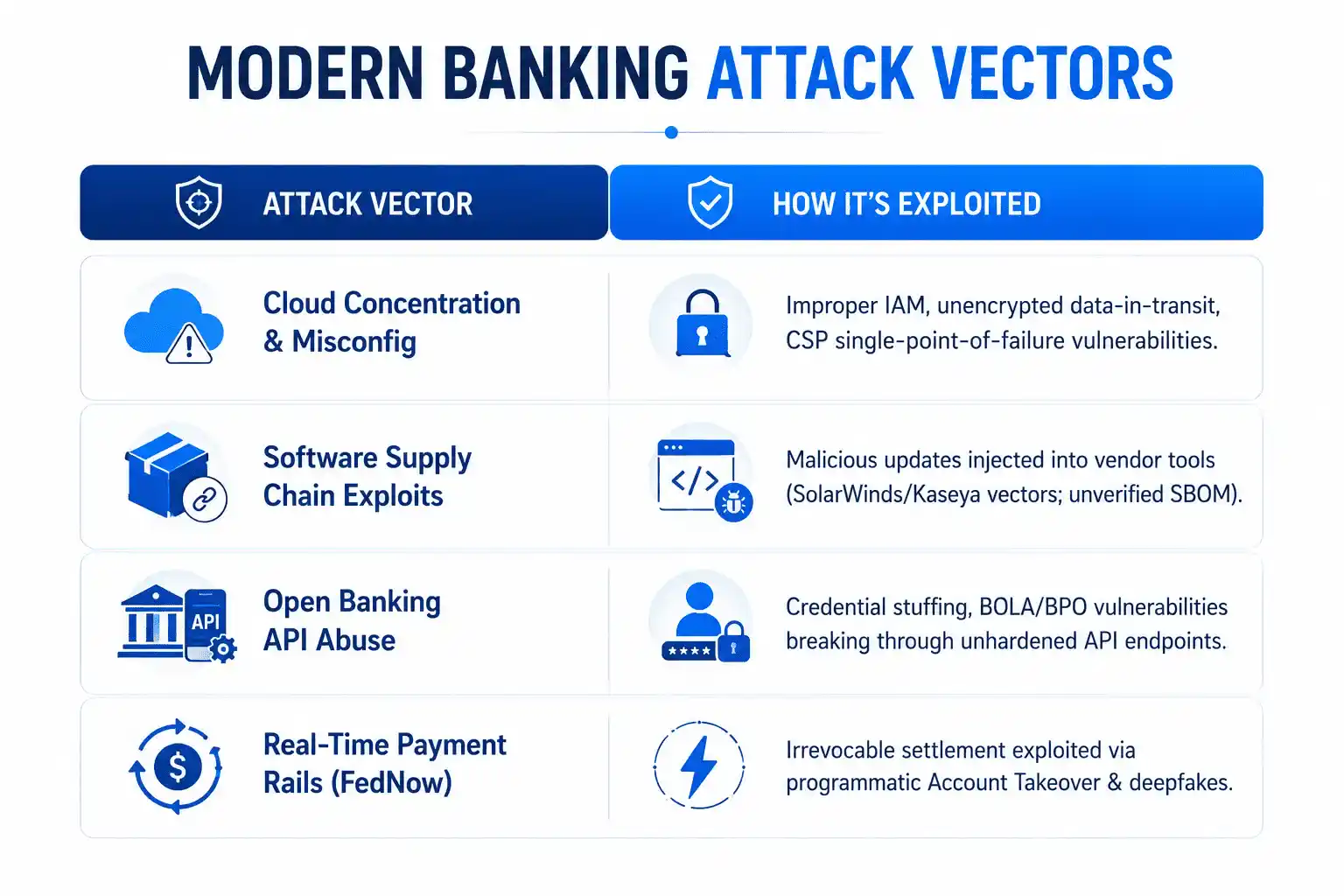
Cloud Misconfigurations and Service Provider Concentration Risk
As financial institutions migrate workloads to hybrid and multi-cloud environments, security gaps frequently open due to improper configuration management and weak access boundary controls. For instance, during our AWS cloud security migration for lending platforms, implementing zero implicit trust boundaries resolved critical infrastructure vulnerabilities.
Regulatory examinations under the FFIEC Architecture, Infrastructure, and Operations (AIO) booklet highlight that top cloud security misconfigurations, such as misconfigured Identity and Access Management (IAM), unencrypted internal transit, and flawed object-level access controls, expose core banking data stores.
Additionally, reports from the U.S. Department of the Treasury and CISA highlight cloud concentration risk as a systemic threat: an operational outage or targeted breach at a single dominant Cloud Service Provider (CSP) can cause collateral disruption across dozens of financial entities simultaneously.
Third-Party Vendor Software Supply Chain Attacks
Modern banking relies on complex environments of core banking vendors, payment processors, and IT service tools. FFIEC Development, Acquisition, and Maintenance (DA&M) guidance and FDIC InTREx supervisory reports show how malicious code injected into software updates (reminiscent of the SolarWinds and Kaseya attacks) easily bypasses perimeter defenses to compromise downstream internal systems.
Under CISA Cyber Performance Goals (CPG 2.0) and interagency supervisory expectations, institutions must enforce continuous vulnerability management, fourth-party risk auditing, and Software Bill of Materials (SBOM) verification throughout their continuous software delivery pipelines.
Credential Stuffing & Open Banking API Exploitation
Open Banking initiatives utilize Application Programming Interfaces (APIs) to exchange financial data with third-party fintech applications. Understanding what API security is and why it is critical helps mitigate risks, as the Federal Reserve and FFIEC identify improperly configured APIs as primary targets for credential stuffing, programmatic bot attacks, and mass data exfiltration.
Threat actors exploit vulnerabilities listed in the OWASP API Security Top 10, notably Broken Object Level Authorization (BOLA) and Unrestricted Resource Consumption, to bypass legacy authentication gateways and scrape customer account databases.
Real-Time Payment Rails (FedNow and RTP) Attack Surface Expansion
The rollout of instant payment networks, such as the FedNow Service and Real-Time Payments (RTP), eliminates traditional clearing delays. Under Federal Reserve Operating Circular No. 5, connected banking nodes must enforce stringent endpoint isolation, mutual authentication, and continuous anomaly monitoring backed by AI fraud detection for banks.
Because transactions settle irrevocably within seconds, malicious actors deploy programmatic social engineering, synthetic identity fraud, and AI voice cloning to execute rapid exfiltration before legacy batch fraud detection triggers can intervene.
Zero Trust Network Architecture (ZTA) for Banking Infrastructure
To mitigate these evolving vectors, financial institutions must implement a comprehensive zero trust security architecture aligned with NIST SP 800-207 Zero Trust Architecture (ZTA). Zero Trust operates on a simple principle: never trust, always verify. Every access request, microservice call, and database query is treated as untrusted, regardless of whether it originates outside the network or from an internal IP address.
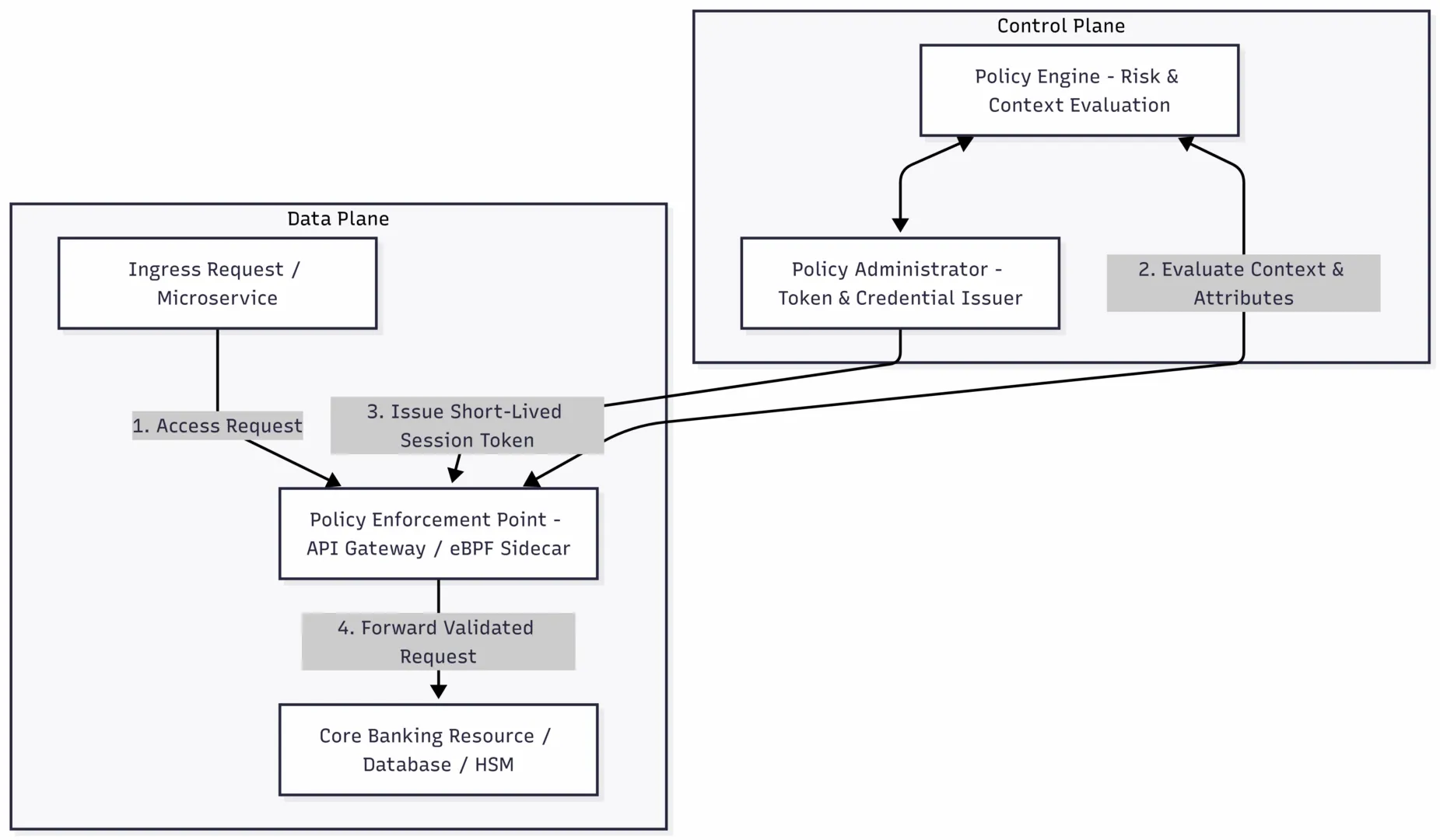
Control Plane vs. Data Plane Separation
NIST SP 800-207 mandates a strict separation between the control plane and the data plane:
- Policy Decision Point (PDP): Comprising a Policy Engine (PE) and Policy Administrator (PA), the PDP continuously evaluates real-time contextual attributes, including identity proofing, device health, location, time-of-day, and threat intelligence.
- Policy Enforcement Point (PEP): Distributed PEPs (such as API gateways, service mesh proxies, or kernel-level eBPF firewalls) intercept all data-plane traffic, enforcing decisions rendered by the PDP.
Static Perimeter Firewalls vs. Runtime Micro-Segmentation
| Security Vector | Legacy Castle-and-Moat Perimeter | Zero Trust Micro-Segmentation |
| Trust Boundary | Network edge (IP subnets, broad VLANs) | Individual workload, container pod, or database table |
| Lateral Movement | Unrestricted once outer firewall is breached | Blocked by default-deny internal policies |
| Authentication | One-time at session entry | Continuous per-request authentication & authorization |
| Identity Model | Static IP addresses & network location | Cryptographic service identity (e.g., SPIFFE/SPIRE) |
| Encryption | Often unencrypted on internal networks | End-to-end encryption in transit (mTLS 1.3) everywhere |
Hardening the 3 Architectural Zones of Banking IT
A hardened banking network organizes infrastructure into three isolated, highly defended deployment zones:
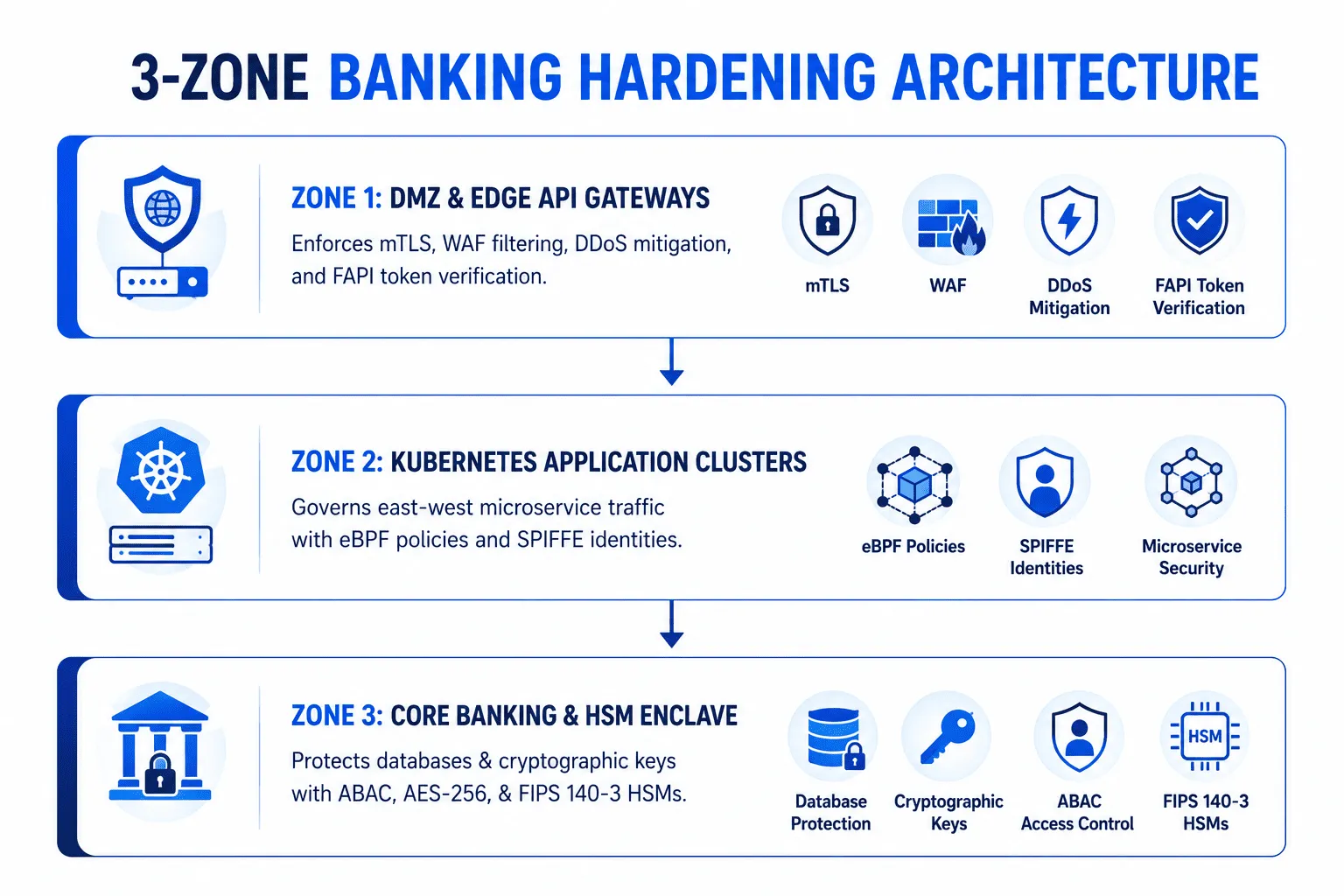
Zone 1: DMZ & Edge API Gateways (Public & Partner Ingress)
The ingress layer acts as the initial PEP for incoming traffic from mobile applications, web portals, and third-party fintech partners.
- Edge Enforcement: Deploy Web Application Firewalls (WAF) alongside DDoS mitigation (e.g., Cloudflare Magic Transit or AWS Shield) to inspect layer 7 traffic.
- API Hardening: Enforce Mutual TLS (mTLS) and rate-limiting at the edge to block botnets and credential-stuffing campaigns before requests reach application logic.
Zone 2: Kubernetes Microservice Clusters (East-West Traffic)
Inside containerized environments, east-west (service-to-service) communications require fine-grained access policies aligned with enterprise Kubernetes best practices.
- Service Mesh & eBPF: Utilize lightweight eBPF kernel-level tracing (e.g., Cilium) and service meshes (e.g., Istio) to enforce identity-based network policies.
- Cryptographic Workload Identity: Replace IP-based whitelist rules with SPIFFE/SPIRE tokens. Workloads programmatically establish mTLS connections verified via short-lived X.509 certificates, blocking unauthorized lateral movement across container namespaces.
# Example: Cilium eBPF Strict Network Policy for Core Payment Service
apiVersion: "cilium.io/v2"
kind: CiliumNetworkPolicy
metadata:
  name: "secure-payment-processor-ingress"
  namespace: "banking-core"
spec:
  endpointSelector:
    matchLabels:
      app: payment-processor
  ingress:
    - fromEndpoints:
        - matchLabels:
            app: api-gateway
            tier: edge
      toPorts:
        - ports:
            - port: "8443"
              protocol: TCP
          rules:
            http:
              - method: "POST"
                path: "/v1/transactions/execute"
Zone 3: Core Banking Databases & Hardware Security Modules (HSM) Enclave
The inner vault houses core ledger databases, customer PII, and master cryptographic keys.
- Database Isolation: Isolate databases inside restricted enclaves with no direct internet ingress. Access is restricted exclusively to authorized microservices via Attribute-Based Access Control (ABAC).
- FIPS 140-3 HSM Integration: Master cryptographic operations (such as PIN generation, account re-keying, and transaction signing) are offloaded to dedicated Hardware Security Modules (HSMs) certified to FIPS 140-3 Level 3 or 4.
- Field-Level Encryption (FLE): Encrypt sensitive fields, such as Primary Account Numbers (PAN) and Social Security Numbers (SSN), at the application layer before reaching database disk stores.
Encryption Standards & Key Lifecycle Management
Financial data must remain unreadable to unauthorized parties, whether stored on disk or traversing internal/external networks.
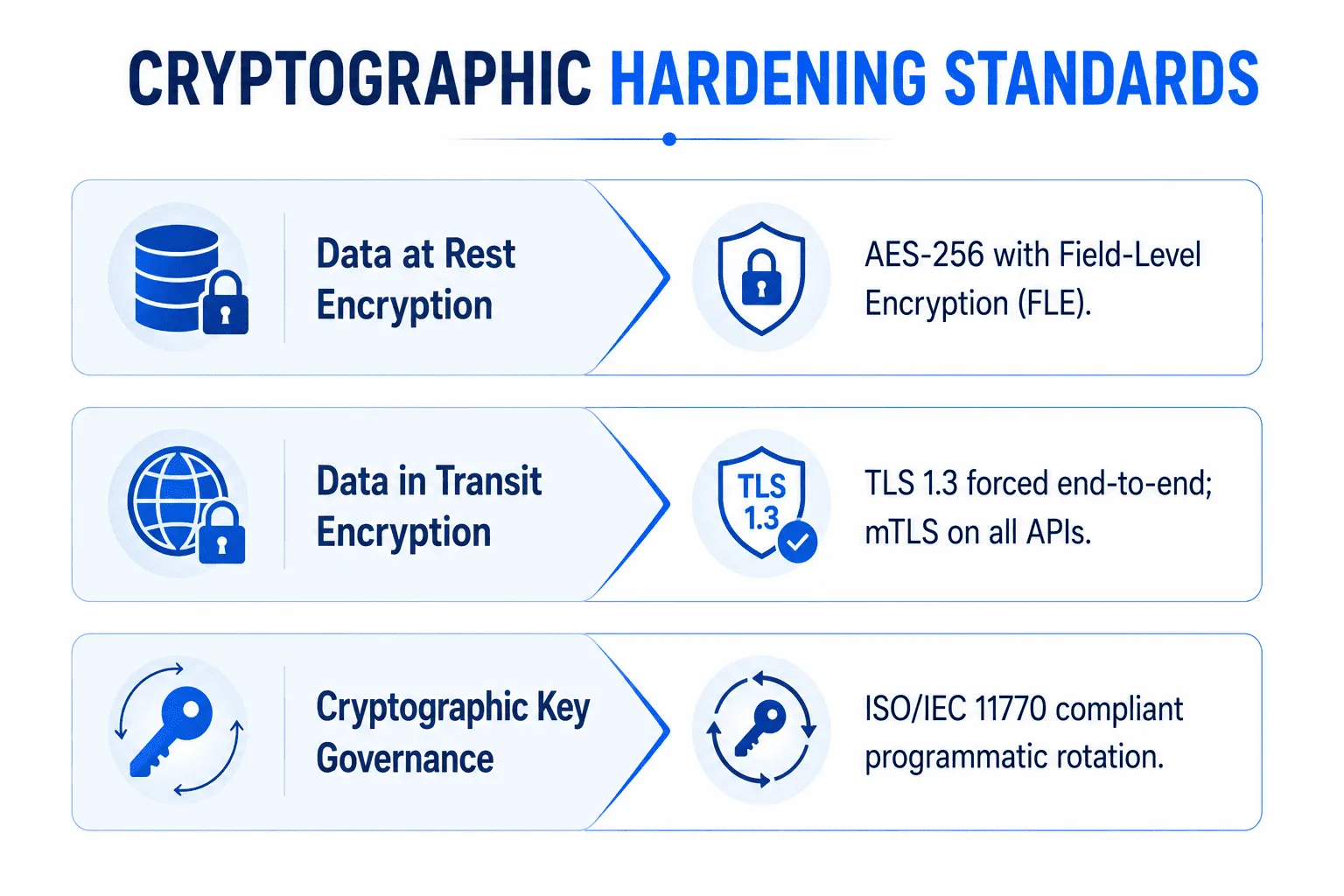
Data at Rest: AES-256 & Field-Level Protection
- All storage volumes, database backups, and log repositories must enforce AES-256 encryption.
- Critical fields (PAN, card CVVs, account balances) require Field-Level Encryption (FLE). Even if an attacker gains raw database access, encrypted fields remain protected without application-held keys.
Data in Transit: TLS 1.3 & mTLS Enforcement
- Disable legacy protocols (SSL v3, TLS 1.0, TLS 1.1, TLS 1.2) across all banking endpoints, standardizing strictly on TLS 1.3.
- Implement Mutual TLS (mTLS) for all microservice-to-microservice and external API communications to guarantee cryptographic authentication of both client and server.
Cryptographic Key Lifecycle Management
Following ISO/IEC 11770 key management frameworks:
- Generation: Keys are generated inside FIPS-validated HSM hardware using hardware random number generators (TRNG).
- Storage: Key Encryption Keys (KEKs) wrap Data Encryption Keys (DEKs). KEKs never leave the secure boundary of the HSM. For decentralized and asset-backed systems, we established Web3 and DeFi asset security architecture protecting transaction signing engines.
- Rotation: Enforce scheduled, policy-driven key rotation schedules (e.g., rotating DEKs every 90 days or after specific byte thresholds).
- Revocation & Destruction: Maintain programmatic revocation pipelines to instantly destroy compromised key material across distributed environments.
Financial API Hardening: FAPI & Token Binding
Open Banking APIs require security configurations beyond standard Web OAuth setups.
Financial-grade API (FAPI) Profile Constraints
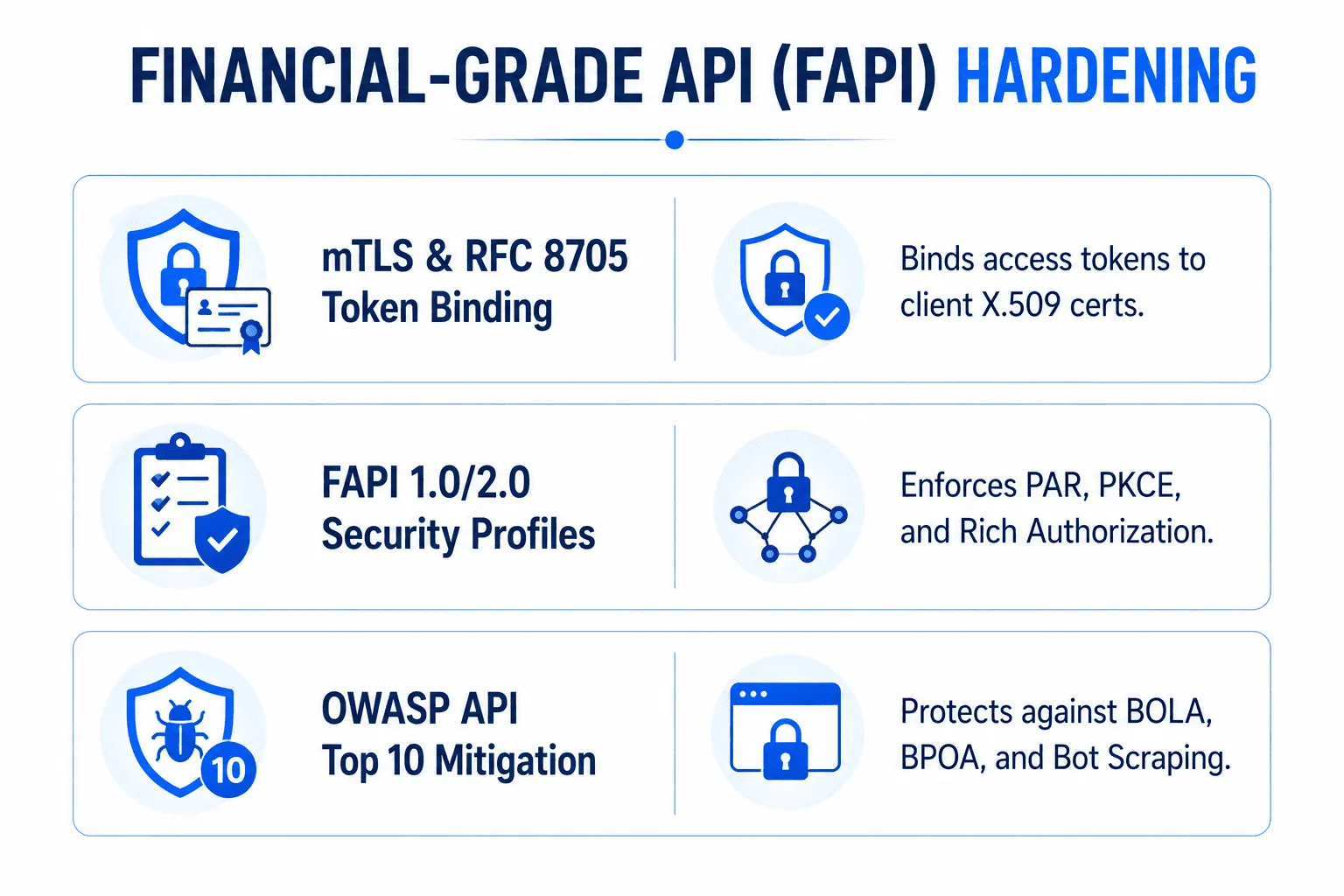
The OpenID Foundation established the FAPI 1.0 and 2.0 specifications to remove security optionality present in standard OAuth 2.0. Hardened banking APIs must enforce:
- Pushed Authorization Requests (PAR): Forces authorization parameters to be passed directly out-of-band via encrypted HTTP POST requests, eliminating URL tampering in user browsers.
- Proof Key for Code Exchange (PKCE): Prevents authorization code injection attacks on mobile banking clients.
- Rich Authorization Requests (RAR): Enables fine-grained specification of transaction details (e.g., precise currency amounts, payee identifiers) directly within authorization prompts.
mTLS Token Binding (RFC 8705)
Standard OAuth access tokens act as bearer tokens: anyone possessing the string can make API calls. Under RFC 8705 (OAuth 2.0 Mutual-TLS Client Authentication and Certificate-Bound Access Tokens):
- The API Gateway cryptographically binds the issued access token to the client application’s mTLS X.509 certificate thumbprint.
- If a stolen token is presented over a different TLS channel, the API Gateway rejects the request.
Mapping Regulatory Compliance Frameworks
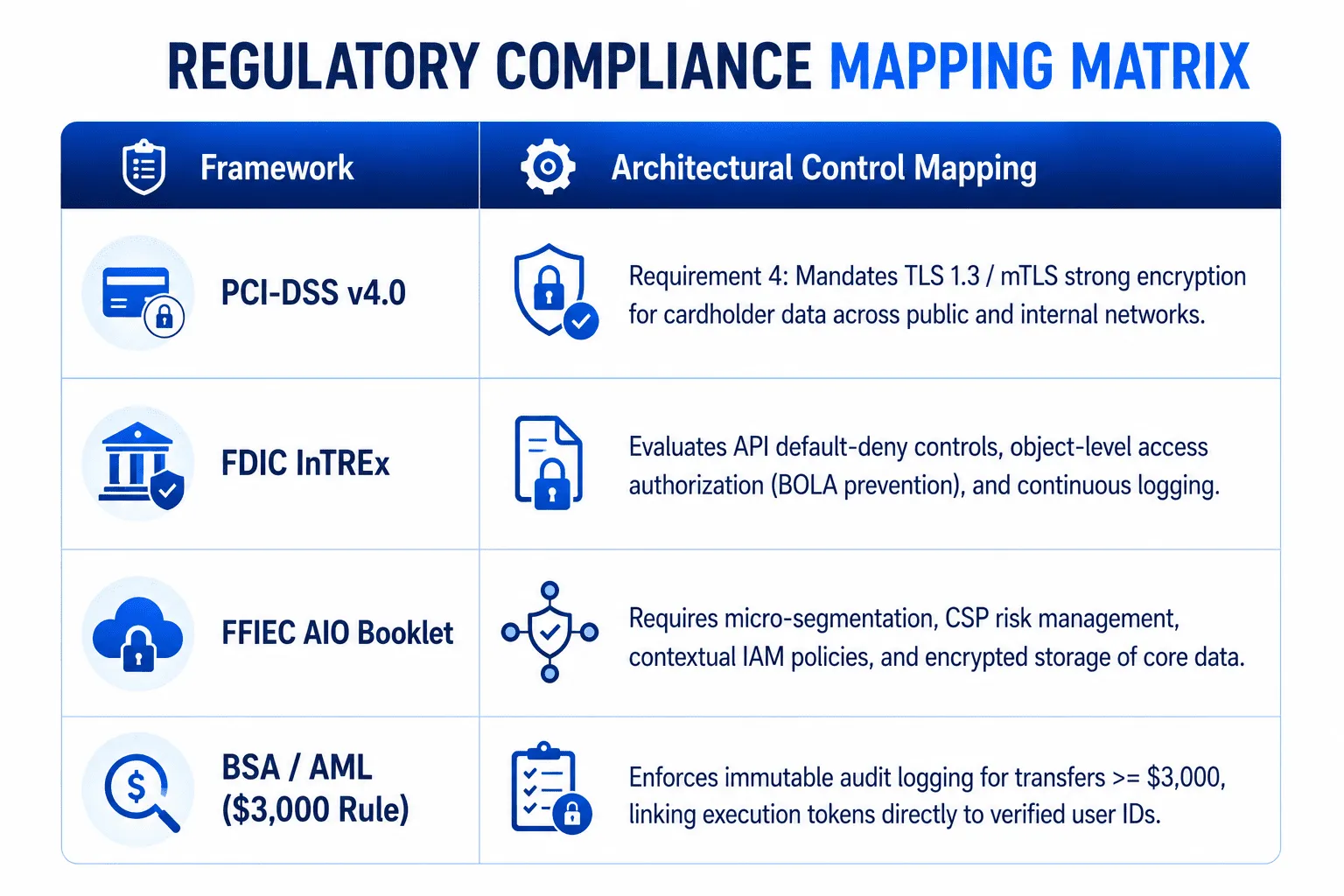
Implementing these architectural controls satisfies key requirements across major financial security standards:
BSA $3,000 Transaction Rule Logging
Under the Bank Secrecy Act (BSA) $3,000 recordkeeping rule, financial institutions must maintain immutable audit trails for electronic funds transfers equal to or exceeding $3,000.
By integrating mTLS token binding with FAPI profiles, API Gateways automatically capture required compliance parameters, authenticated user identity, source account, destination account, execution timestamp, and dollar value, directly within cryptographically signed audit logs, simplifying programmatic Suspicious Activity Report (SAR) generation.
To understand the detailed mapping of these controls to FFIEC and FDIC compliance mandates, refer to our comprehensive banking cybersecurity compliance architecture guide.
CISO Actionable Implementation Checklist
Use this phased checklist to guide your network hardening initiative:
Phase 1: Perimeter & Edge Defense (Weeks 1–4)
- [ ] Conduct continuous OWASP API vulnerability scanning across all external endpoints.
- [ ] Enforce mTLS authentication on all third-party fintech and Open Banking gateways.
- [ ] Deprecate legacy TLS 1.0/1.1 protocols; enforce TLS 1.3 across edge load balancers.
- [ ] Configure WAF rate-limiting to prevent scripted credential-stuffing campaigns.
Phase 2: Internal Micro-Segmentation (Weeks 5–12)
- [ ] Deploy eBPF-based network policy enforcement (e.g., Cilium) within Kubernetes clusters.
- [ ] Replace static internal IP whitelists with cryptographic SPIFFE/SPIRE workload identities.
- [ ] Implement default-deny ingress and egress policies for container namespaces.
- [ ] Establish centralized Policy Decision Points (PDP) for real-time access authorization.
Phase 3: Core Vault & HSM Hardening (Weeks 13–20)
- [ ] Migrate key management workloads to FIPS 140-3 Level 3/4 Hardware Security Modules.
- [ ] Implement Field-Level Encryption (FLE) for sensitive data fields (PAN, SSN) at rest.
- [ ] Enforce scheduled key rotation policies compliant with ISO/IEC 11770 standards.
- [ ] Integrate API gateway audit logs with SIEM/SOAR platforms for real-time BSA compliance tracking.
Building a Hardened Banking Security Architecture
Hardening digital banking infrastructure requires moving past perimeter defenses. By adopting NIST SP 800-207 Zero Trust Architecture, deploying eBPF micro-segmentation, enforcing FAPI security profiles, and managing key lifecycles with FIPS 140-3 HSMs, financial institutions create a hardened, defense-in-depth posture while embedding essential features for fintech software development.
Looking to upgrade your banking platform’s security architecture or prepare for upcoming FFIEC/PCI-DSS v4.0 audits? Contact HyScaler’s Cybersecurity Engineering Team or explore our managed infrastructure and security engineering services for hands-on implementation support.