

Table of Contents
Introduction
In 2026, global cybercrime damages are estimated at $10.5 trillion annually, a figure tracked by Cybersecurity Ventures and widely cited across the industry. The global average cost of a data breach now stands at $4.44 million, according to IBM’s 2025 Cost of a Data Breach Report, the most comprehensive annual study of its kind, covering over 600 organizations across 17 industries worldwide.
As more industries undergo digital transformation, the risk of cyberattacks scales with it, and strong network security solutions have never been more critical.
Today’s businesses face threats that range from advanced ransomware to persistent intrusions that go undetected for months. But network security goes beyond just protecting data. It helps businesses stay compliant with regulations, maintain customer trust, and avoid costly operational disruptions.
In this article, we cover the top network security solutions every business should consider, how each one works, what it delivers, and how to pick the right combination for your specific environment.
What Are Network Security Solutions?
Network security solutions are tools and strategies that help protect your company’s network from hackers, data leaks, and other online threats.
They work by creating several layers of protection. These layers watch your network, spot unusual activity, and block threats before they can cause serious problems for your business.
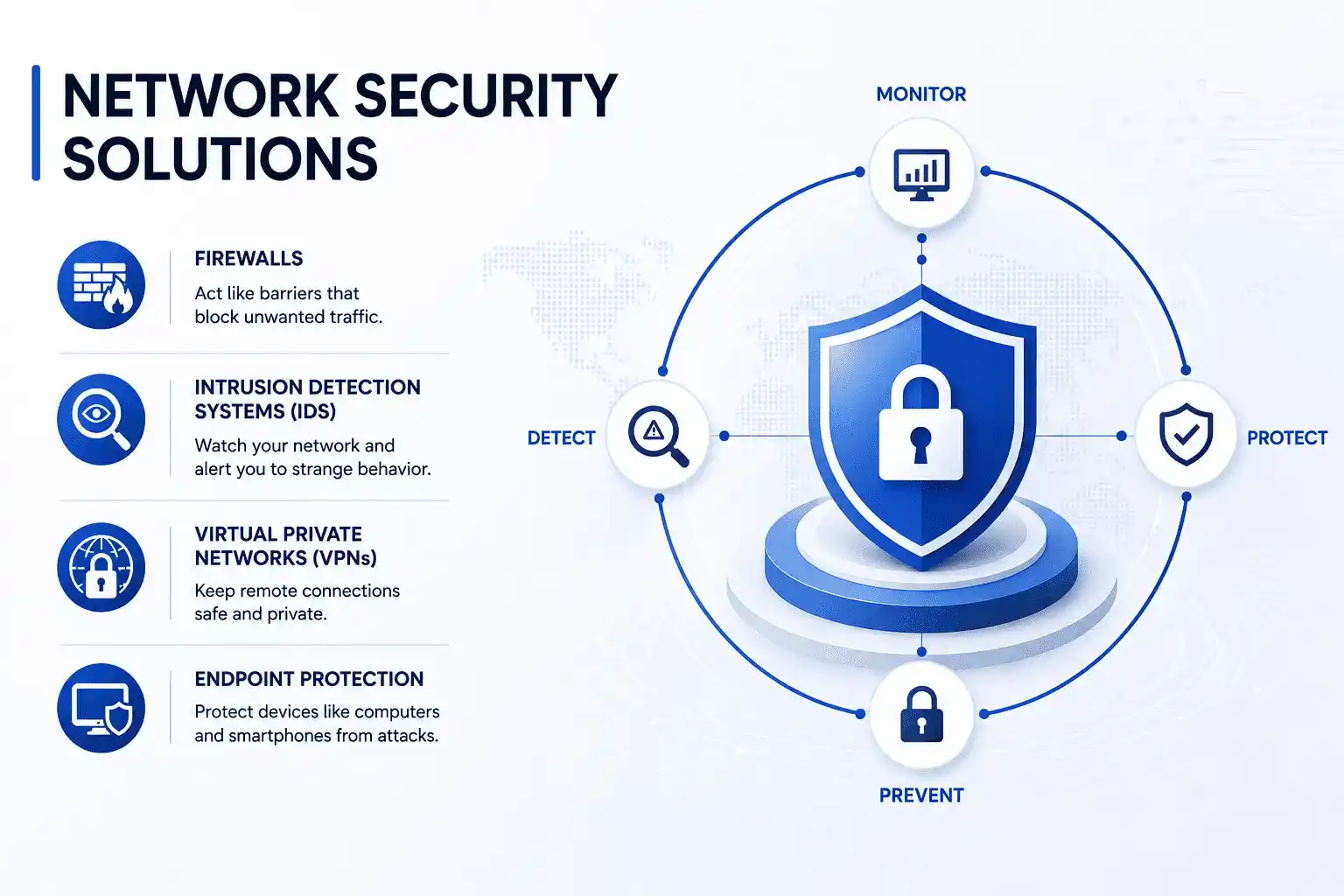
Some of the main tools used in network security are:
- Firewalls: These act like barriers that block unwanted traffic.
- Intrusion Detection Systems (IDS): These tools watch your network and alert you to strange behavior.
- Virtual Private Networks (VPNs): These keep remote connections safe and private.
- Endpoint Protection: This protects devices like computers and smartphones from attacks.
Why Do Modern Businesses Need Network Security Solutions?
Every connected device, remote employee, and cloud application is a potential entry point for attackers. Network security is no longer optional; it is a core business requirement.
Here is a breakdown of why:
1. The Threat Landscape Is Evolving Fast: Today’s attackers use AI and machine learning to run smarter, faster campaigns. Phishing is more convincing, ransomware is more targeted, and persistent threats can sit undetected inside a network for months. Legacy defenses cannot keep up.
- AI-powered attacks are making phishing emails harder to distinguish from legitimate communication
- Ransomware has grown more targeted, often locking down entire business operations at once
- Advanced persistent threats (APTs) can sit undetected inside a network for months before causing visible damage
- Automated attack tools allow even low-skilled threat actors to launch large-scale campaigns with minimal effort
2. Every Business Is a Target Regardless of Size: Smaller organizations are frequently attacked because they tend to have fewer defenses, making them lower-effort targets. No business, from a small consultancy to a mid-sized manufacturer, is too small to be on an attacker’s radar.
- Small businesses are often seen as stepping stones to larger supply chain partners
- Limited IT resources mean vulnerabilities go unpatched, and threats go undetected for longer
- No dedicated security team makes incident response slower and recovery more costly
- Customer data, payment records, and IP hold value for attackers regardless of company size
3. The Cost of a Breach Goes Beyond the Incident: A breach triggers forensic costs, regulatory fines, legal exposure, operational downtime, and long-term revenue loss. For many businesses, especially smaller ones, a single significant incident can threaten the entire operation.
- Forensic investigation and incident response require significant time and specialist resources
- Regulatory fines under GDPR, HIPAA, and PCI DSS can compound an already costly situation
- Operational downtime halts productivity and directly impacts revenue
- Reputational damage leads to customer churn and lost business that is difficult to quantify or recover
4. Regulatory Compliance Is Non-Negotiable: GDPR, HIPAA, PCI DSS, and other frameworks require documented controls, audit trails, and breach procedures. Non-compliance adds heavy penalties on top of an already costly incident. Network security is what enables continuous compliance.
- GDPR mandates data protection controls and breach notification within 72 hours for EU-related data
- HIPAA requires healthcare organizations to safeguard patient data with technical and administrative controls
- PCI DSS governs how payment card data is stored, processed, and transmitted
- Audit trails and documentation must be maintained continuously, not just at the time of an incident
5. Remote Work and Cloud Have Expanded the Attack Surface: Hybrid work and cloud operations have dissolved the traditional network perimeter. Employees connect from home networks, personal devices, and public connections, each an unguarded gap without the right solutions in place.
- Home networks and personal devices lack the protections applied to corporate infrastructure
- Public Wi-Fi connections expose data in transit without proper encryption in place
- Multi-cloud environments increase complexity and create blind spots in visibility and access control
- Shadow IT employees using unsanctioned apps or tools introduce risk that security teams may not even be aware of
6. Customer Trust Is a Competitive Asset: A breach does not just cost money; it costs confidence. Businesses that can demonstrate a strong, well-maintained security posture hold a real competitive edge, particularly in industries where data sensitivity is high.
- Customers share sensitive data expecting it to be protected; a breach breaks that implicit agreement
- Partners and vendors increasingly require proof of security posture before entering or renewing contracts
- Publicly disclosed breaches attract negative media coverage that is difficult to counter
- Demonstrated security practices differentiate businesses competitively, especially in data-sensitive industries
What Are the Top 5 Network Security Solutions for Businesses?
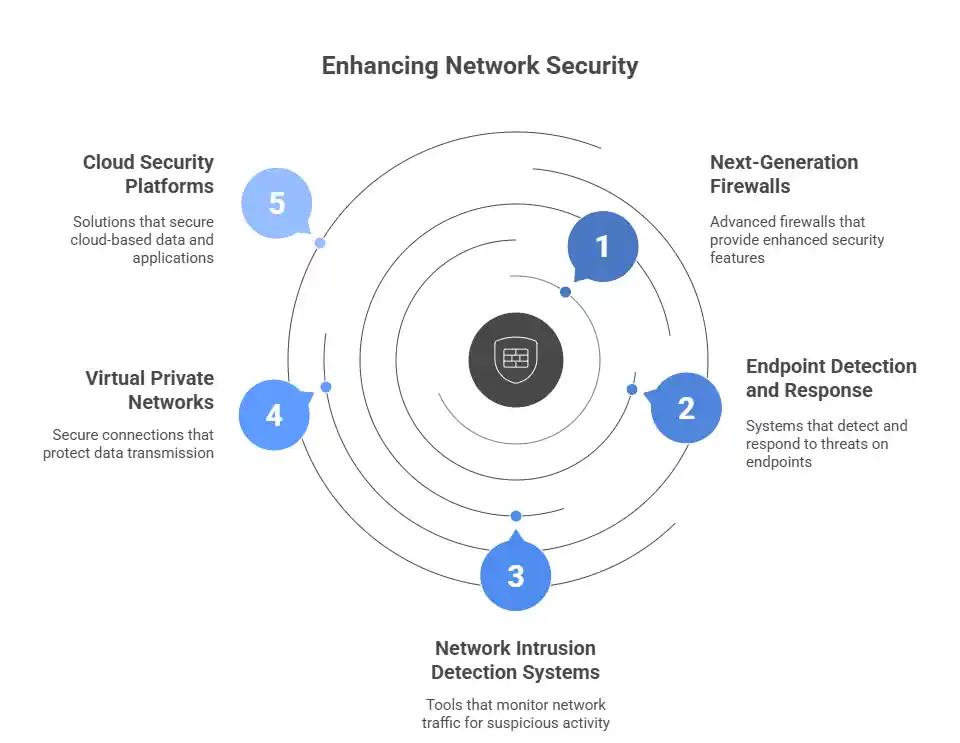
1. Next-Generation Firewalls (NGFWs)
What it does: NGFWs serve as the primary barrier between your internal network and external threats. Unlike traditional firewalls, they perform deep packet inspection, application-level filtering, and built-in intrusion prevention, giving security teams visibility into traffic at a granular level.
Key Benefits:
- Blocks the vast majority of attempted intrusions in real time
- Maintains network performance for legitimate business traffic
- Provides continuous threat detection and automated response
Best for: All business sizes seeking comprehensive perimeter protection
2. Endpoint Detection and Response (EDR)
What it does: EDR secures individual devices, laptops, desktops, mobile devices, and IoT equipment with continuous real-time monitoring and automated threat containment. When a device is compromised, EDR isolates it before the threat spreads.
Key Benefits:
- Identifies and contains threats at the device level
- Protects distributed and remote workforces effectively
- Significantly reduces mean time to detection (MTTD)
Best for: Organizations with remote employees or diverse device environments
3. Network Intrusion Detection Systems (NIDS)
What it does: NIDS continuously analyzes network traffic using behavioral analysis and signature-based detection. It flags unusual patterns that could indicate an active attack or a lurking threat that has evaded perimeter defenses.
Key Benefits:
- Detects advanced persistent threats (APTs) that bypass firewalls
- Provides forensic data for post-incident investigation
- Enables faster containment of security incidents
Best for: Medium to large businesses with complex network infrastructure
4. Virtual Private Networks (VPNs)
What it does: VPNs create encrypted tunnels for remote access, protecting data in transit between employees and corporate systems, whether they’re connecting from home, a coffee shop, or a branch office.
Key Benefits:
- Reduces security incidents significantly for remote workers
- Protects sensitive data over public or unsecured networks
- Supports compliance with data protection regulations
Best for: Organizations with remote employees or multiple office locations
5. Cloud Security Platforms
What it does: Cloud security platforms protect data, applications, and infrastructure hosted in cloud environments. They provide identity and access management, data encryption, and ongoing compliance monitoring across multi-cloud setups.
Key Benefits:
- Prevents unauthorized access to cloud-stored data and applications
- Maintains compliance across multiple cloud providers simultaneously
- Scales seamlessly alongside business growth and cloud adoption
Best for: Businesses using cloud services or undergoing digital transformation
How to Choose the Right Network Security Solution for Your Business
Step 1: Assess Your Business Needs
- Business Size: Small businesses (1-50 employees) vs. enterprises (500+ employees)
- Industry Requirements: Healthcare, finance, and retail each have specific compliance needs
- Data Sensitivity: Classify data as public, internal, confidential, or restricted
- Current Infrastructure: Inventory existing systems and security tools
Step 2: Evaluate Scalability Requirements
- Growth Planning: Choose solutions that can expand with your business
- User Capacity: Ensure systems can handle increasing employee counts
- Feature Upgrades: Look for platforms with modular add-on capabilities
- Performance Impact: Solutions should maintain speed as you scale
Step 3: Determine Your Budget
- Initial Costs: Licensing fees, hardware, and implementation expenses
- Ongoing Expenses: Monthly subscriptions, maintenance, and support costs
- ROI Considerations: Calculate potential savings from prevented breaches
- Cost-Effective Options: Consider managed security services for smaller budgets
Step 4: Check Integration Capabilities
- Existing Systems: Ensure compatibility with the current IT infrastructure
- SIEM Integration: Connect with security information and event management tools
- API Availability: Look for solutions with robust integration options
- Single Sign-On: Streamline user access across security platforms
Step 5: Research Vendor Reputation
- Customer Reviews: Check testimonials and case studies
- Industry Certifications: Look for SOC 2, ISO 27001, and other security standards
- Track Record: Evaluate the vendor’s history in handling security incidents
- Support Quality: Assess the availability of technical support and response times
Benefits of Implementing Network Security Solutions
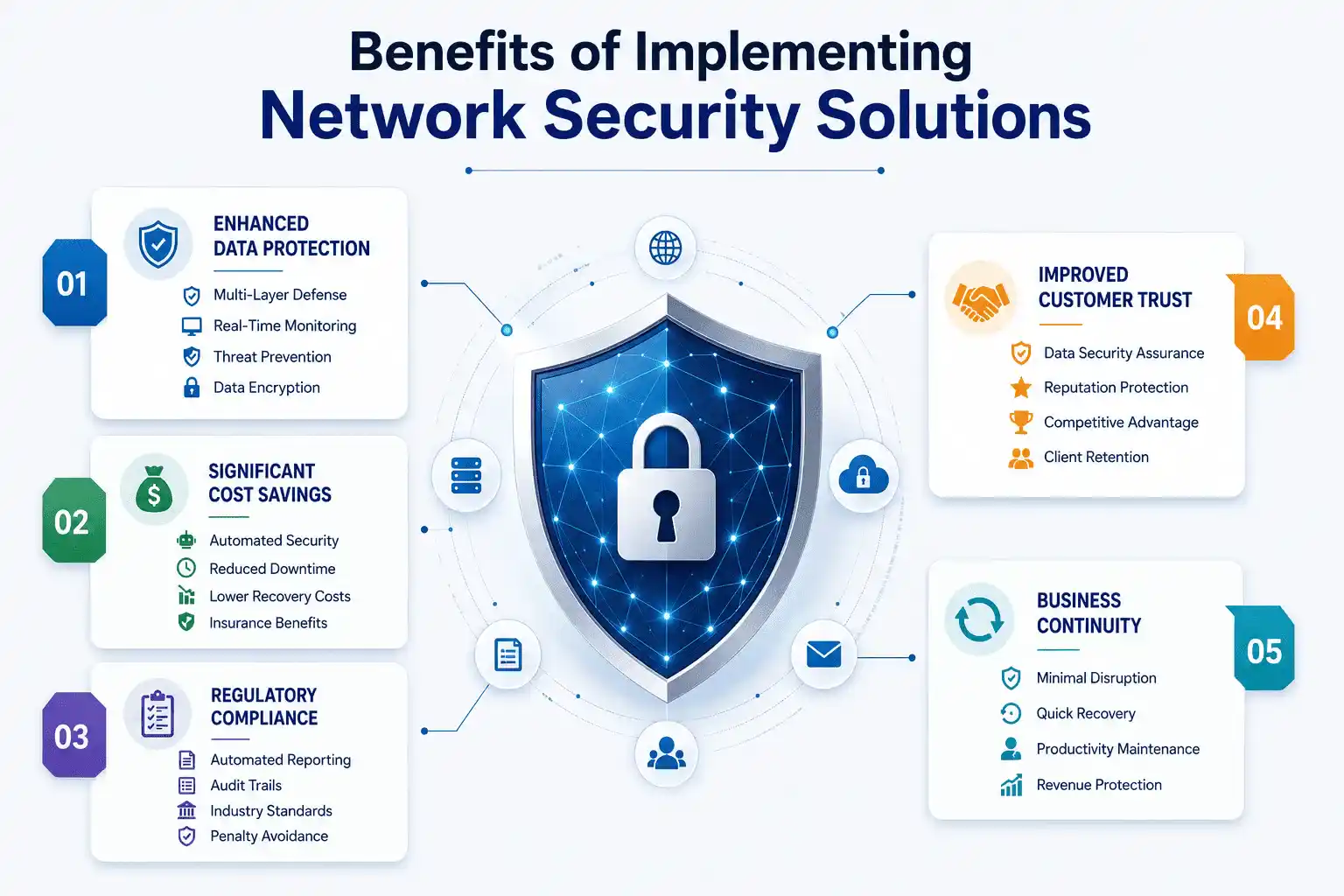
1. Enhanced Data Protection
- Multi-layer Defense: Creates multiple barriers against cyber threats
- Real-time Monitoring: Continuous surveillance of network activities
- Threat Prevention: Blocks attacks before they reach critical systems
- Data Encryption: Protects sensitive information in transit and at rest
2. Significant Cost Savings
- Automated Security: Organizations save $2.22 million annually with security AI
- Reduced Downtime: Minimizes business disruption during security incidents
- Lower Recovery Costs: Faster incident response reduces financial impact
- Insurance Benefits: Many providers offer discounts for robust security measures
3. Regulatory Compliance
- Automated Reporting: Generates compliance reports for audits
- Audit Trails: Maintains detailed logs of security events
- Industry Standards: Helps meet GDPR, HIPAA, PCI DSS requirements
- Penalty Avoidance: Reduces risk of regulatory fines and sanctions
4. Improved Customer Trust
- Data Security Assurance: Demonstrates commitment to protecting customer information
- Reputation Protection: Prevents brand damage from security breaches
- Competitive Advantage: Strong security becomes a market differentiator
- Client Retention: Customers prefer businesses with proven security measures
5. Business Continuity
- Minimal Disruption: Maintains operations during security incidents
- Quick Recovery: Faster restoration of services after attacks
- Productivity Maintenance: Employees can work without security concerns
- Revenue Protection: Prevents income loss from cyber incidents
Common Myths About Network Security Solutions
Myth 1: “Only Large Businesses Need Advanced Security”
Reality Check:
- Small businesses are prime targets for cybercriminals
- 55.8% of ransomware incidents affect companies with 1-50 employees (Source)
- Limited security resources make small businesses vulnerable
- Cybercriminals view small businesses as “easy targets.”
Why This Matters: Small businesses often lack dedicated IT security teams, making them attractive targets for automated attacks and opportunistic criminals.
Myth 2: “One Security Solution Fits All Business Needs”
Reality Check:
- Healthcare breaches cost $9.77 million on average (Source)
- Financial services face $6.08 million in average breach costs (Source)
- Different industries have unique compliance requirements
- Threat landscapes vary significantly across sectors
Why This Matters: A manufacturing company’s security needs differ drastically from a healthcare provider’s requirements, demanding tailored approaches.
Myth 3: “Security Solutions Slow Down Network Performance”
Reality Check:
- Modern solutions use AI and machine learning for efficient processing
- Next-generation firewalls maintain performance while providing protection
- Cloud-based security offloads processing from local networks
- Proper implementation actually improves network visibility and optimization
Why This Matters: Today’s security solutions are designed to enhance rather than hinder business operations, providing protection without sacrificing productivity.
FAQ
Are VPNs still necessary with modern cloud-based work environments?
Yes, and the reason goes beyond simple encryption. While cloud platforms handle application access well, a VPN addresses a different problem: securing the connection itself, particularly when employees work from home networks, hotel Wi-Fi, or other untrusted connections that a cloud platform has no control over.
Will implementing security solutions slow down my network performance?
Modern network security solutions, particularly Next-Generation Firewalls, are designed to maintain network performance while providing protection. They use advanced processing capabilities and can actually improve network visibility and optimization when properly implemented.
What is the difference between a firewall and an intrusion detection system?
A firewall controls what traffic enters or exits your network based on predefined rules, while an IDS monitors live traffic for suspicious patterns and alerts your team; it watches for threats that may have already slipped through.
Do small businesses really need network security solutions?
Yes. Small businesses are disproportionately targeted because they often have weaker defenses; a large share of ransomware attacks hit smaller organizations, and the recovery costs can be severe enough to shut a business down.
How often should a business update or audit its network security?
Security postures should be reviewed at least quarterly, with formal audits annually, or immediately after a significant infrastructure change, new product launch, or industry regulation update.
What is the difference between EDR and traditional antivirus software?
Traditional antivirus scans for known virus signatures, while EDR continuously monitors device behavior, detects anomalous activity in real time, and can automatically isolate a compromised device, offering far broader coverage against modern threats.
Is a VPN enough to secure remote workers?
A VPN encrypts the connection but does not protect the endpoint device itself or guard against compromised credentials. It should be paired with multi-factor authentication and EDR for comprehensive remote worker security.
What is a managed security service provider (MSSP), and should small businesses use one?
An MSSP is a third-party firm that monitors and manages your security tools on your behalf. For small businesses without a dedicated IT security team, an MSSP is often a cost-effective way to access enterprise-grade protection without building the capability internally.
Can cloud security platforms replace on-premise security tools?
For most businesses, cloud platforms handle a significant share of workloads effectively, but a hybrid approach is usually more practical. On-premise tools still matter for protecting local infrastructure, legacy systems, and highly sensitive data.