

Table of Contents
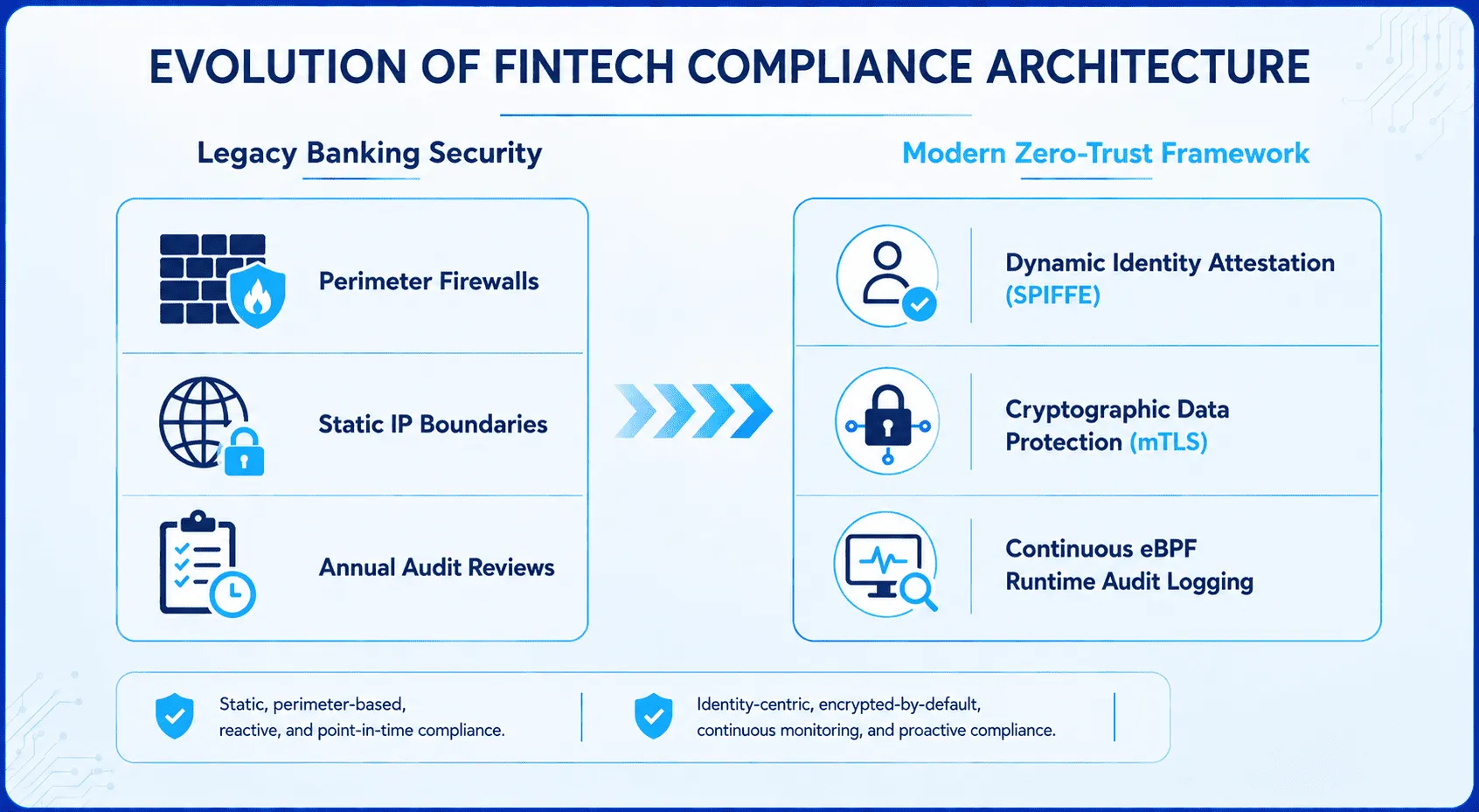
The digital banking landscape has reached a critical regulatory inflection point. As financial platforms transition from monolithic core systems to containerized microservices and hybrid cloud environments, legacy perimeter security is no longer sufficient to satisfy regulatory examinations.
In the first half of 2021 alone, ransomware attacks targeting the banking sector surged over 1,300%, prompting financial regulators to tighten technical controls across the entire infrastructure footprint.
Modern compliance for fintech platforms is no longer a periodic, manual checklist exercise. Regulators, including the Federal Deposit Insurance Corporation (FDIC), the Federal Financial Institutions Examination Council (FFIEC), and the Consumer Financial Protection Bureau (CFPB), now evaluate infrastructure through continuous, technical audit lenses such as the FDIC’s InTREx (Information Technology Risk Examination) program.
Achieving verifiable resilience requires aligning infrastructure design directly with authoritative frameworks: FFIEC AIO and DA&M Booklets, NIST SP 800-207 Zero Trust Architecture, and the Financial-grade API (FAPI 2.0) profile.
This guide outlines the architectural patterns, regulatory controls, and implementation schemas required to build a compliant, breach-resistant financial platform that satisfies modern audit requirements while preserving developer velocity./im
FFIEC, FDIC InTREx, and GLBA Safeguards
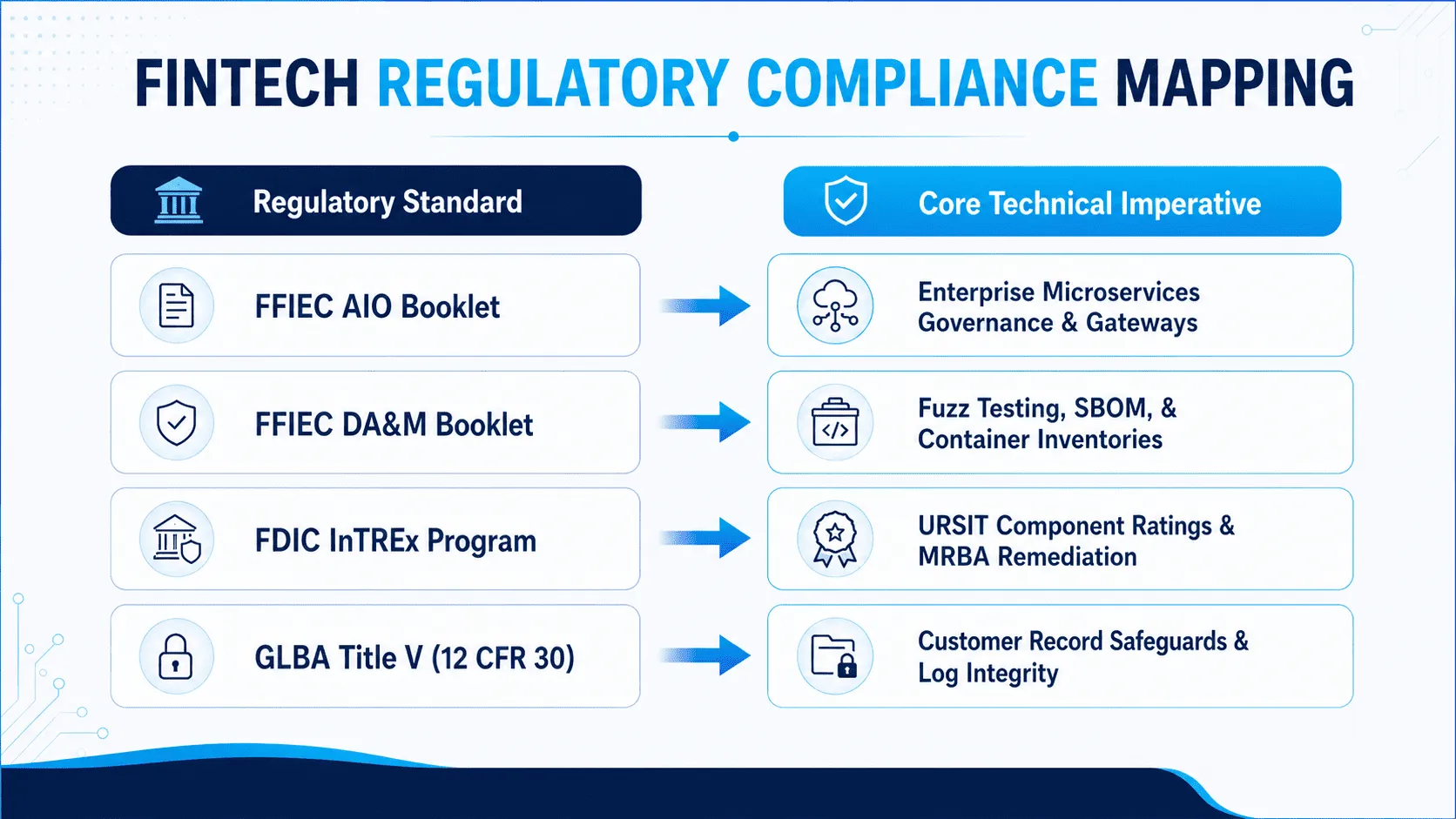
Architecting a compliant financial platform requires reconciling requirements across overlapping regulatory authorities. Rather than treating each regulation as an isolated mandate, enterprise security teams must map core technical controls directly to governing standards.
Key Regulatory Frameworks Governing Banking Infrastructure
- FFIEC Architecture, Infrastructure, and Operations (AIO) Booklet: Mandates enterprise-wide governance across distributed hybrid environments, API gateways, and microservice topologies. It enforces zero implicit trust between internal zones.
- FFIEC Development, Acquisition, and Maintenance (DA&M) Booklet: Governs software supply chain lifecycle security. It requires automated Software Bill of Materials (SBOM) generation, black-box fuzz testing, static analysis, and verified container image registries.
- FDIC Information Technology Risk Examination (InTREx) Program: Determines a bank’s Uniform Rating System for Information Technology (URSIT) component score across Audit, Development & Acquisition, Management, and Support & Delivery. Deficiencies trigger Matters Requiring Board Attention (MRBA) tracked via supervisory systems.
- GLBA Safeguards Rule (12 CFR 30 App B / 12 CFR 208 App D-2): Mandates technical and administrative safeguards protecting customer record confidentiality, enforcing log immutability and restricted DBA access.
Mandatory Recordkeeping & Log Tamper Resistance
To satisfy Regulation E (12 CFR 1005) and Bank Secrecy Act (BSA) requirements, duplicate transaction journals must be retained for a minimum of 60 days to enable total system reconstruction. Furthermore, system audit logs must be streamed to write-once, read-many (WORM) storage vaults protected by cryptographic hash chains to prevent DBA tampering.
HyScaler specializes in engineering compliant, secure enterprise data architectures that eliminate single-point-of-failure vulnerabilities and regulatory audit gaps. For example, in a high-compliance enterprise deployment, HyScaler engineered an intranet-based Retrieval-Augmented Generation (RAG) platform designed to operate with zero cloud dependency.
The architecture enforces strict data isolation by combining AES-256 encryption at rest, TLS encryption for internal transit, and Role-Based Access Control (RBAC) integrated directly with LDAP/Active Directory.
Audit logging and system health are continuously streamed to real-time observability dashboards (Grafana/Kibana), providing immutable, fully transparent trace records and document citations that satisfy stringent regulatory frameworks, including ISO 27001.
Zero Trust Architecture Frameworks: NIST SP 800-207 & SP 800-204A/C
Transitioning banking platforms from traditional castle-and-moat models to Zero Trust Architecture (ZTA) requires adopting the blueprint defined in NIST SP 800-207 alongside microservice-specific guidelines in NIST SP 800-204A and SP 800-204C.
Under Zero Trust, network location provides zero implicit trust; every request, whether originating from an external client or an internal service pod, must be dynamically authenticated, authorized, and encrypted.
Architectural Pillars of Banking Zero Trust
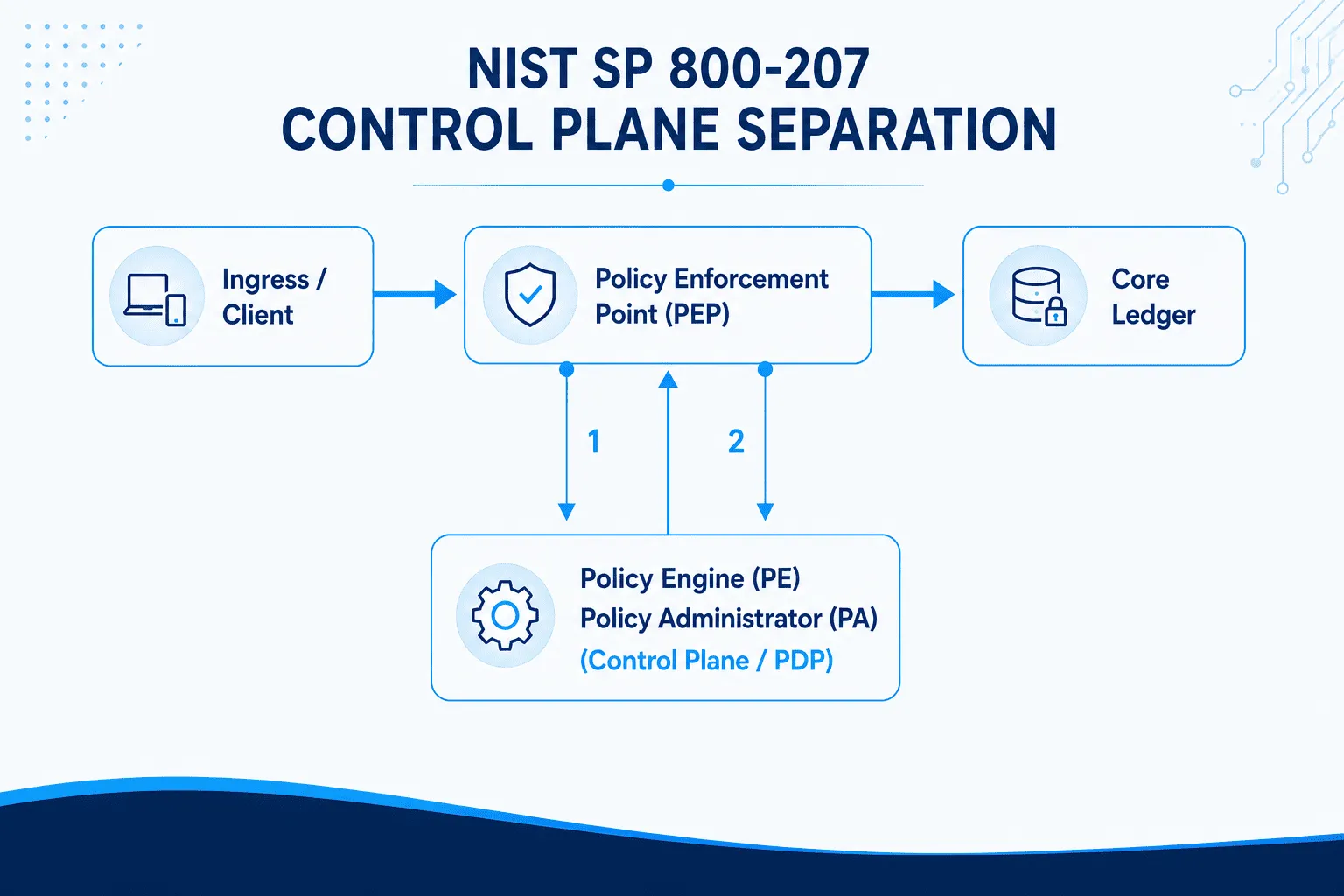
- Strict Control Plane & Data Plane Separation: The Policy Decision Point (PDP), composed of the Policy Engine (PE) and Policy Administrator (PA), evaluates contextual signals (device health, IP reputation, biometric data, risk score) before issuing time-bound credentials. Distributed Policy Enforcement Points (PEPs), such as Envoy sidecars or API Gateways, enforce these decisions directly in the data plane.
- Workload Identity Attestation via SPIFFE/SPIRE (NIST SP 800-204C): To eliminate static API tokens and shared secrets, modern fintech architectures utilize SPIFFE/SPIRE. SPIRE agents running on node clusters attest workload properties (container image hash, namespace, service account) and dynamically issue short-lived X.509 SVID certificates to microservices.
- Default-Deny Micro-Segmentation: All east-west traffic between microservices must be blocked by default. Service-to-service communication paths are explicitly authorized based on cryptographic identity rather than static IP subnets.
API Hardening: Implementing Financial-Grade API (FAPI 2.0) & mTLS
APIs represent the primary ingress attack surface for modern fintech apps, payment gateways, and open banking integrations. Standard OAuth 2.0 implementations leave security options open that can be exploited via authorization code interception or token theft. To establish audit-ready API boundaries, banking platforms must mandate the Financial-grade API (FAPI 2.0) security profile.
Core Cryptographic API Hardening Standards
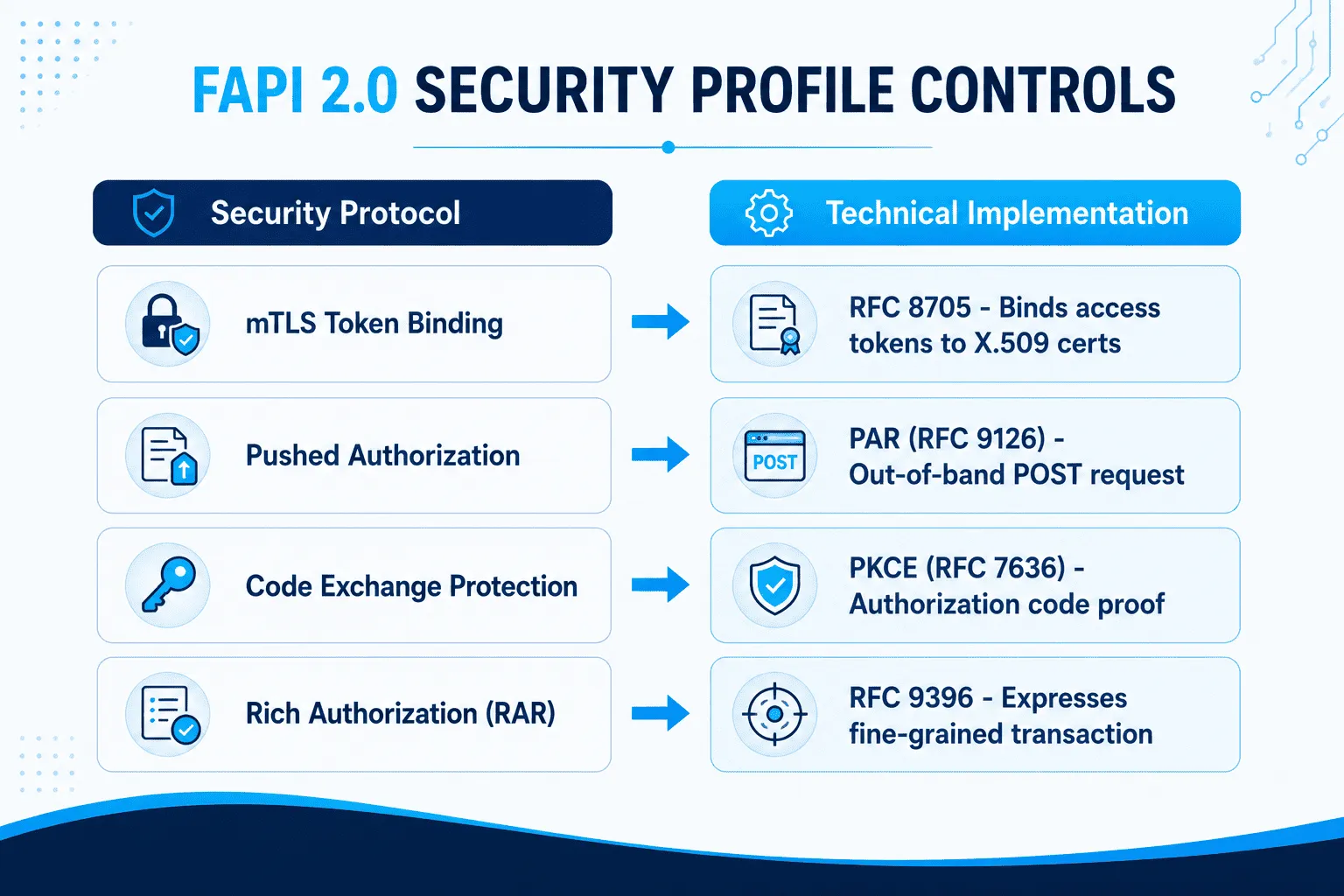
- Mutual TLS (mTLS) Token Binding (RFC 8705): OAuth access tokens must not function as plain bearer tokens. Under RFC 8705, the API Gateway cryptographically binds issued OAuth tokens to the client application’s X.509 client certificate thumbprint. If an attacker steals a bearer token and presents it over a different TLS channel, it results in immediate termination at the gateway.
- Pushed Authorization Requests (PAR / RFC 9126): Standard OAuth authorization flows pass payload parameters through front-channel browser redirects, exposing transaction data to URL tampering and browser history logging. PAR mandates that all authorization parameters be passed directly via encrypted back-channel HTTP POST calls, returning a single-use authorization request URI.
- Proof Key for Code Exchange (PKCE / RFC 7636): Prevents authorization code injection and interception attacks on native mobile and single-page banking apps by validating dynamic cryptographic code verifiers.
- Rich Authorization Requests (RAR / RFC 9396): Allows mobile banking and payment clients to specify precise, structured transaction details (e.g., exact transfer amounts, destination IBANs, multi-currency limits) directly within the authorization payload.
HyScaler implements these controls by engineering Financial-grade API (FAPI 2.0) profiles and NIST SP 800-207A Zero Trust Architecture patterns across containerized API Gateways and microgateways.
Within our End-to-End MLOps and software engineering practice, HyScaler codifies mTLS token binding and strict payload validation into immutable infrastructure manifests, guaranteeing zero-trust authorization and total protection against mobile client compromise.
Software Supply Chain Security & Mitigating Cloud Concentration Risk
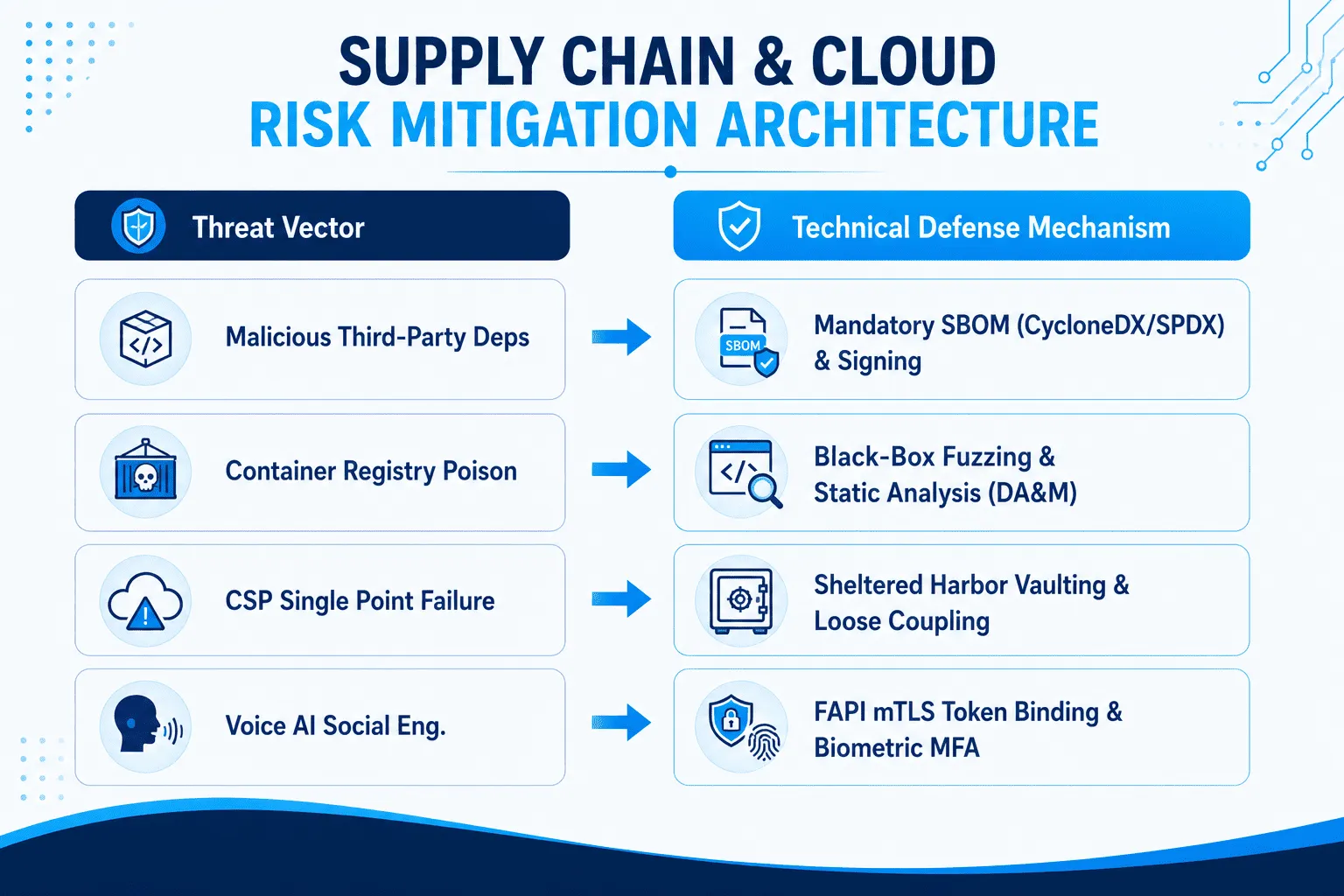
Modern digital banking platforms rely heavily on third-party core banking vendors, open-source microservice frameworks, and external Cloud Service Providers (CSPs). While accelerating feature deployment, these dependencies introduce severe supply chain poisoning vulnerabilities and systemic operational risks.
Software Supply Chain Defense (FFIEC DA&M Booklet)
To protect container pipelines against compromised dependencies (e.g., SolarWinds, Log4j), financial engineering teams must enforce:
- Automated Software Bill of Materials (SBOM): Generate real-time CycloneDX or SPDX manifest files for every production build to track all open-source libraries and transitive dependencies.
- Cryptographic Image Signing: Sign container images stored in enterprise registries using Sigstore/Cosign. Unsigned or modified container images are denied execution by Kubernetes Admission Controllers.
- Black-Box Fuzz Testing: Perform dynamic, automated black-box fuzz testing on API contracts and binaries before production promotion, fulfilling FFIEC DA&M standards.
Mitigating Cloud Concentration Risk & Systemic Outages
The U.S. Department of the Treasury and CISA highlight cloud concentration risk as a major systemic vulnerability: an operational outage at a dominant CSP can simultaneously paralyze multiple core financial institutions.
- Loosely-Coupled Multi-Cloud Architectures: Design microservices using cloud-agnostic abstractions (Kubernetes, OpenTelemetry, HashiCorp Vault) to avoid vendor lock-in and enable rapid failover.
- Sheltered Harbor Vaulting: Maintain air-gapped, encrypted data vaults containing critical consumer account balances and transaction histories, formatted to Sheltered Harbor specifications for rapid restoration following a catastrophic CSP failure or ransomware attack.
Declarative Zero Trust Enforcement: eBPF Micro-Segmentation Policy
To demonstrate audit compliance under NIST SP 800-207 and FFIEC AIO guidelines, banking platforms must move away from manually configured, IP-based iptables firewalls. Utilizing Cilium eBPF (Extended Berkeley Packet Filter) enables granular, kernel-level network micro-segmentation, enforcing strict layer-7 application rules and mandatory SPIFFE-based mTLS identity attestation directly in the Linux kernel without proxy overhead.
Production Cilium Network Policy for Core Ledger Workloads
The following declarative policy isolates core banking transaction microservices, enforcing a default-deny posture for unauthorized ingress/egress while restricting communication paths to authenticated API Gateways and Hardware Security Modules (HSMs).
# CiliumNetworkPolicy: Zero Trust East-West Micro-Segmentation & Ingress Enforcement
# Aligned with NIST SP 800-207, NIST SP 800-204A, and FFIEC AIO Booklet Standards

apiVersion: "cilium.io/v2"
kind: CiliumNetworkPolicy
metadata:
  name: "core-banking-ledger-znp"
  namespace: "production-banking"
spec:
  endpointSelector:
    matchLabels:
      app: core-ledger-microservice
      tier: financial-core

  # Default-Deny: Reject all non-explicitly authorized ingress traffic
  ingress:
    - fromEndpoints:
        - matchLabels:
            app: api-gateway-pep
            role: ingress-controller
      toPorts:
        - ports:
            - port: "8443"
              protocol: TCP
          rules:
            http:
              - method: "POST"
                path: "/v2/ledger/transfer"

  # Mandatory mutual TLS (mTLS) & SPIFFE Cryptographic Identity Attestation
  authentication:
    mode: "required"
    spiffe:
      trustDomain: "hyscaler-banking.internal"

  # Egress Restrictions: Restrict database connectivity strictly to HSM/Security Enclave
  egress:
    - toEndpoints:
        - matchLabels:
            app: hsm-key-management
            tier: security-enclave
      toPorts:
        - ports:
            - port: "11100"
              protocol: TCP
Policy Execution & Compliance Impact
- Layer-7 Path Filtering: Restricts incoming calls strictly to authorized HTTP POST /v2/ledger/transfer endpoints, preventing unauthorized administrative path discovery.
- Kernel-Level Identity Validation: Validates the calling pod’s SPIFFE identity (spiffe://hyscaler-banking.internal/…) at the eBPF layer before packet processing occurs in user space.
Building Audit-Resilient Banking Architecture: The CISO Execution Blueprint
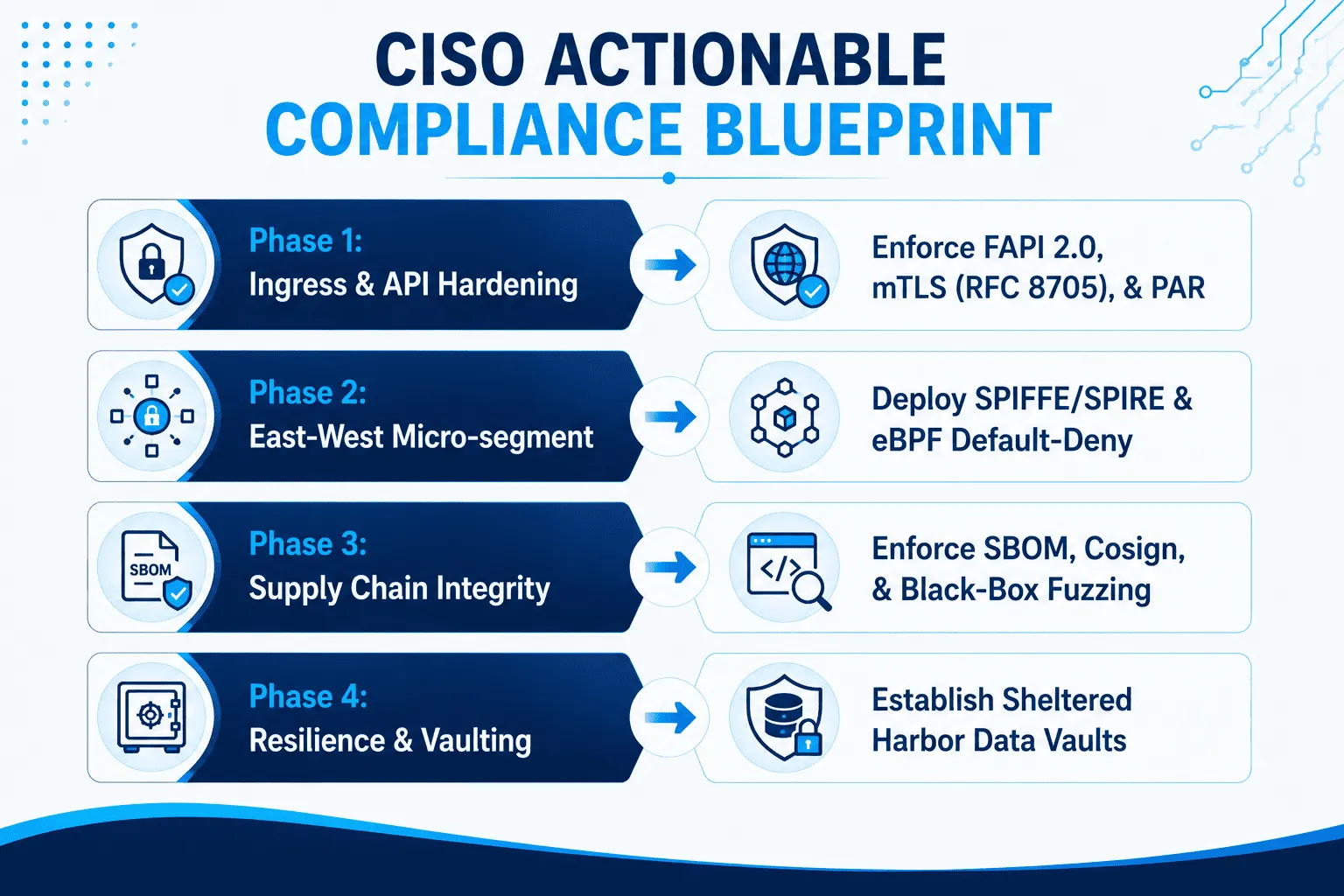
Satisfying modern cybersecurity standards for fintech platforms requires bridging the gap between high-level regulatory mandates and actual technical execution. By embedding NIST SP 800-207 Zero Trust Architecture, FFIEC AIO/DA&M controls, FAPI 2.0 API profiles, and eBPF micro-segmentation directly into your infrastructure pipeline, financial institutions can eliminate single points of failure while securing favorable URSIT ratings during FDIC InTREx examinations.
The CISO Implementation Checklist
To transition your banking platform toward continuous compliance and breach resilience, prioritize the following action items:
- Audit API Ingress Boundaries: Replace standard OAuth 2.0 bearer tokens with mTLS token binding (RFC 8705) and Pushed Authorization Requests (PAR) across all external banking APIs.
- Eliminate Static Workload Credentials: Deploy SPIFFE/SPIRE across Kubernetes nodes to issue short-lived cryptographic identities (SVIDs) for service-to-service calls.
- Automate Supply Chain Checks: Integrate mandatory SBOM generation (CycloneDX) and container image signing into CI/CD pipelines to comply with FFIEC DA&M standards.
- Secure Immutable Audit Logs: Stream transaction journals to WORM storage vaults with cryptographic hash chains to satisfy Regulation E (60-day rule) and GLBA requirements.
- Mitigate Cloud Concentration Risk: Maintain air-gapped data backups adhering to Sheltered Harbor specifications to ensure immediate transaction recovery during cloud provider outages.
Partner with HyScaler for Compliant Engineering
Building and maintaining a secure, audit-ready financial architecture demands deep expertise across DevSecOps, cloud infrastructure, and regulatory compliance. At HyScaler, our specialized engineering teams partner with leading fintechs and financial institutions to architect zero-trust microservices, secure API gateways, and automated compliance pipelines.
👉 Ready to harden your banking infrastructure? Contact HyScaler’s Cybersecurity & DevOps Engineering Team today for a comprehensive architectural assessment.