

Table of Contents
In today’s digital era, whether you’re launching a startup or managing an established company, a robust online presence is crucial for success. With ever-evolving technologies and shifting web design trends, it’s challenging to maintain an up-to-date and distinctive website that truly represents your brand.
Outsource web development offers a strategic solution to these challenges, allowing you to leverage expert skills and innovative technologies. In this blog post, we’ll delve into the key benefits of outsourcing web development, demonstrating how it can enhance your site’s ability to drive traffic and conversions.
What is Outsource Web Development?
Outsource web development is the practice of entrusting your website’s development to an external agency or freelancer who possesses specialized skills and expertise. This approach ensures the creation of effective, efficient, and secure online solutions. Outsourced developers, being specialists in their field, can often deliver high-quality work more quickly and cost-effectively than an in-house team.
Furthermore, outsourcing helps mitigate technical debt and other risks by engaging experienced professionals who adhere to industry best practices. For businesses of all sizes, outsourcing web development can significantly simplify the process of establishing or enhancing a web presence.
Benefits of Outsourcing Web Development
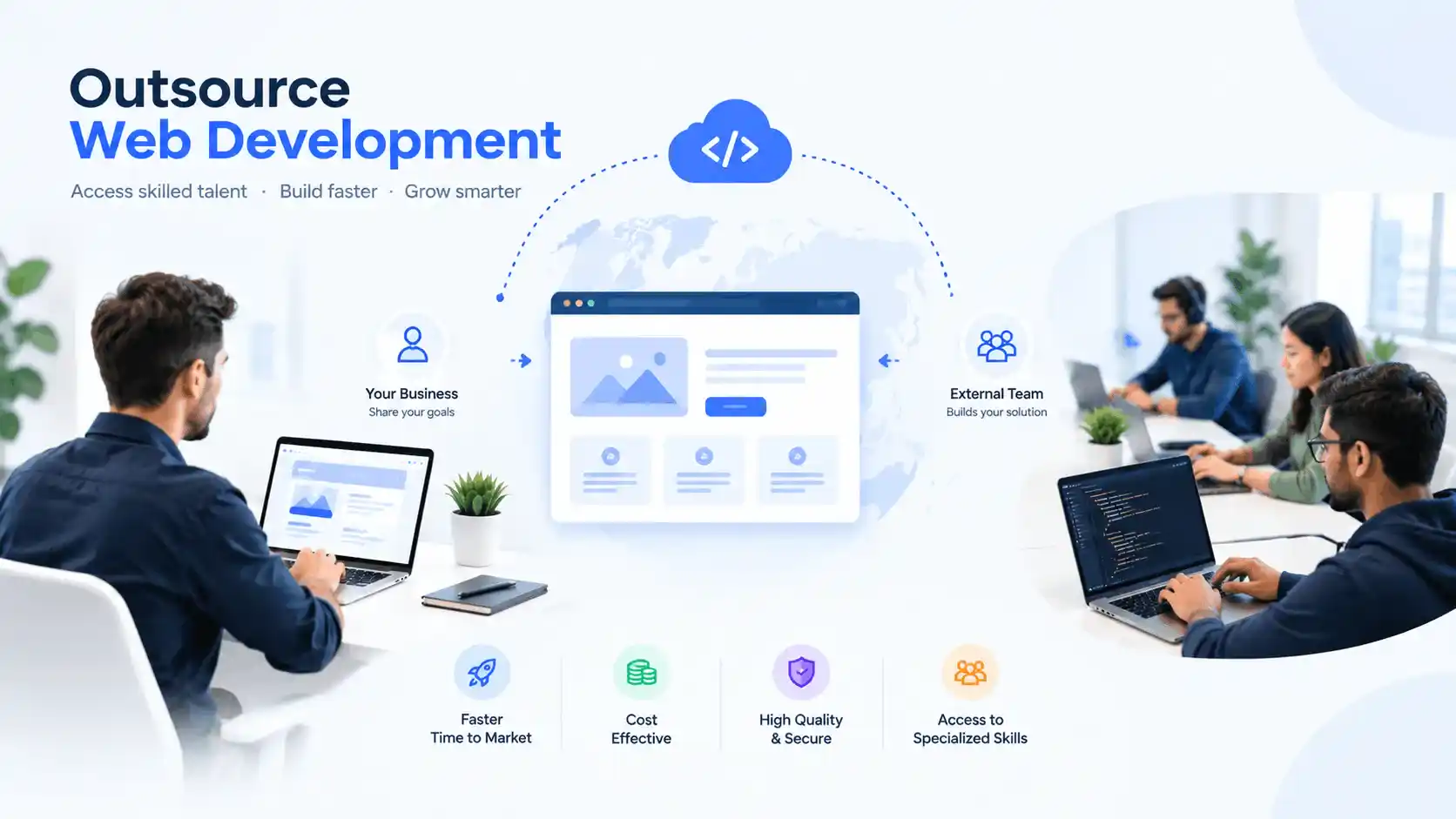
Outsource web development has surged in popularity recently, offering compelling advantages for businesses aiming to enhance efficiency, reduce costs, and achieve faster outcomes. This article delves into five primary benefits of outsourcing web development that can catalyze business growth.
1. Cost Savings
- Lower Labor Costs: Outsourcing your web development to a third party can lead to significant cost savings over maintaining an in-house team. With outsourced developers, you gain access to top-tier expertise and experience at a fraction of the cost, alongside the flexibility to scale your spending based on project demands. While outsourcing, your business will still have to use 1099 pdf forms to inform the freelancer and the IRS about the money paid out.
- Reduced Overhead Expenses: Engaging in outsourced web development services can diminish your overhead costs. These providers come equipped with advanced tools and technology, enabling the creation of efficient web solutions without the hefty price tag of internal operations.
- Scalability: The scalable nature of outsourcing allows you to adjust resources based on your current needs, ensuring that you can expand or reduce your development capacity without the burdens of permanent overheads.
2. Access to Expertise
- Specialized Skills: Outsourcing connects you with specialists in web development who bring cutting-edge technology and industry-specific knowledge to your projects. Implementing identity verification processes ensures that the offshore specialists you work with are authenticated, reducing the risk of fraud and enhancing the security of your projects. This expertise helps in crafting customized, secure, and robust websites.
- Broader Talent Pool: Outsourcing opens doors to a global talent pool, offering a broader spectrum of skills and perspectives. This diversity can introduce new ideas and approaches to your web projects, enhancing innovation.
3. Increased Efficiency
- Enhanced Project Management: Outsource web development often includes superior project management capabilities, with professionals who streamline every phase from conception to deployment, ensuring timely and successful project completions.
- Optimized Resource Management: The flexibility to scale resources as needed allows for more efficient use of time and money, enhancing your project’s overall efficiency.
- Improved Collaboration and Communication: Advanced tools and platforms facilitate better collaboration and communication among team members, which is crucial for timely and effective project delivery.
4. Flexibility
- Adaptability: Outsourced teams can rapidly adapt to changing project requirements, helping to navigate challenges and alterations smoothly without disrupting the project flow.
- Global Insights: By tapping into a global network of developers, you gain insights into emerging technologies and methodologies, keeping your business at the forefront of innovation.
5. Focus on Core Business
- Strategic Allocation of Effort: Outsourcing non-core activities like web development allows you to concentrate on your business’s central competencies, driving growth and innovation where it counts.
- Reduced Internal Distractions: By delegating web development, you minimize internal distractions, enabling your team to focus on achieving broader business objectives.
- Resource Reallocation: Freed-up resources can be redirected towards strategic areas of your business, enhancing productivity and operational efficiency.
Companies That Prove the Benefits of Outsource Web Development
Outsourcing is not a shortcut reserved for small businesses. Several well-known companies leaned on outside developers, designers, or contractors in their early days. The stories below come from public accounts, and each one highlights a different benefit and a different lesson. Some are about building a website or app, others about the wider practice of using outside talent, but the principles carry over.
- GitHub: Scott Chacon is well-recognized as the CIO of GitHub, but his journey began when he met CEO and co-founder Chris Wanstrath at a Ruby meetup in San Francisco. With a rare expertise in Git, Chacon was initially brought on as a consultant and later crafted the backend of GitHub’s Gist feature, playing a crucial role in the platform’s mastery of Git.
2. AppSumo: Founded with just $50, AppSumo‘s Noah Kagan leveraged his network to secure early ad placements and convinced a developer to create a PayPal button and credit card form for the same amount. His clear vision and solid concept were key in quickly bringing his business idea to life.
3. Fab.com: Jason Goldberg, founder of Fab.com, initially hired a software development firm in India to create his e-commerce platform. Recognizing the need for more robust support, he eventually acquired the firm, attributing the success of Fab.com to the effective management of the outsourcing process.
5. Groove: Unable to find a co-founder with the necessary tech expertise, Alex Turnbull outsourced the technical development of his SaaS company. This strategic move allowed him to maintain full ownership and save on the costs associated with a full-time tech team.
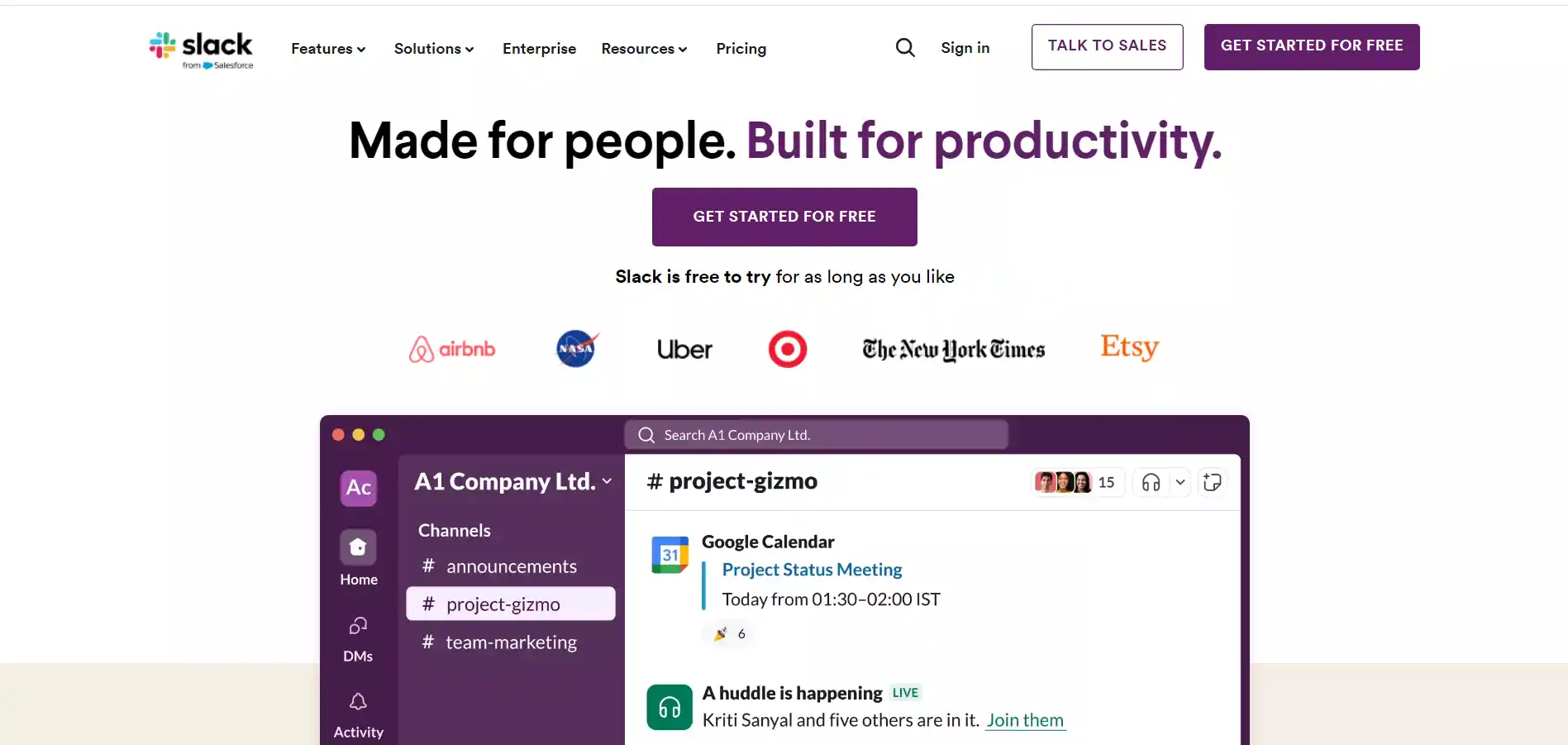
6. Slack: In its formative stages, Slack hired design firm MetaLab to overhaul its website, app, and logo—elements crucial to the user experience today. MetaLab’s work has not only benefited Slack but also other high-profile clients across various industries.
7. UpWork: As a platform specializing in crowdsourced work, UpWork was naturally built by a team of contractors. Following a merger between ODesk and Elance, CEO Stephane Kasriel highlighted that 150 of their 200 product and engineering staff were freelancers sourced from ODesk.
8. SeatGeek: Jack Groetzinger, founder of SeatGeek, advocates strongly for outsourcing in startup phases. He extensively utilized contractors for tasks ranging from data collection to software development, emphasizing the cost-effectiveness of outsourcing, especially from less expensive labor markets.
9. Alibaba: Known globally today, Alibaba initially outsourced its development to a U.S.-based firm to leverage the advanced skills available abroad, a strategic move that was crucial under the stringent Chinese internet restrictions at the time.

When to Outsource and When to Keep It In-House
The choice to outsource web development makes sense when you need specialist skills quickly, your workload is uneven, or the website is important but not your core product. It is also a strong fit for redesigns, migrations, and time-boxed builds.
Keeping work in-house can be better when the website is your product, when the codebase changes daily and needs deep company context, or when strict data rules limit who can touch your systems. Many companies land on a hybrid: an in-house owner who sets direction, plus an external team for execution.
Modern Trends Shaping Outsourced Web Development
The way outside teams work keeps evolving, and a good partner should be able to speak to each of these.
- AI-assisted development. Many teams now use AI coding tools to speed up routine work. Ask how they review generated code, protect your data, and keep quality consistent.
- Security and privacy by default. Expect secure development practices, dependency scanning, and clear handling of personal data.
- Composable and headless architectures. Separating the front end from content and commerce systems gives flexibility, but it needs experienced architects.
- Performance and accessibility as baseline. Page experience affects search visibility and conversions, so speed and accessibility should be part of the definition of done.
- Outcome-focused contracts. More clients tie milestones and payments to delivered results instead of hours logged.
How to Choose the Right Partner
Before you outsource web development, run a short, structured evaluation.
- Define scope and goals. Write down what you need, what success looks like, and what is out of scope.
- Review relevant work. Look for projects similar to yours in complexity and industry, and ask to speak with past clients.
- Meet the actual team. Talk to the developers and project manager who will work on your project, not only the sales lead.
- Compare engagement models. Match the model to how well-defined your project is (see the table below).
- Check process and security. Ask about testing, code review, documentation, access control, and how they handle handover.
- Start small. A paid pilot or a first milestone shows how the partner communicates and delivers before you commit further.
Why HyScaler Is a Strong Partner for Your Web Project
If you decide to outsource web development, the checklist above is the right way to compare vendors. Here is how HyScaler measures up against it, based on the company’s own published information and public client reviews.
Conclusion
Outsource web development presents a strategic opportunity for businesses aiming to enhance efficiency, reduce costs, and tap into specialized expertise without the overhead of an in-house team. By embracing this approach, companies can leverage global talent, benefit from cutting-edge technology, and adjust resources dynamically to meet project demands.
Whether you’re a small startup or a large enterprise, the advantages of outsourcing web development can lead to substantial improvements in your digital presence and overall business success. As the market evolves, having a reliable, high-quality web development partner can make all the difference in staying competitive and achieving your business goals.
Related Article
FAQs
What does it mean to outsource web development?
It means hiring an outside agency, freelancer, or team to design, build, or maintain your website or web app instead of relying only on in-house staff. You can outsource the whole project or just specific parts.
Is it cheaper to outsource web development than to hire in-house?
Often, because you avoid recruiting, benefits, equipment, and idle time between projects. But the lowest quote is not always the lowest total cost, so factor in rework and management time.
What is the difference between offshore, nearshore, and onshore, and which is better?
Onshore means your own country, nearshore means a nearby country in a similar time zone, and offshore means farther away with bigger time gaps. The best fit depends on budget, overlap hours, and how closely you need to collaborate.
How do I choose a partner to outsource web development?
Define your scope, review similar past work, check independent reviews and references, meet the actual team, and begin with a small paid milestone.
What questions should I ask an outsourcing company before hiring?
Ask about relevant projects, who will work on yours, their process and testing, communication rhythm, security practices, code ownership, and how handover works.
How do I protect my intellectual property and make sure I own the code?
Sign an NDA, state code ownership in the contract, and keep the repository in your own account with the vendor given access.