

Table of Contents
In the rapidly evolving landscape of artificial intelligence, where technological advancements unfold at an unprecedented pace, building a high-performing AI dream team is critical. For organizations with aspirations of not just keeping pace but leading in innovation and driving unparalleled success, the assembly of an exceptional team is the linchpin.
The term “AI dream team” encapsulates the idea of bringing together a group of individuals whose collective skills and diverse expertise create a synergy that goes beyond the sum of their individual capabilities. It is this collaborative force that has the potential to propel a company towards groundbreaking advancements in the realm of artificial intelligence.
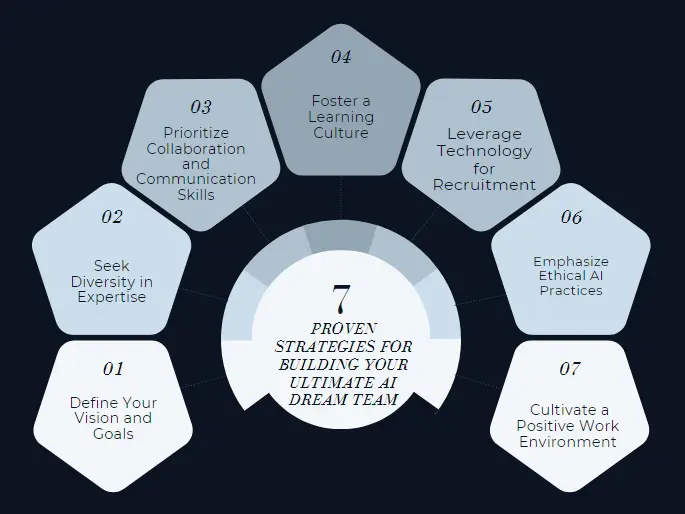
The journey to crafting the ultimate AI dream team requires a strategic approach to hiring – a process that extends beyond the traditional recruitment methods. To assist organizations in this pursuit, we present seven proven hiring strategies. These strategies are meticulously designed not only to attract top-tier talent but also to cultivate a collaborative environment that is inherently conducive to innovation.
The term “AI dream team” not only reflects the aspiration for excellence in technical proficiency but also underscores the importance of cohesion among team members. The collective intelligence, creativity, and problem-solving acumen of such a team can transcend the boundaries of conventional achievement, setting the stage for pioneering endeavors in the dynamic field of artificial intelligence. As organizations embark on the journey of forming their AI dream teams, they are not merely assembling talent but forging a collaborative force that has the potential to redefine the future of AI innovation.
1. Define Your Vision and Goals:
Before you build an AI dream team, decide what problem it exists to solve. “Adopt AI” is not a goal. ” Cut support resolution time with an assistant trained on our own knowledge base”.
A clear goal is the first step to building an AI dream team that works. It tells you which roles to hire first, which tools to buy, and how to measure success. It also helps with hiring. Strong candidates want to know what they will work on and why it matters. Mission-driven labs such as OpenAI and Anthropic attract talent partly because their purpose is stated so plainly, and any company can borrow that habit.
Tip: Write a one-page brief covering the problem, the users, the data available, and the outcome you expect. Share it with every candidate.
2. Hire for a Mix of Skills, Not a Single Specialty
Anyone who tries to build an AI dream team around only data scientists will stall at deployment. Real projects need a blend of people who can research, engineer, ship, and maintain.
The core roles to fill when you build an AI dream team usually include:
| Role | What they do | When to hire |
|---|---|---|
| Data engineer | Builds pipelines and keeps data clean and accessible | First, since nothing works without usable data |
| Machine learning engineer | Trains, tunes, and integrates models | Early, once the use case is clear |
| AI engineer | Builds applications on top of large language models, including prompts, retrieval, and agents | Early for generative AI products |
| Data scientist | Analyzes data and tests hypotheses | When you need experimentation and insight |
| MLOps or platform engineer | Handles deployment, monitoring, and cost control | Before you scale past a pilot |
| AI product manager | Connects the work to business value | Once more than one project is running |
| Governance or ethics lead | Sets risk, privacy, and compliance standards | Before launch, not after |
Smaller companies often combine two or three of these roles in one person. That is fine, as long as you know which gaps remain.
3. Prioritize Communication and Collaboration
Building a successful AI dream team extends beyond individual technical prowess. While technical expertise serves as the foundation, it’s imperative to recognize that an AI dream team thrives on collaboration and secure enterprise communication. In the dynamic landscape of artificial intelligence, projects often demand cross-disciplinary collaboration, requiring team members to convey complex technical concepts to colleagues with diverse backgrounds.
AI work crosses boundaries. A model builder has to explain trade-offs to a product manager, and an engineer has to understand what the legal team needs. When you build an AI dream team, test for these skills on purpose.
Ask candidates to explain a past project to a non-technical listener. Run a short paired exercise where they work with someone from another function. Watch how they handle disagreement and unclear requirements, because AI projects have plenty of both.
4. Decide Whether to Build, Hire, Upskill, or Partner
You do not have to fill every seat with a new hire to build an AI dream team. Each path has a different cost and speed:
- Hire: Best for core roles that will stay central to your product.
- Upskill: Best for engineers and analysts who already know your systems and domain.
- Partner or outsource: Best for short projects, niche skills, or a fast proof of concept.
- Buy: Best when a ready-made tool solves the problem well enough.
Many organizations blend these. A common pattern is to hire a small core, upskill existing staff, and bring in a partner for specialized work while the internal team gets up to speed.
5. Foster a Culture of Continuous Learning
The tools and techniques in AI change quickly, so a team’s ability to learn matters more than any single skill on a resume. When you build an AI dream team, look for curiosity in interviews and then protect time for learning after they join.
Practical ways to do that include a regular paper or tool review, budget for courses and certifications, internal demos where people share experiments, and room to test new ideas without a full project plan.
6. Make Responsible AI Part of the Job
Responsible AI is now a hiring and delivery requirement, not an extra. Regulations such as the EU AI Act and growing governance guidance in other regions, India included, expect organizations to manage risk, document decisions, and protect user data.
Bake this into how you build an AI dream team from the start:
- Name an owner for AI risk and governance.
- Review training data for bias, consent, and privacy issues.
- Keep humans in the loop for decisions that affect people.
- Document how models are tested and monitored after release.
Teams that treat ethics as routine engineering practice move faster later, because they avoid expensive rework and lost trust.
7. Use Technology in Hiring, With Human Oversight
AI-assisted recruiting tools can help you build an AI dream team faster by helping you screen resumes, match skills to requirements, and schedule interviews. They save time, especially when applicant volume is high.
They also carry risk. A screening model trained on past hiring decisions can repeat past bias, and a famous example of this led one large company to abandon an internal recruiting tool. Use automation to sort and organize, not to make final decisions. Audit the results regularly, and keep a person responsible for every hiring call.
Exemplary Companies Harnessing to Form Their AI Dream Teams
Several leading companies have established formidable AI dream teams to drive innovation and stay at the forefront of artificial intelligence research and development. Here are examples of companies renowned for their AI expertise:
1. Google (Alphabet Inc.):
- AI Initiatives: Google is a pioneer in AI research, and its AI subsidiary, DeepMind, has made significant strides in machine learning, particularly in areas like deep reinforcement learning.
- Team Expertise: Google’s AI team comprises experts in machine learning, natural language processing, computer vision, and other AI-related fields.
2. Facebook (Meta):
- AI Initiatives: Facebook has a dedicated AI research division working on projects such as image recognition, language understanding, and AI for social good.
- Team Expertise: Meta’s AI team includes specialists in deep learning, computer vision, and natural language processing.
3. Microsoft:
- AI Initiatives: Microsoft is heavily invested in AI, with initiatives spanning cloud-based AI services (Azure AI), conversational AI (Cortana), and AI for business applications (Microsoft 365).
- Team Expertise: Microsoft’s AI team comprises researchers and engineers with expertise in various AI domains.
4. Tesla:
- AI Initiatives: Tesla is at the forefront of incorporating AI into autonomous vehicles. Its AI team focuses on developing advanced driver-assistance systems and full self-driving capabilities.
- Team Expertise: Tesla’s AI dream team includes experts in computer vision, robotics, and neural networks.
5. OpenAI:
- AI Initiatives: OpenAI is a research organization dedicated to advancing artificial intelligence in a safe and beneficial manner. It focuses on projects ranging from natural language processing to reinforcement learning.
- Team Expertise: OpenAI’s team includes some of the top AI researchers and practitioners globally, contributing to cutting-edge advancements in the field.
6. IBM:
- AI Initiatives: IBM Watson is a well-known AI initiative that spans machine learning, natural language processing, and cognitive computing. IBM is also actively involved in AI research and development for enterprise solutions.
- Team Expertise: IBM’s AI team comprises experts in data science, machine learning, and AI strategy.
7. Amazon:
- AI Initiatives: Amazon Web Services (AWS) offers a range of AI services, and the company is involved in AI research for applications like voice recognition (Alexa) and logistics optimization.
- Team Expertise: Amazon’s AI team includes specialists in cloud-based AI, machine learning, and natural language understanding.
These companies have invested significantly in assembling AI dream teams to lead the way in developing cutting-edge technologies and applications that leverage the power of artificial intelligence.
Conclusion
Building an AI dream team requires a strategic and thoughtful approach. By implementing the seven proven hiring strategies outlined above, your organization can attract and assemble a group of talented individuals who collectively form an AI dream team. These strategies, ranging from defining a clear vision and goals to prioritizing diversity in expertise, act as a blueprint for assembling a team that not only possesses the technical prowess required for AI development but also thrives on collaboration and innovation.
The emphasis on collaboration ensures that your AI dream team operates as a cohesive unit, pooling diverse skills and perspectives to tackle complex challenges in the dynamic landscape of artificial intelligence. Embracing the potential of your AI dream team goes beyond fulfilling technical requirements. It involves cultivating a culture that encourages creativity, open communication, and a shared commitment to success. When team members feel empowered to contribute their ideas and collaborate effectively, the result is a dynamic environment where innovation flourishes.
Your AI dream team, armed with a unified vision and diverse skill sets, has the capability to lead the way in the ever-evolving field of artificial intelligence. As they navigate the exciting challenges of this technology landscape, the synergy within the team becomes a driving force for breakthroughs and advancements, positioning your organization at the forefront of AI innovation and success.
FAQ
What is an AI dream team?
An AI dream team is a multidisciplinary group of professionals with complementary expertise in areas such as artificial intelligence, machine learning, data science, natural language processing, software development, and AI ethics. Together, they collaborate to develop and implement effective AI solutions.
What roles should be included in an AI team?
An AI team may include machine learning engineers, data scientists, AI researchers, software engineers, data engineers, product managers, AI/ML architects, and specialists in AI ethics or governance. The ideal team structure depends on the project’s goals, complexity, and industry requirements.
How do you build a successful AI team?
Building a successful AI team starts with defining clear business and AI objectives. Organizations should then identify the required skills, hire professionals with complementary expertise, encourage collaboration, promote continuous learning, and establish a culture that supports innovation and responsible AI development.
What skills should you look for when hiring AI professionals?
Beyond technical expertise in machine learning, data science, NLP, computer vision, or generative AI, organizations should look for problem-solving, communication, collaboration, adaptability, and continuous-learning skills. Knowledge of responsible and ethical AI practices is also increasingly important.
Why is diversity important in an AI team?
Diversity brings different perspectives, experiences, and approaches to problem-solving. A team with expertise across multiple AI and business domains can identify more potential solutions, reduce blind spots, and develop AI applications that better address the needs of diverse users.
How can companies improve collaboration within an AI team?
Companies can improve collaboration by establishing clear responsibilities, using shared project-management and communication tools, encouraging knowledge sharing, conducting regular team discussions, and creating an environment where team members can openly exchange ideas and feedback.
How can organizations keep their AI teams up to date?
Organizations can encourage continuous learning through technical training, certifications, workshops, conferences, research papers, internal knowledge-sharing sessions, and hands-on experimentation with emerging AI technologies. This helps teams adapt to the rapidly changing AI landscape.
Why are ethical AI practices important for AI teams?
Ethical AI practices help teams identify and address risks such as bias, privacy concerns, lack of transparency, and potential misuse of AI. Incorporating responsible AI principles into development can help organizations build safer, more trustworthy, and sustainable AI solutions.
Can AI tools be used to recruit AI professionals?
Yes. AI-powered recruitment tools can help organizations screen resumes, identify candidates based on predefined skills, and streamline parts of the hiring process. However, human oversight remains important to evaluate factors such as communication, cultural fit, problem-solving ability, and ethical judgment.
What makes an AI team successful?
A successful AI team combines strong technical expertise with clear goals, diverse skills, effective communication, continuous learning, responsible AI practices, and a positive work environment. The combination of these factors enables teams to turn AI ideas into practical business outcomes.