
Table of Contents
Unlocking a phone with a glance is now so routine that few people stop to think about the technology behind it. Yet digital biometrics has moved far beyond the lock screen. It now sits behind airport boarding gates, mobile banking logins, hospital record systems, and the passkeys that are steadily replacing passwords.
The picture has also become more complicated. Generative AI can fake faces and voices convincingly, regulators are drawing firm lines around where biometric identification is allowed, and security teams are learning that a match alone is no longer proof of identity. This guide explains how digital biometrics works today, where it is being used, what has changed in the threat landscape, and where the technology is heading next.
What Are Digital Biometrics?
Digital biometrics is the use of unique physical or behavioral traits, such as fingerprints, facial geometry, iris patterns, voice, or typing rhythm, to confirm who someone is in a digital or physical system. Unlike a password, which can be guessed, shared, or phished, a biometric trait is tied to the person rather than to something the person knows.
Two ideas are worth keeping apart. Verification asks whether a person is who they claim to be, which is a one-to-one comparison. Identification asks who a person is by searching a database, which is a one-to-many comparison. Most consumer uses, such as unlocking a phone, are verification, while most of the public debate concerns identification. A well-designed system of digital biometrics also converts each trait into a mathematical template instead of storing a raw image and increasingly keeps that template on the user’s own device.
Research and Markets values the overall biometrics market at about USD 59.7 billion in 2026 and projects it to reach USD 103.08 billion by 2030, a growth rate of roughly 14.6% a year. Mordor Intelligence puts the market at about USD 67.9 billion in 2026, growing at around 15% annually through 2031. Fortune Business Insights sizes the biometric system market at about USD 36.6 billion in 2026, growing at roughly 11.5% a year through 2034.
The Core Technologies Powering Digital Biometrics
Facial Recognition
Facial recognition turns a face image into a numerical fingerprint of the face. Older explanations describe it as measuring the distance between the eyes or the angle of the nose, but modern systems do not rely on hand-picked measurements. They learn which features matter from millions of training images.
How it works
- Detection: the system locates the face within the frame.
- Alignment: facial landmarks (eyes, nose, and mouth corners) are used to rotate, scale, and crop the face into a standard pose.
- Embedding: a deep neural network, typically a convolutional network or vision transformer, converts the aligned face into a fixed-length vector called an embedding.
- Comparison: the embedding is compared with the enrolled one using a distance measure such as cosine similarity. A score above the threshold means a match.
Technical details
- Training: networks are trained with margin-based loss functions that pull images of the same person together in vector space and push different people apart, which is what makes matching robust to lighting, expression, and viewing angle.
- Depth sensing: many phones add structured-light or infrared depth sensing to build a 3D map of the face, which is much harder to fool with a flat photo than a standard camera.
- Liveness: passive methods analyze skin texture, reflections, and depth cues, while active methods ask the user to blink, turn, or follow a prompt.
- 1:N search: for large galleries, embeddings are indexed so the system can find close candidates quickly without comparing against every record.
Strengths and limits: according to a Bipartisan Policy Center review of NIST testing, many algorithms are 98% to 99% accurate across every demographic group tested, though performance varies widely between vendors. Accuracy still depends on image quality, pose, occlusion, and aging, and face is the modality most exposed to deepfakes and injection attacks.
Fingerprint and Palm Recognition
Fingerprint sensors remain the workhorse of digital biometrics, and Mordor Intelligence reports that fingerprint technology holds the largest share of the biometrics market, at roughly 36.6%. The method rests on the ridge and valley pattern on the skin of the fingertip, which is formed before birth and differs even between identical twins.
How it works
- Sensing: an optical sensor photographs the finger, a capacitive sensor measures electrical differences between ridges and valleys, and an ultrasonic sensor maps the surface using sound waves.
- Enhancement: the image is cleaned up, and the ridge flow is traced.
- Minutiae extraction: the software locates minutiae, the points where ridges end or split, and records their position, angle, and type.
- Matching: the system aligns the new minutiae set with the stored one and counts how many points correspond.
Technical details
- Template: most systems store a compact minutiae template rather than the full image, which reduces both storage and privacy exposure.
- Sensor trade-offs: optical sensors are cheap but easier to spoof, capacitive sensors are common in phones, and ultrasonic sensors can read beneath the skin surface and cope better with wet or dirty fingers.
- Liveness: sensors look for signs of a living finger, such as subsurface features, conductivity, or pulse, to reject silicone or printed copies.
However, by learning an individual’s private behavioral singularity over time, these systems can track behavior in real-time and identify anomalies that may alert to the possibility of fraud or account takeover. In high-stakes online assessments, Proctortrack combines behavioral analysis with identity verification, browser lockdown, AI-based monitoring, and automated or live proctoring to identify suspicious activity and protect exam integrity at scale. For example, if the typing pattern of a user changes dramatically, the system might flag the behavior as suspicious and require further authentication procedures.
Iris and Retina Scanning
The iris is the colored ring around the pupil, and its texture is extremely distinctive and stable across adult life. The retina is the layer of blood vessels at the back of the eye. Both are used for high-assurance identification, but iris scanning is far more common because it can be captured without close contact.
How iris recognition works
- Capture: a camera with near-infrared illumination images the eye, which reveals texture even in dark irises and reduces reflections from the cornea.
- Segmentation: the system finds the pupil boundary, the outer iris boundary, and the eyelids, and masks out any eyelash or eyelid coverage.
- Normalization: the ring-shaped iris is unwrapped into a fixed-size rectangular strip, so pupil size changes do not affect the comparison.
- Encoding: filters such as Gabor wavelets analyze the texture and produce a compact binary code.
- Matching: two codes are compared with a Hamming distance, which simply measures the share of bits that differ. A small distance means the same eye.
Retina scanning shines low-intensity infrared light into the eye and reads the vascular pattern at the back. It is very accurate, but it needs the user to be very close and cooperative, so it is now rare outside specialist high-security uses.
Strengths and limits: Fortune Business Insights identifies iris recognition as the segment with the highest expected growth within biometric systems, helped by rising use in public services and healthcare. Its main limits are specialist hardware, sensitivity to eyelids, glasses, and capture distance, and the need for users to look at the camera.
Voice Recognition
Voice recognition, more precisely called speaker verification, confirms who is speaking, unlike speech recognition, which works out what is being said. It uses the combined effect of vocal tract shape and speaking habits, including pitch, tone, cadence, and pronunciation.
How it works
- Capture: the user speaks a fixed passphrase (text-dependent) or ordinary speech (text-independent).
- Feature extraction: audio is broken into short frames and converted into spectral features such as mel-frequency cepstral coefficients, which describe the sound’s frequency content.
- Voiceprint: a neural network turns the features into a compact speaker embedding that represents the voice.
- Scoring: the embedding is compared with the enrolled voiceprint, and anti-spoofing models check for replayed recordings or synthetic speech.
Strengths and limits: voice offers a hands-free login that fits call centers and phone banking. It is sensitive to background noise, illness, and phone line compression, and voice-cloning tools can now imitate a speaker from a short sample, so voice works best as one signal among several.
Behavioral Biometrics
Behavioral biometrics measures how a person interacts with a device instead of what they physically look like. Because it runs quietly in the background, it adds a continuous layer to digital biometrics: instead of checking identity once at login, it keeps scoring the session.
What it measures
- Keystroke dynamics: dwell time (how long a key is held), flight time (the gap between keys), and typing rhythm across common letter pairs.
- Mouse and pointer movement: speed, acceleration, path curvature, pauses, and click patterns.
- Touch and motion on mobile: swipe velocity, touch pressure and area, and how the phone is held, read from the touchscreen and the accelerometer and gyroscope.
- Navigation habits: how a user moves through screens, forms, and menus, and how quickly they complete familiar tasks.
How it works
- Baseline: the system observes normal sessions over time and builds a behavioral profile for each user.
- Continuous scoring: machine learning models, such as anomaly detection or neural networks, compare live behavior with the profile and produce a rolling risk score.
- Action: if the score crosses a threshold, for example, when the typing pattern changes sharply or a bot-like navigation pattern appears, the system triggers step-up authentication or flags the session for review.
Strengths and limits: it is invisible to the user and useful against account takeover and bots. It needs time to learn a baseline, behavior drifts with fatigue, injury, or a new device, and monitoring must be disclosed and lawful, especially in workplaces.
Applications Across Industries
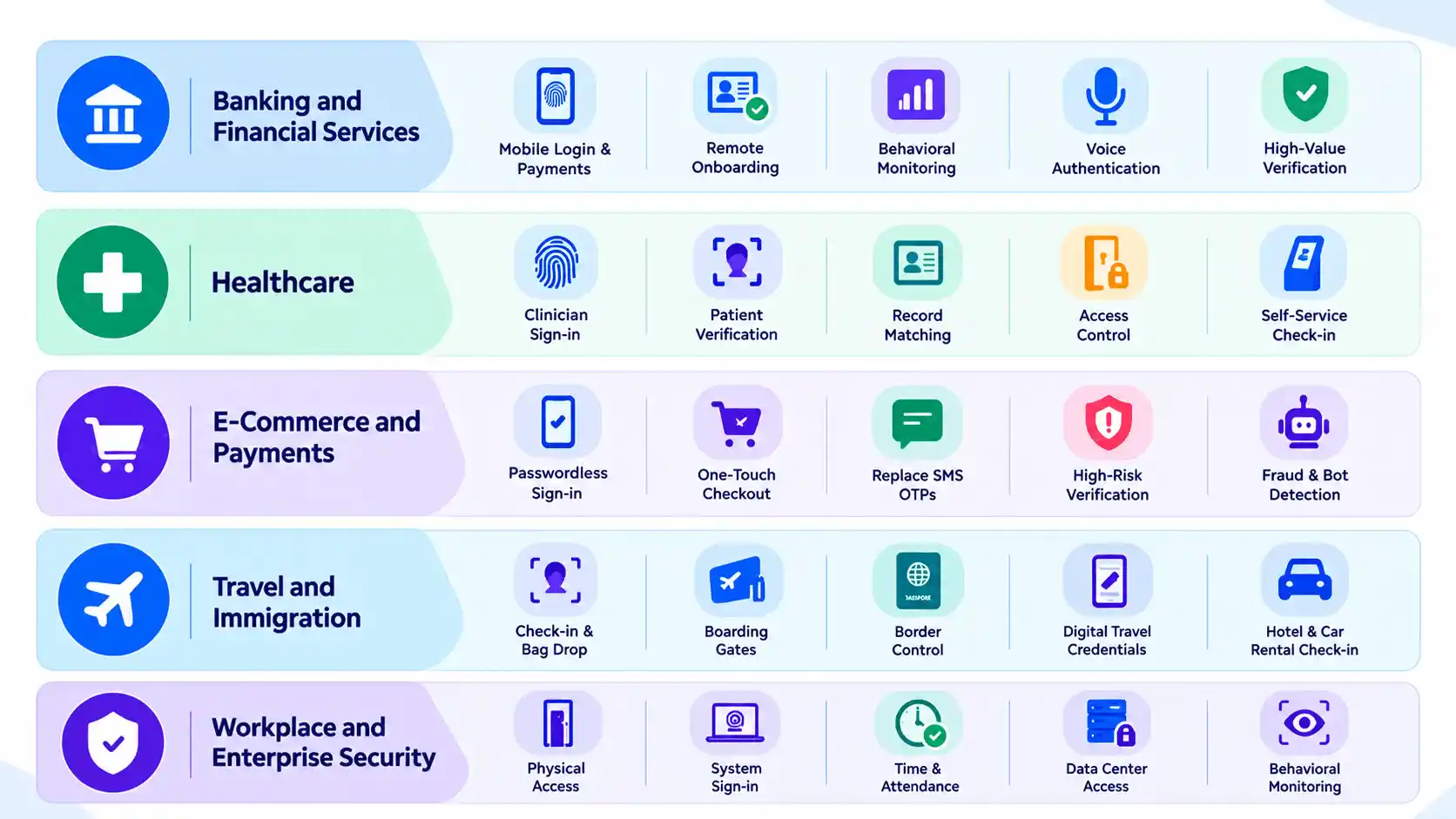
Banking and Financial Services
Common methods: digital biometrics in banking combine face recognition, fingerprint scanning, voice authentication, and behavioral signals such as keystroke and touch patterns, backed by liveness detection and device-bound passkeys.
Key use cases
- Mobile app login and payment approval with a fingerprint or face scan.
- Remote customer onboarding, where a live selfie is matched against an ID document with liveness checks.
- Behavioral monitoring that flags unusual typing, navigation, or transaction patterns.
- Voice authentication for phone banking and call-center callers.
- Step-up verification for high-value transfers and changes to account details.
Healthcare
Common methods: digital biometrics in healthcare rely on fingerprint and palm vein readers for clinicians, face and iris recognition for patient identification, and voice verification for telehealth, often alongside smart-card or PIN factors.
Key use cases
- Fast, secure clinician sign-in to electronic health records.
- Patient identity verification during telemedicine sessions.
- Matching patients to the correct record to prevent duplicate or mixed-up files.
- Access control for pharmacies, medication cabinets, and restricted wards.
- Self-service check-in kiosks that confirm identity at registration.
E-Commerce and Payments
Common methods: digital biometrics in retail and payments mostly means a fingerprint or face scan that unlocks a passkey on the customer’s device, supported by behavioral analytics during browsing and checkout and voice verification on support lines.
Key use cases
- Passwordless sign-in to shopping and payment accounts with passkeys.
- One-touch checkout approval on the customer’s phone.
- Replacing SMS one-time codes with on-device biometric confirmation.
- Extra verification for high-risk actions such as changing an address or payment method.
- Bot and account-takeover detection from behavioral signals.
Travel and Immigration
Common methods: digital biometrics in travel centers on face recognition, with iris and fingerprint used at some borders, and matching against the photo stored in the chip of an electronic passport.
Key use cases
- Check-in and bag drop through face matching.
- Boarding gates and lounge access without showing documents.
- Automated border gates that compare a traveler with their passport photo.
- Digital travel credentials stored on a phone and verified with a selfie.
- Contactless check-in at hotels and car rental desks.
Workplace and Enterprise Security
Common methods: digital biometrics at work span fingerprint, face, palm vein, and iris readers for physical access, hardware-bound passkeys for system sign-in, and behavioral analytics for continuous monitoring.
Key use cases
- Door and turnstile access to restricted areas.
- Strong workforce sign-in to enterprise systems with hardware-bound passkeys.
- Time and attendance tracking that prevents buddy punching.
- Protected access to data centers, labs, and secure storage.
- Continuous monitoring of sensitive sessions for unusual behavior.
Challenges and Concerns
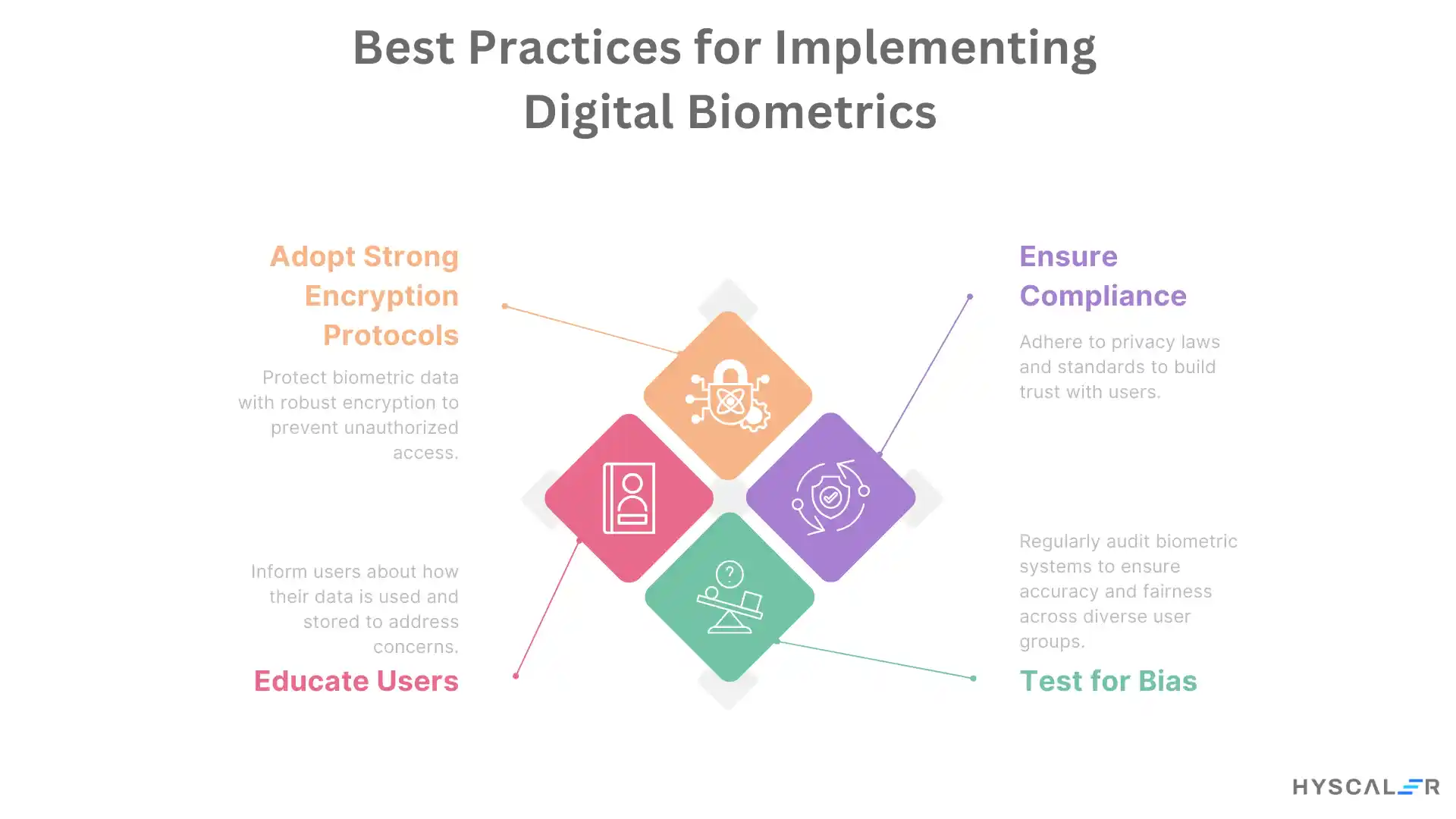
Although digital biometrics has significant advantages for its ethical and practical deployment in various industries, several challenges need to be overcome.
Privacy Concerns
The collection and storage of digital biometrics data, including finger impressions, facial photographs, and iris scans, pose serious privacy issues. Biometric data is, by definition, always private, and misuse or unauthorized access to this type of intimately personal information can have serious harmful effects. As a 2020 report by the Electronic Frontier Foundation (EFF) states, more than 1.5 billion facial recognition records were stored around the world, prompting worries about unauthorized data dissemination and monitoring.
Maintaining compliance with privacy legislation such as the General Data Protection Regulation (GDPR) in Europe and the California Consumer Privacy Act (CCPA) in the United States is critical to protecting individual rights and preventing breaches of digital biometrics data.
Data Security
Since digital biometrics systems store very personal information, those biometric databases are likely to be sought after by cybercriminals. If targeted, hackers could illegally access sensitive information on a large scale. A 2019 study by the National Institute of Standards and Technology (NIST) found that 18% of biometric databases in use worldwide were not adequately secured, making them vulnerable to attacks.
To prevent unauthorized access and breaches of digital biometrics, security measures need to be taken, such as robust encryption protocols, multi-factor authentication, and secure storage solutions.
Bias in Facial Recognition
Facial recognition is one of the building blocks of digital biometrics, though it has drawn criticism for its potential susceptibility to bias. Research has demonstrated that facial recognition systems are weak in correctly identifying individuals belonging to ethnic groups. A 2019 study by the MIT Media Lab revealed that commercial digital biometrics systems misidentified darker-skinned and female faces at significantly higher rates than lighter-skinned or male faces.
In certain scenarios, facial recognition algorithms were 34% more likely to be mistaken for darker-skinned women. Developers must work toward minimizing biases in digital biometrics algorithms to ensure fairness, equity, and effective use in critical sectors like law enforcement and hiring practices.
Cost of Implementation
Although digital biometrics offers significant security, the initial cost of setting up may be prohibitive, particularly for small and medium enterprises (SMEs). A 2020 Biometrics Institute survey found that 60% of small business respondents reported the cost of digital biometrics as a significant obstacle in deploying such a technology. Costs go beyond the hardware (scanner and camera) to the software, the training, and the ongoing maintenance.
Nevertheless, with the development and increased widespread acceptance of digital biometrics technology, the cost is anticipated to decrease and therefore be more affordable to smaller organizations in the future.
Final Thoughts
Biometrics has matured from a novelty into core security infrastructure, and the growth forecasts from multiple research firms agree on the direction even where they differ on size. But the same AI advances that improved matching accuracy also made fakes cheaper and more convincing. The organizations that benefit most will treat digital biometrics as a layered, privacy-first capability rather than a silver bullet, and will keep pace with regulation as it evolves.
Ready to transform security with digital biometrics? Begin to explore the ways this technology could make your organization more efficient and secure today.
READ MORE:
AI Rendering: Unlocking the Future of Intelligent Visualization
The Quiet Revolution of Green Hydrogen: Powering a Sustainable Future
FAQs
What are biometrics and how do they work?
Biometrics identify people by physical or behavioral traits. A system enrolls a trait as a template, then compares each new scan against it to confirm a match.
What are the main types of biometrics?
The main types are face, fingerprint, iris, retina, voice, vein, and palm, plus behavioral signals such as typing rhythm, mouse movement, and touchscreen swipes.
Is biometric authentication safer than a password or PIN?
Generally yes, because a trait can’t be phished or guessed. It is strongest when paired with liveness checks, a PIN fallback, or another factor.
Can someone unlock my phone with my fingerprint or face without my consent?
It is possible if you are asleep or if someone forces you. Use your phone’s lockdown mode, which temporarily disables biometrics and requires your PIN.
Can fingerprints or faces be copied or spoofed?
Researchers have shown that lifted prints, photos, and masks can fool weak sensors. Modern systems add liveness detection and 3D or infrared sensing to block these attacks.
Can deepfakes or AI-generated photos bypass face recognition?
They can, especially when synthetic video is injected directly into a verification flow. Layered defenses such as liveness and injection-attack detection help counter this.
Is it legal to collect biometric data from employees or customers?
Usually only with a lawful basis and clear consent. The GDPR, the EU AI Act, and US state laws such as Illinois’ BIPA all impose strict rules.
What is the future of biometrics?
Expect layered, deepfake-resistant verification, passkeys, wallet-based digital identity, contactless vein and palm methods, and privacy-first design shaped by tighter regulation.