
Table of Contents
Most AI projects don’t fail because the model is weak. They fail because a step was skipped: the use case was vague, the data was messy, no one planned how to evaluate quality, or no one owned the product after launch. The AI product engineering lifecycle gives teams a repeatable path from first idea to a product that keeps improving in production.
This guide explains each stage, the building blocks behind it, the team you need, and the risks to plan for.
Quick Summary
- What it is: a stage-by-stage framework for taking an AI product from idea to scale.
- Who it’s for: product leaders, CTOs, engineering managers, and founders planning or rescuing an AI initiative.
- What you’ll learn: the seven lifecycle stages, core building blocks, team roles, governance, costs, and common failure modes.
- Why it’s useful: it helps you avoid expensive rework, stalled pilots, and products that work in a demo but not in the real world.
What Is AI Product Engineering?
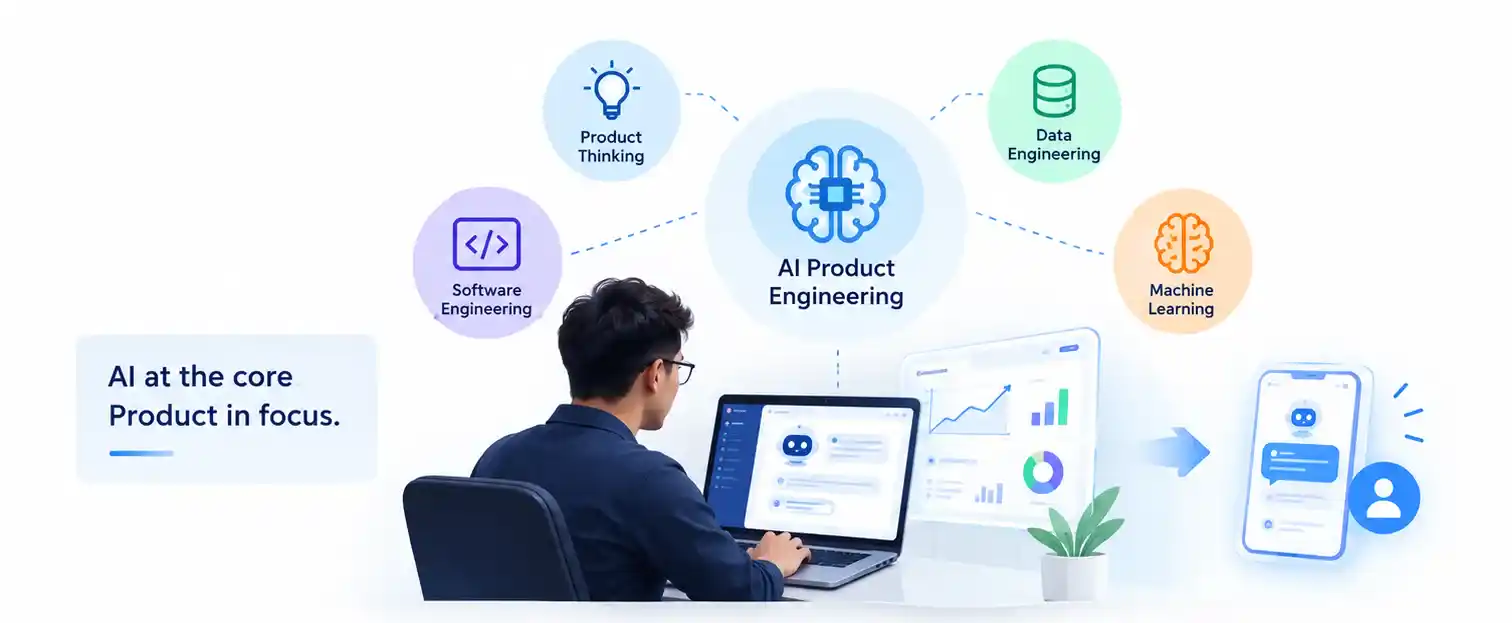
AI product engineering is the discipline of designing, building, deploying, and continuously improving products where AI is central to the value delivered, not a bolt-on feature. It brings product thinking, software engineering, data engineering, and machine learning into one delivery process so the model, data, interface, and business goal are planned together instead of in isolation.
In practice, this discipline is organized around the AI product engineering lifecycle: a structured path that takes a product from a validated idea to a scaled, monitored, and evolving solution. Understanding what AI product engineering covers makes each stage of that path easier to plan and budget for.
What AI Product Engineering Covers
AI product engineering covers the whole product, not just the model. A typical engagement spans:
- Problem definition: identifying the user, the pain point, and the business outcome the AI product should deliver.
- Data foundations: sourcing, preparing, and governing the data the product learns from or retrieves.
- Intelligence layer: selecting, adapting, and evaluating the models, whether through APIs, retrieval-augmented generation, fine-tuning, or custom builds.
- Application and integration: connecting the AI capability to existing systems, workflows, and user interfaces.
- Operations: releasing, monitoring, and maintaining the product so quality holds up in the real world.
- Governance: building in security, privacy, and responsible AI practices from the start.
Core Principles
Teams that do this well tend to share a few working principles:
- Outcome-first thinking. Every decision traces back to a measurable business or user result, not to a technology trend.
- Data as a product asset. Data quality, access, and ownership are treated with the same care as code because they shape the user experience.
- Continuous evaluation. AI output is probabilistic, so quality is measured before launch and monitored after it.
- Human-centered design. Interfaces help users understand, trust, and correct what the AI produces.
- Iteration over perfection. Products improve through short cycles of building, measuring, and refining.
Why It Matters Now
Several business drivers push organizations to treat AI as a product discipline rather than a series of experiments:
- Customer expectations: people now expect intelligent, personalized, conversational experiences.
- Competitive pressure: rivals that ship useful AI features set a new baseline for the market.
- Operational efficiency: automation and decision support reduce manual effort across departments.
- Faster learning cycles: teams that experiment in a structured way learn what works sooner.
- Data as an asset: companies sitting on years of proprietary data can turn it into a differentiator.
- Mature platforms: cloud AI services and open tooling have lowered the barrier to building.
A structured AI product engineering lifecycle turns these drivers into measurable outcomes instead of scattered pilots.
The AI Product Engineering Lifecycle: Seven Stages
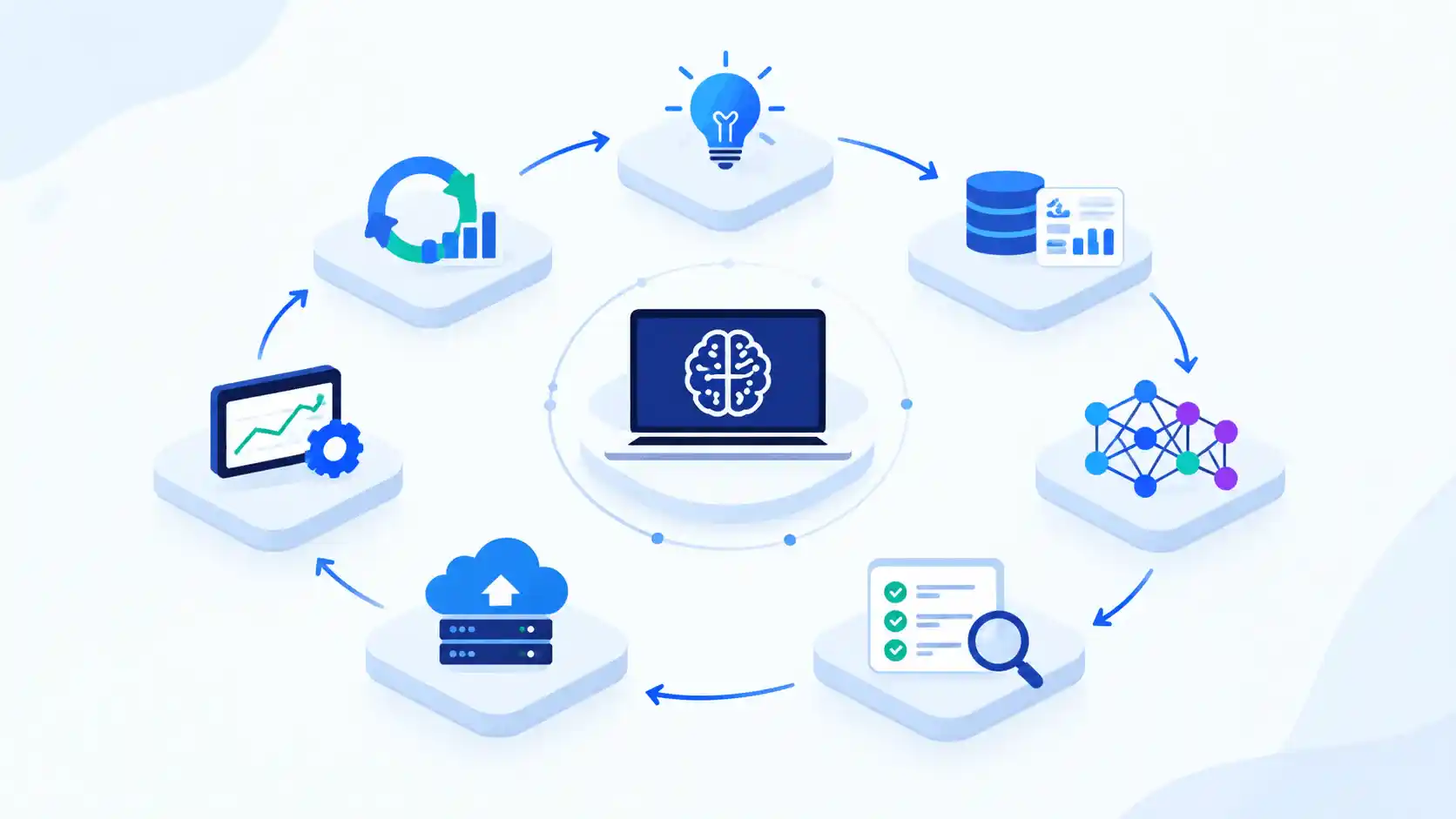
The AI product engineering lifecycle has seven connected stages, and each one produces specific deliverables that the next stage depends on. In practice, the stages overlap. Data work continues while prototypes are built, and monitoring insights feed directly back into problem definition. Think of the AI product engineering lifecycle as a loop, not a straight line.
Each stage below covers what it is, the technical activities involved, what good looks like, and what to watch out for.
Stage 1: Problem and Use-Case Validation
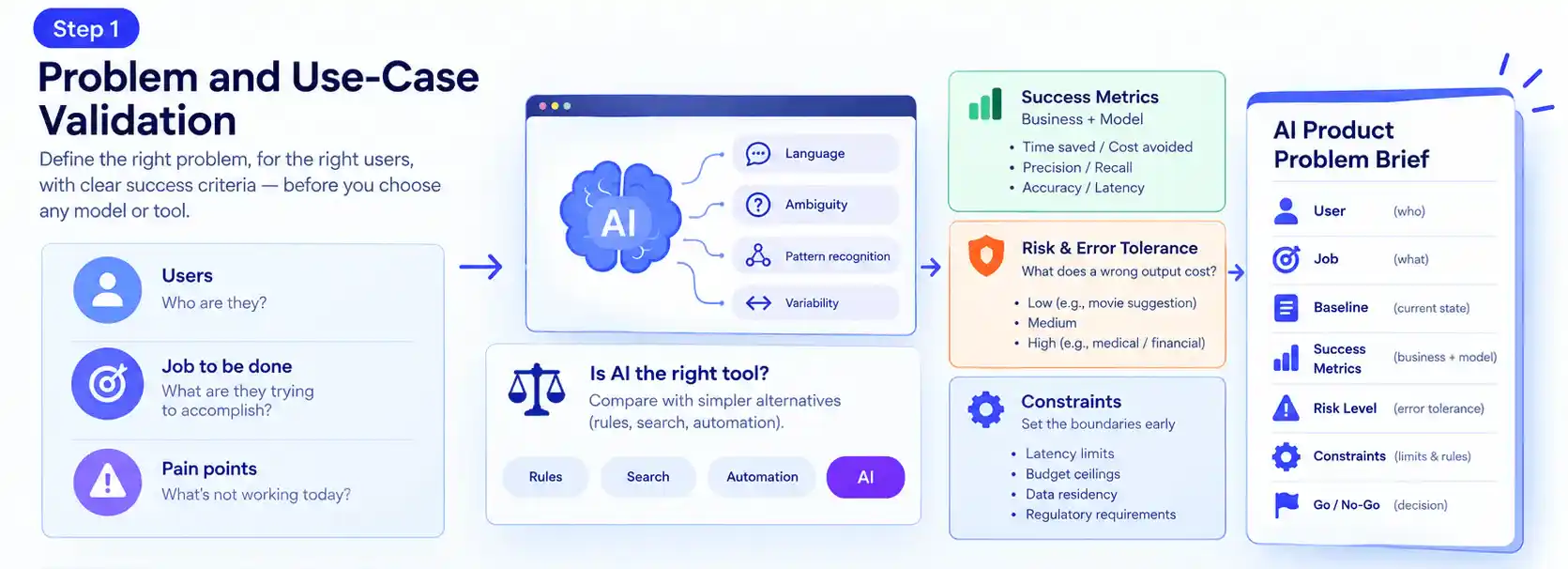
What it is: Defining the exact problem the AI product should solve, for whom, and how success will be measured, before any model or tool is chosen.
Why it matters: Every later decision in the AI product engineering lifecycle, from data to architecture to cost, traces back to this stage. A vague problem produces a vague product, and no amount of engineering fixes that.
Key activities
- Frame the problem as a user job. Use a jobs-to-be-done approach: what is the user trying to accomplish, what do they do today, and where does it hurt? Write it as a single testable statement, for example, “reduce the time an analyst spends triaging a support ticket,” rather than “add AI to support.”
- Test whether AI is the right tool. Compare an AI approach against simpler alternatives such as rules, search, or workflow automation. AI earns its place when the task involves language, ambiguity, pattern recognition, or variability that fixed rules can’t handle. If a deterministic solution meets the need, it’s cheaper, more predictable, and easier to maintain.
- Define success metrics at two levels. Business metrics (time saved, cost avoided, conversion, satisfaction) show value. Model-level metrics (precision, recall, answer accuracy, groundedness, and latency) show quality. Set target thresholds and a pre-launch baseline now, because you can’t prove improvement without one.
- Assess risk and error tolerance. Decide what a wrong output costs. A wrong movie suggestion is harmless, while a wrong medical or financial output is not. Risk level determines how much human review, validation, and governance the rest of the delivery process needs.
- Map constraints early. Note latency limits, budget ceilings, data residency rules, and regulatory categories so they shape the design instead of blocking it later.
What good looks like: A one-page problem brief with the user, the job, the baseline, the success metrics, the risk level, and a go/no-go criterion.
Watch out for: Building for novelty. If nobody can name the user or the metric, pause.
Stage 2: Data Strategy and Readiness
What it is: Identifying, accessing, cleaning, structuring, and governing the data the product will depend on, both for building and for running it.
Why it matters: In the AI product engineering lifecycle, data quality sets the ceiling on product quality. Models can only reflect the data they learn from or retrieve.
Key activities
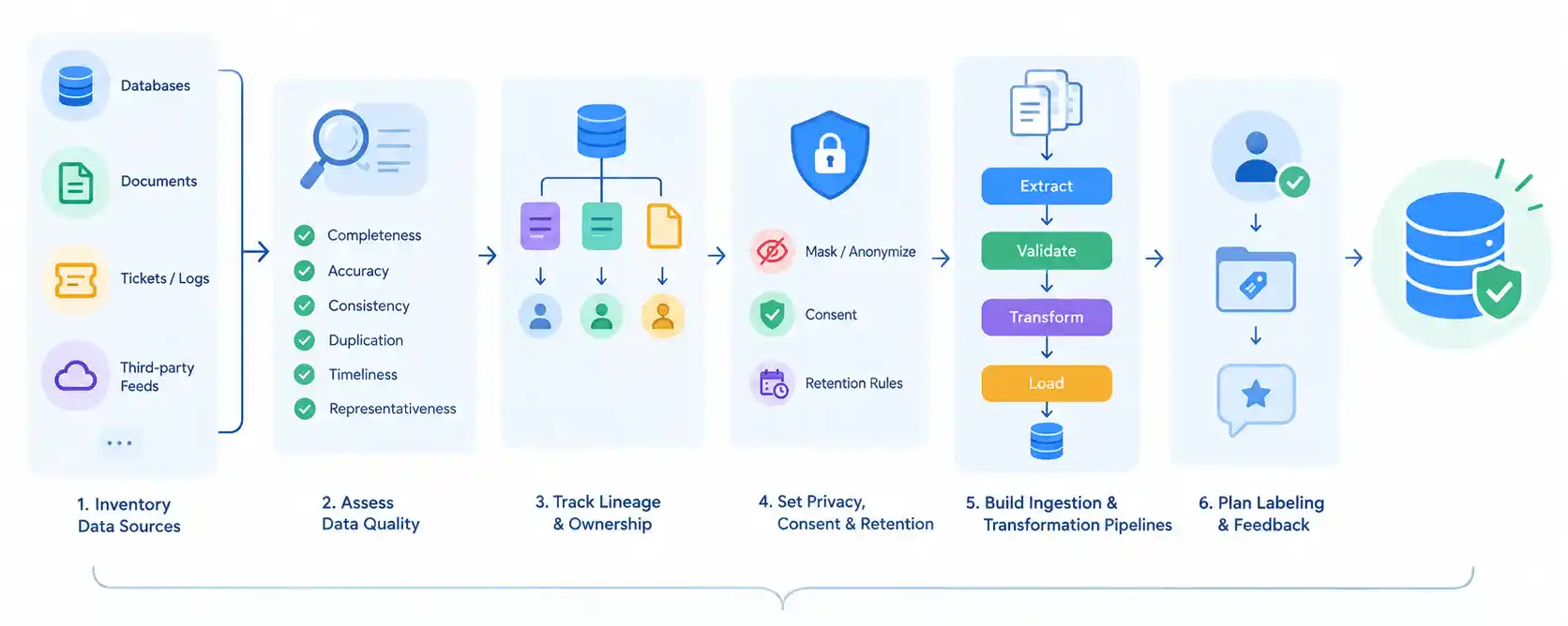
- Inventory data sources. List every relevant source (databases, documents, tickets, logs, third-party feeds), its owner, format, freshness, and access method. Identify gaps between what you have and what the use case needs.
- Assess quality along specific dimensions. Check completeness, accuracy, consistency, duplication, timeliness, and representativeness. A dataset that under-represents certain users or scenarios will produce a product that underperforms for them.
- Establish lineage and ownership. Data lineage traces where each piece of data came from and how it was transformed. It’s essential for debugging bad outputs, satisfying audits, and knowing which data is safe to use.
- Set privacy, consent, and retention rules. Classify data by sensitivity, apply masking or anonymization where needed, and define what may enter prompts, training sets, or logs. Decide retention periods before collection begins.
- Design ingestion and transformation pipelines. Build repeatable pipelines that extract, validate, transform, and load data, with schema checks and automated quality alerts. For retrieval-based products, this includes document parsing, cleaning, chunking, and metadata tagging.
- Plan labeling and feedback data. If you need ground-truth labels for evaluation or fine-tuning, decide who labels, how quality is checked, and how disagreement is resolved. Plan to capture real user feedback later.
What good looks like: A documented data map, automated quality checks, clear ownership, and a compliant path for every data source in scope.
Watch out for: Discovering late that data is incomplete, biased, siloed, or legally restricted. Check this before committing to a model approach.
Stage 3: Model Selection (Build, Buy, Fine-Tune, RAG)
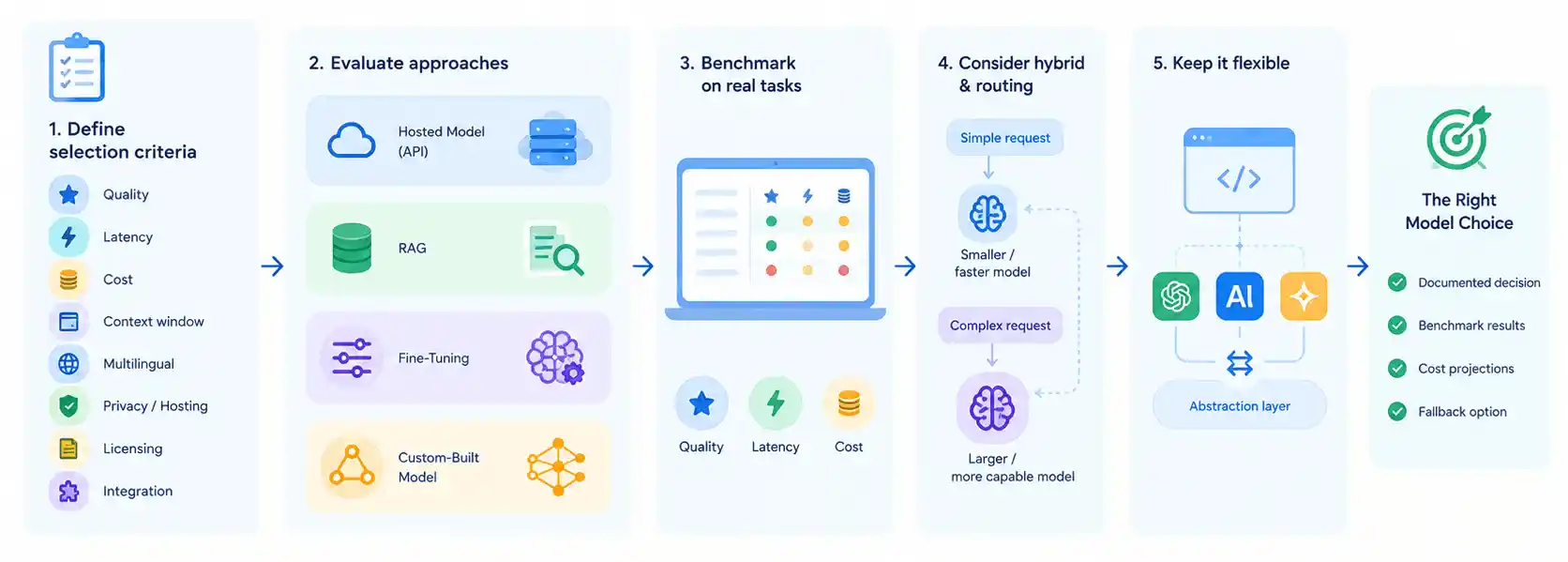
What it is: Choosing how the product’s intelligence will be sourced and adapted.
Why it matters: Within the AI product engineering lifecycle, this is the most visible decision, but it works best when driven by the requirements from Stages 1 and 2 rather than by trends. The choice affects quality, cost, speed, control, and long-term flexibility.
Key activities
- Define selection criteria first. Rank what matters: output quality, latency, cost per request, context window, multilingual support, privacy and hosting requirements, licensing, and ease of integration. Criteria let you compare models objectively.
- Evaluate the four main approaches.
- Use a hosted model through an API for speed and broad capability. You trade some control and accept ongoing per-usage cost and vendor dependency.
- Retrieval-augmented generation (RAG) when answers must reflect your own or frequently changing knowledge. The model retrieves relevant passages at query time, which grounds answers and reduces fabrication without retraining.
- Fine-tuning when you need consistent tone, structured formats, or specialized domain behavior. Parameter-efficient methods such as LoRA adapt a model at lower cost than full retraining, though they still need quality training data and upkeep.
- Custom-built models when the problem is unique, data is proprietary and abundant, or the model itself is your competitive asset. This carries the highest cost and expertise requirement.
- Benchmark on your own tasks. Public leaderboards measure general ability, not your use case. Run candidate models against a representative sample of real inputs and compare quality, latency, and cost side by side.
- Consider hybrid and routing patterns. Many production systems use a small, fast model for simple requests and a larger model for complex ones, or combine RAG with light fine-tuning. Routing can cut cost without lowering quality where it matters.
- Avoid lock-in. Put a thin abstraction layer between your application and the model provider so models can be swapped as the market changes.
What good looks like: A documented decision with benchmark results, cost projections, and a fallback option.
Watch out for: Over-engineering. Start with the simplest approach that meets the quality bar, then add complexity only when measurements justify it.
Stage 4: Architecture and Integration
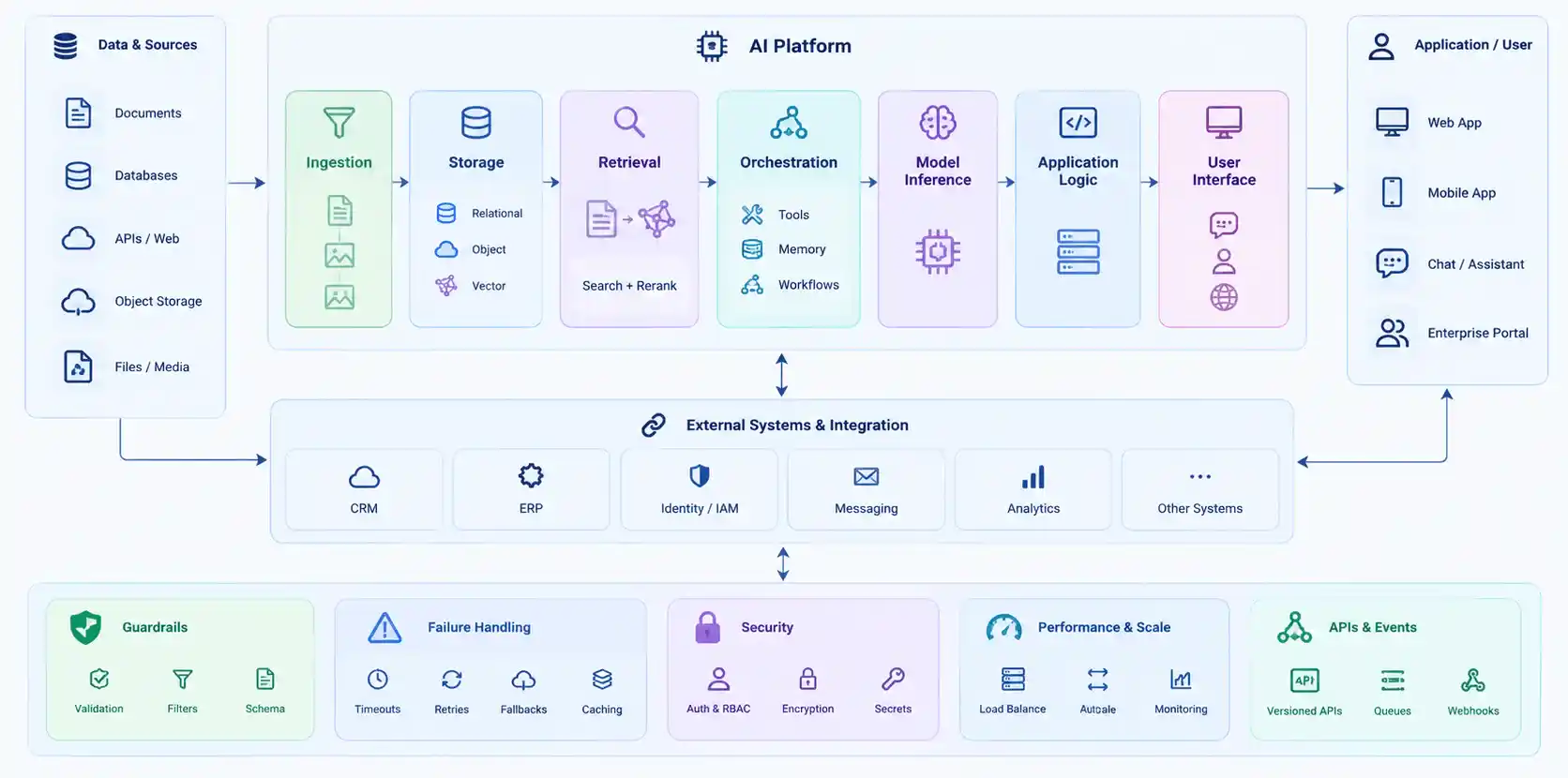
What it is: Designing how the model, data, business logic, and interface fit together, and how the product connects to the systems the organization already runs.
Why it matters: In any AI product engineering lifecycle, the product lives inside a larger ecosystem of CRMs, ERPs, identity systems, and databases. Weak integration is a leading reason strong prototypes stall before production.
Key activities
- Choose a reference architecture. Typical layers are ingestion, storage (relational, object, and vector), retrieval, model inference, orchestration, application logic, and the user interface. Decide which layers are managed services and which you operate yourself.
- Design the retrieval layer carefully. For RAG products, decisions on chunk size, embedding model, hybrid keyword-plus-semantic search, metadata filtering, and reranking directly determine answer quality. Treat retrieval as a product component, not plumbing.
- Plan orchestration. Frameworks such as LangChain or custom code coordinate prompts, tools, memory, and multi-step workflows. For agentic behavior, define which tools the AI may call, with what permissions, and what needs human approval.
- Build guardrails into the flow. Add input validation, output schema enforcement, content filters, and checks that stop sensitive data from reaching a model or a user.
- Engineer for failure. Define timeouts, retries, fallbacks to simpler responses, and graceful degradation when a model is slow, wrong, or unavailable. Add caching, including semantic caching for repeated queries, to control latency and cost.
- Secure the whole path. Apply authentication, role-based access, encryption in transit and at rest, secrets management, and protection against prompt injection and data leakage.
- Integrate through stable interfaces. Expose the AI capability through versioned APIs, and use event-driven patterns or queues for slow or batch work so the wider system isn’t blocked.
What good looks like: An architecture diagram, an integration plan, defined non-functional requirements (latency, throughput, availability), and a threat model.
Watch out for: Tight coupling to one model, one vendor, or one data source, which turns every future change into a rebuild.
Stage 5: Prototyping and Evaluation
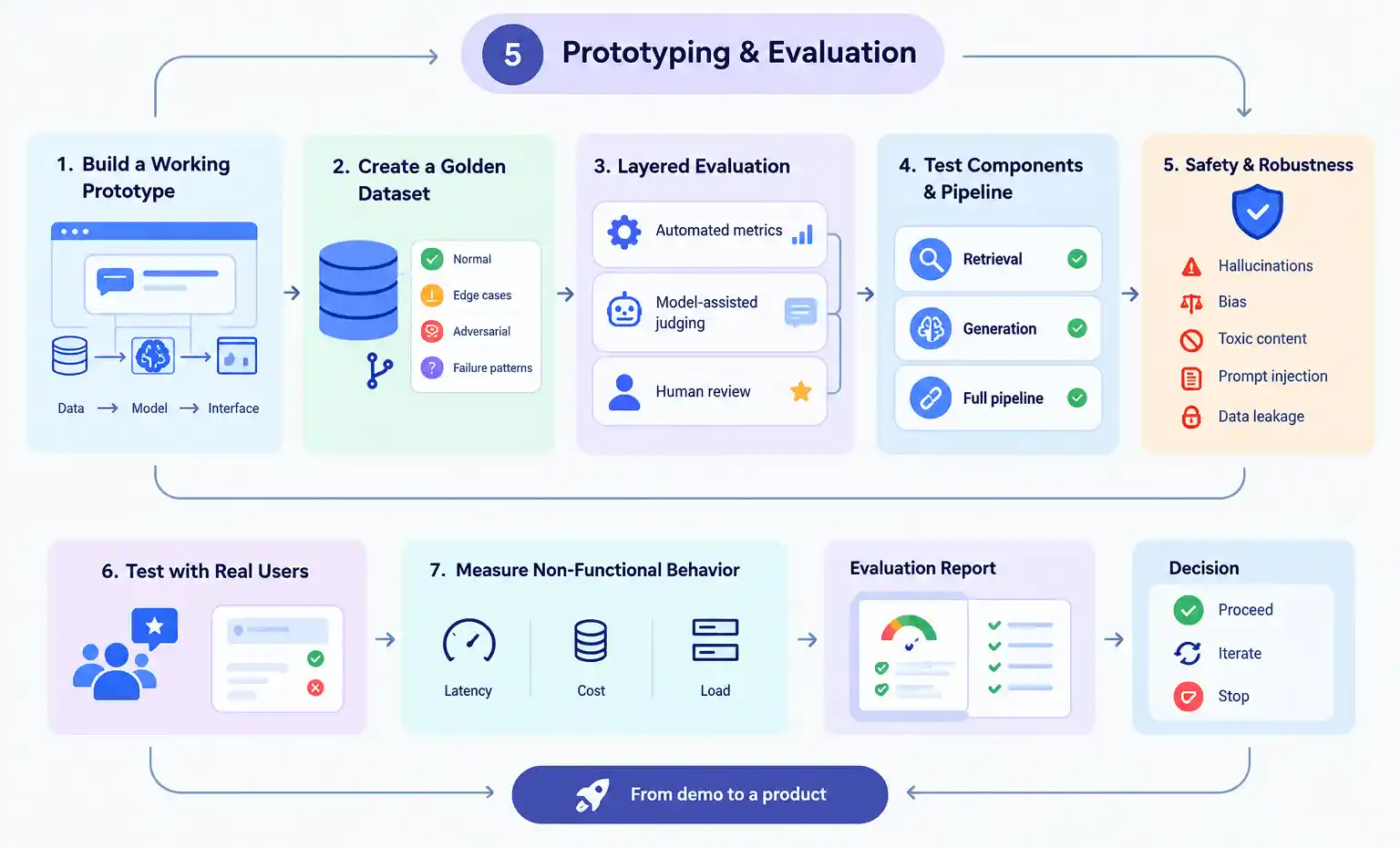
What it is: Building a working version quickly and testing it rigorously against realistic scenarios.
Why it matters: Evaluation is what separates a demo from a product in the AI product engineering lifecycle. Without systematic evaluation, teams rely on a handful of impressive examples and get surprised in production.
Key activities
- Build the thinnest end-to-end slice. Connect data, model, and interface with minimal features so you can test the real experience early, then deepen it in later iterations.
- Create a golden dataset. Assemble a curated set of realistic inputs with expected outputs or scoring criteria, covering typical cases, edge cases, adversarial inputs, and known failure patterns. Version it like code.
- Use layered evaluation. Automated metrics provide scale, such as exact match, retrieval hit rate, groundedness, and format compliance. Model-assisted grading (an LLM acting as judge, with clear rubrics) extends coverage to open-ended answers. Human review supplies the final judgment on nuance, tone, and safety. Calibrate automated judges against human ratings so you know how far to trust them.
- Evaluate components separately and together. Test retrieval on its own (did it find the right passage?), generation on its own (did it use the passage correctly?), and the full pipeline. This pinpoints where quality is lost.
- Run safety and robustness tests. Probe for hallucinations, bias, toxic content, prompt injection, and sensitive-data leakage. Red-team the product before real users do.
- Test with real users. Prototype sessions reveal whether the interface builds appropriate trust and whether users notice and correct errors.
- Measure non-functional behavior. Track latency percentiles, cost per request, and behavior under load, not just quality.
What good looks like: An evaluation report with scores against the thresholds from Stage 1, a list of known limitations, and an agreed decision to proceed, iterate, or stop.
Watch out for: Judging quality by cherry-picked examples, or evaluating once and never again. Rerun evaluation whenever a prompt, model, or data source changes.
Stage 6: Deployment and MLOps/LLMOps
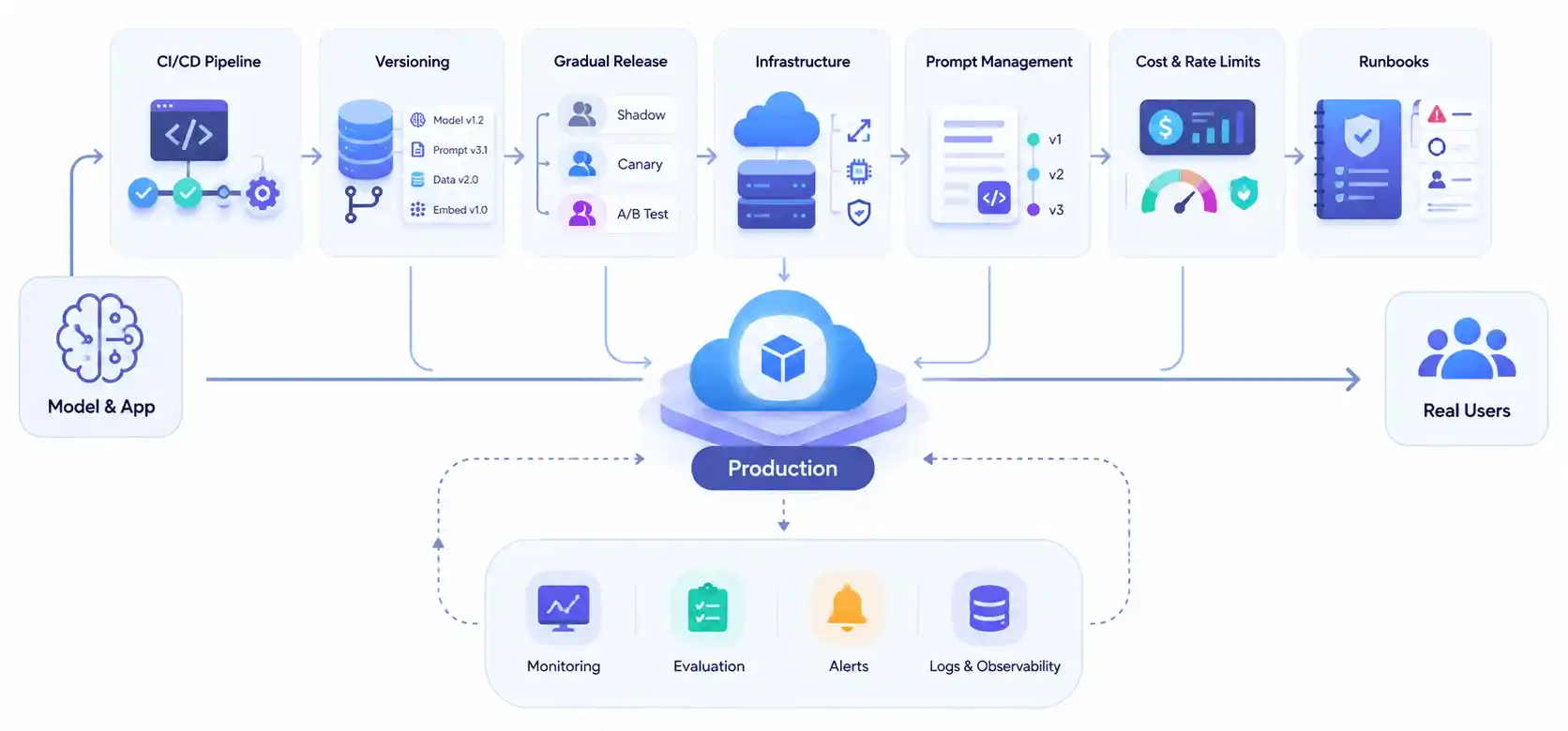
What it is: Releasing the product and building the operational machinery that keeps it reliable, reproducible, and improvable.
Why it matters: The AI product engineering lifecycle creates value only when the product runs for real users at real scale with predictable behavior.
Key activities
- Automate release pipelines. Extend CI/CD to cover models, prompts, retrieval indexes, and configuration. Every change should pass automated tests and evaluation gates before release.
- Version everything. Track versions of models, prompts, datasets, embeddings, and evaluation sets, so any output can be reproduced and any release rolled back.
- Release gradually. Use shadow deployments (the new version runs silently beside the old one), canary releases to a small user segment, and A/B tests to compare versions on real outcomes before full rollout.
- Right-size infrastructure. Choose between managed endpoints and self-hosting based on volume, latency, and privacy needs. Configure autoscaling, batching, and quantization or other optimizations where they reduce cost without harming quality.
- Manage prompts as production assets. Store prompts in version control, review changes like code, and test them against the golden dataset.
- Control cost and rate limits. Set budgets, quotas, and alerts per feature or customer, and apply caching and model routing to keep spend predictable.
- Prepare operational runbooks. Document incident response, rollback steps, escalation paths, and on-call ownership for AI-specific failures.
What good looks like: Repeatable, low-risk releases, fast rollback, and clear ownership of the running system.
Watch out for: Treating deployment as a one-time event. In AI systems, every model, prompt, or data change is a potential release.
Stage 7: Monitoring, Feedback Loops, and Iteration
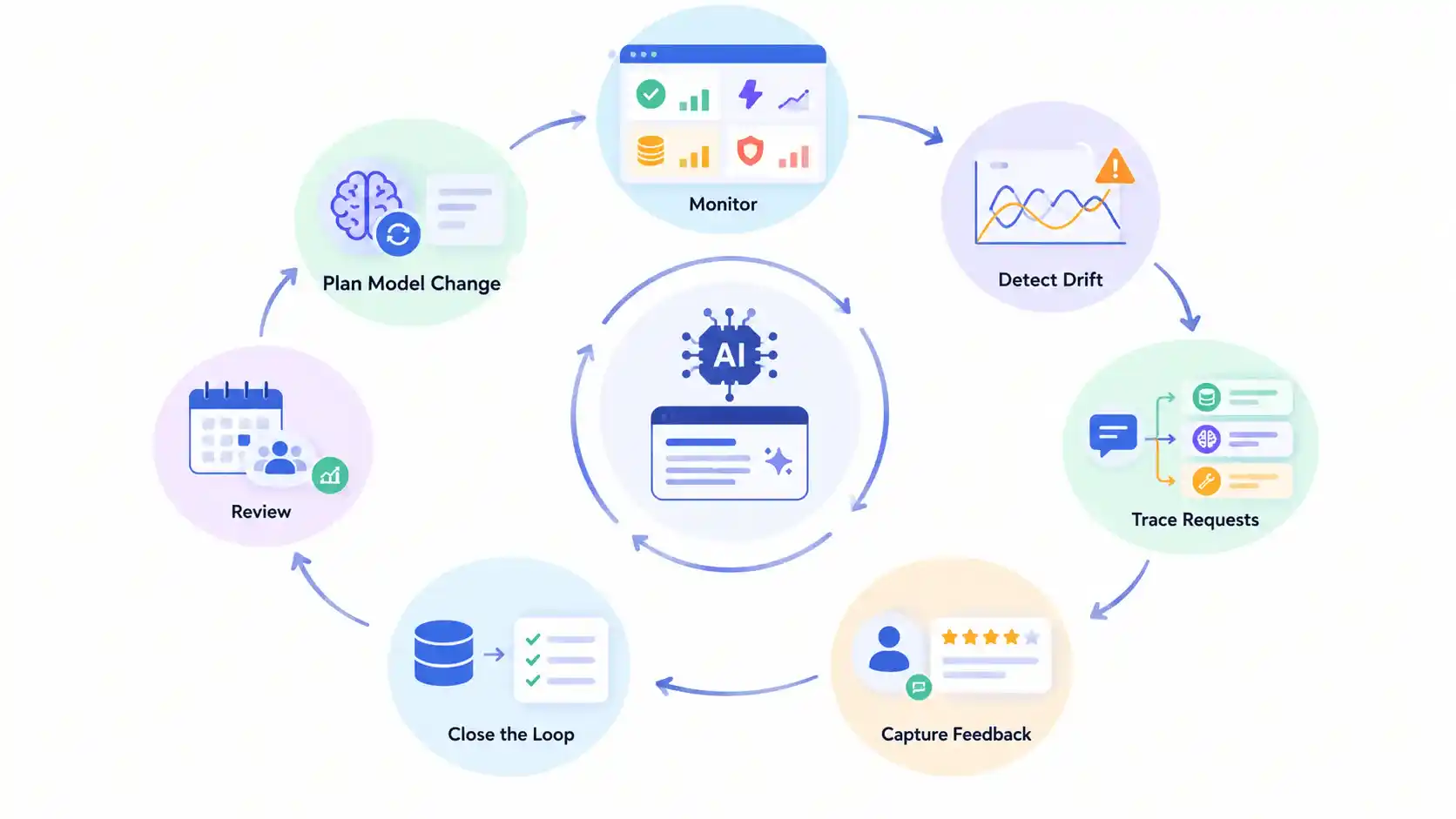
What it is: Continuously observing how the product performs in the real world and using those signals to improve it.
Why it matters: This stage is what makes the AI product engineering lifecycle a loop instead of a line. Models drift, data changes, and users behave in ways no test set predicted. Quality that isn’t monitored will quietly erode.
Key activities
- Monitor across four dimensions. Track quality (accuracy, groundedness, user ratings), operations (latency, error rates, availability), cost (tokens or compute per request, spend per feature), and safety (flagged outputs, policy violations).
- Detect drift. Watch for data drift (inputs changing over time), concept drift (the meaning of correct changing), and retrieval drift (the knowledge base going stale). Set thresholds that trigger alerts and reviews.
- Trace requests end to end. Log prompts, retrieved context, model outputs, and tool calls, with privacy controls, so you can diagnose why a specific answer was wrong.
- Capture feedback deliberately. Combine explicit signals (ratings, corrections, escalations) with implicit ones (edits, abandonment, repeat queries). Make giving feedback effortless.
- Close the loop. Route failure cases into the golden dataset, use them to refine prompts, retrieval, or fine-tuning data, and rerun evaluation before release. Each cycle should make the next one cheaper.
- Review on a schedule. Hold regular product reviews covering quality trends, cost, incidents, roadmap items, and governance checks, and revisit Stage 1 assumptions as the business changes.
- Plan for model change. Providers update and retire models. Track upcoming changes and re-evaluate before migrating.
What good looks like: Dashboards and alerts the team actually uses, a steady flow of feedback into improvements, and quality that holds or improves over time.
Watch out for: Launching and moving on. The teams that treat monitoring as part of the product are the ones whose AI products keep getting better.
Core Building Blocks
Every stage of the AI product engineering lifecycle draws on the same set of components:
- Data pipelines: collect, clean, and move data reliably to where it’s needed.
- Model layer: the foundation models, fine-tuned models, or custom models that provide intelligence.
- Orchestration: frameworks such as LangChain that connect models, tools, memory, and workflows.
- Vector stores: databases that let the product search by meaning, which is essential for RAG.
- APIs and integrations: the connections to internal systems and third-party services.
- UX layer: the interface that makes AI output understandable, controllable, and trustworthy.
- Observability: logging, tracing, and evaluation tools that make behavior visible.
Why it’s useful: thinking in building blocks makes it easier to plan, budget, and hand off work to the right specialists.
Governance, Security, and Compliance
Trust is a product feature. Building governance into the AI product engineering lifecycle from the start is cheaper than retrofitting it.
- Responsible AI: set principles for fairness, transparency, accountability, and human oversight.
- Data protection: control what data enters prompts and models and how long it’s kept.
- Security: guard against prompt injection, data leakage, and misuse of connected tools.
- AI governance platforms: centralize model inventories, risk assessments, approvals, and audit trails.
- Regulation: the EU AI Act takes a risk-based approach, with stricter obligations for higher-risk uses. Classify your product early and involve legal counsel.
Why it’s useful: teams that plan for governance move faster later, because reviews and audits don’t derail delivery.
Common Challenges and Failure Modes
The AI product engineering lifecycle exists largely to prevent the following problems:
| Challenge | What it looks like | How to reduce it |
|---|---|---|
| Hallucinations | Confident but wrong or invented answers | Ground outputs in trusted data (RAG), add validation, and keep humans in the loop for high-stakes cases |
| Poor data quality | Inconsistent, biased, or outdated outputs | Invest early in data readiness and ongoing monitoring |
| Integration debt | A prototype that can’t connect to real systems | Design architecture and APIs early; keep components modular |
| Scaling problems | Costs, latency, or reliability break under real usage | Load test, set usage limits, optimize prompts, and model choice |
| PoC purgatory | Pilots that impress but never reach production | Define success criteria and a path to production before the pilot begins |
Why HyScaler Is a Better Fit
Most teams don’t struggle with one stage of the AI product engineering lifecycle. They struggle with the handoffs, where a validated idea meets messy data or a working prototype meets an unprepared production environment. HyScaler supports the AI product engineering lifecycle from discovery through scale, starting with use-case validation and success metrics, then moving into data readiness and integration-ready architecture so the product connects cleanly to your existing systems.
From there, HyScaler builds, tests, and releases the product with structured evaluation, then stays on to monitor quality, cost, and drift after launch. Real-world feedback goes back into each iteration, so improvements rest on evidence rather than guesswork. Whether you need a full-cycle partner or support at a single stage, this approach helps you move from idea to scale with fewer surprises.
Conclusion
The AI product engineering lifecycle is not a rigid checklist. It’s a shared way of working that keeps business value, data, models, and operations aligned. Teams that follow it validate ideas earlier, ship with fewer surprises, and keep improving after launch. Start with a clear problem, prepare your data, evaluate rigorously, and treat monitoring as part of the product.
FAQs
Why do so many AI projects fail to reach production?
Common causes are vague goals, poor data, and weak integration. Following a structured AI product engineering lifecycle keeps these risks visible early.
What is the difference between an AI demo and a production AI product?
A demo shows the happy path with clean inputs. A production product must handle messy data, edge cases, scale, cost limits, and ongoing monitoring.
What are the stages of the AI product engineering lifecycle?
The AI product engineering lifecycle covers problem validation, data readiness, model selection, architecture, prototyping and evaluation, deployment, and monitoring.
Should we use RAG, fine-tuning, or a hosted API?
Start with the simplest option that meets your quality bar. Model selection is Stage 3 of the AI product engineering lifecycle, so decide it after your data and use case are clear.
How do we evaluate an LLM-based product?
Build a golden dataset from real tasks, then combine automated metrics, model-assisted grading, and human review. Evaluation sits at the heart of the AI product engineering lifecycle, so rerun it after every change.
How important is data quality?
In the AI product engineering lifecycle, data quality sets the ceiling on product quality. Incomplete or biased data leads directly to poor outputs.
What is the difference between MLOps and LLMOps?
MLOps manages traditional model pipelines, while LLMOps adds prompt management, retrieval, and evaluation. Both support deployment in the AI product engineering lifecycle.
How do chunking and embedding choices affect RAG quality?
Chunk size and the embedding model decide what the retriever can find. Getting them right early keeps the AI product engineering lifecycle on track, since weak retrieval limits answer quality.
What are shadow deployments and canary releases?
A shadow deployment runs a new version silently beside the live one, and a canary releases it to a small group first. Both reduce release risk in the AI product engineering lifecycle.