

Table of Contents
Let’s be honest, most software projects don’t fail because of bad ideas.
They fail because of poor engineering execution.
A recent industry study found that nearly 70% of digital product initiatives fail to hit their original launch timelines, and over half never achieve the business outcomes they were designed for.
Meanwhile, the global product engineering services market is projected to exceed $1.8 trillion by 2030, driven by an explosion in AI-native applications, cloud-first infrastructure, and rising customer expectations.
Whether you’re a startup trying to ship your first product or an enterprise modernizing a decade-old platform, the partner you choose to engineer your product will make or break your roadmap.
This guide breaks down everything you need to know, from what product engineering services actually include, to how much they cost in the US, to how AI is changing the game in 2026.
What Are Product Engineering Services?
Product engineering services refer to the end-to-end process of designing, building, deploying, and continuously improving digital products.
It’s different from traditional software development in a few important ways.
| Traditional Software Development | Product Engineering |
|---|---|
| Project-focused | Product-focused |
| Fixed scope | Continuous evolution |
| Delivery-oriented | Outcome-oriented |
| Build and exit | Build, optimize, scale |
In short, traditional development builds what you ask for.
Product engineering builds what your users need and keeps improving it.
A full-service product engineering company covers the entire product lifecycle:
- Discovery & Validation – defining the problem, understanding users, de-risking the roadmap
- Product Design – UX/UI, customer journeys, design systems
- Architecture Engineering – cloud architecture, microservices, event-driven systems
- Product Development – frontend, backend, APIs, mobile applications
- Quality Engineering – automated testing, performance, security
- Deployment & DevOps – CI/CD pipelines, monitoring, infrastructure automation
- Modernization & Scaling – AI integration, cloud migration, platform engineering
Why Product Engineering Services Matter More Than Ever in 2026
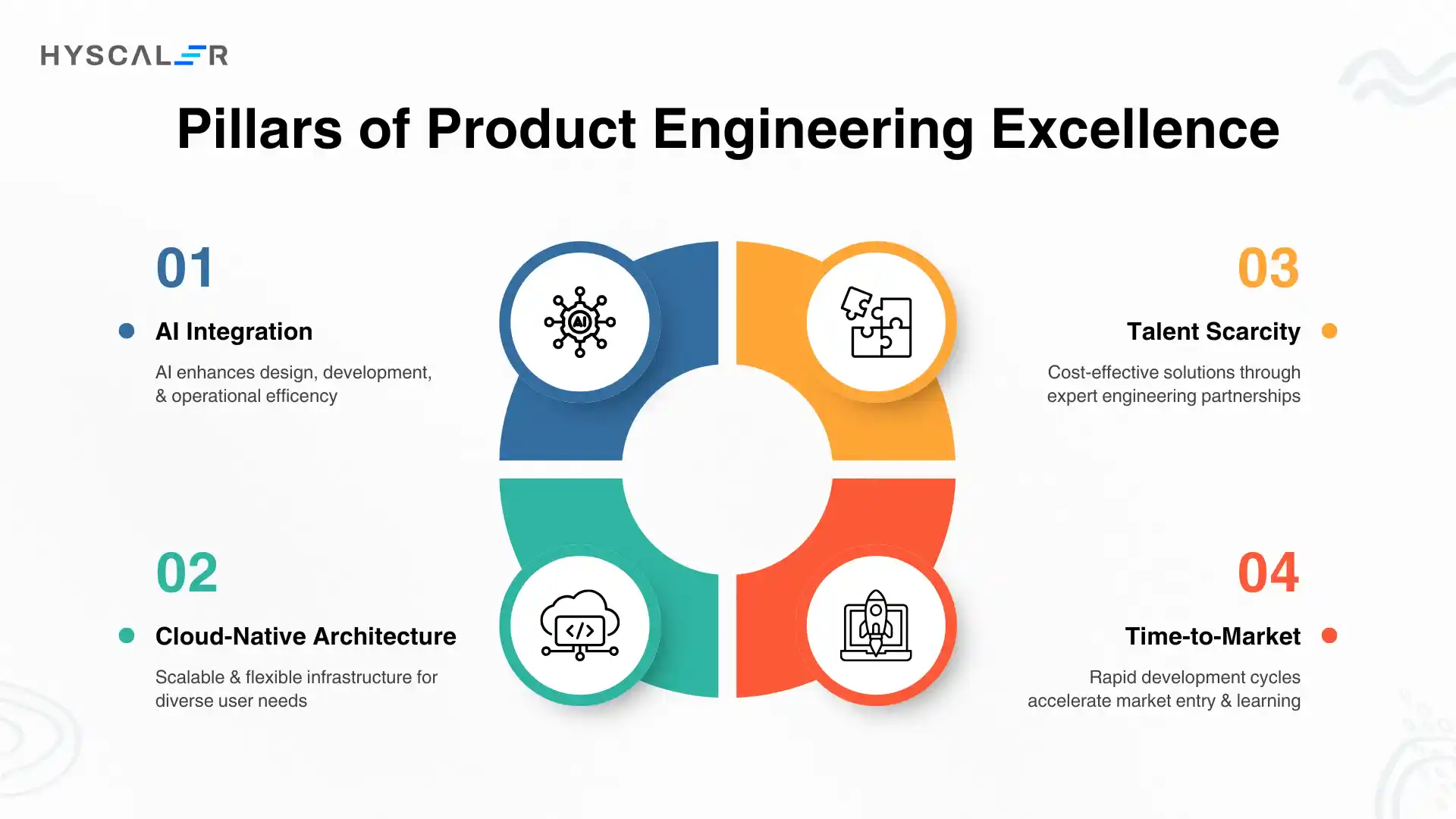
AI Is Reshaping How Products Are Built
This is the biggest shift in product engineering in a generation.
AI isn’t just a feature you add anymore; it’s becoming the backbone of how products are designed, built, and operated.
In 2026, leading engineering teams are deploying:
- AI copilots that write, review, and optimize code in real time
- AI-native applications where intelligence is core to the product, not bolted on
- Agentic workflows where autonomous AI agents handle complex user tasks end-to-end
- Generative AI features embedded directly into product experiences
Teams that haven’t adopted AI-assisted development are already falling behind in speed and cost efficiency.
Time-to-Market Has Become a Competitive Moat
Speed isn’t just nice to have, it’s existential.
The average time from idea to MVP has compressed from 12–18 months to 3–6 months for well-engineered products.
Companies that ship fast, learn fast, and iterate fast are winning markets.
Those that take 18 months to launch are often entering a market that’s already moved on.
Cloud-Native Architecture Is Now the Default
Monolithic architectures are a liability in 2026.
Cloud-native design using microservices, containerization, and serverless compute gives products the elasticity they need to scale from 100 users to 10 million without re-engineering the foundation.
US Engineering Talent Remains Scarce and Expensive
The average US software engineer salary now exceeds $140,000 annually before benefits, equity, and overhead.
Senior cloud and AI engineers are harder to find and even more expensive.
This has driven many US companies to rethink their hiring model entirely, turning to product engineering partners who can deliver dedicated, expert teams at a fraction of the cost of full-time US hiring.
How AI Is Transforming Product Engineering
The current SERP is full of pages that mention AI in passing.
But AI’s impact on product engineering is deep, structural, and already happening.
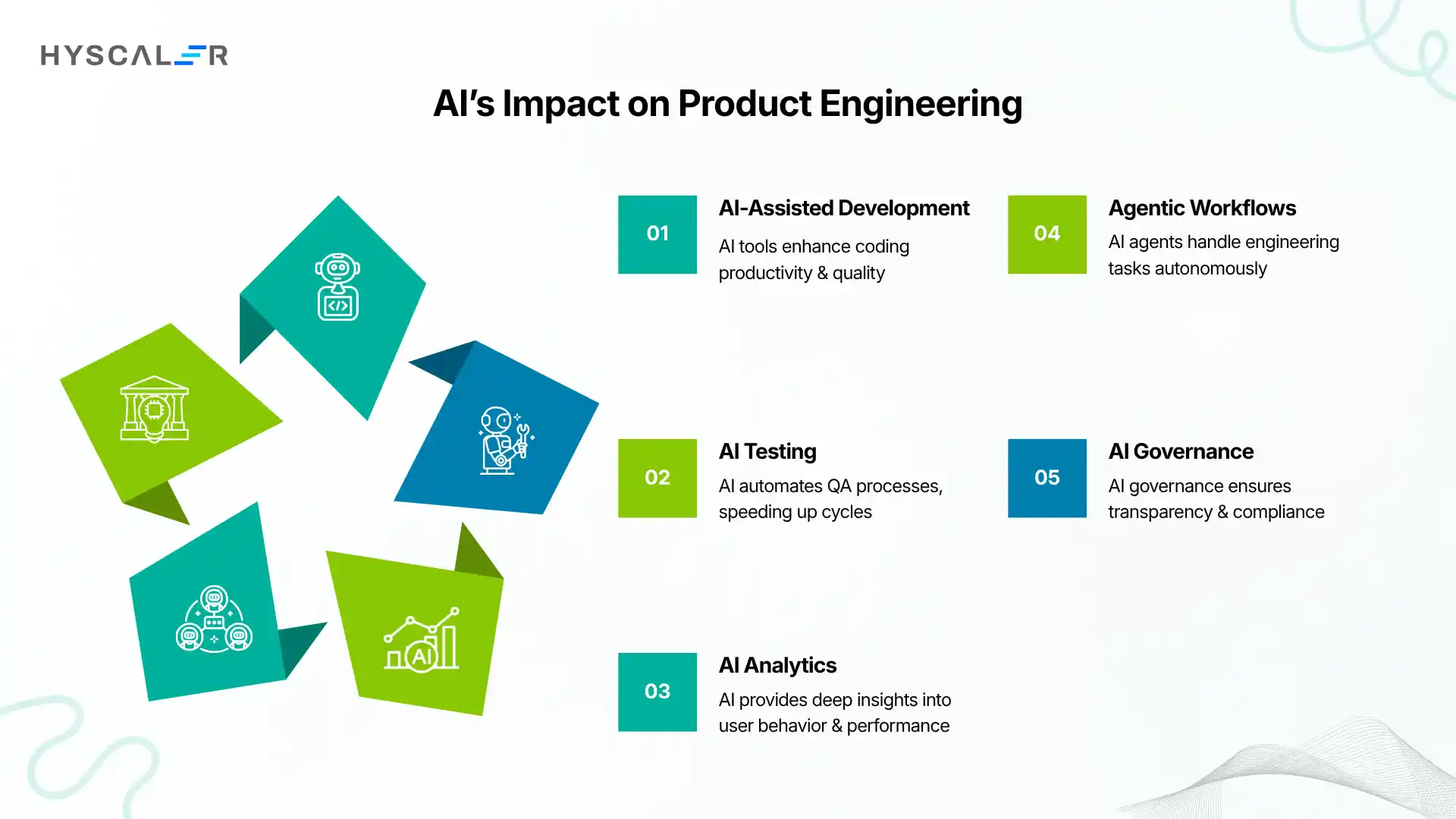
AI-Assisted Development
Tools like GitHub Copilot, Cursor, and Claude Code are now standard in high-performance engineering teams.
Developers using AI assistance report productivity gains of 30–55% on routine coding tasks.
More importantly, AI assistance improves code quality with fewer bugs, better test coverage, and more consistent documentation.
AI Testing and Quality Automation
Traditional QA is manual, slow, and expensive.
AI-driven testing platforms can now auto-generate test cases, detect regressions intelligently, and predict where new code is most likely to introduce bugs.
This compresses QA cycles from weeks to days.
AI-Powered Product Analytics
Modern AI observability tools don’t just tell you when something breaks, they tell you why and what to fix.
AI product analytics can identify feature adoption patterns, user drop-off points, and performance bottlenecks without a team of data analysts.
Agentic Workflows and Autonomous Engineering
The frontier in 2026 is agentic AI systems, where AI agents take on entire engineering sub-tasks with minimal human supervision.
Product teams are using agentic workflows for everything from automated documentation to autonomous infrastructure optimization.
This is no longer experimental; it’s production-ready.
AI Governance and Responsible Engineering
With AI capability comes AI risk.
Leading product engineering companies are building governance frameworks that ensure AI features are transparent, auditable, and compliant with emerging US and EU regulations.
If your engineering partner isn’t thinking about AI governance, that’s a red flag.
Product Engineering Services for Startups vs Enterprises
One of the most common mistakes companies make is working with an engineering partner that specializes in the wrong segment.
A partner excellent at 0-to-1 MVP builds may struggle with enterprise-scale modernization and vice versa.
| Factor | Startups | Enterprises |
|---|---|---|
| Primary Goal | Product-market fit | Scale and modernization |
| Focus | MVP and iteration | Legacy system transformation |
| Budget | $25K–$300K | $250K–$2M+ |
| Team Model | Dedicated squads | Multi-team programs |
| Key Risk | Building the wrong thing | Accumulating technical debt |
| AI Priority | AI-native features | AI integration into legacy systems |
For startups: you need a partner who can help you validate before you build, ship fast, and pivot without blowing up the codebase. Speed and product thinking matter more than process.
For enterprises: you need a partner with the rigor to operate inside existing systems, manage compliance, coordinate across teams, and deliver modernization without disrupting production.
Experience with regulated industries (healthcare, fintech, insurance) is often critical.
Product Engineering Services Cost in the US (2026 Guide)
Cost is the question every buyer has, and almost no competitor answers honestly.
Here’s a realistic breakdown.
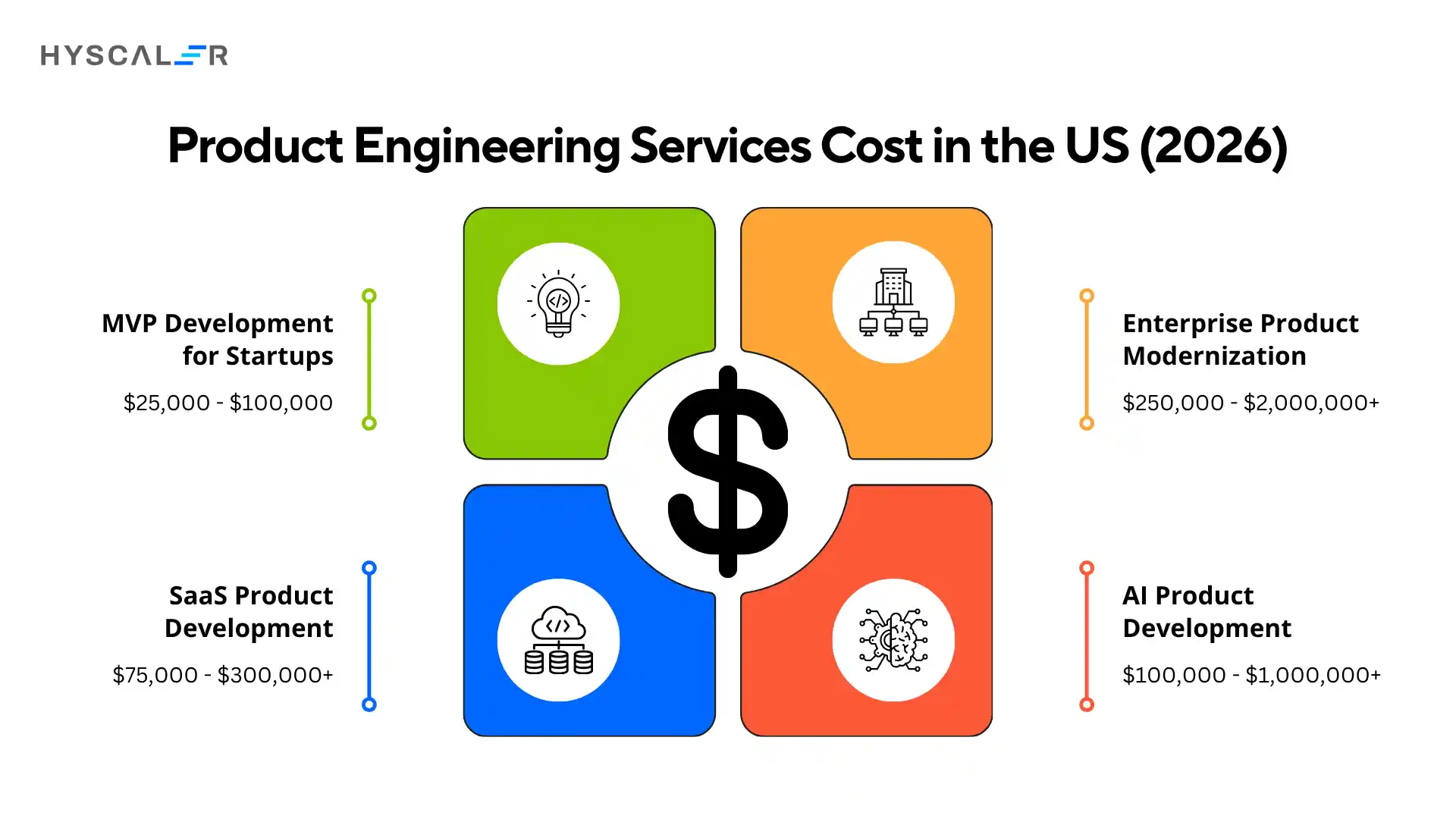
MVP Development for Startups
Estimated cost: $25,000 – $100,000
This covers discovery, basic UX/UI design, core feature development, testing, and initial deployment.
At the low end, you’re looking at a focused 8 -12 week sprint with a small team.
At the high end, a more complex product with integrations, a mobile app, or custom AI features.
SaaS Product Development
Estimated cost: $75,000 – $300,000+
Building a full SaaS product with user authentication, billing, multi-tenancy, dashboards, APIs, and ongoing iteration is a serious investment.
Cloud infrastructure, DevOps setup, and quality engineering add to the cost.
Enterprise Product Modernization
Estimated cost: $250,000 – $2,000,000+
Modernizing a legacy platform is complex work.
It involves architecture assessment, phased migration, data engineering, re-platforming to cloud-native infrastructure, and often the parallel running of old and new systems.
Large programs with compliance requirements (HIPAA, SOC2, PCI-DSS) sit at the higher end.
AI Product Development
Estimated cost: $100,000 – $1,000,000+
AI product development spans a wide range, depending on the depth of AI involvement.
A product with embedded LLM features (like an AI assistant or document processing) starts around $100K.
Building a proprietary AI platform with custom model fine-tuning, agentic workflows, and enterprise-grade governance can reach $1M+.
Key Cost Drivers
The factors that most affect product engineering cost in the US:
- Team size and seniority: Senior architects and AI engineers cost significantly more than generalist developers
- Product complexity: integrations, compliance requirements, and custom AI increase cost
- Engagement model: dedicated product teams typically offer better value than time-and-materials billing for complex builds
- Location of the engineering team: US-based teams cost 3-5x more than equally skilled offshore or nearshore teams
How to Choose the Right Product Engineering Company
The market is crowded.
Here’s what actually separates great product engineering partners from average ones:
1. Do they think in products, not projects?
The best partners ask questions about user outcomes, business metrics, and product strategy, not just feature lists.
If their first conversation is about hours and deliverables, that’s a warning sign.
2. Do they have genuine AI capabilities?
In 2026, any serious product engineering company must have demonstrated AI engineering capabilities, not just “we use ChatGPT.”
Look for experience with LLM integration, agentic systems, AI observability, and responsible AI practices.
3. Can they show you relevant case studies?
A FinTech startup and a healthcare enterprise have very different needs.
Ask for case studies in your industry and at your company’s stage.
Vague portfolio pages aren’t enough.
4. What does their delivery model look like?
Dedicated product teams with a consistent squad (product engineer, designer, QA, DevOps) deliver better results than rotating consultant pools.
Understand who will actually be working on your product day-to-day.
5. How do they handle post-launch?
The product doesn’t stop when the first version ships.
Strong partners have structured post-launch optimization programs, SLAs, and a clear path to ongoing iteration.
6. Are they compliance-aware?
If your product operates in healthcare, fintech, insurance, or any regulated vertical, your engineering partner must understand SOC2, HIPAA, PCI-DSS, and relevant data privacy laws.
Don’t assume, ask directly.
Product Engineering KPIs That Actually Matter
Most engineering teams track vanity metrics.
High-performance product engineering is measured differently.
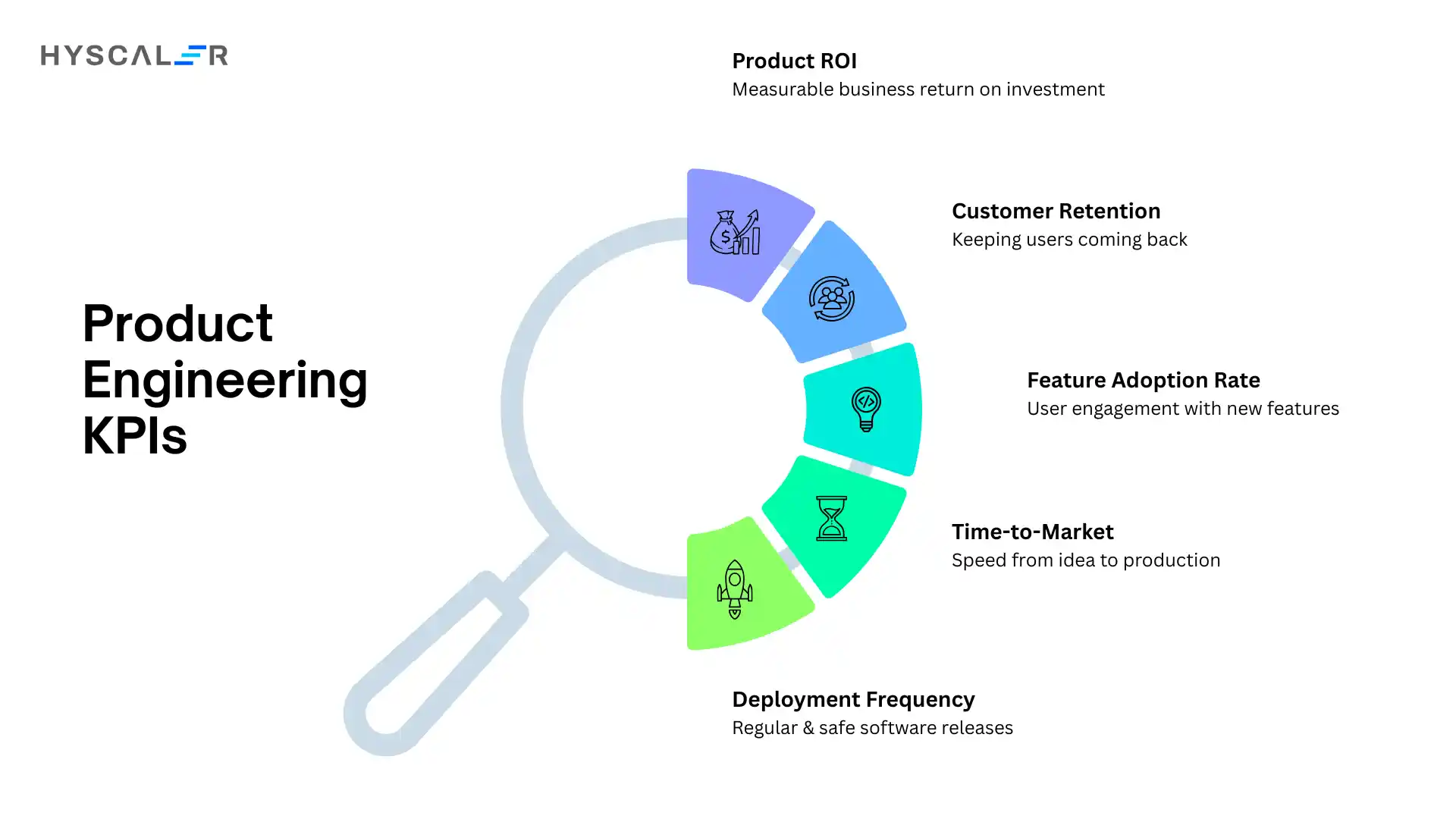
- Deployment Frequency: How often can you safely ship? Daily deployment is a sign of engineering maturity.
- Time-to-Market: from idea to production, how fast is your cycle?
- Feature Adoption Rate: Are users actually using what you build?
- Customer Retention: Does the product keep users coming back?
- System Uptime / Reliability 99.9% uptime is table stakes; leading products target 99.99%
- Engineering Velocity: Are teams getting faster over time, or slowing down?
- Product ROI: What’s the measurable business return on engineering investment?
If your current engineering partner doesn’t track and report these metrics, they’re not thinking about your product’s success; they’re thinking about their own utilization.
Why HyScaler for Product Engineering Services
HyScaler is built on a simple belief: engineering only matters if it drives product outcomes.
What that means in practice:
End-to-End Product Ownership: from discovery workshops to post-launch optimization, HyScaler’s teams own the full product lifecycle. You get one partner, not a chain of vendors.
AI-First Engineering: HyScaler’s engineering practice is built around AI-native development. That means AI-assisted coding, intelligent QA automation, LLM integration, and agentic workflow design not as add-ons, but as standard practice.
Cloud-Native by Default: Every product HyScaler builds is designed for cloud-native scalability from day one. AWS, Azure, and GCP architectures, microservices design, and DevSecOps are baked into every engagement.
Startup Speed, Enterprise Rigor: HyScaler has worked across the spectrum, from 8-week MVPs for funded startups to multi-year modernization programs for enterprise clients. The team adapts its model to your stage and goals.
Transparent Delivery: no black boxes. HyScaler clients have full visibility into engineering velocity, sprint outcomes, and product metrics throughout the engagement.
Product Engineering Trends to Watch in 2026
The companies winning in product engineering right now are ahead of these shifts:
- AI-Native Products – built with intelligence at the core, not layered on top
- Agentic AI Systems – autonomous agents handling complex workflows inside products
- Platform Engineering – internal developer platforms that improve engineering velocity at scale
- Edge AI – moving AI inference closer to users for speed and data privacy
- Hyperautomation – automating everything from testing to deployment to operations
- Multi-Cloud Architectures – resilience and flexibility across AWS, Azure, and GCP
- Digital Twins – virtual replicas of physical systems for manufacturing, logistics, and healthcare
FAQ
What are product engineering services?
Product engineering services cover the full lifecycle of building a digital product from discovery and design through development, deployment, and ongoing optimization. Unlike traditional software development, product engineering is outcome-focused and continuous, not project-based.
How much do product engineering services cost in the US?
Costs range from $25,000 for a basic startup MVP to $2M+ for enterprise modernization programs. AI product development typically falls in the $100K–$1M range, depending on complexity. The biggest cost drivers are team seniority, product complexity, and the engagement model.
What’s the difference between software development and product engineering?
Software development is typically project-scoped with fixed deliverables. Product engineering is ongoing, outcome-focused, and tied to business metrics like user retention and product ROI. Product engineering teams own the product, and software development teams build to spec.
Should startups outsource product engineering?
For most US startups, yes, especially in the early stages. Building an in-house engineering team is expensive, slow, and risky if the product hasn’t found market fit yet. A dedicated product engineering partner lets you move fast, validate quickly, and scale when you’re ready.
How long does product development take?
A basic MVP takes 8–16 weeks with a focused team. A full SaaS product takes 4–9 months. Enterprise modernization programs typically run 12–36 months, depending on scope.
What industries use product engineering services?
Healthcare, FinTech, retail, manufacturing, logistics, EdTech, SaaS, and insurance are the most common verticals. Any industry building digital products benefits from dedicated product engineering expertise.
What are AI-powered product engineering services?
These are engineering engagements where AI is embedded at every layer: AI-assisted development, intelligent QA, LLM-powered product features, agentic workflows, and AI observability. In 2026, AI-powered product engineering will become the standard, not a premium.
Ready to build something that lasts? Talk to HyScaler’s product engineering team about your next product.