
Table of Contents
Every enterprise wants AI in production, but far fewer have the data foundation to support it. Models earn the headlines. The quieter work of collecting, cleaning, moving, and governing data decides whether an initiative scales or stalls. That work is called AI data engineering.
This guide covers what it is, how it differs from traditional approaches, the components of an AI-ready stack, and a maturity model you can use to judge your AI readiness.
Quick Overview: AI Data Engineering at a Glance
Definition: AI data engineering is the practice of designing, building, and operating the pipelines, storage, governance, and serving layers that make data reliable, timely, and usable for machine learning and generative AI systems.
Key takeaways:
- AI initiatives frequently stall at the data layer, not the model layer, which is why AI data engineering matters as much as model choice.
- Traditional pipelines feed dashboards. AI-ready data pipelines feed models that learn, retrieve, and act.
- An AI-ready stack adds unstructured data handling, feature and vector stores, and continuous quality monitoring.
- Governance and lineage are requirements for enterprise AI, not optional extras.
- A staged maturity model helps teams invest in the right order.
Who it’s for: CTOs, data leaders, and AI program owners who are planning or rescuing AI initiatives.
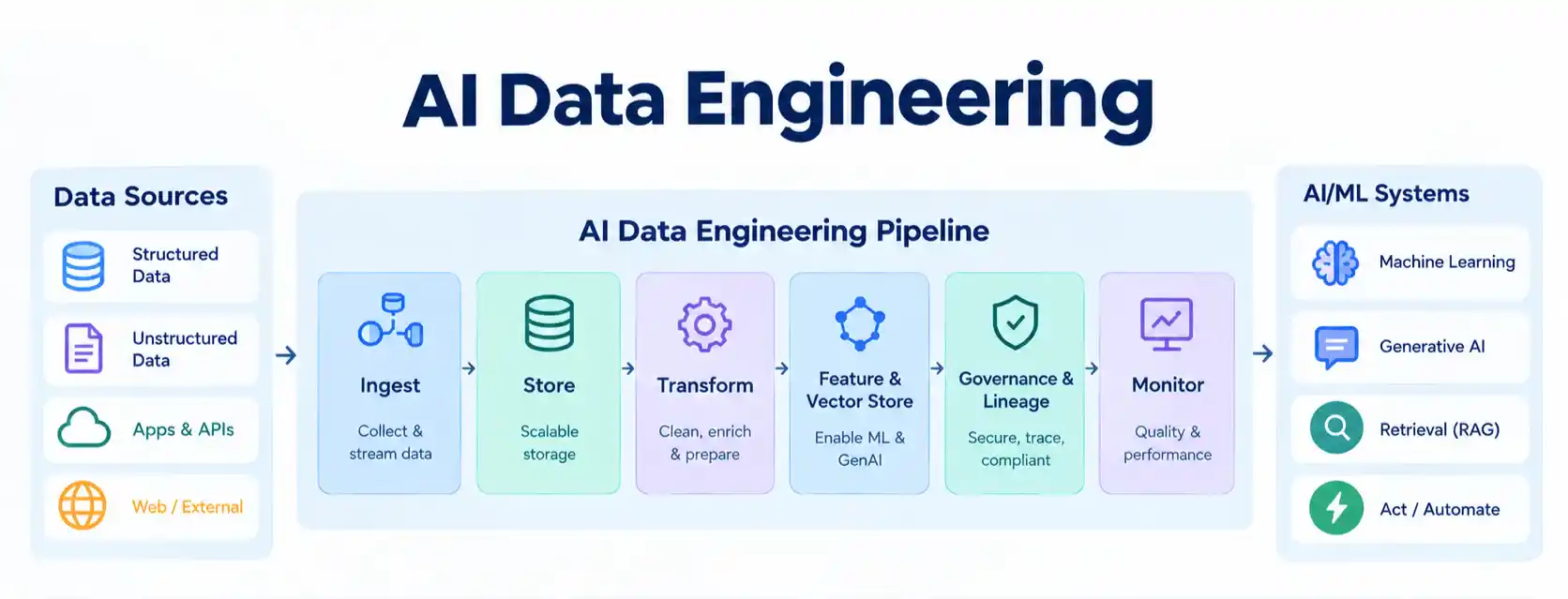
Core components: ingestion, storage, transformation, orchestration, feature and vector layer, governance, and observability.
| Dimension | Traditional Data Engineering | Data Engineering for AI |
|---|---|---|
| Primary goal | Reporting and analytics | Training, retrieval, and automated decisions |
| Data types | Mostly structured | Structured, semi-structured, and unstructured |
| Main consumers | Analysts and BI tools | Models, agents, and applications |
| Freshness | Scheduled batches | Batch, streaming, and real-time serving |
| Quality focus | Accuracy of reports | Accuracy, bias, drift, and lineage |
What Is AI Data Engineering?
It is the discipline of preparing and delivering AI-ready data so AI systems can train, retrieve, and make decisions reliably. A traditional data engineer builds pipelines for analysts. An AI data engineer builds AI data pipelines for models, which are far less forgiving of stale, biased, or poorly labeled inputs.
The scope is wider than classic pipelines. It includes handling unstructured data such as documents, images, and logs; generating embeddings for vector search; serving features with low latency; and tracking lineage so every prediction can be traced back to its source data. It also supports MLOps by keeping training and serving data consistent.
Data engineer vs. AI engineer is a common point of confusion. AI engineers focus on models and applications, while AI data engineering ensures those models receive trustworthy inputs in the first place. Think of AI data engineering as the supply chain behind every AI system: if the supply is unreliable, the product will be too.
Why AI Projects Fail at the Data Layer
AI project failure usually traces back to unprepared data, not a weak model. The most common causes are:
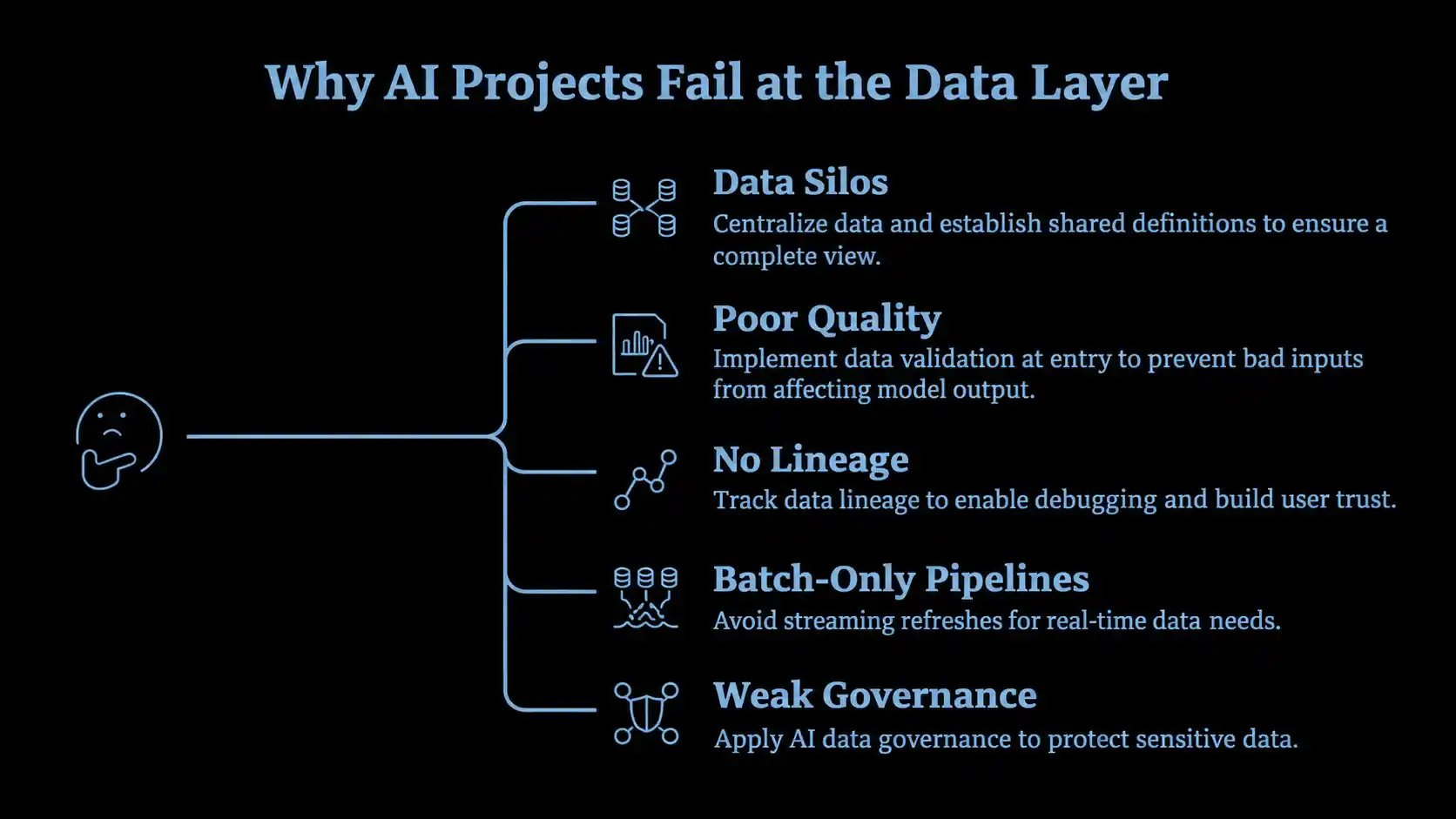
1. Data Silos: Nobody sees the full picture
- What it is: Critical data sits in disconnected systems with no shared definitions.
- How it shows up: Two teams report different numbers for the same metric, and every AI use case starts with weeks of manual data hunting.
- Why it hurts AI: Models learn from partial views, so predictions miss context.
- The fix: Centralize critical sources and agree on shared definitions.
2. Poor Quality: Bad inputs, confident outputs
- What it is: Duplicates, missing values, and inconsistent formats degrade model output, which makes data quality for AI a first-order concern.
- How it shows up: The same customer appears three times, dates arrive in mixed formats, and key fields are blank.
- Why it hurts AI: Models do not flag bad inputs. They learn from them and answer with full confidence.
- The fix: Validate data at the point of entry, with schema checks and anomaly alerts.
3. No Lineage: Nobody can explain the answer
- What it is: Teams cannot explain where a training record or retrieved document came from.
- How it shows up: A model gives a questionable answer, and no one can trace it back to a source.
- Why it hurts AI: Debugging, audits, and user trust all stall without a traceable path.
- The fix: Track data lineage from source system to transformation to prediction.
4. Batch-Only Pipelines: Answers built on yesterday’s data
- What it is: Models need fresh data, but pipelines refresh overnight.
- How it shows up: Assistants quote outdated policies, and fraud or pricing decisions use old signals.
- Why it hurts AI: Stale data produces answers that were right once and are wrong now.
- The fix: Add streaming or event-triggered refreshes where freshness matters, and keep batch where it does not.
5. Weak Governance: Sensitive data in the wrong hands
- What it is: Sensitive data reaches models without proper access controls.
- How it shows up: An assistant surfaces confidential records to people who should not see them.
- Why it hurts AI: Privacy, compliance, and security risks can stop a project that otherwise works.
- The fix: Apply AI data governance: access control, masking, and permission-aware retrieval before data reaches a model.
Each is solvable, but only if you treat it as an engineering problem from day one. This is where AI data engineering earns its place in an AI program.
Core Components of an AI Data Engineering Stack
An AI-ready stack has seven layers, and each answers one question about your data. Skip a layer, and the gap shows up later as stale answers, failed audits, or models nobody trusts. Together they form the AI data infrastructure that AI data engineering teams run.
1. Ingestion: How does data get in?
- What it does: Data ingestion moves data from source systems into one central platform.
- Key tasks: Batch loads (ETL and ELT) from databases and files, API and SaaS connectors, change data capture, and event streaming.
- AI-specific need: Pulls in unstructured sources such as documents, tickets, emails, and logs, not only tables.
- Example tools: Airbyte, Fivetran, Debezium, Apache Kafka.
2. Storage: Where does data live?
- What it does: Holds raw and refined data in one governed place.
- Key tasks: Lakehouse tables, object storage for documents and media, and bronze/silver/gold layering.
- AI-specific need: Structured tables and raw files sit side by side, with versioned datasets so training runs are reproducible.
- Example tools: Databricks, Snowflake, Delta Lake, Apache Iceberg.
3. Transformation: How does raw data become usable?
- What it does: Cleans and shapes data for models and retrieval.
- Key tasks: Deduplication, standardization, joins, and validation rules.
- AI-specific need: Chunking documents, attaching metadata such as source and date, and generating embeddings.
- Example tools: dbt, Apache Spark.
4. Orchestration: What runs, in what order?
- What it does: Data orchestration schedules and monitors every workflow.
- Key tasks: Dependency management, retries, alerts, and backfills.
- AI-specific need: Triggers embedding refreshes and retraining when upstream data changes.
- Example tools: Apache Airflow, Dagster, Prefect.
5. Feature and Vector Layer: How do models get their inputs?
- What it does: Serves consistent inputs for training, inference, and retrieval through a feature store and a vector database.
- Key tasks: Feature definitions, online and offline serving, and vector indexing.
- AI-specific need: Hybrid search (semantic search plus keyword search) and reranking, so the right chunks reach the model.
- Example tools: Feast, Tecton, Pinecone, Qdrant, pgvector.
6. Governance: Who can use what, and can we prove it?
- What it does: Controls access, trust, and traceability.
- Key tasks: Data catalog, role-based access, PII masking, and lineage from source to prediction.
- AI-specific need: Permission-aware retrieval and source-trust rules that decide which content is preferred.
- Example tools: OpenMetadata, Collibra, Unity Catalog.
7. Observability: Is the data still healthy?
- What it does: Data observability catches problems before models do.
- Key tasks: Freshness, volume, and schema checks, plus anomaly alerts.
- AI-specific need: Tracks drift and stale embeddings.
- Example tools: Great Expectations, Soda, Monte Carlo.
AI Data Engineering for Different AI Workloads
Different AI workloads place different demands on the same foundation. Building AI-ready data pipelines means matching the pattern to the workload instead of forcing one design on all of them.
- Classical machine learning: data engineering for machine learning needs labeled, versioned datasets and reproducible features for every machine learning pipeline.
- Generative AI and RAG: data engineering for generative AI needs clean unstructured content, sensible chunking, rich metadata, and fresh embeddings. Every RAG pipeline (retrieval-augmented generation) and LLM data pipeline depends on this preparation, and retrieval quality improves with vector search, reranking, and regular embedding refresh.
- Agentic AI: needs reliable, permission-aware access to live systems, because agentic AI acts on the data it reads.
- Real-time AI: needs a real-time data pipeline with streaming and low-latency serving for fraud detection, recommendations, and dynamic pricing.
Data Quality, Governance, and Compliance
Trustworthy AI starts with trustworthy data. In AI data engineering, quality has to be enforced where data enters the platform through validation rules, schema checks, and anomaly detection. Waiting until a model misbehaves is far more expensive.
Lineage is the second pillar. When a model produces a questionable output, teams need to trace it back through features, transformations, and source systems. Privacy controls matter just as much: PII masking, honoring consent, and applying retention rules.
Regulation is also raising expectations. Frameworks such as the EU AI Act set data requirements for governance and documentation on high-risk systems. Good data governance for AI treats data compliance as built-in pipeline steps instead of after-the-fact audits, and strong AI data engineering makes that possible.
Architecture Patterns That Work
No single architecture fits every organization, but four patterns appear repeatedly. Each solves a different problem, and most AI data engineering teams combine them over time.
1. Lakehouse: One platform for analytics and AI
- What it is: Lakehouse architecture is unified storage that serves both analytics and AI workloads.
- Best for: Teams that run reports, machine learning, and document-based AI on the same data.
- How it works: Open table formats put structured tables and raw files on one governed platform.
- Trade-off: It needs good governance and table maintenance, or it can turn into a messy lake.
2. Medallion Layers: Quality added in stages
- What it is: Medallion architecture refines raw data in stages, with each layer adding quality and structure.
- How it works: Bronze is raw data as it arrived, silver is cleaned, deduplicated, and validated, and gold is business-ready data for models and reports.
- Best for: Teams that need clear quality checkpoints and easy reprocessing.
- Trade-off: More layers mean more storage and pipeline steps to maintain.
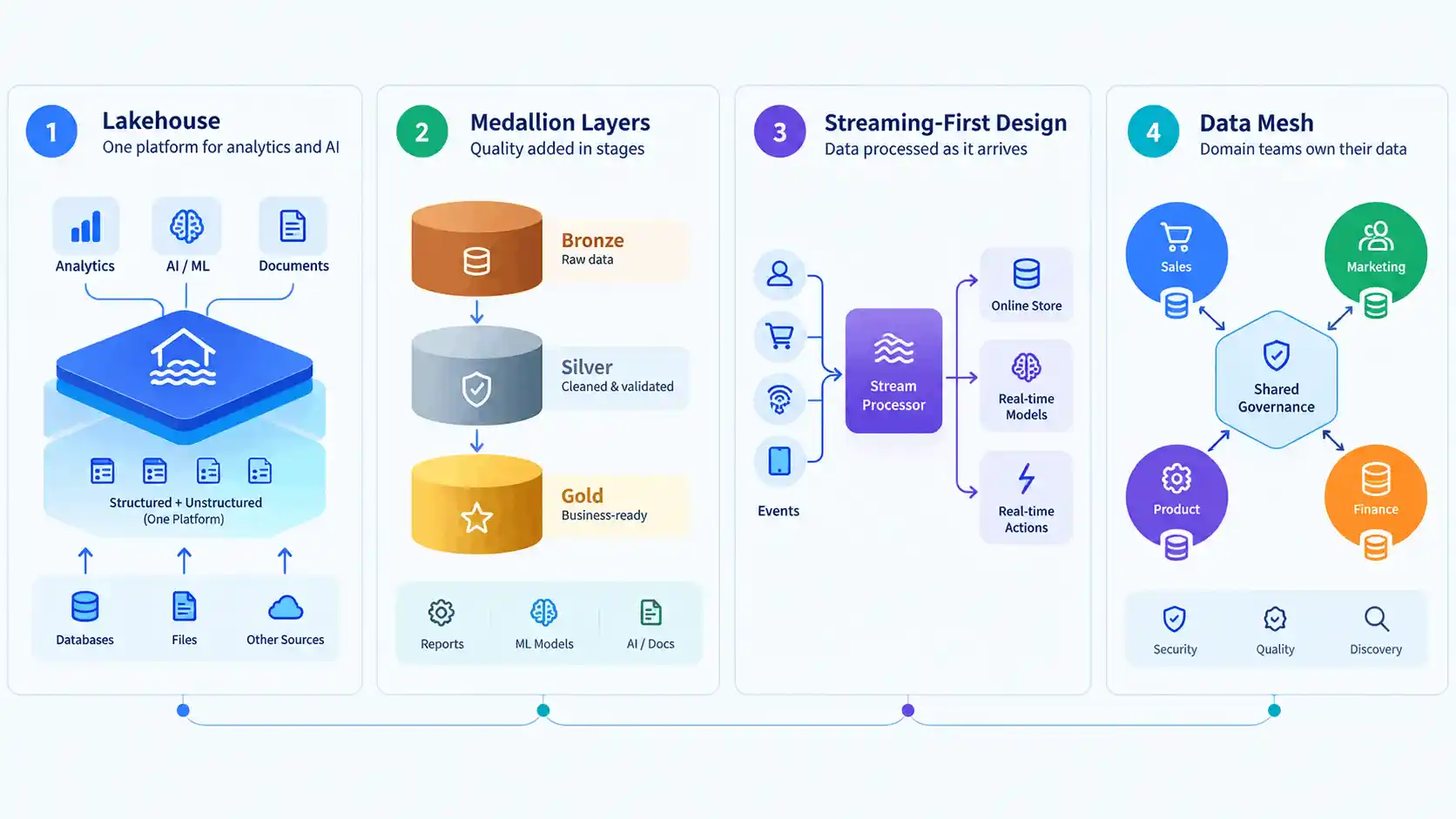
3. Streaming-First Design: Data processed as it arrives
- What it is: Event-driven architecture, also called streaming architecture, for real-time use cases.
- Best for: Fraud detection, recommendations, and dynamic pricing.
- How it works: Events flow through a stream processor such as Apache Flink into online stores, so models see current data within seconds.
- Trade-off: It is more complex and costly to run than batch, and it must handle late or out-of-order events.
4. Data Mesh: Domain teams own their data
- What it is: Domain teams own their data as products under shared governance.
- Best for: Large organizations with many data-producing teams.
- How it works: Each domain publishes reliable, documented data products, while central standards cover security, quality, and discovery.
- Trade-off: It needs organizational maturity and strong shared governance. Without them, ownership turns into fragmentation.
Many teams start with a lakehouse and medallion layers, then add streaming and mesh principles as they scale.
The AI Data Readiness Maturity Model
Use this five-stage data maturity model as an AI readiness assessment. It works as a data readiness framework for judging your AI data readiness and choosing what to fix next.
| Stage | Name | What It Looks Like | Next Step |
|---|---|---|---|
| 1 | Ad hoc | Siloed data, manual extracts, unclear ownership | Centralize critical sources |
| 2 | Managed | Central storage, scheduled pipelines, basic quality checks | Standardize definitions and add monitoring |
| 3 | Governed | Catalog, access control, lineage, data contracts | Add feature and vector layers |
| 4 | AI-ready | Batch and streaming, feature and vector serving, drift monitoring | Automate quality and feedback loops |
| 5 | Optimized | Self-service data products, continuous feedback from models to data | Refine cost, speed, and reuse |
If your AI pilots keep stalling, you likely sit at stage one or two. Moving up one stage at a time makes AI data engineering investments more predictable than jumping straight to advanced tooling.
Build, Buy, or Partner?
Most organizations weigh three routes:
- Build in-house: best when you have a mature data team and want a long-term core capability, though hiring takes time.
- Buy platforms: speeds up tooling, but you still need people to design, connect, and operate the pipelines.
- Partner with specialists: best when you need speed or niche skills such as streaming, vector search, or governance design.
Many organizations combine all three. A data engineering partner designs the foundation and accelerates delivery, then internal teams take ownership over time. Data engineering outsourcing works best when the handover is planned from the start. When evaluating an AI data engineering partner, ask about their delivery process, cloud experience, governance approach, and how they hand over knowledge to your team.
How HyScaler Delivers AI Data Engineering
HyScaler helps organizations build the data foundation their AI ambitions depend on. HyScaler’s AI data engineering services and AI data engineering consulting follow five steps:
- Assess: evaluate current data sources, quality, and governance against the maturity model.
- Design: define the target architecture, tooling, and priorities around your highest-value use cases.
- Build: develop ingestion, transformation, and serving pipelines, including feature and vector layers.
- Govern: set up cataloging, access control, lineage, and compliance checks.
- Operate and enable: add observability and transfer knowledge so your team can run and extend the platform.
Conclusion: Build the Data Foundation Before You Scale the Model
AI succeeds or fails on the strength of its data. Models get the attention, but most AI project failures trace back to silos, poor quality, missing lineage, stale pipelines, and weak governance. These are engineering problems with a clear order of attack: assess where you stand, match the pipeline to the workload, and strengthen one maturity stage at a time. Retrieval deserves special attention, because what a model never sees, it cannot use.
Organizations that invest in AI data engineering early spend less time rescuing failed pilots and more time shipping systems people trust. If you are unsure where to begin, start with an AI data engineering readiness assessment, then build the data foundation for AI in stages so every new AI use case lands on solid ground.
Frequently Asked Questions
What is AI data engineering?
It is the practice of building the pipelines, storage, and governance that deliver reliable, timely data to AI systems.
How is AI data engineering different from traditional data engineering?
Traditional work serves reporting. This work serves models, adding unstructured data, embeddings, feature serving, and drift monitoring.
What is an AI-ready data pipeline?
It is a pipeline that ingests, cleans, validates, and serves data to models with quality checks, lineage, and the right freshness.
Do I need a data pipeline for RAG?
Yes. Retrieval quality depends on ingestion, chunking, embedding refresh, and permission-aware indexing.
What is the difference between a data lake and a lakehouse?
A lakehouse adds warehouse-style reliability and governance to lake storage, which suits mixed analytics and AI workloads.
What do AI data engineering services include?
They typically include assessments, architecture design, pipeline development, governance setup, observability, and team enablement.
How do you prepare enterprise data for generative AI?
Consolidate sources, clean and chunk documents, add metadata, generate embeddings, and apply access controls before retrieval.