
Table of Contents
An AI model can score impressively on a benchmark and still fail inside a real enterprise workflow.
It might retrieve the wrong document, call the wrong tool, expose sensitive data, or cost more per task than the process it replaced.
Enterprise AI evaluation is how organizations find this out before customers do.
This guide explains what to evaluate, which metrics matter, how to build an evaluation framework, and how to decide whether an AI system is ready for production.
What Is Enterprise AI Evaluation?
Enterprise AI evaluation is the structured testing of an AI model, application, or agent against a specific business use case.
It measures quality, safety, reliability, cost, and business outcomes to decide whether the system should be deployed, modified, piloted, or rejected.
It is not the same as comparing public benchmark scores.
Benchmarks tell you what a model can do in general.
Enterprise evaluation tells you whether your system can be trusted with your work.
Why Enterprise AI Evaluation Matters
Benchmark performance doesn’t equal production performance: Public benchmarks use standard datasets in controlled conditions. Your workflows involve proprietary data, ambiguous requests, permissions, and integrations that no benchmark captures.
Failures carry business consequences: AI errors can affect revenue, customer trust, and regulatory compliance. A customer-support assistant may answer accurately and still be unfit for production if it exposes customer data, makes unauthorized account changes, or costs more than the human workflow it replaces.
AI systems change after launch: Model updates, prompt edits, new data, and changed tools can all shift behavior. A system that passed evaluation in March may behave differently in June.
Evaluation creates evidence: Leaders approving an AI deployment need more than a demo. Evaluation gives them documented results to justify going live, holding back, or scaling up.
What Should Enterprises Evaluate?
Strong evaluation looks at the whole system across seven dimensions, plus the business impact that ties them together.
| Evaluation area | What to measure | Example metric |
|---|---|---|
| Accuracy | Correctness of outputs | Correct answer rate |
| Groundedness | Whether claims are supported by sources | Citation/grounding score |
| Task success | Whether the workflow achieves its goal | Resolution rate |
| Safety & security | Harmful or unauthorized behavior | Policy violations |
| Reliability | Consistency and failure recovery | Failure/retry rate |
| Performance | Speed and availability | p95 latency |
| Economics | Cost relative to value | Cost per successful task |
The eighth layer is business impact: time saved, cost reduced, revenue influenced, customer satisfaction, and the burden on human reviewers. An AI system that is technically impressive but no better than the existing workflow is not a success.
Enterprise AI Evaluation vs. AI Benchmarking
| Factor | AI benchmarking | Enterprise AI evaluation |
|---|---|---|
| Purpose | Compare general capability | Determine production suitability |
| Data | Standard public datasets | Business-specific data |
| Environment | Controlled | Realistic enterprise environment |
| Metrics | Benchmark score | Quality, risk, cost, and business metrics |
| Security | Usually limited | Core consideration |
| Business ROI | Usually absent | Explicitly measured |
| Production monitoring | No | Yes |
| Outcome | Model ranking | Deploy, modify, pilot, or reject |
The takeaway: benchmarks help shortlist models. Enterprise evaluation decides whether the system deserves trust. Snowflake draws the same line between evaluating an underlying model and evaluating the complete application built on it.
How to Build an Enterprise AI Evaluation Framework
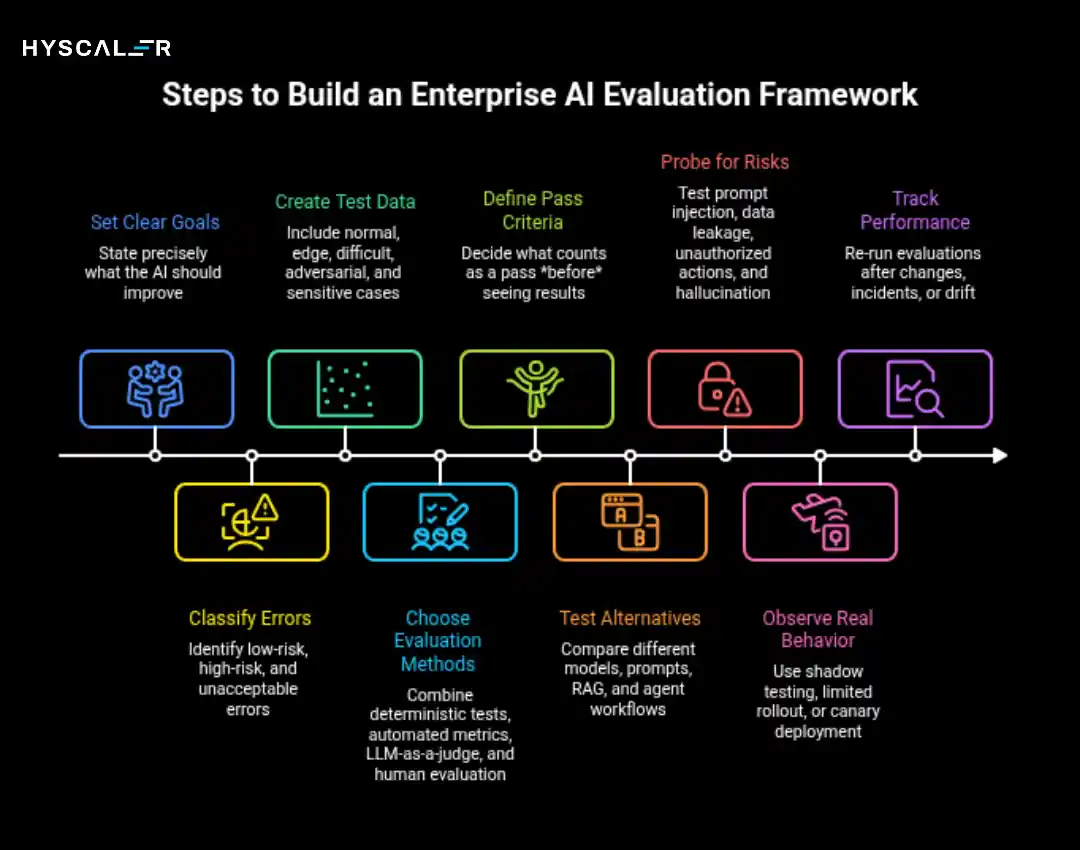
1. Define the business objective
State precisely what the AI should improve.
For example: reduce support resolution time from 12 minutes to 5 minutes without increasing escalations or error rates.
Without a measurable objective, you cannot define success.
2. Define acceptable failure
Classify errors before testing.
Identify low-risk errors, high-risk errors, unacceptable actions, and the situations that must escalate to a human.
The acceptable threshold depends on the business impact of failure.
A marketing-copy assistant and a system approving financial transactions should not share the same tolerance.
3. Build a representative evaluation dataset
Include normal cases, edge cases, difficult cases, adversarial inputs, historical failures, and sensitive-data scenarios.
There is no universal number of test cases.
Narrow pilots may begin with dozens or hundreds, while higher-risk or highly variable workloads need far larger suites.
4. Select metrics and scoring methods
Combine deterministic tests, automated metrics, LLM-as-a-judge scoring, and human evaluation.
No single method covers everything.
5. Set release thresholds before testing
Decide what counts as a pass before you see results.
Thresholds set afterward tend to bend toward the outcome people were hoping for.
6. Compare models and configurations
Test Model A against Model B, different prompt versions, RAG configurations, and agent workflows.
Record cost and latency trade-offs alongside quality.
7. Test safety and failure modes
Probe prompt injection, data leakage, unauthorized actions, incorrect tool calls, hallucination, and failure recovery.
These are the failures that become incidents.
8. Run a controlled production pilot
Use shadow testing, limited rollout, human-in-the-loop review, or canary deployment to observe real behavior with limited exposure.
9. Monitor and re-evaluate
Re-run evaluations after model, prompt, data, or tool changes, after major incidents, and when production drift appears.
Microsoft similarly recommends evaluation during development, before deployment, and in production to catch regressions and drift.
Enterprise AI Evaluation Methods
| Method | Best for | Limitation |
|---|---|---|
| Automated tests | Deterministic requirements | Weak on subjective quality |
| Benchmarking | Initial model comparison | Poor proxy for proprietary workflows |
| LLM-as-a-judge | Scalable semantic evaluation | Needs validation and calibration |
| Human evaluation | Nuance and high-risk decisions | Slower and more expensive |
| Production evaluation | Real-world behavior | Requires monitoring infrastructure |
How to Evaluate RAG and AI Agents
RAG systems
Measure the components separately rather than collapsing them into one score:
- Retrieval quality
- Context relevance
- Groundedness
- Citation accuracy
- Answer correctness
A wrong answer may come from poor retrieval, not the model.
A single blended score hides which part needs fixing.
AI agents
Agents act, so evaluating a single response is not enough.
Evaluate the full workflow:
- Task completion
- Tool selection and tool-call correctness
- Planning and execution
- Permission handling
- Recovery from failure
- Multi-step consistency
- Cost per completed task
The field is moving from judging individual outputs toward trace and workflow evaluation, which examines every step an agent took to reach its result.
Enterprise AI Evaluation Scorecard
Use this template to summarize results for decision-makers:
| Category | Metric | Target |
|---|---|---|
| Accuracy | Task success | Defined baseline |
| Grounding | Supported claims | Defined threshold |
| Safety | Critical violations | 0 |
| Reliability | Failed workflows | Defined threshold |
| Latency | p95 response time | SLA |
| Cost | Cost per successful task | Budget |
| Business | Time/cost saved | Baseline |
Set targets according to use-case risk and your current baseline, not a number copied from a generic benchmark.
Common Enterprise AI Evaluation Mistakes
- Relying on public benchmarks alone. They rarely reflect your data or workflows.
- Testing only happy-path prompts. Production users will not be so cooperative.
- Measuring accuracy but ignoring cost. A correct answer that is too expensive is still a failure.
- Evaluating the model instead of the system. Retrieval, tools, and orchestration fail too.
- Using LLM-as-a-judge without calibration. Judge models need validating against human ratings.
- Skipping human review for high-risk use cases.
- Evaluating once and never again.
- Not connecting results to business outcomes.
When Is an AI System Ready for Production?
Use a simple three-state decision framework.
GO
- Meets the defined quality threshold
- No critical safety failures
- Meets latency and cost requirements
- Business case validated against the baseline
- Monitoring in place
CONDITIONAL GO
- Minor known failures with a clear remediation plan
- Human review in place for risky cases
- Limited rollout rather than full launch
NO-GO
- Critical security failures
- Unacceptable hallucination or error rates
- Uncontrolled or unauthorized actions
- Costs exceed business value
- No reliable way to monitor behavior
Enterprise AI Evaluation Best Practices
- Evaluate the business task, not just the model.
- Use real enterprise scenarios.
- Test normal, edge, and adversarial cases.
- Combine automated and human evaluation.
- Set thresholds before testing.
- Measure cost and latency alongside quality.
- Evaluate RAG and agent components separately.
- Version your regression datasets.
- Tie evaluation results to deployment gates.
- Keep evaluating after launch.
Move from AI Demo to Production with Confidence
Evaluation is what separates an impressive AI demo from a system your business can rely on.
It is also not a one-time exercise. It is part of running AI in production, alongside monitoring, guardrails, and cost control.
HyScaler’s AI services and solutions cover LLM integration, RAG, agents, and MLOps, with evaluations and monitoring built in after launch.
If you are preparing an AI model, RAG application, or agent for production, our team can help you build the evaluation framework, set the release thresholds, and measure results against your baseline.
Book a consultation with HyScaler to assess whether your AI system is ready to ship.
FAQs
What is enterprise AI evaluation?
It is the structured testing of an AI model, application, or agent against a specific business use case. It measures accuracy, safety, reliability, cost, and business impact to decide whether the system is ready to deploy, needs changes, or should be rejected.
How is enterprise AI evaluation different from AI benchmarking?
Benchmarking compares general model capability on standard datasets. Enterprise evaluation tests the complete system on business-specific data and conditions, including security, cost, and ROI, to determine whether it is suitable for production use.
What metrics should enterprises use to evaluate AI?
Common metrics cover accuracy, groundedness, task success, safety violations, reliability, p95 latency, and cost per successful task. Add business metrics such as time saved, human review burden, and resolution rate, measured against your existing workflow.
How do you evaluate an AI agent?
Evaluate the whole workflow, not just the final answer. Measure task completion, tool selection, tool-call correctness, permission handling, failure recovery, multi-step consistency, and cost per completed task, ideally by reviewing full execution traces.
How often should enterprise AI systems be evaluated?
Continuously. Evaluate during development and before deployment, then re-run evaluations after any change to the model, prompts, data, or tools, after incidents, and on a regular schedule to catch drift.
How many test cases are needed for enterprise AI evaluation?
There is no universal number. It depends on risk, variability, and workload. Narrow pilots may start with dozens or hundreds of cases, while high-stakes or highly varied systems need much larger suites covering edge and adversarial scenarios.