

Table of Contents
Software in 2026 rarely fails because one function is broken.
It fails because dozens of services, APIs, AI models, databases, and cloud platforms interact in ways nobody predicted.
AI-generated code ships faster than teams can review it, applications lean on microservices, serverless functions, and event-driven pipelines, and continuous deployment means integration tests run dozens or hundreds of times a day.
Integration testing has become the backbone of reliable software delivery, and it now sits inside Quality Engineering rather than as a QA afterthought.
What Is Integration Testing?
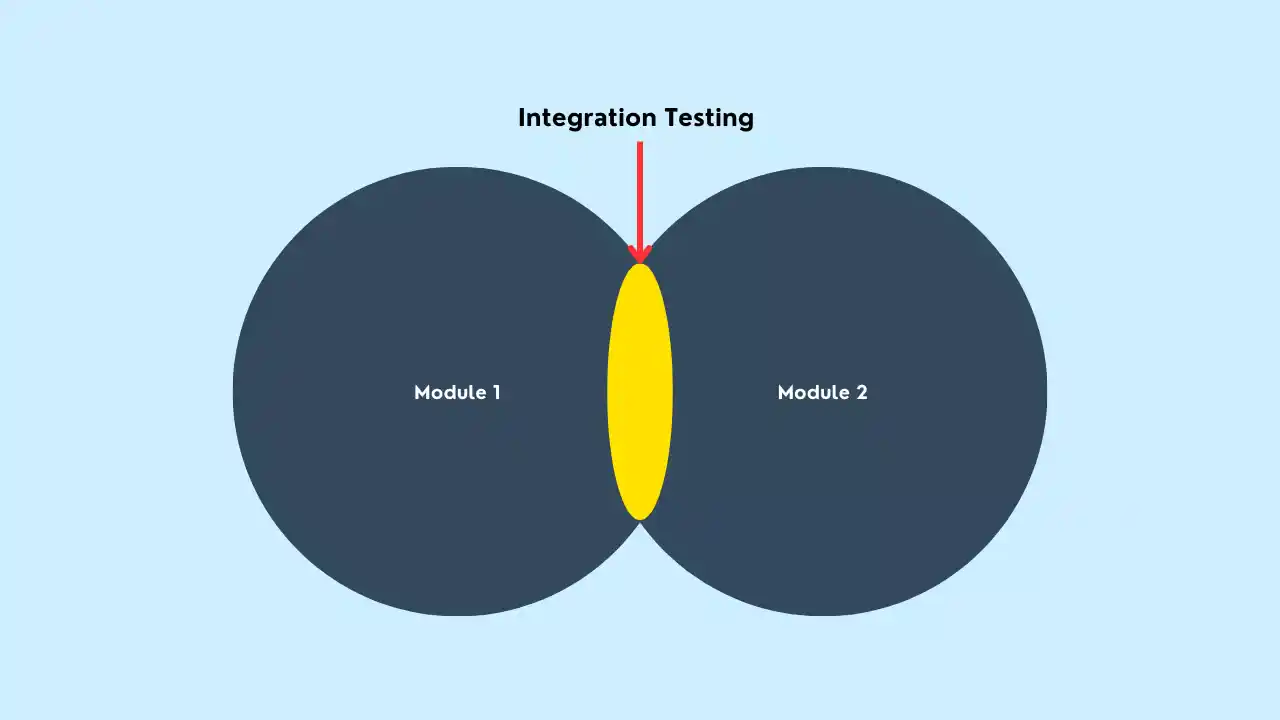
Integration testing is the phase of the software development lifecycle where individually tested modules, services, and components are combined and verified as a working whole.
Where unit testing checks a single function in isolation, integration testing checks whether components, APIs, databases, and third-party services communicate correctly, exchange data in the right format, and behave predictably under real conditions.
Catching integration defects early prevents them from surfacing as production incidents, and it directly protects quality assurance outcomes and user trust, since most real-world failures come from how pieces connect rather than from any single piece in isolation.
Why Integration Testing Matters More in 2026
Several shifts have raised the stakes this year:
- AI-generated code introduces integration risk, since AI assistants write plausible-looking code that can silently break API contracts
- API-first development means most products are built as a set of internal and external APIs before any UI exists
- Cloud-native applications and Kubernetes deployments multiply the number of moving parts that must agree with each other
- Event-driven architectures decouple services in ways that make timing and ordering bugs easy to miss
- Multi-cloud systems and SaaS integrations add third-party dependencies outside a team’s direct control
- Platform engineering teams now expect integration testing to be a built-in capability of the developer platform, not a bolt-on step
Continuous integration testing ensures the software’s integrity and functionality by incorporating new features and modules.
How Integration Testing Works
It typically happens after unit testing confirms that individual components work in isolation, and before full system testing validates the product against business requirements.
It also runs continuously inside CI/CD pipelines, so every pull request is checked against real or realistic dependencies before it merges.
The core workflow is: define the interfaces under test, prepare test data and dependent services (real, mocked, or virtualized), execute the interaction, and verify the result against expected contracts, formats, and error handling.
Types of Integration Testing
The classic strategies still apply and remain a useful foundation:
- Big Bang Integration: combine all modules at once after unit testing; fast to plan but hard to debug in large systems
- Top-Down Integration: test high-level modules first, using stubs for lower-level components not yet built
- Bottom-Up Integration: test low-level modules first, using drivers to simulate higher-level components
- Sandwich (Hybrid) Integration: test middle layers first, then integrate upward and downward simultaneously
Modern Approaches
Contract Testing
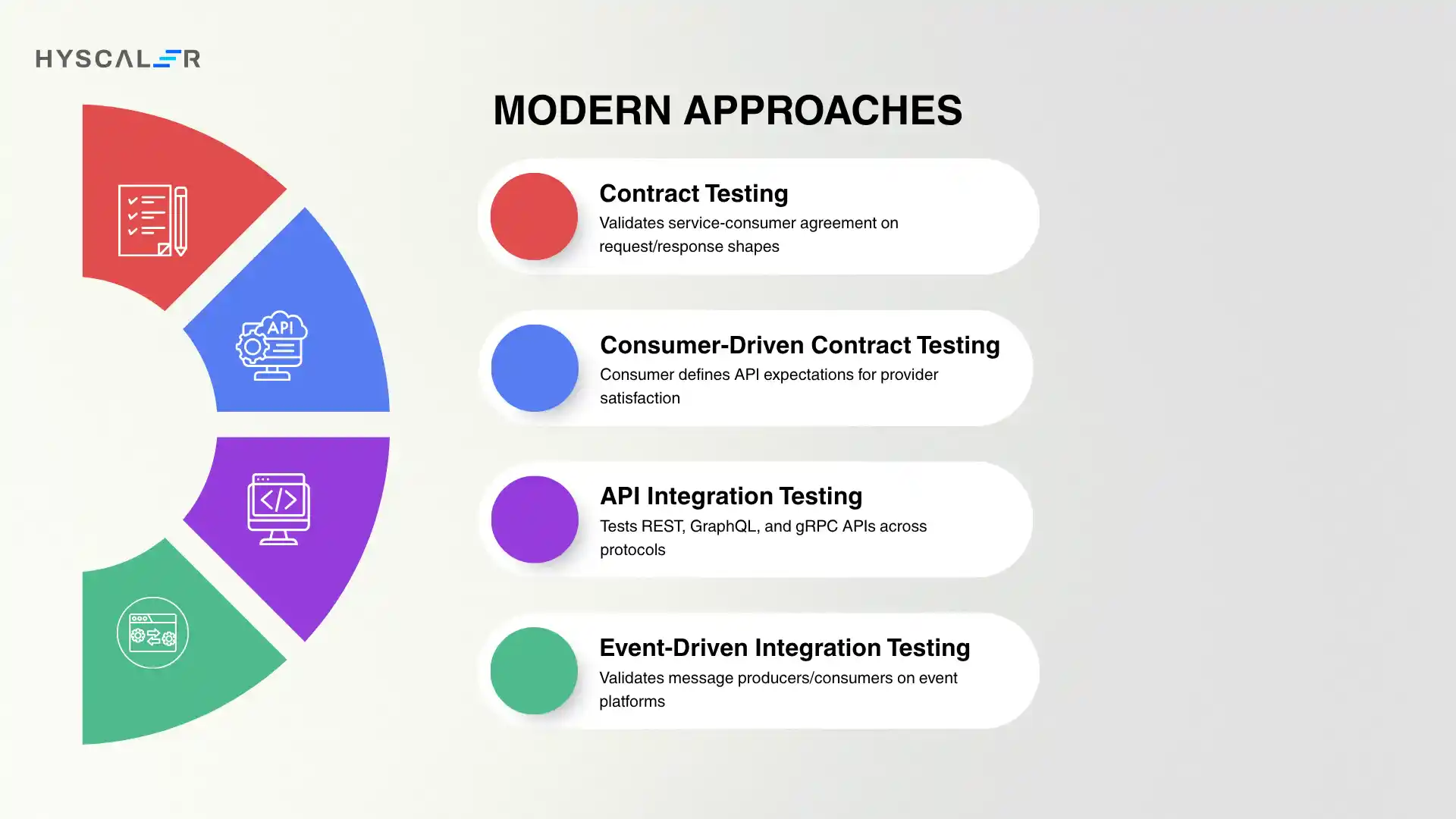
Contract testing validates that a service and its consumers agree on the shape of requests and responses, without needing every dependent service running at once.
Tools like Pact are the standard here and are essential once a system is built from more than a handful of microservices.
Consumer-Driven Contract Testing
An extension of contract testing where the consumer of an API defines the expectations the provider must satisfy, which is popular among enterprise engineering teams managing many internal API consumers.
API Integration Testing
Covers REST, GraphQL, gRPC, and asynchronous APIs, validating status codes, payload schemas, authentication, pagination, and error responses across every protocol a system exposes.
Event-Driven Integration Testing
Validates message producers and consumers on platforms such as Kafka, RabbitMQ, Azure Service Bus, and Amazon EventBridge, with particular attention to message ordering, retries, and at-least-once delivery guarantees.
Integration Testing in Microservices
Microservices architectures turn every service boundary into a potential failure point.
Effective integration testing here combines contract testing between services, staged environments that mirror production topology, and service virtualization for dependencies that are slow, costly, or owned by another team.
The goal is confidence that a change to one service will not silently break another.
API & Event-Driven Integration Testing in CI/CD
Modern pipelines ,GitHub Actions, GitLab CI, Azure DevOps, Jenkins, CircleCI, and ArgoCD ,run integration tests automatically on every pull request, gating merges and deployments until interactions pass.
This includes pre-merge validation, deployment gates tied to ephemeral or preview environments, and automated rollback when a post-deploy integration check fails.
Integration Testing for AI Applications
AI systems have introduced an entirely new integration surface that traditional testing guides rarely cover:
- LLM APIs and prompt orchestration pipelines
- Retrieval-Augmented Generation (RAG) pipelines and vector databases
- AI agents and multi-step tool-calling workflows
- MCP (Model Context Protocol) servers connecting agents to external tools
- Memory systems and guardrails that must behave consistently across sessions
Testing these systems means validating not just whether an API call succeeds, but whether the retrieved context, the model’s output, and any downstream tool calls remain correct, safe, and consistent across runs.
Integration Testing in Platform Engineering
Platform engineering teams now provide integration testing as a shared capability: ephemeral test environments spun up per pull request, preview deployments for reviewers, and on-demand test environments that mirror production configuration.
This removes the bottleneck of a single shared staging environment and lets teams run integration tests in parallel.
AI-Powered Integration Testing
AI is now also used to run and maintain the tests themselves.
Modern tooling can:
- Generate test cases and realistic mock data from API schemas
- Detect and quarantine flaky tests automatically
- Prioritize regression suites based on code change risk
- Analyze failures and recommend or auto-apply fixes
- Self-heal broken test scripts when a UI or API changes in a minor way
Best Practices
- Define clear test cases and scenarios, including edge cases and negative paths
- Use stubs, drivers, and service virtualization for dependencies that are missing or unreliable
- Automate wherever possible and run tests on every merge
- Adopt shift-left and shift-right testing so issues are caught before and after release
- Practice contract-first development so APIs are validated before implementation begins
- Validate infrastructure as code alongside application code
- Use synthetic production data and ephemeral environments to keep tests realistic without risking real data
- Apply chaos engineering principles to integration points, not just infrastructure
- Maintain close communication between developers and testers on interface changes
Common Challenges in 2026
- AI-generated code changing APIs without clear documentation of the change
- Third-party SaaS API versioning and deprecations
- Rate limits and cloud latency across multi-region deployments
- Service mesh complexity and distributed transaction handling
- Event ordering issues in asynchronous, event-driven systems
- Flaky cloud test environments
- AI hallucinations surfacing inside agent workflows
Mitigating these consistently relies on mocking and service virtualization, incremental integration with continuous integration, environment replication with infrastructure as code, and risk-based test prioritization.
Top Integration Testing Tools (2026)
| Category | Recommended Tools |
|---|---|
| API Testing | Postman, Bruno, Insomnia |
| Contract Testing | Pact |
| Test Automation | Playwright |
| Integration Frameworks | Testcontainers |
| Mocking | WireMock, MockServer |
| Performance | k6 |
| CI/CD | GitHub Actions, GitLab CI |
| Container Testing | Docker Compose |
| Kubernetes | Kind, Minikube |
| AI Testing | LangSmith, Promptfoo, DeepEval |
Real-World Examples
Integration testing shows up directly in the systems people use every day: an e-commerce checkout validating payment gateway, inventory, and tax service calls together; a banking payment gateway confirming ledger updates match transaction confirmations; a healthcare EHR system synchronizing patient records across integrated providers; a ride-sharing app confirming location, pricing, and driver-matching services agree in real time; and an AI customer support chatbot validating that its retrieval pipeline, LLM response, and CRM handoff all stay in sync.
Integration Testing Checklist
- APIs available and reachable in the test environment
- Database migrations complete
- Environment variables configured correctly
- Test data seeded and consistent across services
- Authentication and authorization tested
- Failure scenarios validated, not just happy paths
- Timeouts tested under realistic latency
- Retry logic verified for transient failures
- Logging enabled for every integration point
- Monitoring and alerting configured before go-live
Integration Testing vs Other Testing Types
| Aspect | Integration Testing | Regression Testing | Contract Testing |
|---|---|---|---|
| Focus | Interfaces between modules | Existing features after a change | Agreed API shape between consumer and provider |
| Timing | As modules are combined | After changes or updates | Before or alongside integration |
| Scope | Component interactions | All affected areas | Request/response schema only |
| Typical trigger | New integration point | Any code change | API version change |
Conclusion
Integration testing has moved from a late-stage QA checkpoint to a continuous, platform-level capability that spans microservices, event-driven systems, CI/CD pipelines, and now AI applications themselves.
Teams that treat contract testing, AI-powered test maintenance, and platform-provided ephemeral environments as standard practice will ship faster with fewer production surprises.
As architectures keep growing more distributed and AI-generated code becomes routine, integration testing will only become more central to delivering reliable software in 2026 and beyond.
FAQ
What is integration testing in microservices?
It is the practice of verifying that independently deployable services communicate correctly through their APIs and events, without needing every service running simultaneously, often using contract testing and virtualization.
How is contract testing different from integration testing?
Contract testing checks that a request and response match an agreed schema between a consumer and provider in isolation, while integration testing verifies actual runtime behavior when components interact together.
Should AI-generated code always undergo integration testing?
Yes. AI-generated code can look correct while subtly changing API behavior, data formats, or error handling, so it should go through the same or stricter integration validation as human-written code.
Can AI automate integration testing?
AI tools can generate test cases, create mock data, detect flaky tests, and suggest fixes, but human review remains important for business-critical logic and security-sensitive paths.
What are flaky integration tests?
Tests that pass or fail inconsistently without a code change, usually caused by timing issues, shared test data, or unreliable external dependencies.
What tools are best for integration testing in Kubernetes?
Kind and Minikube are commonly used to spin up lightweight clusters for testing, often paired with Testcontainers and Docker Compose for service dependencies.
When should integration tests run in CI/CD?
On every pull request before merge, and again after deployment to a staging or preview environment, so both code correctness and environment configuration are validated.
Is integration testing necessary for serverless applications?
Yes. Serverless functions depend heavily on managed services, event triggers, and timeouts, all of which need integration validation since they cannot be fully verified through unit tests alone.