

Table of Contents
Every growing business eventually reaches the same decision point. A process that once worked is now slowing the team down, whether it is customer management, reporting, onboarding, or workflow automation. Someone suggests buying a software tool, while someone else suggests bringing in an expert to build or fix it properly. This is the SaaS vs consultant decision, and getting it wrong can cost you months and a large part of your budget.
The risks run in both directions:
- Choosing the wrong SaaS: you end up paying for a subscription that nobody uses, or one that forces your team into manual workarounds.
- Hiring a consultant too early: you spend far more than necessary on a problem that a simple, affordable tool could have solved.
In the SaaS vs consultant debate, neither option is better in every situation. The right answer depends on your goals, your team, your budget, and how unique your problem really is. This SaaS vs consultant guide compares both options on cost, speed, customization, and risk, explains when each makes sense, and shows why many businesses combine the two. Here, “consultant” means an IT or technology consultant: someone who designs, implements, or advises on software systems and digital processes.
What Is SaaS?
SaaS, short for Software as a Service, is software you access over the internet and pay for through a subscription, usually monthly or annually. The vendor hosts the application, handles updates and security, and serves many customers from the same platform. You sign up, configure your account, and start working, often within a day.
The main characteristics of SaaS are the following:
- Vendor-managed: the provider takes care of hosting, maintenance, security patches, and upgrades, so your team does not have to.
- Subscription pricing: you pay per user, per feature tier, or based on usage, which keeps costs predictable at the start.
- Ready to use: there is no development project, so setup takes days rather than months.
- Built for many customers: the product is shaped around the average user, which makes it reliable but less flexible.
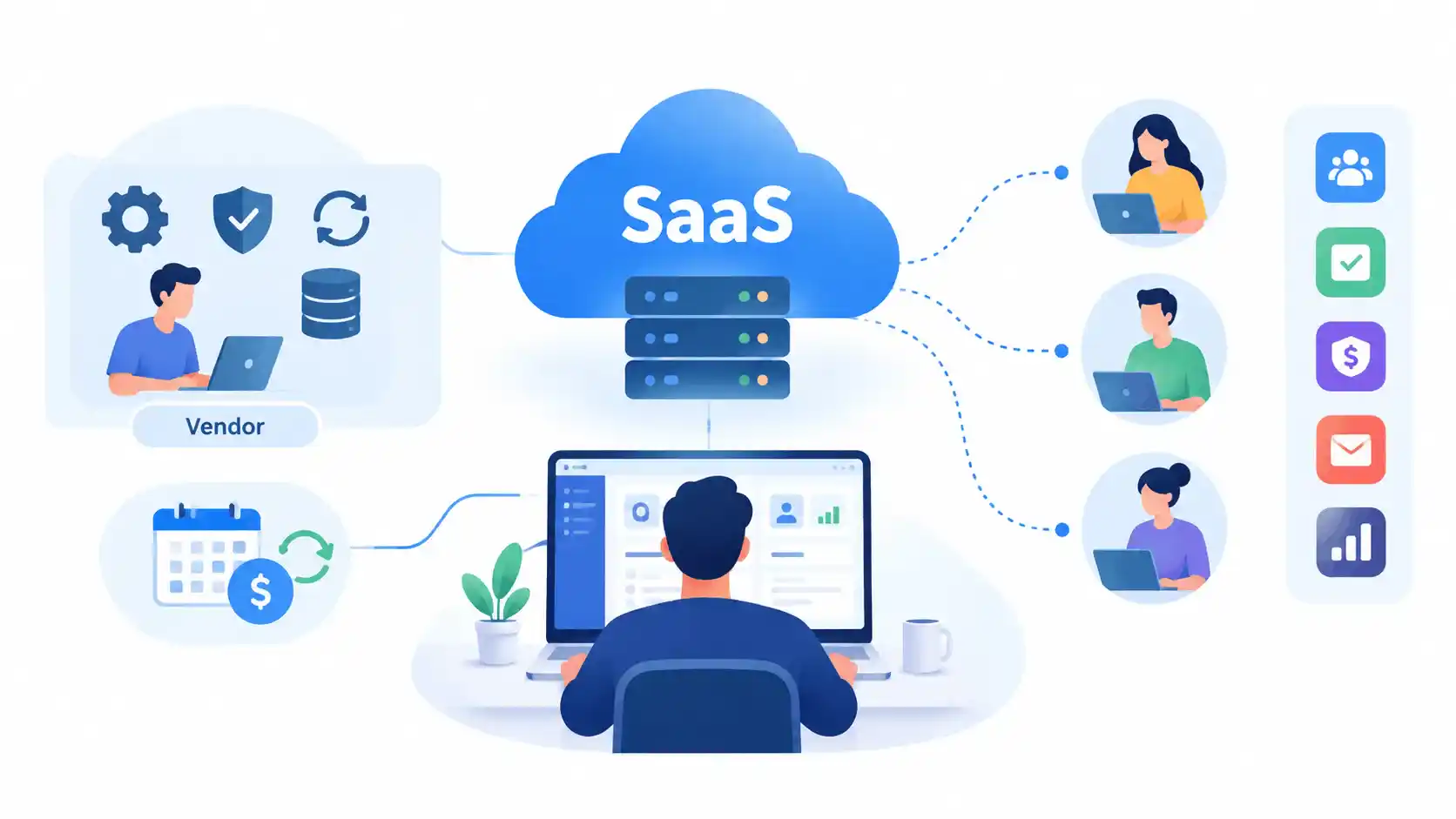
Common examples include CRM platforms, project management tools, accounting software, email marketing systems, and analytics dashboards. The appeal is simplicity: you are renting a finished product that thousands of other businesses already rely on, so the most common problems have already been found and fixed. The trade-off is that you get the features the vendor chose to build, working the way the vendor decided they should. That limit sits at the heart of the SaaS vs consultant decision.
What Is a Consultant?
A technology consultant is an expert, or a firm of experts, that you bring in to solve a specific problem or guide a larger initiative. Rather than handing you a finished product, a consultant studies how your business works, recommends an approach, and often helps build or implement the solution alongside your team.
Engagements usually take one of three forms:
- Project-based: a defined scope, timeline, and deliverable, such as migrating your systems or building a custom integration.
- Retainer: ongoing monthly support, optimization, and advice, useful when your needs change regularly.
- Advisory: strategic guidance on tool selection, architecture, or roadmap planning, without the consultant doing the hands-on delivery.

Companies typically hire a consultant when the problem is complex, the stakes are high, or the internal team lacks the skills or time to handle it. You’re paying not for a product but for expertise applied directly to your situation. That difference is the core of the SaaS vs consultant choice.
SaaS vs Consultant: A Head-to-Head Comparison
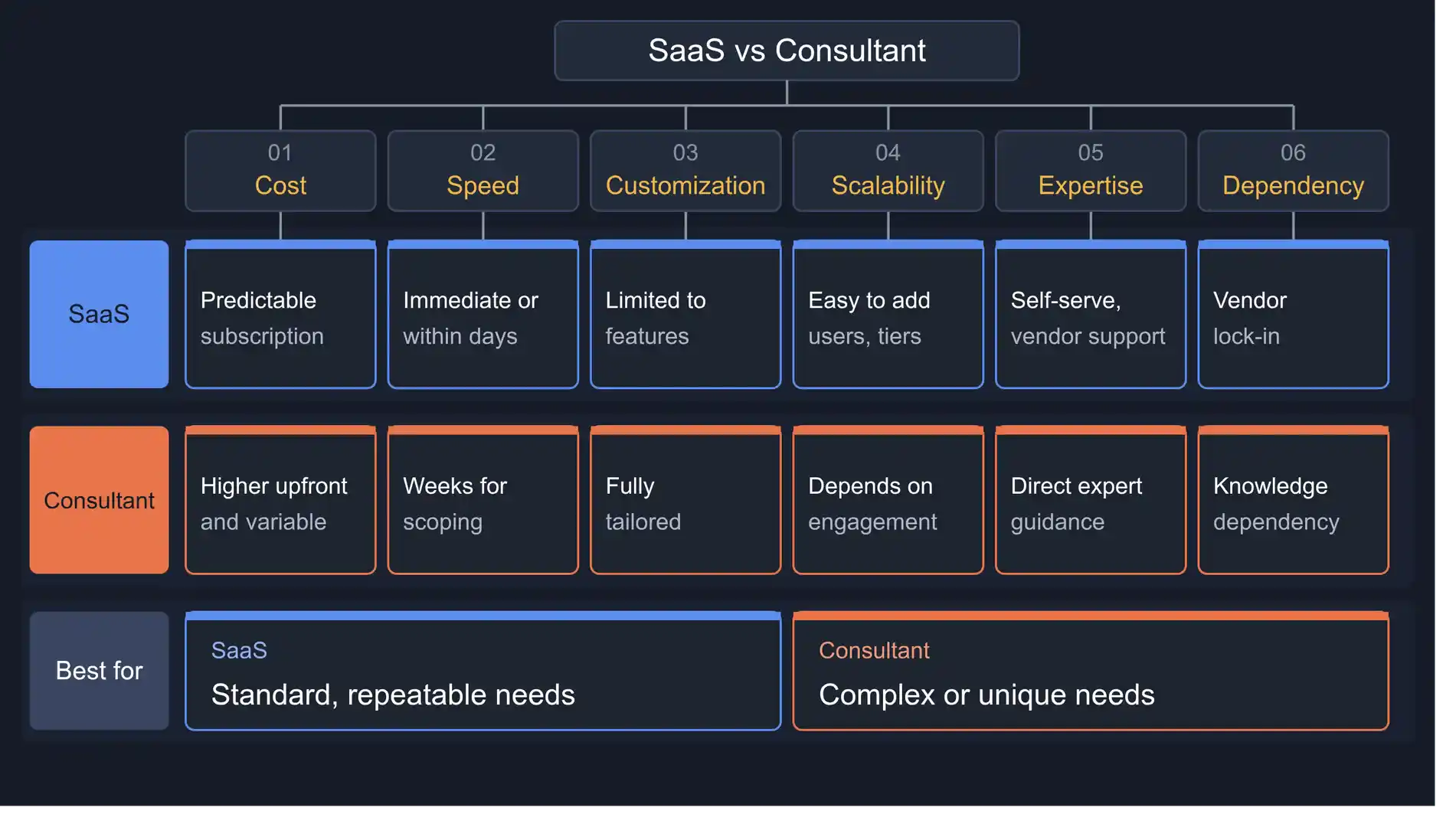
The table below summarizes the SaaS vs consultant comparison at a glance. The sections that follow explain each factor in more detail.
Cost Comparison
In a SaaS vs consultant cost comparison, SaaS almost always wins in the short term, while the long-term picture is more balanced.
- Short-term cost: SaaS starts at a few dozen or a few hundred dollars a month, while a consultant requires a project fee, day rate, or retainer upfront.
- Long-term cost: subscription fees grow with every new user, higher tier, and add-on, and several years of payments can exceed the cost of a one-time custom solution.
- Hidden costs: a tool that does not fit your process creates workarounds and lost productivity, while a vaguely scoped consulting project can drift over budget.
For this reason, compare the total cost over three to five years rather than judging by the first month alone.
Speed and Time to Value
In a SaaS vs consultant race against the clock, SaaS is the faster option by a clear margin. You can often be running within the same week, which matters when a problem costs you money every day it stays unsolved. A consultant needs time to understand your business, scope the work, and deliver, so the investment pays off later but will not help if you need a working solution by next Monday.
Customization and Fit
In the SaaS vs consultant contest on fit, this is where consultants hold the clear advantage. SaaS gives you configuration, meaning settings, templates, and integrations that operate within the product’s limits. A consultant gives you customization, meaning a solution shaped around how your business actually works. If your workflow is unusual or is a competitive advantage in itself, an off-the-shelf tool may never fit properly.
Risk and Dependency
Both sides of the SaaS vs consultant choice create dependency, just of different kinds:
- SaaS dependency: you rely on a vendor’s pricing, roadmap, and uptime, and moving away later can be painful once your data and processes are tied to the platform.
- Consultant dependency: knowledge can sit with one person or firm, and if nothing is documented, your business may be unable to maintain or change what was built.
Good consultants reduce this risk through thorough documentation, team training, and a clean handover at the end of the project.
SaaS Pros and Cons
Understanding the SaaS pros and cons helps you judge whether a tool will be a quick win or a long-term constraint. It is also a key part of any SaaS vs consultant evaluation.
Advantages of SaaS
- Fast setup: you can start almost immediately without a lengthy implementation project.
- Lower entry cost: a subscription avoids the large upfront investment that custom work requires.
- Automatic updates: the vendor handles maintenance, security patches, and new features for you.
- Easy scaling: adding users or upgrading a plan usually takes only a few clicks.
- Proven product: established platforms have already been tested by many other businesses.
Disadvantages of SaaS
- Limited flexibility: you work within the vendor’s design and feature set, with little room to change it.
- Rising costs: per-user pricing and paid add-ons can become expensive as your team grows.
- Vendor lock-in: moving your data and processes to another platform is rarely simple or cheap.
- Integration gaps: connecting the tool to your existing systems may require extra work or middleware.
- Feature mismatch: you may pay for features you never use while still missing the one you need.
Consultant Pros and Cons
In the SaaS vs consultant comparison, a consultant offers a different balance. The main strength is fit, and the main weakness is cost and control.
Advantages of a consultant
- Tailored solutions: the outcome is built around your actual workflows and goals, not an average customer’s.
- Experienced guidance: a good consultant has seen similar projects and helps you avoid common mistakes.
- Strategic perspective: an experienced consultant will often question whether you are solving the right problem, which can be worth more than the implementation itself.
- Handles complexity: integrations, migrations, and compliance requirements are far easier with a specialist.
- Flexible engagement: support can be scaled up or down as your needs change.
Disadvantages of a consultant
- Higher upfront cost: quality expertise is expensive, especially for custom work.
- Slower start: scoping, onboarding, and delivery all take time before you see results.
- Variable quality: results depend heavily on the individual or firm you choose, so careful selection matters.
- Knowledge dependency: without documentation, your business can become reliant on one person.
- Scope creep: vague requirements can stretch both the timeline and the budget.
When to Choose SaaS
In the SaaS vs consultant decision, SaaS is the right call when your need is common and the best tools on the market already solve it well. Mature products exist for most standard functions, and competition keeps them good and affordable.
SaaS is usually the better choice in these situations:
- Standard business functions: accounting, email marketing, basic customer management, and project tracking are well served by existing platforms.
- Limited budget: a subscription keeps cash flow predictable and avoids a large upfront commitment.
- Small teams: fewer users mean lower subscription costs and simpler setup.
- Tight timeline: if you need results this month rather than next quarter, SaaS gets you there faster.
- No in-house technical team: the vendor carries the burden of infrastructure and maintenance.
In the SaaS vs consultant choice, startups testing an idea benefit especially, because SaaS lets them move quickly without heavy commitments and revisit the decision as they grow. The same applies to small businesses with straightforward processes: there is rarely a good reason to build something you can simply buy.
When to Hire a Consultant
Knowing when to hire a consultant can save you from both overspending and under-solving. The clearest signal is that your workflows are unique, but several other situations point the same way:
- Unique or competitive workflows: forcing a process that sets you apart into a generic tool can weaken the very thing that makes your business different.
- Strategic decisions: choosing a core platform, planning a cloud migration, or designing system architecture will shape your business for years and benefit from outside expertise.
- Compliance-heavy industries: sectors like healthcare and finance often face regulatory requirements that go beyond what standard tools handle.
- Complex integrations: connecting multiple systems, legacy software, and scattered data sources usually exceeds what any single tool can do.
- Outgrown SaaS: when spreadsheets, manual workarounds, and add-ons keep piling up, a tailored solution can end up cheaper than continued patching.
- No internal expertise: if nobody on your team can evaluate or implement the options, expert guidance prevents expensive mistakes.
A useful SaaS vs consultant rule of thumb: if you can describe your problem in one sentence and a dozen tools claim to solve it, start with SaaS. If describing it takes a whiteboard and three meetings, talk to a consultant.
The Hybrid Approach: SaaS and Consulting Together
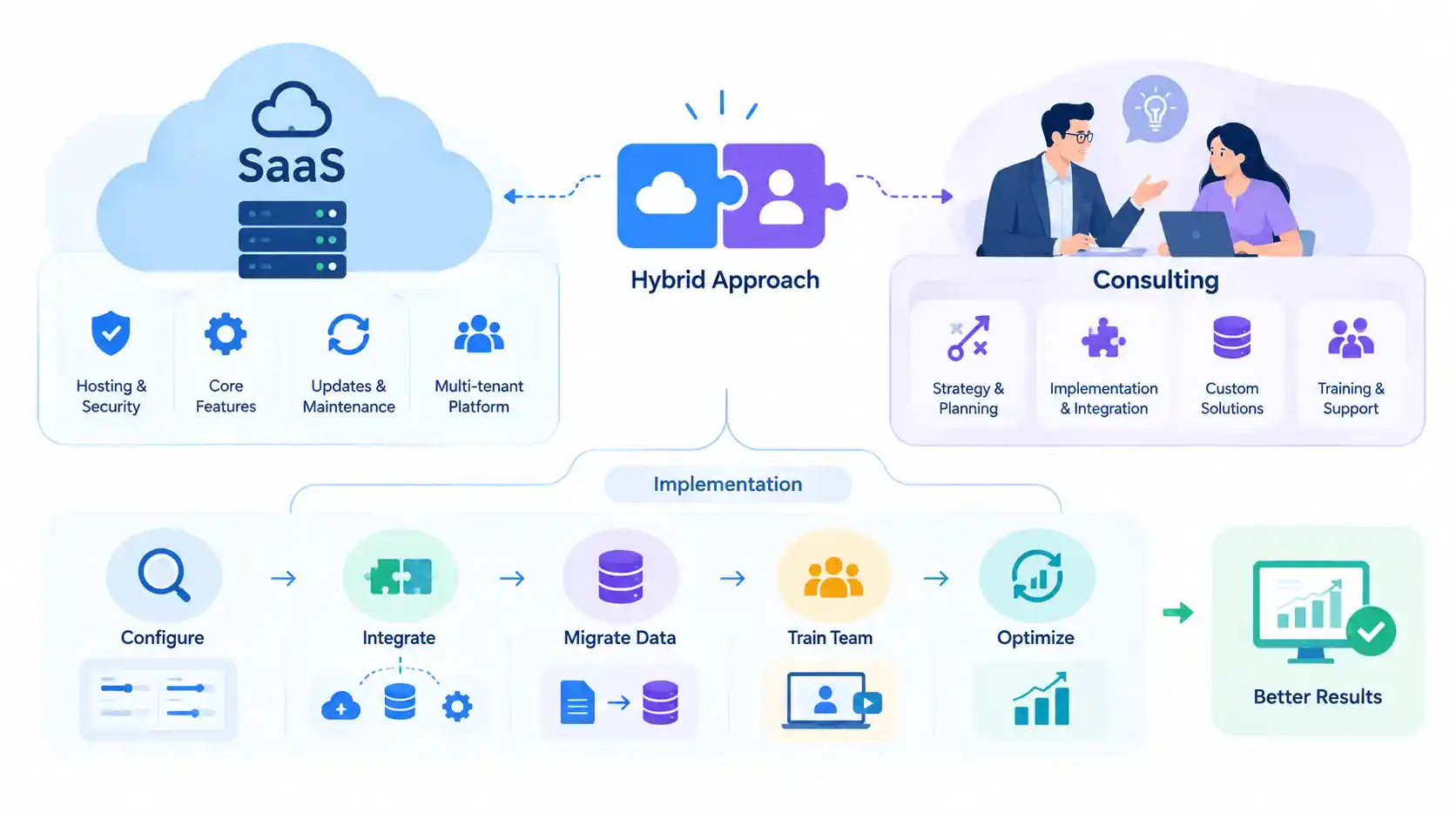
The phrase “SaaS vs consultant” suggests you must pick one, but many businesses get the best results from a hybrid approach to SaaS and consulting. In this approach, SaaS serves as the core platform, while a consultant tailors its implementation to your specific business needs.
In a SaaS vs consultant hybrid, imagine you buy a CRM platform and then hire a consultant to configure it for your sales process, build custom integrations with your current systems, transfer existing data, and equip your team with the necessary training. You gain the speed and stability of a proven product along with the fit of a tailored implementation.
The hybrid approach resolves the SaaS vs consultant dilemma for several reasons:
- Division of strengths: SaaS handles the commodity parts such as hosting, security, and core features, while the consultant focuses on workflows, integrations, reporting, and strategy.
- Lower selection risk: a consultant can help you choose the right platform before you commit to a long contract.
- Reduced lock-in: planning data portability from the start means you are not trapped if you need to switch later.
Hybrid arrangements typically take one of three forms:
- Advisory first, then SaaS: a consultant helps you select and negotiate the right tool before any purchase is made.
- SaaS plus implementation: you buy the software and the consultant handles configuration, integration, and training.
- SaaS plus retainer: a subscription is paired with ongoing optimization and support so the setup keeps evolving with your business.
How to Decide: A Quick Checklist
If you are still unsure about SaaS vs consultant, work through these questions honestly:
- How standard is your need? If thousands of businesses share the same problem, SaaS probably solves it.
- What is your timeline? Results needed within weeks favor SaaS.
- What is your budget, upfront and over three years? Evaluate the overall expenses instead of focusing solely on the initial payment.
- How complex is your environment? Multiple systems, legacy tools, or compliance requirements point toward a consultant.
- Do you have in-house skills? If nobody can configure or manage the solution, you will need expert help whichever route you take.
- Does this process play a key role in setting your business apart from competitors? If so, investing in a customized solution can deliver greater value.
- How fast will you scale? Check that SaaS pricing and limits still work when your team is two to five times its current size.
In the SaaS vs consultant checklist, if most answers lean toward standard, fast, and budget-conscious, choose SaaS. If most lean toward complex, strategic, and unique, a consultant is the better fit. If your answers are mixed, the hybrid approach is probably your best option.
Conclusion: Choose the Fit, Not the Trend
The SaaS vs consultant question has no universal winner. SaaS wins on speed, simplicity, and low entry cost, which makes it ideal for standard needs and tight budgets. Consultants win on customization, expertise, and the ability to handle complexity, which makes them the better choice when your needs are unique or the stakes are high. For many businesses, combining the two delivers the strongest results.
The most reliable way to settle SaaS vs consultant is to define your problem clearly and then match the solution to its complexity. Review your choice as you grow, because the right answer for a ten-person team is rarely the right answer for a hundred-person one.
If you are not sure which path fits your business, our team can review your requirements and help you choose between SaaS, a custom solution, or a hybrid approach. Book a free consultation to get a clear recommendation based on your goals.
FAQs
Is SaaS cheaper than hiring a consultant?
In the short term, usually yes. SaaS has low upfront costs and predictable subscriptions, while consultants require a larger initial investment. Over several years, however, subscription costs can grow along with your team, so it is best to compare the total cost over three to five years.
Should I buy SaaS or hire a consultant?
Buy SaaS if your need is standard, your budget is limited, and you need speed. Hire a consultant if your workflows are unique, your systems are complex, or the decision is strategic. If you are unsure, a short advisory engagement can help you decide before committing to either route.
Can a consultant replace SaaS tools?
Sometimes. A consultant can build a custom solution that replaces one or several SaaS tools, which can make sense when you are paying for many subscriptions or need features that no product offers. For most standard needs, though, an existing tool is faster and cheaper.
What is the difference between SaaS and a custom solution?
SaaS is a ready-made product shared by many customers and paid for through a subscription. A custom solution is built specifically for your business, usually with a higher upfront cost but greater flexibility and ownership.
Is SaaS or a consultant better for startups?
Most startups should begin with SaaS because it is fast and affordable. Bring in a consultant when you hit a challenge that the tools cannot handle, such as complex integrations, compliance, or scaling.
Can I customize SaaS without hiring a consultant?
Often yes. Most business SaaS offers settings, custom fields, APIs, and integrations you can use yourself. A consultant becomes worthwhile when the customization needs complex integrations, data migration, or compliance work your team cannot handle.