

Table of Contents
If you run a small or mid-sized business, you’ve probably heard the phrase ‘digital transformation’ more times than you can count.
But what does it actually mean for a business like yours, and where do you even start?
The reality is that in 2026, digital transformation is no longer a luxury reserved for large enterprises.
It’s fast becoming a survival requirement for SMBs.
AI-powered competitors are automating tasks that once took hours.
Customers now expect fast, personalized, digital-first experiences.
And manual, paper-based operations are quietly draining your time and money.
| 📊 Stat: Over 70% of SMBs are increasing digital investments in 2026 to improve efficiency and customer experience. (Source: Deloitte SMB Digital Report 2025) |
This guide gives you a practical, no-jargon roadmap built specifically for small and mid-sized businesses to begin (or accelerate) your digital transformation journey.
Whether you’re a retail store, a healthcare clinic, a logistics firm, or a local service business, these steps apply to you.
| Intent | What You’ll Get in This Guide |
|---|---|
| Informational | A plain-English definition of digital transformation |
| Practical | 10 step-by-step actions you can take starting this week |
| Strategic | A prioritization framework built for SMB budgets and timelines |
| Commercial | Recommended tools and technology categories for each stage |
What Is Digital Transformation for SMBs?
| 📌 Definition: Digital transformation for SMBs is the process of using digital tools and technology to improve how your business operates fundamentally, serves customers, and creates value, moving from manual or outdated systems to modern, efficient digital processes. |
It’s worth separating two terms that often get confused:
- Digitization = converting paper/analog data into digital format (e.g., scanning invoices).
- Digital Transformation = rethinking your entire business model with technology at the core.
Here’s what it looks like in practice across industries:
- Retail: Replacing a cash register with an integrated POS + inventory + e-commerce system.
- Healthcare: Moving from paper records to electronic health records and telehealth platforms.
- Logistics: Using real-time GPS tracking and automated dispatch instead of phone calls and spreadsheets.
- Local services: Automating appointment bookings, reminders, and customer follow-ups.
Why Digital Transformation Matters for Small Businesses in 2026
The pressure on SMBs has never been greater.
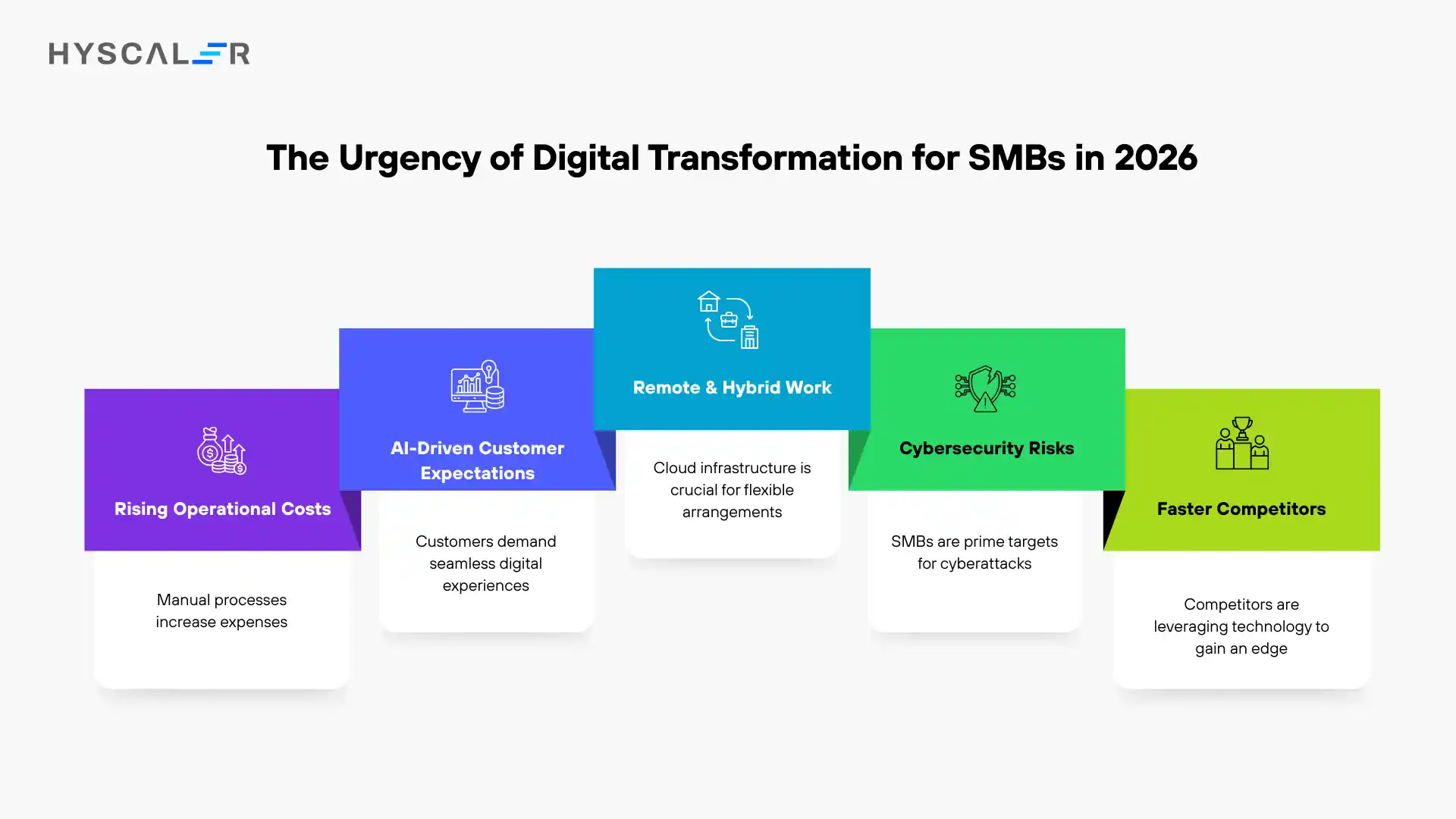
Here’s why the timing matters:
1. Rising Operational Costs
Manual processes are expensive in time, error-prone, and employee-intensive.
Automation can reduce operational overhead by 20–40% in areas like invoicing, scheduling, and customer communication.
2. AI-Driven Customer Expectations
Customers now compare their experience with YOUR business against Amazon, Uber, and Netflix.
They expect instant responses, personalized recommendations, and seamless digital interaction.
3. Remote and Hybrid Work
SMBs without cloud infrastructure struggle to support flexible work arrangements, which now directly impacts hiring and retention.
4. Cybersecurity Risks
Small businesses are the #1 target for cyberattacks because they’re perceived as easier targets.
Digital transformation includes building defenses to protect your business.
5. Faster, Better-Funded Competitors
Your competitors, both large enterprises and digitally native startups, are using AI, automation, and data analytics to move faster and serve customers better.
Standing still is falling behind.
Common Challenges SMBs Face During Digital Transformation
Knowing what stands in your way is half the battle.
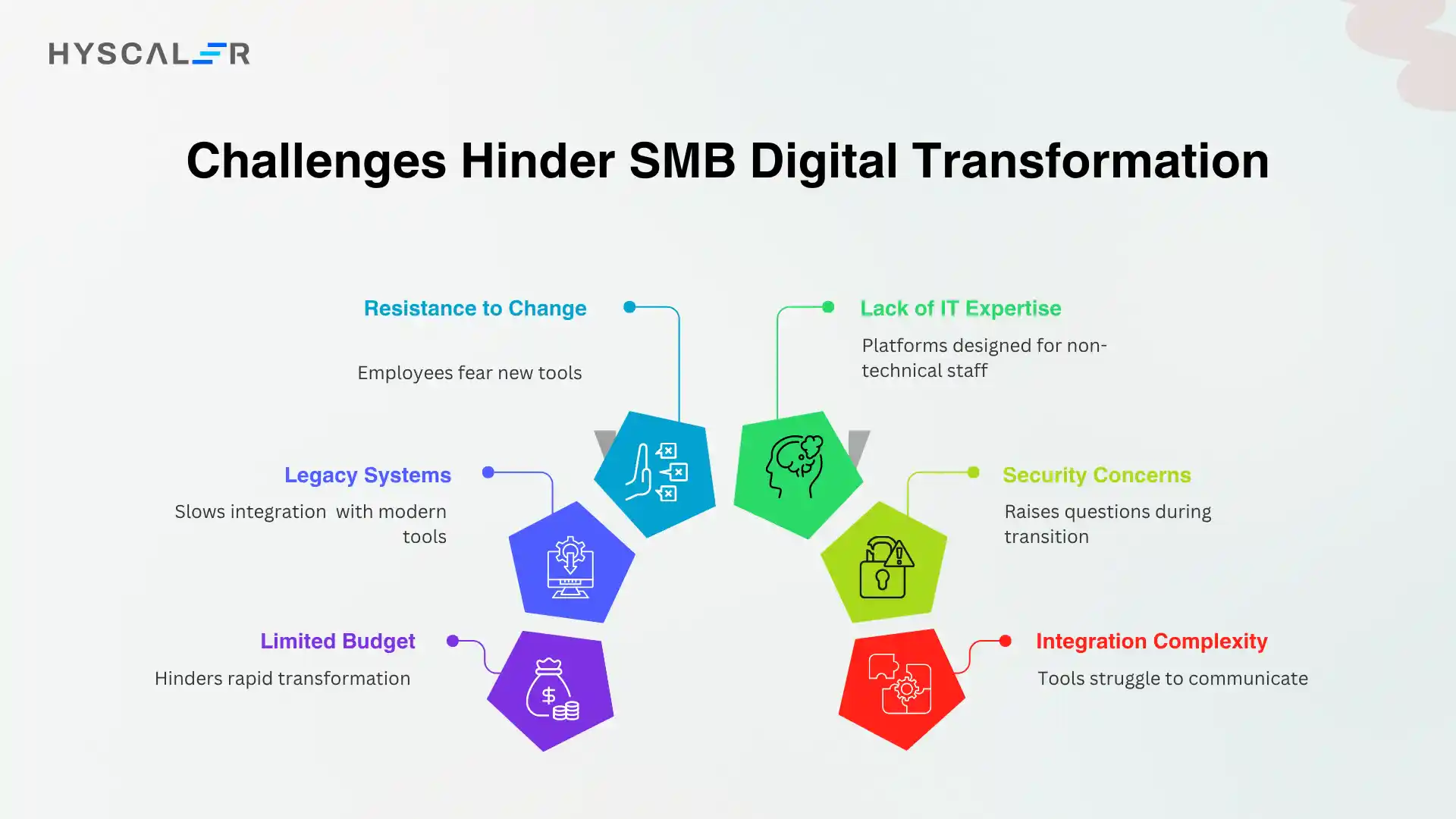
Here are the most common obstacles, and the good news is, all of them are solvable.
- Limited budget: Most SMBs can’t transform overnight. A phased approach with SaaS tools makes transformation affordable.
- Legacy systems: Older software or hardware that doesn’t integrate well with modern tools can slow progress. Prioritizing migration is key.
- Resistance to change: Employees fear new tools. Culture and training investment are just as important as technology investment.
- Lack of IT expertise: You don’t need a large IT team. Many modern platforms are designed to be managed by non-technical staff.
- Security concerns: Transitioning to cloud or new platforms raises security questions. This is manageable with the right protocols in place.
- Integration complexity: Getting your tools to ‘talk to each other’ is a real challenge. Choosing an integration-friendly tech stack from the start helps.
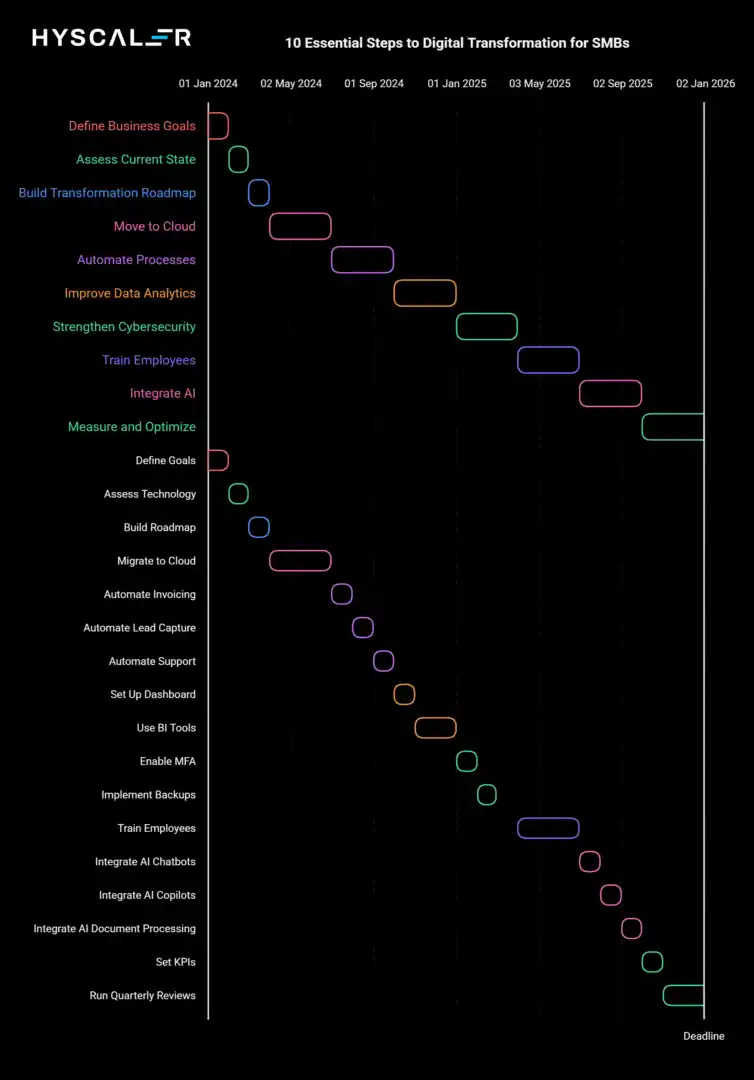
10 Essential Steps to Digital Transformation for SMBs
These steps are designed to be followed in order; each one builds on the last.
Don’t try to do everything at once.
Start small, prove value, and scale.
Step 1: Define Clear Business Goals
Before touching any technology, get clear on what you’re actually trying to achieve.
Digital transformation without a goal is just expensive chaos.
Ask yourself: What specific business problems am I trying to solve?
- Reduce operational costs by 25% in 12 months
- Improve customer response time from 24 hours to under 2 hours
- Eliminate manual data entry from invoicing and payroll
- Scale to 3x revenue without hiring 3x the staff
Use the SMART framework: goals should be Specific, Measurable, Achievable, Relevant, and Time-bound.
| 💡 Pro Tip: Don’t start with ‘we want to be more digital.’ Start with ‘we want to reduce invoice processing time by 60% in 6 months.’ That’s a goal technology can actually solve. |
Step 2: Assess Your Current Technology and Processes
You can’t plan a journey without knowing your starting point.
Map out what you currently have:
- Which processes are still manual or paper-based?
- Which software tools are you using? Are they outdated?
- Where are your data silos? (i.e., information trapped in spreadsheets or siloed apps)
- What are your biggest operational bottlenecks?
Create a simple audit table:
| Process/Tool | Current State | Pain Point | Priority to Fix |
|---|---|---|---|
| Invoicing | Manual (Word docs) | Time-consuming, error-prone | High |
| Customer support | Email + phone only | Slow response, no tracking | High |
| Inventory management | Spreadsheet | No real-time visibility | Medium |
| HR & payroll | Manual + paper | Compliance risk | Medium |
Step 3: Build a Digital Transformation Roadmap
Now translate your goals and audit into a phased plan.
A good roadmap has three horizons:
- Short-term (0–3 months): Quick wins automate one process, adopt one SaaS tool, and migrate data to the cloud.
- Medium-term (3–12 months): Build your core digital infrastructure (CRM, ERP, collaboration tools).
- Long-term (12+ months): Advanced capabilities, AI integration, predictive analytics, autonomous workflows.
Prioritize by: highest ROI first, easiest to implement, and least disruption to current operations.
| 📋 Template: List your top 5 transformation priorities. For each, assign: timeline, owner, estimated cost, and success metric. Keep it simple and visible to your team. |
Step 4: Move to Cloud-Based Infrastructure
Cloud is the foundation of everything else.
If your data, tools, and workflows live on local servers or individual computers, you’re already behind.
What cloud transformation looks like for SMBs:
- Replace desktop software with SaaS equivalents (e.g., QuickBooks Online, Microsoft 365, Google Workspace).
- Move file storage to cloud platforms (Google Drive, SharePoint, Dropbox Business).
- Adopt a cloud-based CRM (Salesforce Essentials, HubSpot, Zoho CRM).
- Use cloud project management tools (Asana, Monday.com, ClickUp).
Benefits: access from anywhere, automatic updates, lower IT maintenance, and easier team collaboration.
| ⚠️ Common Mistake: Migrating everything at once. Start with one department or one tool category, prove value, then expand. |
Step 5: Automate Repetitive Business Processes
This is where SMBs start seeing real-time and cost savings.
Look for any task your team does the same way, repeatedly; that’s an automation opportunity.
Top automation wins for SMBs:
- Invoice generation and payment reminders (tools: FreshBooks, Xero, QuickBooks).
- Lead capture and follow-up emails (tools: HubSpot, Mailchimp, ActiveCampaign).
- Customer support triage (tools: Zendesk, Freshdesk, AI chatbots).
- Document approvals and e-signatures (tools: DocuSign, PandaDoc).
- Social media scheduling tools like SocialBu, Buffer, and Hootsuite)
AI automation takes this further: modern AI tools can handle document processing, classify emails, generate reports, and manage complex workflows with minimal human input.
Step 6: Improve Data Collection and Analytics
Most SMBs are sitting on a goldmine of data, but it’s scattered, unanalyzed, and underused.
Start here:
- Set up a simple dashboard to track your most important metrics (revenue, leads, customer satisfaction, operational costs).
- Use built-in analytics in your existing tools (Google Analytics for website, CRM reports for sales).
- Upgrade to business intelligence (BI) tools as you grow (Power BI, Looker Studio, Tableau).
The goal: move from gut-based decisions to data-driven decisions. Real-time reporting lets you catch problems early and double down on what’s working.
| 📊 Example: A small e-commerce business used Google Analytics + Shopify data to discover that 60% of their abandoned carts happened on mobile. They optimized their mobile checkout and recovered $40K in revenue the next quarter. |
Step 7: Strengthen Cybersecurity and Compliance
Digital transformation increases your attack surface.
As you adopt more cloud tools and store more data online, security cannot be an afterthought.
Essential cybersecurity steps for SMBs:
- Enable Multi-Factor Authentication (MFA) on all accounts.
- Use a password manager (1Password, Bitwarden) for your team.
- Set up automated backups (cloud + offsite).
- Implement endpoint security on all company devices.
- Review compliance requirements for your industry (GDPR, HIPAA, PCI DSS).
- Train employees to recognize phishing attacks, as human error causes 82% of breaches.
| 🔐 Note: A cyberattack costs the average SMB $200,000+, enough to put many out of business. Invest in basic security now; it’s far cheaper than recovering from a breach. |
Step 8: Train Employees and Build a Digital Culture
Technology alone doesn’t transform a business; people do.
This is the step most SMBs skip, and it’s often the reason transformation projects fail.
What a digital culture looks like:
- Leadership actively champions the change and explains why it matters.
- Employees are given time and resources to learn new tools.
- Mistakes during the transition are treated as learning opportunities, not failures.
- AI literacy is built into onboarding for new hires.
Practical steps:
- Run hands-on workshops when new tools launch.
- Assign ‘digital champions’ within each team to support peers.
- Use platforms like LinkedIn Learning, Coursera, or tool-specific training hubs.
Step 9: Integrate AI and Emerging Technologies
If there’s one theme defining SMB digital transformation in 2026, it’s AI.
And the good news: AI is more accessible and affordable for small businesses than ever before.
Practical AI applications for SMBs:
- AI chatbots for 24/7 customer support (Intercom, Tidio, Drift).
- AI copilots for drafting emails, proposals, and reports (Microsoft Copilot, Claude, ChatGPT).
- AI-powered document processing to extract and organize data from invoices, contracts, and forms.
- Predictive analytics to forecast demand, churn, or inventory needs.
- AI agents that autonomously execute multi-step workflows without human input.
You don’t need to build custom AI.
Start with AI features embedded in the tools you already use.
Most modern SaaS platforms are rapidly adding AI capabilities.
Step 10: Continuously Measure and Optimize
Digital transformation is not a one-time project. It’s an ongoing practice of improvement.
Set KPIs for every initiative:
- Cost savings (e.g., % reduction in manual processing time).
- Revenue impact (e.g., % increase in lead conversion rate).
- Customer experience (e.g., NPS score, support ticket resolution time).
- Employee productivity (e.g., tasks completed per day before/after automation).
Run quarterly reviews: What worked? What didn’t? What should we tackle next?
This iterative approach keeps your transformation aligned with your business goals as they evolve.
Digital Transformation Technologies SMBs Should Prioritize
Not all technologies are equal when it comes to SMB ROI.
Here’s where to focus:
- Cloud computing: The foundation enables everything else (AWS, Google Cloud, Azure, or SaaS-first approach).
- AI and automation: Highest ROI potential for routine task elimination and customer experience enhancement.
- CRM systems: Essential for managing customer relationships at scale (HubSpot, Salesforce, Zoho).
- ERP software: Integrates finance, inventory, HR, and operations into one system (NetSuite, Odoo, SAP Business One).
- Cybersecurity platforms: Non-negotiable as you digitize more operations (CrowdStrike, Sophos, or SMB-focused solutions).
- Data analytics: Turn your operational data into strategic insights (Power BI, Looker, Tableau).
- Collaboration tools: Keep remote/hybrid teams aligned (Slack, Microsoft Teams, Notion).
How Much Does Digital Transformation Cost for SMBs?
This is one of the most searched questions, and the honest answer is: it depends on your starting point, goals, and approach.
But here’s a useful framework:
| Approach | Estimated Cost | Best For |
|---|---|---|
| DIY / Freemium SaaS tools | $0 – $500/month | Solopreneurs, early-stage SMBs |
| Phased SaaS adoption | $500 – $3,000/month | Growing teams (10–50 employees) |
| Managed transformation partner | $5,000 – $30,000+ (project) | Mid-market SMBs with legacy systems |
| Full custom platform build | $30,000 – $200,000+ | SMBs targeting enterprise scale |
The key insight: phased transformation with SaaS tools makes this very manageable.
You don’t need to spend $100K upfront.
Many SMBs see positive ROI within 6–12 months by automating just one or two high-cost manual processes.
Key Benefits of Digital Transformation for SMBs
- Operational efficiency: Do more with the same (or fewer) resources.
- Better customer experience: Faster, more personalized service that matches customer expectations.
- Faster scalability: Grow without proportionally growing your headcount or overhead.
- Improved decision-making: Real-time data replaces gut instinct.
- Reduced manual work: Free your team to focus on high-value activities.
- Competitive advantage: Move faster, serve better, and adapt quicker than competitors still operating manually.
Mistakes SMBs Should Avoid During Digital Transformation
- Trying to transform everything at once leads to chaos, cost overruns, and abandoned projects. Always phrase it.
- Ignoring employee adoption: Technology without people’s buy-in fails. Invest in training and change management.
- Choosing tools without a strategy: ‘Shiny tool syndrome’ is real. Every tool should map to a specific business goal.
- Weak cybersecurity: New digital processes mean new vulnerabilities. Security is not optional.
- No KPI tracking: If you can’t measure it, you can’t manage it. Define success metrics before you start.
- Going it alone: Working with experienced transformation partners, even for specific phases, dramatically increases success rates.
Future Trends in SMB Digital Transformation
Staying ahead means knowing what’s coming.
Here are the trends reshaping SMB digital strategy in 2026 and beyond:
- AI agents: Autonomous AI systems that complete multi-step business tasks (scheduling, research, reporting) without human input.
- Hyperautomation: Combining AI, ML, and RPA to automate virtually any repeatable business process.
- Low-code / no-code platforms: Allowing non-technical SMB owners to build custom apps and workflows without developers.
- Predictive AI: Moving from descriptive analytics (‘what happened’) to predictive insights (‘what will happen’).
- Edge computing: Processing data closer to where it’s generated, enabling real-time decisions in retail, manufacturing, and logistics.
- AI-powered customer experience: Hyper-personalized interactions at scale, across every touchpoint.
How HyScaler Helps SMBs Accelerate Digital Transformation
Navigating digital transformation is easier with a partner who has done it before.
HyScaler works with SMBs to design and execute practical transformation roadmaps without the enterprise price tag.
Our work spans:
- AI integration: Embedding AI tools into your existing workflows and customer touchpoints.
- Cloud modernization: Migrating legacy systems to scalable, cost-efficient cloud infrastructure.
- Business process automation: Identifying and automating your highest-cost manual processes.
- Legacy application modernization: Replacing outdated systems with modern, integrated alternatives.
- Scalable app development: Building custom platforms when off-the-shelf tools aren’t enough.
Whether you’re just beginning your transformation or looking to accelerate what you’ve started, our team can help you move faster and smarter.
Final Thoughts
Digital transformation is no longer a question of if; it’s a question of when and how.
For SMBs, the window to act is now, before the gap between digitally-advanced competitors and those still operating manually becomes impossible to close.
The good news: you don’t need to transform everything overnight.
Start with one goal.
Run one pilot.
Prove one win.
Then scale.
The most successful SMB transformations we’ve seen all share one thing in common: they started simple, moved deliberately, and kept the focus on business outcomes, not technology for its own sake.
| 🚀 Your Next Step: Pick one process in your business that’s costing you the most time or money. That’s your starting point. Define the goal, find the right tool, and take the first step today. |
FAQ
What is digital transformation for SMBs?
Digital transformation for SMBs is the process of adopting digital tools and technology to improve how your business operates, serves customers, and competes, moving away from manual, outdated, or disconnected systems toward integrated, modern, and often AI-powered processes.
Why is digital transformation important for small businesses?
Because the competitive landscape is shifting rapidly. Customers expect digital-first experiences, AI is automating tasks that once required staff, and SMBs that don’t adapt risk being outpaced by competitors, both large enterprises and digitally-native startups.
What are the first steps to digital transformation?
Start by defining clear business goals, then audit your current technology and processes. From there, build a phased roadmap that prioritizes quick wins and high-ROI changes before tackling more complex infrastructure upgrades.
How much does SMB digital transformation cost?
It varies significantly based on scope and approach. DIY SaaS adoption can start at $0–$500/month, while a managed transformation engagement with a partner typically ranges from $5,000 to $30,000+. A phased approach keeps costs manageable and lets ROI offset investment over time.
What technologies should SMBs adopt first?
Cloud-based infrastructure (SaaS tools, cloud storage) and CRM systems typically offer the fastest ROI and form the foundation for everything else. Once those are in place, automation and analytics naturally follow.
Can small businesses use AI affordably?
Yes, many AI features are now built into tools SMBs already use (Microsoft 365 Copilot, Google Workspace AI, HubSpot AI). Dedicated AI chatbots, document processing tools, and workflow automation platforms are also available at SMB-friendly price points.
How long does digital transformation take?
There’s no single answer; transformation is ongoing. However, most SMBs start seeing meaningful results from initial phases within 3–6 months. Full transformation of core business processes typically takes 1–3 years, depending on the starting point and investment level.
What are common SMB digital transformation challenges?
The most common challenges include limited budget, legacy systems, resistance to change from staff, lack of internal IT expertise, and the complexity of integrating multiple tools. All of these are solvable with a phased approach and the right support.
What is a digital transformation roadmap?
A digital transformation roadmap is a prioritized, time-bound plan that maps out which technologies you’ll adopt, in what order, and what success looks like at each stage. It connects your technology decisions directly to your business goals.
How do SMBs measure digital transformation success?
Track KPIs tied directly to your goals: operational cost reduction, customer satisfaction scores, employee productivity, revenue growth, lead conversion rates, and time saved through automation. Review these quarterly and adjust your roadmap accordingly.