

Table of Contents
The SaaS industry is undergoing its most significant shift since the move to the cloud.
AI is no longer a feature bolt-on; it’s becoming the core product layer.
The global AI SaaS market is projected to grow from $131.73 billion in 2025 to $182.22 billion in 2026, with generative AI SaaS registering a 57% CAGR.
Yet despite massive investment, only 31% of enterprise AI initiatives actually reach production.
The gap between starting an AI SaaS project and shipping something scalable is wide and growing.
This guide covers what it genuinely takes to close it.
What Is AI SaaS Product Development?
AI SaaS product development is the process of designing, building, and scaling cloud-based software platforms powered by artificial intelligence, including machine learning models, large language models (LLMs), generative AI, and autonomous AI agents.
It differs from traditional SaaS development in three fundamental ways:
- Non-deterministic outputs: AI models produce probabilistic results, not predictable logic trees. Testing, evaluation, and monitoring need to be rebuilt from the ground up.
- Model dependency: your product’s behavior is tied to an external model (GPT-4o, Claude, Gemini) and its updates, pricing changes, and rate limits.
- Operational complexity: running AI in production means managing token costs, inference latency, vector databases, embedding pipelines, and model drift simultaneously.
Traditional SaaS vs. AI SaaS
| Dimension | Traditional SaaS | AI SaaS |
|---|---|---|
| Core logic | Deterministic code | Probabilistic AI models |
| Personalization | Rule-based | Dynamic, context-aware |
| Failure modes | Bugs, downtime | Hallucinations, drift, bias |
| Infrastructure | Servers, databases | + GPUs, vector DBs, MLOps |
| Testing | Unit/integration tests | + AI evaluation frameworks |
| Cost model | Compute-based | + Token/inference-based |
Why AI SaaS Is Accelerating in 2026
Three forces are compressing the adoption curve:
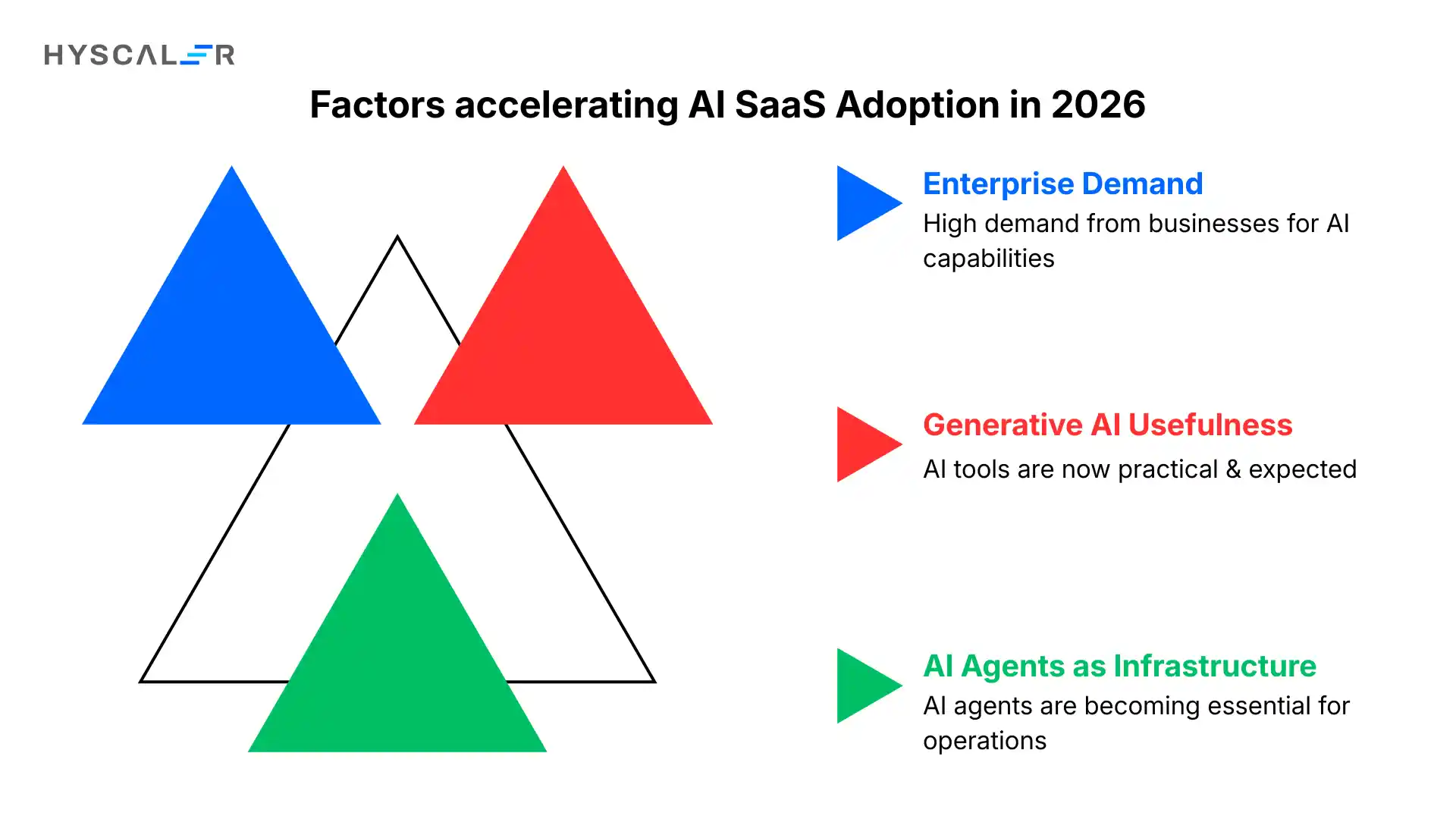
Enterprise demand is real: Around 85% of SaaS companies are integrating AI capabilities into their products. Enterprise software spending is projected to exceed $1.4 trillion in 2026, largely driven by generative AI. Organizations that delay risk building on an increasingly outdated foundation.
Generative AI has crossed the usefulness threshold: Copilots, document processing, semantic search, and workflow automation are no longer experimental; they’re expected. Vertical AI SaaS (purpose-built for legal, healthcare, finance, logistics) is particularly fast-moving.
AI agents are becoming infrastructure: Reports suggest 80% of Fortune 500 companies are already deploying AI agents in some form. Multi-agent systems where multiple AI models collaborate on complex, multi-step tasks are moving from research into production pipelines.
Core Architecture of an AI SaaS Platform
Getting the architecture right early prevents expensive rewrites later.
A production-ready AI SaaS platform typically consists of five integrated layers:
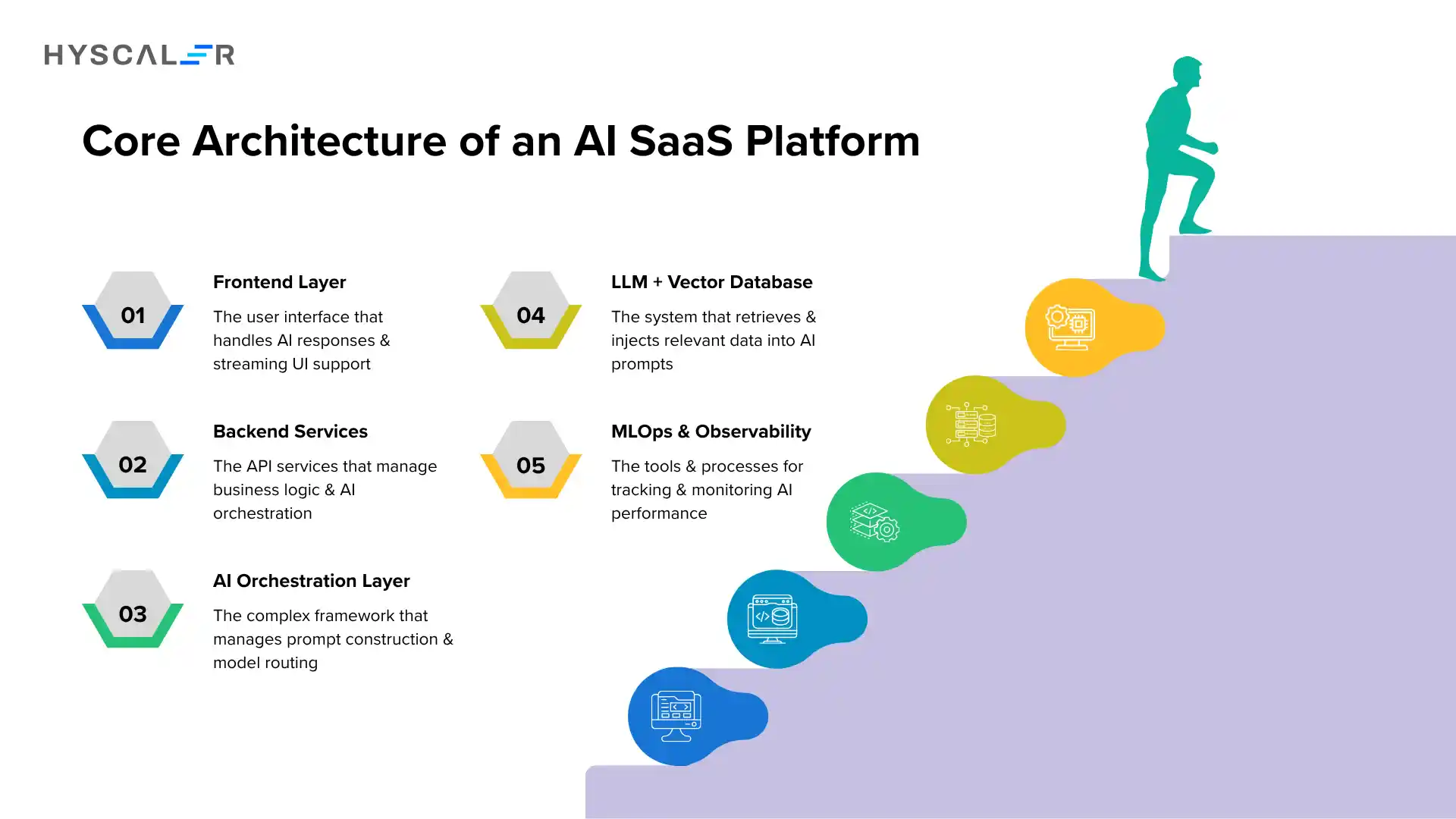
1. Frontend Layer
Standard web stack (React, Next.js) with one important addition: streaming UI support.
AI responses stream token-by-token; your frontend needs to handle this gracefully, not wait for full responses.
2. Backend Services
Python (FastAPI) or Node.js for API services.
Python is dominant for AI-adjacent work given its ML ecosystem.
Structure your backend to separate AI orchestration from your core business logic.
This keeps things testable and maintainable as models change.
3. AI Orchestration Layer
This is where most of the complexity lives.
Frameworks like LangChain or LlamaIndex manage prompt construction, context management, tool calling, and model routing.
For agent-heavy systems, CrewAI or custom orchestration becomes necessary.
4. LLM + Vector Database Integration
Most production AI SaaS uses Retrieval-Augmented Generation (RAG): rather than fine-tuning a model on your data, you retrieve relevant chunks at query time and inject them into the prompt.
This requires a vector database (Pinecone, Weaviate, Qdrant) to store embeddings and run semantic similarity searches.
5. MLOps and Observability
Without observability, you’re flying blind.
MLflow for experiment tracking, LangSmith for LLM tracing, and cloud-native monitoring (CloudWatch, Datadog) for infrastructure.
You need to track prompt versions, model outputs, latency, cost-per-query, and hallucination rates.
AI SaaS Tech Stack in 2026
| Layer | Recommended Technologies |
|---|---|
| Frontend | React, Next.js |
| Backend | Python/FastAPI, Node.js |
| AI Models | GPT-4o, Claude 3.5, Gemini 1.5 |
| Vector Database | Pinecone, Weaviate, Qdrant |
| Orchestration | LangChain, LlamaIndex, CrewAI |
| Cloud | AWS, Azure (strong OpenAI integration), GCP |
| MLOps | MLflow, LangSmith, Weights & Biases |
| Auth & Multi-tenancy | Auth0, Clerk, custom JWT |
| Observability | Datadog, CloudWatch, OpenTelemetry |
Stack selection should be driven by your AI model choice (Azure favors OpenAI), your team’s existing expertise, and compliance requirements, not trend-following.
AI Agent Architecture in SaaS Applications
AI agents are AI systems that can take actions autonomously, calling APIs, searching the web, writing and executing code, and interacting with databases based on a high-level goal, without step-by-step human instruction.
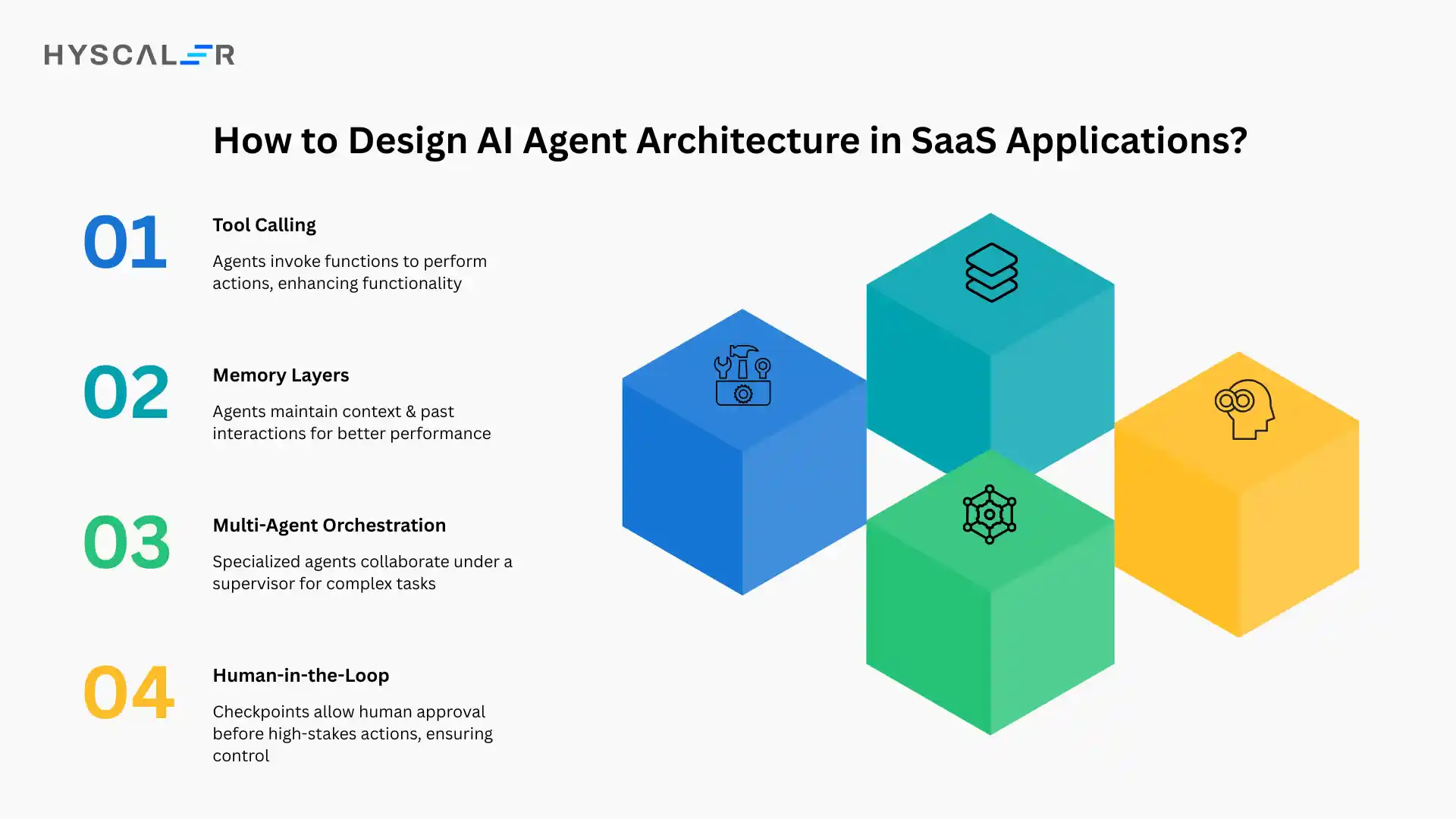
In SaaS products, agent architecture introduces:
- Tool calling: agents invoke defined functions (send email, query CRM, generate report) as part of their reasoning loop
- Memory layers: short-term (conversation context), long-term (vector store), and episodic (past interaction summaries)
- Multi-agent orchestration: specialized agents (researcher, writer, validator) collaborate under a supervisor agent
- Human-in-the-loop controls: checkpoints where agents pause for approval before high-stakes actions
The main risk is also the main power: autonomy.
Agents that can act broadly must be constrained carefully with defined tool scopes, output validation, and audit trails.
AI SaaS Development Lifecycle
Successful AI SaaS products follow a tighter, more iterative cycle than traditional SaaS:
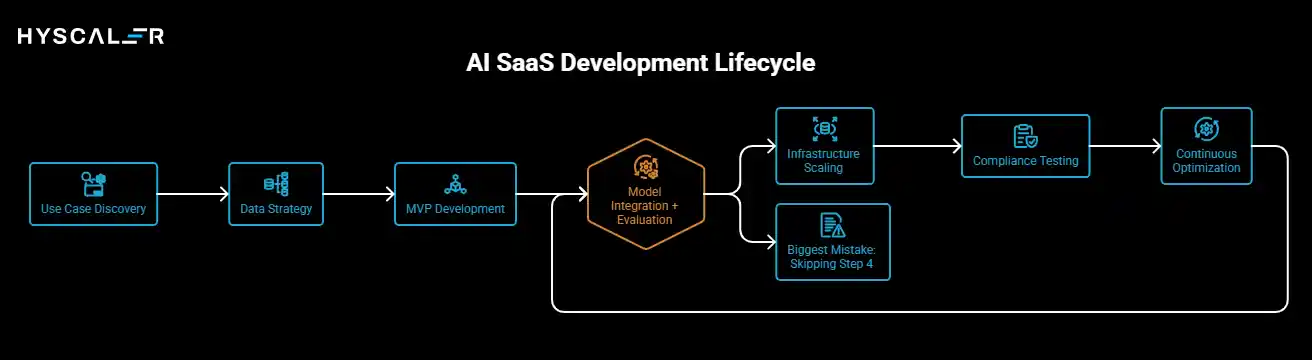
- Use case discovery: identify where AI creates measurable value (cost reduction, speed, quality) vs. where it adds complexity without payoff
- Data strategy: determine what proprietary data you have, what you need, and how to structure it for AI consumption
- MVP development: build the thinnest useful product; defer infrastructure scale
- Model integration + evaluation: integrate LLMs/agents and establish evaluation benchmarks before launch, not after
- Infrastructure scaling: move from prototype infra to production-grade (multi-tenancy, rate limiting, failover)
- Compliance testing: security, data isolation, regulatory checks (SOC 2, GDPR, HIPAA, where relevant)
- Continuous optimization: ongoing prompt tuning, cost management, model updates, and drift monitoring
The biggest mistake teams make: skipping step 4.
Without an evaluation framework in place, you have no way to know if a model update improved or regressed your product.
AI SaaS Product Development Cost Breakdown
Cost is the most underestimated variable in AI SaaS.
Production AI deployments frequently face 500-1000% cost underestimation due to token-based pricing models that don’t behave like traditional compute.
| Stage | Estimated Cost Range |
|---|---|
| MVP (3-4 months) | $40,000 – $120,000 |
| AI Integration (LLM, RAG, agents) | $20,000 – $80,000 |
| Cloud Infrastructure (year 1) | $15,000 – $60,000 |
| Security & Compliance | $10,000 – $40,000 |
| MLOps Setup | $10,000 – $30,000 |
| Scaling (post-launch, year 1) | $30,000 – $100,000+ |
Hidden cost drivers to watch:
- Token costs at scale: a product making 10,000 API calls/day at $0.01/call = $36,500/year before growth
- GPU inference costs: if self-hosting models, GPU instances run $2-$10/hour
- Embedding pipeline costs: indexing large document libraries into vector DBs has upfront and ongoing costs
- Re-evaluation costs: every model update should trigger a re-evaluation run
Build vs. Buy: Should You Build Your Own AI Infrastructure?
| Factor | Build | Buy |
|---|---|---|
| Customization | Full control | Limited to vendor features |
| Time to market | 3-9 months | Days to weeks |
| Cost (year 1) | $100K-$400K+ | $20K-$100K+ |
| Data control | Complete | Vendor-dependent |
| Scalability | Engineering effort | Usually handled |
| Competitive differentiation | High | Low |
The practical answer: Buy or use managed services for commodity infrastructure (auth, hosting, monitoring). Build for your core AI differentiation the workflows, prompts, agent logic, and data pipelines that are unique to your product. Few companies have good reasons to self-host LLMs in 2026.
Security, Compliance & Governance
AI SaaS introduces security surface areas that traditional SaaS doesn’t have:
- Prompt injection: malicious inputs that hijack model behavior; requires input sanitization and output validation
- Data isolation: in multi-tenant AI systems, ensuring one customer’s data never leaks into another’s context is non-trivial
- Model security: fine-tuned models or embedded data can be extracted through adversarial querying
- AI observability: you need logs of what your AI said, to whom, and why, for compliance, debugging, and auditing
Compliance frameworks to plan for:
- SOC 2 Type II: required for enterprise sales
- GDPR: mandatory for EU customers; affects data retention and model training
- HIPAA: required for healthcare applications; affects where and how data is processed
Teams working with regulated industries should treat compliance as a design constraint, not a post-launch checklist.
Engineering partners like HyScaler that have built enterprise AI systems before can significantly reduce the time and cost of getting this right.
Common Challenges in AI SaaS Development
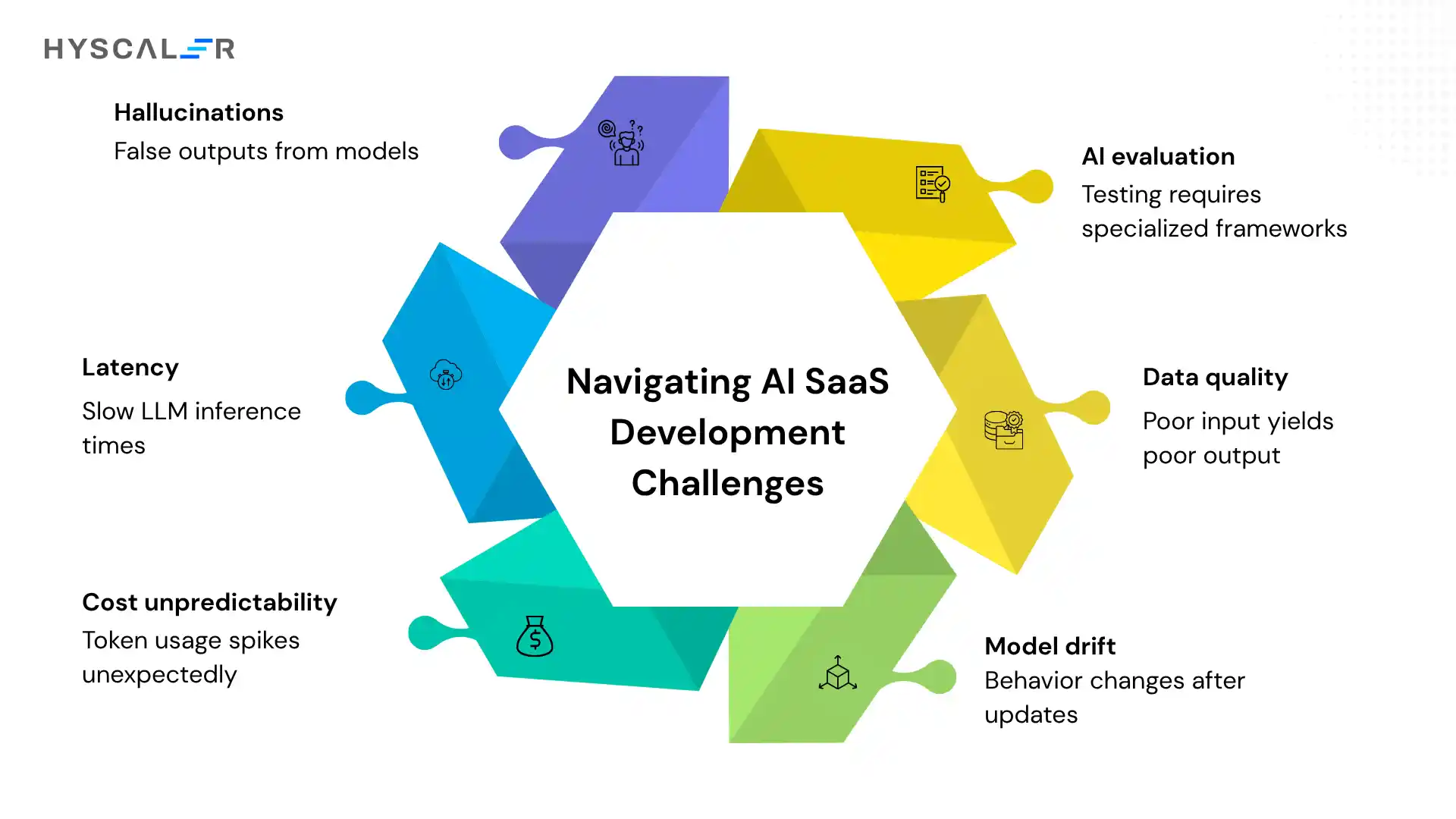
- Hallucinations: models confidently generating false outputs; mitigated with RAG, output validation, and human review checkpoints
- Latency: LLM inference is slow (2-15 seconds per call); streaming, caching, and async design are essential
- Cost unpredictability: token usage can spike unexpectedly; implement usage caps and cost alerts early
- Model drift: model provider updates can subtly change behavior; run regression evaluations on every update
- Data quality: AI quality is upstream of model quality; poor input data produces poor outputs regardless of model capability
- AI evaluation at scale: testing AI systems requires purpose-built evaluation frameworks, not standard QA processes
Future Trends in AI SaaS (2026 and Beyond)
- AI-native SaaS: products where AI is the primary interface, not a feature panel
- Autonomous agents: agents that execute multi-day, multi-step workflows with minimal human oversight
- Multimodal AI: systems that process and generate text, images, audio, and video in a unified pipeline
- Vertical AI SaaS: specialized platforms built for specific industries with domain-tuned models and workflows
- Open-source LLM adoption: Llama, Mistral, and similar models enabling on-premise deployment for data-sensitive industries
- AI operating systems: orchestration layers that manage multiple AI agents, tools, and data sources as a unified platform
Building a production-grade AI SaaS platform requires engineering depth across AI orchestration, cloud infrastructure, MLOps, and security. If you’re evaluating your architecture or looking for an implementation partner, HyScaler’s AI engineering team works with startups and enterprises to design and ship scalable AI systems from MVP to production.
FAQ
What is AI SaaS?
AI SaaS is cloud-based software where artificial intelligence, machine learning, LLMs, or AI agents are a core part of the product’s functionality, not just a feature add-on.
How much does it cost to build an AI SaaS product?
A production-ready MVP typically costs between $40,000 and $120,000. Full-scale platforms with compliance, MLOps, and agent infrastructure range from $150,000 to $400,000+ in year one.
How long does it take to build an AI SaaS platform?
A focused MVP takes 3-4 months. A production-ready, scalable platform with compliance and MLOps in place typically takes 9-18 months.
What are AI agents in SaaS?
AI agents are AI systems that can autonomously complete tasks, calling APIs, reading documents, writing code, and making decisions based on a high-level goal rather than step-by-step instructions.
Should startups build or buy AI infrastructure?
Buy commodity infrastructure (auth, hosting, monitoring). Build your core AI differentiation with the prompts, agents, data pipelines, and workflows that make your product unique.
What compliance standards matter for AI SaaS?
SOC 2 for enterprise readiness, GDPR for EU users, and HIPAA for healthcare. Prompt injection protection and data isolation are baseline security requirements for any multi-tenant AI system.
What is RAG and why does it matter?
Retrieval-Augmented Generation (RAG) is a technique where relevant data is fetched from a vector database and injected into a model’s prompt at query time. It’s the primary method for grounding AI outputs in your proprietary data without fine-tuning.
What is the biggest mistake in AI SaaS development?
Skipping AI evaluation infrastructure. Without a systematic way to measure output quality, every model update becomes a risk rather than an improvement.