
Table of Contents
The Internet of Things (IoT) is the network of physical objects that are embedded with sensors, software, and other technologies to connect and exchange data with other devices and systems over the Internet. IoT development is the process of designing, building, and deploying IoT solutions that can solve real-world problems and create value for various industries and applications.
IoT development is important because it can enable new levels of efficiency, productivity, innovation, and customer satisfaction. IoT development can also address some of the major challenges facing the world today, such as climate change, health care, urbanization, and security.
In this article, we will explore the top 10 IoT development trends to watch in 2026 and beyond. These trends will shape the future of IoT development and offer new opportunities and challenges for developers, businesses, and consumers. Before we get into the trends, it’s important to understand the challenges that IoT Development presents.
What are some IoT development challenges?
The process of designing, building, and deploying IoT solutions that can solve real-world problems and add value to various industries and applications is known as IoT development. However, there are some challenges to IoT development that must be addressed and overcome.
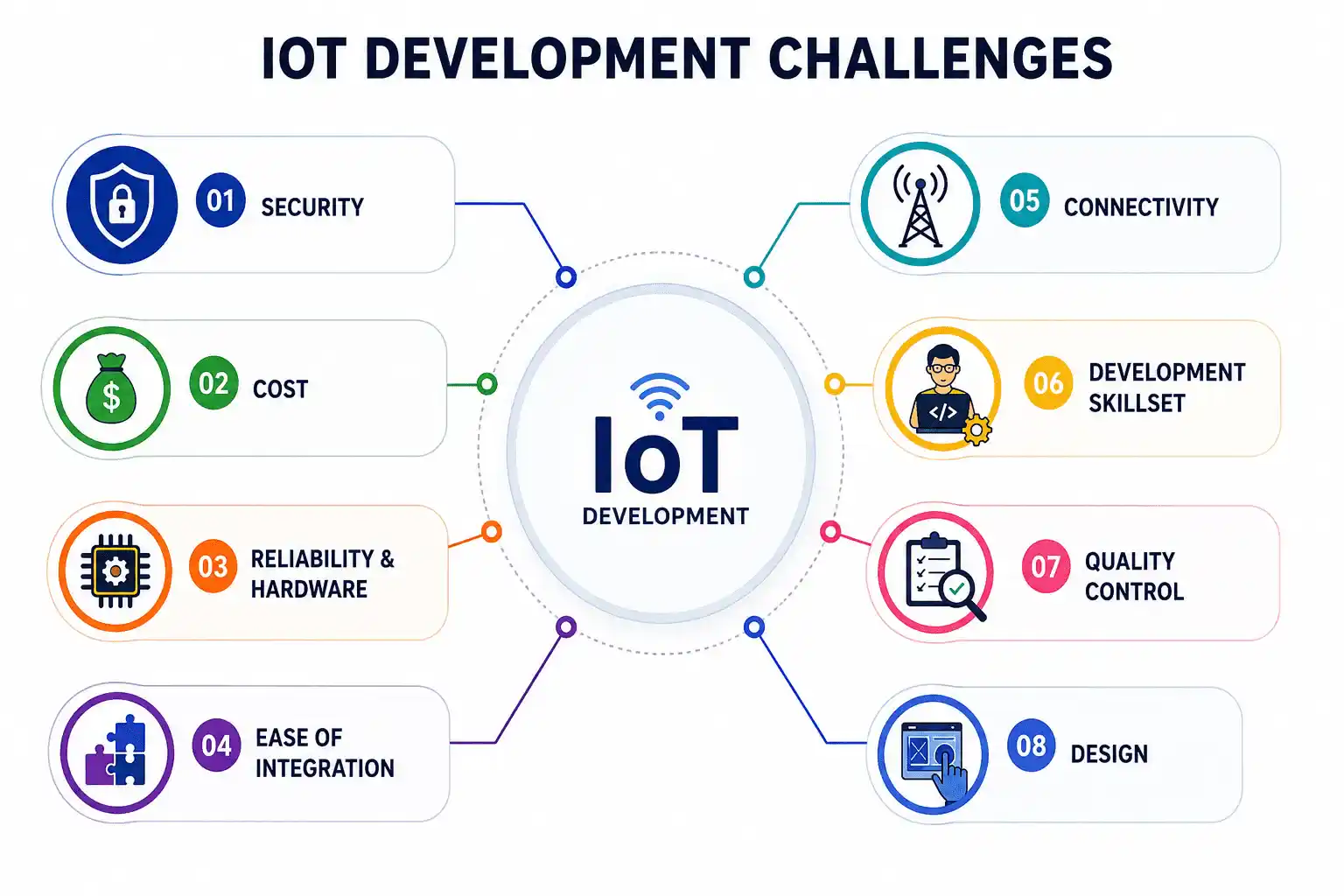
The following are some of the most common IoT development challenges:
- Security: Cyberattacks, hacking, data theft, and unauthorized access are all threats to IoT devices and networks. To protect the confidentiality, integrity, and availability of IoT systems and data, strong encryption, authentication, firewalls, and other mechanisms must be implemented.
- Cost: IoT development necessitates a significant initial investment in infrastructure, hardware, software, and maintenance. IoT development also has hidden costs such as network bandwidth, cloud storage, data processing, and so on. IoT development must balance the cost and benefit of IoT solutions in order to maximize the return on investment.
- Reliability and Hardware: Failures, errors, malfunctions, and disruptions of IoT devices and networks can occur due to a variety of factors, such as power outages, network congestion, environmental conditions, physical damage, and so on. IoT development must ensure the dependability and durability of IoT devices and networks, as well as backup and recovery options.
- Ease of Integration: IoT devices and networks must communicate and interact with one another as well as with other systems and platforms. IoT development must ensure device and network compatibility and standardization, as well as the use of common protocols, interfaces, and formats.
- Connectivity: To exchange data and information, IoT devices and networks require stable, fast, and secure connectivity. IoT development must take into account the availability and quality of network coverage, bandwidth, latency, and other factors, as well as the use of appropriate technologies such as 5G, Wi-Fi, Bluetooth, and so on.
- Development Skillset: IoT development necessitates a wide range of skills, including software programming, hardware engineering, data science, cloud computing, and so on. IoT development requires a qualified and experienced team of developers who can collaborate and innovate on IoT projects.
- Quality Control: IoT development must ensure the quality and performance of IoT devices and networks, as well as meet users’ and customers’ expectations and requirements. IoT development requires rigorous testing and validation of IoT devices and networks, as well as providing feedback and support.
- Design: IoT development must take into account the design and usability of IoT devices and networks, as well as providing a user-friendly and intuitive interface. IoT development must comprehend the needs and preferences of users and customers in order to create IoT solutions that are appealing, engaging, and functional.
These are some of the major obstacles to IoT development. These challenges, however, can be viewed as opportunities for innovation and improvement. IoT development can create successful and impactful IoT solutions that benefit various industries and applications by utilizing the best practices and solutions for each challenge.
Trend 1: Edge Computing
Edge computing has evolved from simply moving data processing closer to the device into something more significant: Edge AI. The demand for local inference has grown sharply, driven by the need to reduce latency, improve resilience, cut bandwidth costs, and protect data privacy.
Approximately 21 billion IoT devices are deployed globally, and the majority still rely on external processing or simple rule-based logic. That gap is narrowing fast. Edge AI enables devices to analyze data, make decisions, and act without waiting for a cloud round-trip.
Benefits of Edge AI for IoT development:
- Real-time decision-making with near-zero latency
- Reduced dependence on cloud infrastructure and costs
- Greater data privacy by keeping sensitive data local
- Improved resilience when network connectivity is disrupted
Examples:
- Industrial cameras performing defect detection directly on the factory floor
- Wearables detecting health anomalies and alerting users instantly
- Smart speakers process voice queries fully offline
- Autonomous systems coordinating locally without a central server
Trend 2: Artificial Intelligence (AI) and Machine Learning (ML)
AI and IoT are no longer separate disciplines; they are converging into AIoT (Artificial Intelligence of Things). The AIoT market reached over $60 billion and is growing at a compound annual rate of around 26%, reflecting how central this convergence has become.
By embedding machine learning into connected systems, AIoT enables real-time predictions, anomaly detection, and autonomous decisions. This goes well beyond the smart thermostats and basic automation of earlier IoT generations.
Benefits of AIoT:
- Predictive maintenance that reduces unplanned downtime
- Personalized, context-aware services at scale
- Autonomous process optimization without human intervention
- Anomaly detection for security, safety, and quality control
Examples:
- Manufacturing systems running predictive maintenance that cut operational costs by up to 25%
- Smart city infrastructure that dynamically adjusts traffic signals and reduces congestion
- Healthcare wearables that detect early warning signs of cardiac events and alert clinicians
- Agricultural drones that analyze crop health and automate irrigation decisions
Trend 3: 5G Networks
5G has moved from the pilot stage to mainstream deployment, and its impact on IoT is significant. With data rates of up to 20 Gbps, latency as low as 1 millisecond, and support for up to one million devices per square kilometer, 5G unlocks IoT use cases that were previously impractical.
Transportation and logistics alone account for roughly 26% of global 5G IoT connections, driven by telematics, real-time navigation, and supply chain visibility. Cellular IoT connections globally are projected to reach approximately 7 billion.
Benefits of 5G for IoT development:
- Enables massive, dense device deployments
- Supports real-time applications requiring ultra-low latency
- Reduces power consumption for connected devices
- Improves interoperability across complex IoT ecosystems
Examples:
- Autonomous vehicles communicating with infrastructure to prevent collisions
- Remote surgical systems enabling telemedicine in real time
- Smart city platforms monitor air quality, traffic, and energy simultaneously
- Industrial robotics coordinating across factory floors with microsecond precision
Trend 4: IoT Security
IoT security has matured from an afterthought into a core architectural concern. As the connected device footprint expands, so does the attack surface. Smart home devices, patient monitoring systems, and industrial edge nodes all represent potential entry points for malicious actors.
The industry has shifted toward a security-by-design approach, where protections are built into devices and networks from the start, not layered on after deployment.
Key security challenges today:
- Diversity and complexity of devices across different vendors and platforms
- Limited computational resources on many IoT endpoints
- Lack of consistent regulation and global standards
- Physical tampering risks for deployed edge devices
Best practices for IoT security:
- Implementing zero-trust architecture across device networks
- Using blockchain for tamper-proof transactions and audit trails
- Applying over-the-air (OTA) firmware updates to patch vulnerabilities at scale
- Training development teams on secure-by-default principles
Examples:
- AI-based threat detection that identifies and isolates compromised devices
- Biometric authentication for access control in industrial IoT environments
- Blockchain-secured supply chain data for logistics and pharmaceuticals
- Edge computing architectures that minimize data exposure to central servers
Trend 5: IoT Development in Healthcare
The Internet of Medical Things (IoMT) is transforming how healthcare is delivered. Health organizations integrating IoT with cloud analytics platforms report measurable improvements: shorter patient wait times, fewer readmissions, and better utilization of critical equipment.
IoT in healthcare is no longer about isolated devices; it’s about building a connected, data-driven care model that benefits both patients and providers.
Benefits of IoT for healthcare:
- Continuous patient monitoring outside hospital settings
- Faster clinical decision-making backed by real-time data
- Reduced healthcare costs through earlier intervention
- Increased access to care through telehealth platforms
Examples:
- Remote monitoring devices track vital signs, medication adherence, and symptoms
- AI-enabled wearables that detect early signs of atrial fibrillation or blood glucose spikes
- Smart implants like insulin pumps and pacemakers that adjust automatically based on patient data
- Telehealth platforms connecting patients and providers across geographies
Trend 6: IoT in Manufacturing
Industrial IoT (IIoT) has become foundational to digital transformation in manufacturing. The shift from reactive maintenance to data-driven predictive models has delivered measurable results, with organizations reporting reductions in IT and analytics costs alongside meaningful performance improvements.
Smart factories are no longer a concept. IoT-connected machines, sensors, and systems now manage production lines with greater precision and efficiency than traditional methods.
Benefits of IoT for manufacturing:
- Significant reduction in unplanned downtime through predictive maintenance
- Real-time quality control that catches defects before they reach customers
- Optimized inventory and supply chain visibility
- Improved worker safety through environmental and equipment monitoring
Examples:
- Predictive maintenance systems that stream machine data into AI models to forecast failures
- Computer vision sensors that inspect every item on an assembly line
- Digital twin-based simulations that test production changes before physical implementation
- Smart factories are achieving “lights-out” automation where AI manages entire production floors
Trend 7: IoT in Smart Cities
IoT in smart cities has expanded from sensor-based monitoring into a platform for active governance and urban optimization. Cities now use interconnected IoT systems to manage traffic, energy, public safety, waste, and citizen services, often in real time.
The convergence of IoT, 5G, and AI is enabling city planners to make decisions backed by live data rather than historical reports.
Benefits of IoT for smart cities:
- Reduced traffic congestion and carbon emissions
- Improved energy efficiency across city infrastructure
- Enhanced public safety through predictive monitoring
- Better citizen services through data-driven resource allocation
Examples:
- Adaptive traffic management systems that respond dynamically to congestion
- Smart energy grids that balance renewable energy loads using AIoT in real time
- Sensor-driven waste collection routing that reduces fuel use and inefficiency
- Public safety platforms that integrate camera networks, environmental sensors, and emergency response systems
Trend 8: IoT in Agriculture
IoT has moved precision agriculture from experimental to essential. Soil sensors, drones, and connected irrigation systems now give farmers granular, real-time visibility into crop and field conditions, enabling smarter resource use and higher yields.
IoT in agriculture also supports more resilient supply chains, helping producers anticipate disruptions and reduce food waste.
Benefits of IoT for agriculture:
- Optimized crop yields with reduced water and fertilizer consumption
- Early detection of pest infestations and disease
- Reduced operational costs through automated decision-making
- Improved supply chain traceability from farm to shelf
Examples:
- Soil monitoring sensors measuring moisture, pH, and temperature in real time
- AI-enabled drones assessing crop health across large areas in minutes
- Automated irrigation systems that adjust water distribution based on weather forecasts and soil data
- Smart greenhouse environments that self-regulate temperature, humidity, and lighting
Trend 9: IoT in Retail
IoT in retail has shifted from an inventory management novelty to a strategic layer for personalization and operational efficiency. Connected devices now help retailers understand shopper behavior, reduce shrinkage, and tailor offers both in-store and online.
Benefits of IoT for retail:
- Increased sales through real-time personalized recommendations
- Reduced inventory shrinkage and out-of-stock incidents
- Faster, frictionless checkout experiences
- Improved demand forecasting and supply chain responsiveness
Examples:
- Smart shelves that automatically alert staff when products need restocking or are misplaced
- RFID-enabled inventory systems that track stock levels in real time
- Smart carts that scan items as shoppers browse and enable checkout without queues
- In-store analytics platforms that map foot traffic and optimize product placement
Trend 10: IoT in Transportation
IoT in transportation is driving meaningful improvements in safety, fuel efficiency, logistics, and the passenger experience. With the rise of connected vehicles and smart infrastructure, transportation is becoming one of the most data-rich sectors in the world.
5G connectivity is a key enabler here, supporting the real-time data exchange that autonomous and connected vehicle systems require.
Benefits of IoT for transportation:
- Reduced traffic congestion and vehicle emissions
- Lower fuel costs through optimized routing
- Enhanced road safety through vehicle-to-vehicle (V2V) and vehicle-to-infrastructure (V2I) communication
- Real-time logistics visibility across global supply chains
Examples:
- Connected vehicles sharing road condition and hazard data with the infrastructure
- Smart logistics platforms track shipments with real-time ETA accuracy
- Fleet management systems that monitor driver behavior, fuel consumption, and vehicle health
- Predictive traffic signal systems that reduce idle time and improve urban flow
Conclusion
In this article, we have explored the top 10 IoT development trends to watch in 2026 and beyond. These trends will shape the future of IoT development and offer new opportunities and challenges for developers, businesses, and consumers.
Some of the predictions for the future of IoT development are:
- IoT devices will become more ubiquitous, diverse, and intelligent
- IoT data will become more valuable, actionable, and secure
- IoT applications will become more innovative, personalized, and impactful
- IoT standards will become more unified, regulated, and compliant
FAQ’s
What is the difference between IoT and IIoT?
IoT is a broad term covering all connected consumer and enterprise devices, from smart home gadgets to wearables. IIoT (Industrial Internet of Things) specifically refers to connected systems in industrial settings, such as manufacturing, oil and gas, and logistics, where reliability, safety, and precision are non-negotiable priorities.
How do IoT devices communicate with each other?
IoT devices use a range of protocols depending on bandwidth needs, range, and power constraints. Wi-Fi and Ethernet suit high-bandwidth scenarios; Bluetooth and Zigbee cover short-range, low-power use cases; LoRaWAN handles wide-area deployments; and MQTT serves as the lightweight messaging standard across most IP-based IoT systems.
What is the biggest security risk in IoT?
The most common risks are default or unchanged credentials, unpatched firmware, and unencrypted data transmission, each one a potential entry point for attackers. Security-by-design, where protections are baked in from day one rather than added later, is now the accepted standard for any serious IoT deployment.
What is AIoT and why does it matter?
AIoT (Artificial Intelligence of Things) is the convergence of AI and IoT, where connected devices don’t just collect data – they analyze it and act on it locally using machine learning models. It matters because it enables real-time anomaly detection, predictive maintenance, and autonomous decision-making without relying on a cloud round-trip.
How important is battery life in IoT device design?
It’s critical for any device not on mains power. Battery-powered sensors, trackers, and wearables need carefully balanced sleep cycles, transmission frequency, and processing to hit target lifespans of months or years. Protocols like LoRaWAN and NB-IoT were specifically designed for this use case, and energy harvesting (solar and kinetic) is growing as an alternative.
What is the difference between MQTT and HTTP for IoT communication?
MQTT is a lightweight publish-subscribe protocol built for low-bandwidth, high-latency environments, exactly what many IoT devices operate in, making it far more efficient than HTTP for machine-to-machine communication. HTTP is better suited for request-response interactions and web-facing APIs, but its overhead makes it a poor choice for battery-powered or bandwidth-constrained IoT devices.
What is the Matter protocol, and why is everyone talking about it?
Matter is an open-source smart home connectivity standard backed by Apple, Google, Amazon, and Samsung, designed to make devices from different brands work seamlessly together. It is quickly becoming the default interoperability standard for consumer IoT, reducing the frustration of locked-in ecosystems that have long plagued smart home adoption.