

Table of Contents
Prompt engineering taught AI to answer better questions.
Context engineering teaches AI to solve real business problems.
That shift, from crafting clever inputs to architecting the entire information environment around a model, is quietly becoming the most consequential skill in enterprise AI development.
As AI agents take on multi-step work inside CRMs, ERPs, codebases, and support queues, a well-worded prompt stops being enough. The system needs memory.
It needs to retrieve the right facts at the right moment.
It needs to know what tools it can call, what state a workflow is in, and what a specific user has already told it.
That’s context engineering, and by the end of this guide, you’ll understand why it’s becoming one of the most valuable AI skills in enterprise software development and how leading organizations are building for it in 2026.
Quick Answer: What Is Context Engineering?
Context engineering is the discipline of designing systems that assemble, manage, and deliver the right information, memory, tools, and instructions to an AI model at the right time, so it can complete a task accurately rather than just respond to a single prompt.
- Why it matters: LLMs are only as good as what they can see in a given moment. Context engineering controls what they see.
- One-line comparison: Prompt engineering optimizes a single message; context engineering optimizes the entire information pipeline feeding the model over an ongoing task.
- Enterprise example: A customer support AI agent that pulls a caller’s order history, past tickets, and refund policy before answering isn’t relying on a clever prompt; it’s relying on context engineering.
Why Context Engineering Is the Next Evolution of AI
Software has moved through a clear progression:
Traditional Software → Machine Learning → Generative AI → Prompt Engineering → Agentic AI → Context Engineering
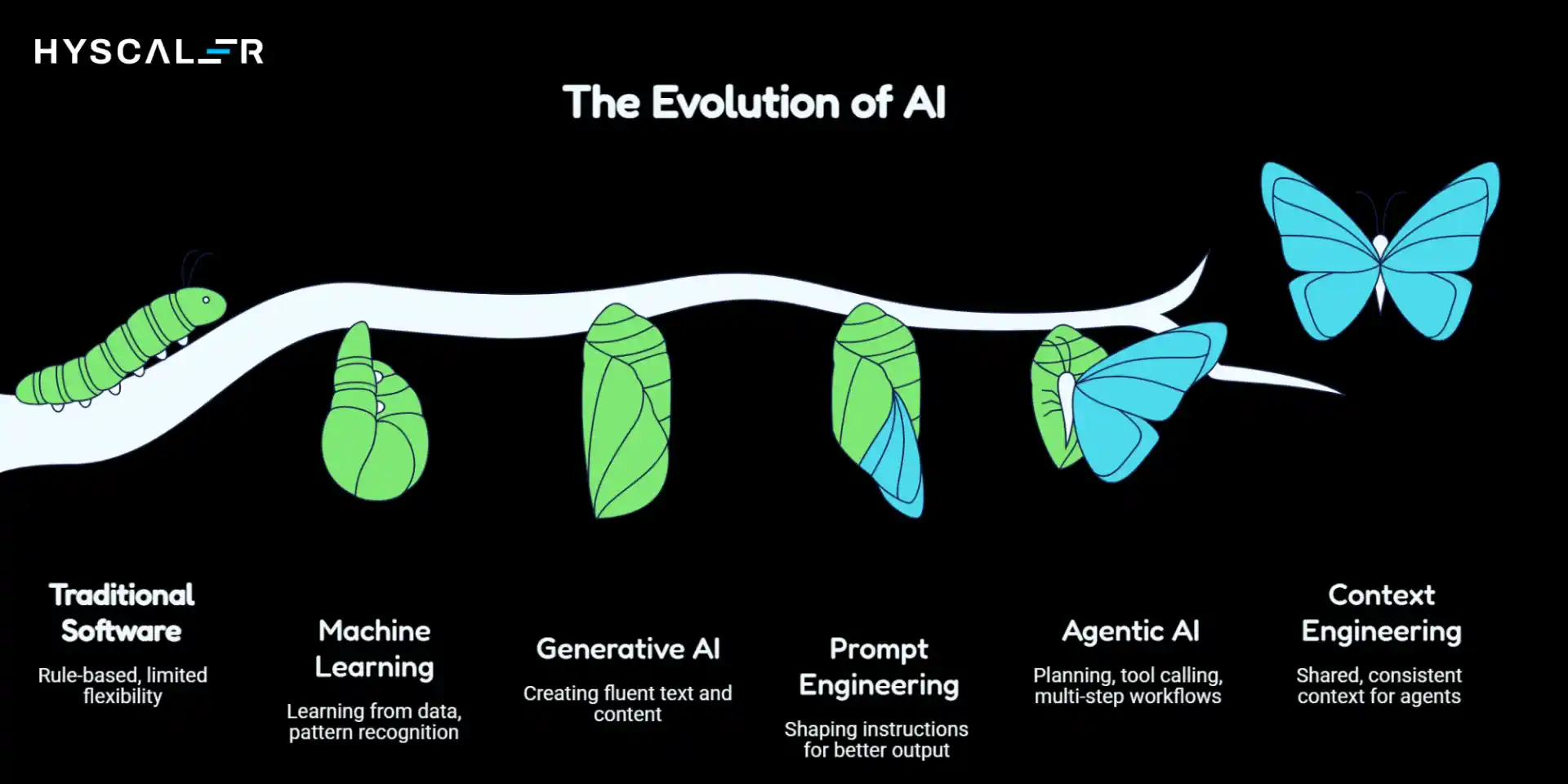
Each stage solved the limitation of the one before it.
Generative AI produced fluent text but had no way to act.
Prompt engineering made that text more useful by shaping instructions carefully.
But prompts alone break down the moment a task requires more than one turn, more than one data source, or more than one tool.
Agentic AI, systems that plan, call tools, and execute multi-step workflows, exposed this gap immediately.
An agent booking a meeting, updating a CRM record, or triaging a support ticket needs ongoing awareness of prior steps, business rules, and system state.
Multi-agent systems raise the bar further: multiple autonomous agents dividing up a task need shared, consistent context to avoid stepping on each other.
As HyScaler’s guide to multi-agent systems notes, these networks work by dividing up tasks and communication, with each agent contributing to a collective goal, something that’s impossible without a deliberate context layer connecting them.
Add enterprise complexity, data silos, permissions, compliance, and long-reasoning models that hold state across many steps, and it becomes clear: context, not just prompting, is now the bottleneck.
What Is Context Engineering?
Context engineering is the practice of designing the pipeline that decides what an LLM sees before it generates a response: relevant memory, retrieved knowledge, tool definitions, user state, and formatting, all assembled dynamically rather than hardcoded into a static prompt.
Goals of context engineering:
- Ground responses in accurate, current, and relevant information
- Preserve continuity across turns, sessions, and workflows
- Give models the tools and permissions to act, not just describe
- Reduce hallucinations by narrowing what the model has to guess
Core components it coordinates:
- Context – everything visible to the model at inference time
- Memory – what persists across turns or sessions
- Knowledge – external facts retrieved from documents, databases, or APIs
- Retrieval – the mechanism that finds and ranks relevant knowledge
- State – where a task or conversation currently stands
A simplified flow:
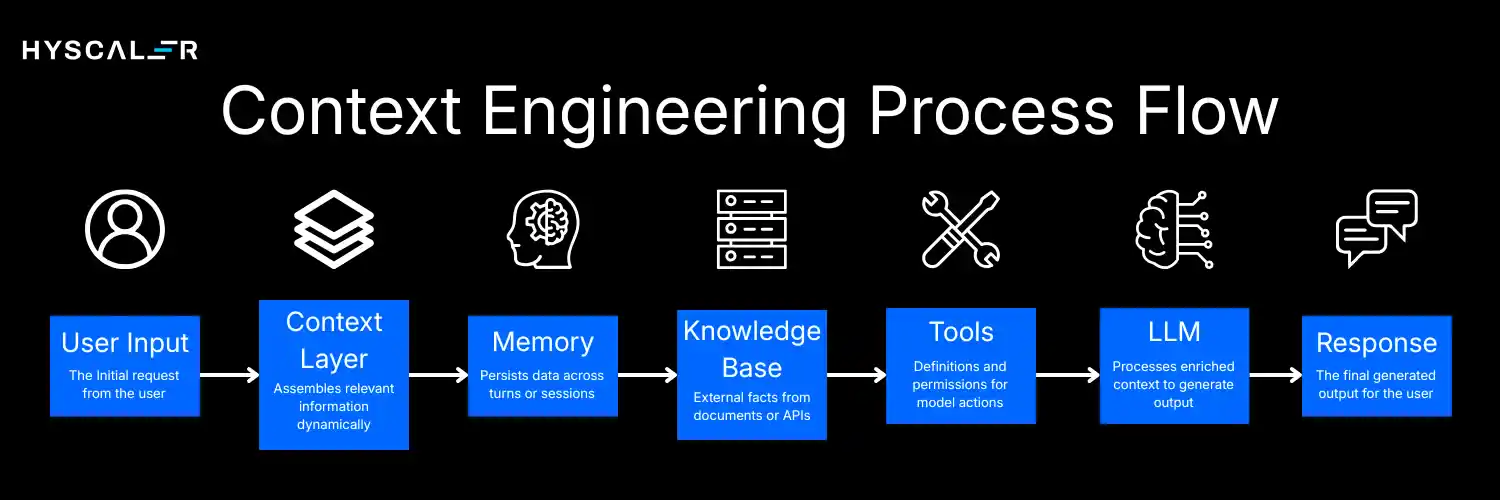
Each layer filters and enriches what eventually reaches the model, so the final response reflects far more than the user’s literal words.
Why Prompt Engineering Is No Longer Enough
Prompt engineering solves a narrow problem: given a fixed context, how do you phrase instructions to get better output?
It has real limits once systems need to operate over time and across tools:
- No memory – every prompt starts cold unless something outside the prompt reintroduces prior context
- No personalization – the model can’t adapt to a specific user without that user’s history being fed in
- Hallucinations – without retrieval grounding, the model fills gaps with plausible-sounding guesses
- Repeated instructions – teams end up re-pasting the same boilerplate into every prompt
- Lost conversation state – long or multi-session interactions lose track of what’s already been resolved
| Capability | Prompt Engineering | Context Engineering |
|---|---|---|
| Memory | None (per-prompt) | Short- and long-term memory systems |
| Tools | Not addressed | Integrated tool calling |
| Retrieval | Manual copy-paste | Automated, ranked retrieval |
| Personalization | Static | Dynamic, user-aware |
| Scalability | Breaks down at scale | Built for multi-user, multi-session scale |
| Enterprise readiness | Limited | Designed for it |
Core Components of Context Engineering
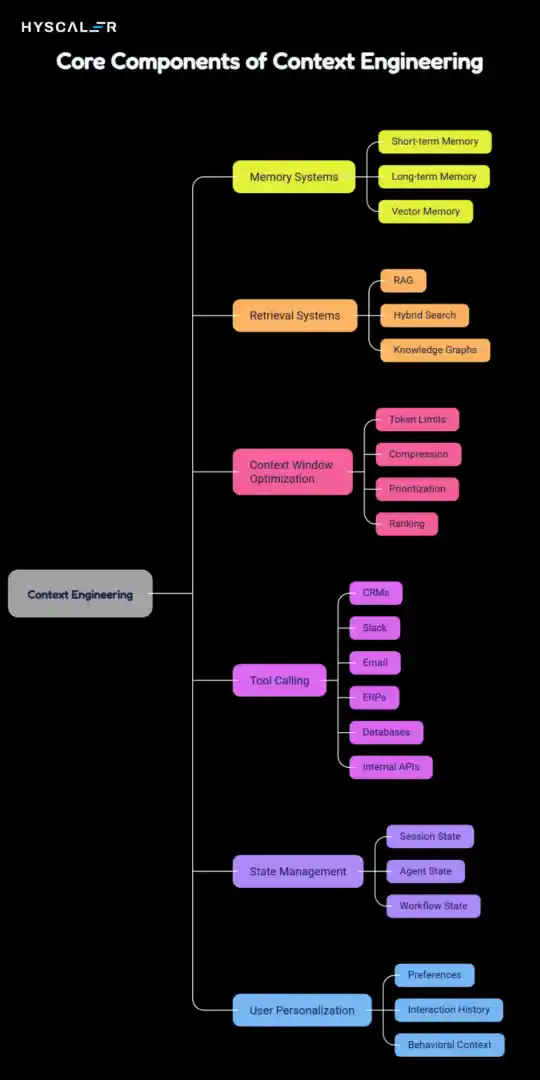
Memory Systems
- Short-term memory holds the current session or task state
- Long-term memory persists facts, preferences, and history across sessions
- Vector memory stores embeddings so semantically similar past information can be retrieved later, not just exact matches
Retrieval Systems
- RAG (Retrieval-Augmented Generation) fetches relevant documents before generation. As HyScaler’s own RAG explainer describes it, retrieval-augmented generation combines the power of large language models with an organization’s specific knowledge base, enabling accurate, contextual responses rather than generic ones.
- Hybrid search blends keyword and semantic search for both precision and recall
- Knowledge graphs capture relationships between entities, useful when facts depend on structure, not just similarity
Context Window Optimization
Even long-context models have limits and cost implications.
Effective systems handle:
- Token limits, how much can fit before truncation or cost spikes
- Compression, summarizing older context instead of discarding or repeating it in full
- Prioritization, deciding what’s essential versus optional for a given turn
- Ranking, ordering retrieved content by relevance before it reaches the model
Tool Calling
Context engineering extends beyond text into action.
Systems connect models to CRMs, Slack, email, ERPs, databases, and internal APIs, so the model can retrieve live data or trigger a workflow instead of only describing what should happen.
State Management
- Session state – what’s happened in the current interaction
- Agent state – where an autonomous agent is in a multi-step plan
- Workflow state – the status of a broader business process the AI is participating in
User Personalization
Preferences, interaction history, and behavioral context let the same underlying model produce meaningfully different, more useful responses for different users.
Context Engineering Architecture
A typical enterprise architecture looks like this:
User → Gateway → Context Builder → Retriever → Memory → Tool Layer → Reasoning Model → Output
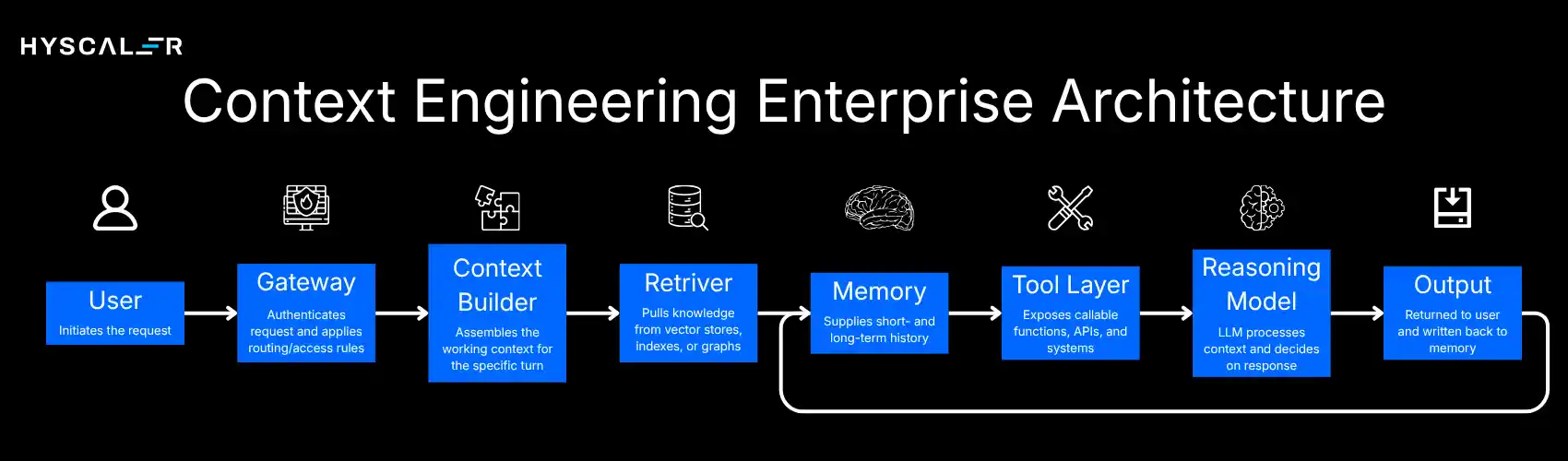
- Gateway authenticates the request and applies routing and access rules
- Context Builder assembles the working context for this specific turn
- Retriever pulls in relevant knowledge from vector stores, search indexes, or knowledge graphs
- Memory supplies short- and long-term history relevant to the user or task
- Tool Layer exposes callable functions, APIs, and connected systems
- Reasoning Model (the LLM) processes the assembled context and decides on a response or action
- Output is returned to the user, and often written back into memory for future turns
Context Engineering vs Prompt Engineering vs RAG vs MCP
These terms are often used interchangeably, but they describe different layers of the same stack.
| Prompt Engineering | RAG | MCP | Context Engineering | |
|---|---|---|---|---|
| Purpose | Optimize a single instruction | Ground responses in external documents | Standardize how models connect to tools and data | Orchestrate the entire context pipeline |
| Memory | None | Limited to retrieved documents | Session-level, tool-mediated | Full memory architecture |
| Tools | Not handled | Not handled | Core focus | Includes tool orchestration |
| Context scope | Single prompt | Retrieved knowledge only | Live tool/data connections | Memory + knowledge + tools + state |
| Scalability | Low | Moderate | High for tool access | Highest, designed for enterprise scale |
| Complexity | Low | Moderate | Moderate–High | High |
| Best use case | One-off tasks, content generation | Knowledge-heavy Q&A | Connecting an LLM to live systems | Multi-step, multi-session, multi-tool AI applications |
Worth clarifying: MCP (Model Context Protocol) is a standard, not a competing philosophy.
As explained in HyScaler’s guide comparing RAG and MCP, MCP lets LLMs use tools and perform actions, connecting them with external tools, APIs, and data in real time, moving LLMs beyond just generating text.
In practice, RAG and MCP are usually two components inside a broader context engineering architecture, not alternatives to it.
How Context Engineering Works
- User request – a query, command, or task trigger arrives
- Context collection – the system gathers session and user metadata
- Memory retrieval – relevant short- and long-term memory is pulled in
- Knowledge retrieval – RAG or hybrid search surfaces relevant documents or data
- Tool execution – if the task requires action, tools are invoked (e.g., via MCP)
- Reasoning – the model processes the assembled context and produces a plan or response
- Output – the result is delivered to the user or downstream system
- Memory update – the interaction is written back into memory for future context
Real-World Examples of Context Engineering
Healthcare AI: Patient history + lab reports + prior appointments + insurance data + clinical guidelines → a grounded treatment or scheduling recommendation, rather than a generic answer.
Customer Support: CRM records + previous tickets + order history + policy documents → a response that reflects what actually happened with that customer, not a templated reply.
Financial Services: Transaction history + fraud signals + risk scoring → decision support that reflects a customer’s actual risk profile in real time.
Software Engineering: GitHub activity + Jira tickets + Slack threads + internal documentation → an AI coding assistant that understands project context, not just the file open in the editor.
Enterprise Search: Company documents + Confluence + SharePoint + Google Drive → an assistant that answers from an organization’s actual knowledge, with source grounding.
Context Engineering for AI Agents
Agents need context more than any other AI system, because they act over multiple steps without a human re-supplying information each time.
That requires:
- Agent memory to track what’s already been done
- Planning informed by current state, not just the original instruction
- Reflection, evaluating whether a prior step succeeded before continuing
- Tool selection based on what’s available and permitted
- Execution that updates shared state as it goes
- Multi-agent collaboration, where specialized agents hand off context to each other under a coordinating layer
This coordination problem is exactly why multi-agent orchestration has become a distinct engineering discipline.
HyScaler’s research into enterprise deployments found that multi-agent orchestration layers coordinate specialized agents, one for CRM updates, one for billing lookups, one for communication, under a central orchestrator that manages context, sequencing, and exception handling.
Context Engineering for Enterprise AI
Enterprise deployment adds constraints that hobby or prototype projects rarely face:
- Data silos across departments and legacy systems
- Permissions: context must respect who’s allowed to see what
- Compliance: regulated industries need auditable data handling
- Security: context pipelines are a new attack surface if not designed carefully
- Real-time data requirements, where stale context produces stale (or wrong) answers
- Governance: clear ownership of what data feeds AI systems and how
One of the biggest enterprise decisions sitting underneath all of this is where models and data actually live.
As HyScaler’s comparison of the two approaches puts it, public AI offers speed and convenience, while private AI offers control and customization, and the right choice depends on the specific use case, risk tolerance, and compliance requirements.
Context engineering has to be designed differently depending on which path an organization takes.
Best practices for enterprise context engineering:
- Build permission-aware retrieval so the AI only sees what a given user is authorized to see
- Treat context pipelines as production infrastructure, with monitoring and versioning
- Separate short-lived session context from durable organizational knowledge
- Design for auditability from day one, not as a retrofit
Common Challenges
- Hallucinations when retrieval is weak, or context is incomplete
- Token limitations that force hard tradeoffs on what to include
- Latency introduced by multiple retrieval and tool-calling steps
- Data freshness: context is only as good as how current the underlying data is
- Security and PII exposure through memory or retrieved documents
- Scaling context pipelines across many concurrent users and sessions
- Observability: knowing why a model produced a given answer given its context
- Cost optimization: every token retrieved and passed to the model has a price
Best Practices
- Prioritize the most relevant context over the most available context
- Reduce token waste with compression and summarization
- Summarize long conversations instead of replaying full history
- Use hybrid retrieval (keyword + semantic) rather than one method alone
- Cache intelligently to avoid redundant retrieval calls
- Build permission-aware retrieval into the pipeline, not around it
- Evaluate continuously; context quality drifts as data and usage change
- Monitor context relevance as a first-class metric, not an afterthought
- Optimize embeddings and re-index as your knowledge base evolves
- Incorporate human feedback loops to catch context failures early
- Version your context pipelines the way you version code
- Separate memory types (short-term vs long-term) rather than treating memory as one blob
- Design fallback behavior for when retrieval returns nothing useful
Popular Context Engineering Frameworks & Tools (2026)
| Category | Examples |
|---|---|
| Agent orchestration | LangGraph, CrewAI, AutoGen |
| Retrieval & indexing | LlamaIndex, Haystack |
| Prompt/context optimization | DSPy |
| Model providers with native tool use | OpenAI Responses API, Anthropic Claude, Google Gemini |
| Vector databases | Pinecone, Weaviate, Qdrant, Milvus |
| Memory & caching | Redis, Mem0, Graphiti |
| Protocol standards | MCP servers |
Measuring Context Engineering Success
- Groundedness – how well responses are supported by retrieved context
- Hallucination rate – frequency of unsupported claims
- Latency – end-to-end response time across retrieval, tools, and generation
- Response accuracy – correctness against ground truth or human review
- Tool success rate – how often tool calls complete correctly
- Context relevance – how well retrieved content actually matches the need
- User satisfaction – direct feedback signals
- Cost per request – token and infrastructure cost per completed interaction
Future of Context Engineering
Several trends are shaping where this goes next:
- Persistent AI memory that carries across products and sessions, not just within one app
- Adaptive context that adjusts dynamically based on task complexity
- AI-native operating systems where context management is a system-level function, not an app-level one
- Knowledge-graph-driven AI for reasoning over structured relationships, not just similarity
- Multimodal context spanning text, images, audio, and structured data together
- Longer-context models reducing (but not eliminating) the need for aggressive compression
- More autonomous AI requiring deeper, longer-horizon context management
- Context compression techniques maturing as a discipline of their own
- Enterprise memory systems becoming as standard as databases are today
- AI-native software architectures built around context as a first-class layer, not bolted on
How HyScaler Builds Context-Aware AI Systems
Designing a context engineering pipeline touches nearly every layer of the enterprise AI stack: memory architecture, retrieval systems, tool integration, permissions, and observability, all working together reliably in production.
HyScaler works across this full stack, including agentic AI development for multi-agent systems that autonomously execute complex workflows and process automation, RAG system development for enterprise knowledge bases and document search, MCP integration for connecting models to live tools and data, and broader AI consulting and custom LLM application work.
The team’s RAG implementations are built to help businesses unlock the full potential of their data through accurate information retrieval and generation, and its automation work is aimed at streamlining complex, multi-step business processes end-to-end.
Looking to build AI agents that truly understand your business context?
HyScaler helps organizations design secure, scalable context engineering architectures that improve accuracy, reduce hallucinations, and power enterprise-grade AI applications.
FAQ
What is context engineering?
The discipline of designing systems that supply an AI model with the right memory, knowledge, tools, and state at the right time, rather than relying on a single well-written prompt.
Is context engineering replacing prompt engineering?
No. Prompt engineering still matters for shaping individual instructions; context engineering handles everything around that instruction: memory, retrieval, tools, and state.
What is the difference between RAG and context engineering?
RAG is one retrieval technique inside a broader context engineering system. Context engineering also covers memory, tools, personalization, and state, which RAG alone doesn’t address.
What is AI context management?
The ongoing process of deciding what information an AI system retains, retrieves, and exposes to a model across a session or workflow.
Why is context important for LLMs?
LLMs generate responses based only on what’s visible in their context window at that moment. Missing or irrelevant context directly causes incomplete, generic, or hallucinated answers.
How do AI agents use context?
Agents rely on context to track task progress, recall prior steps, select the right tools, and coordinate with other agents during multi-step execution.
What are context windows?
The maximum amount of text (measured in tokens) a model can process in a single request, including both the prompt and any retrieved or historical context.
Can ChatGPT use context engineering?
Yes, any LLM-based system, including ChatGPT-based products, can be wrapped in a context engineering architecture using memory, retrieval, and tool integrations built around the model.
What tools are used for context engineering?
Frameworks like LangGraph, CrewAI, and LlamaIndex; vector databases like Pinecone and Qdrant; memory layers like Mem0 and Redis; and protocols like MCP for tool connectivity.
What is persistent memory in AI?
Memory that survives beyond a single session, allowing an AI system to recall facts, preferences, or history from earlier interactions.
Is context engineering required for enterprise AI?
For anything beyond simple single-turn use cases, effectively yes; enterprise workflows involve multiple data sources, permissions, and steps that a single prompt can’t handle.
What is MCP in AI?
Model Context Protocol, a standard for connecting LLMs to external tools, APIs, and data sources so they can retrieve information or take action in real time.
What is long-context AI?
Models designed to process very large context windows, reducing (though not eliminating) the need for aggressive summarization or compression.
What are vector databases used for?
Storing and searching embeddings, numerical representations of text or data, so a system can retrieve semantically similar content rather than relying on exact keyword matches.
How do you optimize context for LLMs?
Prioritize the most relevant information, compress or summarize older context, rank retrieved content before passing it to the model, and remove redundant or stale data.