
Table of Contents
Global supply chains are broken in ways most consumers never see, including counterfeit goods, opaque sourcing, payment delays, and lost shipments, costing businesses trillions every year. Blockchain use cases in supply chain management are solving these problems at the root level by creating immutable, real-time, shared records across every participant in the chain.
In 2026, blockchain is no longer experimental. It is an operational backbone for blockchain logistics, in industries ranging from food and pharma to luxury goods and cross-border trade. This article covers the most impactful blockchain use cases in supply chain management, complete with hard statistics, real-world company examples, and the future trends you need to know.
What Is Blockchain in a Supply Chain?
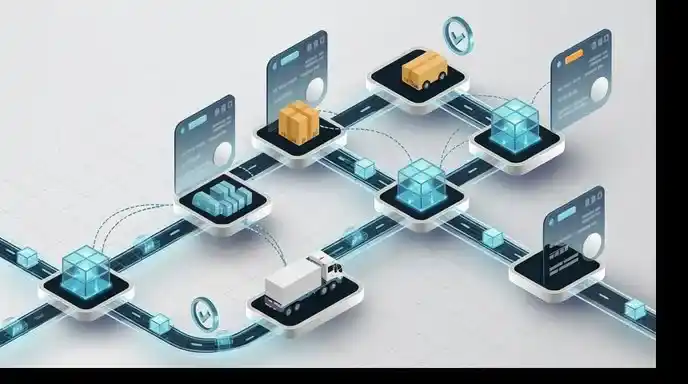
At its core, a blockchain is an immutable, decentralized, distributed ledger that records transactions across a network of computers. When applied to supply chains, every movement of goods, from manufacturer to wholesaler to retailer, is recorded as a time-stamped, tamper-proof block of data.
This shared, transparent record eliminates the need for intermediaries, reduces manual paperwork, and gives every stakeholder a single source of truth. DLT supply chain architecture represents a fundamental shift from siloed records to a unified, verifiable data layer that no single party can manipulate or delete.
Top Use Cases of Blockchain in Supply Chain
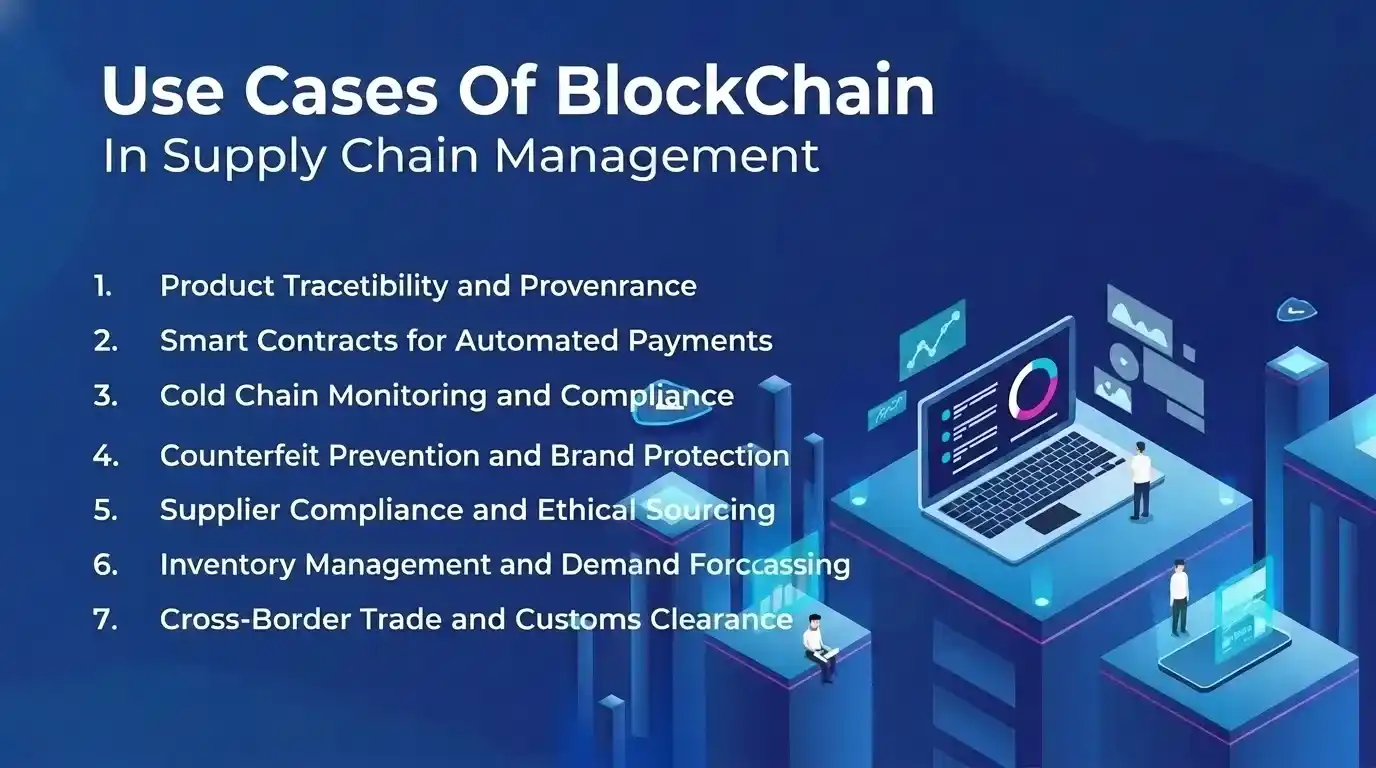
1. Product Traceability and Provenance
Every product gets a tamper-proof digital identity, logging each handoff on an immutable ledger visible to all stakeholders instantly.
Key Impact:
- Drastically cuts product trace time from days to seconds
- Reduces recall investigation costs and response time significantly
- Eliminates counterfeit and mislabeling risks across the entire chain
Real-World Example: Walmart + IBM Food Trust reduced mango farm-to-shelf tracing from 7 days to 2.2 seconds.
Product Traceability & Provenance
2. Smart Contracts for Automated Payments
Payment releases automatically the moment a delivery is confirmed: no invoices, no delays, no disputes.
Key Impact:
- Shrinks weeks-long payment cycles to within a single business day
- Significantly cuts transaction processing costs for all parties
- Near-eliminates payment disputes between suppliers and buyers
Real-World Example: Walmart Canada and DLT Labs built a blockchain-based freight invoice system, automating payments to over 70 third-party carriers, eliminating invoice disputes that previously required manual reconciliation.
Smart Contracts for Automated Payments
3. Cold Chain Monitoring and Compliance
IoT sensors feed real-time temperature data directly onto an immutable ledger, creating instant, auditable compliance proof for every shipment.
Key Impact:
- Substantially reduces pharmaceutical temperature excursion incidents
- Protects billions in products lost annually due to cold chain failures
- Delivers real-time, regulator-ready compliance records automatically
Real-World Example: Pfizer and IBM tracked verifiable temperature records for every COVID-19 vaccine shipment in real time using blockchain.
Cold Chain Monitoring & Compliance
4. Counterfeit Prevention and Brand Protection
Each product receives a cryptographic digital ID at manufacture, making it impossible to inject fake goods anywhere in the chain undetected.
Key Impact:
- Dramatically reduces counterfeit incidents across industries
- Tackles hundreds of billions lost annually to fake pharmaceutical drugs
- Makes product authentication instant at any point in the chain
Real-World Example: De Beers’ Tracr platform gives every diamond an unforgeable digital product passport from the mine to the retail counter, instantly verifying authenticity and ethical sourcing.
Counterfeit Prevention & Brand Protection
5. Supplier Compliance and Ethical Sourcing
Every supplier tier, from Tier 1 to raw material source, is documented with immutable, verifiable records that auditors can access in real time.
Key Impact:
- Cuts ESG audit time and cost by a significant margin
- Closes supplier visibility gaps that most executives cite as a critical risk
- Provides regulator-ready proof of ethical sourcing across all tiers
Real-World Example: Everledger uses blockchain to track conflict minerals, including cobalt, from mine to manufacturer. Separately, BMW has piloted its own blockchain-based cobalt sourcing programme to meet ethical sourcing standards reflecting a wider industry shift toward on-chain supplier verification.
Supplier Compliance & Ethical Sourcing
6. Inventory Management and Demand Forecasting
A single shared ledger replaces fragmented data silos, giving every partner identical real-time stock visibility across the entire network.
Key Impact:
- Reduces excess inventory carrying costs considerably
- Cuts stockout rates across the distribution network
- Eliminates the bullwhip effect through real-time shared data
Real-World Example: Unilever has piloted blockchain across its supply chain in Southern Africa, connecting smallholder farmers, processors, and distributors on a shared ledger, improving procurement visibility and accelerating supplier payments significantly.
Inventory Management & Demand Forecasting
7. Cross-Border Trade and Customs Clearance
Bills of lading, certificates of origin, and customs declarations are digitized on a single permissioned platform visible to all parties simultaneously.
Key Impact:
- Cuts customs clearance from several days to within hours
- Slashes documentation errors across international trade flows
- Saves the shipping industry trillions lost to manual processing annually
Real-World Example: Singapore’s Networked Trade Platform connects thousands of businesses and government agencies on a live blockchain network for trade documentation. CargoX similarly powers blockchain document transfer for Egypt’s national import system, processing hundreds of thousands of trade documents with full auditability.
Cross-Border Trade & Customs Clearance
Key Benefits of Blockchain in Supply Chain
The core benefits driving adoption of blockchain use cases in supply chain operations include:
Transparency: Blockchain transparency gives every stakeholder identical real-time data, eliminating disputes and information asymmetry across the entire network.
Immutability: Records cannot be altered retroactively, building trust across parties who may not know each other – critical in multi-tier global supply chains.
Efficiency: Automation via smart contracts and digital documentation drastically cuts manual processes, reducing cycle times from weeks to hours.
Cost Reduction: Fewer intermediaries, faster settlements, and reduced fraud losses directly improve margins at every level of the supply chain.
Regulatory Compliance: Auditable, time-stamped records make it far easier to demonstrate compliance with food safety laws, drug traceability mandates, and sustainability regulations.
Resilience: Real-time shared visibility helps supply chain managers identify disruptions, supplier failures, port delays, and weather events and respond faster than any traditional system allows.
Future Trends: Where Blockchain Use Cases in Supply Chain Are Heading
The next wave of blockchain use cases in supply chain innovation is accelerating fast:
AI + Blockchain: Artificial intelligence is now being layered onto blockchain supply chain data, predicting disruptions before they happen, flagging anomalies in real time, and auto-rerouting shipments. The combination of AI’s predictive power with blockchain’s trusted data layer is creating a self-optimizing supply network.
Asset Tokenization: Physical goods, pallets, containers, and even individual products are being tokenised on the blockchain, unlocking new supply chain financing models in which assets can be used as collateral instantly, without the friction of traditional banking.
DeFi Trade Finance: Decentralized finance protocols are beginning to power supply chain lending against blockchain-verified invoices and inventory records, giving small suppliers access to capital that traditional banks have historically denied them.
Carbon & ESG Tracking: As carbon border taxes and mandatory ESG reporting expand globally, blockchain use cases in supply chain sustainability tracking are becoming a regulatory requirement, not an option. Immutable carbon footprint records at every stage of the supply chain are the new baseline expectation.
Conclusion
The data is unambiguous: blockchain use cases in supply chain management deliver measurable, proven value across traceability, payments, compliance, anti-counterfeiting, and cross-border trade. From Walmart’s 2.2-second food trace to De Beers’ unforgeable diamond passports, real companies are generating real returns today.
Blockchain use cases in supply chain operations are not a future investment; they are a present competitive advantage. As AI integration, tokenization, and interoperability standards mature through 2026 and beyond, the gap between early adopters and laggards will only widen.
For any business that sources, moves, or delivers goods, the strategic question is no longer whether blockchain use cases in supply chains apply to you. It is how quickly you can implement them.
FAQ’s
What are the top blockchain use cases in supply chain management?
The top blockchain use cases in supply chain include product traceability, smart contract payments, cold chain monitoring, counterfeit prevention, ethical sourcing, inventory management, and cross-border trade documentation.
How does blockchain improve supply chain transparency?
Blockchain use cases in supply chain transparency give every stakeholder a single, real-time, tamper-proof view of all transactions and product movements across the entire network.
How does blockchain enhance product traceability in supply chains?
Every product gets a unique digital identity that permanently records each handoff from raw material to end consumer, making blockchain use cases in supply chain traceability among the most impactful in the industry.
How do blockchain use cases in supply chain prevent counterfeiting?
Blockchain assigns a cryptographic digital ID to every product at manufacture, making it impossible to introduce fake goods into the chain undetected.
What are the biggest challenges of implementing blockchain use cases in supply chain?
High implementation costs, legacy system integration, lack of industry-wide standards, scalability limitations, and low in-house blockchain expertise are the most common barriers.
What is a digital product passport in blockchain use cases in supply chain?
A digital product passport is a blockchain-based record attached to a product storing its full history, origin, handling, ownership, and certifications accessible instantly by any authorized party in the chain.
Are blockchain use cases in supply chain the future of logistics?
Yes, with AI integration, digital product passports, and mandatory ESG regulations accelerating adoption, blockchain use cases in supply chain are becoming core infrastructure for global trade by 2026 and beyond.