
Table of Contents
Last month, a founder told us she got three quotes for a food delivery app. The first came in at $8,000. The second is at $72,000. The third is at $180,000. Same feature list. Same App Store target. Three completely different numbers.
She wasn’t being scammed. The quotes reflected three different approaches, a solo freelancer working from a template, a mid-size agency building custom, and a US-based firm with a full product team. Each was honest. None of them told her which approach was right for her budget, her timeline, or her risk tolerance.
That gap between the cheapest quote and the most expensive one is where most first-time founders lose money, not by overpaying, but by choosing blindly. This post is built to close that gap. By the end, you’ll know what iOS apps actually cost in 2026, what drives those costs up and down, and how to build a budget that matches the app you actually need.
What Does It Actually Cost to Build an iOS App in 2026?
A quick answer to the cost of building an iOS app will land you between $10,000 and $350,000+, depending on the complexity of your application and the location of your development team.
That range is wide because iOS apps are not a single category. A single-screen utility and a real-time marketplace with personalized recommendation models are both “iOS apps,” but they share almost nothing in terms of engineering effort.
To plan your budget, you need numbers that reflect the current market. Here’s a detailed breakdown of iOS app development cost by complexity based on our projects and market data from Clutch’s 2025 Mobile Developer Database and GoodFirms’ 2025 Mobile App Cost Research, adjusted for 2026 rate increases:
| App Complexity | Core Characteristics | Estimated Cost Range | Typical Timeline |
|---|---|---|---|
| Simple App | Basic UI/UX, 1–3 core features, no external backend, local device storage, basic notifications. Examples: calculators, timers, single-purpose utility apps. | $10,000–$40,000 | 3–6 months |
| Mid-Complexity App | Custom UI/UX, user authentication, payment integration, third-party APIs (maps, basic analytics, social log-in). Examples: booking engines, fitness trackers, e-commerce apps. | $40,000–$120,000 | 6–9 months |
| Advanced App | Custom UI with animations, real-time chat, recurring subscriptions, initial machine learning integrations, multi-role user portals. Examples: custom fintech portals, telehealth apps, on-demand marketplaces. | $100,000–$250,000 | 9–12 months |
| Enterprise-Level App | Scalable database architecture, high-security compliance (GDPR, HIPAA), multi-platform integrations, ERP/CRM connections, custom backend systems. Examples: regulated banking apps, fleet logistics platforms. | $250,000–$500,000+ | 12–18+ months |
These figures are market averages. They give you a starting framework that is more specific than the broad ranges published online. According to GoodFirms’ 2025 research, a native iOS application built for high-performance operations typically requires this level of investment to ensure market readiness.
How iOS App Costs Are Calculated
App development costs are calculated using a simple formula:
Total Cost = (Hourly Rate × Development Hours) + Design + Infrastructure + Compliance + Hidden Costs
To understand how this formula works in practice, let’s look at the budget allocation across development phases. According to the research, budget is typically distributed as follows:
Here’s a detailed breakdown of budget allocation across development phases based on market data:
| Development Phase | Share of the Total Budget | Estimated Cost Range (Mid-Level App) |
|---|---|---|
| Conceptualization & Planning | 5–10% | $2,500–$12,000 |
| UI/UX Design | 10–20% | $5,000–$24,000 |
| Frontend Development | 25–35% | $10,000–$42,000 |
| Backend Development | 25–35% | $10,000–$42,000 |
| QA and Testing | 10–15% | $5,000–$18,000 |
| Deployment and Launch | 5–10% | $2,500–$12,000 |
To show you how this plays out in a real project, here is a worked cost calculation for a mid-level fitness subscription app using a vetted Latin American development team charging a blended rate of $60 per hour:
Here’s a detailed breakdown of a worked cost calculation for a mid-level fitness subscription app based on Latin American developer rate data:
| Project Element / Feature | Estimated Development Time | Calculation (Hours × $60/hr) | Estimated Cost |
|---|---|---|---|
| UI/UX Design (15 screens + branding) | 150 hours | Fixed Design Allocation | $12,000 |
| User Registration & Auth (Apple/Social) | 40 hours | 40 × $60 | $2,400 |
| Subscription Setup (StoreKit 2) | 60 hours | 60 × $60 | $3,600 |
| Progress Charts & HealthKit Integration | 80 hours | 80 × $60 | $4,800 |
| Workout Video Streaming Player | 100 hours | 100 × $60 | $6,000 |
| Backend API & Server Setup (Node.js/PostgreSQL) | 200 hours | 200 × $60 | $12,000 |
| Database Management & Storage Setup | 80 hours | 80 × $60 | $4,800 |
| Admin Control Panel (Web Portal) | 120 hours | 120 × $60 | $7,200 |
| Quality Assurance & Bug Triage | 150 hours | 150 × $60 | $9,000 |
| App Store Deployment & CI/CD Pipeline | 50 hours | 50 × $60 | $3,000 |
| Project Management & Overhead | 120 hours | 120 × $60 | $7,200 |
| Total Project Estimate | 1,000 hours | – | $72,000 |
By breaking down the calculation this way, you can see exactly where every dollar goes. This makes it easier to review and compare agency quotes. Right?
7 Factors That Determine Your iOS App Development Cost
Seven factors shape your development budget. Understanding these lets you scope your project and control costs before signing a contract.
Let’s look at each of these factors.
1. App Complexity and Feature Count
Every feature you add increases design time, coding hours, and testing cycles. A simple feature like social login takes a fraction of the time required for a custom real-time messaging system.
Here’s a detailed breakdown of feature-level development hours and costs based on historical project tracking data:
| Feature / System Component | Average Development Time | Estimated Cost Range (Global Average: $50/hr) |
|---|---|---|
| User Authentication (Email + Social Login) | 20–40 hours | $1,000–$2,000 |
| Push Notifications (Segmented & Scheduled) | 25–50 hours | $1,250–$2,500 |
| Stripe Payment Gateway Integration | 30–60 hours | $1,500–$3,000 |
| Location Services & GPS Tracking | 40–90 hours | $2,000–$4,500 |
| Camera Integration & Basic Image Processing | 40–80 hours | $2,000–$4,000 |
| Real-Time Chat (WebSocket/WebRTC) | 50–120 hours | $2,500–$6,000 |
| Custom Admin Dashboard (Web Portal) | 60–120 hours | $3,000–$6,000 |
2. UI/UX Design Quality
Stock templates and minimal customization cost $2,000–$5,000. A custom design system, including wireframes, interactive prototypes, and branded visual assets costs $10,000–$30,000+.
Design directly impacts user retention. According to user churn data published by Business of Apps, over 70% of users abandon an app after the first day if the interface is confusing. If your business depends on user engagement, custom design is a necessity.
3. Developer Location and Hiring Model
Developer location determines the hourly rate. The same application can cost significantly less when built by an outsourced team in Poland, Brazil, or India, compared to a local team in San Francisco or London.
Here’s a detailed breakdown of developer hourly rates by geography and experience based on market data from Toptal, Clutch, and GoodFirms published rate surveys:
| Country / Region | Junior Rate (USD) | Mid-Level Rate (USD) | Senior Rate (USD) |
|---|---|---|---|
| United States | $50–$80/hr | $80–$130/hr | $130–$200+/hr |
| Canada | $45–$70/hr | $70–$120/hr | $120–$180+/hr |
| United Kingdom | $45–$70/hr | $70–$110/hr | $110–$170+/hr |
| Germany | $40–$65/hr | $65–$105/hr | $100–$160+/hr |
| Poland | $25–$40/hr | $40–$70/hr | $70–$100/hr |
| Ukraine | $20–$35/hr | $35–$60/hr | $60–$90/hr |
| Brazil | $20–$30/hr | $30–$55/hr | $55–$85/hr |
| India | <$20/hr | $20–$35/hr | $35–$60/hr |
4. Backend Infrastructure and Third-Party Integrations
If your app stores user data or synchronizes profiles across devices, it needs a backend. Early-stage apps often use managed backend services like Firebase or Supabase to keep initial costs low. A custom backend built on AWS or GCP adds $15,000–$60,000+ to your budget.
Third-party integrations also add development hours. Connecting to APIs like Twilio for SMS, Google Maps for routing, or Salesforce for customer data can take 20–80 hours per integration.
5. AI or Machine Learning Features
Integrating third-party AI APIs (such as OpenAI or Anthropic) costs $5,000–$15,000. Building and training a custom machine learning model for example, a proprietary computer vision system adds $30,000–$100,000+ to your budget.
According to user survey data published by Business of Apps, 42% of respondents use AI-based apps daily, and 63% believe AI features are more beneficial. High demand for AI functionality makes these features a significant consideration.
6. Ongoing Maintenance and App Store Updates
Development costs do not end at launch. Operating systems change, and Apple releases a major iOS update every September. If you do not update your app, it will degrade.
Maintenance costs are typically modeled annually. Here’s a detailed breakdown of annual maintenance category cost estimates based on market data from Business of Apps’ 2026 Mobile App Maintenance Cost Research:
| Maintenance Category | What It Involves | Annual Cost Range |
|---|---|---|
| Third-Party API updates | Ensuring compatibility with external services (Stripe, Twilio) | $3,000–$20,000/yr |
| iOS Platform Updates | Updating code for the latest iOS releases and Apple SDKs | $5,000–$30,000/yr |
| Server & Backend Maintenance | Hosting management, security patching, and server scaling | $5,000–$25,000/yr |
| User Support & Bug Triage | Investigating user reports, fixing app crashes, and minor updates | $2,000–$10,000/yr |
| UI/UX Refinement | Minor visual tweaks, layout improvements based on telemetry | $5,000–$25,000/yr |
| Database Management | Performance optimization, query indexing, and backups | $5,000–$15,000/yr |
| Licenses & Subscriptions | Costs for development tools, analytics software, domain SSLs | $1,000–$10,000/yr |
| Total Annual Maintenance | All-in recurring operational cost | $26,000–$135,000/yr |
7. Security, Compliance, and Data Privacy
Apps handling health records must comply with HIPAA regulations, adding $10,000–$30,000 for encrypted storage and audit logs. Financial apps need PCI-DSS compliance, adding $5,000–$15,000. Managing European user data requires GDPR compliance mechanisms, adding $8,000–$20,000. Compliance costs protect your business from legal risks and App Store rejection.
iOS App Cost by Type: From Utility Apps to Regulated Platforms
App category influences cost because of structural differences. A marketplace needs database synchronization and payment rails, while an e-learning app focuses on video hosting and caching.
Here’s a detailed breakdown of iOS app cost ranges by industry vertical and geography based on market research:
| App Type / Industry | Primary Features | Typical Development Time | Cost Range (India Dev) | Cost Range (US Dev) |
|---|---|---|---|---|
| Fintech App | Digital wallets, fraud detection, end-to-end encryption | 9–12+ months | $80,000–$150,000 | $250,000–$500,000+ |
| eCommerce App | Product catalog, payment gateway, inventory management | 6–9 months | $40,000–$90,000 | $120,000–$250,000 |
| On-Demand App | Real-time GPS tracking, customer booking, billing portal | 6–9 months | $60,000–$100,000 | $180,000–$300,000 |
| Social Media App | User profiles, image sharing, real-time messaging feed | 6–9 months | $50,000–$95,000 | $150,000–$300,000 |
| Healthcare App | Telemedicine video, HIPAA backend, messaging portal | 9–12 months | $50,000–$110,000 | $150,000–$300,000 |
| Gaming App | Custom physics engine, 3D graphics, in-app purchases | 9–15+ months | $50,000–$120,000 | $150,000–$500,000+ |
| Food Delivery App | Restaurant listings, cart system, live courier tracking | 6–8 months | $40,000–$80,000 | $120,000–$200,000 |
| Travel Booking App | Booking engine, maps integration, travel documents | 6–9 months | $50,000–$90,000 | $150,000–$250,000 |
| eLearning App | Video streaming, course syllabus, quiz logic, user stats | 6–9 months | $40,000–$80,000 | $120,000–$200,000 |
Selecting the right category determines your baseline technical architecture. Right?
Freelancer vs. Agency vs. In-House: Cost and Risk Comparison
Who you hire determines your risk profile. A freelancer is cost-effective but presents project management challenges. An agency has overhead but manages the team.
Here’s a detailed breakdown of hiring model trade-offs, costs, and risks based on market data:
| Dimension | Freelancer | Software Development Agency | In-House Engineering Team |
|---|---|---|---|
| Hourly Rate Range | $25–$150/hr | $50–$250/hr | $130,000–$180,000/yr (salaries) |
| Typical Mid-App Cost | $15,000–$50,000 | $40,000–$120,000 | $150,000–$350,000+ |
| Project Management | Handled by you | Included in team structure | Handled by your internal lead |
| Risk of Project Delays | High (limited accountability) | Low (contractual milestones) | Moderate (resource limitations) |
| Best For | Prototyping, small utility apps | MVPs, production-grade apps | Post-revenue scaling and iteration |
| When to Avoid | Regulated apps (Fintech, Health) | Very small tasks (< 40 hours) | Early-stage pre-seed startups |
Freelancers require significant oversight. If you lack project management experience, a freelance project can stall due to communication issues and lack of structural accountability. For production-grade applications, structured teams mitigate these operational risks.
Hidden Costs Most Founders Miss
A developer’s quote covers code production. It does not cover operations and launching.
Here’s your checklist of annual hidden costs and operational fees based on market data analysis:
| Cost Category | Description | Estimated Expense (Year 1) |
|---|---|---|
| Apple Developer Fee | Required to publish apps on the App Store | $99/yr ($299/yr for enterprise) |
| App Store Optimization (ASO) | Keyword research, screen mockups, testing listings | $2,000–$8,000 (one-time + setup) |
| Usability Testing | Gathering feedback from target groups before release | $3,000–$10,000 |
| Crash Telemetry & Analytics | Integration of tools like Sentry, Mixpanel, Firebase | $600–$6,000/yr |
| Legal Fees & Policies | Drafting Terms of Service, Privacy Policy, and EULA | $2,000–$13,000 |
These hidden costs add up. To help you plan, we have developed a Total Cost of Ownership (TCO) model that combines build costs, hidden expenses, and annual maintenance for the first year:
Here’s a detailed breakdown of the Total Cost of Ownership (TCO) for the first year based on compiled development, hidden, and maintenance cost data:
| App Complexity Tier | Base Development Cost | First-Year Hidden Costs | First-Year Maintenance | Total First-Year Spend |
|---|---|---|---|---|
| Simple App | $15,000–$40,000 | $5,000–$10,000 | $5,000–$10,000 | $25,000–$60,000 |
| Mid-Complexity App | $40,000–$120,000 | $10,000–$25,000 | $15,000–$30,000 | $65,000–$175,000 |
| Advanced App | $100,000–$250,000 | $25,000–$45,000 | $30,000–$60,000 | $155,000–$355,000 |
| Enterprise-Level App | $250,000–$500,000+ | $45,000–$80,000 | $60,000–$120,000 | $355,000–$700,000+ |
This total first-year budget is what you need to track. If you only plan for the initial build, your project may stall when post-launch costs arrive. Right?
iOS vs. Android: Which Costs More in 2026?
Native iOS apps often cost 10–15% less to build than Android apps because the iOS platform has fewer distinct device models. This reduces fragmentation and testing hours.
However, user acquisition costs (CAC) are typically higher on iOS. Apple search campaigns and App Store conversions command a premium.
Here’s a detailed breakdown of iOS vs. Android development, platform, and acquisition metrics based on market data from Precedence Research and Business of Apps’ user acquisition cost analysis:
| Metric | iOS (Apple App Store) | Android (Google Play Store) |
|---|---|---|
| Build Cost Differential | Baseline (10–15% lower testing hours) | +10–15% higher testing hours |
| Average Cost per Install (CPI) | $4.70 (Global average) | $3.40 (Global average) |
| Gaming Category CPI | $2.23 (Liftoff data) | $0.63 (Liftoff data) |
| Fintech Category CPI | $4.35 (Liftoff data) | $2.09 (Liftoff data) |
| In-App Purchase Price Growth | +40% increase (Apptopia) | +9% increase (Apptopia) |
| Market Share (Marketplace Revenue) | 63% revenue share (Precedence) | 37% revenue share (Precedence) |
| Apple Developer Fee | $99/yr ($299/yr for enterprise) | $25 (one-time registration fee) |
iOS requires lower initial testing costs but requires higher user acquisition spending. If you plan to monetize via in-app purchases, iOS offers a higher return per user. Android offers wider reach at a lower acquisition cost.
How to Budget for Your iOS App: A 5-Step Process
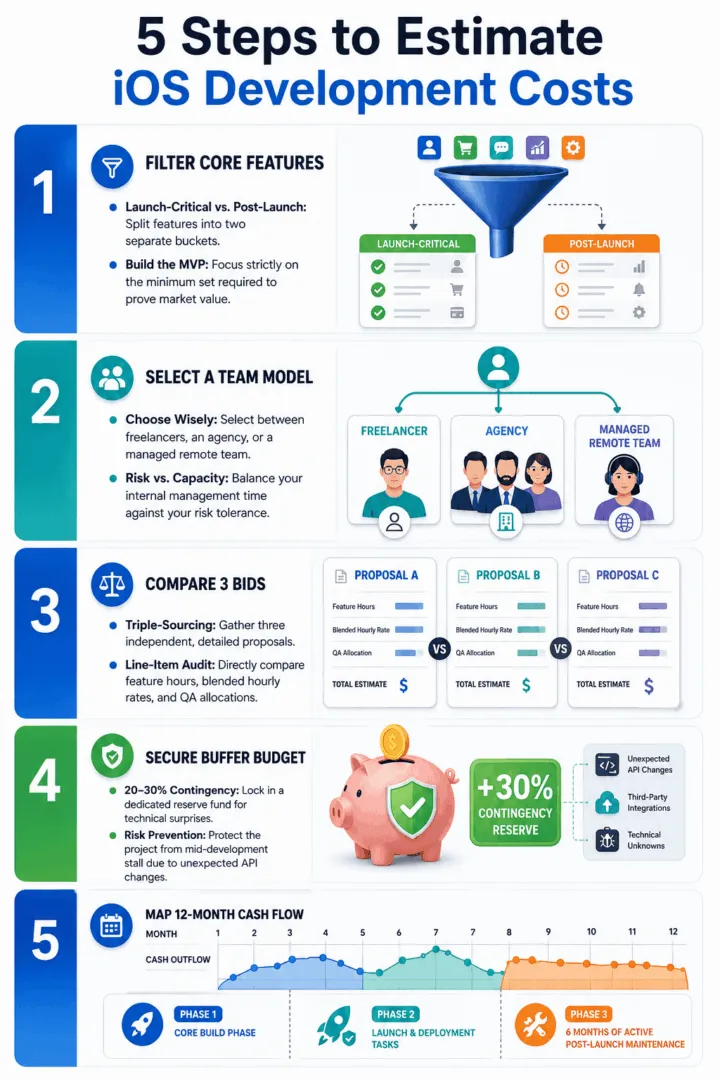
To build a realistic budget, follow these five steps:
Step 1: Scrutinize your feature list. Split your features into launch-critical and post-launch. Build the minimum set needed to prove your business value.
Step 2: Choose your development model. Select freelancers, an agency, or a managed remote team based on your risk tolerance and management capacity.
Step 3: Collect three independent proposals. Request detailed estimates from three teams. Compare feature-level hours, blended rates, and QA allocations.
Step 4: Add a 20–30% contingency reserve. Technical surprises, API updates, and design tweaks occur in every project. A budget contingency prevents project failure.
Step 5: Map your 12-month cash flow. Map out your spending across the build phase, launch tasks, and the first six months of maintenance.
Real-World Cost Examples (Industry-Based Scenarios)
To illustrate how these factors combine, let’s examine four composite scenarios based on common app projects:
Habit Tracker (Simple Tier)
- The Application: A habit tracker with streaks, local notifications, and five static screens. No backend database all data is stored locally using SwiftData.
- The Team: One mid-level iOS freelancer in Eastern Europe ($45/hr) and one part-time designer ($40/hr).
- The Timeline: 8 weeks.
- The Cost: ~$18,000 ($13,000 development + $3,500 design + $1,500 hidden launch costs).
Fitness Subscription App (Mid-Complexity Tier)
- The Application: A subscription-based coaching app with workout videos, billing via StoreKit 2, HealthKit integrations, and a basic admin control portal.
- The Team: A small agency in Latin America (blended rate: $60/hr) providing a designer, backend engineer, and two mobile developers.
- The Timeline: 5 months.
- The Cost: ~$85,000 ($65,000 development + $12,000 design + $8,000 backend integration).
Telehealth Platform (Complex Tier)
- The Application: A patient portal featuring real-time WebRTC video consultation, HIPAA-compliant patient messaging, integration with hospital EHR systems, and billing options.
- The Team: A US-based agency (blended rate: $160/hr) providing a product manager, UX researcher, database architect, three developers, and a QA engineer.
- The Timeline: 10 months.
- The Cost: ~$280,000 ($210,000 development + $25,000 UI/UX + $20,000 compliance setup + $15,000 EHR API work + $10,000 project management).
Enterprise Logistics App (Regulated Tier)
- The Application: A fleet routing system with driver tracking, offline data syncing for remote routes, enterprise ERP integrations (SAP), and end-to-end security encryption.
- The Team: A hybrid team consisting of a US-based product architect and a dedicated engineering group in Eastern Europe (blended rate: $75/hr).
- The Timeline: 12 months.
- The Cost: ~$420,000 ($310,000 development + $35,000 design + $30,000 ERP API integration + $25,000 security engineering + $20,000 QA and deployment support).
Here’s a detailed breakdown of the four worked case studies side-by-side based on regional development rates and project scopes:
| Metric | Habit Tracker | Fitness Subscription App | Telehealth Platform | Enterprise Logistics |
|---|---|---|---|---|
| Complexity | Simple | Mid-Complexity | Complex | Regulated / Enterprise |
| Team Structure | 2 Freelancers | Small Agency Team | Full Agency Team | Hybrid Engineering Team |
| Primary Region | Eastern Europe | Latin America | United States | Eastern Europe / US |
| Timeline | 8 weeks | 5 months | 10 months | 12 months |
| Total Cost | ~$18,000 | ~$85,000 | ~$280,000 | ~$420,000 |
Comparing these projects illustrates how features, location, and compliance requirements shape the bottom line. Right?
How HyScaler Helps You Plan and Build
At HyScaler, we build custom iOS applications for startups and enterprise teams. We align engineering decisions with your business goals, providing milestone-based delivery and transparent cost models.
We help you scope your project, pick the right technology stack (such as native Swift vs. cross-platform Flutter), and structure your backend database for scale.
If you want to discuss your app idea and build an accurate cost estimate, Schedule a 30-minute free discovery call with our engineering team, Inquire Now.
FAQ (Frequently Asked Questions)
We have answered the most common questions founders and product managers ask about iOS app development costs, pricing, and feasibility:
How much does it cost to build an app for iOS and Android?
The combined Android and iOS app development cost ranges from $50,000 to $180,000 for a mid-level cross-platform app using frameworks like Flutter or React Native. If you build two separate native apps, the cost increases by 60% to 80% because it requires two independent engineering teams.
How much does Apple charge to create an app?
Apple does not charge an application fee to write code. However, publishing the app requires an iOS developer account, which has a cost of $99 per year for individuals and companies, or $299 per year if you are building an iOS app for internal use.
Is making iOS apps worth it?
Yes, iOS app development is highly viable. While iOS devices hold a smaller global market share than Android, Apple’s App Store accounts for 63% of global marketplace revenue. iOS users have higher average purchase rates and higher subscription conversion rates, making it the preferred platform for revenue generation.
Does Apple take 30%?
Yes. Apple charges a 30% transaction commission on paid app purchases, in-app purchases (IAP), and digital subscriptions. However, through the App Store Small Business Program, companies earning under $1 million in annual net revenue can apply for a reduced commission rate of 15%. Physical goods and services (such as Uber rides or physical e-commerce purchases) are exempt from this commission.
How much does the iOS developer program cost?
The iOS developer program cost is $99 per year for individual developers and organizations. For enterprise teams distributing applications internally without listing them publicly, the Apple Developer Enterprise Program costs $299 per year.
What does the $99 Apple developer get you?
The $99 annual developer account grants you access to TestFlight for beta testing, Apple’s advanced native SDKs (like CloudKit, HealthKit, and StoreKit), and the ability to submit apps to the App Store for public download.
How much is an app with 100,000 users worth?
The value of an app with 100,000 active users ranges from $50,000 to $1,000,000+, depending on its monetization model and revenue generation. A utility app that monetizes via basic ads might generate $500 to $2,000 per month, whereas a SaaS or subscription app with 100,000 users could generate $50,000+ in monthly recurring revenue, yielding a much higher business valuation.
How much can a 1000 downloads app make?
An app with 1,000 downloads typically makes very little ranging from $10 to $200 per month. Ad-based apps need hundreds of thousands of views to generate meaningful returns, whereas a subscription-based app with a 5% conversion rate ($10/month subscription) can generate $500 per month from 1,000 downloads.
Is there any application fee for iOS?
There is no fee for submitting or updating an application on the App Store. The only direct fee is the annual Apple Developer Program fee of $99.
Are iOS apps free?
Over 90% of apps on the App Store are free to download, monetizing instead through ads, subscriptions, or in-app purchases. For paid apps, the average price is under $2.00, although niche business utilities and enterprise applications can cost significantly more.
How much do you pay for iPhone apps?
Most users pay nothing upfront because the vast majority of iPhone apps are free to download. Users typically pay for services via in-app purchases or recurring subscriptions, which range from $0.99 to $29.99+ per month depending on the application tier.
Why are iOS apps so expensive?
The initial cost to build an iOS app is driven by the specialized skills required to write Swift and SwiftUI code, the strict interface design guidelines set by Apple, and the cost of the hardware needed for development (Macs and iOS test devices). In 2026, the average cost of iOS app development ranges from $40,000 to $120,000 for custom-built applications.
How much does Android and iOS app development cost in India?
The average iOS app cost in India ranges from $15,000 to $45,000 for a mid-level custom application. Due to lower hourly developer rates ($20 to $45 per hour), the total iPhone app development cost in India is approximately 60% to 70% lower than building the same app with local teams in the United States or Western Europe.
How much does it cost to publish an iOS app?
Beyond the $99 annual Apple Developer account fee, publishing costs include app store optimization (ASO) design assets, legal policy drafting (privacy policy, EULA), and setup of analytics/crash telemetry, which adds $4,000 to $15,000 in launch preparation.
How much does it cost to host an iOS app?
iOS apps themselves are hosted and downloaded directly from Apple’s App Store servers at no charge. However, if your app requires a custom backend database, user accounts, or media storage, hosting the backend server on AWS, Google Cloud, or Firebase costs $50 to $2,000+ per month depending on user traffic.
How do you know how much an app costs on iPhone?
You can check the price of any app directly on its App Store product page under the download button. The page also features an “In-App Purchases” section that lists all available subscription and purchase tiers, which is useful for price tracking and understanding the app’s monetization history.