

Table of Contents
Mobile apps have become essential for modern living, offering convenience and accessibility across virtually every service category. As more people rely on smartphones and tablets, businesses that invest in high-quality mobile experiences gain measurable competitive advantages in reach, engagement, and revenue.
In 2026, however, the conversation has evolved significantly. It is no longer simply about choosing between native and cross-platform development. The real decision now involves weighing AI-assisted development pipelines, shared business logic strategies via Kotlin Multiplatform, the maturity of the React Native New Architecture, Flutter’s proven enterprise scaling, and the rise of on-device AI. This guide reflects these shifts with verified data, updated platform positions, and new sections designed to help development teams and technology leaders make better-informed decisions.
What Are Mobile App Development Platforms?
Mobile app development platforms are software frameworks, toolkits, and ecosystems used to build applications across operating systems, including iOS, Android, Windows, macOS, and the web. They offer features and services that streamline the development lifecycle, from prototyping and coding to testing, deployment, and maintenance.
In 2026, there are three primary categories for mobile application development:
- Native app development platforms: Built specifically for one operating system (Swift/Xcode for iOS, Kotlin/Android Studio for Android). These provide direct access to all platform APIs, delivering the highest possible performance and deepest OS integration. They remain the default choice for apps where system-level access, animation fidelity, or hardware performance are non-negotiable. To build a deeper understanding of these platforms, learn coding through tutorials or courses that focus on iOS and Android app development.
- Cross-platform app development platforms: Enable a single codebase to compile and run across multiple operating systems. Modern frameworks like Flutter and the React Native New Architecture have significantly closed the performance gap with native development, making cross-platform the default strategic choice for most business applications in 2026.
- Hybrid / shared logic platforms: Kotlin Multiplatform (KMP) represents a third approach, sharing only the business logic layer (networking, data, state management) while keeping the UI fully native per platform. This architecture is gaining strong enterprise traction as a low-risk, incremental path to code sharing without sacrificing native UX.
Mobile App Development Trends in 2026
Before comparing individual platforms, understanding the macro trends shaping platform selection in 2026 is essential for making decisions that remain sound over a two-to-three year horizon.
1. AI-Powered Mobile Development
The biggest structural shift in mobile engineering in 2026 is the integration of AI coding assistants and AI-generated components into the development workflow. Tools including GitHub Copilot, Cursor, Claude Code, and Gemini Code Assist are now embedded into the daily routines of most mobile development teams.
The practical impact is significant. AI-assisted development tools now generate an estimated 40–50% of all code in high-adoption teams, accelerating prototyping, reducing boilerplate, automating test generation, and assisting with localization. Smaller teams are shipping faster than larger teams could just two years ago. For platform selection, this means frameworks with strong TypeScript or Dart ecosystems (React Native and Flutter respectively) benefit from better AI tooling support due to training data density.
| Data Point: AI-assisted development tools now write up to 50% of all code, yet 46% of developers still report caution around AI accuracy, meaning human review remains essential. |
2. On-Device AI
Apple Intelligence, Gemini Nano, and optimised on-device model runtimes are enabling mobile apps to run inference locally without network round-trips. Use cases include real-time image classification, voice transcription, predictive personalisation, and privacy-preserving data processing. This trend has significant implications for platform choice native iOS and Android offer the deepest integration with on-device AI chipsets, while Flutter and React Native increasingly expose bindings to platform ML libraries through plugins.
3. Cross-Platform Becoming the Default
A structural shift occurred around 2024–2025: cross-platform frameworks are now the starting assumption for most new projects, not native development. According to recent analysis, Flutter and React Native together power over 80% of the cross-platform market. The market for cross-platform frameworks is projected to grow from $50 billion in 2025 at a 20% compound annual growth rate through 2033, reflecting a fundamental and lasting change in how mobile apps are built.
4. Kotlin Multiplatform Reaching Enterprise Mainstream
KMP adoption jumped from approximately 12% in late 2023 to 23% by 2025, nearly doubling in 18 months. Major enterprises including Netflix, McDonald’s, Cash App, Duolingo, and Airbnb now ship KMP code to millions of users. The technology reached stable production status in November 2023, and Compose Multiplatform for iOS reached stable status in May 2025, enabling optional shared UI in addition to shared business logic.
5. Super Apps
Multi-service app platforms that bundle payments, messaging, commerce, health, and services into a single experience are no longer an exclusively Asian phenomenon. Western markets are seeing similar consolidation. This architecture favours modular, scalable cross-platform frameworks and micro-frontend approaches over simpler single-purpose app patterns.
6. PWAs Resurging for Commerce
Progressive Web Apps are finding renewed relevance in 2026 for lightweight commerce and B2B internal tooling, particularly where app store distribution is not required and fast iteration velocity matters. Flutter’s web output and WebAssembly-based rendering have made Flutter a viable PWA development option.
Top 11 Mobile App Development Platforms (2026)
The following platforms are evaluated across performance, ecosystem maturity, enterprise readiness, developer experience, and 2026 relevance.
1. Flutter
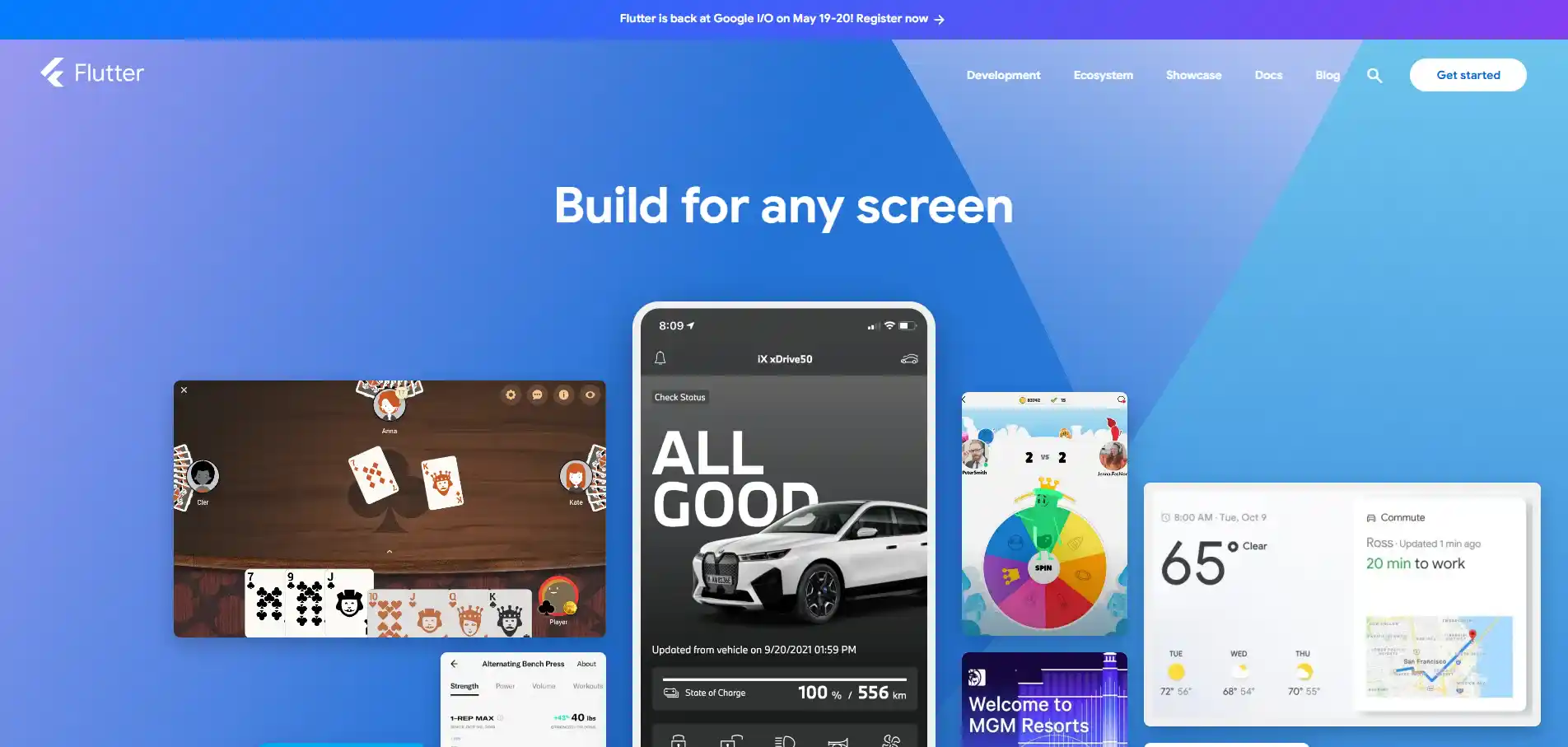
Developed by Google, Flutter is an open-source UI toolkit for building natively compiled applications for mobile, web, and desktop from a single Dart codebase. In 2026, Flutter had moved from ’emerging’ to one of the two dominant cross-platform frameworks globally.
Adoption: According to Statista data cited across multiple 2025–2026 developer surveys, Flutter holds approximately 46% cross-platform developer adoption, the highest of any cross-platform framework. Nearly 30% of new free iOS apps submitted to the App Store in 2025 were built with Flutter, up from approximately 10% in 2021. Enterprise adoption in financial services grew 217% since 2021.
Enterprise users: Google Pay, BMW, eBay Motors, Alibaba, Tencent, ByteDance, Nubank.
Key Features
- Hot reload changes appear on-device in under one second, preserving application state
- Impeller rendering engine delivers consistent, predictable frame rates with no shader compilation jank
- Single codebase targeting iOS, Android, web (including WebAssembly/PWA), desktop (macOS, Windows, Linux), and embedded
- 94% average code sharing between platforms in enterprise deployments
- Flutter 3.38+ includes stateful hot reload across multiple browsers and configuration-based web debugging
Pros
- Fastest path to multi-platform deployment for new teams
- Consistent UI across all platforms ideal for design-system-driven organisations
- Strong MVP development velocity, startups, and SaaS companies favour Flutter for time-to-market
- 93% developer satisfaction rate; 2 million developers globally
Cons
- Dart is a less common language than JavaScript or Kotlin hiring pool is smaller
- Shared UI can feel ‘Android-like’ on iOS if not carefully customised to platform conventions
- Larger app binary sizes compared to native
| 2026 Best For: Startups, SaaS products, ecommerce, apps requiring strong visual consistency across platforms, and teams starting fresh without existing JavaScript or Kotlin investment. |
2. React Native
Maintained by Meta, React Native allows developers to build cross-platform mobile applications using JavaScript and React. In 2026, React Native’s position has been fundamentally upgraded by the completion of the New Architecture.
Important 2026 Update: The React Native New Architecture (Fabric renderer + TurboModules + JSI) became the default in React Native 0.76, released in October 2024. As of 2026, React Native 0.79+ is the production standard. The characterisation of React Native as ‘slower than native’ is now outdated for the vast majority of business application use cases.
Adoption: Statista enterprise data from a 2025 survey of 500 enterprise mobile development teams found 42% used React Native. React Native and Flutter together power over 80% of the cross-platform market.
New Architecture: What Actually Changed
- JSI (JavaScript Interface) eliminates the asynchronous bridge, enabling direct and synchronous communication between JavaScript and native code, removing a fundamental performance ceiling of the old architecture
- Fabric renderer aligns with native rendering pipelines. Scrolling, animations, and layout are now consistent with native platform behaviour
- TurboModules load lazily, reducing startup time. Shopify measured approximately 10% improvement in Android launch times post-migration
- Memory usage reduced by approximately 39% compared to old architecture (85MB to 52MB baseline)
- Consistent 60fps during complex animations, previously a known weakness
- Hermes V1 (experimental as of 0.82) delivers further startup improvements of 30–40% compared to 2024 builds; cold start under 800ms on mid-range Android
- Expo ecosystem is now the recommended starting point for all new React Native projects. EAS Build has largely replaced local build configuration
Pros
- Largest pool of available developers due to JavaScript/React familiarity
- Strong TypeScript ecosystem, AI coding assistants perform very well in this environment
- Excellent for organisations with existing web React teams sharing components
- 2–4 week ramp-up for experienced JavaScript developers
- Expo SDK and EAS Build dramatically reduce DevOps complexity
Cons
- Migration from old to New Architecture requires effort for existing large codebases
- Libraries not yet updated for New Architecture (pre-2024) can create compatibility friction
- JavaScript is not the fastest runtime for computationally intensive operations
| 2026 Best For: Organisations with existing JavaScript/React web teams, shared web-and-mobile development, enterprise business apps, and teams that need a large hiring market. |
3. Kotlin Multiplatform (KMP)
Kotlin Multiplatform is a technology from JetBrains that allows development teams to share business logic code across Android, iOS, web, and desktop while keeping the UI layer fully native per platform. In 2026, KMP has crossed from early-adopter to enterprise mainstream.
Adoption trajectory: KMP adoption grew from approximately 7% in 2024 to 23% in 2025, a near-tripling in under 18 months. According to the State of Kotlin Multiplatform Survey, 60% of developers have used or experimented with KMP in a production context.
Enterprise validation: Netflix, McDonald’s, Cash App, Duolingo (shipping weekly to 40M+ users with KMP), Airbnb (95% shared booking logic, release cycle from monthly to weekly), Google Workspace (Google Docs iOS), AWS Kotlin SDK (300+ services), ING, Uber, Mercedes-Benz.io, N26, Roblox.
Why KMP Is Gaining Enterprise Trust in 2026
- Shared business logic + native UI: KMP shares the code that matters most for consistency (data models, API calls, business rules, caching logic) while letting iOS use SwiftUI and Android use Jetpack Compose, preserving full native UX fidelity
- Low rewrite risk: KMP can be adopted incrementally, starting with one shared module. Teams do not need to rebuild their entire app, making it the lowest-risk cross-platform investment
- Compose Multiplatform reached stable iOS status in May 2025, enabling optional shared UI for teams that want it, without forcing it
- Google Workspace and JetBrains partnership: The Kotlin Foundation now includes Meta as a Gold Member alongside Google’s enterprise-level institutional backing
- Fintech and healthcare strength: Regulated industries favour KMP because the shared logic layer can be audited once while native UI layers pass platform-specific compliance reviews
- K2 compiler (default since 2025): 40% faster builds and improved type inference
Pros
- Best choice for Android-heavy organisations expanding to iOS, no new language required
- Native performance on both platforms, with no rendering engine abstraction layer
- A gradual migration path exists for existing apps to adopt incrementally without a full rewrite
- Kotlin is already the language for 70% of the top 1,000 Play Store apps
Cons
- iOS developers face a steeper learning curve. Kotlin syntax differs from Swift
- Compose Multiplatform shared UI may feel Android-centric on iOS if native parity is important
- The third-party SDK ecosystem is still maturing; some payment, analytics, and auth SDKs lack stable KMP-first support
- KMP skill sets remain relatively rare specialist hiring is harder than Flutter or React Native
| 2026 Best For: Enterprises with existing Android/Kotlin teams expanding to iOS, fintech and healthcare apps, legacy Android apps modernising incrementally, and organisations that need native UI performance on both platforms with shared business logic. |
4. .NET MAUI (formerly Xamarin)
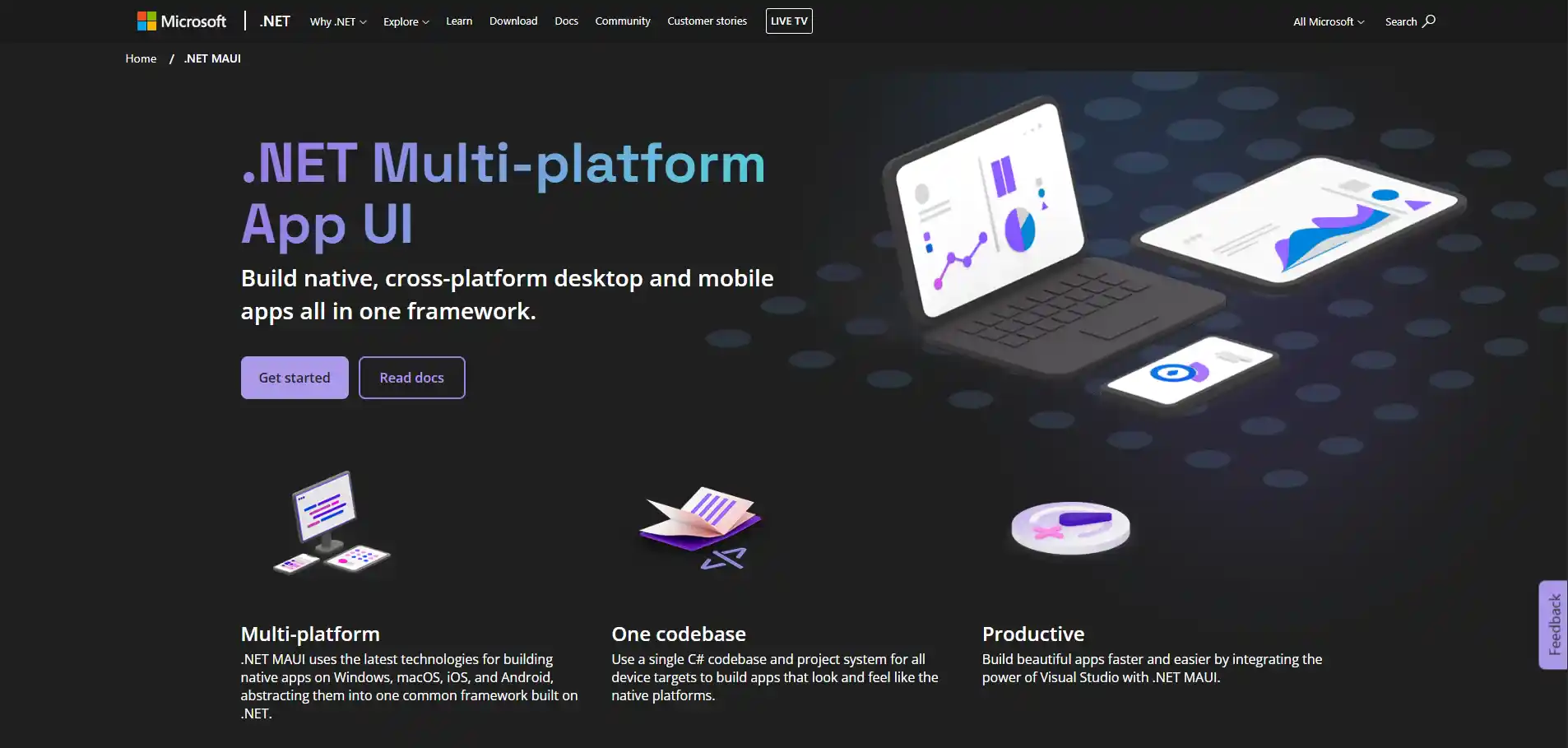
Xamarin has been succeeded by .NET MAUI (Multi-platform App UI) as Microsoft’s primary cross-platform framework, using C# and .NET to build apps for iOS, Android, macOS, and Windows. Xamarin.Android and Xamarin.iOS entered maintenance mode as of May 2024, with migration to .NET MAUI now the official path.
Key Features
- Single .NET codebase targeting mobile and desktop
- Native API access with up to 90% code sharing
- Strong integration with Microsoft Azure, Active Directory, and the broader Microsoft ecosystem
- Hot reload and XAML-based UI development
Pros
- Strongest choice for organisations already deeply invested in the Microsoft technology stack
- Native performance with full platform API access
- Enterprise-grade tooling through Visual Studio
Cons
- Xamarin is officially in maintenance organisations. Xamarin should plan migration to .NET MAUI
- Smaller developer community compared to Flutter and React Native
- Limited relevance outside Microsoft-centric enterprise environments
| 2026 Best For: Microsoft enterprise ecosystem organisations using Azure, Active Directory, and Visual Studio toolchains who need mobile apps on iOS, Android, and Windows. |
5. Unity
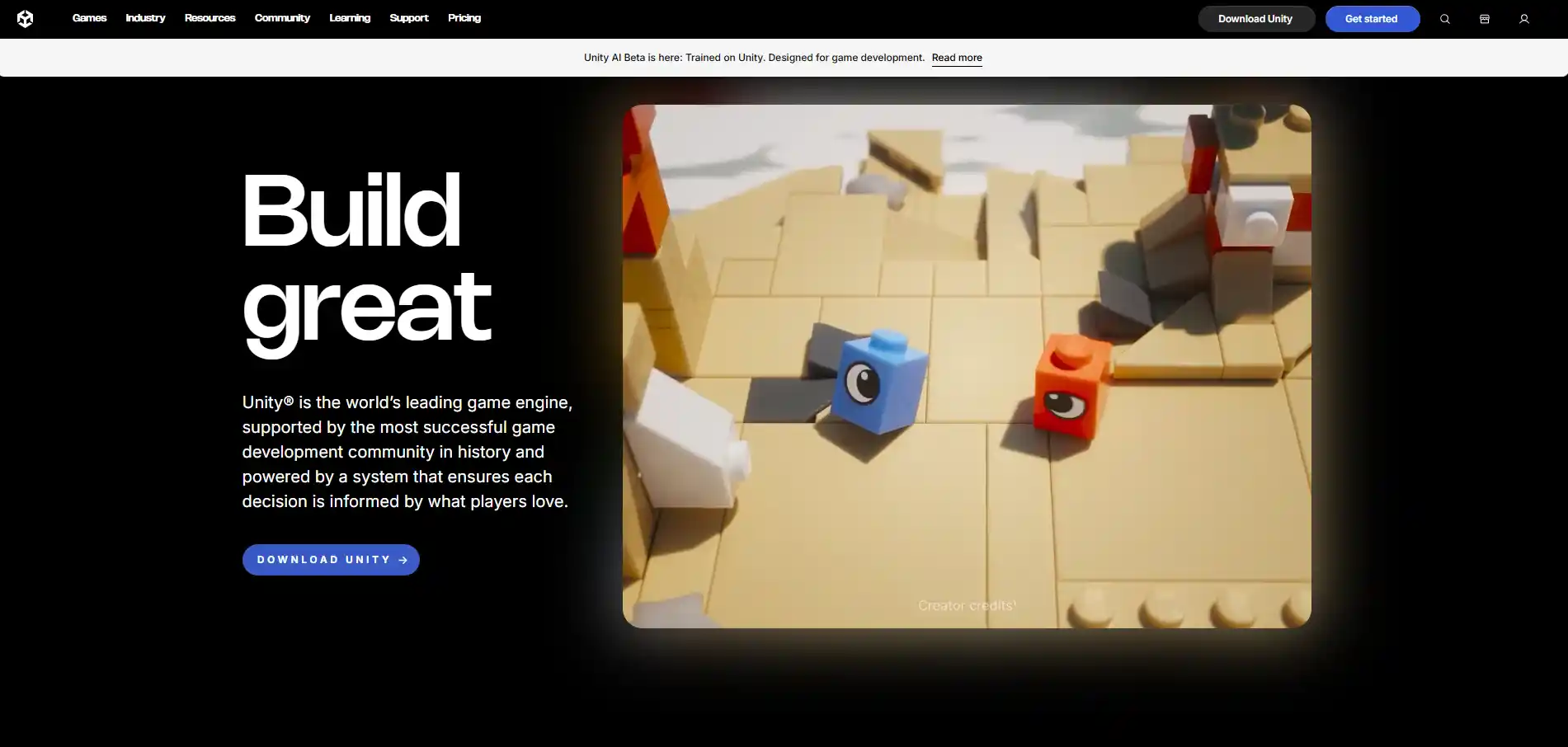
Unity remains the world’s leading platform for building 2D, 3D, AR, and VR applications across 25+ platforms. It is primarily a game engine, but is also used for interactive simulations, training applications, and industrial visualisation tools.
Key Features
- Advanced real-time 3D rendering engine
- Cross-platform deployment including iOS, Android, consoles, desktop, and XR headsets
- Extensive asset store with pre-built components
- Built-in analytics, collaboration, and multiplayer networking tools
Pros
- Unmatched for games, AR/VR, and immersive experiences
- Deploy to mobile, desktop, and console from a single codebase
- Large developer community and asset ecosystem
Cons
- Significant overkill for standard business applications
- Performance-intensive and generates larger app sizes
- Advanced features and enterprise use require paid licences
| 2026 Best For: Mobile games, AR/VR experiences, industrial simulations, and interactive training applications. |
6. Ionic
Ionic is an open-source cross-platform framework using HTML, CSS, and JavaScript, typically combined with Angular, React, or Vue. Apps run inside a WebView, providing near-native experience with device feature access through plugins.
Key Features
- Web-technology-based development accessible to any web developer
- Rich library of pre-built UI components
- Single codebase for mobile and web PWA deployment
- Integrates with Capacitor for native device feature access
Pros
- Lowest barrier to entry for web developers building mobile apps
- Strong PWA capabilities good for apps targeting both app stores and web browsers
- Actively maintained with a healthy component library
Cons
- WebView-based rendering is still slower than Flutter or React Native for animation-heavy UIs
- Native feature access requires Capacitor plugins that may vary in quality and maintenance
| 2026 Best For: Internal enterprise tools, B2B web-to-mobile extensions, PWAs, and teams with pure web backgrounds who need basic mobile presence quickly. |
7. Apache Cordova
Apache Cordova is an open-source framework that wraps web applications (HTML5, CSS3, JavaScript) inside a native container, enabling deployment to iOS and Android. It is among the oldest cross-platform frameworks and remains in active open-source maintenance.
Key Features
- Familiar web technologies, no new language required
- Plugin-based access to native device capabilities
- Single codebase for multiple mobile OS
Pros
- Very low learning curve for web developers
- Cost-effective for simple utility apps
Cons
- Newer frameworks like Flutter and React Native have significantly reduced Cordova’s market relevance for new projects
- Performance ceiling is lower than that of any other framework in this list
- Plugin ecosystem quality is inconsistent
| 2026 Best For: Maintenance of existing Cordova apps. New projects should default to Ionic with Capacitor, React Native, or Flutter. |
8. Sencha Ext JS
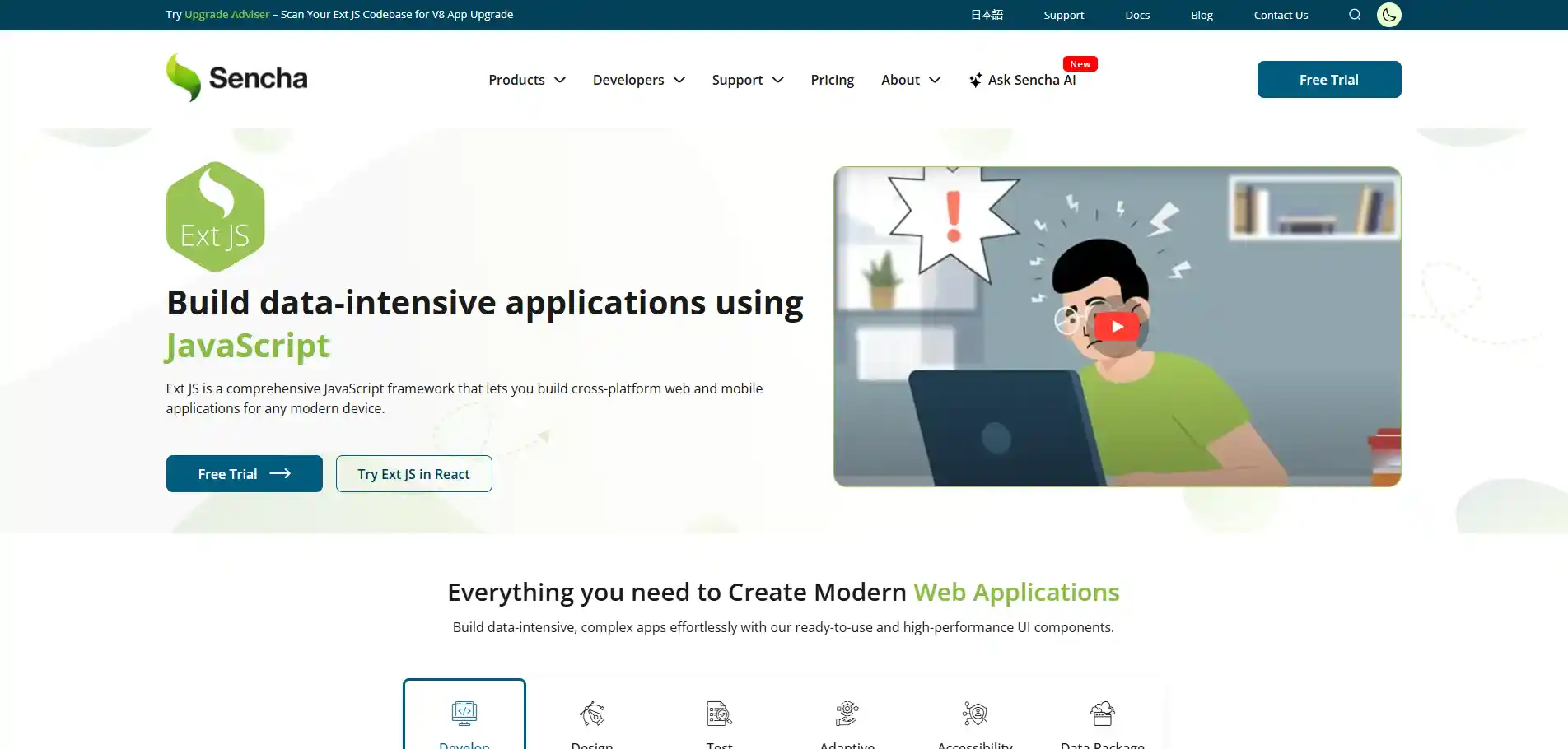
Sencha Ext JS is a JavaScript framework for building data-rich enterprise web and mobile applications. It is optimised for organisations handling large datasets, financial dashboards, ERP interfaces, and data grid-heavy enterprise tools.
Key Features
- Comprehensive library of enterprise-grade UI components, including complex grids, charts, and data visualisations
- Designed for large dataset performance and stability
- JavaScript-based accessible to front-end teams
Pros
- Best-in-class for data-intensive enterprise UI financial dashboards, ERP systems, and analytics platforms
- Optimised UI components handle large datasets without performance degradation
Cons
- Steeper learning curve than React Native or Flutter
- Requires a paid commercial licence for enterprise use
- Limited relevance for consumer-facing apps
| 2026 Best For: Internal enterprise data-heavy applications: financial dashboards, ERP interfaces, and analytics tools where data grid performance is the primary requirement. |
9. OutSystems
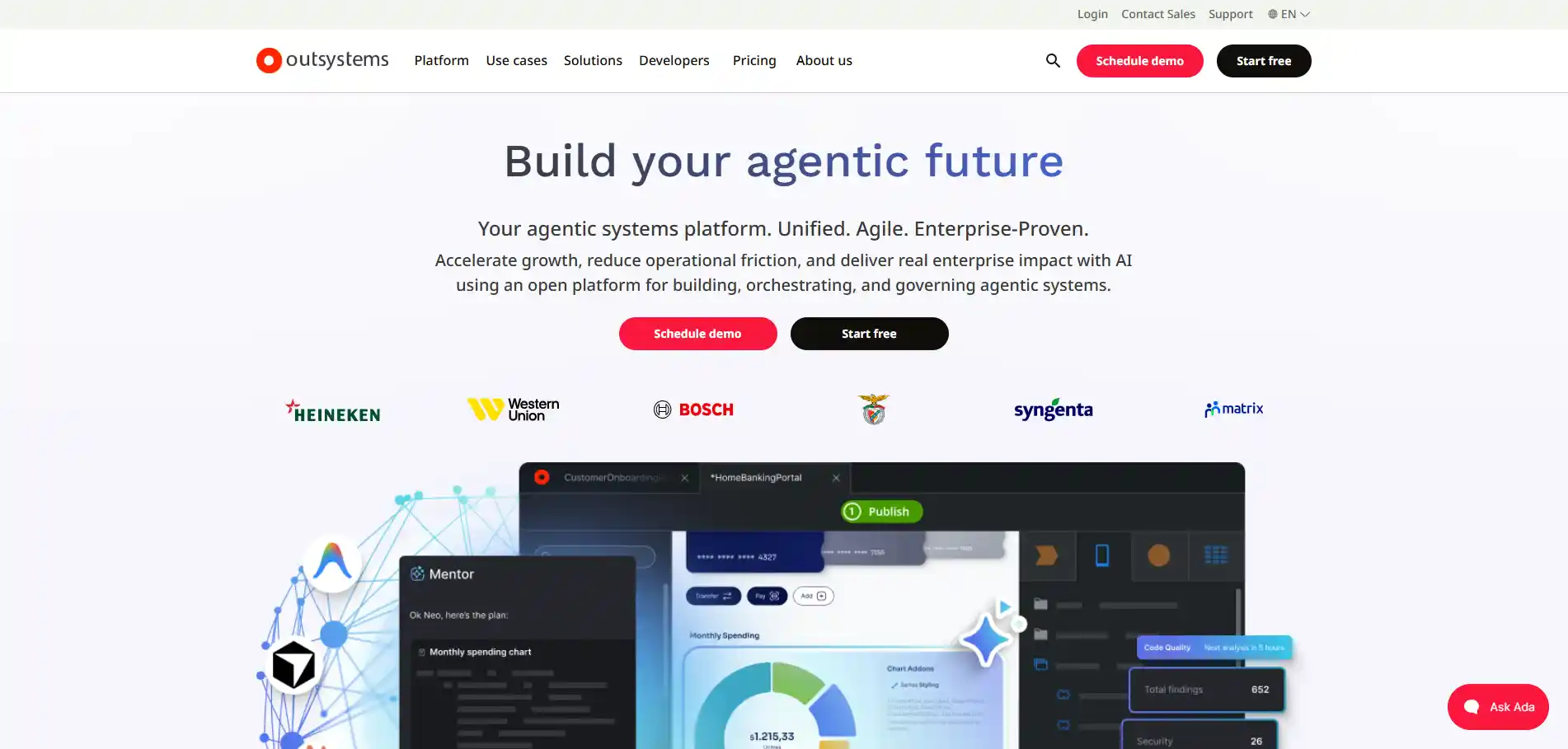
OutSystems is a leading enterprise low-code platform that enables visual, drag-and-drop application development with AI-powered automation and deep integration capabilities. It targets enterprises that need to deliver scalable apps rapidly without proportional increases in developer headcount.
Key Features
- Visual development environment with AI-assisted component generation
- Cross-platform output for iOS, Android, and web from a single model
- Enterprise integrations with SAP, Salesforce, Oracle, and major databases
- Built-in security, governance, and compliance tooling
Pros
- Dramatically faster delivery for process-driven enterprise apps, internal tools, approval workflows, and customer portals
- KPMG data shows 81% of companies see low-code as strategically important; 53% report better process efficiency
- Reduces dependency on scarce senior mobile developers for routine internal applications
Cons
- Advanced customisation beyond the visual model requires technical expertise
- Vendor lock-in risk: long-term dependency on the OutSystems ecosystem
- Not suited for consumer apps expecting millions of users with complex UX requirements
| 2026 Best For: Enterprise internal tools, customer portals, approval workflows, and organisations that need to scale app delivery without proportional developer hiring. |
10. Appy Pie
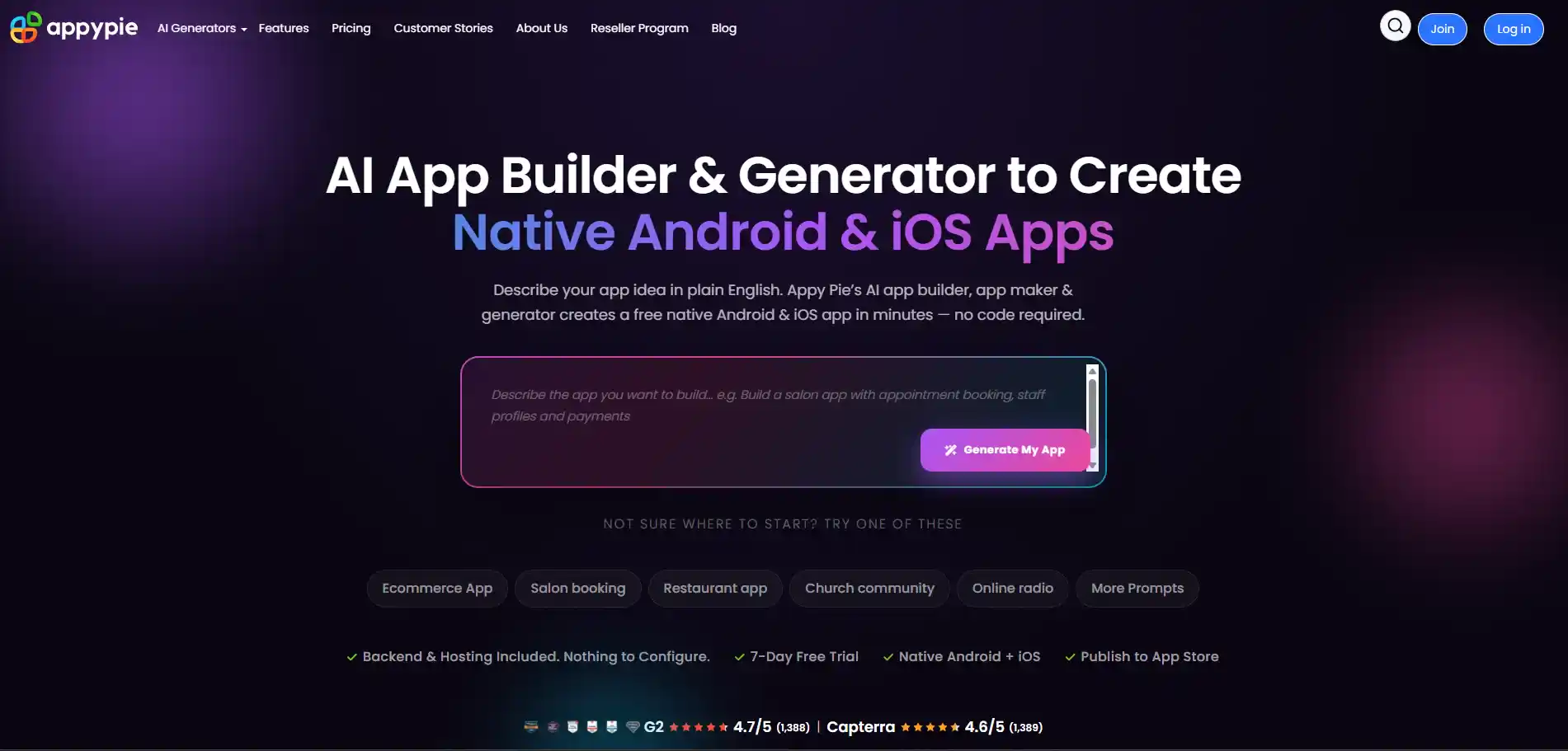
Appy Pie is a no-code, drag-and-drop mobile app builder targeting small businesses, entrepreneurs, and non-technical founders. It enables app creation for iOS, Android, and web without any programming knowledge.
Key Features
- Drag-and-drop visual builder with industry-specific templates
- Integrations with PayPal, social media, push notifications, and third-party services
- App Store and Google Play publishing support
Pros
- No coding required, fastest path from idea to published app for non-technical users
- Apps can be built and launched within hours
- Affordable for small businesses and startups with limited budgets
Cons
- Scalability ceiling not suitable for apps expecting high user volumes
- Limited customisation compared to Flutter, React Native, or KMP
- Ongoing subscription costs
| 2026 Best For: Small businesses, restaurant apps, local service apps, and entrepreneurs who need a digital presence quickly without development resources. |
11. BuildFire
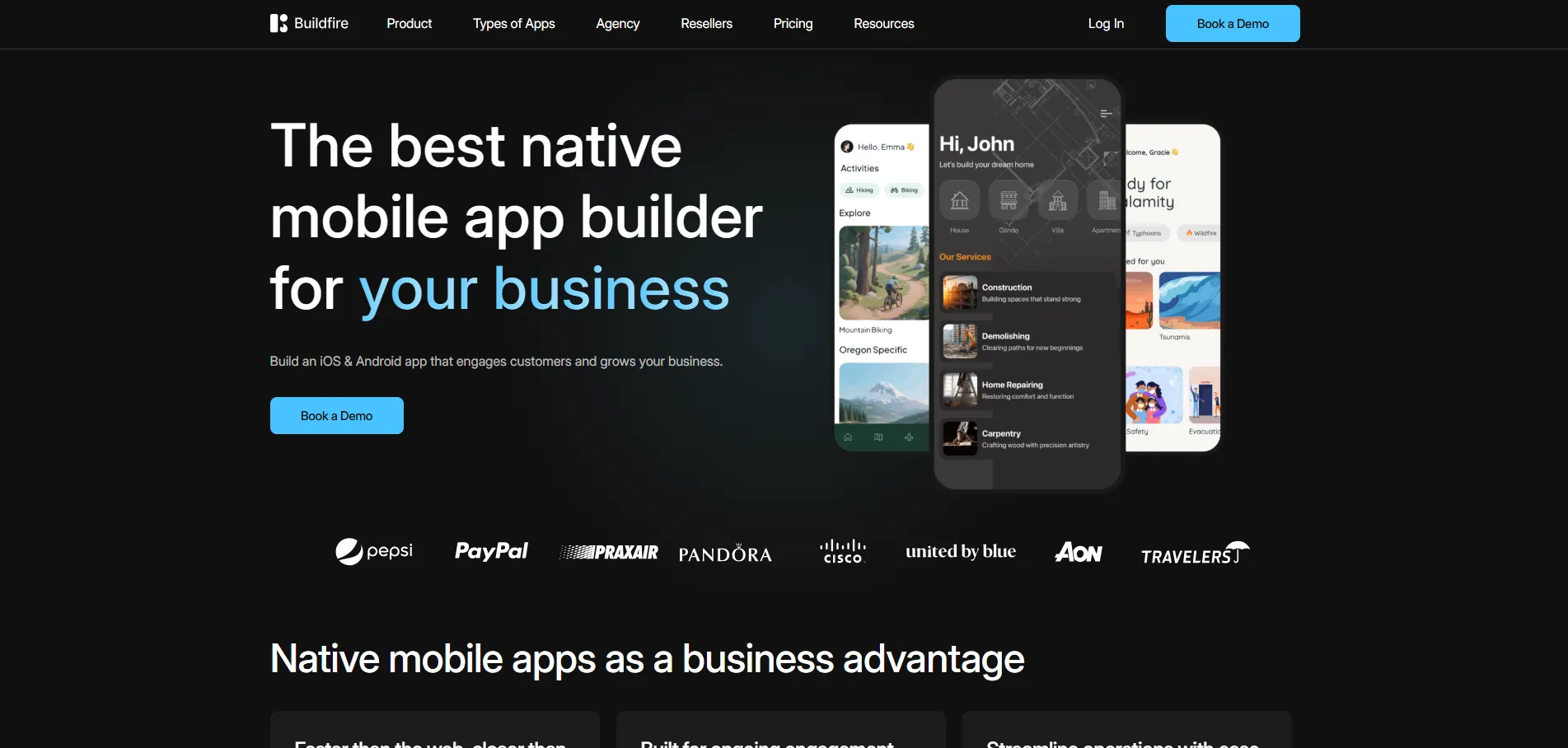
BuildFire is a no-code mobile app platform for SMBs and organisations that need reliable app functionality without custom development. It is plugin-based, supports iOS, Android, and PWA, and includes content management capabilities.
Key Features
- Hundreds of pre-built plugins for push notifications, loyalty, chat, e-commerce, and media
- Industry templates for gyms, schools, churches, and e-commerce
- App management without developer intervention for content updates and analytics
Pros
- Accessible to non-technical users while supporting reliable SMB-scale apps
- Custom feature development available through BuildFire’s developer team
Cons
- Ongoing subscription costs accumulate over time
- Not suited for mission-critical enterprise apps with complex architecture requirements
| 2026 Best For: SMBs, community organisations, gyms, schools, and media companies needing reliable apps without custom development investment. |
Best Platform by Use Case 2026 Decision Guide
The following table consolidates platform recommendations based on verified 2026 data, enterprise adoption patterns, and development team profiles. Use this as a starting framework; the final selection should account for team expertise, existing codebase, and budget constraints.
| Use Case | Best Choice | Key Reason |
|---|---|---|
| Startup MVP / new product | Flutter | Fastest multi-platform deployment, 70–95% code sharing, strong visual consistency |
| Enterprise business app | React Native or KMP | React Native for JS teams; KMP for Android-first orgs expanding to iOS |
| High-performance mobile gaming | Unity (3D) or Native | Full GPU access, native rendering pipelines |
| Banking/fintech app | Native or KMP | Native for regulatory UI requirements; KMP for shared auditable business logic |
| Shared web + mobile team | React Native | Reuses React/TypeScript skills; Expo reduces DevOps overhead |
| Microsoft enterprise ecosystem | .NET MAUI | Azure, Active Directory, Visual Studio integration |
| Fast e-commerce/consumer app | Flutter | UI consistency, fast iteration, strong pub.dev ecosystem |
| Internal enterprise tools | OutSystems or Ionic | Low-code delivery speed; Ionic for web teams |
| Data-heavy enterprise dashboard | Sencha Ext JS | Best-in-class large dataset grid performance |
| On-device AI integration | Native iOS/Android | Deepest chipset access; Core ML, TensorFlow Lite, Gemini Nano APIs |
| SMB / no-code app | Appy Pie or BuildFire | No developer required; fast and affordable |
| AR/VR / immersive experience | Unity | Industry standard for 3D and immersive mobile |
How AI Is Changing Mobile App Development in 2026
The integration of AI into the mobile development workflow is the single most operationally significant shift of 2025–2026. This is not about AI-powered features within apps; it is about AI embedded in the development process itself.
AI Coding Assistants
The following tools have become standard in mobile engineering teams:
- GitHub Copilot: Inline code completion across Flutter (Dart), React Native (TypeScript), Swift, and Kotlin. Most widely adopted across enterprise teams.
- Cursor: An AI-native IDE with multi-file context awareness and instruction-following for larger refactoring tasks. Strong adoption among React Native and Flutter developers.
- Claude Code: Anthropic’s agentic coding tool, used for complex multi-step mobile development tasks, including architecture design, test generation, and documentation. Available as a command-line tool.
- Gemini Code Assist: Google’s enterprise AI coding assistant. Strong integration with Android Studio and Flutter toolchain, making it particularly relevant for Flutter and Kotlin Multiplatform projects.
Practical Impact on Development Teams
- Faster prototyping: AI assistants reduce initial feature scaffolding from days to hours for experienced developers
- Reduced boilerplate: State management patterns, API integration code, and navigation scaffolding are largely generated
- Automated test generation: Unit and widget tests can be generated from function signatures, accelerating test coverage
- AI-assisted localization: String extraction and initial translation generation reduce localization overhead significantly
- Smaller teams shipping faster: Teams of 3–5 mobile developers can now deliver at velocities that previously required 8–12
| Data Point: AI-assisted development tools now write approximately 40–50% of production code in high-adoption teams. However, 46% of developers report caution around AI accuracy; human review of AI-generated code remains a non-negotiable quality gate. (Neontri, 2026) |
Correcting Outdated Framework Narratives
Several widely-repeated claims about mobile frameworks are no longer accurate in 2026. The following table documents what was true previously and what the current data shows.
| Outdated Claim | 2026 Reality |
|---|---|
| React Native sacrifices performance | React Native New Architecture (default since 0.76, late 2024) delivers near-native performance for the vast majority of business applications. The bridge-based performance ceiling has been removed. |
| Flutter is an emerging framework | Flutter is one of the two dominant cross-platform frameworks globally, with ~46% developer adoption, 2M+ developers, and production deployments at Google Pay, BMW, Alibaba, and eBay Motors. |
| Hybrid apps always feel inferior | Flutter uses its own rendering engine (Impeller); there is no WebView. React Native New Architecture uses the Fabric renderer, closely aligned with native rendering. The ‘feels hybrid’ perception is framework-specific and largely outdated for both. |
| Cross-platform always means lower quality | Flutter and React Native together power 80%+ of the cross-platform market. Consumer apps at scale, including Google Pay and Shopify’s merchant app, are built on these frameworks. |
| KMP is experimental / not production-ready | KMP reached stable status in November 2023. Compose Multiplatform for iOS reached stable May 2025. Duolingo ships KMP code weekly to 40M+ users. AWS Kotlin SDK spans 300+ services. |
| Xamarin is a current recommendation | Xamarin entered maintenance mode in May 2024. .NET MAUI is the Microsoft-supported successor. New projects should use .NET MAUI or migrate existing Xamarin apps. |
Cost and Development Time by Approach 2026 Estimates
Development economics in 2026 have shifted due to AI assistance, maturing toolchains, and larger talent pools for leading frameworks. The following ranges are based on aggregated industry data and should be treated as directional benchmarks rather than precise quotes.
| Approach | Typical Cost vs Native | Development Speed | Maintenance Overhead |
|---|---|---|---|
| Full native (iOS + Android separate) | Baseline (100%) | Baseline | Two codebases, two teams |
| Flutter (cross-platform) | 30–45% lower | 40–60% faster for new builds | Low single codebase, hot reload |
| React Native New Architecture | 30–40% lower | 35–55% faster | Low-medium JS ecosystem management |
| Kotlin Multiplatform (shared logic) | 15–30% lower | 20–40% faster | Medium shared logic + native UI layers |
| .NET MAUI | 20–35% lower | 25–40% faster | Medium Microsoft update cadence |
| OutSystems / low-code | 40–60% lower for internal tools | 60–80% faster for process apps | Low platform-managed updates |
| No-code (Appy Pie, BuildFire) | 70–85% lower | Fastest (hours) | Very low fully managed |
Once the tradeoffs are clear, the harder question is who builds and maintains it, which is the gap our custom mobile app development services are built to close.
Enterprise Mobile Architecture Considerations
For enterprise technology leaders evaluating platform investments, platform selection is only part of the decision. The following architectural dimensions are increasingly relevant to long-term mobile strategy in 2026.
Backend Architecture: Microservices and Edge APIs
Modern enterprise mobile apps are designed around microservices backends with mobile-specific API gateways (BFF Backend for Frontend pattern). This decouples platform selection from backend constraints. Edge/cloud-native APIs reduce mobile client latency by processing data closer to the user increasingly important for AI-powered features.
Offline-First Architecture
Enterprise apps in field service, healthcare, logistics, and retail increasingly require an offline-first data architecture where the app functions fully without network connectivity and synchronises when a connection is available. KMP is particularly well-suited here because the shared Kotlin layer can implement consistent offline logic across platforms, typically using SQLDelight for cross-platform database access.
Security and Compliance
Regulated industries (banking, healthcare, government) impose specific requirements that affect platform selection. Native and KMP approaches allow platform-specific security APIs (Secure Enclave on iOS, Android Keystore) to be used directly. Cross-platform frameworks expose these through plugins, which may introduce a version lag. Teams in regulated environments should audit plugin security maintenance cadences as part of their framework evaluation.
Real-Time Sync
Features requiring real-time data trading platforms, collaborative tools, and live logistics tracking benefit from WebSocket or server-sent event integration. All major frameworks support this, but the maturity of the relevant libraries varies. Flutter’s riverpod and React Native’s integration with libraries like React Query provide well-maintained real-time patterns.
Future Outlook: Mobile Development Beyond 2026
For teams making multi-year platform investments, the following mobile app developments are likely to shape mobile architecture decisions through 2027–2028.
- AI-generated apps: The trajectory from AI-assisted coding to AI-generated initial app scaffolding from natural language specifications is underway. This will not replace platform expertise but will change where developer time is spent.
- Agentic mobile experiences: Apps that autonomously take actions on behalf of users, booking, purchasing, and scheduling will require deeper OS integration and new permission models. Native frameworks have an early advantage here.
- Voice-native mobile UX: On-device voice processing combined with local LLM inference will make voice a primary interaction pattern for certain app categories. Native APIs for voice processing remain ahead of cross-platform bindings.
- Wearables and ambient computing: Apple Vision Pro, Android XR, and next-generation wearables will create new platform targets. Flutter’s multi-platform architecture positions it well for new form factors; SwiftUI for visionOS remains the native choice for Apple spatial computing.
- Kotlin/Wasm for web: Kotlin’s WebAssembly target is maturing through 2026–2027. If it reaches production stability, it would give KMP a genuine web presence, making it competitive with Flutter across all platform categories.
Benefits of Using Mobile App Development Platforms
1. Development Efficiency
Platforms with shared codebases (Flutter, React Native, KMP) reduce duplicated engineering effort. For standard two-platform (iOS + Android) deployments, cross-platform approaches consistently achieve 30–60% faster development timelines compared to maintaining separate native codebases. With AI-assisted development now accelerating individual developer output by an additional 30–50%, the compounding efficiency gains are significant.
2. Cross-Platform Compatibility
Modern cross-platform frameworks deliver UI and performance parity that was not achievable three years ago. Flutter’s Impeller engine and React Native’s Fabric renderer both produce results that are visually and functionally indistinguishable from native for the overwhelming majority of business app use cases.
3. Cloud and Backend Integration
All major platforms offer mature libraries for REST, GraphQL, WebSocket, and cloud SDK integration (Firebase, AWS Amplify, Azure). The differentiation is less about capability and more about ecosystem maturity and maintainer quality of specific packages.
4. Testing and Quality Tooling
Flutter’s widget testing framework, React Native’s Jest integration, Detox E2E framework, and Kotlin’s robust testing ecosystem all provide enterprise-grade quality assurance tooling. AI-assisted test generation is increasingly augmenting manual test authoring across all platforms.
Conclusion
The mobile development platform landscape in 2026 is the most mature and strategically nuanced it has ever been. Flutter and React Native have consolidated their dominance of the cross-platform market, collectively powering over 80% of new cross-platform projects. Kotlin Multiplatform has crossed into enterprise mainstream with a 23% adoption rate and validation from major global companies. The React Native New Architecture has removed the performance objections that historically pushed teams toward native. And AI-assisted development is compressing timelines across all frameworks.
For most organisations, the right framework is determined less by raw capability, all the leading frameworks are capable, and more by team expertise, existing technology investments, target user experience requirements, and hiring market realities. The comparison table in this guide provides a starting framework. Pair it with an honest assessment of your team’s current skills and your product’s specific requirements, and the decision becomes significantly more tractable.
Xamarin users should note: migration to .NET MAUI is now the official Microsoft recommendation. New projects should not start on Xamarin.
What all leading platforms share in 2026 is this: the era in which ‘cross-platform’ was a shortcut with meaningful quality trade-offs is over. The question is no longer whether cross-platform is viable. It is the cross-platform approach that matches your specific organisational context.
FAQ
What are the two main platforms for mobile apps?
The two primary operating system platforms are iOS (App Store) and Android (Google Play). In 2026, most serious production apps use a cross-platform framework, such as Flutter, React Native, or Kotlin Multiplatform, to target both from a shared codebase, rather than maintaining two separate native codebases.
Which is the best mobile app framework in 2026?
There is no single best framework; the right choice depends on your team and product context. Flutter leads for startups and new teams targeting multi-platform deployment. React Native is strongest for organisations with JavaScript/React expertise. Kotlin Multiplatform is the leading choice for Android-first enterprise organisations expanding to iOS. See the use case table in this guide for specific recommendations.
Is React Native still worth learning in 2026?
Yes. React Native New Architecture stabilised in 2024 and resolved the historical performance criticisms. Enterprise adoption is at 42% among large development teams. The JavaScript/TypeScript ecosystem and Expo toolchain make React Native one of the most productive mobile frameworks available. It remains a strong career investment.
What is Kotlin Multiplatform, and should I use it?
Kotlin Multiplatform (KMP) enables shared business logic across Android and iOS while keeping the UI native per platform. It reached production stability in November 2023, and Compose Multiplatform for iOS reached stable status in May 2025. KMP adoption has grown from 7% to 23% in under 18 months. It is the right choice for Android-heavy teams expanding to iOS and for organisations in regulated industries where auditable shared logic provides compliance advantages.
Which platform is best for enterprise mobile apps?
For enterprise development in 2026: React Native (New Architecture) for organisations with JavaScript teams; Kotlin Multiplatform for Android-first enterprises; .NET MAUI for Microsoft-centric organisations; OutSystems for internal process-driven apps requiring fast low-code delivery. Native development remains relevant for apps with strict on-device AI, hardware, or regulatory UI requirements.
How is AI changing mobile app development in 2026?
AI coding assistants (GitHub Copilot, Cursor, Claude Code, Gemini Code Assist) now generate approximately 40–50% of code in high-adoption teams. This has compressed timelines significantly and reduced the minimum team size needed to ship production apps. AI also automates test generation, accelerates localisation, and assists with debugging. The core skill shift is from writing all code manually to directing, reviewing, and architecting AI-generated code.
Which is the most affordable mobile app development platform?
If you’re looking for an affordable mobile app development platform, options like Appy Pie, BuildFire, and Swiftic are great choices. They offer no-code drag-and-drop builders, making them budget-friendly for startups, small businesses, and individuals who want to launch apps without high development costs.
Which mobile app development platform is best for cross-platform apps?
For cross-platform apps, Flutter and React Native are considered the best mobile app development platforms. They allow developers to build apps that run seamlessly on both iOS and Android, reducing time and cost.
What is the difference between native and hybrid app development platforms?
Native platforms (like Swift for iOS and Kotlin for Android) build apps specifically for one operating system, offering the best performance and user experience.
Hybrid or cross-platform app development platforms (like Ionic, Xamarin, and Flutter) use a single codebase for multiple platforms, making them more affordable and faster to develop.
Which mobile app development platform is best for enterprises?
For large enterprises, OutSystems, Xamarin, and Kony (Temenos Quantum) are strong choices. These mobile app development platforms offer enterprise-grade security, scalability, and system integrations, making them suitable for complex and mission-critical applications.