
Table of Contents
If you are looking for a reliable way to meet your business’s software needs, custom application development services deserve a close look. Software built around your workflows helps you work more efficiently, serve customers better, and stand out in a crowded US market.
However, not all custom application development services are created equal. It is important to partner with a provider who understands your unique business requirements and can deliver solutions that match them precisely. Whether your goal is to streamline operations, improve customer experience, or boost overall productivity, the right development partner makes the difference.
Through dedicated custom application development services, you receive software that follows your exact specifications and is delivered on schedule. There is no need to settle for generic, off-the-shelf products when tailored application development can give your business exactly what it needs to grow.
Customized Solutions to Meet Your Specific Business Needs
Every business runs differently, with its own workflows, goals, and customer expectations. Off-the-shelf software is built for a broad audience, so it rarely matches those details. Custom application development services close that gap by building software around how your company actually operates.
Why Off-the-Shelf Software Often Falls Short
- One-size-fits-all design: It is built for general use, so it cannot fully match your specific processes.
- Forced workarounds: Your team has to adapt its operations to the software instead of the other way round.
- Limited functionality: Features you need may be missing, while features you don’t need add clutter.
- Weak fit with your workflows: It may not connect smoothly with the way your teams already work.
What Custom Application Development Services Deliver
- Built around your business: Tailored application development focuses directly on your unique requirements, not on an average user.
- Smooth workflow integration: The software fits your workflows, objectives, and goals from day one.
- No compromises: You keep the functionality you need without reshaping your operations to suit a generic package.
Whether you need a bespoke CRM system, an ERP solution, or a tailored mobile app, custom application development services can shape the software to fit your organization.
Key takeaway: Off-the-shelf software asks your business to adapt to it. Custom application development services adapt the software to your business.
Benefits of Tailored Software Solutions vs. Off-The-Shelf Software Solutions:
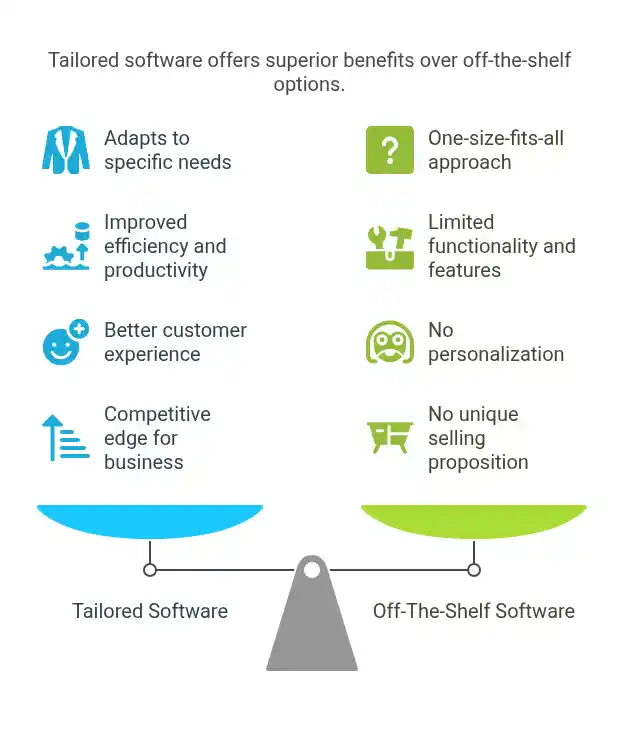
- Adapts to your specific business needs versus a one-size-fits-all approach.
- Improved efficiency and productivity versus limited functionality and features.
- Better customer experience versus no personalization.
- Competitive edge for your business versus no unique selling proposition.
As the sources indicate, tailored application development solutions offer a range of benefits unmatched by off-the-shelf options. They address specific business needs, improve efficiency and productivity, enhance customer experience, and provide a competitive edge. So, whether you need a bespoke CRM system, an ERP solution, or a tailored mobile app, application customization services can provide the bespoke solutions necessary to elevate your business.
The Custom Application Development Process
Custom application development services is a multi-stage process, and each stage builds on the one before it. Skipping or rushing a stage usually leads to delays, rework, and higher costs later. Knowing what happens at every step helps you plan your project, set clear expectations, and work more effectively with your development partner.
Most modern teams run these stages in an agile way, working in short cycles called sprints. This means you see working software early, share feedback often, and can adjust priorities as your business needs change, instead of waiting until the end to find out whether the product fits.
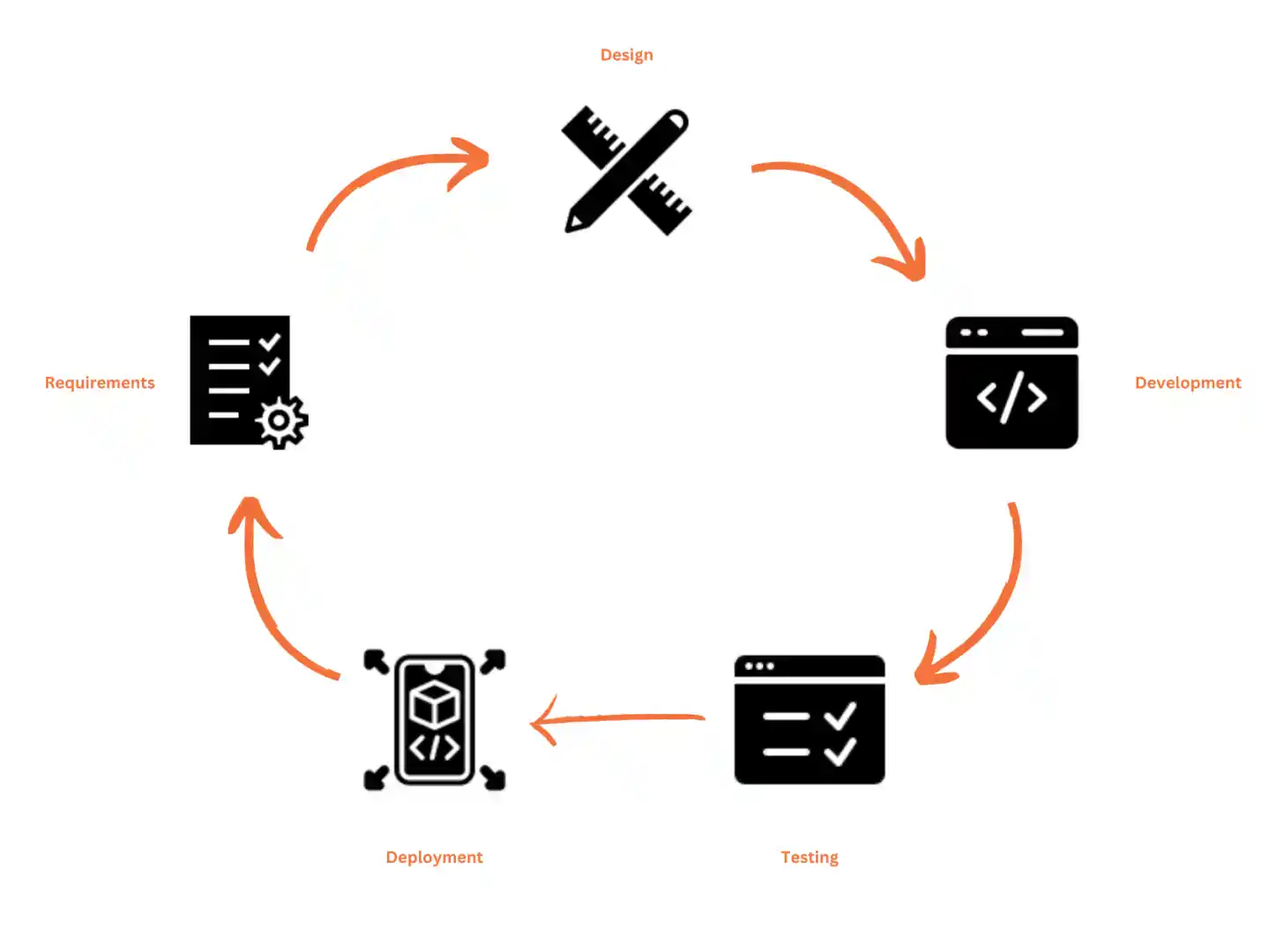
Process at a Glance
| Stage | Focus | Key Activities | Main Deliverables |
|---|---|---|---|
| 1. Requirements Gathering | Understanding your business needs | Stakeholder interviews, workflow mapping, scope definition | Requirements document, project plan |
| 2. Design | Planning how it will look and work | Wireframes, prototypes, architecture and tech stack planning | Design blueprint, clickable prototype |
| 3. Development | Building the application | Front-end and back-end coding, integrations, code reviews | Working software delivered in sprints |
| 4. Testing | Checking quality and security | Functional, performance, security, and user acceptance testing | Test reports, stable build |
| 5. Deployment | Launching and onboarding users | Environment setup, data migration, training | Live application, user documentation |
| 6. Support and Maintenance | Keeping it reliable and improving it | Monitoring, updates, security patches, enhancements | Long-term performance and growth |
Stage 1: Requirements Gathering
This is the foundation of the whole project. The development team works closely with you to understand what problem the application must solve, who will use it, and what success looks like.
What happens in this stage:
- Interviews and workshops with stakeholders and future users
- Mapping of current business processes and pain points
- Review of technical constraints, existing systems, and integration needs
- Defining project scope, priorities, budget range, and timeline
- Identifying compliance and data security requirements
What you receive: A comprehensive requirements document and a project plan that both sides agree on.
Why it matters: Unclear or changing requirements are one of the most common reasons projects go over budget or miss deadlines. Time spent here saves effort later.
Stage 2: Design
Once requirements are clear, the team turns them into a detailed plan for how the application will be structured, how it will look, and how users will move through it.
What happens in this stage:
- Creating wireframes and interactive prototypes so you can see and test the experience before any code is written
- Designing the user interface and user experience (UI/UX) around real user needs
- Planning the application architecture, database structure, and system integrations
- Selecting the technology stack, frameworks, and design patterns
- Planning security measures and scalability from the start
What you receive: A high-level design blueprint, wireframes, and a prototype you can review and approve.
Why it matters: Changing a design on paper is far cheaper than changing finished code. Reviewing prototypes early helps catch usability problems before development begins.
Stage 3: Development
This is where the actual coding begins, following the approved design blueprint and agreed coding standards. The team, made up of software customization specialists with expertise in the required programming languages and frameworks, builds the application in stages.
What happens in this stage:
- Building the front end (what users see) and the back end (logic, database, and APIs)
- Integrating third-party services, payment gateways, or existing business systems where needed
- Using version control and regular code reviews to keep quality high
- Delivering working features in short sprints, with demos after each cycle
- Setting up automated build and deployment pipelines where appropriate
What you receive: Working software delivered in stages, so you can review real progress and give feedback throughout.
Why it matters: Regular demos keep the project aligned with your expectations and reduce the risk of surprises at the end.
Stage 4: Testing
Before launch, the application goes through thorough testing to confirm it works as intended, performs well, and keeps your data safe.
Common types of testing:
- Functional testing: Checks that every feature works as specified.
- Integration testing: Confirms that different parts of the system and connected tools work together.
- Performance testing: Measures speed and stability, including behavior under heavy use.
- Security testing: Looks for vulnerabilities that could put data at risk.
- Compatibility testing: Verifies the application works across devices, browsers, and operating systems.
- User acceptance testing (UAT): Lets your own team try the application in real scenarios before approving it.
What you receive: Test reports and a stable, bug-fixed build that is ready for launch.
Why it matters: Issues found before launch are much easier and cheaper to fix than issues found by your customers.
Stage 5: Deployment
The application is released in your chosen environment, either on-premises or in the cloud. A careful rollout helps your team adopt the new software with minimal disruption.
What happens in this stage:
- Setting up and configuring the production environment
- Migrating existing data into the new application where needed
- Choosing between a full launch and a phased or pilot rollout
- Training users and providing clear documentation
- Providing close support right after go-live to resolve early issues quickly
What you receive: A live application, trained users, and documentation for future reference.
Why it matters: Even a well-built application can fail if users are not prepared to use it. Training and a smooth rollout drive adoption.
Stage 6: Support and Maintenance
Launch is not the end of the process. Ongoing support keeps the application reliable as your business, users, and technology change.
What happens in this stage:
- Monitoring performance and fixing bugs as they appear
- Applying security patches and software updates
- Scaling the application as user numbers and data grow
- Adding new features and improvements based on user feedback
- Providing help and support according to agreed response times
What you receive: An application that stays secure, stable, and useful over time.
Why it matters: Regular maintenance protects your investment in custom application development services and helps the application keep pace with your business.
How to Make the Development Process Smoother
These practical tips help you get more value from custom application development services:
- Define your goals clearly: Know the problem you want to solve and how you will measure success.
- Involve end users early: The people who will use the application daily often spot issues others miss.
- Prioritize features: Start with the features that matter most and add others in later phases.
- Stay involved: Join regular demos and give timely feedback and approvals.
- Agree on communication: Set clear reporting, meeting schedules, and points of contact.
- Plan for the long term: Discuss maintenance, support, and future enhancements before the project ends.
Key takeaway: Every stage demands expert skills, experience, and resources. Partnering with a reliable provider of custom application development services helps your project run smoothly and deliver the outcomes you expect.
Advantages of Custom Application Development Services
If you aim to maximize productivity, streamline operations, improve customer experience, and gain a competitive edge in the US market, then custom application development services are indeed the key to your success. Opting for tailored application development solutions, designed specifically for your unique business requirements, unlocks a range of benefits that off-the-shelf products simply cannot match.
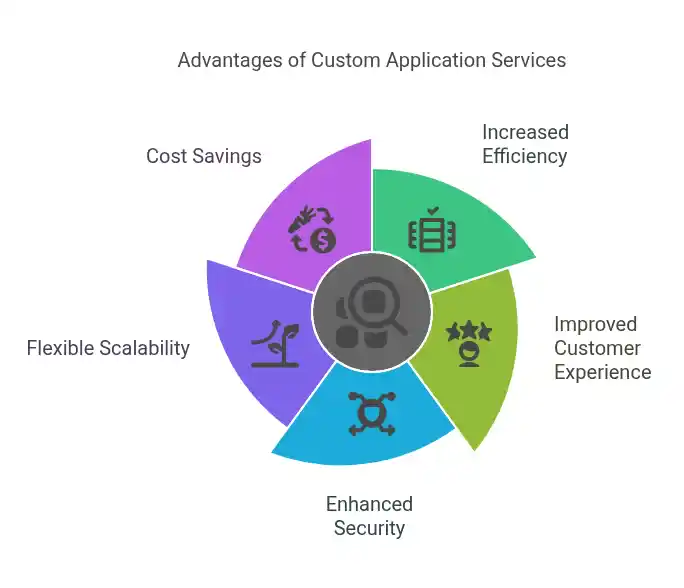
Here are some of the numerous benefits of application customization services:
- Increased Efficiency: Custom application services are designed to automate and streamline processes, leading to greater efficiency and reducing the risk of errors or inconsistencies.
- Improved Customer Experience: A tailored application development solution provides a superior user experience for your customers, featuring more intuitive interfaces, faster response times, and customized features that meet their specific needs.
- Enhanced Security: Custom application services can be designed with advanced security features, safeguarding your data and confidential business information from cyber threats and unauthorized access. This is a critical aspect of secure custom application management.
- Flexible Scalability: Custom software solutions are built to accommodate your business growth and changing needs, with the inherent ability to scale up or down as required, supporting long-term custom application management.
- Cost Savings: The initial investment in custom software may be higher than buying an off-the-shelf product. Over time, however, custom application development services can lower costs by removing licensing fees, reducing manual work, and improving overall efficiency.
These are just some of the profound benefits businesses can enjoy by opting for custom application services. By partnering with software customization specialists, you can truly unlock technology’s full potential and secure a competitive advantage in the US market.
Expertise and Knowledge of the US Market
When you select a provider of custom application development services, look closely at their experience with US businesses. A team that understands the challenges and opportunities of the US business landscape can shape software that fits how your customers, partners, and regulators expect you to operate.
What to Look For in a US-Focused Development Partner
- Industry experience: A portfolio of projects across different industries, showing a clear understanding of market needs.
- Compliance awareness: Familiarity with regulations that may apply to your sector, such as HIPAA for healthcare data or PCI DSS for payment data.
- Business and cultural fit: Understanding of US business norms, customer expectations, and communication styles.
- Time zone and communication: Reasonable overlap with your working hours so questions get answered quickly.
- Strategic alignment: A team that takes time to understand your goals instead of only your feature list.
The right provider of custom application development services brings both technical skill and market understanding, so the solution supports your business goals from day one.
Reliable and Timely Delivery of Custom Applications

On-time delivery is one of the most important things to look for in custom application development services. A delayed application means delayed benefits, so your development partner should manage schedules with the same care they give to code quality.
At HyScaler, our custom application development services follow a structured project management approach designed to meet your requirements and deadlines while maintaining quality at every stage.
How Reliable Delivery Is Achieved
- Clear milestones: The project is broken into defined phases with visible deadlines.
- Regular communication: Progress updates and demos keep you informed throughout.
- Quality assurance: Rigorous testing finds and resolves issues before deployment.
- Skilled developers: A team that stays current with the latest technologies and best practices.
- Post-launch support: Ongoing help so the application keeps running smoothly after go-live.
This approach helps your application launch with minimal disruption to daily operations.
Conclusion
Custom application development services can be a transformative force for your business. The tailored application development solutions offered by expert service providers can significantly help you optimize operations, enhance customer experience, and gain a substantial competitive edge in the US market.
A clear development process, an experienced team, and a partner who understands your market all contribute to a better result. By choosing an experienced provider of custom application development services, you can expect software that is delivered on time, fits your needs, and is easy to support after launch.
By choosing a reliable and experienced provider of custom application services, you can be confident that your custom applications will be delivered in a timely and efficient manner, simplifying custom application management. Don’t hesitate to leverage these expert software customization specialists to transform your business and maintain a leading position against the competition.
Reach out to us to learn more about our custom application development services and how they can benefit your business today.
FAQs
What are custom application development services?
Custom application development services cover the full process of designing, building, testing, deploying, and maintaining software made around one business’s workflows, goals, and users. Instead of adapting your operations to a generic product, the software is shaped to fit how your team actually works.
How much do custom application development services cost?
Cost depends on scope, number of features, integrations, target platforms, design complexity, and team size. Because no two projects are alike, the most reliable way to get a number is a discovery phase, where the vendor defines requirements and gives you a scoped estimate instead of a generic price range.
How long does it take to build a custom application?
A focused MVP can be ready in a matter of weeks, while complex enterprise systems with many integrations can take many months. Timelines depend on scope, technical complexity, and how quickly your team reviews and approves work. Building in phases lets you launch core features first.
Custom software vs. off-the-shelf: which is better?
Off-the-shelf software is quicker to start with and works well for standard, common needs. Custom software fits unique workflows, scales with your growth, and avoids per-user license costs that build up over time. Neither option is always cheaper, so compare total ownership cost over several years.
When should I build custom software instead of buying?
Build when the software supports your core process or competitive edge, or when existing tools need heavy workarounds and add-ons to do the job. Buy ready-made tools for commodity needs such as email, payroll, or accounting, where a standard product already does the work well.
What are the stages of custom application development?
The main stages are requirements gathering, design, development, testing, deployment, and ongoing support. Modern teams usually run these in short agile sprints, so you see working software early, give feedback often, and can adjust priorities before small issues become expensive changes.
What types of custom applications can a business build?
Businesses commonly build CRM and ERP systems, mobile apps, customer portals, workflow automation tools, and internal dashboards. Custom development also covers integrations that connect these tools with existing systems, so data flows smoothly across your operations.
Who owns the source code of a custom application?
Ownership depends on your contract with the development partner. Make sure the agreement states that intellectual property and source code transfer to you upon payment, and get this in writing before work begins. Clear ownership terms protect you if you later change vendors or bring development in-house.
Is custom software more secure than off-the-shelf software?
Security can be designed around your specific data, access rules, and compliance needs, which is a real advantage. However, custom software is only as secure as the testing, code reviews, and patching practices behind it, so ask any vendor how they handle security throughout development and after launch.
Can custom software integrate with existing systems or replace legacy software?
Yes. Custom applications can connect to your existing tools through APIs, and legacy systems can be modernized or replaced in phases. A phased approach limits disruption to daily operations, lets your team adapt gradually, and reduces the risk that comes with switching everything over at once.