

Table of Contents
Most businesses no longer ask whether they should use generative AI. They ask which model to use, and the answer is rarely the most popular one. Generative AI models can now produce text, images, code, audio, and video, but they differ widely in how they work, what they cost to run, and where they fail. Picking a model because it tops a benchmark or dominates the headlines often leads to inflated inference bills, slow responses, and painful integration work.
This guide is written for CTOs, CIOs, and technology and business leaders. It explains the major types and architectures of generative AI models, shows where each one delivers value, and walks through a practical framework for selecting, implementing, and governing the right model for your organization.
What Are Generative AI Models?
Generative AI models are machine learning systems trained on large datasets to learn patterns and generate new content, such as text, images, audio, video, and code, in response to prompts or other inputs.
During training, a model processes enormous amounts of data and adjusts its internal parameters until it can capture the statistical structure of that data. At use time, a prompt (a question, an instruction, an image, or a combination) steers the model toward an output that fits the patterns it learned. The better the prompt and the surrounding context, the more relevant the result.
This is what separates generative models from traditional predictive AI. A predictive model classifies or scores existing data, for example flagging a transaction as likely fraud. A generative model creates something new, such as a draft customer reply or a product image.
Two terms are often confused. A foundation model is a broad, pretrained model that can be adapted to many tasks. A large language model (LLM) is one type of foundation model, built primarily for language. Not every generative AI model is an LLM, and not every foundation model generates text.
How Do Generative AI Models Work?
The details vary by architecture, but most generative AI systems follow the same lifecycle:
- Data collection: Relevant text, images, audio, code, or other data is gathered for training.
- Preprocessing: The data is cleaned, filtered, and converted into a format the model can learn from.
- Model training: Neural networks learn patterns and relationships by repeatedly predicting, comparing, and adjusting.
- Prompt processing: At runtime, the model interprets the user’s instruction and any supplied context.
- Content generation: The model produces an output based on what it learned.
- Evaluation and refinement: Outputs are tested, and the model, prompts, or surrounding application are improved.
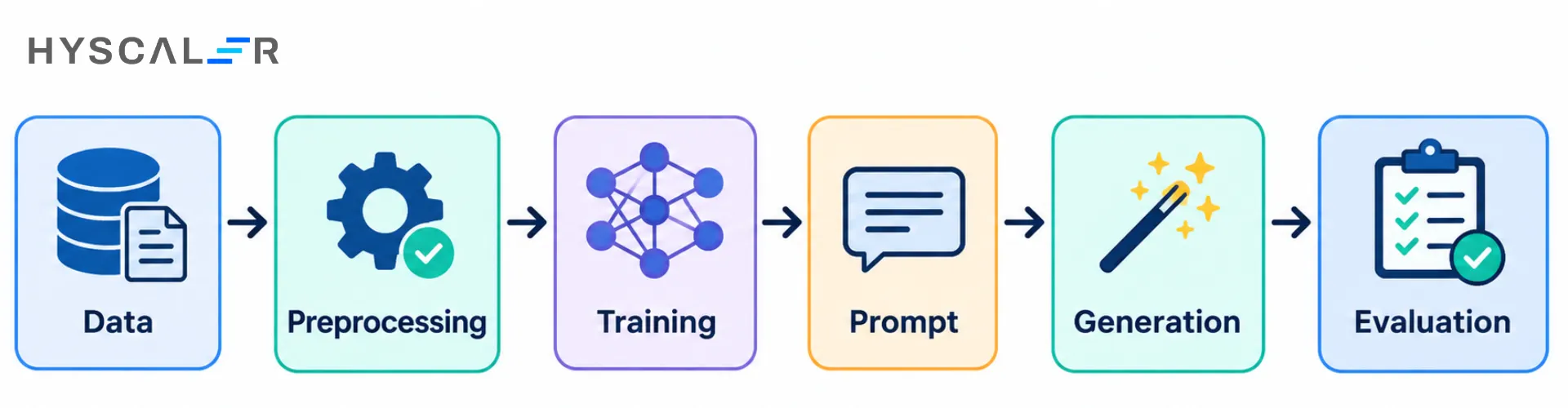
What changes between architectures is step five. A language model predicts the next token, one piece of text at a time. A diffusion model starts with noise and removes it step by step until an image emerges. A GAN pits two networks against each other. Understanding these differences is the first step toward matching a model to a workload.
What Are the Different Types of Generative AI Models?
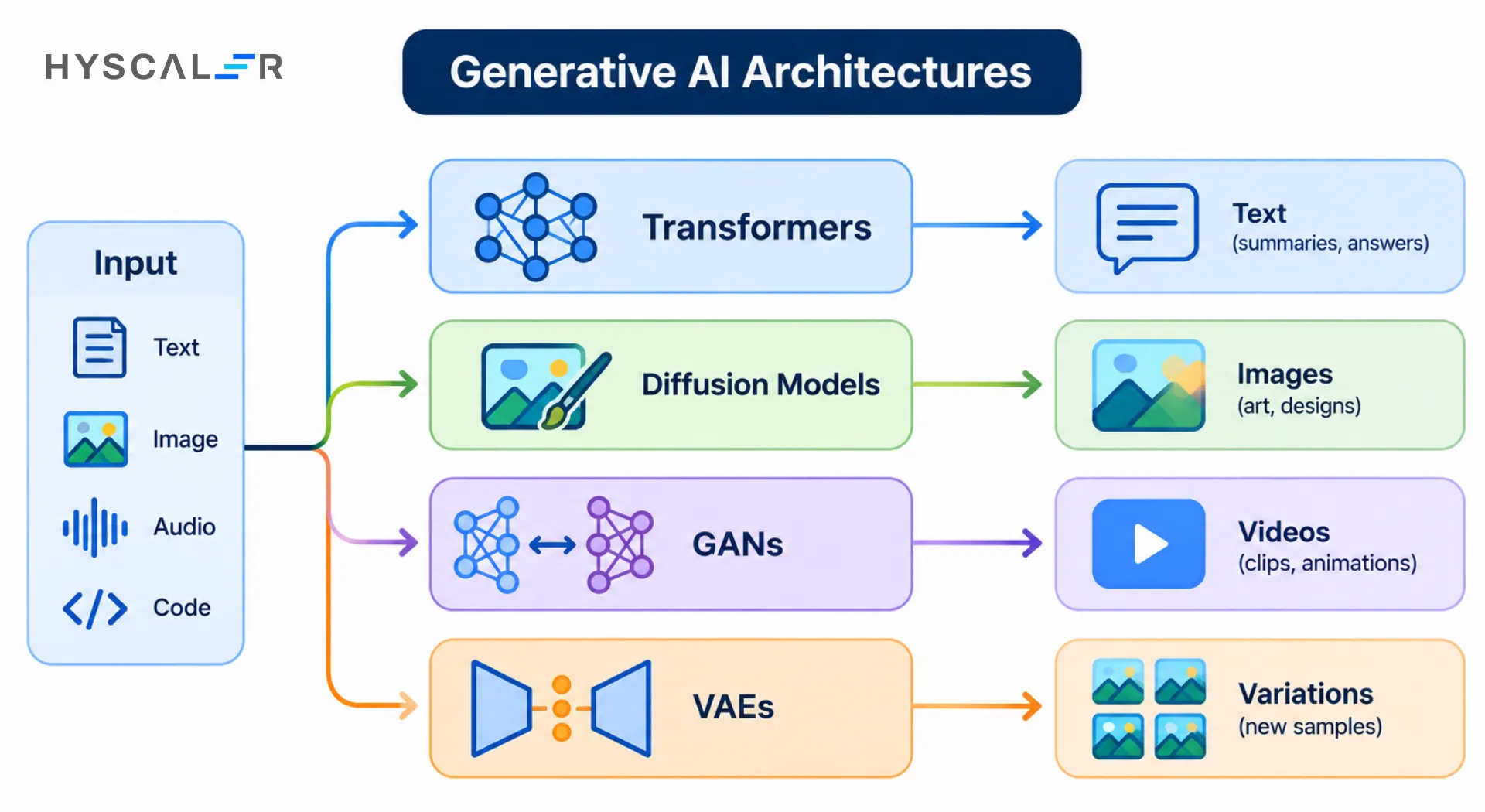
There is no single, universally accepted list of generative AI model types. Models can be classified in at least three ways: by architecture (how they generate), by modality (what data they handle), and by size or specialization (how they are deployed). These categories overlap. A single LLM can also be multimodal and reasoning-oriented, so the eight categories below should be read as lenses, not mutually exclusive boxes.
1. Transformer-Based Models and Large Language Models (LLMs)
Transformers are the architecture behind most modern language AI. Their key innovation is the attention mechanism, which lets the model weigh how relevant every part of the input is to every other part. That is how a model keeps track of context across a long document or conversation.
Most LLMs are autoregressive: they generate output one token at a time, with each new token conditioned on everything before it. This makes them strong at drafting, summarizing, translating, answering questions, writing code, and powering conversational assistants. Well-known families include GPT, Claude, Gemini, Llama, and Mistral.
Business example: A financial services firm uses an LLM to summarize lengthy customer communications and help employees find the right policy guidance in seconds instead of searching through shared drives. Teams exploring this route often start with enterprise AI development support to scope the use case properly.
2. Diffusion Models
Diffusion models learn to reverse a gradual noising process. During training, they see images progressively corrupted with noise and learn to undo it. During generation, they begin with random noise and refine it step by step into a coherent image, guided by a text prompt or other condition.
They dominate image generation and are increasingly used for video and other media. Typical applications include advertising creative, product visualization, design exploration, and synthetic data generation. Stable Diffusion and FLUX are widely used image examples, alongside a growing set of video generation models.
Business example: An e-commerce company generates dozens of product-background variations for a seasonal campaign without arranging a separate photoshoot for each one.
3. Generative Adversarial Networks (GANs)
A GAN consists of two neural networks trained against each other. The generator creates samples, and the discriminator tries to tell them apart from real data. As the discriminator improves, the generator is forced to produce more realistic output.
GANs are used for image synthesis, image enhancement, and synthetic data. Diffusion models have overtaken them for general image generation, but GANs remain relevant where fast generation matters, since they typically produce a sample in a single pass, and in specialized domains where their behavior is well understood. Their main weakness is training instability.
Business example: A manufacturer generates synthetic defect images to expand a small dataset used for visual inspection research.

4. Variational Autoencoders (VAEs)
A VAE has two parts: an encoder that compresses data into a compact representation called a latent space, and a decoder that reconstructs data from it. Because the latent space is smooth and structured, sampling from it produces plausible variations of the data the model has seen.
VAEs are useful for synthetic data, anomaly research, and scientific modeling. Compared with newer image-generation approaches, their outputs can be blurrier or less detailed, which is why they now often act as a component inside larger systems (for example, compressing images before a diffusion model processes them) rather than as standalone generators.
Business example: A research team uses a VAE-based approach to generate variations of structured scientific data for controlled experiments.

5. Multimodal AI Models
Multimodal models work across more than one type of data, such as text, images, audio, and video. Some accept multiple input types and respond in text. Others can also generate images or speech. Vision-language models can read a chart or a scanned form, and real-time voice models can hold spoken conversations.
For enterprises, the value lies in work that has never fit neatly into text alone: document understanding, visual inspection, customer support that includes screenshots or photos, and video analysis.
Business example: An insurance company routes claim documents, photographs, and the customer’s written description through a multimodal workflow that gives claims reviewers a structured summary and flags inconsistencies. A human reviewer still makes the decision.

6. Small Language Models (SLMs)
Small language models are language models with far fewer parameters than frontier LLMs, so they need less memory and computing power. That makes them faster, cheaper per request, and easier to run on-device, at the edge, or on private infrastructure.
They are typically less capable on open-ended or highly complex tasks, but they can perform very well when fine-tuned for a narrow domain. Classification, routing, extraction, and internal assistants are natural fits.
Business example: A company uses a small model to classify and route thousands of routine support requests, escalating only the complicated ones to a larger model. This is the kind of build that benefits from custom AI-powered applications designed around the actual workload.

7. Reasoning Models
Reasoning models are trained or configured to work through problems in multiple steps before answering, often spending additional computation at inference time to plan, check, and revise. They tend to perform better on tasks that involve multi-step logic, planning, math, complex code, and detailed document analysis.
The trade-off is higher latency and cost. A reasoning model is overkill for drafting a routine email or tagging a ticket. Evaluate reasoning capability against what your task actually demands, not against how impressive it looks in a demo.
Business example: An enterprise software team uses a reasoning model to investigate a complex production failure, trace likely causes across services, and propose a debugging plan for engineers to verify.

8. Specialized Audio, Video, and Code Generation Models
Some models are built for a particular output type or domain:
- Audio and speech: text-to-speech, speech-to-text, voice translation, and music generation.
- Video generation: models that create or edit short video clips from text or image prompts.
- Code generation: models tuned for writing, completing, reviewing, and testing software.
- Domain-specific models: models adapted for areas such as legal, medical, scientific, or industrial workloads.
Business example: A global organization uses speech generation and translation to localize employee training materials for different markets, with native speakers reviewing the final versions.
A note on overlap: These categories blend in practice. A frontier LLM may be multimodal, reasoning-capable, and strong at code at the same time. Treat the categories as a vocabulary for describing what a model does, not as a rigid taxonomy.
Comparison of Different Generative AI Models
The table below summarizes how the categories differ in what they do well and what to watch for.
| Model type | Primary capability | Business applications | Main consideration |
|---|---|---|---|
| Transformer / LLM | Text and code generation | Enterprise assistants, document processing | Accuracy and inference cost |
| Diffusion | Image and media generation | Marketing, product design | Generation time and compute |
| GAN | Synthetic data and realistic images | Inspection, data augmentation | Training stability |
| VAE | Data representation and generation | Research, synthetic data | Output fidelity |
| Multimodal | Multiple data formats | Document and visual analysis | Modality support |
| SLM | Efficient language generation | Classification, internal assistants | Capability limitations |
| Reasoning | Complex problem-solving | Research, planning, code analysis | Latency and cost |
| Specialized | Specific content generation | Speech, video, software | Task-specific performance |
No single model suits every enterprise application. Some workloads benefit from a large general-purpose model, while others perform better and cost far less with a smaller, specialized, or multimodal one.
Generative AI Models vs. Traditional AI Models
Generative and predictive AI solve different problems, and mature organizations use both.
| Comparison | Generative AI | Traditional predictive AI |
|---|---|---|
| Primary purpose | Generate new content | Predict or classify outcomes |
| Input | Prompts and contextual data | Usually structured or labeled data |
| Output | Text, images, audio, code | Scores, predictions, classifications |
| Common applications | Content creation, document analysis | Fraud detection, demand forecasting |
| Evaluation | Output quality, accuracy, relevance | Precision, recall, prediction error |
Consider a retailer. A predictive model forecasts demand for each product, and a generative model writes the product descriptions and campaign copy for the items expected to sell. The two approaches can sit in the same workflow, with the predictive model’s output informing what the generative model creates.
Real-World Business Applications of Generative AI Models
The most useful way to think about applications is by business problem, then work backward to the model type.
Healthcare
Generative AI assists with clinical documentation, summarizing medical records, and automating administrative workflows such as prior authorization paperwork. Language and multimodal models are the usual fit. Human review is essential: clinicians must verify anything that touches patient care, and privacy requirements shape every deployment decision.
Banking and Financial Services
Use cases include processing financial documents, powering customer service assistants, and supporting compliance research. LLMs grounded in approved policy documents work well here, and reasoning models can help with complex document review. Compliance staff should validate outputs that inform regulated decisions.
Retail and E-commerce
Retailers use language models for product descriptions and personalized messaging, and diffusion models for product imagery and campaign visuals. Brand teams should review generated content for accuracy, tone, and intellectual property concerns before publishing.
Manufacturing
Typical applications include technical documentation, maintenance knowledge assistants that answer questions from manuals, and synthetic training data for inspection systems (using GANs or diffusion models). Engineers should validate any guidance that affects safety or equipment operation.
Software and Technology
Code generation, test-case creation, documentation, and debugging are among the most mature enterprise uses. Code-specialized and reasoning models are common choices. Generated code still needs code review, security scanning, and testing like any other contribution.
Open-Weight vs. Proprietary Generative AI Models
This choice affects cost, control, and risk, so it deserves explicit attention.
| Factor | Open-weight models | Proprietary models |
|---|---|---|
| Model access | Weights available under applicable licenses | Usually vendor-managed |
| Customization | Greater deployment and customization flexibility | Depends on vendor capabilities |
| Infrastructure | Self-hosted or managed options | Often accessed through APIs |
| Control | More infrastructure control | Greater vendor dependency |
| Maintenance | Organization manages more operations when self-hosted | Vendor manages much of the underlying infrastructure |
| Cost | Hosting and operational costs | API and service usage costs |
A few points matter in practice:
- Open-weight does not automatically mean open source. Many open-weight models ship with licenses that restrict commercial use, scale, or specific applications. Read the license before building on a model.
- Data privacy and hosting. Self-hosting keeps data inside your environment, which helps with residency and sensitivity requirements, but you take on security and patching. Vendor APIs raise questions about data handling that contracts and settings must answer.
- Vendor lock-in. Proprietary APIs can create dependency on one provider’s pricing and roadmap. Designing an abstraction layer between your application and the model reduces that risk.
- Operational responsibility. Running models yourself requires GPU capacity, monitoring, and engineering time.
Neither approach is universally better. Many organizations use proprietary models for the hardest tasks and open-weight models for high-volume or sensitive workloads.
How to Choose the Right Generative AI Model for Your Business
The most valuable decision you will make is not which model is best in general, but which model is best for a specific job. Evaluate candidates against these factors:
| Selection factor | What businesses should evaluate |
|---|---|
| Business objective | What problem should the model solve? |
| Output quality | Does it meet task-specific accuracy requirements? |
| Model capability | Does it support the required modality and complexity? |
| Latency | Can it meet response-time expectations? |
| Cost | What is the total cost per successful task? |
| Security | Can it satisfy privacy and access requirements? |
| Integration | Can it connect with existing business systems? |
| Scalability | Can it support projected usage? |
| Licensing | Are commercial and deployment rights suitable? |
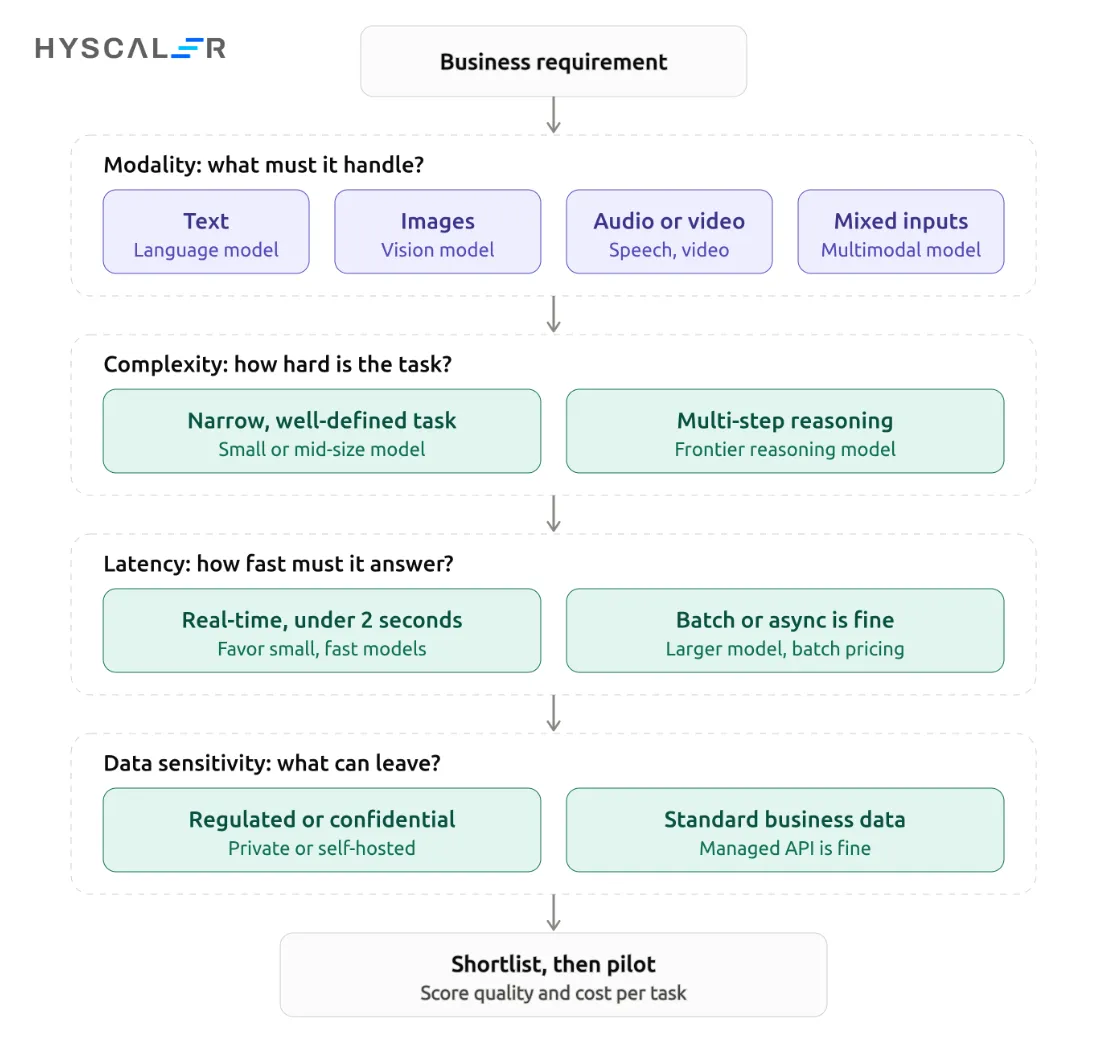
Match the Model to the Business Use Case
- Document processing: an LLM or multimodal model.
- Product image generation: a diffusion model.
- Routine support classification: a small language model.
- Complex analytical tasks: a reasoning model.
- Synthetic image generation: a GAN or diffusion model, depending on speed, fidelity, and training requirements.
Evaluate Models Using Real Workloads
Public benchmarks tell you how a model performs on someone else’s tasks. Instead, test two or three candidates against the same representative sample of your own data and measure:
- Accuracy and output quality.
- Response time.
- Cost per successful task (not just cost per request, since retries and corrections add up).
- Error and hallucination rates.
- Security and compliance fit.
This task-specific approach aligns with the model-selection guidance from major cloud providers, including Microsoft, which recommends evaluating models against real requirements instead of choosing by popularity.
Consider Multi-Model Architectures
A single application often uses several models. A small model might classify and route incoming requests, a larger LLM might handle complex questions, a multimodal model might read attached documents, and a reasoning model might handle the occasional hard case. Routing work to the cheapest model that can do it well is one of the most effective ways to control cost without sacrificing quality.
![Consider Multi-Model Architectures: multi-model enterprise architecture with a routing layer, small model, large model, multimodal model, retrieval layer, and human review step]](https://assets.hyscaler.com/wp-content/uploads-webpc/uploads/2024/01/consider-multi-model-architectures.png.webp)
How Businesses Can Implement Generative AI Models
Moving from idea to production works best as a sequence of deliberate steps.
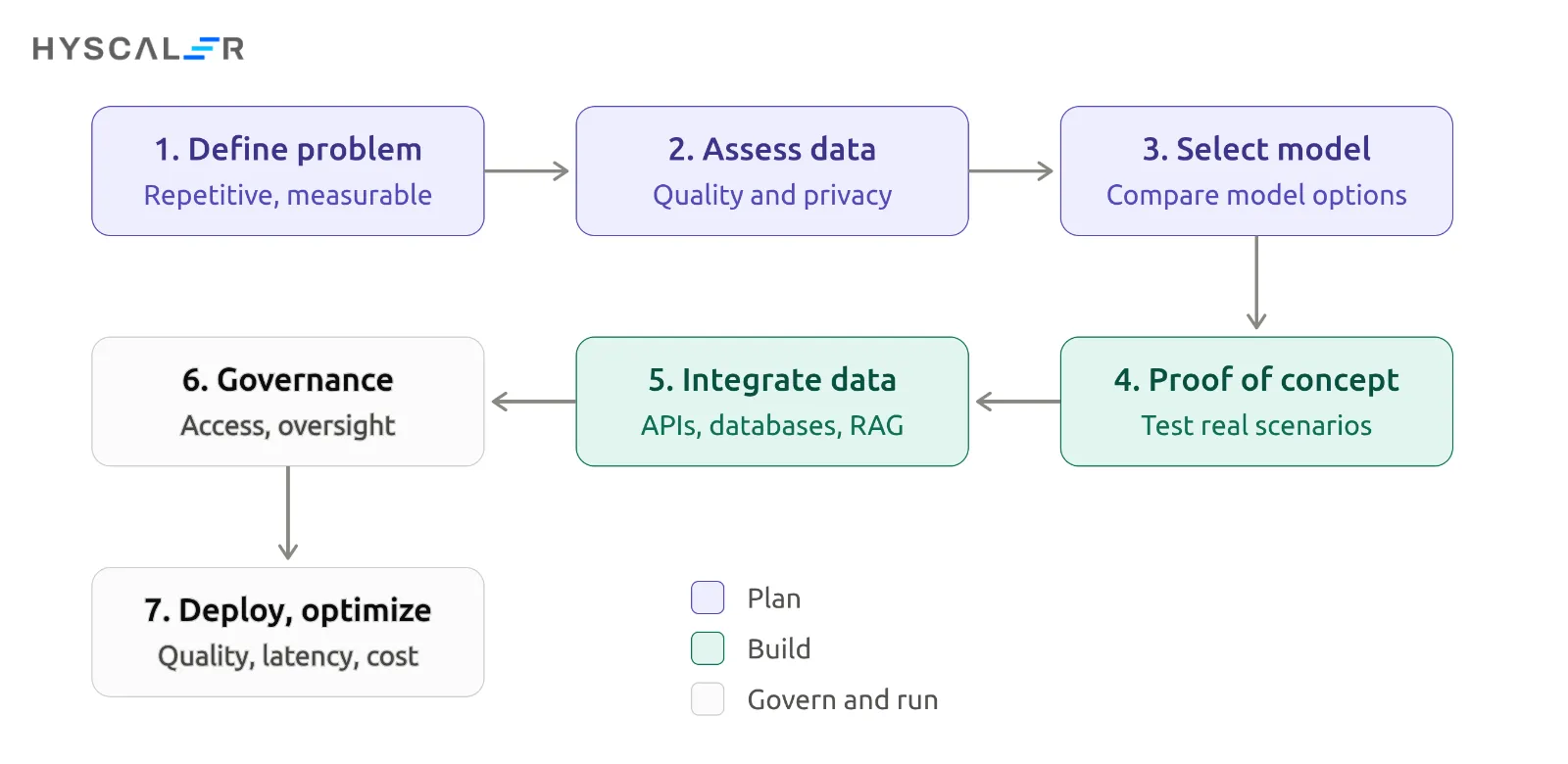
- Identify the business problem: Look for a repetitive, time-consuming, or knowledge-intensive process where speed or consistency matters, and define how you will measure improvement.
- Assess data readiness: Evaluate the quality, accessibility, privacy status, and integration requirements of the data the solution will use. Weak data foundations are a common reason pilots stall, which is why many teams invest early in enterprise data engineering.
- Select the appropriate model: Compare foundation models, open-weight models, specialized models, and managed APIs against the selection factors above.
- Build a proof of concept: Test the candidate against real scenarios with clear success criteria, such as accuracy thresholds, time saved, or cost per task.
- Integrate business data and systems: Connect enterprise applications, databases, APIs, and knowledge sources. Use retrieval-augmented generation (RAG) when answers must be grounded in business-specific, frequently changing information. Our AI integration services cover this connective work.
- Implement security and governance: Establish access controls, data protection, output validation, human oversight, and monitoring before launch, not after.
- Deploy, monitor, and optimize: Track quality, latency, inference cost, adoption, and business outcomes. Refine prompts, retrieval, or the model itself, and replace models when a better option appears. Reliable deployment depends on the right cloud infrastructure and deployment approach.
Example: an enterprise knowledge assistant. A company wants employees to get accurate answers about HR, IT, and compliance policies. The assistant receives a question, retrieves the most relevant approved internal documents, passes them to the model as context, and generates an answer that cites its sources. Access controls ensure each employee only sees documents they are permitted to read, and feedback from users flags answers that need correction. This pattern, increasingly built with MCP-based AI agents, keeps answers grounded in verified content instead of relying on what the model memorized.
Both Google Cloud and AWS publish detailed implementation guidance that is worth consulting as you plan your architecture.
Challenges and Limitations of Generative AI Models
Generative AI is powerful, but it introduces risks that need deliberate mitigation:
- Hallucinations and inaccurate outputs – Models can produce confident but wrong answers. Mitigation: ground responses in verified data with RAG, require citations, and add human review for high-stakes outputs.
- Data privacy and security risks – Sensitive data can leak through prompts, logs, or misconfigured integrations. Mitigation: apply least-privilege access, data masking, and clear policies on what may be sent to which model.
- Bias and inconsistent results – Models reflect biases in their training data and may behave differently across inputs. Mitigation: test across representative groups and scenarios, and monitor outputs continuously.
- High computational and inference costs – Large models are expensive at scale. Mitigation: route simple tasks to smaller models, cache repeated results, and track cost per successful task.
- Intellectual property and licensing concerns – Training data, generated content, and model licenses can raise legal questions. Mitigation: review licenses, set content usage policies, and involve legal counsel early.
- Integration complexity – Connecting models to legacy systems is often harder than the model itself. Mitigation: start with well-scoped workflows and build on standard APIs and integration patterns.
- Model drift and ongoing maintenance – Performance can change as data, user behavior, and model versions change. Mitigation: maintain evaluation sets, version your prompts and models, and re-test regularly.
- Human oversight requirements – Full automation is rarely appropriate for consequential decisions. Mitigation: define where humans approve, review, or can override outputs.
The NIST Generative AI Risk Management Profile is a useful reference for structuring these controls and building a responsible deployment program.
Future Trends in Generative AI Models
Rather than speculate, it is more useful to focus on developments with clear enterprise implications:
- More capable multimodal models: Systems that handle documents, images, audio, and video together will simplify workflows that currently need several tools.
- Smaller, more efficient models: Strong performance at lower cost makes private and on-device deployment more practical.
- Improved reasoning. Better multi-step problem solving will expand automation into analysis-heavy work, though cost and latency will still matter.
- Open-weight adoption: More capable open models give organizations stronger options for control and customization.
- Specialized, domain-adapted models: Models tuned to industries and tasks can outperform general models on narrow workloads.
- Multi-model orchestration and agentic workflows: AI agents, which are systems that plan and take actions using models and tools, will coordinate multiple models across business processes. Note that agents are systems built on models, not a model architecture themselves.
- Better evaluation and governance: Expect stronger tooling for testing, monitoring, and auditing models, and growing regulatory attention.
How HyScaler Helps Businesses Build and Integrate Generative AI Solutions
Choosing a model is only one part of delivering value. HyScaler works with organizations to identify high-impact use cases, select and integrate the right models through our AI development services, and build custom applications through our software development services. We connect enterprise data using data engineering and RAG, deploy solutions on suitable cloud infrastructure, and develop AI agents and AI-powered workflow automation that fit the way your teams already work.
Conclusion
Generative AI models differ widely in architecture and capability, from LLMs and diffusion models to multimodal, small, and reasoning models. Choosing well means balancing business needs, performance, cost, security, and integration instead of following the latest headline. And model selection is only the beginning: lasting results depend on reliable data, thoughtful implementation, governance, and continuous optimization. To explore how these ideas apply to your organization, learn more about HyScaler’s AI development capabilities.
FAQ
What is the difference between an LLM and a generative AI model?
A generative AI model is the broad category covering any model that creates new content, including text, images, audio, video, and code. An LLM is one type, designed mainly for language tasks. Diffusion models, GANs, and speech models are generative AI models that are not LLMs.
Which generative AI models are best for enterprise applications?
It depends on the task. LLMs suit document processing and assistants, diffusion models suit visual content, multimodal models suit mixed data, and small models suit high-volume routine work. Most enterprises combine several, selected through testing on their own data.
Can businesses train their own generative AI models?
Yes, but training a large model from scratch requires massive data, computing power, and expertise. Most businesses instead adapt existing models through prompting, RAG, or fine-tuning, which is far less expensive and usually sufficient for business needs.
What is the difference between fine-tuning and RAG?
Fine-tuning adjusts a model’s weights using additional training data to change its behavior or style. RAG retrieves relevant documents at query time and supplies them to the model. RAG is usually better for knowledge that changes frequently; fine-tuning suits consistent format or domain behavior.
Are open-weight generative AI models suitable for commercial use?
Often, but it depends on the license. Some permit broad commercial use, while others restrict scale, industries, or applications. Review the specific terms, and evaluate security, hosting, and support responsibilities before building a product on an open-weight model.
How much does it cost to implement generative AI in a business?
Costs vary widely based on scope, model choice, data readiness, integration needs, and usage volume. Key drivers include inference or hosting costs, engineering effort, and governance. Starting with a focused proof of concept gives a realistic estimate before scaling.