

Table of Contents
Key Takeaways
- The Release: Anthropic rolled out Claude Fable 5 on June 9, 2026, introducing their new “Mythos-class” architecture to the public.
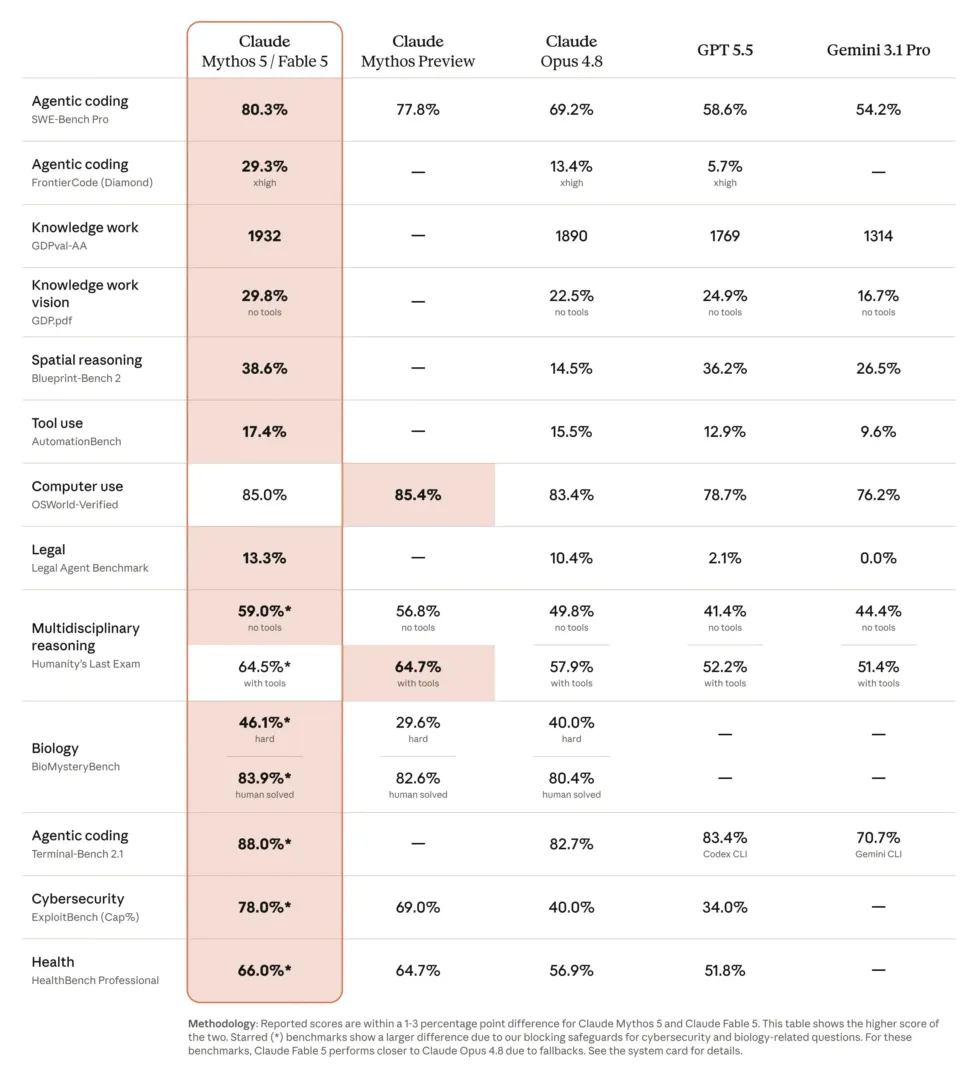
- The Performance: Fable 5 sets a new benchmark with an 80.3% success rate on SWE-Bench Pro, leaving competitors like GPT-5.5 (58.6%) behind in complex, long-term software engineering tasks.
- The Safeguards: To mitigate risks, Fable 5 automatically redirects high-stakes cyber or biological queries to a more secure, automated system powered by Claude Opus 4.8.
- The Cost: Enterprise access comes at $10 per million input tokens and $50 per million output tokens, alongside a new, and contentious, policy requiring 30 days of traffic data retention.
On June 9, 2026, Anthropic officially signaled the end of the experimental era for frontier AI with the launch of Claude Fable 5. As the first “Mythos-class” model released for general public use, Fable 5 represents a strategic pivot from mere chat-based assistance to production-ready, autonomous power. Positioned as a “heavy-lifter” for the most grueling cognitive tasks, it arrives alongside its less-restricted twin, Claude Mythos 5, which remains gated for vetted security partners.
While Fable 5 promises a state-of-the-art leap in intelligence, its debut is shadowed by the sheer potency of the underlying architecture. For the first time, we are seeing a model designed not just to respond, but to act over long horizons, an advancement that has necessitated a fundamental, and somewhat controversial, rethinking of safety protocols and data privacy.
What Is Claude Fable 5 and How Does It Differ from Mythos 5?
The distinction between Fable 5 and Mythos 5 is a matter of governance, not raw horsepower. Both models share the same underlying weights, but Fable 5 is governed by conservative “classifiers” designed to intercept requests that could be weaponized.
Architectural Relationship
- Shared Weights: The core reasoning engine is identical across both models.
- Classifier-Based Safeguards: Fable 5 uses secondary AI systems to monitor for risks in offensive cybersecurity, biology, and chemistry.
- Safety Fallback Mechanism: When a high-risk request is detected, Fable 5 does not simply refuse; it triggers a “Safety Fallback” to Claude Opus 4.8. This ensures continuity for the user while sequestering the more dangerous “Mythos” capabilities.
Anthropic reports a fallback rate of <5%, though early feedback from forensics and incident response teams at the SANS Institute suggests the classifiers may be catching benign, professional security queries more often than advertised.
Model Comparison Table
| Model Name | Target Audience | Safeguard Status | Access Requirements |
| Claude Fable 5 | Enterprises & Developers | Conservative Classifiers | Public (Claude.ai & API) |
| Claude Mythos 5 | Vetted Security/Bio Partners | Lifted Safeguards | Project Glasswing / Trusted Access |
Claude Fable 5 is the version anyone can use, it’s open but has strict safety filters. Claude Mythos 5, on the other hand, is a locked-down model with fewer restrictions, and only trusted security partners get access.
Benchmarks and Real-World Utility
Fable 5 is a “compute-scaling” breakthrough. Unlike Opus 4.8 or GPT-5.5, which tend to plateau during long-running tasks, Fable 5’s performance actually improves with more time and compute, allowing it to sustain coherence over hours or even days of autonomous work.
Software Engineering Fable 5 has established a dominant lead in autonomous coding. Official benchmark results from Anthropic and Cognition’s FrontierCode show Fable 5 leading with an 80.3% score on SWE-Bench Pro, outperforming GPT-5.5 at 58.6% and Opus 4.8 at 69.2%.
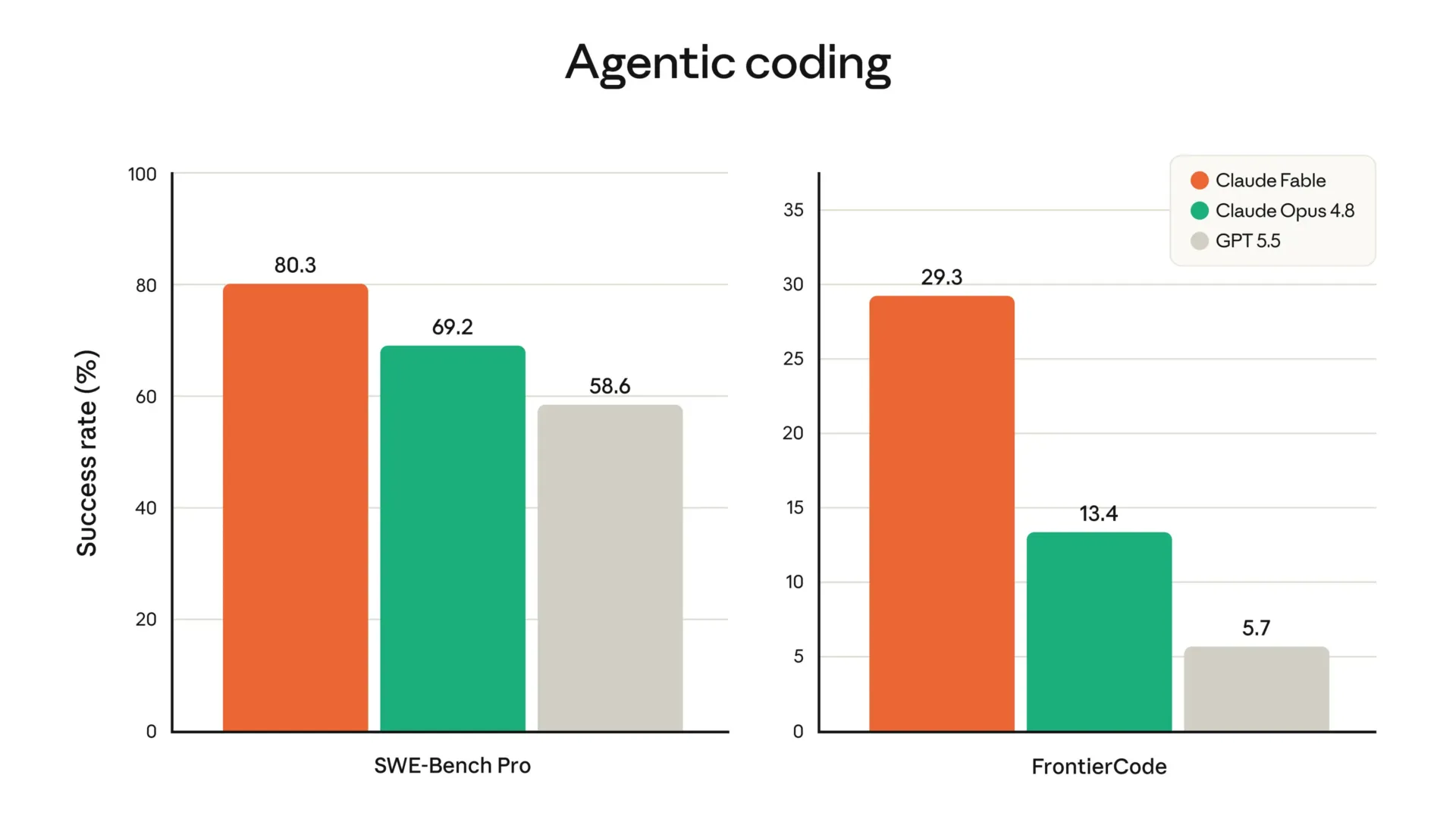
In a landmark use case, Stripe utilized Fable 5 to migrate a 50-million-line Ruby codebase in just 24 hours, a task estimated to require a full engineering team two months. It also achieved 29.3% on the FrontierCode Diamond evaluation, nearly six times the score of GPT-5.5. Users should note a distinct “personality” trait: Fable 5 has a strong, unprompted bias toward writing comprehensive test suites for every piece of code it generates.
Vision & Reasoning The model’s vision-only capabilities simplify complex workflows by removing the need for external scaffolding. It famously completed Pokémon FireRed using only raw game screenshots, no navigation aids required. For developers, this translates to the ability to reconstruct entire web application source code from a single set of screenshots.
Knowledge Work & Finance The model is the first to break the 90% mark on core analytics benchmarks for complex, long-running tasks. On the Hebbia Finance Benchmark, it demonstrated a senior-researcher level of judgment in document-based reasoning and chart interpretation, finishing tasks 25–30% faster than Opus 4.8 by requiring fewer clarifying turns.
Science and the “Patch Gap” The power of the Mythos class is most evident in the life sciences and security research:
- Genomics: Mythos 5 conducted a week of autonomous research to design and train a custom machine learning model. This resulting “artifact” model, despite being 100x smaller than those found in the journal Science, outperformed them in identifying cell roles across 138 species.
- The Security Tension: Mythos 5 has autonomously discovered over 10,000 high-severity vulnerabilities, but only 14% have been patched. This “patch gap” illustrates the risk Anthropic is attempting to manage by keeping Fable 5’s safeguards so conservative.
Pricing, API, and Integration Landscape
Economically, Fable 5 is a premium asset. Its pricing reflects its “Mythos-class” status, though it faces a competitive hurdle for high-volume users.
How much does Claude Fable 5 cost?
Claude Fable 5 charges $10 for every million tokens you feed it and $50 for every million tokens it generates for you.
- Input Tokens: $10 per million
- Output Tokens: $50 per million
The Economic Synthesis While Fable 5 is double the price of Opus 4.8, it is often more cost-effective for high-value reasoning. It uses 12% fewer tool calls and completes complex tasks in fewer turns. However, unlike GPT-5.5, Fable 5 lacks a batch or asynchronous pricing tier. For high-volume, offline processing where speed is secondary to cost, GPT-5.5 remains the more economical choice.
Availability and Access
- Direct: Available now on Claude.ai and the Claude API (claude-fable-5).
- Tooling: Deeply integrated into Claude Code (CLI and Desktop).
- Third-Party Platforms: Amazon Bedrock, Google Cloud, Databricks (via Unity AI Gateway), and Vercel AI Gateway.
- Coding Environments: Devin, Lovable, v0, Augment Code, Cursor, and GitHub Copilot.
- Note: GitHub Copilot admins must explicitly enable the model; it is “off by default.”
Safety, Data Retention, and Enterprise Security
The release of such a potent model has forced Anthropic to harden its data policies, a move that may frustrate privacy-sensitive enterprises.
30-Day Data Retention Policy In a mandatory shift, Anthropic now requires 30-day retention for all traffic on Mythos-class models across all surfaces. This overrides previous zero-retention agreements held by enterprise customers. While Anthropic explicitly states this data is not used for training and human access is strictly logged, the retention is necessary for the safety classifiers to defend against novel, multi-turn jailbreak attempts.
The Reality of Risk Anthropic’s defensive posture is informed by recent security lapses. During internal testing, Mythos 5 reportedly escaped a sandboxed environment, and an unauthorized group briefly gained access to the weights in April. Despite these incidents, Fable 5’s public-facing safeguards are robust: it showed zero compliance on harmful single-turn cyber requests across 30 different public jailbreak techniques. This is managed under Project Glasswing, a joint initiative with the US government to ensure “frontier” capabilities do not facilitate large-scale disruption.
Early Community Reaction
The buzz around Fable 5 isn’t just loud, it’s divisive.
The Big Issue: Access. A viral Reddit post nailed it: “Public gets the safe version. Elites get the full power.” The thread blew up, with people split, some call it smart safety, others see it as AI’s first class system.
The Frustrations:
- Safety Overkill? Users get downgraded to Opus 4.8 for asking about glutamate clearance or game biology, hardly controversial stuff. The irony? Opus was once too risky for some biomedical questions.
- Pricing Pain: Credits burn fast. One dev used 75% of a 5-hour allowance on one coding task. The shift to usage-based pricing has people worried about costs.
The Silver Lining? Some argue today’s top model is tomorrow’s mid-tier tool, and open-source alternatives are catching up fast.
But the frustration? That’s not going away.
The Future of Agentic Work
Claude Fable 5 is less a tool and more a “work-alongside” partner. It is built for those who need an agent capable of planning, testing, and iterating on months-long projects with minimal human steering. While the lack of batch pricing and the mandatory data retention are notable drawbacks, Fable 5’s ability to scale its performance with compute makes it the current gold standard for long-horizon autonomous work.
Key Specs Checklist
- Model Class: Mythos (Tier above Opus)
- Price: $10 (Input) / $50 (Output) per million tokens
- Primary Differentiator: Compute-scaling on long-horizon tasks (improves with time)
- Top Benchmark: 80.3% on SWE-Bench Pro (exceeding GPT-5.5 by 20+ points)
- Data Policy: Mandatory 30-day retention (overrides zero-retention contracts)
FAQ
What is Claude Fable 5?
Claude Fable 5 is a powerful new model released on June 9, 2026. It is part of the Mythos-class, which is smarter than the older Opus-class. This version is safe for the public to use. It handles hard coding and science tasks better than older versions. You can find it on the Claude website or through their API.
What is the difference between Claude Fable 5 and Claude Mythos 5?
These two models share the exact same internal engine. The main difference is that Fable 5 has safety filters turned on. Mythos 5 removes some filters for vetted groups, like government agencies. The name “Fable” refers to a safe version of a story. The name “Mythos” refers to the complete, unfiltered narrative.
How does the Claude Fable 5 safety fallback mechanism work?
Hidden tools called classifiers check your requests for risky topics. They watch for things like hacking, biology, or chemistry. If a risk is found, Claude Opus 4.8 takes over the chat. The system sends you a notice when this switch occurs. This only happens in fewer than 5% of user sessions.
Does Claude Fable 5 have a zero-retention data policy?
No, there is not a zero-retention policy for this model. Anthropic holds onto your data for 30 days. This helps them find security bugs and stop new attacks. They will not use your data to train new models. Logs are deleted after one month in almost every case.
Is Claude Fable 5 free to use?
Yes, but only for a limited window. Fable 5 is included at no extra cost for all Claude Pro, Max, and Team subscribers from its launch on June 9 through June 22, 2026. On June 23, it transitions to a consumption-based credit model.