
Table of Contents
AI in supply chain management helps businesses anticipate demand, optimize inventory, improve logistics, and respond to disruptions before they become costly. It does this by turning data from across the supply chain into forecasts, recommendations, and, where appropriate, automated actions. For supply chain leaders, operations managers, business owners, CTOs, and data teams, the question is no longer whether AI is relevant. It is where to apply it first, how to implement it, and how to prove it works.
Traditional supply chain management relies on teams in procurement, quality assurance, production, warehousing, and transportation working from spreadsheets and disconnected systems. That approach struggles with fluctuating demand, logistics disruptions, and inventory inefficiencies. AI-powered tools are now accessible to businesses of all sizes, and they can streamline processes, automate repetitive tasks, and surface insights buried in supply chain data.
This guide covers the main applications, benefits, architecture, implementation roadmap, costs, risks, and ROI of AI in supply chain management, with a clear line between what is established today and what is still emerging.
In short: The strongest results come from focused use cases such as demand forecasting, inventory optimization, logistics, and supplier risk, built on clean, integrated data and measured against clear KPIs. Results depend on data quality, system integration, user adoption, and ongoing evaluation.
What Is AI in Supply Chain Management?
AI in supply chain management is the use of machine learning, predictive analytics, optimization algorithms, and other AI technologies to improve forecasting, inventory planning, procurement, logistics, and operational decision-making across the flow of goods, from sourcing raw materials to final delivery.
AI draws on historical transactions, real-time operational data, and external signals such as weather, traffic, and market trends. It then identifies patterns, predicts outcomes, and recommends or triggers actions that help teams decide faster and with more accuracy.
How Does AI Work in Supply Chain Management?
Most supply chain AI systems follow the same workflow:
- Collect data from ERP, warehouse management, transportation, procurement, IoT sensors, and external sources.
- Clean and integrate data so identifiers, units, and timestamps are consistent across systems.
- Apply predictive models and optimization algorithms to detect patterns and recommend actions.
- Deliver insights or actions through the operational systems teams already use.
- Monitor results and improve models continuously as conditions and data change.
AI vs. Traditional Supply Chain Management
| Dimension | Traditional approach | AI-enabled approach |
|---|---|---|
| Decision speed | Periodic reviews, often weekly or monthly | Continuous analysis with near-real-time recommendations |
| Data sources | Internal historical data, spreadsheets | ERP, WMS, TMS, IoT, carrier feeds, and external signals combined |
| Forecasting | Static averages and manual adjustments | Models that learn from seasonality, promotions, and market signals |
| Disruption response | Reactive, after delays or shortages occur | Early warnings and suggested contingency actions |
| Automation | Rule-based and manual data entry | Intelligent automation of routine, well-defined workflows |
| Human oversight | Humans make and execute most decisions | Humans set goals, approve consequential actions, and handle exceptions |
Types of AI Used in Supply Chain Management
These technologies are not interchangeable, and choosing the right one for each problem is a core part of a successful project.
- Machine learning and predictive analytics: Forecast demand, delays, supplier risk, and equipment failures from historical and current data.
- Optimization algorithms: Find the best routes, reorder quantities, or warehouse layouts within real-world constraints such as cost, capacity, and service levels.
- Generative AI and supply chain copilots: Let planners ask questions in plain language, summarize exceptions, and draft supplier communications. They support people rather than replace planning models.
- AI agents and workflow automation: Investigate issues, gather information from connected systems, and carry out approved, bounded tasks.
- Computer vision and IoT-enabled AI: Inspect products and packaging, monitor equipment and cold chains, and track assets in real time. Related capabilities include robotic process automation (RPA) for order processing, invoice management, and data entry, and natural language processing for chatbots that provide tracking updates and answer customer queries.
Key Applications of AI in Supply Chain Management
The sections below describe where AI delivers practical value across supply chain workflows.
AI-Powered Demand Forecasting
Machine learning models analyze historical sales, seasonality, promotions, pricing, and external demand signals to predict what customers will buy and when. Demand sensing goes further by updating forecasts as new data arrives, such as point-of-sale activity, weather, or order trends, so plans do not go stale.
Measure forecasting with two metrics: forecast accuracy (how far predictions deviate from actual demand) and forecast bias (whether the model consistently over- or under-predicts). A forecast that is accurate on average but consistently biased still creates excess stock or shortages.
Inventory Optimization and Replenishment
AI predicts stockouts and excess inventory before they happen, and it helps tune safety stock, reorder points, and replenishment timing for each SKU and location. The core trade-off is between carrying costs and service levels: holding more stock protects availability but ties up cash and storage. AI makes that trade-off explicit and adjusts it as demand and lead times change.
Predictive Analytics for Supply Chain Planning
Predictive models can forecast shipment delays, supplier risks, demand shifts, and equipment failures. Predictive analytics estimates what is likely to happen, while prescriptive analytics recommends what to do about it, such as changing a reorder quantity or choosing an alternative route. For a deeper look, see HyScaler’s dedicated guide to predictive analytics in supply chain management.
AI in Logistics, Transportation, and Route Optimization
AI analyzes traffic patterns, weather conditions, and delivery schedules to optimize transportation. Typical uses include:
- Dynamic routing and delivery-time prediction, which reduces fuel consumption and improves on-time delivery.
- Carrier selection and freight-cost optimization.
- Shipment exception detection and rerouting when delays appear.
For the systems that carry out these plans, see HyScaler’s guide to supply chain execution software.
AI in Procurement and Supplier Management
Procurement teams use AI to:
- Score and monitor supplier risk. AI evaluates supplier reliability, monitors geopolitical and financial risks, and flags potential disruptions. This supplier & risk management guide is a useful companion.
- Analyze spend. Spend analysis software such as Suplari provides AI-driven spend visibility that supports better purchasing decisions.
- Automate transactions. AI can process purchase orders and invoices and support sourcing decisions. Procurement software can streamline these workflows further.
Better supplier insight also strengthens relationships, since shared performance data makes collaboration and issue resolution easier.
AI in Warehousing and Manufacturing
- Computer vision for quality inspection detects defects in products and packaging, improving quality assurance and reducing production errors.
- Warehouse slotting, picking, and labor planning use stock-level tracking, robotics, and smart sensors to prevent overstocking and stockouts and to speed up fulfillment.
- Predictive maintenance anticipates equipment and production-line failures so repairs happen before breakdowns.
Real-Time Supply Chain Visibility and Risk Management
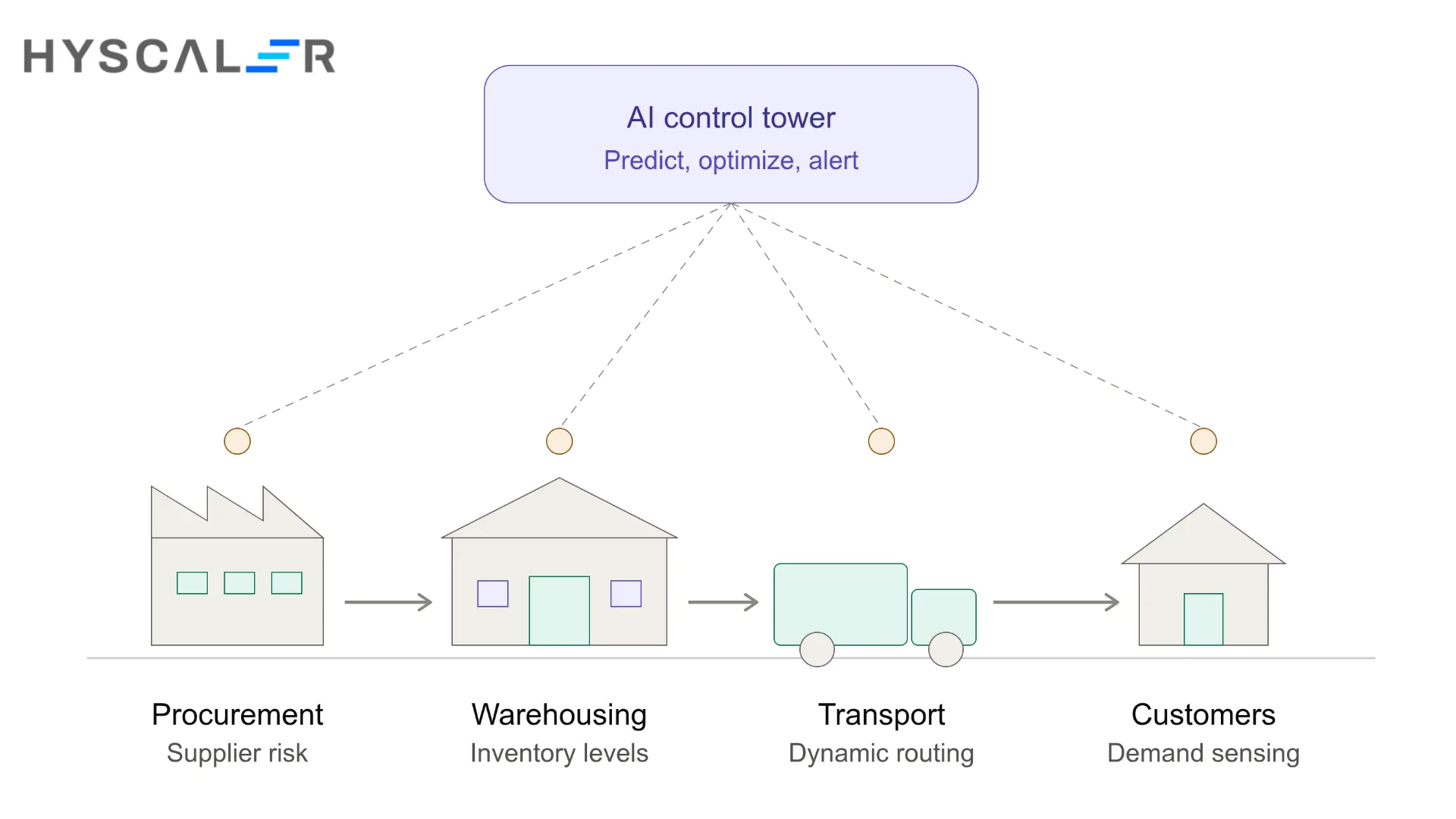
AI can combine shipment tracking, supplier information, IoT data, weather, and external disruption signals into one view. Supply chain control towers present this view to planners, raise risk alerts, and manage exceptions. Early warnings give teams time to execute contingency plans, such as switching suppliers, expediting shipments, or reallocating inventory, before customers feel the impact.
AI Agents and Automation in Supply Chain Management
Traditional automation follows fixed rules: if a condition is met, an action runs. AI agents can reason across multiple systems. They investigate a delayed shipment, check inventory and carrier options, and propose an alternative route or prepare a replenishment recommendation.
This capability is still maturing, so deploy agents within clear limits:
- Restrict agents to bounded, well-defined actions.
- Require human approval for consequential decisions.
- Enforce access controls and keep audit logs of every action.
- Define escalation rules for cases the agent cannot resolve.
HyScaler’s AI services help businesses integrate these capabilities into existing workflows rather than replacing the systems teams rely on.
Benefits of AI in Supply Chain Management
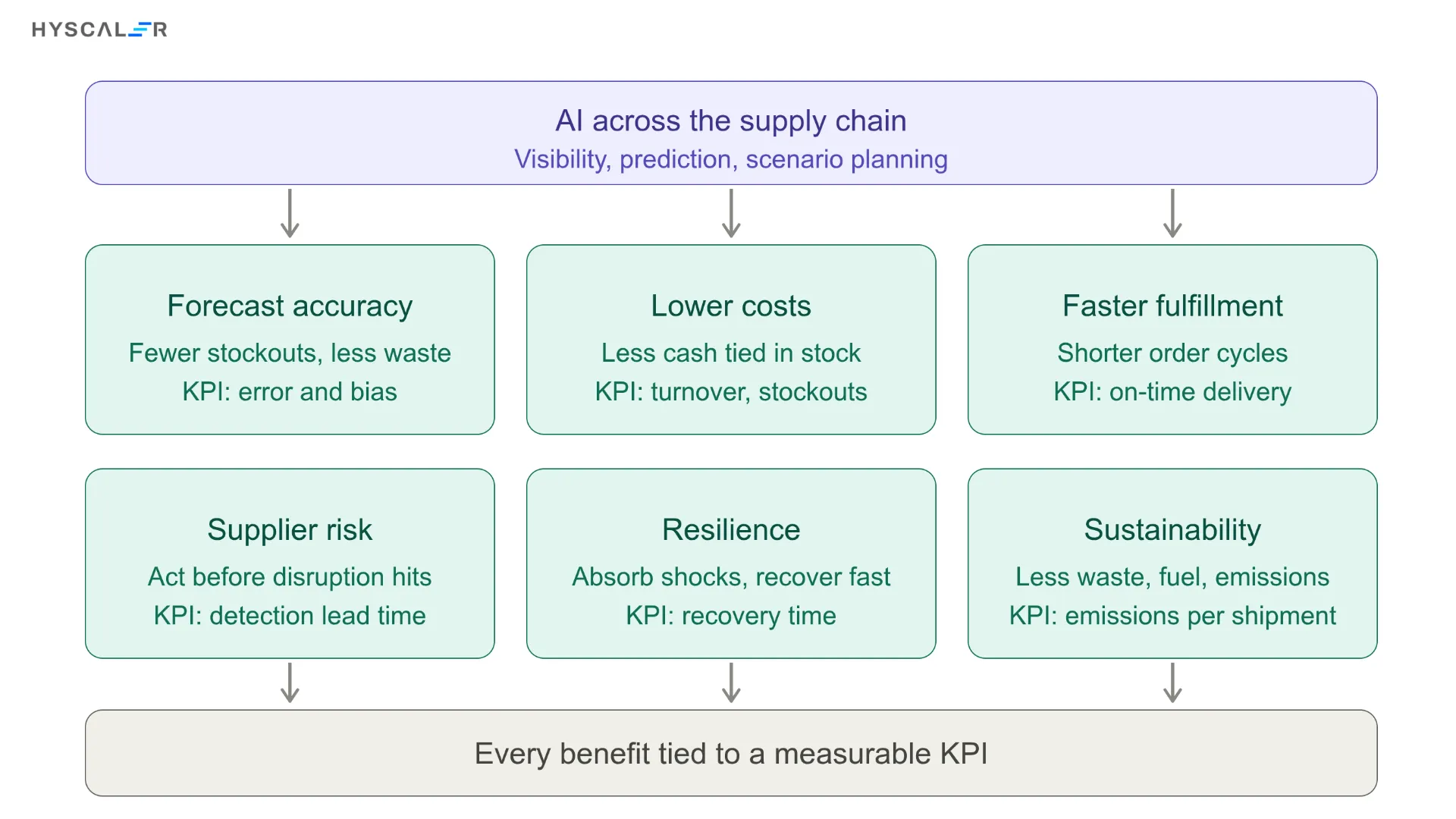
AI delivers the most value when each benefit is tied to a measurable business outcome.
Improved Demand Forecast Accuracy
Learning from historical data and market signals, AI predicts demand more accurately than static methods. The business outcome is fewer stockouts, less excess inventory, and less waste.
Lower Inventory and Operating Costs
Better forecasts and optimized replenishment reduce carrying costs and working capital tied up in stock. Automation of routine tasks such as inventory tracking and order processing also reduces errors and increases productivity.
Faster Order Fulfillment and Delivery
Route optimization, delivery-time prediction, and smarter warehouse operations shorten order cycles, improve on-time delivery, and lower transportation costs.
Better Supplier Risk Management
AI detects signals of supplier failure, geopolitical risk, or compliance issues early, and it can monitor changing regulatory requirements. Teams can act proactively instead of absorbing the disruption.
Greater Supply Chain Resilience
Combining visibility, prediction, and scenario planning helps organizations absorb shocks and recover faster.
Improved Sustainability and Reduced Waste
Accurate planning and efficient logistics reduce overproduction, fuel use, and emissions (see the sustainability section below).
Linking Benefits to KPIs
| Benefit | KPIs to track |
|---|---|
| Forecast accuracy | Forecast error, forecast bias |
| Lower inventory and operating costs | Inventory turnover, carrying cost, stockout rate |
| Faster fulfillment and delivery | On-time delivery, order cycle time, freight cost per shipment |
| Supplier risk management | Supplier lead-time variability, disruption detection lead time |
| Resilience | Recovery time after disruption, service level during disruption |
| Sustainability | Waste reduction, fuel consumption, emissions per shipment |
Benchmark each KPI before implementation. Claims about percentage improvements should come from verified company results or your own pilot data, not generic industry figures.
How AI in Supply Chain Management Enhances Sustainability
AI makes supply chains more sustainable by optimizing resource use, reducing waste, and lowering carbon footprints.
- Optimized inventory and waste reduction: Demand forecasting prevents overproduction and excess inventory, cutting waste and unnecessary resource use.
- Energy efficiency in logistics: Route optimization and smart fleet management reduce fuel consumption and transportation emissions.
- Sustainable sourcing and supplier monitoring: AI evaluates suppliers’ sustainability practices and helps monitor ESG (Environmental, Social, and Governance) compliance.
- Smart manufacturing and resource optimization: Predictive maintenance and real-time monitoring improve equipment efficiency, reducing energy, water, and material waste.
- Circular economy support: AI helps identify opportunities for recycling, reuse, and remanufacturing, extending product life cycles and reducing reliance on virgin raw materials.
These gains are practical today, particularly in forecasting, routing, and maintenance. More advanced sustainability-aware planning is still emerging.
How AI in Supply Chain Management Works: Architecture and Data Requirements
Key Data Sources and Integrations
Supply chain AI draws on many systems:
- ERP, WMS (warehouse management), TMS (transportation management), CRM, and procurement systems
- Warehouse scanners and IoT devices
- Carrier APIs and tracking feeds
- External data such as weather, traffic, market indicators, and disruption alerts
AI Supply Chain Architecture
A typical architecture has six layers:
- Data ingestion and integration from operational systems and external feeds.
- Data lake or warehouse with quality checks that validate and standardize incoming data.
- Feature engineering and model development, where raw data is turned into model inputs, and models are trained and tested.
- Forecasting, optimization, and AI agent layers that generate predictions, recommendations, and bounded actions.
- API integration with operational systems so outputs reach planners and execution tools where work already happens.
- Monitoring, governance, and feedback loops that track model performance, detect drift, and capture user feedback.
Why Data Quality Matters
Models are only as reliable as the data behind them. Common problems include inconsistent SKU identifiers across systems, missing supplier lead times, duplicate records, delayed shipment updates, and siloed systems that cannot share information. Fixing these issues often delivers more value than choosing a more sophisticated model.
HyScaler’s data engineering services cover data integration, pipelines, governance, and analytics foundations. For a broader view, read HyScaler’s guide to data engineering for enterprise AI.
Build a reliable data foundation for AI. If disconnected systems are holding back your supply chain analytics, talk to HyScaler’s data engineering team.
Security, Governance, and Human Oversight
Supply chain data includes sensitive commercial information such as pricing, supplier terms, and customer demand. Protect it with:
- Role-based access controls and encryption.
- Compliance with data protection regulations such as GDPR and CCPA.
- Continuous model monitoring and performance reviews.
- Explainability, so planners can understand why a recommendation was made.
- Auditability of automated and AI-assisted decisions.
- Approval thresholds that route high-impact decisions to people.
How to Implement AI in Supply Chain Management: Step-by-Step Roadmap
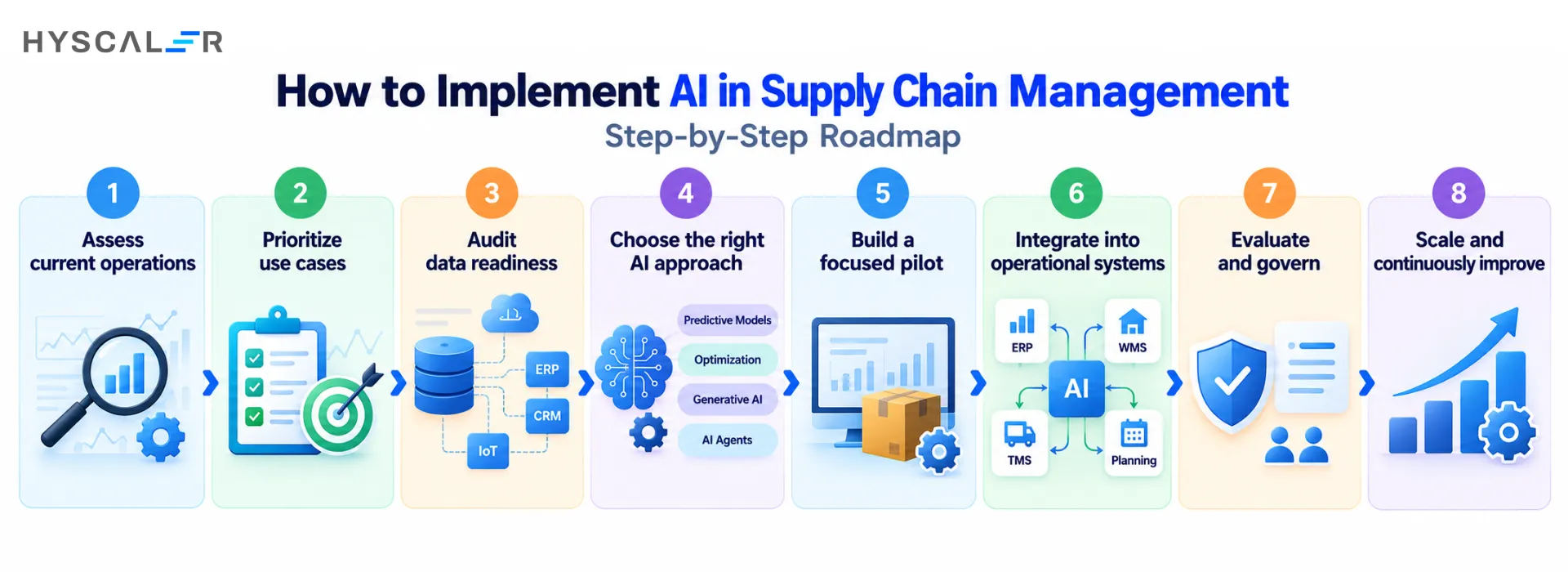
- Assess current operations – Identify bottlenecks, baseline performance, and high-value opportunities. Review existing data collection, storage, and management practices.
- Prioritize use cases – Rank them by business impact, feasibility, risk, and data availability. Define clear objectives, such as better forecasting, optimized logistics, or lower costs, and align them with overall supply chain strategy.
- Audit data readiness – Validate data quality, accessibility, ownership, and integration requirements across ERP, CRM, IoT, and other sources. Invest in integration tools and scalable cloud storage where needed.
- Choose the right AI approach – Decide between predictive models, optimization, generative AI, and agents based on the problem. Evaluate vendors and platforms for compatibility with existing systems.
- Build a focused pilot – Select one measurable workflow, facility, or product category, such as inventory management or route optimization. Measure performance and refine before expanding.
- Integrate into operational systems – Embed recommendations in the tools teams already use so insights lead to action.
- Evaluate and govern – Track performance, test edge cases, and define human approval rules. Train employees on AI-driven workflows, build a data-driven culture, and apply cybersecurity and compliance safeguards.
- Scale and continuously improve – Expand only after validating results, adoption, and operating costs. Keep monitoring performance, refining models, and adapting to business needs.
Implementation Roadmap Table
| Phase | Key deliverables | Success criteria |
|---|---|---|
| Assess and prioritize | Process review, baseline KPIs, ranked use-case list | Agreed use case with a measurable target |
| Prepare data | Data audit, integration plan, quality fixes | Required data accessible, consistent, and owned |
| Pilot | Working model in one workflow, facility, or category | KPI improvement versus baseline; user feedback captured |
| Integrate | Connections to ERP, WMS, TMS, or planning tools | Recommendations used in daily workflows |
| Govern and evaluate | Monitoring, approval rules, audit logs | Stable performance; no unmanaged risk |
| Scale | Rollout to more sites, products, or use cases | Sustained results at acceptable cost |
Timelines vary widely with scope, data readiness, and integration complexity, so define them for your own use case rather than relying on a universal number.
Explore AI implementation with HyScaler. If you want help selecting use cases, checking feasibility, or assessing data readiness, speak with HyScaler’s AI team.
ROI of AI in Supply Chain Management: KPIs and Business Case
How to Measure Supply Chain AI ROI
A practical formula is:
ROI (%) = (Benefits − Total Costs) ÷ Total Costs × 100
Benefits include reduced inventory carrying costs, fewer stockouts, lower freight expenses, reduced waste, and labor savings. Total costs include implementation, licensing, infrastructure, integration, security, training, and ongoing monitoring and maintenance. Compare against the baseline you captured before the pilot.
KPIs to Track Before and After Implementation
| Business area | Suggested KPIs |
|---|---|
| Forecasting | Forecast error and bias |
| Inventory | Inventory turnover, stockout rate, carrying cost |
| Logistics | On-time delivery, freight cost per shipment |
| Procurement | Supplier lead-time variability, purchase-price variance |
| Warehouse | Order accuracy, order cycle time |
| Risk | Disruption detection lead time, recovery time |
| Financial | Net savings, payback period, total cost of ownership |
What Does AI in Supply Chain Management Cost?
There is no single price. Costs depend on use case, data readiness, and integration complexity. The main cost drivers are:
- Data integration and infrastructure
- AI model development or licensing
- ERP, WMS, and TMS integration
- Cloud usage and third-party data
- Testing, security, and governance
- Employee training, maintenance, and model monitoring
A focused pilot has a very different cost profile from a multi-site enterprise rollout. Estimate costs against a clearly defined use case, and include ongoing costs, not only the build.
Challenges of Implementing AI in Supply Chain Management
| Challenge | Practical mitigation |
|---|---|
| Poor data quality and fragmented systems | Run a data audit first; standardize identifiers; build integration pipelines |
| Legacy system integration | Use APIs and middleware to add AI alongside ERP, WMS, and TMS rather than replacing them |
| High upfront and ongoing costs | Start with a focused pilot; budget for monitoring and maintenance; scale only on proven results |
| Skills gaps and employee adoption | Train teams, involve planners early, and position AI as decision support; address job-displacement concerns openly |
| Forecast errors and model drift | Monitor accuracy continuously; retrain models; compare against baselines |
| Security, privacy, and supplier data access | Apply encryption and role-based access; comply with GDPR, CCPA, and contractual data limits |
| Limited explainability and over-automation | Favor explainable outputs; require human approval for high-impact actions; keep audit trails |
| Difficulty proving ROI and scaling pilots | Set KPIs and baselines before launch; choose pilots that can extend to other sites or categories |
These hurdles are manageable with strategic planning, which lets businesses capture AI’s benefits while keeping the transition smooth.
Industry Use Cases of AI in Supply Chain Management
The scenarios below are illustrative examples of common applications, not documented customer results.
- Retail and e-commerce: Demand forecasting, inventory allocation across stores and warehouses, and delivery optimization.
- Manufacturing: Predictive maintenance, supplier risk monitoring, and production planning.
- Food and beverage: Perishable inventory planning, waste reduction, and cold-chain monitoring.
- Healthcare and pharmaceuticals: Temperature monitoring, traceability, and inventory availability for critical products.
- Logistics and third-party logistics (3PL): Route optimization, ETA prediction, and fleet utilization.
Future Trends of AI in Supply Chain Management
As AI technology advances, supply chains will become more resilient, adaptive, and environmentally conscious. Some of these trends are established, while others are still emerging.
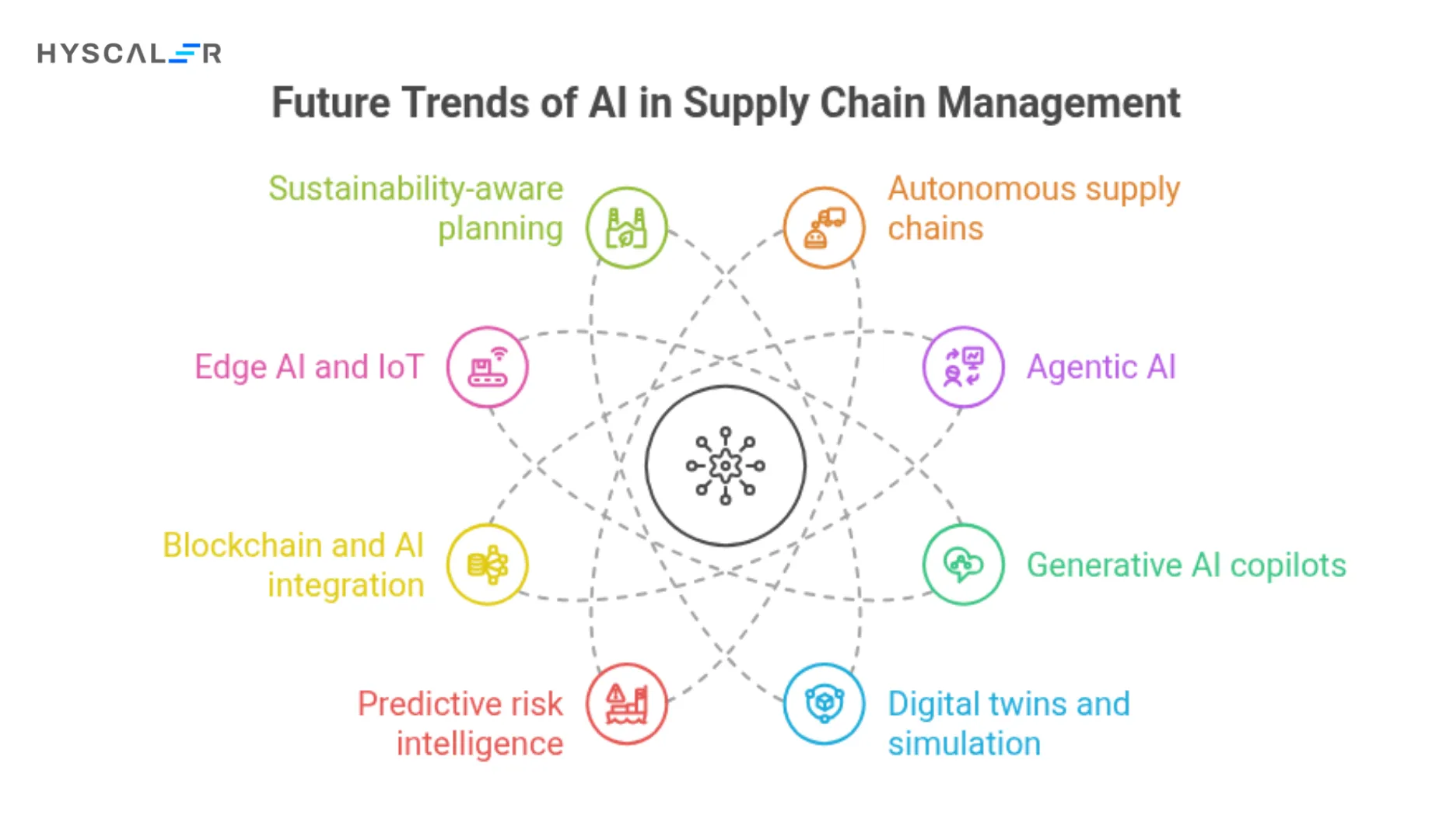
- Autonomous supply chains: Self-learning algorithms will optimize processes with less human intervention across procurement, inventory, and logistics, including through integrated procurement software. Full autonomy is not a universal reality today. Supervised, semi-autonomous workflows with human approval are the realistic near-term model.
- Agentic AI: AI agents that handle routine exceptions and prepare decisions within defined permissions are emerging, and they work best with strong governance.
- Generative AI copilots: Planners can query data and summarize risks in natural language, speeding up analysis.
- Digital twins and scenario simulation: Virtual supply-chain models let teams test disruptions and strategy changes before committing.
- Real-time predictive risk intelligence: Continuous monitoring of suppliers, routes, and external events for earlier warnings.
- Blockchain and AI integration: Blockchain adds transparency, security, and trust, and AI can analyze recorded transactions to detect fraud, optimize contract execution, and improve traceability, reducing risks from counterfeit products and disruptions.
- Edge AI and connected IoT systems: Processing data closer to warehouses, vehicles, and equipment enables faster responses.
- Sustainability-aware planning: AI-driven optimization that accounts for energy use, waste, and emissions alongside cost and service.
How HyScaler Can Help with AI in Supply Chain Management
HyScaler supports organizations across the challenges described above:
- AI strategy and use-case selection: Identify high-value opportunities and build an implementation roadmap.
- Data engineering and integration: Prepare reliable data pipelines and connect operational systems through data engineering services.
- AI and predictive analytics: Build forecasting, anomaly detection, and decision-support capabilities through HyScaler’s AI services.
- AI agents and automation: Integrate bounded AI workflows with appropriate controls.
- Enterprise software engineering: Extend or modernize existing applications to support AI-enabled processes.
Conclusion
AI in supply chain management helps organizations make better predictions, reduce avoidable costs, respond to disruptions sooner, and automate appropriate workflows. From demand forecasting and logistics to supplier risk and sustainability, the opportunity is real. The challenges are real, too, including high initial investment, data quality, integration, and workforce adaptation.
Results depend on clean data, integration into daily operations, user adoption, and ongoing evaluation. Start with a focused use case, measure against a baseline, govern carefully, and scale what works.
Discuss your supply chain AI use case with HyScaler. Whether you are assessing data readiness or choosing a first pilot, get in touch with our team.
FAQ
What is AI in supply chain management?
AI in supply chain management uses machine learning, predictive analytics, optimization algorithms, robotic process automation, and other AI technologies to improve forecasting, inventory planning, procurement, logistics, and operational decision-making.
How does AI improve efficiency in supply chain management?
AI automates repetitive tasks, improves demand forecasting, optimizes logistics routes, streamlines warehouse operations, and supports better decisions, which leads to higher efficiency and lower operating costs.
How is AI used in supply chain management?
AI is used to forecast demand, optimize inventory, predict shipment delays, assess supplier risks, improve warehouse operations, automate procurement tasks, support quality control, and power customer support chatbots.
What are the main applications of AI in supply chains?
The main applications are demand forecasting, inventory management, logistics and route optimization, supplier risk assessment, quality control, warehouse automation, and customer support through chatbots and automation.
What are the main benefits of AI in supply chain management?
The main benefits include better forecasting, lower inventory costs, improved delivery performance, earlier risk detection, greater operational efficiency, and improved resilience. Actual results depend on implementation quality and business context.
How does predictive analytics improve supply chain management?
Predictive analytics combines historical data and current signals to estimate future demand, delivery delays, inventory shortages, supplier disruptions, and equipment failures, so teams can respond earlier.
What is the difference between predictive and prescriptive analytics in supply chains?
Predictive analytics estimates what is likely to happen. Prescriptive analytics recommends actions to reach a goal or reduce a risk, such as changing a reorder quantity or selecting an alternative delivery route.
How do AI agents help in supply chain management?
AI agents can investigate exceptions, gather information from connected systems, recommend corrective actions, and execute approved low-risk workflows within defined permissions and human oversight.
What are the challenges of implementing AI in supply chain management?
Common challenges include fragmented data, integration with legacy systems, high initial investment, data privacy and security risks, workforce adaptation and resistance to change, model reliability, and difficulty turning predictions into operational decisions.
How much does AI implementation in supply chain management cost?
Costs vary with the use case, data readiness, integration complexity, software licensing, infrastructure, security, and ongoing maintenance. A focused pilot has a different cost profile from a multi-site enterprise implementation, so estimate costs against a clearly defined scope.
How can businesses measure the ROI of supply chain AI?
Compare implementation and operating costs with measurable benefits such as reduced inventory carrying costs, fewer stockouts, lower freight expenses, improved forecast accuracy, reduced waste, and labor savings.
How long does it take to implement AI in supply chain management?
The timeline depends on data readiness, integration requirements, use-case complexity, and governance needs. A limited pilot can be much quicker than a production deployment across multiple facilities and enterprise systems.
Can small businesses benefit from AI in supply chain management?
Yes. AI-powered supply chain solutions are more accessible than before. Smaller businesses can start with focused applications such as demand forecasting, reorder recommendations, shipment tracking, or supplier risk alerts, then expand after demonstrating value, without needing massive upfront investment.