

Table of Contents
Your company already knows the answer.
The problem is that it is spread across SharePoint, Confluence, Google Drive, Salesforce, ServiceNow, email threads, PDFs, and the heads of a few long-tenured employees.
Traditional search hands people a list of documents.
What they need is a trusted answer.
Employees feel this daily.
McKinsey Global Institute estimates put nearly 20% of the workweek of communication-heavy roles into hunting for internal information.
That figure comes from older research, so treat it as a directional signal, but it matches what most IT leaders see in their own organizations.
AI knowledge management addresses the gap.
But dropping documents into a vector database and attaching a chatbot is not enough.
Enterprise deployments also need permission-aware retrieval, governance, source attribution, freshness controls, and ongoing evaluation.
AI knowledge management for enterprises is the use of AI, semantic retrieval, retrieval-augmented generation (RAG), and governance controls to securely capture, organize, retrieve, and apply an organization’s knowledge across business systems.
What Is AI Knowledge Management for Enterprises?
AI knowledge management is a layer of intelligence over your existing knowledge sources.
It lets people and AI agents ask questions in natural language and get answers grounded in company content, with citations, while respecting who is allowed to see what.
It is not a chatbot bolted onto a wiki.
It performs four core functions:
- Capture: pull knowledge from enterprise systems.
- Organize: classify, tag, enrich, and structure it.
- Retrieve: find relevant content using semantic and keyword search.
- Apply: produce answers, summaries, recommendations, or actions.
AI knowledge management vs. traditional knowledge management
| Capability | Traditional KM | AI knowledge management |
|---|---|---|
| Search | Keyword-based | Semantic and natural language |
| Output | Documents and pages | Synthesized, cited answers |
| Data sources | Curated repositories | Multiple enterprise systems |
| Organization | Mostly manual | AI-assisted, human-governed |
| Retrieval | Static | Context-aware |
| Maintenance | Manual | Automated sync plus governance |
| AI agent support | Limited | Designed for agents |
The key shift is that AI KM usually does not replace your repositories.
It sits on top of them.
Why Enterprises Need It
Skip the generic “AI boosts productivity” pitch.
These are the concrete problems.
Knowledge is fragmented
HR policies live in SharePoint, product documentation in Confluence, customer history in Salesforce, support procedures in ServiceNow or Zendesk, engineering knowledge in GitHub, and operational know-how in email and Slack.
No single search box covers all of it.
Finding a document is not the same as getting an answer
A policy answer may require combining a handbook, a regional addendum, and a recent HR announcement.
Traditional search returns three links.
AI retrieval can assemble the answer and show its sources.
Institutional knowledge walks out the door
Retirements, turnover, and undocumented processes create expensive gaps.
A Panopto and YouGov study found US knowledge workers lose about 5.3 hours a week waiting on colleagues for information or recreating knowledge that already exists.
Your knowledge now has two audiences
Humans read it, but AI systems and agents increasingly consume it too.
Content written for people (ambiguous titles, no metadata, outdated duplicates) is hard for machines to use reliably.
A knowledge layer has to be machine-readable as well as human-readable.
The market is moving.
A study of 382 executives found 85% of organizations are exploring or deploying large language models, and nearly 30% are integrating RAG to connect corporate data with them.
The same research found that 71% see data quality and security as critical risks.
That tension between momentum and risk is why architecture and governance matter.
How AI Knowledge Management Works
Most enterprise implementations follow the same seven steps:
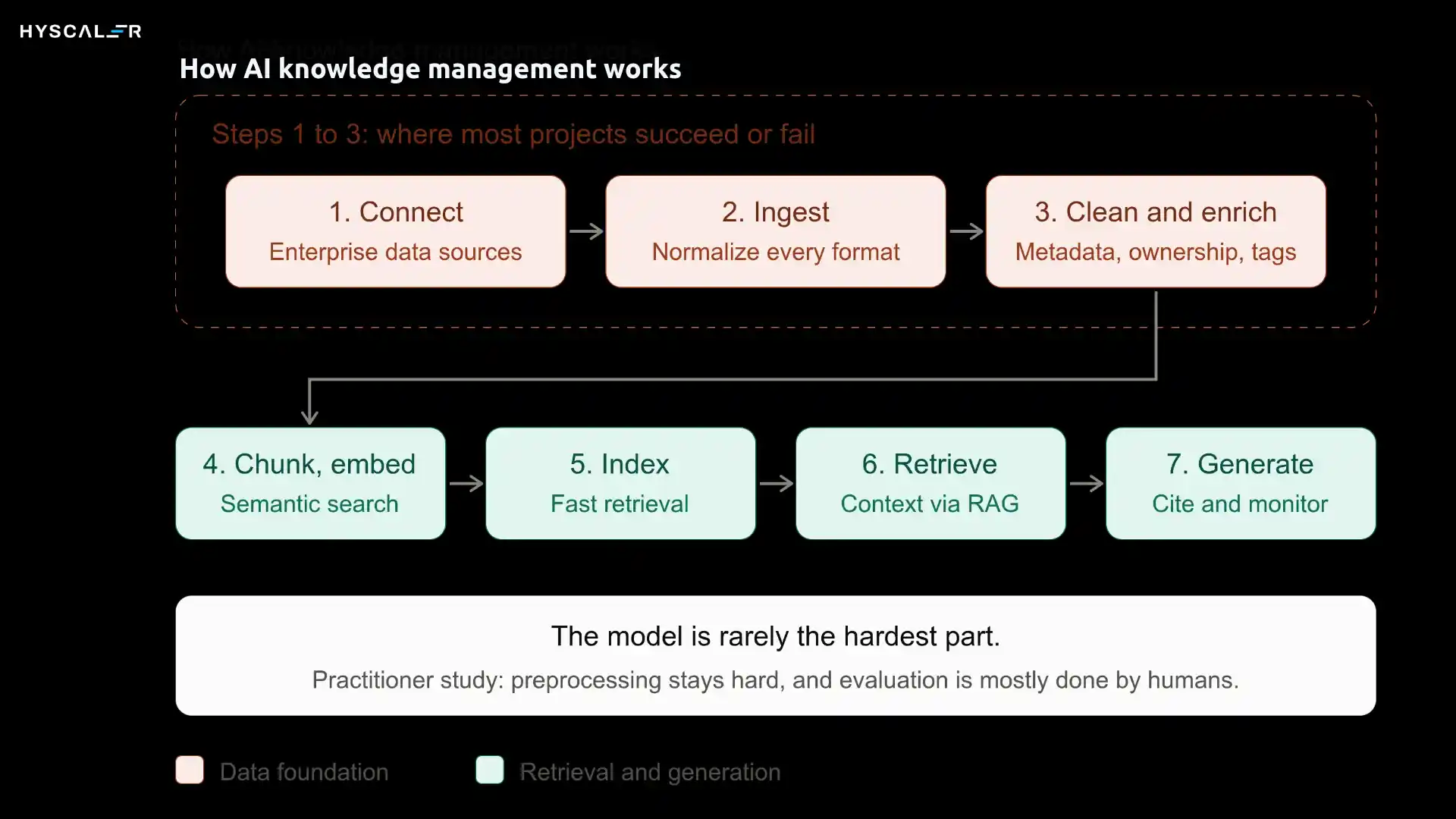
- Connect enterprise data sources.
- Ingest and normalize content from different formats.
- Clean and enrich it with metadata, ownership, and classification.
- Chunk and embed content so it can be searched semantically.
- Index it for fast retrieval.
- Retrieve relevant context for each question using RAG.
- Generate, cite, evaluate, and monitor the response.
Steps 1 to 3 are where most projects succeed or fail.
A published interview study of industry practitioners found that data preprocessing remains a key challenge and that evaluation is mostly done by humans rather than automated methods.
The model is rarely the hardest part.
Enterprise AI Knowledge Management Architecture
“LLM plus vector database” describes a demo, not an enterprise system.
A production architecture works in layers:
| Layer | What it does |
|---|---|
| Experience layer | AI assistants, enterprise search, copilots, agent interfaces, APIs |
| Orchestration layer | Query understanding, intent classification, query rewriting, model routing, agent coordination |
| Retrieval layer | Hybrid (vector plus keyword) search, metadata filtering, reranking, contextual retrieval |
| Knowledge layer | Vector and document indexes, knowledge graphs where useful, structured data, metadata |
| Processing layer | Ingestion, parsing, OCR, chunking, embedding, classification, deduplication, versioning |
| Data sources | SharePoint, Confluence, Google Drive, Salesforce, ServiceNow, databases, warehouses, GitHub, email, chat, PDFs |
Cutting across every layer are the controls that make it enterprise-grade: identity and access management, encryption, audit logging, governance, data loss prevention, observability, evaluation, and compliance.
Design for this from day one. Retrofitting permissions into a system built without them is far harder than building them in.
Connecting many sources, enforcing enterprise permissions, and integrating AI into existing workflows takes production-grade engineering.
That is the work behind HyScaler’s Artificial Intelligence (AI) Services & Solutions, which cover enterprise AI architecture, RAG development, and data pipelines.
What Role Does RAG Play?
Retrieval-augmented generation (RAG) is an AI architecture that retrieves relevant information from an external knowledge source and gives it to an AI model as context before it generates an answer.
The flow looks like this:

Question → query processing → retrieval → reranking → context assembly → LLM → grounded answer → citations
Enterprises favor RAG because it:
- works with current information, not just what a model learned in training
- uses proprietary company knowledge without retraining the model
- supports source citations and auditing
- lets you control what the model can see
Industry research reflects this.
One survey of North American organizations found RAG is increasingly the connective tissue of enterprise AI, though both generative AI and RAG remain in early deployment stages.
RAG vs. fine-tuning
| Factor | RAG | Fine-tuning |
|---|---|---|
| Updating knowledge | Update the source content | Retraining workflow |
| Best for | Current enterprise information | Style, behavior, domain adaptation |
| Source citations | Natural fit | Not inherent |
| Frequently changing content | Strong fit | Poor fit |
| Cost of knowledge updates | Lower | Higher |
The two are complementary, but for knowledge that changes, RAG is usually the starting point.
One important caveat: RAG does not guarantee accuracy. Bad source data, weak chunking, poor retrieval, stale content, or wrong permissions can all produce confident wrong answers.
RAG Architecture Choices
Not every organization needs the most sophisticated pattern.
Match the approach to the problem.
Naive RAG (chunk, embed, vector search, LLM) is fine for prototypes, small knowledge bases, and simple Q&A.
Advanced RAG adds hybrid retrieval, metadata filtering, reranking, query rewriting, and citation generation. This is the typical baseline for production enterprise search.
GraphRAG adds a knowledge graph so the system can reason over relationships. It suits product dependencies, supply chains, compliance mappings, and other interconnected entities.
Agentic RAG lets the system break down questions, search multiple sources, retrieve iteratively, choose tools, and validate intermediate results. It fits complex, multi-step research and workflows.
| Approach | Complexity | Best use |
|---|---|---|
| Naive RAG | Low | Prototypes |
| Advanced RAG | Medium | Production enterprise search |
| GraphRAG | High | Relationship-heavy knowledge |
| Agentic RAG | High | Multi-step research and workflows |
Start at the lowest level that meets your accuracy needs, and move up only when evaluation shows you need to.
Enterprise Knowledge Sources AI Can Connect
Typical categories include:
- Structured: SQL databases, CRM, ERP, data warehouses, APIs
- Unstructured: PDFs, Word documents, presentations, policies, manuals, contracts
- Collaboration: Slack, Microsoft Teams, email, meeting transcripts
- Knowledge platforms: SharePoint, Confluence, Google Drive, Notion, internal wikis
- Engineering: GitHub, GitLab, Jira, technical documentation
The temptation is to index everything.
Don’t choose sources based on business relevance, ownership, permissions, sensitivity, freshness, and quality.
An AI system that ingests outdated drafts and duplicate files will faithfully repeat their mistakes.
Security and Access Control
The principle is simple and non-negotiable:
An AI assistant must never retrieve information a user is not authorized to access.
Here is how to make that real.
Identity-aware retrieval: The flow should be: user identity → permissions → retrieval filtering → authorized context. Filter before content reaches the model, not after. A model that has seen restricted content can leak it.
Role-based access control: Mirror existing rules: HR documents for HR, contracts for Legal, strategy documents for executives, customer records for authorized teams. Permissions in source systems change, so synchronize them regularly.
Data protection: Encrypt data at rest and in transit, manage secrets properly, and isolate networks.
Vector database security: Embeddings are not harmless. OWASP’s 2025 list of LLM risks added Vector and Embedding Weaknesses as a new entry, covering RAG embedding poisoning and cross-tenant leakage. Use tenant isolation, metadata-based access policies, and index-level logging.
Prompt injection: Prompt injection remains the top risk on the OWASP list. In a RAG system, the danger is indirect: malicious instructions hidden in a document or web page that the model later reads as trusted context. Treat retrieved content as untrusted input, limit what the model is permitted to do, and validate outputs.
Auditability: Log who asked, what was retrieved, which sources were used, which model responded, and what answer was returned. When something goes wrong, you need to reconstruct it.
Security is also what practitioners emphasize most. The interview study mentioned earlier found that industry requirements focus primarily on data protection, security, and quality.
Keeping Enterprise Knowledge Accurate and Up to Date
This is the most overlooked part of AI knowledge management.
Treat it as an operating model, not a one-time project.
The knowledge lifecycle:
Create → Review → Approve → Publish → Index → Retrieve → Monitor → Update → Retire
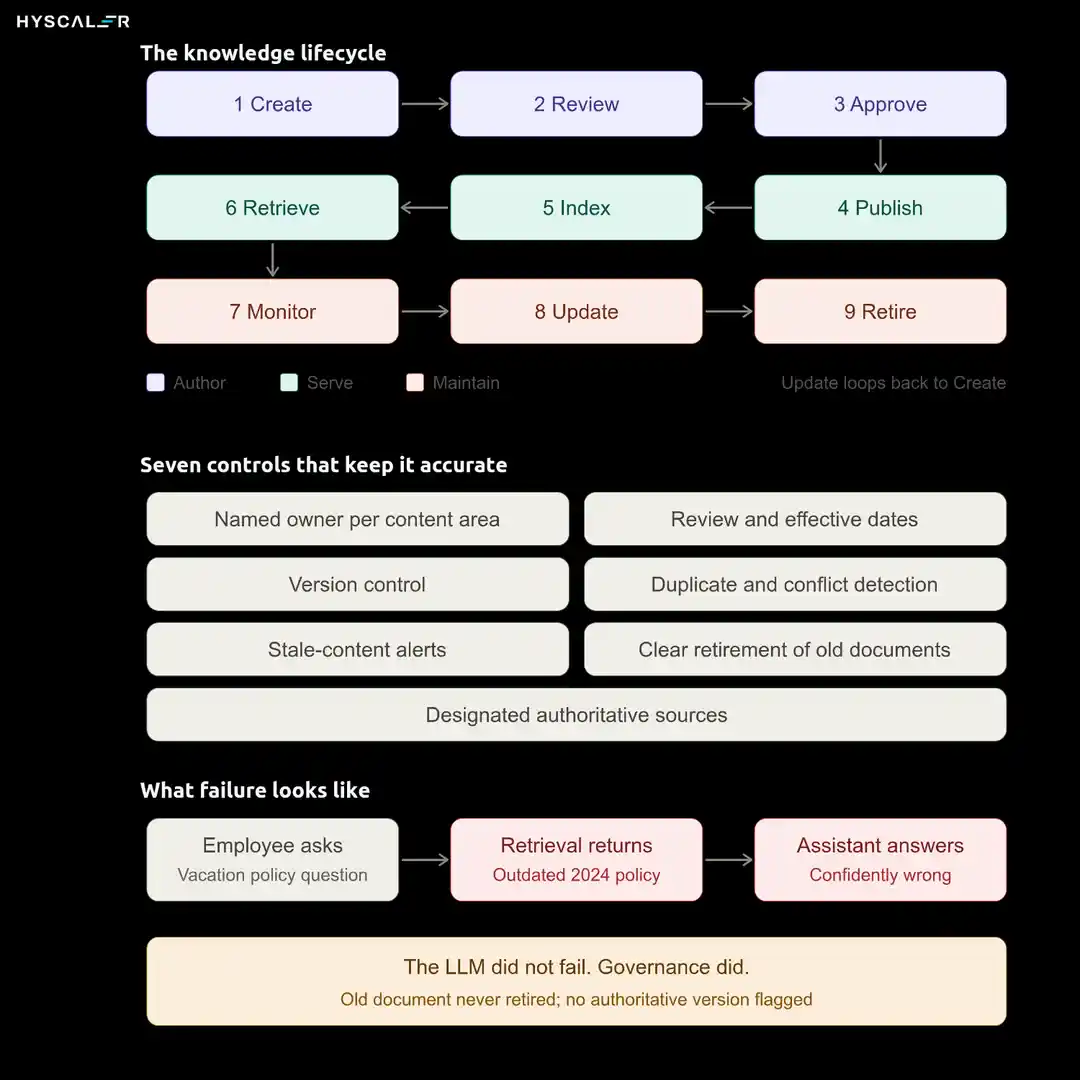
To make it work, put these in place:
- named owners for every content area
- review and effective dates
- version control
- duplicate and conflict detection
- stale-content alerts
- clear retirement of obsolete documents
- designated authoritative sources
An example: An HR assistant tells an employee about the 2024 vacation policy instead of the current one. The LLM didn’t fail. Governance did. The old document was never retired, and nothing told the retrieval system which version was authoritative.
When answers go wrong, check the content before blaming the model.
How to Evaluate an Enterprise AI Knowledge System
Whether the chatbot “sounds good” is not an evaluation.
Measure five dimensions separately:
| Dimension | What to measure |
|---|---|
| Retrieval | Recall, relevance, ranking quality |
| Generation | Faithfulness, correctness |
| Grounding | Citation accuracy, source support |
| Security | Permission enforcement (test with restricted users) |
| Operations | Latency, cost, uptime |
Evaluating retrieval separately from generation tells you where to fix problems.
If the right document never reached the model, no prompt will save you.
Then connect the technical metrics to business outcomes:
- search time reduction
- employee self-service rate
- support deflection
- onboarding speed
- resolution time
- answer acceptance rate
- adoption
Technical accuracy is not the same as business value.
A correct answer that takes 20 seconds and lives outside the employee’s workflow may still go unused.
Build your test set from real employee questions before broad rollout, and include questions that should be refused because the user lacks access.
Common Challenges and How to Address Them
| Challenge | Practical response |
|---|---|
| Poor-quality source content | Content ownership and governance |
| Permission leakage | Identity-aware retrieval, tested regularly |
| Stale knowledge | Sync schedules and lifecycle policies |
| Weak retrieval | Hybrid search, reranking, evaluation |
| Hallucinations | Grounded generation, citations, refusal behavior |
| Too many disconnected sources | Prioritized connector roadmap |
| High implementation cost | Start with one narrow, high-value use case |
| Low adoption | Embed AI into existing workflows, not another portal |
How to Implement AI Knowledge Management: 8 Steps
1. Identify the highest-value knowledge problem: Good candidates include HR questions, customer support, engineering documentation, compliance research, sales enablement, and contract knowledge.
2. Audit existing knowledge: For each source, record the owner, quality, sensitivity, freshness, and accessibility.
3. Define security requirements: Document user roles, data classification, permission models, data residency, compliance obligations, and audit needs.
4. Select your first sources: Start with one or two high-value sources, not the whole enterprise.
5. Build the RAG pipeline: Cover ingestion, parsing, chunking, embeddings, indexing, retrieval, reranking, and generation.
6. Build evaluation before broad deployment: Create the test set and baseline metrics first.
7. Pilot with one team: Measure real business outcomes, not just user enthusiasm.
8. Expand and govern continuously: Add sources, departments, agents, and workflow automation, with the governance model growing alongside.
Build vs. Buy vs. Build with a Partner
| Factor | Build | Buy | Build with a specialist partner |
|---|---|---|---|
| Customization | High | Medium | High |
| Time to deployment | Longer | Faster | Moderate |
| Integration flexibility | High | Vendor-dependent | High |
| Security customization | High | Vendor-dependent | High |
| Internal engineering needed | High | Lower | Moderate |
| Best for | Mature AI teams | Standard requirements | Complex environments without the capacity to build everything |
Buying works when your needs match a vendor’s product.
Building gives control, but demands sustained engineering.
Many enterprises land in the middle: custom integrations and architecture, delivered with a specialist partner, without staffing every component internally.
Practical Use Cases
Employee knowledge assistant: An employee asks about parental leave in California. The system retrieves the right policy for their location and role, and cites it.
Customer support: Agents get answers drawn from product documentation, past cases, troubleshooting guides, and release notes in one place.
Engineering knowledge: Teams search architecture documents, GitHub, Jira, incident reports, and runbooks together.
Legal and compliance: Staff query policies, contracts, regulations, and internal controls, with strict access boundaries.
Sales enablement: Reps combine product documentation, pricing, case studies, competitive intelligence, and approved messaging.
Healthcare: Organizations can connect clinical protocols and operational policies, but regulated environments require appropriate privacy, security, and compliance controls from the start.
What Does Enterprise AI Knowledge Management Cost?
There is no honest universal price.
Cost depends on:
- number and complexity of data sources
- document volume and ingestion frequency
- model usage and query volume
- retrieval infrastructure
- security and compliance requirements
- integrations
- monitoring
- ongoing governance
A useful way to budget: implementation + infrastructure + model usage + integration + governance + ongoing maintenance.
Governance and maintenance are the line items teams most often forget.
Best Practices
- Start with one high-value use case.
- Treat permissions as part of retrieval, not an afterthought.
- Identify authoritative sources clearly.
- Use hybrid retrieval for important searches.
- Preserve document metadata.
- Return citations with every answer.
- Evaluate retrieval separately from generation.
- Monitor for stale and conflicting content.
- Keep humans involved in high-risk decisions.
- Design the knowledge layer to serve future AI agents.
AI Knowledge Management vs. Enterprise Search vs. RAG vs. Knowledge Graphs
| Technology | Primary purpose | Generates answers? | Best for |
|---|---|---|---|
| Enterprise search | Find information | Usually no | Document discovery |
| AI knowledge management | Govern, retrieve, and apply knowledge | Yes | Enterprise-wide knowledge |
| RAG | Ground AI responses in sources | Yes | AI assistants |
| Knowledge graph | Model relationships | Not inherently | Complex, connected data |
| AI agents | Execute tasks with knowledge and tools | Yes | Automated workflows |
These are complementary.
A mature system often uses all of them.
Conclusion
Enterprise AI knowledge management is not putting company documents into a chatbot.
It is a governed knowledge layer that ingests information, respects permissions, retrieves relevant context, grounds AI responses in sources, and improves as knowledge changes.
The practical path is straightforward.
Start with one business-critical knowledge problem.
Connect authoritative sources.
Set security and evaluation requirements early.
Build a focused RAG system, measure business outcomes, and expand from there.
If you are planning that first use case, talk to HyScaler’s AI team about architecture, RAG development, and secure integration for your environment.
FAQ
What is AI knowledge management?
AI knowledge management uses AI, semantic search, and RAG to capture, organize, and retrieve organizational knowledge. Unlike traditional systems that return documents, it delivers synthesized, cited answers from multiple sources while enforcing permissions and governance.
How does AI knowledge management work?
Content is ingested from enterprise systems, cleaned, enriched with metadata, chunked, and indexed. When someone asks a question, the system retrieves authorized, relevant context, generates a grounded answer with citations, and logs the interaction for monitoring and governance.
What is RAG in enterprise knowledge management?
Retrieval-augmented generation connects a language model to current company information. The system retrieves relevant content first, then has the model answer using it. This keeps responses current, supports citations, and avoids retraining the model whenever documents change.
Is RAG better than fine-tuning for enterprise knowledge?
For frequently changing proprietary information, RAG is generally the better fit because you update the source, not the model. Fine-tuning serves different goals, such as adjusting tone or domain behavior, and the two can be combined.
How do enterprises secure AI knowledge management systems?
Combine identity-aware retrieval, role-based access control, encryption, tenant isolation, audit logging, and defenses against prompt injection. Permissions must be enforced before content reaches the model, and access controls should be tested regularly with restricted accounts.
Can it work with existing enterprise systems?
Yes. Most deployments connect through APIs and connectors to systems like SharePoint, Confluence, Salesforce, ServiceNow, databases, and cloud storage. Source content stays where it is, while the AI layer indexes and retrieves it.
How do you prevent hallucinations?
You can’t eliminate them, but you can reduce them. Improve retrieval quality, ground answers in retrieved sources, require citations, allow the system to decline when evidence is missing, evaluate continuously, and maintain clean, authoritative content.
How do you keep an AI knowledge base up to date?
Synchronize sources on a schedule, assign content owners, use versioning and effective dates, detect stale or conflicting documents, and retire outdated content. Treat freshness as an ongoing governance process, not a one-time cleanup.
What data should enterprises include first?
Start with high-value, authoritative, well-owned sources where permissions are clear. Resist indexing everything. Quality, relevance, and sensitivity matter more than volume, and you can expand once the first use case proves its value.
How much does it cost?
There is no single price. Costs depend on data sources, document volume, usage, security needs, integrations, and ongoing governance. Budget for implementation, infrastructure, model usage, integration, and maintenance, not only the initial build.