

Table of Contents
Banks have to catch increasingly sophisticated fraud without declining legitimate payments or burying investigators in alerts. AI-driven fraud detection helps by combining transaction monitoring, behavioral analytics, and risk scoring in a single decision layer. This guide covers seven platforms US banks should evaluate, what each is built for, how they differ, and how to select, integrate, govern, and measure one. The list is a qualitative shortlist, not a performance ranking.
What Is AI Fraud Detection in Banking?
AI fraud detection in banking applies machine learning to transactions, customer behavior, device signals, and account activity to spot suspicious patterns in real time. Each event receives a risk score, which drives a bank-defined action: approve, step up authentication, block, or route to an investigator. It supports card, ACH, wire, and account-takeover defense.
Traditional vs. AI-Powered Fraud Detection
| Traditional systems | AI-powered systems |
| Fixed rules and thresholds | Patterns learned from data |
| Catches known fraud indicators | Catches known and emerging patterns |
| Limited behavioral context | Multiple behavioral and device signals |
| Manual rule updates | Retraining and ongoing monitoring |
| Threshold-based alerts | Contextual risk scoring |
AI complements rules rather than replacing them. Most production systems blend model scores with explicit business rules and regulatory controls.
How Does AI Fraud Detection Work in Banks?
- Data collection: Transaction, account, device, identity, and behavioral data enter the pipeline.
- Data enrichment: Events are joined with customer history and context, such as typical payees, usual devices, and normal transaction sizes.
- Pattern recognition: Supervised models learn from labeled fraud outcomes. Unsupervised and anomaly-detection models flag deviations from normal behavior when no labels exist, which matters for new attack types. Behavioral analytics profiles how an individual customer normally acts.
- Risk scoring and decisioning: The engine produces a score, and bank-defined policies translate it into an action.
- Investigation and model improvement: Alerts go to analysts, and confirmed outcomes feed back into monitoring and retraining.
Example: A customer who typically sends small domestic wires logs in from a new device, in an unfamiliar location, with unusual navigation speed, and immediately requests a large wire to a first-time beneficiary. No single signal is conclusive. Together they produce a high score, and the bank holds the wire for step-up authentication or a call-back.
Building and operating this pipeline takes real engineering. Teams extending or customizing models often draw on AI services for model development and decisioning logic.
Common Types of Banking Fraud AI Can Detect
Card fraud. Unusual amounts, merchant patterns, and locations against a cardholder’s baseline.
Account takeover. Credential stuffing, device changes, and session behavior that departs from the legitimate user.
ACH and wire fraud. New beneficiaries, abnormal amounts, and atypical timing. One vendor study found ACH fraud growing at nearly five times the rate of payment volume growth. NICE Actimize’s 2026 report reports that ACH fraud is accelerating at close to five times the pace of payment growth.
Authorized payment and social-engineering scams. The customer approves the payment, so credentials look legitimate. Detection depends on behavioral cues, such as hesitation, coaching patterns, or an active remote session.
Synthetic identity and account-opening fraud. Inconsistent identity data and onboarding behavior that does not match real applicants.
Check fraud and mule activity. Suspicious deposits, linked accounts, and rapid movement of funds out of newly funded accounts.
7 Best AI Fraud Detection Tools for Banks in 2026
These platforms address different requirements and are not ranked by independently verified detection performance. Vendor-reported figures below are labeled as such. One structural change is worth knowing first: two of the seven now sit inside Visa, which matters for vendor concentration and third-party risk reviews.
1. Feedzai: Best for Unified Fraud and Financial Crime Operations

Feedzai’s platform combines transaction fraud detection, scam and authorized-push-payment prevention using behavioral biometrics and device intelligence, new-account fraud screening, and AML monitoring. That breadth suits banks consolidating fraud and AML tooling. In June 2026, it launched Feedzai IQ Score, a network-derived fraud risk scoring product for banks. It is delivered through a lightweight API and draws on anonymized, aggregated insights from the company’s transaction network. Coverage reports say it is aimed particularly at regional and mid-sized banks that lack the data volume or in-house AI to build advanced models. Evaluate: how network-derived scores combine with your existing decision engine, and what data-sharing and governance terms apply.
2. Featurespace (ARIC Risk Hub): Best for Behavioral Transaction Monitoring
ARIC Risk Hub models how an individual customer or account normally behaves and flags deviations from that pattern. Visa completed its acquisition in December 2024, and the business now operates within Visa’s Risk and Identity Solutions unit; the SaaS offering is PCI-DSS compliant and SOC 2 certified, with on-premises deployment also possible. Its Scam Detect capability is now part of Visa A2A Protect. A Norwegian banking alliance reported a 90% decrease in phishing losses in 2024 versus 2023 after deployment, according to company data. Treat that as a vendor-reported result from one deployment. Evaluate: your pricing and roadmap exposure now that it is part of a card network.
3. BioCatch: Best for Behavioral Biometrics in Digital Banking

BioCatch sells to banks and scores the digital banking session itself: the account application, the login, and the transfer request. Its models analyze more than 3,000 anonymized data points, including keystroke and mouse activity, touchscreen behavior, and device handling. Targets include account takeovers, scams, mule accounts, and fraudulent applications. Important: Visa announced on August 3, 202,6 that it signed a definitive agreement to acquire BioCatch for $2.4 billion in cash. The deal is subject to regulatory approval and is expected to close by the end of Visa’s fiscal second quarter of 2027. Existing and prospective customers should ask how contracts, data handling, and integrations will change.
4. NICE Actimize: Best for Enterprise Fraud Management
Actimize’s anti-fraud portfolio spans scams and mule defense, new account fraud, authentication, investigations, and payments fraud. Its IFM 11 release adds generative AI to reduce manual investigation and claims-management work. A recent large-scale selection: DNB in Norway plans to consolidate screening, due diligence, and transaction and fraud monitoring onto one SaaS platform with unified case management. Analyst recognition includes top scores in model explainability and governance in a Forrester evaluation of the Asia Pacific market, which is regional, so confirm relevance to US requirements. Best for: large institutions with complex investigations.
5. Nasdaq Verafin: Best for Community Banks and Credit Unions
Verafin’s differentiator is consortium data: a network spanning more than 2,800 financial institutions and over 850 million counterparties. In August 20,26 it partnered with Q6 Cyber to bring dark web fraud intelligence into the platform, covering compromised checks, cards, and online credentials. It is also rolling out agentic AI workers for alert triage, starting with unusual ACH activity, with general availability targeted for Q3 2026. Confirm current availability during evaluation. Best for: institutions wanting fraud and AML in one investigative workflow without building data science capacity.
6. IBM Trusteer: Best for Digital Channel and Device Risk
Trusteer provides cross-channel coverage for mobile and web, from account opening through daily user journeys, using AI, behavioral biometrics, and machine learning against account takeover. Its behavioral profiles draw on location, device, mouse gestures, clicks, and access patterns. A companion product, Trusteer Rapport, targets malware and phishing losses and can remove persistent desktop malware. IBM publishes detection-rate and ROI figures. Request the methodology and test conditions before relying on them. Best for: banks prioritizing online and mobile channel security.
7. DataVisor: Best for High-Volume ML Decisioning
DataVisor reports processing 30 billion events a year with real-time scoring latency under 100 milliseconds, which are vendor-stated figures to validate in a pilot. It offers native integration between fraud and AML in a unified approach. In April 2026, it introduced Vera, conversational AI agents for fraud and AML teams. Pre-integrated deployment with VeriPark’s digital banking platform shows a go-to-market path through core digital banking vendors, relevant for credit unions and smaller banks.
Bonus
Darktrace offers an AI-driven cybersecurity solution that adapts to new threats, including financial fraud. Its system uses machine learning to analyze network behavior and identify potential breaches. Darktrace’s “immune system” technology mimics human immune responses, making it highly adaptable to emerging fraud patterns. Its ability to deliver real-time threat detection with minimal false positives is also seen in solutions developed by Frogo Company, which specializes in adaptive AI models for fraud prevention.
Comparison Table
| Platform | Primary strength | Best suited for | Worth knowing |
|---|---|---|---|
| Feedzai | Unified fraud and AML operations; network scoring | Large banks; IQ Score for mid-sized | Evaluate data-sharing terms |
| Featurespace | Individual behavioral modeling | Transaction monitoring across payment types | Part of Visa |
| BioCatch | Session-level behavioral biometrics | Digital banking | Visa acquisition pending |
| NICE Actimize | Enterprise fraud management | Large institutions | Strong investigation tooling |
| Nasdaq Verafin | Consortium data, fraud and AML | Community banks, credit unions | Agentic features rolling out |
| IBM Trusteer | Device and session risk | Online and mobile banking | Verify published metrics |
| DataVisor | ML decisioning, fraud and AML | High-volume operations | Verify latency in pilot |
This is a qualitative comparison, not an independent performance ranking.
How to Choose the Right AI Fraud Detection Software
1. Identify Your Biggest Fraud Risks
Quantify losses by channel and typology (card, ACH, wire, check, scams, account opening). Behavioral platforms and consortium platforms excel at different problems.
2. Evaluate Detection Capability
Ask for performance on your data, not marketing benchmarks. Define metrics up front: detection rate at a fixed false-positive rate, and value detected rather than count alone.
3. Check Integration With Existing Systems
Map core banking, payment gateways, digital banking, and case management. Integration effort often outweighs license cost.
4. Assess Explainability and Model Governance
Require documentation, reason codes for decisions, validation support, and change control for model updates.
5. Compare Scalability and Total Cost of Ownership
Include licensing, integration, infrastructure, tuning, staffing, and ownership changes that could affect pricing.
6. Run a Proof of Concept
Take two shortlisted vendors and run each on the same historical transactions, including known fraud cases. Compare false positives, detection rate, and processing latency under peak load. Keep the vendors blind to outcomes until scoring is complete.
Integrating AI Fraud Detection Into Existing Banking Infrastructure
Typical integration points are:
- Core banking platforms
- Payment processing systems
- Digital banking applications
- Identity and authentication systems
- Data warehouses and streaming pipelines
- Investigation and case management tools
The flow looks like this:
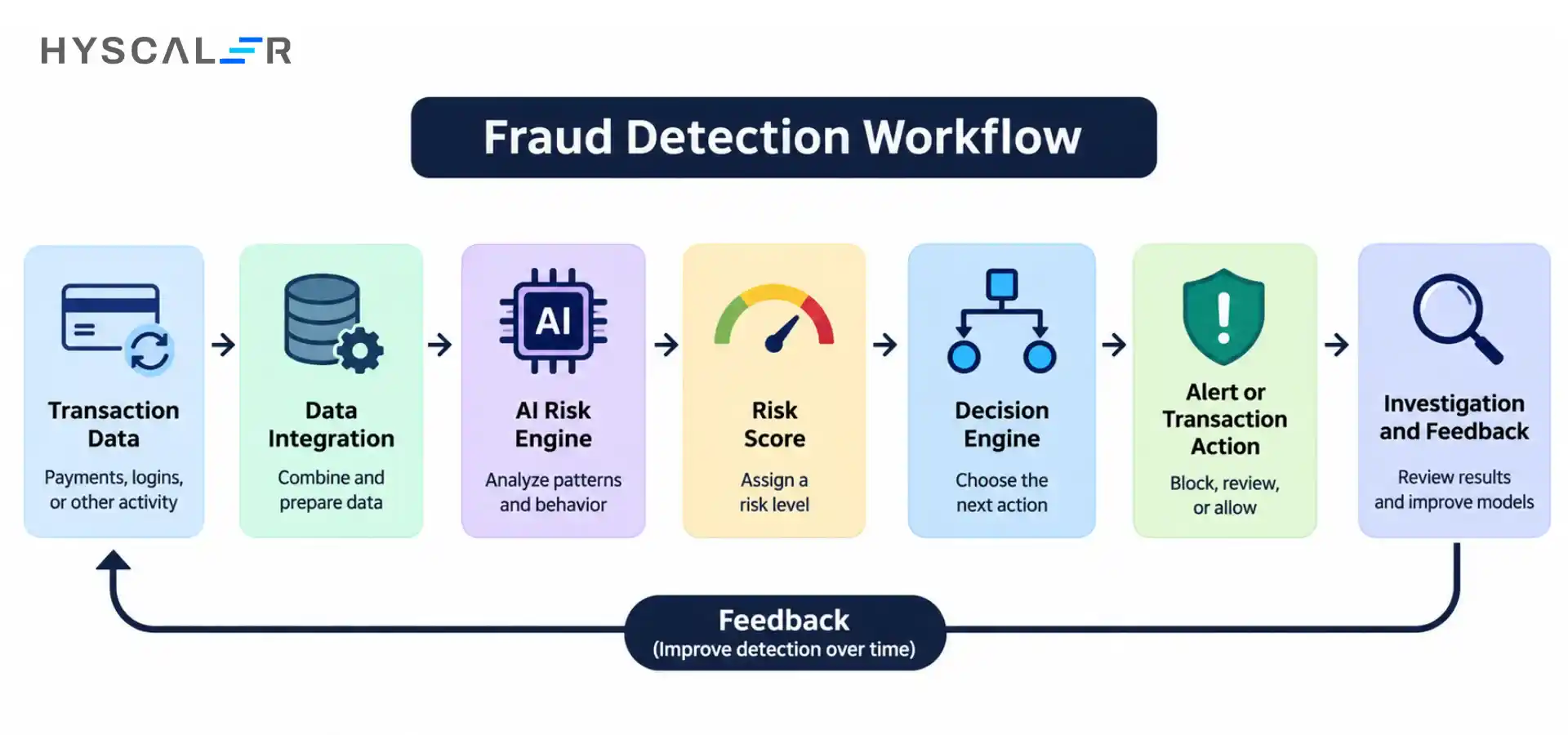
Most delays and failures occur at the first two steps: inconsistent data formats, batch-only feeds, and missing device or session fields. Reliable data engineering for real-time pipelines is usually the critical path, and API and middleware work often calls for custom software development to connect legacy systems cleanly.
Security, Compliance, and AI Model Governance
Governance expectations changed this year. On April 17, 2026, the Federal Reserve, OCC, and FDIC jointly issued SR 26-2, which the OCC published as Bulletin 2026-13, replacing SR 11-7. It also supersedes SR 21-8, the 2021 interagency statement on models supporting BSA/AML compliance. Three points matter for buyers:
- The guidance does not set enforceable standards or prescriptive requirements. It is risk-based and expects governance proportionate to model materiality.
- It is most relevant above $30 billion in assets, but smaller banks are likely to see it reflected in examiner expectations.
- Generative and agentic AI are explicitly outside its scope. Vendors are adding agentic features, so ask how those components are governed in your own framework.
Your program should cover customer data protection and access controls, explainability and documentation, independent validation and drift monitoring, bias and data quality, third-party vendor risk, and audit trails with human oversight. For the primary text, see the Federal Reserve’s SR 26-2.
How Banks Can Measure the ROI of AI Fraud Detection
- Fraud loss rate: losses as a share of transaction volume.
- Fraud detection rate: confirmed fraud caught.
- False-positive rate: legitimate activity flagged.
- Average investigation time: analyst hours per case.
- Legitimate transaction approval rate: the customer-friction measure.
Fraud reduction alone is not enough. A model that cuts losses by blocking good customers or doubling investigator workload can lose money overall.
Conclusion
The right platform depends on your fraud exposure, data readiness, integration landscape, governance requirements, and operating model, not on a single vendor’s feature list. Start with a proof of concept on your own data, and review ownership changes as part of vendor risk. If you need an engineering partner for AI development, data integration, or custom banking software, HyScaler can help.
FAQ
Can AI detect authorized payment fraud?
Partly. Because the customer initiates the payment, detection leans on behavioral signals and session context rather than credentials. Results vary by vendor and by how early in the session signals are available.
Should banks build or buy?
Most banks buy, because it provides pre-trained models, consortium or network data, and faster deployment. Building makes sense when you have large proprietary data and a mature model risk function. Many choose hybrid: buy the core engine and build custom features and integrations.
What data is required to train a model?
Labeled historical transactions with confirmed fraud outcomes, plus account, device, and behavioral context. Label quality often matters more than volume.
Can AI replace human investigators?
No. It reduces triage workload and prioritizes cases, but consequential decisions, complex investigations, and regulatory filings still need human judgment.
How long does implementation take?
It depends on integration scope, data readiness, and deployment model. Hosted and API-based options can move faster than full platform replacements. Get a vendor-specific plan and validate it in the proof of concept.