

Table of Contents
The competition in the talent marketplace is rising rapidly in the modern world. Old recruitment methods are slow, resulting in inefficiency, delays, and even losing magnificent talent. AI recruitment tools offer a futuristic way that is wired for transforming agencies in talent discovery, evaluation, and the onboarding process.
Certainly, using artificial intelligence at present brings a new dimension to hiring, as it helps by streamlining the entire hiring process while reducing bias and improving judgment.
Understanding AI-Driven Recruitment Tools
AI-enabled recruitment tools use artificial intelligence to automate as well as improve some of the recruitment phases. They will manage large datasets and repetitive tasks, as well as provide predictive insights, thus giving recruiters more time to go into strategic activities like developing relationships with candidates.
Machine learning algorithms with natural language processing (NLP) and predictive analytics technologies are among the key technologies powering these tools toward creating a much faster and better hiring experience.
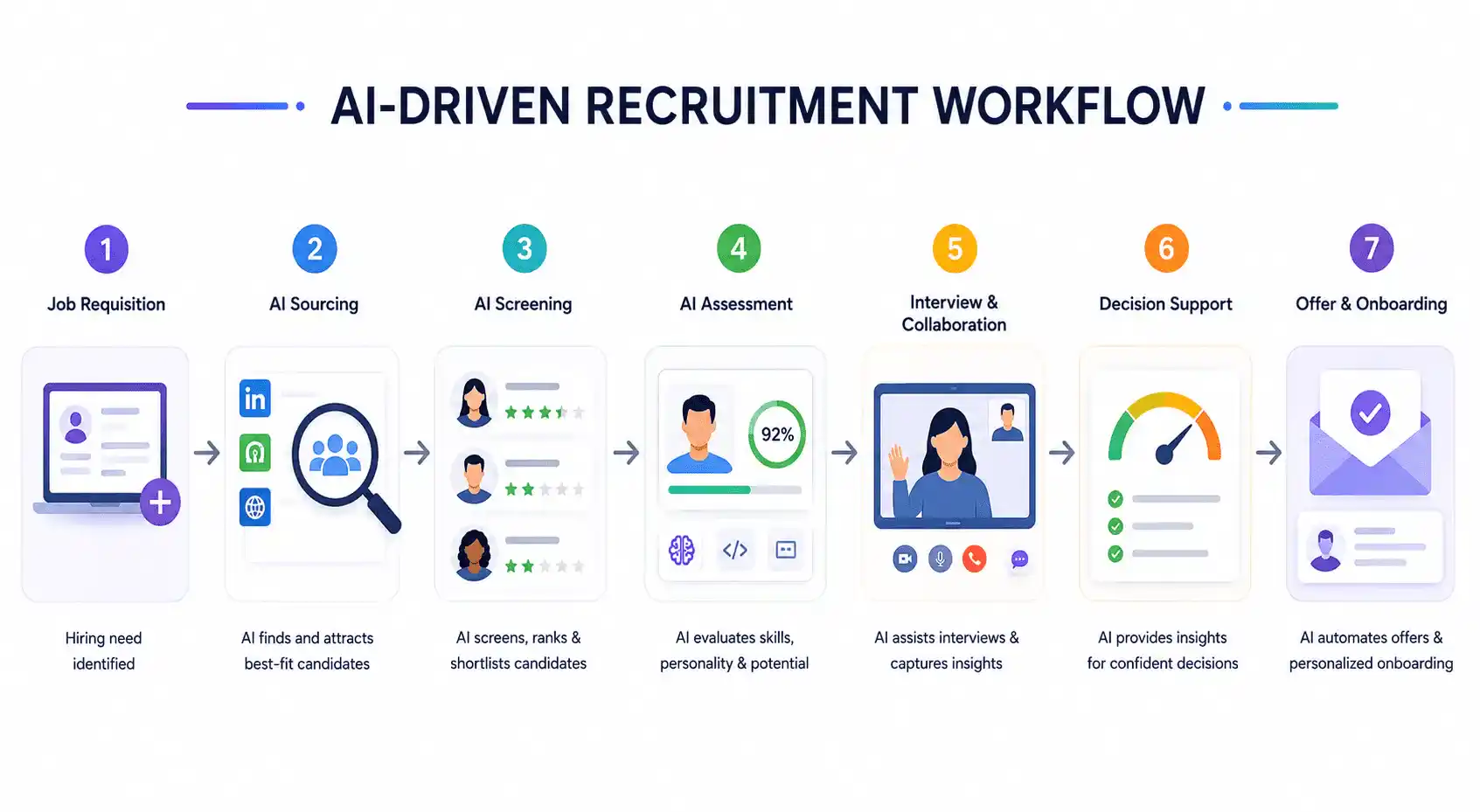
Examples of Leading AI-Driven Recruitment Tools
1. LinkedIn Talent Insights
Overview:
LinkedIn Talent Insights is no less than a data-centric platform that offers comprehensive insight into talent pools across the globe regarding the trends of the workforce throughout the world. With such insights, organizations can comprehend labour market dynamics, competitor hiring activities, and skill distribution across specific locations.
Salient Features:
- Real-time data on talent availability and location.
- Insights into competitor talent strategies.
- Skill gap assessment for workforce planning.
- Custom dashboards for easy visualization.
Implication:
LinkedIn Talent Insights arms the organization to formulate dynamic hiring strategies by identifying rich pools in high-potential talent markets and aligning recruitment processes with talent marketplace activities. This strategic approach optimizes resource use and improves hiring efforts.
2. HireEZ
HireEZ is an AI sourcing platform built around a public-web candidate index of 800M+ profiles aggregated from 45+ sources, including LinkedIn, GitHub, Stack Overflow, and industry-specific directories.
Key Features:
- AI-powered search across 45+ online platforms and databases, with candidate enrichment via verified contact details and work history.
- Integrated email sequencing and outreach automation, with CRM and ATS synchronization for unified candidate data.
- An Agentic AI platform covering sourcing, screening, messaging, scheduling, and analytics with recruiter oversight.
- ResumeSense is an AI detection tool that scans for hidden text, prompt injections, and AI-generated resume manipulation.
- Diversity sourcing filters and analytics dashboards, along with team collaboration tools for sharing pipelines and insights.
Impact: HireEZ is best for recruiting teams struggling with pipeline generation, using AI to surface potential matches and optimize engagement strategies by predicting which candidates are most likely to respond.
3. HireVue
Overview:
HireVue engages in video interviewing and AI-based assessments of candidates’ spoken and unspoken communication. Its high-end algorithms scrutinize how a person speaks, their tone, their facial expressions, and so on, to provide deeper assessments of the candidate’s performance.
Key Features:
- On-demand and live video interviews.
- AI-generated candidate assessment.
- Automated scheduling and assessment reports.
- Integration with major ATS platforms.
- Gamified assessments enable cognitive and behavioral measures.
Impact:
HireVue improves and streamlines the recruitment process by introducing assessments of soft skills and cultural fit, which in turn improve candidate-job matching. Additionally, it standardizes evaluations and reduces bias.
4. index.dev
Overview:
Finding strong software engineers has always been hard – but the real problem isn’t the talent shortage; it’s the process. Most companies spend weeks sifting through hundreds of applications only to reach final-round interviews with candidates who don’t meet the bar. index.dev takes a different approach: instead of opening the floodgates, it gives hiring teams direct access to a hand-picked network of senior developers who have already been thoroughly vetted. The platform is built specifically for technical hiring, which means it understands the difference between someone who lists React on their CV and someone who can actually architect a product.
Key Features:
- Dedicated network of senior software engineers, not a general-purpose talent marketplace.
- Matching based on actual technical depth, not just keyword overlap on a resume.
- Candidates arrive pre-vetted, so hiring teams spend time evaluating fit – not filtering noise.
- Supports remote and distributed team hiring across global markets.
- Faster shortlists without sacrificing the quality bar for engineering roles.
Impact:
Most recruitment platforms throw volume at the problem and call it efficiency. index.dev does the opposite – it narrows the field early so that every conversation a hiring manager has is worth having. For engineering-heavy companies where a bad hire sets a team back by months, those that focus on precision over scale are exactly what makes the difference. Teams that have used it consistently report shorter hiring cycles, less recruiter fatigue, and developers who ramp up faster because the fit was right from the start.
5. Entelo
Overview:
Entelo is the best diversity recruiting platform using AI to find and source underrepresented talent. It will help create tools that will help organizations to build diverse teams as well as accomplish their diversity goals.
Salient Features:
- Diversity sourcing with AI.
- Predictive analytics for the success of candidates.
- Automatically contacts candidates.
- DEI metrics reporting & Analytics.
- Integration with Applicant Tracking System for a seamless workflow.
Impact:
Provides growth in inclusion practices using Entelo that help an organization to uplift its internal diversity practices. This is better representation within the workplace, and it needs to deal with talent gaps.
6. iSmartRecruit
iSmartRecruit is an AI-driven recruitment tool designed to streamline the hiring process. It offers intuitive tools that help recruitment teams optimize candidate sourcing, screening, and hiring. Using AI, iSmartRecruit enhances recruitment strategies, improving efficiency and candidate experience worldwide for companies of all sizes.
Key Features:
- AI-Powered Candidate Matching: Automatically matches job descriptions with candidate profiles for faster and more accurate selections.
- Automated Resume Parsing: AI quickly scans resumes to identify top talent based on specific keywords and job requirements.
- Advanced Analytics: Provides actionable insights into recruitment performance, allowing businesses to make data-driven decisions.
- Customizable Workflow: Tailors the recruitment process to meet the specific needs of businesses, ensuring a more personalized approach.
- iSmartRecruit Integrations: Easily integrates with various job boards, HR systems, and social media platforms to expand sourcing channels.
Impact:
iSmartRecruit helps businesses save time by automating time-consuming tasks such as resume screening and candidate matching. With its AI-driven insights, it boosts recruitment efficiency, reduces time-to-hire, and ensures the hiring of high-quality candidates. Ultimately, this results in better talent acquisition and enhanced overall productivity for recruitment teams.
7. Harver
Harver is a cloud-based pre-employment talent assessment platform that assists enterprise-sized organizations with volume hiring. The software leverages AI features built around a proprietary algorithm that self-learns to optimize its effectiveness in identifying the candidates of best fit.
Main Features:
- Harver includes options for skills testing and situational judgement, making it potentially more suitable for companies seeking a wider lens on candidate abilities compared to Pymetrics alone.
- By integrating game-based evaluations from Pymetrics, Harver provides an engaging candidate experience while gathering deep insights.
- Harver is the only purpose-built volume hiring solution enabling companies to hire digitally and fairly.
- Automated hiring workflows that screen thousands of candidates consistently and at scale.
- Strong ATS integrations for seamless recruiter workflows.
Impact: Harver’s focus on predictive talent analytics provides data-driven support for hiring decisions, helping organizations reduce early-stage turnover and accelerate time-to-hire by automatically identifying the best-fit candidates from a large applicant pool.
8. Eightfold AI
Eightfold AI specializes in talent intelligence, applying deep learning to chart out skills, professional progression, and industry directions, assisting organizations to pair candidates with present as well as future roles.
Key Features:
- Semantic AI sourcing across a massive profile database with career move predictions and outcome-based hiring goals.
- Predictive analytics are especially beneficial for internal mobility, ensuring current employees are matched with new opportunities.
- Integrates seamlessly with major HRIS like Workday and SAP SuccessFactors, and ATS like Greenhouse and Lever.
Impact: A Fortune 500 tech firm used Eightfold to shift to skills-based hiring, identifying internal candidates for a significant share of roles and saving millions in external recruiting costs.
9. Manatal
Manatal is an AI-driven recruitment tool built for teams that want capable AI features without the enterprise price tag.
Key Features:
- AI-based recommendations scan job descriptions, search the talent pool, and surface the most suited candidates, saving hiring managers significant time.
- The social enrichment feature gathers data from sites such as LinkedIn to provide complete candidate records.
- Drag-and-drop enabled pipelines for easy candidate organization, with a free trial available.
Impact: Manatal’s minimal design helps even small groups with limited HR tech stacks access powerful AI hiring capabilities. Its AI recommendations feature saves hiring managers considerable time by automatically scanning job descriptions and matching them against the talent pool to bring up the most suitable candidates.
10. SeekOut
SeekOut searches over a billion profiles to find diverse, hard-to-reach candidates, especially in technical and specialized fields. As one of the most powerful recruitment tools available today, it stands out for its ability to surface specialized talent at scale.
Key Features:
- GitHub-specific search and diversity filters with candidate anonymization make it the top choice for teams focused on inclusive hiring.
- The “Likely Open to New Roles” feature uses predictive signals to identify candidates ready to switch jobs.
- SeekOut Assist auto-generates search filters from job descriptions so recruiters spend less time building complex queries.
Impact: SeekOut uses AI-driven talent intelligence to analyze candidate data and identify potential hires based on skills and experience, helping recruiting teams uncover specialized talent that traditional keyword-based searches would otherwise miss. Among recruitment tools built for diversity hiring, it particularly strengthens initiatives by surfacing underrepresented candidates through anonymized filters.
11. ResumeCoach
ResumeCoach is an AI-powered career platform that helps job seekers create, improve, and optimize resumes for specific roles. Its AI Resume Builder provides role-specific suggestions, ATS-friendly templates, and personalized feedback to help candidates present their skills and experience more effectively.
Key Features:
- AI-powered resume creation and optimization.
- ATS resume checker with role-specific keyword suggestions.
- AI-generated resume summaries and content suggestions.
- LinkedIn profile analysis and optimization.
- AI mock interviews and job-matching tools.
Impact:
ResumeCoach helps candidates streamline the resume-building process while improving alignment with recruiter and ATS requirements. By combining AI-driven suggestions with resume analysis and job-specific optimization, it can help job seekers create more targeted applications and improve their overall readiness for the hiring process.
Challenges and Ethical Considerations of AI-Driven Recruitment Tools
Also, it does pose challenges for adoption, while the advantages of AI recruitment tools are otherwise obvious:
- Data Potential Bias: AI systems learn from historical data that carries biases in hiring decisions.
- Privacy Issues: Managing sensitive candidate information within appropriate security and transparency commitments.
- System Integration Challenge: Making AI tools work with already existing human resources systems is an ongoing problem.
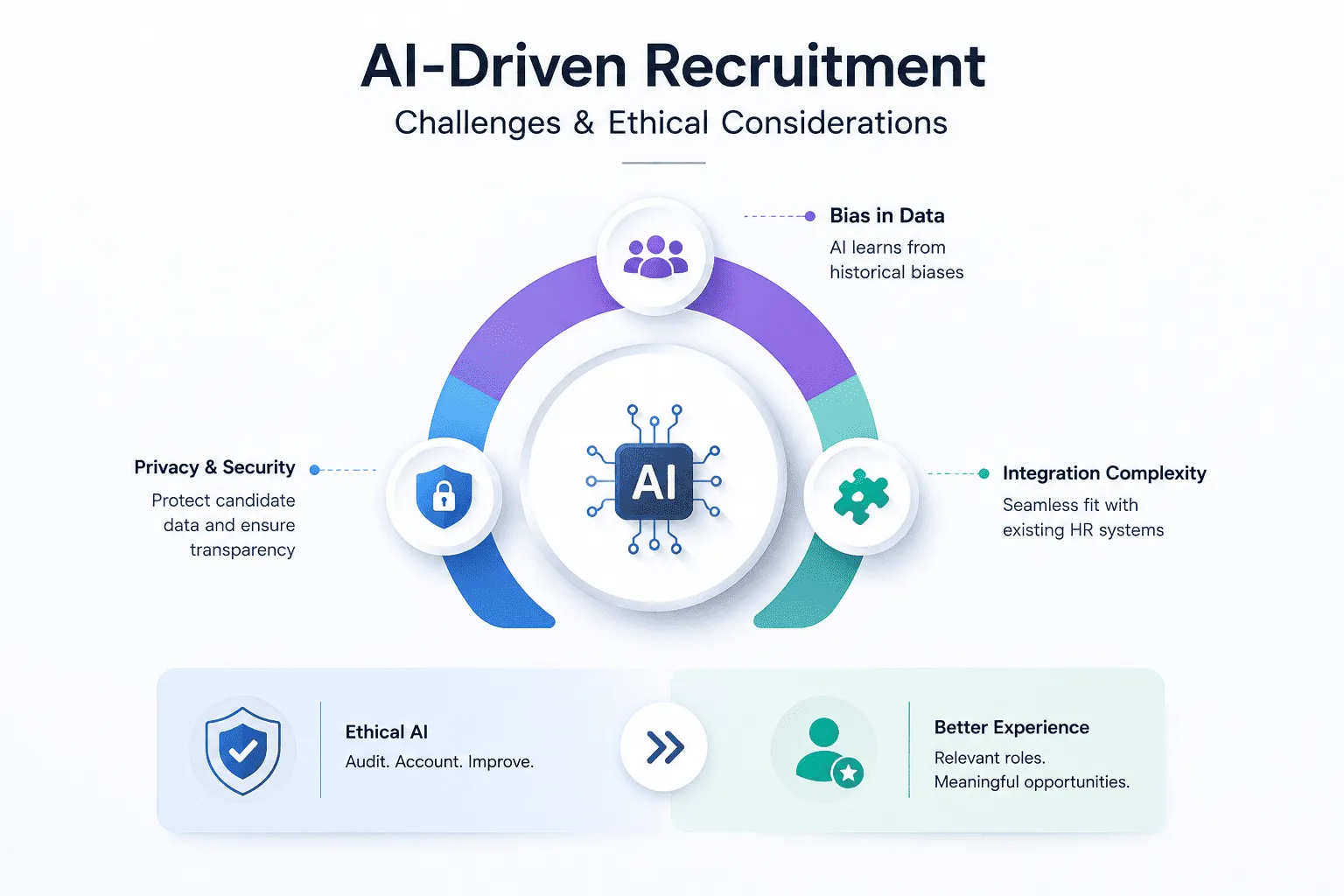
This can be done above all through commitment to ethical AI practices, accountability, and regular auditing of algorithms to reduce biases in organizations. From the candidate side, an AI job search platform can improve the experience by surfacing more relevant roles, reducing mismatches, and aligning opportunities with individual skills and career preferences.
Advantages of Integrating AI-Driven Recruitment Tools in Recruitment
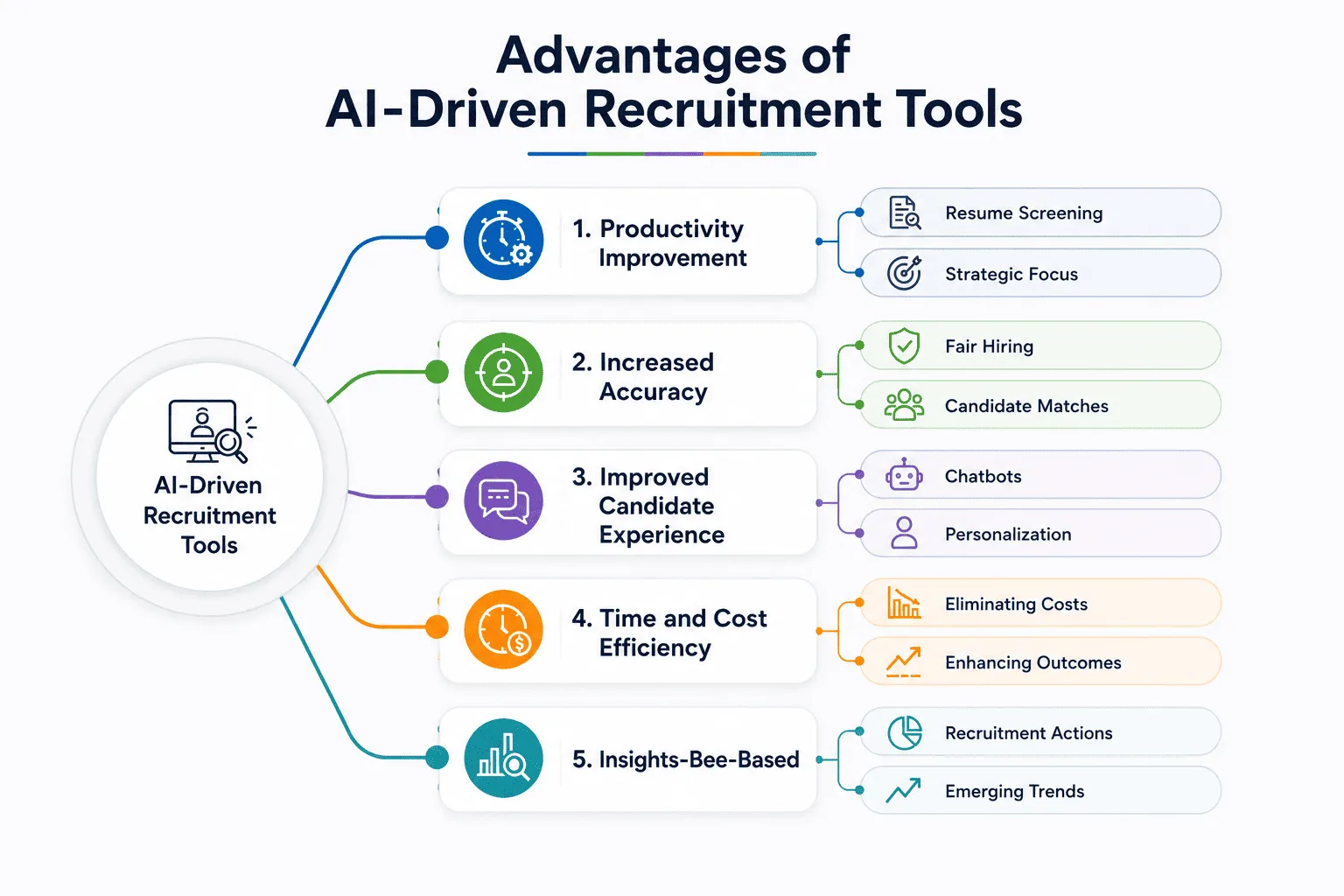
Improvement in productivity: AI-driven recruitment tools cut down the time invested in boring, repetitive processes such as screening resumes, allowing recruiters to dedicate time to efforts towards strategic focus.
Increased Accuracy: By minimizing human error and biases, AI ensures a fairer hiring process and improved candidate matches.
Improved Candidate Experience: Chatbots and personalization make candidates feel valued and involved throughout the hiring process.
Time and Cost Efficiency: AI recruitment tools can make recruitment more effective because they look at every step in a recruitment process and eliminate unnecessary costs while also enhancing recruitment outcomes.
Insights-Driven: These tools can provide insights into recruitment actions, thus enabling recruiters to decide on the basis of data analytics and emerging trends.
Emerging Trends in AI-Driven Recruitment
Recruitment has been continuously transformed by artificial intelligence. Futuristic patterns would include:
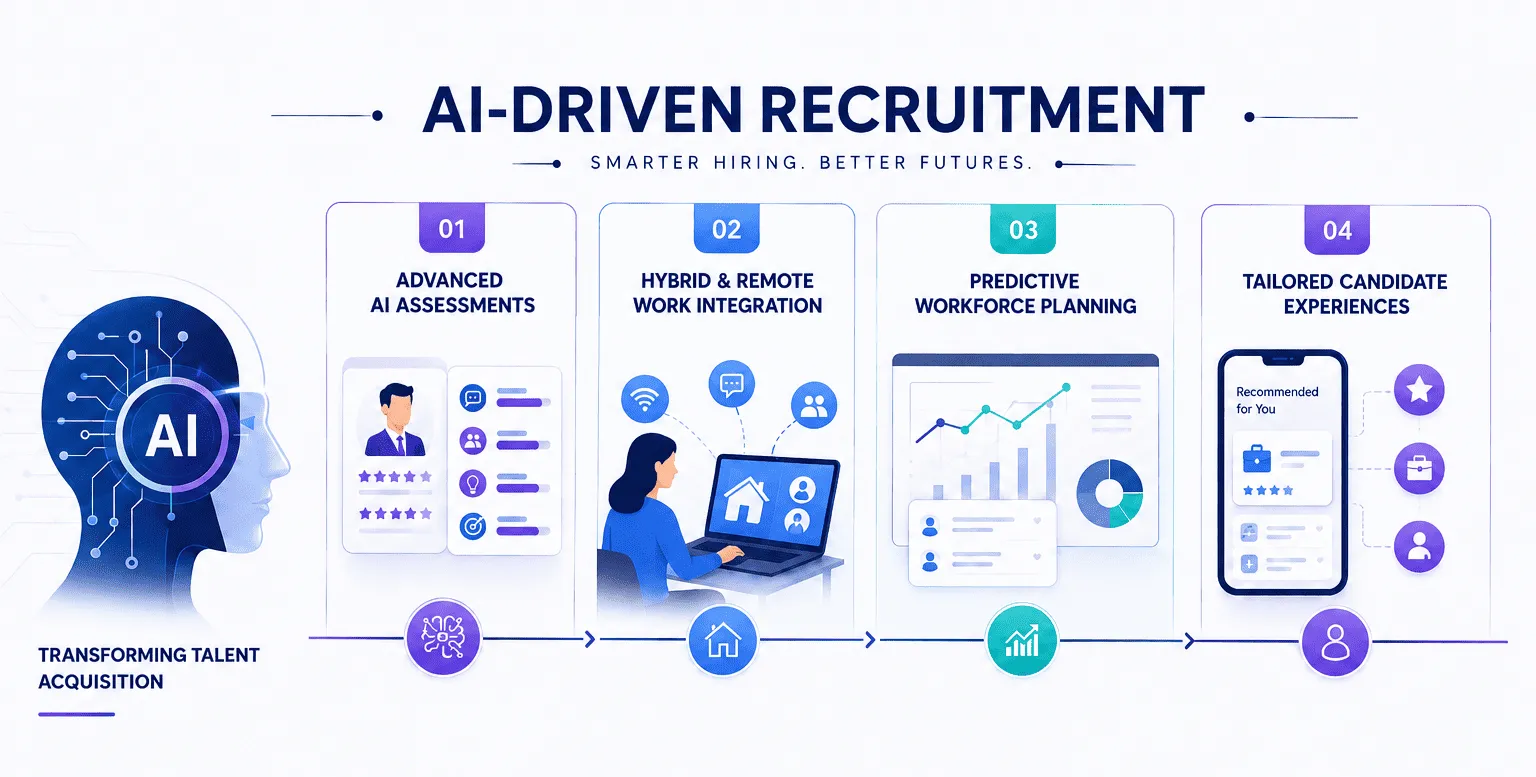
Advanced AI Assessments: Recruitment tools would be developed further to evaluate potential soft skill traits in candidates, along with leadership potential.
Hybrid and Remote Work Integration: AI toolsets will increasingly evolve in assessing candidates’ compatibility in hybrid and remote work, focusing on adaptability and collaboration within the business environment. From the candidate’s side, AI tools could help applicants find jobs, build resumes, and create ATS-friendly resumes that assist them with remote job applications.
Predictive Workforce Planning: AI would help organizations in forecasting the need for hiring and proactively planning their hiring programs.
Tailored Candidate Experiences: Hyper-personalized experiences will be offered by AI recruitment tools in the future; recommendations of a job and that job application might fit an individual.
Conclusion
Recruitment is changing because of technology: AI recruitment tools are improving the speed, accuracy, and efficiency of the hiring process through automation and predictive insights.
As competition for talent grows, those organizations that have started using these tools will have a competitive edge in attracting and retaining top talent. The future of recruitment is that one needs to prepare for this transformation.
FAQs
What are AI-driven recruitment tools?
AI-driven recruitment tools utilize artificial intelligence to automate and enhance various stages of the hiring process, such as resume screening, candidate engagement, and predictive analytics, improving efficiency and reducing bias.
What are the primary benefits of using AI in recruitment?
The key benefits of using AI-powered recruitment tools include improved productivity by automating repetitive tasks, increased accuracy in candidate matching, enhanced candidate experience through personalization, and cost efficiency by optimizing the recruitment process.
What challenges do organizations face when adopting AI recruitment tools?
Organizations may encounter challenges such as potential bias in AI algorithms, privacy concerns regarding candidate data management, and difficulties in integrating AI recruitment tools with existing HR systems.
Is using AI in recruitment legal? What regulations exist?
It’s legal, but regulated companies must comply with equal employment laws and data privacy rules like GDPR to avoid discrimination claims.
What’s the future of AI in recruitment? Where is it headed?
Expect smarter soft-skill assessments, hyper-personalized job recommendations, and AI-powered workforce planning that predicts hiring needs in advance.