
Table of Contents
The healthcare sector is approaching one of the greatest changes in its history of the sector. Artificial Intelligence (AI) and digital technologies are no longer a matter of experiments in 2026, and they are actively transforming the approach to care delivery, management, and optimization. However, outside patient care, there is one field with a silent but strong revolution that is medical billing and revenue cycle management, where AI is transforming the inefficiencies into a quantifiable financial benefit.
The Rise of AI and Digital Transformation in Healthcare
These technologies are leading to a change in the model of healthcare systems to smarter, faster, and more scalable systems, via accelerated medical research and real-time clinical decision-making. In order to know this transformation, it is vital to investigate the main aspects of its blistering increase.
Explosion in AI Research
In recent years, the list of AI-oriented studies in healthcare has grown exponentially, which is not only the interest of academics but the reality of practical use.
This expansion is not only in quantity, but it is a move towards solutions that are viable and deployment-ready. The healthcare organizations are not testing AI anymore; they are putting it into practice both in clinical and operational environments.
Some of the trends that have led to this research boom are:
- More applications of AI in healthcare imaging and diagnostics.
- Entering into intricate areas such as oncology and surgery.
- More emphasis on practical validation and clinical results.
- Implementation of AI in hospitals and workflows.
What Makes Modern AI Powerful
Although AI is not a new concept, it has been able to improve its functionality in recent years. The current healthcare AI is characterized by the capability to process various types of data and make intelligent decisions with the minimum amount of human input.
This transformation is being driven by two big innovations:
Multimodal AI
Multimodal AI systems are capable of processing and integrating various types of data in real-time, including:
- Clinical notes (text)
- Medical images (X-rays, MRIs)
- Audio inputs (interactions with patients)
- Lab and genomic data.
This holistic method will enable healthcare professionals to understand patients better and provide more precise diagnoses because decisions are made based on a holistic profile of the patient and not a single piece of information.
Agentic AI (Decision-Making Systems)
The next step is agentic AI, where machines are able to plan, act, and carry out tasks without human intervention.
In healthcare, AI can:
- Provide physicians with on-the-fly clinical support.
- Automate administrative workflows
- Control appointment, billing, and patient communications.
These systems serve as co-pilots, enhancing performance and decreasing the human workload, which is a crucial aspect in the contemporary healthcare setting.
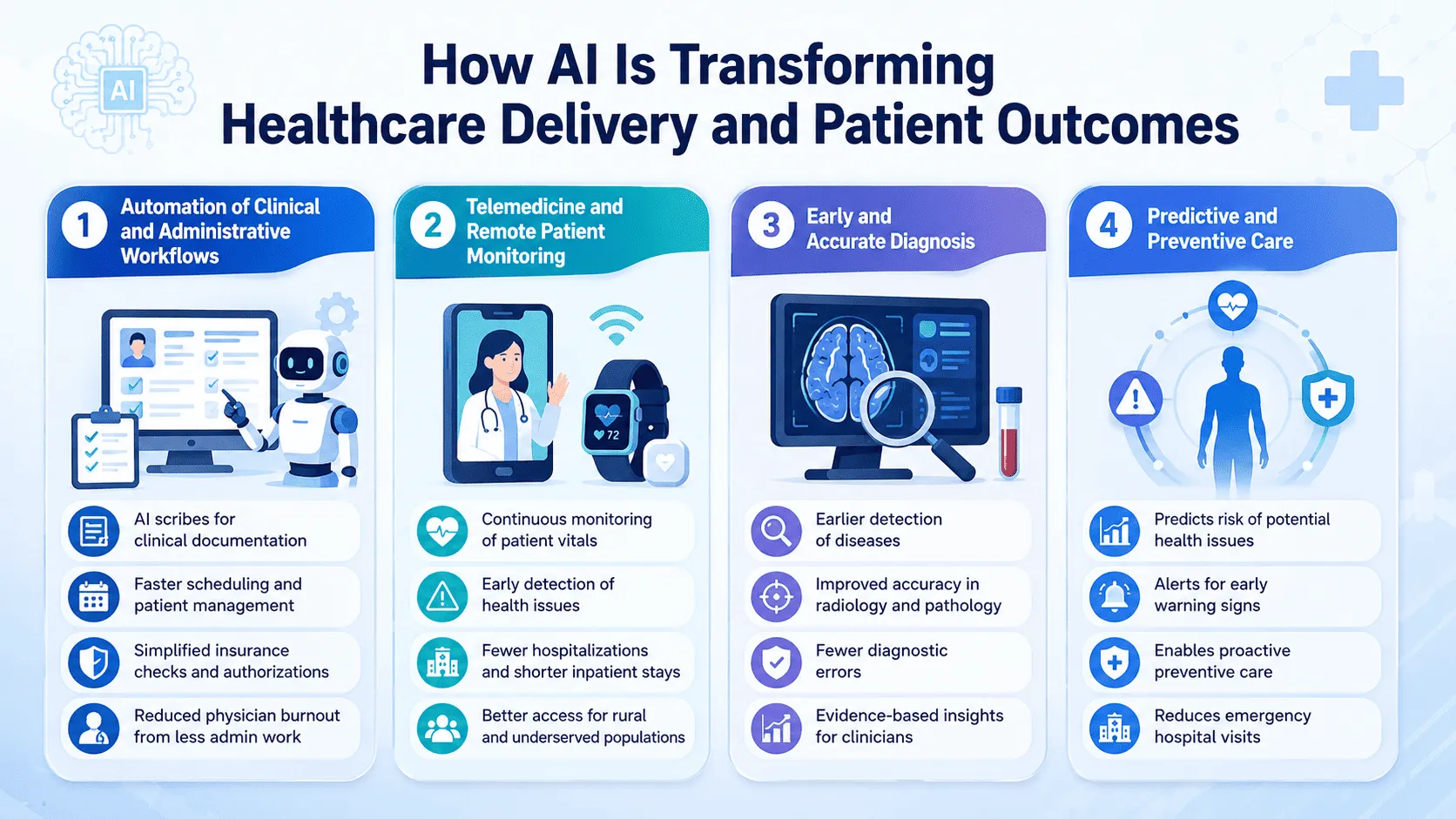
How AI Is Transforming Healthcare Delivery and Patient Outcomes
In order to see this transformation, it is necessary to examine how AI is simultaneously affecting the healthcare delivery systems and patient outcomes.
Automation of Clinical and Administrative Workflows
Among the most evident advantages of AI in healthcare, one can mention the automation of routine and time-consuming tasks. In the past, a major percentage of healthcare providers took time on documentation, scheduling, and administrative tasks.
These responsibilities are currently being done with great accuracy and speed using AI-powered systems.
Key improvements include:
- Artificial intelligence scribes of clinical documentation.
- Accelerated scheduling of appointments and the management of patients.
- Simplified insurance checks and authorizations.
- Less burnout among physicians because of decreased administrative workload.
Telemedicine and Remote Patient Monitoring
Healthcare has never been as accessible as it is now with the advent of digital transformation. Telemedicine and remote patient monitoring (RPM) have ensured that patients can now be attended to without necessarily having to visit hospitals.
Artificial Intelligence is essential to render such systems intelligent and receptive.
Benefits include:
- Constant control of patient vitals by use of wearable devices.
- Early identification of health loss.
- Fewer hospitalizations and decreased inpatient time.
- Better rural and underserved population access.
Early and Accurate Diagnosis
Effective treatment is based on proper diagnosis, and AI is transforming this sphere of medicine drastically.
Medical images, lab reports, and the history of a patient can be analyzed through advanced algorithms with an astounding degree of precision, which minimizes the possibility of human error.
Diagnostic systems based on AI assist in:
- Earlier detection of diseases.
- Improving accuracy in radiology and pathology
- Cutting diagnostic mistakes by a considerable percentage.
- Helping clinicians with evidence-based knowledge.
Predictive and Preventive Care
The role of AI is transforming the current healthcare model, which is reactive, to a preventative and preemptive model. Rather than treating the diseases once they have arisen, healthcare providers can now predict the risks and take steps beforehand.
Based on real-time wearable and health records, AI can:
- Anticipate possible health problems at an early stage.
- Inform about the warning signs.
- Facilitate preventive care.
- Minimize the number of emergency hospital visits.
Alongside AI-driven clinical tools, accessible health education plays an equally important role in prevention. Patients increasingly turn to everyday nutrition guidance, such as understanding the health benefits of peaches and similar lifestyle content, which complements AI-led preventive care by encouraging healthier daily choices long before symptoms ever appear.
Medical Billing, Revenue Cycle Management, and How AI Enhances Accounts Receivable Recovery
By means of AI and digital transformation, healthcare providers can now streamline these operations and open new possibilities for financial performance.
The key to this change is the increasing use of intelligent automation in accounts receivable recovery services, where AI is assisting providers to recover outstanding payments more quickly and efficiently than any time previously.
Smarter Medical Billing Through AI
Artificially intelligent billing systems will help decrease the number of manual mistakes and speed up the whole claims process. These systems can be able to check the accuracy of claims by using historical data and payer behavior to make sure that the claims submitted are correct.
For example, OB-GYN medical billing and revenue cycle management involves a unique mix of preventive, surgical, and obstetric services that demand specialized coding — an area where AI-driven RCM is delivering some of its strongest financial returns.
Key improvements include:
- Accurate automated medical coding.
- Quickly submit and process claims.
- Fewer billing mistakes and non-compliance risk.
- Checking of insurance information in real time.
Intelligent Accounts Receivable Management
Accounts receivable has been a part of healthcare finance that has always been one of the hardest to manage. Late payments, old claims, and a lack of efficiency in follow-ups may pose critical cash flow problems.
AI is revolutionizing this field by bringing:
- All-time insurer and patient follow-ups.
- Dynamically prioritizing high-value and old claims.
- Denial pattern and root causes identification.
- Decrease in Days in Accounts Receivable (DAR)
Financial Impact on Healthcare Providers
The use of AI in revenue cycle operations is providing tangible financial rewards. Not only are Providers enhancing collections, but they are also lowering the cost of operations.
Common outcomes include:
- Increased revenue realization
- Faster reimbursement cycles
- Lower administrative overhead
- Enhanced financial transparency and reporting.
The Shift Toward Outsourced Medical Billing
With the increased sophistication and technology in revenue cycle processes, most healthcare providers are becoming aware of the importance of outsourcing their medical billing services to professional medical billing service providers such as CureCloudMD.
By partnering with experienced providers, healthcare organizations can:
- Get access to enhanced AI-powered billing systems.
- Enhance accounts receivable performance.
- Minimize workload and operating expenses.
- Pay more attention to patient care rather than to administrative work.
Turning Innovation into Measurable Results
By offering specialized solutions, including accounts receivable recovery services, they help healthcare providers turn operational improvements into real financial outcomes.
Providers who have been engaged in such expert partnerships have reported a good track record:
- As much as a 30-40% increase in collections.
- Considerable decrease in accounts receivable.
- Reduced time in reimbursements.
- Improved overall revenue cycle performance
Winding Up
With the continuing transformation in the healthcare context, the implementation of AI in clinical and financial processes is becoming a new norm. Providers that combine advanced technology with strategic outsourcing are not only enhancing efficiency but also creating a more resilient and scalable future – where enhanced care and enhanced revenue performance go hand in hand.